




Abstract
The article explores rhizomatic poetic practices of Medellín-based graffiti artist Señor Ok. His work is the city revealed as a relational, multidimensional texture. It transforms striated urban space to smooth by bringing other meanings from the periphery to the surface and decentralizing the dominant image of the city. I look at his work as poetry as an entanglement of his relationship and his daily life in the city, in the country, in the broader world. I argue that as an assemblage that forms assemblages within the urban textures, his art becomes methodology for critical non-representational affective inquiry of urban spaces.
Introduction
One of my first memories of Medellín is a piece of graffiti showing a rabbit with a big round head, a grouchy face, and long ears, signed “Srok = Señor Ok.” The grouchy face jumps back and forth between a brick wall on a construction site and the columns of bridges and between neighborhoods; it passes by with the speed of a taxi and stops just for a glimpse, long enough for a viewer to notice it by turning back but briefly enough to remember its location. In a dream-like fashion, it starts haunting my imagination of the city making me search for it everywhere, and like the White Rabbit from Alice’s Adventures in Wonderland (Carroll, 1865, Ch. 1), it leads me to a new unknown city, guides me through it, and winks in new directions.
Its appearances and disappearances play a mute urban rhythm in my head that becomes the refrain of the music of the city, of the city’s street art, of the art of this particular urban artist, each of which could be the refrain of something else. The rabbit steps out of the city walls onto caps and t-shirts (Señor Ok, 2018) turning them, those who wear them, and their on- and offline selling points into urban surfaces, and altogether into city matter. By doing so, it indicates where to look for the city, what makes the city, what to read in and about the city, and how. The city’s body is tattooed with graffiti, which cover, reveal, and even heal its scars. They are integral and organic with the texture of the city, disappearing and reappearing, transforming themselves with rhythmic breathing of the living body of the city. Breathing is the product and process of life, and it offers the method of inquiry—post-media (Apprich et al., 2013; Guattari, 2013) inquiry, a form of diffractive analysis (Murris & Bozalek, 2019).
The present article explores the entanglement of work of Colombian Medellín-based poet Santiago Rodas Quintero, graffiti artist Señor Ok, as a form of nomad thought as proposed by Deleuze and Guattari and its unfolding in feminist new materialist thought. While Santiago himself does not directly seek inspiration in this perspective, as he expressed it in our conversations, he does not oppose to the possibility of his work being read through it or rather as it (Interviews August 2, 2018, September 13, 2018, October 17, 2018). I argue that Santiago’s literary or rather his artistic work expands our knowledge of the city, its culture, and artistic genre by inscribing one into the other. It includes his written, spoken, painted, and walked urban word. I also hope that the article will expand our understanding of diffractive analysis, and of poetry and graffiti as each other as inquiry, as research, and engagement methodology.
Santiago’s creative mixture of media does not speak for the city nor does it represent the city but is the city, and in a fluid ongoing manner transforms the city into literature, painting, and back again. His non-linear rhizomatic literary practice that he himself calls antipoetry is the gray, empty space or the space in-between, where the old is both reconfirmed and contested and the new is induced (Massumi, 2002, p. 43). Operating on the “edge of virtual, where [. . .] potential, actually, is found” (Massumi, 2002, p. 43), it “actualises [. . .] invisible universes” (O’Sullivan, 2001, p. 129) of the complex city texture, unites multiple narratives, and provides a guide through the city not just vertically level by level, or horizontally, but in multiple and often unpredictable directions that could be understood one by one, but more so as entanglement (Barad, 2003, 2007). The article is about the city and our knowledge of it in it.
For the purposes of this article, I rely mainly on Santiago’s public work backed by my interviews with him to make sense of the city, as data that also make the theoretical framework. Santiago’s works, completed by the time of writing, are read through each other, in each other’s context, and so is the city. His current work while not been included directly, yet enhances the conclusions drawn in the present article. I do not analyze Santiago’s poetry as flat data but let it take me in it as in a world of its own. The source material defines the non-linear or circular writing style (St. Pierre, 1997) of the article that in its turn highlights the proposal of the source material. The poetry, graffiti, blog entries interlace with other readings as one triggers the other as association expanding each other’s meaning.
Writing = Moving in the Post-Media City
Guattari uses the term post-media as a transformative “active aesthetic reappropriation” of the media space based on ethical responsibility (Genosko, 2013, p. 18). Instead of indicating a new phase (Genosko, 2013, p. 17), the term rather emphasizes what is already happening and what should happen for “a new type of qualitative development, rehabilitating the singularity and the complexity” of the world (Guattari, 2015, p. 98). Guattari’s relational vision of the city as multiplicity and an entanglement of media, actors, practices, and relations aims at empowering city’s silenced inhabitants, practices, and forms of communication, and enriching “individual and collective subjectivity” (Guattari, 2015, p. 110), both human and non-human, the city itself.
The world and the city as part of it are complex and dynamic textures, where “nothing completely coincides, and everything intermingles, or crosses over” (Deleuze & Guattari, 2005, p. 482). The city’s texture can be felt and explored when mobilizing all our senses in our relations with multiple human and non-human agents and by overcoming the hegemony of word-based language as the tool of human exceptionalism (Barad, 2007; Holmes, 2009; Kress & van Leeuwen, 2001; Mills, 2016). Such decentralization in reading/living the city would become the act of resistance to the city as a hegemonic structure (M. Ánjel, 2015, p. 52; Guattari, 2015, p. 100; Tuan, 2013, pp. 113, 135), where any “anarchic manifestations are largely kept at the periphery” (Parra Valencia, 2017, p. 96).
The rhizomatic nomad mode is composed of “directions in motion” (Deleuze & Guattari, 2005, p. 21) without beginning or end; therefore, it is non-linear and non-hierarchical. The simultaneity and multiplicity of becoming of meanings, ways, modes, and so on imply ongoing profound metamorphosis (Deleuze & Guattari, 2005, p. 21). This metamorphosis includes changes in the circumstances of change. The motion, Barad (2003) explains, takes place “in the making of spacetime itself” (p. 817). Deleuze and Guattari (2005) speak of it as “the mode of spatialization, the manner of being in space, of being for space” (p. 482). Intra-action (Barad, 2003, 2007) in the relations of entanglement defines the situatedness or localization (Braidotti, 2006) of the meanings, which could be seen as self-referential from the static perspective.
The nomad space of multiplicity can be explored only in motion, “only by legwork” (Deleuze & Guattari, 2005, p. 371), by moving within and with it. Whether walking, writing, painting, or thinking, the movement is renewable, creative, and self-conscious. The moment it creates the meaning, it starts its own deterritorialization with the purpose of creative change. Barad (2003, 2007) unpacks this thought in her concept of intra-activity. The temporary boundaries are not a pre-given quality of an entity, but as new meanings, they emerge in the relations of entanglement as “a matter of part of the world making itself intelligible to another part” (Barad, 2003, p. 829). The creativity of this movement is responsive, responsible, and affective, as it happens with hope and trust in the possibility of the change that comes from the entanglement of the world (Braidotti, 2016; Massumi, 2015). It is rather consciously anarchic, understood as a reaction to the inevitable deterioration and routinization of any natural order together with time and a search for a way to keep the living energy alive (Feyerabend, 1993, p. 266). Self-conscious attention to one’s own actions characterizes critical thought and its unfolding in nomad thought (Honan, 2007) as a simultaneity of being, thinking, and doing (Jackson & Mazzei, 2012; St. Pierre, 2013).
Antipoetry, a non-binding name Santiago uses for his poems, does not deny the genre but like the prefix “post-” in Guattari’s post-media questions the fixed nature (St. Pierre, 2013) of the genre definitions. Graffiti and street art scholarship embrace the blurred border of the genre (Borriello & Ruggiero, 2013; Ross et al., 2017) and see it increasingly as “self-proposed [. . .] communication occurrences” (Soares Neves, 2013, p. 163), narratives in and for the city. Santiago goes beyond one particular genre. He is a polyglot, who chooses a word, a phrase, a way to speak in one language or another depending on his surroundings, habits, desires, on a whatever-comes-first principle, switching codes or mixing them together at any moment. On different occasions, Santiago mentioned that he separates his graffiti, poetry, and teaching (Interviews September 13, 2018; October 17, 2018). The different names that he uses for different settings, similar to masks, both accentuate the separation and the flexibility of the border. This distinction emerges in the relations of reconfiguration and entanglement, establishing the borders to contest them toward the singularity of the space, a uniquely patterned collective-individual assemblage (Borum, 2017).
Instead of multi- or transmedia, I would rather call Santiago a post-media artist, understood in Guattari’s terms (Apprich et al., 2013) and his poetry rhizomatic and diffractive. Different modes do not just complement each other but work in entanglement, sometimes repeating, sometimes complementing, and altogether transforming and expanding the multiple meanings of both the content and the media. Santiago proposes that “each poem could be an excuse for the previous one and they united make grand excuse that is the poetry” 1 (Los poemas) (Rodas & Pluk, 2015, p. 39), and “all the cities are one, repeated in the mirror” (Las golondrinas) (Rodas Quintero, 2014, p. 34). 2 Walking, painting, and writing explore and situate (localize) each other.
Señor Ok’s tagging, as a Deleuzo-Guattarian refrain and repetition, contests the two-dimensional reading and narrating of the city and explores its open-ended, multidimensional, or nomadic nature using all the surfaces and spaces that it comes across in a manner similar to a parkour practitioner running the city. It appeals to the multiple modes of human perception of reality (Kress & van Leeuwen, 2001; Mills, 2016) and to multiple expressions of the shared world matter (Barad, 2007; Braidotti, 2016) of which it is part. It emphasizes the nature of a post-media city, a city of multiplicity with its secret language in multiplicity literature. The following sections unpack the overarching themes and refrains of Santiago’s work—silence, grayness, mirror, and secret language—so developing the dialogue with nomad and new materialist thought and with each other.
Silencing = Deterritorialization
For Deleuze and Guattari (2005), deterritorialization is the process of becoming. Defacialization (Deleuze & Guattari) or masking (Santiago) are the movements of deterritorialization, lines of flight or of escape from the limits marked by themselves (Deleuze & Guattari, 2005). They do not deny the structure: “even masks ensure the head’s belonging to the body, rather than making it a face” (Deleuze & Guattari, 2005, p. 176). Instead, they invite us to reassemble it; they “explore the potentials of their respective mediums and break away from the beaten paths” (Massumi, 2005, p. xiii). This is the movement of the ongoing reconfiguration of the striated—structure-oriented—space to the smooth—ever-changing—space to the striated space. They intra-act in their entanglement, constantly re-enacting their own boundaries (Barad, 2007).
Tagging is the mask of a graffiti artist. It indicates the nomadic nature of identity (Golovátina-Mora, 2018): it is “the way to have a parallel identity,” “I am Señor OK; it does not give me peace, but I like how it sounds” (Señor Ok, 2016a). It makes one’s work silent and yet more powerful, encourages the artist to erase oneself—“I am nobody” (Rodas, 2015a) to “empower and define, in a way, what we are” (Señor Ok, 2016a). For Santiago (Rodas, 2015a), tagging, whether in a written form or in the form of a simple image (a character) that can be rapidly reproduced, is “a form of writing, subtle and coarse, as language inside another one, for which the face, profession or the place of residence do not matter” (Señor Ok, 2016a). It “imposes the interpretative horizon that allows reading this signature in any of their works at any wall” (Señor Ok, 2016a). It is “magic,” “a game” of blurring and transforming conventional social and linguistic borders and establishing new ones, introducing new dynamics. Santiago attributes such silencing to all his works, whether painting or poetry-writing.
The silencing implies re-conceptualization of the authorship of one’s work. The new authorship shares the open nature of public space by revealing and encouraging further work in cooperation with the artists (Señor Ok, Facebook and Flickr channels), with the urban environment, with the surface structure, media and passers-by in the community, intra-action between the autonomous agents. Each one does what one can, what one is better at, or what one feels like doing at that moment. The library register of Santiago’s second poem collection Trampas tropicales (2015), for instance at Medellín public library Bilibloteca Pública Piloto (BPP, 2022), hierarchizes the authors: Santiago is named as the author and Jim Pluk—as the secondary author and the illustrator, yet the book’s cover and title page mention two authors—Santiago Rodas and Jim Pluk—without specifying their roles in the project.
The video of cooperative work between Señor Ok, Mito, and Jim Pluk (Pluk, 2014a) articulates the intra-action of the multiplicity city, the silencing-deterritorialization of multiple self-proposed borders, and shifting spatialities of urban art (Cresswell, 1992; Light et al., 2012). New media further facilitate such boundary-blurring and expand the meaning of graffiti, its audience, community, and the media of communication (Arango Bran, 2015; Jenkins et al., 2016; Light et al., 2012; MacDowall & de Souza, 2018; McQuire, 2008; Ross et al., 2017). Photography and video both register the stages of graffiti and accentuate its fluid and mobile nature. A short video on YouTube seen in 2018 but uploaded in 2014 transmits the reality of the moment: It is an act of sharing not only with people in the streets but also in their study rooms, for instance, by expanding the street or moving it in time and place and altogether creating a new urban media spacetime.
The assemblage of new meaning is the event, and is the result of co-authoring between human, non-human, living, and non-living participants. Working together on the wall that divides the road, the artists pass their togetherness on to their tags, publicly registering the fact of their shared work: The tags do not just appear next to each other, but they are composed as a group picture, where the face of the grouchy rabbit is slightly turned to the tag face of Jim Pluk, the rabbit’s paw is at Jim’s tag’s shoulder, and Mito’s grinning cat is right next to them also slightly turned toward them. Verbal tags accompany the image (Pluk, 2014b). The texture of the surface localizes and redirects the image and the dynamics of the work: The video captures a bee on a little plant growing on a relief of the wall. A hand holding a brush with white paint on it carefully works around the knob. Two men passing by turn their heads to look at the work in progress and make a dance move in response to the music that the artists are probably listening to while working. The artists share their lunch. An animal with a bucket and a paint roller on a long stick, a character left on the wall by someone else, seems to instruct Señor Ok (Image 1). The video does not end with the painting complete but includes cleaning the palettes and the street in its making of space-time. It expands and again reconceptualizes the meaning of painting and its time and hints at the emergence of further meanings.
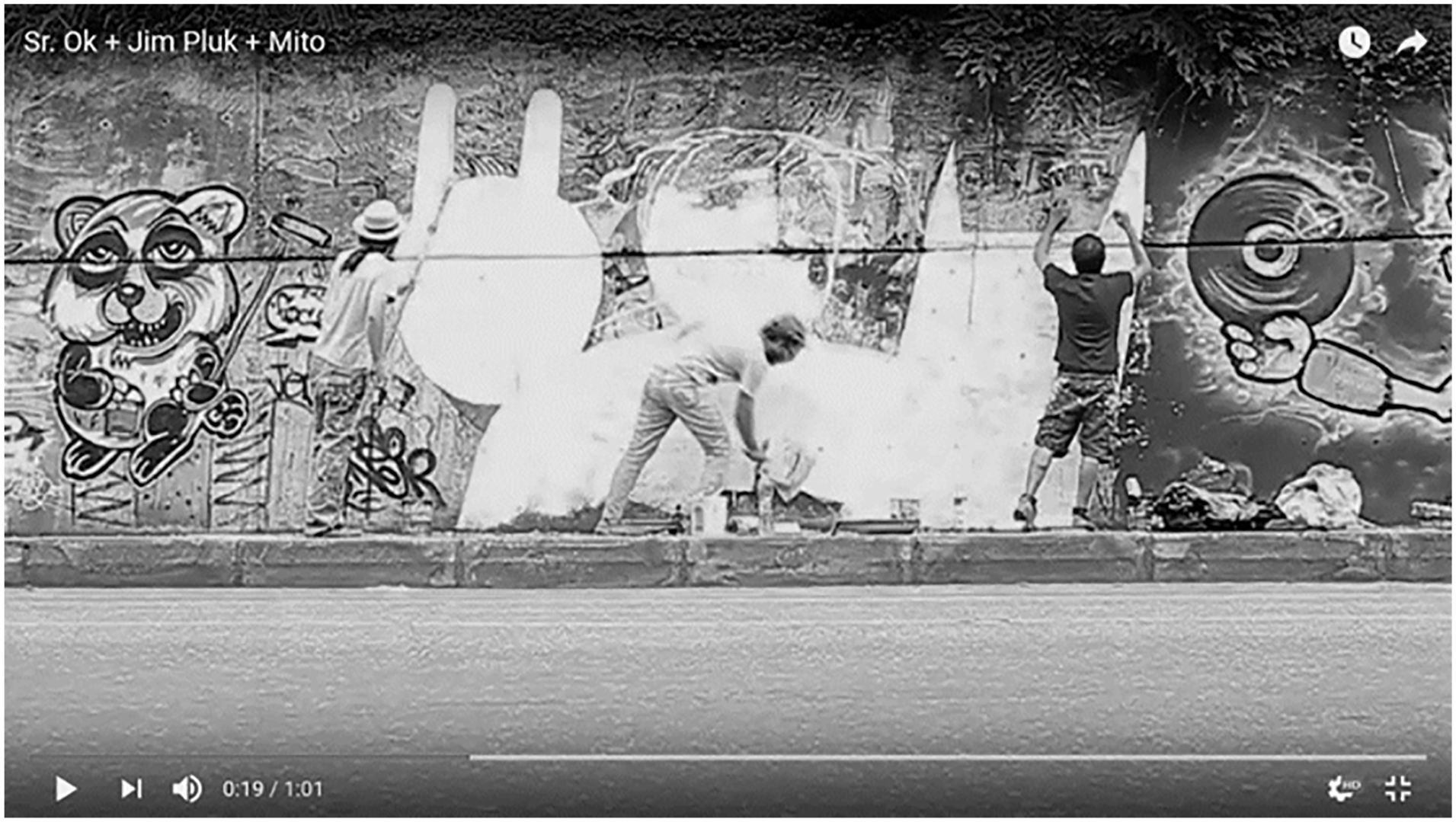
Screenshot from a YouTube video (Pluk, 2014a).
This mural by Señor Ok and Mito on a parking lot wall in a residential neighborhood or rather its appearance in social media (Mito visual, 2016) is another example of silencing. The rabbit and the grinning cat sit in front of the fire inside the elephant-snake hat from The Little Prince (de Saint-Exupéry, 2000, pp. 1–2). Contributing to the discussion of the art and striated thinking initiated by de Saint-Exupéry, they offer another possibility for the interpretation of the bumps in the hat. It is also a possible reference to their earlier painting (Señor Ok, 2012). The painting is photographically registered and shared on Facebook and Flickr. New technological media emphasize the mobility that was hidden in the mind, developing the story by bringing it to the public urban social media surface from the private imagination: The night replaces the day and the fire dies and starts up again.
Masks reassemble the space. They mark the territory occupied by the artist and define his community. This space also goes beyond the particular city border and the country. Señor Ok’s Flickr channel shows images of his tag, for example, in Cuba. In one interview (August 23, 2016), he shared a moment of happiness when he saw a familiar tag in an unknown city, immediately transforming the unfamiliar street into home-like space. Masks signal rhythmic repetitions of the cities mirroring (e.g., Rodas Quintero, 2014, Las golondrinas, p. 34 & Así, p. 38) and expanding each other. This language inside another one traces the invisible path of the artist telling his story. It expands and magically transforms the two-dimensional path from one between two points into multidimensional movement: over posts, the walls of kiosks, bridges, the backs of road signs, little stones in corners otherwise invisible, public phone booths and concert announcements (Señor Ok, 2016b), reconfiguring back and forth thinking into walking and into writing.
Gray Spaces = Expansions
Silencing signals the “motionless voyage” of becoming by dismantling “one’s self in order finally to be alone and meet the true double at the other end of the line” (Deleuze & Guattari, 2005, p. 197). Deleuze and Guattari (2005) note, however, that “this, precisely, is a becoming only for one who knows how to be nobody, to no longer be anybody. To paint oneself gray on gray” (p. 197). It is self-conscious, renewable, and creative movement. Santiago calls graffiti artists autophages (Señor Ok, 2016c): “they devour themselves; they say they fill the city with colours, but they are longing for grey to renew themselves, always unsatisfied.”
Gray is the paint that best covers up wall paintings. It is often used by the city administration to refresh city walls, and becomes “a call for the graffiti ‘community’, another possibility to make a better workpiece” (Señor Ok, 2016c). While it is possible to interpret it in dialectical terms, discourse-anti-discourse, resistance to the dominating practices of invisibilizing the diversity of voices, Santiago speaks about it rather in terms of “a game,” an endless revision of the spaces and possibilities, intra-activity, an incentive for mutual disassemblage. “Administrative grey” becomes an external factor—the public space that intervenes between the hierarchies established by graffiti, the smooth space that produces an in-between or empty space to induce the new. It makes even more sense taking into account the general acceptance of street art and graffiti in Medellín by both administration and people as an actor of positive urban and social transformation (Acosta Ríos, 2017, p. 170; Arango Bran, 2015; Rodas, 2015a).
The relationship with color expands to another setting. The publishing company Atarraya, which Santiago runs with Lina María Parra, publishes a journal called Gris (Gray), whose official goal, according to Lina María, is to open space for the new writers in the city, the new voices, as well as “to explore different ways of presenting an image on paper” (García, 2016). The journal name, Parra explained (García, 2016), among other things refers to the color that is invisible yet is there. The policy of the journal challenges the hierarchy in expression—“stories, poems, illustrations, all are of the same value, none is above the other” (García, 2016). While acknowledging the possibility of not being of great influence in the city, Parra admits that the fact that such space exists “demonstrates that there are other things and intentions,” “otherwise all of us would read the same and hear the same” (García, 2016). As a wall, the journal creates a possibility and calls on authors to create a new meaning together, to reorganize routine movement through the city, to redefine the priorities (Rodas, 2015b).
The journal’s policy complements the policy of the publishing company: to work without preferences with letters and images. As a review of Trampas tropicales (Rodas & Pluk, 2015) comments, “those who are not much into poetry will go for its illustrations” (Piedrahíta, 2016). The review also acknowledges the aesthetics of the edition: “As many independent editions it evidently values a book as an object” (Piedrahíta, 2016). The object facilitates the selling of the poems and illustrations, promotes ideas, or transforms, with its mere presence, the literary urban scene, by offering an alternative place for publication and thinking about literature in the city.
While denying in the interview (August 23, 2016) that his poems are about the city, Santiago autographed my copy of Trampas tropicales as “street poems” and the copy of his first book Gestual (Rodas Quintero, 2014) as “silent poems that are looking for an empty space in the street.” It could be a situated action. Both expressions also refer to the poems that inspired his works (Piedrahíta, 2016), to the urban origin of his poems and to his graffiti. Empty space could mean both the presence and the absence of the meaning that urges the artist to paint/write, as Santiago says (Rodas, 2015c), “at night, while everybody is sleeping, to avoid too many questions, which at the moment of painting, however, do not even matter to him.” Altogether, it unfolds the nature of the poetry: gray space, the space in-between, smooth space, a rhizome, a quest for expression across the urban space in its multiplicity.
Santiago’s poem “No-poetry” (No poesía) appears on the inside part of the book cover as a possible statement. It defines a poem as “a road that is known to be lost from the very beginning” 3 (Rodas Quintero, 2014). It is lost because of the impossibility of finding “the adequate words, . . . the exact order of the words” 4 (Rodas Quintero, 2014) on the two-dimensional paper. His short biography at the other side of the cover echoes, “I am 23 and it is quite difficult to write about my own life” (Rodas Quintero, 2014). They mostly focus on his attempts and failures to institutionalize himself and his search for what he likes doing: “As almost always I was wrong” (Rodas Quintero, 2014).
Santiago recognizes the dynamics of the street as a graffiti artist; it is reflected in his worldview, which consistently and eloquently shapes both the contents and the form of his work. He accompanies the posts of his murals and graffiti in social media with literary quotes and a title treating them as literary pieces; his blogs have references to philosophers and writers; his autographs are coherently connected with his work; his literary works could be compared with his graffiti or rather be their expansion: “His [painting] practice is fast because of the street logistics, but his works invite us to stop, the same way as his poems” (Piedrahíta, 2016). It is impossible to say what is the continuation of what. On one occasion, Santiago presents himself as “an illustrator, a graffiti artist, a writer of the poems and of the other things, not sure in what order exactly” (Atarraya, 2022). With his works, he writes the story in a multidimensional way. The order is defined by the moment, by the surface, by a passer-by, by the material, and so on. It is the order in flux, on the move, the nomadic localized order, which can be changed and rethought at the next moment by the public space, by a new passer-by, or by precipitation as in the collaborative video discussed above (Pluk, 2014a).
The overall absence of preference to the senses and to the media of expression is seen also in his poems: “Air smells with green and yellow” 5 (Una tarde) (Rodas Quintero, 2014, p. 21)—the colors, lights, smells, and sounds fill in the city and merge or entangle the landscape with people—“On the feet of a man the sun sets of the same colour as the sky” 6 (Junto al río) (Rodas & Pluk, 2015, p. 23); the city and its buildings are entangled with air and sky (Rodas Quintero, 2014, p. 22), with day and night; the trees are entangled with the birds and their singing (Rodas Quintero, 2014, Ciudadela, p. 23, Chirlobirlo, p. 63).
His rhizomatic antipoetry is gray and silent, decentered, renewable. It mirrors itself but can’t be reproduced, even if we recognize the repetitions and the same motifs in the graffiti, blog entries, or the poems. Different settings, moment, mood, and so on indicate the new meaning of its offshoot or expansion. His poetry altogether is a map; its different modes are “tracings that must be put on the map” (Deleuze & Guattari, 2005, p. 21). This map urges exploration of the new meanings in our understanding of the author and the city with all its surfaces and inhabitants whether human or non-human. Map allows us to see the multidimensional city, the city in flux, tracing the actual and virtual images of it and of its mirrors.
Mirrors = Tracing
The metaphor of the mirror is often used in artistic and scholarly reflections about the city (M. Ánjel, 2015; J. G. Ánjel & Arango Soto, 2008; Gutiérrez, 2009; Parra Valencia, 2017; Tello Zuluaga, 2015). No matter what the approach is, mirrors appear as localized fragments that work as assemblages of the multiple city reality. Everyday details indicate the tracings and the secret language of the multiplicity.
With his dark and coarse satire and attentive curiosity, Santiago questions the commonalities of life starting with the title of the collection itself: Gestual (“gestural”) (Rodas Quintero, 2014) questioning the dominance of the word-based language; the second collection—Trampas tropicales (tropical traps/tricks) (Rodas & Pluk, 2015)—scrutinizes tropical ways of life, common places, and habits in their exploration of the reasons for violence, an interplay between order and chaos. Piedrahíta (2016) describes Trampas tropicales as the everyday realities of one person. Yet this person is in the city, in his communities, with his family, friends, inspirations, and mentors. It is not just an opinion, as Piedrahíta (2016) characterized it, it is philosophy (Massumi, 2005, p. xiii). Graffiti and the public exhibitions of his canvas, among other things, illustrate and expand the stories: we can see portraits of Santiago’s cat, his dog, and his friends, everyday scenes such as people eating or a hairdresser trimming one’s hair, grouped in his social media galleries under the title “Common places” (Señor Ok. Facebook, Flickr, Instagram channels). They complete the picture of the city as his home and the space of his activities, and create the feeling of the city as home for the one who “stops to look” (Piedrahíta 2016). The street Santiago brings to the street is not violent but is one that brings hope or, at least, that makes one stop to look. It expands the notion of public and mixes private and public in much the same way as Santiago mixes the senses.
His blogs, poems, and paintings are pieces of thoughts that in the most realistic and honest way present the everyday routine of thinking: Thoughts in passing repeat, overcode, de- and reassemble each other. Those pieces of personal and collective memory, of everyday routine in the city, are the details that like pieces of ceramics can tell an archeologist-reader a lot about life in a certain epoch and place, and what and where to look for more. Some details are recognizable, and some are not; each provides tracing for the map and offers a new possibility of knowing, being the seeping edge of virtual, the cutting edge of change (Deleuze & Guattari, 2005; Massumi, 2002, 2015). Repetition, mechanical (decapitated) (Rodas & Pluk, 2015, Autorretratos, p. 17) reproduction is a function of the mirror: It not only multiplies but also erases: “leaving, the woman leaves an empty space repeated through her” 7 (Espejo) (Rodas Quintero, 2014, p. 37), “searching for your lips in this dark room without you” 8 (Casi un espejo) (Rodas Quintero, 2014, p. 41). This erasure is the gray paint that in its turn produces an empty, gray and silent space that urges one to create a new better piece.
The precise date of the poem does not seem to be important for the author. The contents of the poems include references to certain events that could be mere memories put on paper later on. The order of the poems may appear random. There is no organization in the table of contents. The collection Gestual does not even have any contents. The closer look at the texts, however, reveals the themed clusters with porous borders. Santiago compares organizing poems by themes and titles with dressing up the dead: One can do it only before giving all the writings to the fire, “the most faithful reader” and The Antimentor (Rodas Quintero, 2014, pp. 73–74), the renewing and disassembling gray paint. Organizing the poems into clusters, Santiago proposes a certain guideline without imposing it via the contents.
It is an interplay between the striated and smooth space. The theme clusters provide a space for the individual poems to enrich the meaning of the events, phenomena, and realities they speak about. They point at how different events in the city even scattered over the years can become pieces of one story. They look at the event or person from another perspective and at times provide a contradictory follow-up as in the case of the grandpa story (Rodas & Pluk, 2015, Fabio Rodas, p. 46 & Mi abuelo y la escopeta, p. 47) or the death of a teenage friend (Rodas & Pluk, 2015, Regresar a casa, p. 50 & 12 de enero, pp. 51–52). The order of the poems speaks indirectly and without moralization about violence in the streets, its reasons, its faces, its consequences, its banalization (Rodas & Pluk, 2015, pp. 9–24) and the armed conflict, as in two poems about different mothers in Gestual (Rodas Quintero, 2014, El silbo de mi madre, p. 18 & Para antes de la llegada de los ejércitos, p. 19). The contraposition of two mothers subtly urges the reader to think of the life the war victim could have had.
The organization of a poem’s lines echoes the organization of the poems in a volume. For example, the poem that describes the suicide of two teenagers ends with a line in official language: “The father broke someone’s leg. The public attorney is searching for the motives” 9 (Pacto de amor) (Rodas & Pluk, 2015, p. 21). In a similar manner, the author wants to draw attention to banalization, bureaucratization, and dehumanization of death in the poem “A Passenger”: “The train was in maintenance” 10 (Rodas Quintero, 2014, p. 35). The official language could also be contained in the reference to mass media, the source of information in the city that enters the poetry.
In the description of his antipoetry on the back of the cover of Trampas tropicales, Santiago says that it is “dangerously close to being narrative but it is not narrative” 11 (Rodas & Pluk, 2015). Its poetics is in everydayness, encouraging a search for the meaning of the human on the surface, where “it is all closer” 12 (Rodas & Pluk, 2015), even if, or especially because, we speak just about one person—one person in, of, and with the city. Observing from under the bridge while painting, through the painting itself, returning to the painting, from the desk while writing the poems and organizing them for publication, preparing a class, from behind the desk during public presentations, he offers a map that enables the multiverses in the world including his work, his life in the city, poetic and artistic life in the city, the city altogether, to be seen.
The details form tracings and each one of them matters, not because they help to understand the logic of the world or of the author, but they are also just there. “The surroundings do not escape the eyes of the writer, but he does not believe in them,” says the review (Piedrahíta, 2016); “as such not all of this is necessarily true,” 13 writes Santiago about poetry (Rodas & Pluk, 2015, Estrategias, p. 69). The skepticism of his poems indicates the multiplicity of meanings, sources of knowledge, possibilities of interpretation. Taking into account the grayness and the nomadic nature of his work, it is safe to say that he believes and even trusts “in the possibilities of world(s) we have not yet thought” (St. Pierre, 2013, p. 652). For example, in the poem “Pictures” (Rodas & Pluk, 2015, p. 32), he believes the world can give him a possibility to find his long-lost camera in the snow of a volcano and recover his childhood dreams and hopes. Trust and sincere curiosity in the world are the secret language of the world, the expression of its multiplicity, of its otherness, that comes with every detail, every person, emotion, thing, or activity, and with the recognition of the relations of entanglement of the world.
Secret Language Within = Otherness of and Within Self
Epigraphs open both collections, noting the vanity of big words and speaking instead of the slow silent movement toward “the moment where the radical otherness of everything will wound you” (Jose Manuel Arango cited in Rodas Quintero, 2014); “only against oneself one arrives most closely to oneself” (Paul Valéry cited in Rodas & Pluk, 2015). They introduce the necessity of silencing or masking as a part of deterritorialization, which makes one vulnerable but is inevitable in reassembling and learning. They introduce the philosophy of difference into nomad thought that “does not immure itself in the edifice of an ordered interiority; it moves freely in an element of exteriority” (Massumi, 2005, p. xii).
Santiago’s poems are the play of imagination that disassembles the common and reveals the secret language of the multiplicity that “rides difference” (Massumi, 2005, p. xii). “Paintings, tattoos, or marks on the skin embrace the multi-dimensionality of bodies [. . .] Doubtless, there are profound movements of deterritorialization that shake up the coordinates of the body and outline particular assemblages of power,” write Deleuze and Guattari (2005, p. 176). Wrinkles, scars, and sutures of the human body; cracks and mutations on a tree bark; and wall cracks are the language that tells the story of life and of the health of the body. They indicate the structure and its failure, remind us of the inevitability of the destruction of the organizing order people impose on their habitats (Acosta Ríos, 2017, p. 163), and of neglect and forgetting (de Frono, 2015, pp. 32–33). In his poem “A Poet,” Santiago jokingly remembers the burn mark left by fireworks bought from a guy nicknamed Poet: “Perhaps it was the language of true poetry that leaves true scars” 14 (Rodas & Pluk, 2015, p. 30).
In Santiago’s poems, the cracks on the walls are flowers, carefully planted, birds, snakes, and deer hiding in a forest (e.g., Rodas Quintero, 2014, El sembrador de grietas, p. 13). The squeaking sound of the swaying pines are the doors that open the “forgotten paths of childhood” 15 (Recuerdo) (Rodas Quintero, 2014, p. 12). Tears that a tailor dropped on the fabric as she was making a shirt make someone who wears that shirt later on, feel all of a sudden sad (Rodas & Pluk, 2015, Lagrimas, p. 19). A personified river and a personified corpse happily greet someone standing on the river bank; some corpses stop at a rock to meditate, and some happily approached the sea if the police do not impede their natural movement (Rodas & Pluk, 2015, La espalda del río p. 10 & Los cuerpos, p. 11). These are just some examples of his vivid and coarse imagination.
Shared creativity keeps the poetry on the surface and does not let it sink to the depth of philosophical generalizations or moralizing. Poem Autorretratos (Self/author-potraits) speaks of the t-shirts in a closet as lined up copies of the decapitated Self 16 (Rodas & Pluk, 2015, p. 17). The illustration by Jim Pluk suggests where the heads could be: They are on the floor of the closet, surprised and concerned by the smell of footwear (Rodas & Pluk, 2015, p. 18).
This imagination could be called childish, exploratory, and mischievous. In Santiago’s poems, children are curious; they question and verify information about the adult world, especially if it is something prohibited. Their actions, however, are far from being harmless to others or to themselves, even if they are out of naïve curiosity. They get pinched by a crab while exploring their hole (Rodas Quintero, 2014, Es un saludo extraño el de los cangrejos, p. 15), destroy bird nests or throw stones at birds (Rodas Quintero, 2014, Niños y pájaros, p. 11 & De niños, pp. 16–17), play with fire (Rodas & Pluk, 2015, El Poeta, p. 30 & Fuego en el Espejo, p. 48), and play with death (Rodas & Pluk, 2015, Armas, p. 9, Pacto de amor, p. 21, regresar a casa, p. 50, 12 de enero, pp. 51–52). Such curiosity does not disappear when they grow up (Rodas & Pluk, 2015, Fabio Rodas, p. 46 & Carro bomba 60). A poem that describes every mischief that children do, their cruelty toward other living beings is called “De niños” (Rodas Quintero, 2014, pp. 16–17). One can translate this as “about children,” “at the time when we were children,” or “since we were children.” The poem ends with the words, “And we say ‘we hate God’ every chance we get”, which could also be translated though as “And we say ‘we hate God’ every time we get another chance” 17 (p. 17).
Santiago’s poems do not picture a human as evil, but rather as harmfully clueless. They create the feeling of the chaotic urban universe (tropical imaginary) that people are vainly and in different ways trying to organize: including such routines as going to a lawn near the city airport to observe the planes taking off and landing. The poem concludes, “Who knows what could have happened if only one time those who watch the planes landing stopped doing that” 18 (Los que miran aterrizar aviones) (Rodas & Pluk, 2015, p. 24). It is curious that this poem ends the urban violence theme cluster by transforming it into the urban violence/urban routine theme.
The other forms of structuring are mass media, police, fire fighters, a public prosecutor, public opinion, indifference, and the habit of “urgent cleaning” (de Frono, 2015, p. 20)—the practice of erasing all the signs of the night and all the signs of life including the graffiti (de Frono, 2015; García Lázaro, 2013). The cars clean away the dead body of an animal from the freeway by passing over it one after another again and again (Rodas & Pluk, 2015, Animales aplastados, p. 16); people are paid for redirecting corpses that the river thoughtlessly brings to the city (Rodas & Pluk, 2015, La espalda del río, p. 10). The habit of urgent cleaning makes the river itself the means of cleaning that someone else has to clean later on. Santiago’s poems implicitly and subtly show the absurdity and vanity of this cycle of cleaning. A mythical symbol of this is a knife grinder, who sharpens knives in exchange for coins without worrying for what they are being sharpened. Santiago compares him with Kharon, impartial Greek mythical carrier between the world of the living and the world of the dead (Rodas & Pluk, 2015, El afilador de cuchillos, p. 15).
The poems offer possible uses for our imagination—urgent cleaning of the disturbance, wasting energy on the vain cycle of cleaning that in the end contributes to the “fatal destiny that is approaching clearly in front of our eyes” 19 (Simulacros) (Rodas Quintero, 2014, p. 36) or to discover, learn, and read secret languages offered by the more-than-human world. People are lonely and lost in the city—the theme recurrently discussed in his poems (Rodas Quintero, 2014, El tren, p. 26, Los minutos, p. 31, En la ciudad, p. 33, Tu rostro, p. 39): “Cities, mirrors of this solitude” 20 (Así) (Rodas Quintero, 2014, p. 38). Yet they desperately long for the other to merge with, to be the one (Rodas Quintero, 2014, pp. 40–50), often in vain (e.g., Rodas Quintero, 2014, Casi un espejo, p. 41 & Soledades, p. 43). In the solitude/search for love theme cluster (Rodas Quintero, 2014, pp. 40–50), the human body gradually, poem by poem, turns into the body of the city, nature and the universe, and flows to the secret language theme cluster. It indicates the line of flight. The secret language that could be found in “each leaf, each brick, each stone,” each kiss, sword, map, line, draft, day, or night “for us to decipher” 21 (Acertijo) (Rodas Quintero, 2014, pp. 51–52). It is worth deciphering as it can help us find each other, feel proximity to our loved ones in the world, both human and non-human, inspire us, and help us hear “the music of the wings” (Rodas Quintero, 2014, Las golondrinas, p. 34, Nocturno, p. 56). With it, we can find freedom and, dream, hope, and trust, or belief and desire.
Poetry can’t provide a clue if it operates exclusively with the words. The words are “birds that are freed to the emptiness and are waiting to fly” 22 (Palabra) (Rodas Quintero, 2014, p. 58). It is a temporary language: They are a fraction of the world that often misinterpret it as they cannot distinguish one thing from another (Rodas Quintero, 2014, A ciencia cierta, p. 60); a disturbance of the natural order of things (Rodas Quintero, 2014, El silencio de las cosas, p. 69), mostly harmful to the world, while the world patiently waits for its chance to speak up (Rodas Quintero, 2014, Acertijo, pp. 51–52, Arriba, p. 64, El Urapán, p. 65). Silence as an anti-word language is an important language to learn (Rodas Quintero, 2014, Las palabras, p. 47 & Palabra, p. 58). In fact, Santiago writes, the white pages are “the real treasure” 23 (Carta a un joven ladrón) (Rodas Quintero, 2014, p. 72).
The poem is unthinkable without empathic relations with the other, without the matter: the body in the city and the city in the body 24 (Rodas Quintero, 2014, Tu cuerpo, p. 54). Secret language is in all of that as the world is one and shared (Rodas Quintero, 2014, Canto dal agua, p. 68): the sound of the sea that can be heard in the mountains, in the city traffic, a classroom, and a line in a bank (Rodas Quintero, 2014, Se necesita tener un mar siempre cerca, p. 29); “the geometry of death” in the vultures circling over the city (Rodas Quintero, 2014, Geometrías, p. 67); “the forgotten alphabet of water” drawn by the moving insects over the pond surface (Rodas Quintero, 2014, Agua, p. 59). Every gesture, every shape, thing, and medium provide a riddle to guess (Rodas Quintero, 2014, Acertijo, pp. 51–52). The ancient voice talks through them, in dreams (Rodas Quintero, 2014, Nocturno, p. 56, & Sueño, p. 61). One has to respond to those active voices ideally in their own language or accommodate the languages and senses one knows according to the moment.
Conclusion
For we are made of lines. We are not only referring to lines of writing. Lines of writing conjugate with other lines, life lines, lines of luck or misfortune, lines productive of the variation of the line of writing itself, lines that are between the lines of writing. (Deleuze & Guattari, 2005, p. 194)
Santiago’s works are a complex multidimensional story that reveals the complex structure of the city life by being in it. Non-linearity and self-conscious attention characterize his every work signaling simultaneity of thinking and being. His non-linear antipoetry connects in a rhizomatic way his blog posts, teaching, publishing projects and his public appearances, his canvas paintings and graffiti, the works of his co-authors and coparticipants in the city events, in other words with his everyday life in the city, in the country, in the broader world. It spills over to the contents of his work, expanding the meaning of reading and understanding as well. One mirrors, repeats, reflects, and diffractively transforms the other, and together they become something else, or rather, they make the antipoetry. In fact, I see the prefix anti- as Santiago’s deterritorialization of poetry as such and as his silent proposal to open up the borders of a genre among many other borders the language imposes on the ways of knowing.
His poetry contests the meaning of the city as an abstract sedentary settlement and introduces the notion of the city as a temporary, migrating, subjective living being that communicates with us through its walls, roads, and lamp posts among many other surfaces and spaces. Without denying other genres or media, Santiago avoids constraining himself to one. The genre, order is not important as everything is transforming diffractively. Santiago’s work celebrates the diversity of its potentiality. His multidimensional writing opens possibilities for becoming and trusting in the world to offer such possibilities. His poetry and graffiti are kind, despite their black and coarse satire, because of their affirmative nature. They are open and help others to be open to reading and living between the lines of writing. They go beyond word-based language toward the language of bricks, smells, colors, feelings, bodies, and any other language one can think of—the performative language of the post-media city.
The flat surface of the article can be only a trace or two of the world of Santiago’s work that is a living transforming being that keeps on living and expanding. The poems are cited in fractions to emphasize the fragmental, fractional look the article-trace can only give. The only way to understand it is to live through and with the poetry: letting the poems be graffiti, letting the graffiti be the poetry, see the city as a poetry and the poetry as a city, as a theory as a method.
Footnotes
Declaration of Conflicting Interests
The author(s) declared no potential conflicts of interest with respect to the research, authorship, and/or publication of this article.
Funding
The author(s) received no financial support for the research, authorship, and/or publication of this article.
