




Abstract
Art has proven be an asset in maintaining and enhancing our wellbeing. Following a recent field study, the present laboratory investigation assessed whether and to what extent an interaction with art in urban public spaces can positively impact experienced wellbeing. Participants watched videos simulating an interaction with a parking-lot-sized intervention decorated with art, greenery (active control), or nothing (conventional control) in an urban setting. Before and after interacting with each video, participants’ anxiety, stress, positive and negative mood were measured. Subjective experiences of the location and the intervention were also collected. Results showed a unique pattern for the art: (1) while positive mood decreased for both active and conventional controls, it remained stable in the art and (2) exploratory analyses suggested a positive correlation between subjective experiences and wellbeing only for the art. Current results as well as differences and advantages of field and laboratory studies were discussed.
Keywords
Introduction
Cities are attractive places to live. However, they - and their associated lifestyle – can pose various threats to residents. For example they are risks to people's mental health and wellbeing, such as mood and anxiety disorders (Hoare et al., 2019; Lederbogen et al., 2011, 2013; Sundquist et al., 2004). Past studies have demonstrated that interacting with urban green 1 spaces, such as urban parks and forests, is a well-established tool for promoting urban wellbeing. Engaging with urban green spaces positively influences environmental, social, physical, and subjective wellbeing (see the reviews: Jabbar et al., 2022; Krefis et al., 2018; Mensah et al., 2016; Papastergiou et al., 2023; Reyes-Riveros et al., 2021). The question why greenery positively impacts humans has been tried to be answered by several (evolutionary) theories and hypotheses. For example, Ulrich proposed that natural environments, being less stressful than cities, have a more positive, stress-reducing and restorative effect on people (see the Stress Reduction Theory, SRT, Ulrich et al., 1991; Ulrich, 2023). Meidenbauer et al. (2020) suggested another mechanism for the positive effect of natural elements (such as greenery) on wellbeing. Rather than an innate ability of nature to promote wellbeing, they suggest that preference for an environment is what drives the positive impact on wellbeing (i.e., affective states). Thus, natural environments have a positive impact on wellbeing because they are usually preferred.
Over the past two decades, a growing body of evidence has highlighted the potential of the arts to promote wellbeing (see Fancourt & Finn, 2019's World Health Organization (WHO) scoping review). This potential has been observed with a range of settings and stimuli: from online interactions to in-person museum contacts with paintings and/or music (Clow & Fredhoi, 2006; Fekete et al., 2023; Mastandrea et al., 2018; Trupp et al., 2022, 2023). Even though the mechanism behind the positive effect of the arts on wellbeing is still a debated topic (see Mastandrea et al., 2019), new evidence is starting to shed light on this matter. Trupp et al. (2024) discussed the possible mechanisms behind the impact of art viewing on wellbeing. They highlight five main themes that emerge from the literature: affective processes (e.g., emotions and stress regulation, pleasure), cognitive processes (e.g., the idea of stimulating one's senses and attention, an evocation of memories, learning), social processes (e.g., the feeling of connection and bounding when attending the same exhibition), self-transformation (e.g., reflection on one self, find your meaning in life), and resilience (e.g., being able to cope with life's difficult situations, mechanisms of psychological restoration). Interestingly, some of these themes (e.g., affective processes and resilience) are similar to the ones present in the works trying to explain why green can promote wellbeing (e.g., preference and restoration). Drawing from a different field than the psychology of the arts, Tay et al. (2017) from positive psychology, proposed a model explaining how engagement with arts and humanities can contribute to human flourishing. The non-exhaustive mechanisms they highlight are immersion, embeddedness, socialisation, and reflectiveness. These themes resonate with the ones found by Trupp et al. (2024). Expanding upon this line of research (mainly conducted in museums, laboratories, and hospital settings according to Trupp et al. (2024)'s review), our present study explores the potential of art elements in urban environments to promote short-term wellbeing, potentially serving as a beneficial addition to urban green.
Studying the potential impact of artistic elements on wellbeing in urban environments has several advantages. First, as past studies in environmental psychology have extensively focused on the relationship between greenery and city wellbeing, the potential of other human-made elements was overlooked. Second, implementing and maintaining urban green spaces can be particularly challenging, especially in dense urban areas (Haaland & van Den Bosch, 2015). Artistic elements, in contrast to greenery, can be integrated into populated urban zones more effectively. They are highly adaptable in terms of forms and locations. The forms can be street art on walls, statues, architectural elements, or paintings hung in public spaces. In terms of locations, they can be incorporated almost anywhere, from urban streets to parks and squares. This adaptability encourages spontaneous interactions, reaching a wide range of people in all urban areas. With urbanisation rates on the rise and the United Nations’ projection that 68% of the world's population will live in cities by 2050 (United Nations, 2018), it is therefore imperative to explore the potential of artistic elements as potent means for enhancing wellbeing within urban environments.
A recent study has shown the promising impact of urban art on wellbeing. Mikuni et al. (2024) conducted a field study in Vienna (Austria) to assess how the presence of art in public spaces influences wellbeing. They implemented a parking-slot-size metallic street intervention in two different districts. Their intervention was decorated with art or green decorations (see Mikuni et al., 2024, for more details and pictures of the interventions). In the field experiment, participants went for a five-minute walk on the streets where the intervention was placed. Participants came twice to the same street: one to experience the intervention with art decoration and the other to experience the intervention with green decoration. The wellbeing outcomes between art and green decorations were compared. The outcomes were measured physiologically (i.e., stress markers) and subjectively (i.e., subjective feelings of stress, anxiety, and affective mood) before and after the interaction with the intervention. Analyses revealed that an interaction with the art intervention on the street was as effective as the green intervention in reducing stress, anxiety, and negative mood.
Although the study showed promising and essential results for understanding the potential of artistic elements in promoting wellbeing in urban contexts, it holds three main methodological limitations that make interpreting the results difficult. First, they lacked a condition where the participant interacted with the intervention without art or green elements, hence a control with “no treatment” (conventional control condition from hereon). Instead, they argued in favour of having the Green condition (i.e., interacting with the street intervention with the green decorations) as an active control against the Art condition (i.e., interacting with the street intervention with the artistic decorations). An active control is a condition given to participants that differs from the experimental condition with manipulation(s) that is a credible comparison to the experimental condition (Boot et al., 2013). In their case, greenery was chosen as an active control as green elements have been repeatedly shown to promote wellbeing effectively. This approach is constructive for studies employing a within-factor design to ensure that participants’ expectations and motivations are evenly balanced across conditions, reducing potential biases in the outcomes. Nevertheless, by bringing complementary information, a conventional control condition would strengthen the conclusions on the delivered effects from artistic and green elements. Second, the field study aimed to measure participants’ natural reactions to the interventions. Thus, participants were not explicitly instructed to be in contact with the intervention. Instead, they could walk freely around the testing area during the testing period. Consequently, participants differed largely in the amount they interacted with the intervention. Some did not interact at all with the intervention, while others did engage and those who engaged with the intervention might have experienced different durations of exposure to it. Third, when the participants interacted with the intervention, the amount of interaction and the subjective experience of the urban environment varied substantially across individuals. Many factors, such as temperature, weather conditions, or street business, usually do not stay stable in the field environment; these variations make it difficult to disentangle the effects of the interaction with the intervention from those introduced by other elements of the environment participants experienced.
Considering the above concerns and the limited number of studies on the topic, further investigation is needed to clarify the impact of urban public art on wellbeing. While field studies offer valuable opportunities to observe urban environments in an ecologically valid way, they do pose methodological challenges. For instance, the second and third points stated above are difficult to control, especially when researchers try to capture natural and authentic engagement with the field environment. These unpredictable and uncontrolled elements make the interpretation of the results challenging and they also question whether a clear causal relationship can be established between experimental manipulation and the outcomes. One might argue that, in a controlled and standardised laboratory setting, we can address the above points successfully by exposing all the participants to the same video with the exact same duration of exposure to the interventions, potentially reducing the variance stemming from confounding factors in field environments.
The present study tackles the abovementioned limitations by conducting a controlled laboratory-based study, following the research design of Mikuni et al. (2024). We aim to investigate the effects of art on wellbeing in an urban environment. It is important to acknowledge that wellbeing, due to its multifaceted nature, is a challenging term to define (Dodge et al., 2012). In the context of this study, we will use the notion of experienced wellbeing proposed by Stone and Mackie (2013) as our working definition of wellbeing. Experienced wellbeing typically refers to an individual's emotional states and the way they evaluate these states. It also may include sensations such as stress, pain, or arousal. Experienced wellbeing is often captured in real time or immediately following an event. The focus of this paper is on short-term measurements of anxiety, stress, positive mood and negative mood. To this aim, we prepared three videos of the field set up by Mikuni et al. (2024), corresponding to our experimental conditions. The videos differed in the types of decoration in the street intervention: Art (with art in the intervention), Green (with green in the intervention), and Control (empty intervention) conditions. These three conditions allow us to make more substantial claims regarding the impact on experienced wellbeing in the Art condition compared to the active control (Green condition) and the conventional control (Control condition). Further, presenting videos in a laboratory environment enables controlling the exposure time to each intervention (i.e., each participant interacted with the intervention for the same duration) and controlling or excluding other confounding factors, such as temperature and noise, that naturally vary in the field environments. By adopting the same field setting of Mikuni et al. (2024) with the improved procedure (e.g., the inclusion of the conventional control, in a controlled laboratory setting), we aimed to achieve a holistic understanding of the impact of artistic elements on experienced wellbeing in urban environments, accumulating evidence from a different angle.
Our study, which primarily focuses on exploring the impact of urban art on wellbeing, also presents a valuable opportunity to compare the results between a naturalistic field and a more controlled laboratory study. As field experiments gain momentum in empirical art and aesthetic research, it is becoming a common practice to follow up with a laboratory or online study using visual stimuli such as photos or videos from the field (e.g., Chana et al., 2023; Estrada-Gonzalez et al., 2020; Mitschke et al., 2017). We argue that laboratory experiments provide meaningful comparisons to field experiments, as previous research has shown that results from experiments using even still photographs in a laboratory can be effectively extrapolated to on-site experiments (Stamps, 1990). Moreover, in terms of the impact of artistic elements on wellbeing, previous studies in various settings have successfully demonstrated positive effects, from online to field experiments (e.g., Clow & Fredhoi, 2006; Fekete et al., 2023; Mastandrea et al., 2018; Trupp et al., 2022, 2023). However, as emphasised in a recent meta-analysis comparing the aesthetic experiences from actual artworks and their reproductions, the number of studies evaluating the influence of contexts is still limited (Specker et al., 2023). Therefore, our results not only contribute to the understanding of the effects of artistic elements on wellbeing in urban settings but also advocate for the validation of visual stimuli in laboratory follow-up studies, paving the way for further research in the field.
We studied two main research questions: (RQ1) Do the Art and Green conditions show a positive impact on experienced wellbeing, compared to the Control condition? (RQ2) If positive effects on wellbeing in both the Art and Green conditions are present, are the effects similar, or are they more pronounced in one condition? This second question is particularly interesting for future research directions, as we can directly test if artistic elements can be used as an alternative measure to promote wellbeing in urban environments, and if such elements show equivalent or higher beneficial effects on wellbeing than green. We note that this study was pre-registered following an AsPredicted 2 format (AsPredicted#118317 see details on the OSF page for the pre-registration form) before starting the experiment.
For the first research question (RQ1), which focused on the Art/Green vs. Control condition comparison; we expected no differences (or significantly more minor differences) in the measures between before and after the interaction with the video in the Control condition. This result is expected because the Control condition in the present study does not include any element known to influence wellbeing (i.e., art or green). The expectation is valid for our four dependent variables representing experienced wellbeing (anxiety, stress, positive mood and negative mood).
For the second research question (RQ2), focused on the Art vs. Green condition comparison, past literature offers more nuanced evidence for our four wellbeing variables. Most of the evidence for stress and negative mood goes in the same direction. Both art (Clow & Fredhoi, 2006; Trupp et al., 2022; 2023) and greenery (Beil & Hanes, 2013; Raman et al., 2021; Subiza-Pérez et al., 2018) were found to reduce the feeling of stress and negative mood (i.e., the post scores were lower than the pre scores). These results align with the specific findings of Mikuni et al., 2024 - the field study from which this laboratory study takes its roots. In this study, the results from the Art and Green conditions were directly compared. The authors found a significant decrease in stress and negative mood scores in both conditions. Further, the authors also reported that this effect was as strong in the Art condition as it was in the Green condition. For anxiety, the picture is a bit less clear. Trupp et al. (2022; 2023) observed a reduction of anxiety after an encounter with artworks, whereas Stigsdotter et al.'s (2017) measure of anxiety remained constant after a walk in a forest. Mikuni et al. (2024) reported reduced feelings of anxiety in the Art condition and that this reduction was as effective as the Green condition. Finally, the past evidence for positive mood is unclear too. Greenery (Raman et al., 2021) was found to increase positive mood, but art was not (Trupp et al., 2022, 2023). Mikuni et al. (2024)'s positive mood results are clear and aligned with the ones of Trupp et al. (2022, 2023); they did not find a pre/post difference for either Art or Green condition. Given the strong design and methodological links between the present study and Mikuni et al. (2024), we decided to tailor our predictions to their findings. We expect (1) a reduction of stress, negative mood and anxiety in both Art and Green conditions; (2) no increase of positive mood in either the Art or the Green condition; (3) no significant differences between the Art and Green conditions in any measure of experienced wellbeing (i.e., stress, negative mood, anxiety, and positive mood). Considering the alternative results that other studies found, the direct comparison between art and greenery with the same set of measures as Mikuni et al. (2024) is, therefore, informative and telling. We note that these alternative results are from similar set-ups but are still different from the experience of artistic elements and greenery the present study proposes. For example, the interaction with greenery reported by Stigsdotter et al. (2017) is walking in a forest and not a street installation equipped with green elements.
Finally, exploratory analyses were also performed. Specifically, we carried out correlational analysis to explore the relationships between the subjective experiences of the videos, personal traits, and wellbeing outcomes. Indeed, in the present study, we not only asked wellbeing questions but also aesthetic evaluations of the videos and interventions, as well as related personal traits, i.e., general stress level, art interest and knowledge, and nature-relatedness. One rationale for conducting these exploratory analyses is based on evidence that exposure to aesthetically pleasing (urban) environments has the potential to improve individuals’ wellbeing (Galindo & Hidalgo, 2005; Galindo & Rodríguez, 2000; Meidenbauer et al., 2020). Therefore, aesthetic evaluations might be relevant. We also aimed to test if there are inter-individual differences in wellbeing improvements due to the attitude towards presented stimuli. For example, when participants are more interested in or have more knowledge of art, their wellbeing scores might improve significantly more. Such analyses have the potential to offer valuable insights and provide a basis for future investigations aiming at understanding the mechanisms behind the promotion of urban wellbeing.
Methods
Study Design
The study incorporated two experimental variables: Condition (Control, Art, Green) and Measurement time (pre, post). Participants came to the experiment session three times to watch one of the three video conditions (Control, Art, and Green) each time. We note that there were at least seven days in between each session to eliminate any possible carry-over effect from previous sessions. During each session, we directly asked the participants about their experienced wellbeing states before (pre) and after (post) they watched the video stimuli. The order of the video conditions was counterbalanced across the participants. Hence, both Condition (Control, Art, Green) and Measurement time (pre, post) were within-subject factors.
Participants
Participants were recruited via a university online recruitment platform called Sona Systems (https://www.sona-systems.com/). People who were older than 18 years and who were fluent in German were eligible to participate in the study. All participants had normal or corrected to normal eyesight. They received either course credits or 15€ as compensation. This experiment was conducted in accordance with the Declaration of Helsinki ethical standards and with the ethical regulations at the University of Vienna.
The number of participants was calculated using G*Power (Faul et al., 2007). For more detailed information, please refer to the pre-registration protocol shared in OSF (see the AsPredicted2 documents in the “Registered Study Protocol” folder, https://osf.io/8xhng/?view_only=6583929aae714cc193f3466f99230ada). The a priori power analysis suggested 75 participants to detect a small effect size (Cohen's f = 0.14) when assuming a power of 80% at the significance level of α = .05. To account for potentially missing data, we recruited 99 participants. This original sample was reduced to 79 participants (59 female, 20 male, other, Mage = 23.16, SDage = 5.89). The data of 20 participants were excluded as they did not return to the second or third appointment.
Video Stimuli
In the experiment, we presented three different videos to each participant in the laboratory. Each video lasted two minutes and five seconds. The videos showed the point of view (POV) of a pedestrian walking down the street. The first and last 30 s showed the street's surface, a door of a building, etc. In the middle of each video, a parking-lot-sized built intervention on the street was present for about one minute. Depending on the condition, the intervention contained either art, greenery, or no decorations. The section where the pedestrian interacted with the street intervention showed the POV when getting closer to the decorations, looking at the base structure of the street interventions, etc. The type of video corresponds to the factor Condition of the present study. In all videos, the scenes in the first and last 30 s were the same, and only the decoration of the intervention presented in the middle differed.
Videos were filmed with a Canon R6 equipped with a 24–105 mm lens with the widest zoom setting of 24 mm at ISO400 using auto video exposure and enhanced image stabilisation turned on. The original video resolution was 3840 × 2160 pixels (4 K UHD) at 30 progressive frames per second. The videos were edited and further stabilised using Kdenlive (version 24.08.1), a free online software, which led to some moderate cropping of the original footage. The final files were recorded to 1920 × 1080 pixels without sound in H.264 format for use in the experiment. The videos were presented without any sound to reduce the impact of confounding factors.
Overall, the video provided a scene of what a pedestrian walking down a street would see, including how they would come across the intervention and interact with it during their walk. The video stimuli are available on the OSF platform (see the “Video Stimuli” folder, https://osf.io/8xhng/?view_only=6583929aae714cc193f3466f99230ada).
Street Interventions in the Video Stimuli
The street interventions displayed in the middle of the video stimuli had three variations corresponding to the experimental conditions: Control, Art, and Green (see Figure 1). The basic structure of the street intervention is a parking-lot-sized platform consisting of metal and steel pipes (see Mikuni et al., 2024, for a detailed description of the construction). Note that the base structure of the intervention was upcycled from materials used for street furniture, such as bus stops, bicycle stands and polls. The Control condition was only made of the base structure of the intervention. This condition was supposed to measure the impact of interacting with the basic structure of the intervention on wellbeing while controlling for the effects of any additional decorative elements. In the Art condition, the intervention was decorated with 12 laminated artworks created by a local artist team in Vienna. In contrast, in the Green condition, the street intervention was decorated with three big potted plants. The two variations of the intervention with art and greenery decorations contained a visually similar number of decorations.
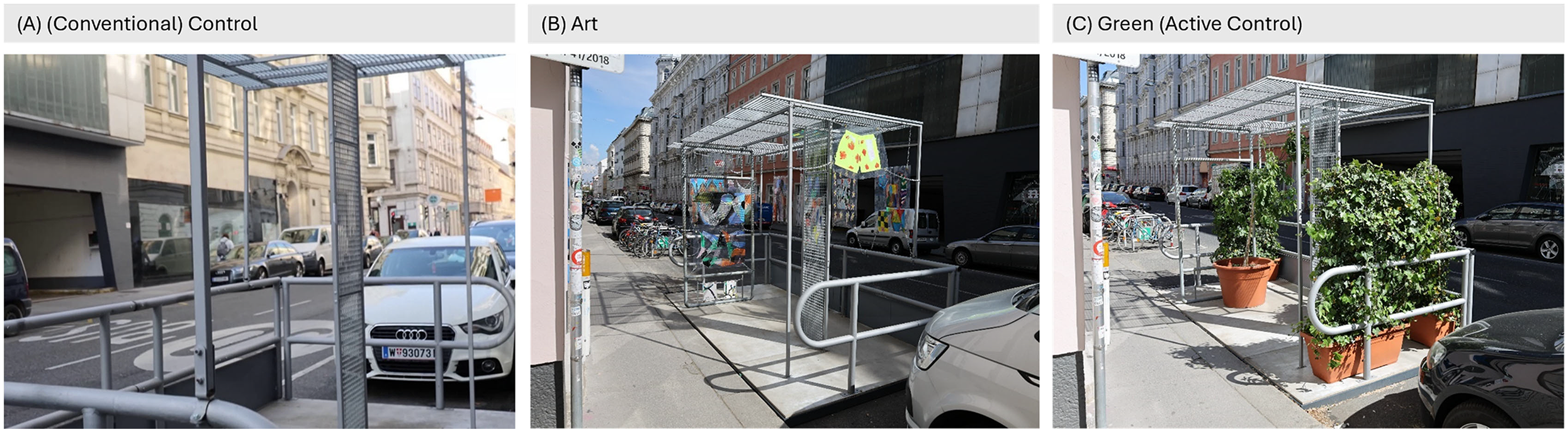
The three variations of the street intervention, giving rise to the three different conditions.
Dependent Variables
Experienced wellbeing measures, personal trait measures, and subjective evaluations of the video were chosen in line with Mikuni et al. (2024). These measures were frequently used in past related research (e.g., Trupp et al., 2022, 2023), allowing us to compare our results more easily with those of other studies. Experienced wellbeing measures were the main variables. Personal trait measures and subjective evaluations were secondary variables.
Experienced Wellbeing Measures: Anxiety, Stress, Positive and Negative Mood States
To measure the experienced wellbeing, we used the State-Trait Anxiety Inventory (STAI-S: German version from Grimm, 2009; adapted from Spielberger et al., 1999), momentary stress scale, and Positive and Negative Affect Schedule (PANAS: German version from Krohne et al., 1996).
The STAI-S assesses individuals’ perceived anxiety levels using 20 items rated on a four-point Likert scale, from 1 (not at all) to 4 (very much so). Momentary stress levels were measured using a sliding Visual Analog Scale (VAS), ranging from 0 (not at all) to 100 (completely). The PANAS evaluates affective mood states through 20 items on a five-point Likert scale from 1 (not at all) to 5 (extremely). These items are divided into two dimensions: ten positive and ten negative mood states.
Personal Trait Measures: General Stress Level, Art Interest/Knowledge, Nature Orientedness
We assessed participants’ overall stress levels in the preceding month using the Perceived Stress Scale (PSS: Cohen et al., 1994), their general interest in art through The Vienna Art Interest and Art Knowledge (VAIAK: Specker et al., 2020) and their connection to nature using the short form of the Nature Relatedness Scale (NR-6: Nisbet & Zelenski, 2013). The PSS scale has ten items, evaluated on a five-point Likert scale, from 0 (never) to 4 (very often). We used both the knowledge and interest scales of the VAIAK. Both scales are respectively composed of 26 and 11 items. The art interest scale is rated on a seven-point Likert scale, from 1 (not at all or less than once a year) to 7 (very much or once a week or more often). Art knowledge is evaluated by correctly answering questions about iconography, techniques, the name of the artist, and the style of the artwork. The NR-6 scale has six items, evaluated on a five-point Likert scale, from 1 (strongly disagree) to 5 (strongly agree). We note that the German version of the VAIAK was used in the present study, while PSS and NR-6 do not have German versions. Hence, those scales were translated by authors who are native German speakers and double-checked among them. Those personal traits were used in the analyses either as a control variable, e.g., assessing the wellbeing outcome considering the general stress level in the past month, or the relation to the degree of wellbeing outcome, e.g., when a person is more interested in art, we expected a more substantial wellbeing effect of the video showing the intervention with the Art decoration.
Subjective Experiences: General Evaluations of the Testing Location, Intervention and Quality of the Video
To understand the subjective experience (i.e., the evaluations of the video stimuli, the intervention presented in the video, and the location) we asked the participants to answer statements/questionnaires. All the statements/questionnaire were measured with a 7-point Likert scale (1: “not at all”, 7: “very much so/completely” for the statements and 0: “not at all”, 6: “very” for the questionnaire about preceived restoration) and were asked after each interaction with a video stimulus. Overall, the general evaluations aim to examine how the participants experienced and perceived the urban environment under different conditions. Such inquiries help us to address further how the experiences and appraisals of the video stimuli are related to the impacts on wellbeing.
Procedure
Upon arrival in the laboratory, we provided general information about the experiment, e.g., the study has three slots on different days, the total duration of each visit. After this, participants signed the informed consent sheet. During the experiment, they sat on a chair approximately 80 cm from the screen. Participants used the mouse and keyboard to provide their answers. Experiment programs were created using Labvanced (Finger et al., 2016) or Qualtrics (Qualtrics, Provo, UT). Qualtrics was used additionally as the valid license of Labvanced expired during our data collection.
After inputting their demographic information, i.e., gender and age, they completed the wellbeing questionnaires, measuring anxiety, stress, and affective mood (positive/negative). Then, they moved on to the video-watching phase. Before the video was presented on the screen, the following instruction was given: “The video shows the perspective of a pedestrian walking along a city street. Please imagine that YOU are the pedestrian and are taking this walk yourself.” They were told not to touch the mouse or keyboard while watching the video clip. After the video was finished, they answered the same wellbeing questionnaires again. Hence, the wellbeing questionnaires were asked twice, before and after watching the video. The presentation order of the video clips was counterbalanced across participants. Furthermore, for both experienced wellbeing measures, the order of the questionnaires was randomised.
After completing the wellbeing measurement, we asked the participants to rate the video's content perceived restorativeness (PRS) and give their evaluation on their general experience and the street intervention. At the end of each session, we checked the next appointment with the participants.
Personal trait measures, i.e., general stress level (PSS), art interest/knowledge, and nature-orientedness, were measured only once at the end of their third and last session. After completing the last questionnaire during the third session, participants were debriefed on the purpose of the study.
Results
Data and code are available on the OSF platform (see the “Data” and “Analysis code” folders, https://osf.io/8xhng/?view_only=6583929aae714cc193f3466f99230ada). Note that the code included assumption checks and analyses. All analyses reported below were performed with R Studio (R Core Team, 2017). Before the main analysis, we checked if the perceived video quality was different across the three conditions, as this could influence the main results. The mean scores of the statement “The quality of the video was good” were 4.53 (SD = 1.47, 95% CI [4.20, 4.86]) in the Control condition, 4.72 (SD = 1.41, 95% CI [4.40, 5.04]) in the Art condition, and 4.71 (SD = 1.43, 95% CI [4.39, 5.03]) in the Green condition, respectively. Considering the mean values and the corresponding 95% confidence intervals, we concluded that participants evaluated the video quality as similarly moderate across all three conditions and that there was no difference in the mean scores across the three conditions.
Further, we computed the descriptive statistics for the subjective experiences (see Table 1). This assessment serves as a manipulation check to see whether participants notice any differences among the three videos and whether they experienced Art and Green conditions differently than the Control condition. The data on the perceived restorativeness of the testing place (PRS), the general experience of the video, and the evaluation of the intervention are presented to understand how different types of street interventions could affect these subjective evaluations. The data shown in Table 1 generally suggests that participants rated the Control condition as the least restorative, resulting in the lowest scores in terms of the general walk experience and evaluation of the intervention itself, followed by Art and then Green conditions. The confidence intervals in the descriptive statistics clearly show that, except for the Duration of the video, there are significant differences between the Control and Art/Green conditions. At the same time, there are no significant differences between the Art and Green conditions. This result shows that both artistic and green decorations in the intervention positively influenced the walking experience and the evaluation of the interventions, and there is a clear difference between Art and Green conditions on the one hand and the Control condition on the other hand.
1.
Descriptive Statistics for the Subjective Experiences: Perceived Restorativeness of the Place (PRS), General Experience of the Video (Enjoyment, Meaningfulness, Duration), and Evaluation Towards the Intervention (Liking, Beauty, Meaningfulness) Across Condition (Control, Art, and Green).
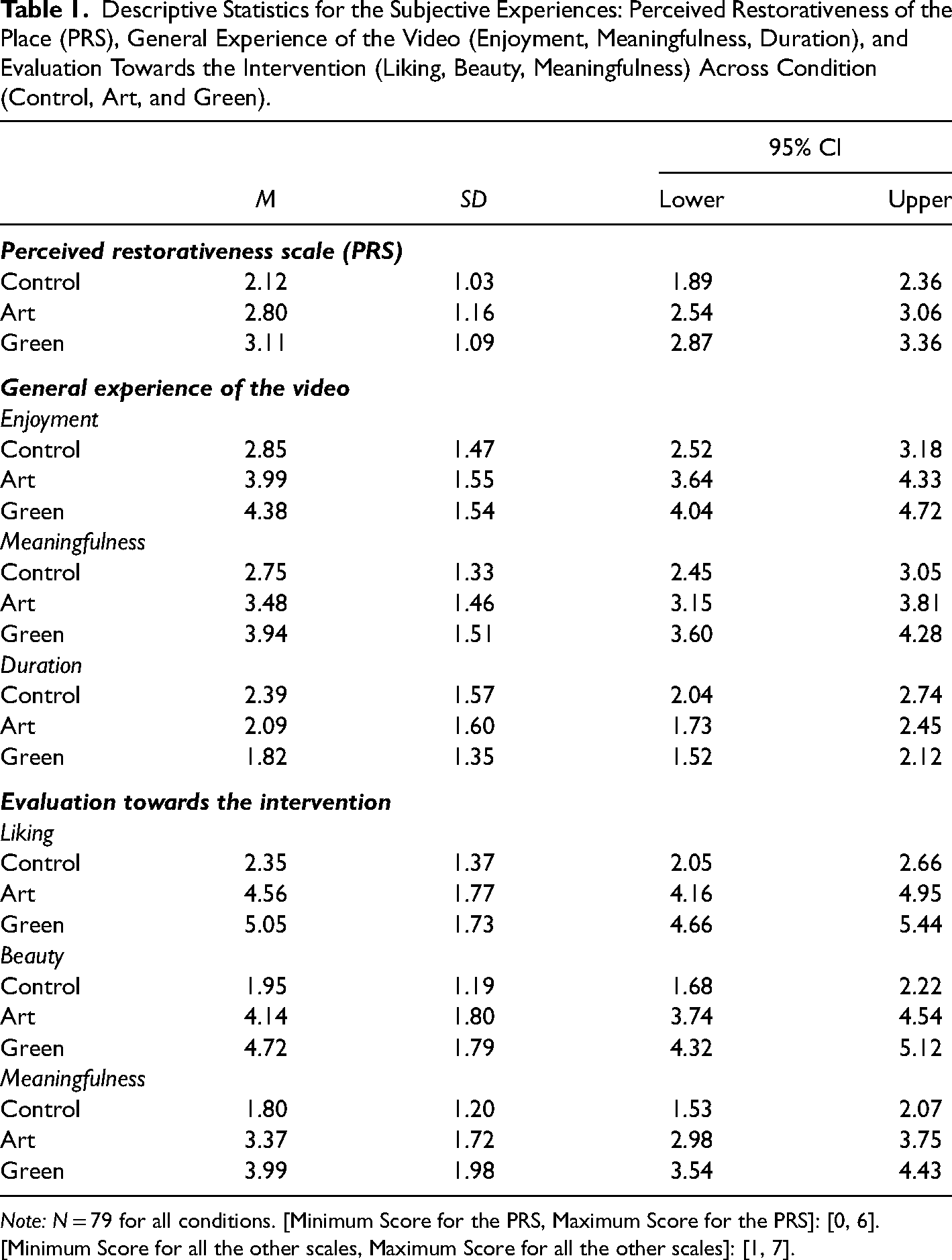
Note: N = 79 for all conditions. [Minimum Score for the PRS, Maximum Score for the PRS]: [0, 6].
[Minimum Score for all the other scales, Maximum Score for all the other scales]: [1, 7].
Descriptive statistics for all experienced wellbeing measures across Time (pre, post) and Condition (Control, Art, and Green) are shown in Table 2.
2.
Descriptive Statistics for Anxiety (STAI), Stress (Momentary Stress Scale), Positive Mood (PANAS) and Negative Mood (PANAS) Across Time (pre, Post) and Condition (Control, Art, and Green).
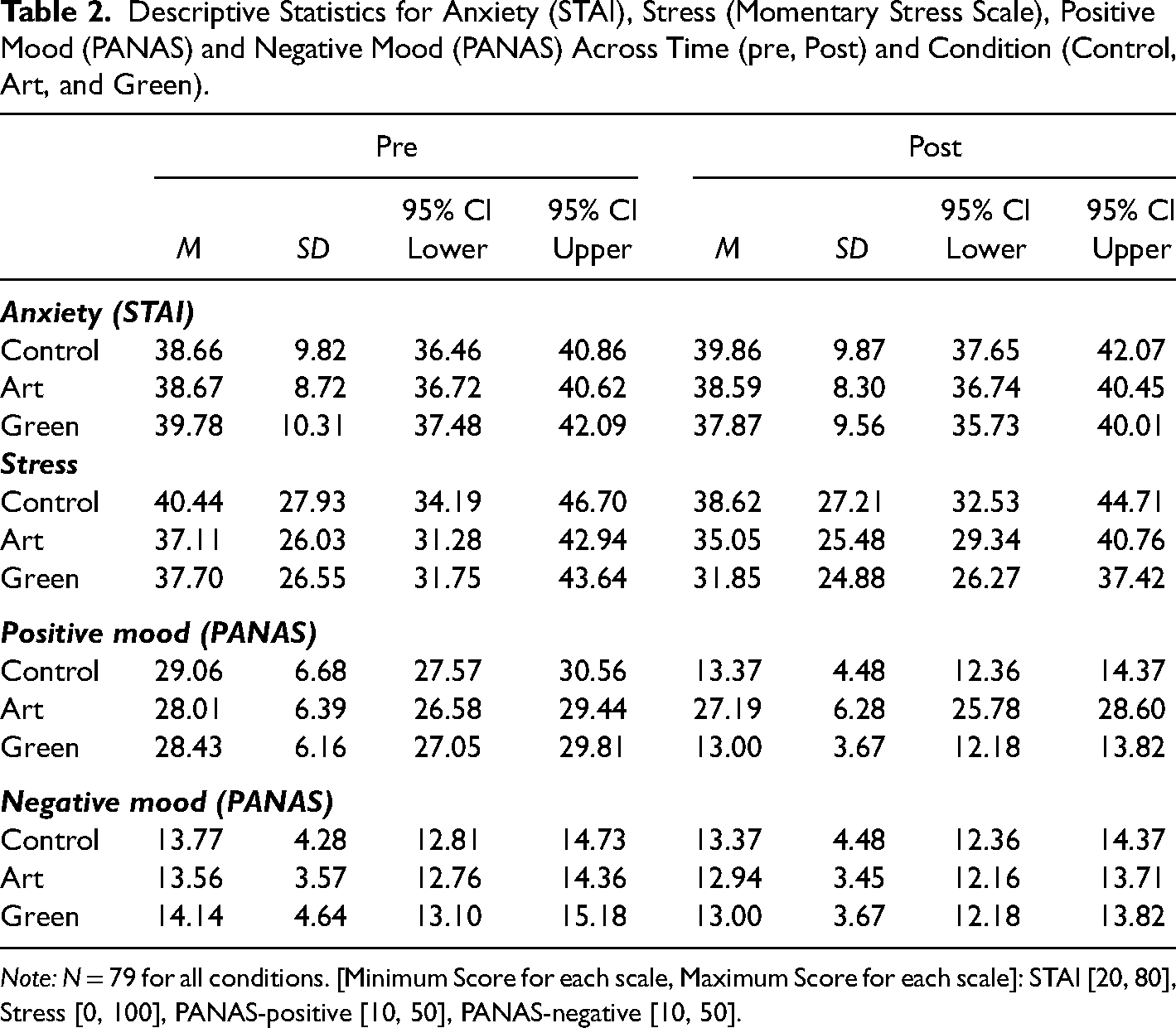
Note: N = 79 for all conditions. [Minimum Score for each scale, Maximum Score for each scale]: STAI [20, 80], Stress [0, 100], PANAS-positive [10, 50], PANAS-negative [10, 50].
To assess the effect of Time and Condition on experienced wellbeing scores, we conducted a two-way repeated-measures multivariate analysis of covariance (MANCOVA). In the analysis, three independent variables (IVs) were set: Time (pre vs. post, within-participant factor), Condition (Control vs. Art vs. Green, within-participant factor) and the interaction between Time and Condition. State anxiety score (STAI-S), momentary stress level (VAS), positive mood (PANAS), and negative mood (PANAS) were set as the dependent variables (DVs). Additionally, the PSS was included as a covariate to consider inter-individual differences in terms of wellbeing outcome based on the general stress level. For example, people who are generally more stressed can benefit more from the intervention regardless of the intervention types. Before running the model, the assumption checks for MANCOVA were performed (see the R code on the OSF project folder). We note that PSS, NR-6, and VAIAK scores from 12 participants were missing due to recording issues. The main wellbeing measures were recorded correctly and were included in the MANCOVA analysis. For those participants whose PSS scores were missing, the PSS scores in the MANOVA were treated as missing values (nMANOVA = 67).
The result of the MANCOVA is shown in the upper part of Table 3. The general result of MANCOVA showed significant main effects for Time and Condition and a significant interaction between Time and Condition (all p-values < .001, all Wilks's lambda ≥ .45). To further unpack these effects, we performed a series of repeated measures analysis of covariance (ANCOVAs) with the same structure as the MANCOVA separately for each experienced wellbeing measure (see the lower parts of Table 3). The results of the ANCOVAs showed that, for anxiety and stress, none of the parameters showed significant results. Hence, neither score changed significantly between pre and post measurements, and the same trend was found across all conditions.
MANCOVA and ANCOVA Statistics for Each Measurement of Experienced Wellbeing Using PSS as a Covariate.
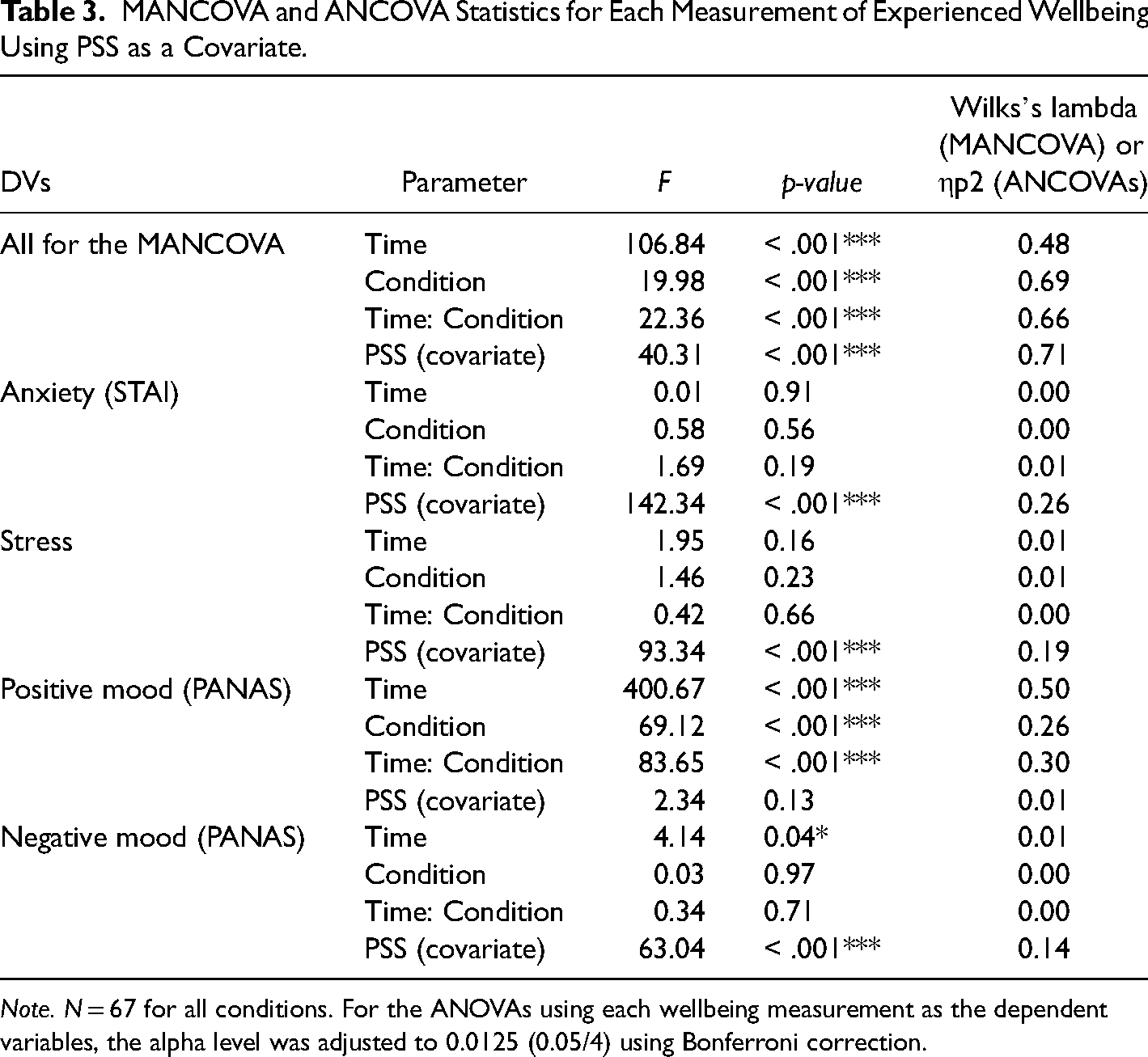
Note. N = 67 for all conditions. For the ANOVAs using each wellbeing measurement as the dependent variables, the alpha level was adjusted to 0.0125 (0.05/4) using Bonferroni correction.
However, for the positive mood (PANAS), the results showed significant main effects of Time and Condition and the interaction between the two factors (see Table 3). As the interaction between the two factors was significant, we performed post-hoc tests to interpret the interaction direction. Detailed information on the post-hoc test can be found in Supplementary Material, Table S1. Overall, in the Control and Green conditions, the results showed a significant main effect of Time (Control: EMMdelta = −16.28, tratio = −17.00, p < .001, Green: EMMdelta = -15.97, tratio = −16.67, p < .001). As shown in the descriptive statistics (Table 2 and Figure 2), the positive mood significantly decreased after interacting with the video in both conditions. On the other hand, in the Art condition, there was no main effect of Time (EMMdelta = −0.96, tratio = −1.00, p = .92). The significant interaction indicates that the positive mood decreased in the Control and Green conditions. In contrast, the scores in the Art condition remained unchanged.
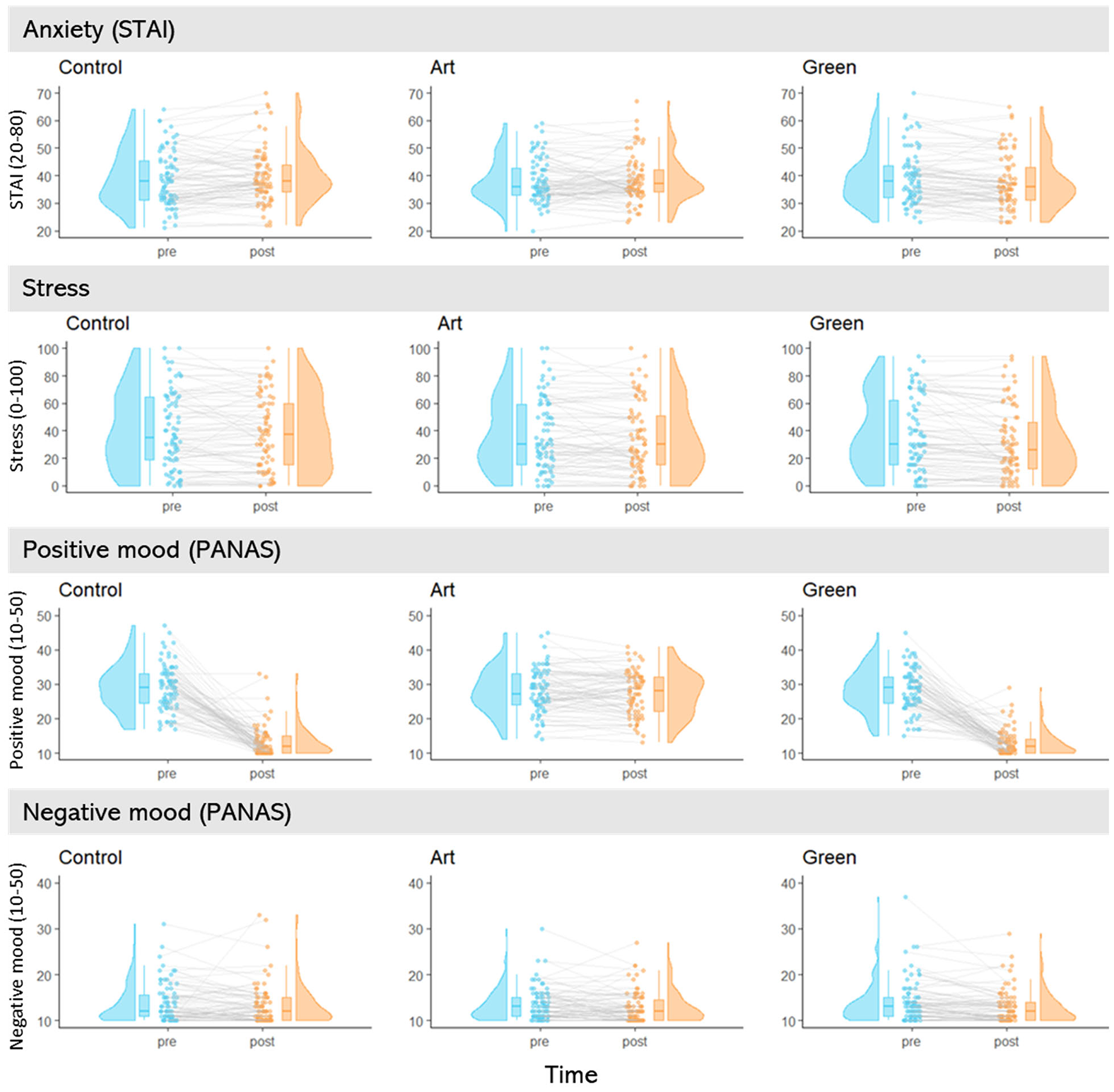
Raincloud plots of subjective wellbeing measurements.
The results for negative mood showed a significant main effect of Time (see Table 3). Together with the descriptive statistics (Table 2 and Figure 2), the score of negative mood decreased across all conditions. Nevertheless, after adjusting the alpha level, this effect disappeared. Seeing the descriptive statistics, reported negative mood scores seem quite low before interacting with the videos, considering the possible lowest score is 10. Hence, it might be possible that our results hit a floor effect.
We note that, for anxiety, momentary stress, and negative mood scores, PSS as a covariate showed significant influence (see Table 3). The results showed that the higher the PSS scores, the higher the above wellbeing measures. Hence, when people have been generally stressed in the past month, they are also anxious, stressed, and in a negative mood at the time of the experiment. Figure S1 in the Supplementary Material visually represents these relationships between experienced wellbeing measured and PSS scores.
3.
Our previous analysis section showed that positive mood decreased after interacting with the video in the Control and Green conditions, whereas there was no change in positive mood in the Art condition. As noted above, 12 participants were missing the PSS scores for their covariate. In this section, we aim to confirm our above findings with different statistical models to supplement our findings.
Specifically, we used a one-way repeated measures analysis of covariance (ANCOVA) for each wellbeing measure. Contrary to the previous series of ANCOVAs, the present analyses had the following structure. The scores acquired during the post-measurement time for each of the four experienced wellbeing measures were set as the DVs. The Condition (Control vs. Art vs. Green, within-participant factor) was set as the IV (the Time factor could not be added in the call formula as the post scores were the DVs). The scores acquired during the pre-measurement time for each of the four experienced wellbeing measures were set as covariates (the PRS scores were not entered in the formula call). The covariates were included to control for baseline differences in each wellbeing measure and assess the effect of Condition.
The results of the ANCOVAs are shown in Table 4. The results of ANCOVAs showed that, for anxiety and negative mood, there was no significant impact of Condition. Hence, after adjusting the post-measurement scores to determine the influence of the pre-measurement scores, there were no differences in the means of post-measurement scores across the three conditions. These results agree with the ones reported in Table 3.
ANCOVA Statistics for Each Measurement of Experienced Wellbeing Using pre-Measurement Score as a Covariate.
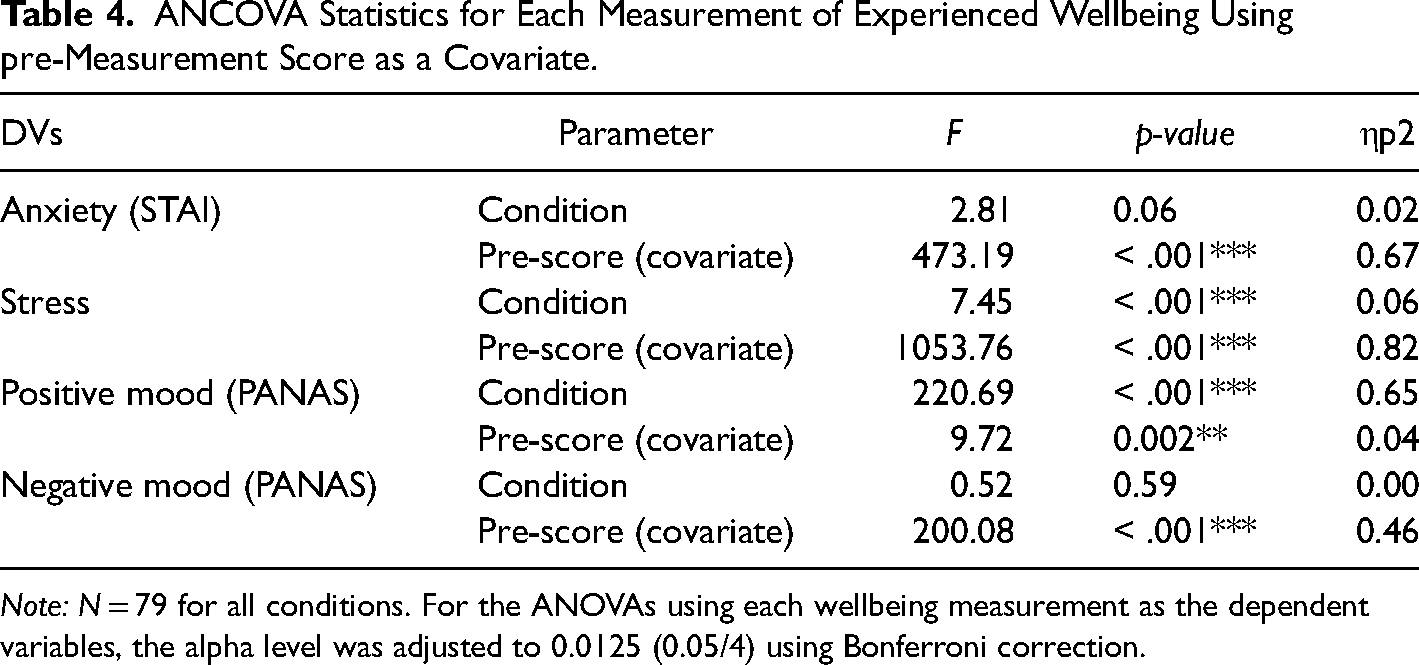
Note: N = 79 for all conditions. For the ANOVAs using each wellbeing measurement as the dependent variables, the alpha level was adjusted to 0.0125 (0.05/4) using Bonferroni correction.
For the positive mood (PANAS), the result showed a significant main effect of Condition. As with the previous section, we performed a post-hoc test to unpack the results further. The post-hoc analysis using Tukey method detected significant differences in the means of post-measurement positive mood scores between the Control/Green and Art conditions (Control vs. Art: EMMdelta = 13.98, tratio = 18.12, p < .001, Green vs. Art: EMMdelta = 14.25, tratio = 18.51, p < .001), while there was no difference between Green and Control conditions (Control vs. Green: EMMdelta = 0.27, tratio = 0.35, p = .93). This result is in line with our finding in the previous section.
Interestingly, this additional analysis detected a significant main effect of Condition for momentary stress, too. The post-hoc analysis with the same methods detected a significant difference between the Control and Green conditions (Control vs. Green: EMMdelta = 4.38, tratio = 2.49, p = .04), while there was no difference between Control/Green and Art conditions (Control vs. Art: EMMdelta = -0.67, tratio = -0.38, p = .92, Green vs. Art: EMMdelta = 3.71, tratio = 2.11, p = .09). Seeing the descriptive statistics (Table 2 and Figure 2), the post-measurement score in the Green condition was significantly lower than the one in the Control condition.
4.
As an exploratory analysis, we investigated how subjective experiences and personal traits are related to experienced wellbeing outcomes. This analysis, therefore, enables us to answer questions such as: Do people show a more significant improvement when they evaluated the testing place/interventions more positively? Do people more interested in art evaluate the art intervention more positively, resulting in a more substantial improvement in wellbeing scores? To this aim, Spearman's rank correlation scores were calculated separately for each condition between the improvement in experienced wellbeing measures (i.e., anxiety, momentary stress, negative/positive mood), and the subjective experiences (PRS, General experience of the video, Evaluation towards the intervention), and personal trait measures (PSS, VAIAK, and NR-6). We note that improvements in experienced wellbeing measures were calculated by subtracting the pre-values from post-values for the negative aspects of wellbeing (i.e., anxiety, momentary stress, negative mood). For positive mood, the post-values were subtracted from the pre-values. In this way, when the improvement scores were bigger than 0, this always implies that negative/positive aspects of wellbeing were improved.
Figure 3 shows the correlation matrix. A Bonferroni-adjusted alpha level of p = .00021 (equivalent to p = .05 divided by 234 correlation tests for three conditions – 78 tests for each matrix, multiplied by three conditions) was applied to control for multiple comparisons. In general, across all three conditions, the improvements in negative wellbeing measures (especially anxiety with stress and negative mood) were positively correlated. Participants who showed greater improvements in anxiety also showed greater improvements in stress and negative mood. Further, subjective experience measures were also positively correlated in all conditions, with more correlations in the Art and Green conditions. Interestingly, regarding the correlation between wellbeing outcomes and subjective experiences, the results show no correlations in the Control and Green conditions. However, the results were different for the Art condition. Specifically, in the Art condition, people who enjoyed the video more and who found the testing place more restorative (PRS) showed more significant improvement in anxiety. The positive mood improvement was also correlated with the PRS score. The personal trait measures did not correlate significantly with any other variable.
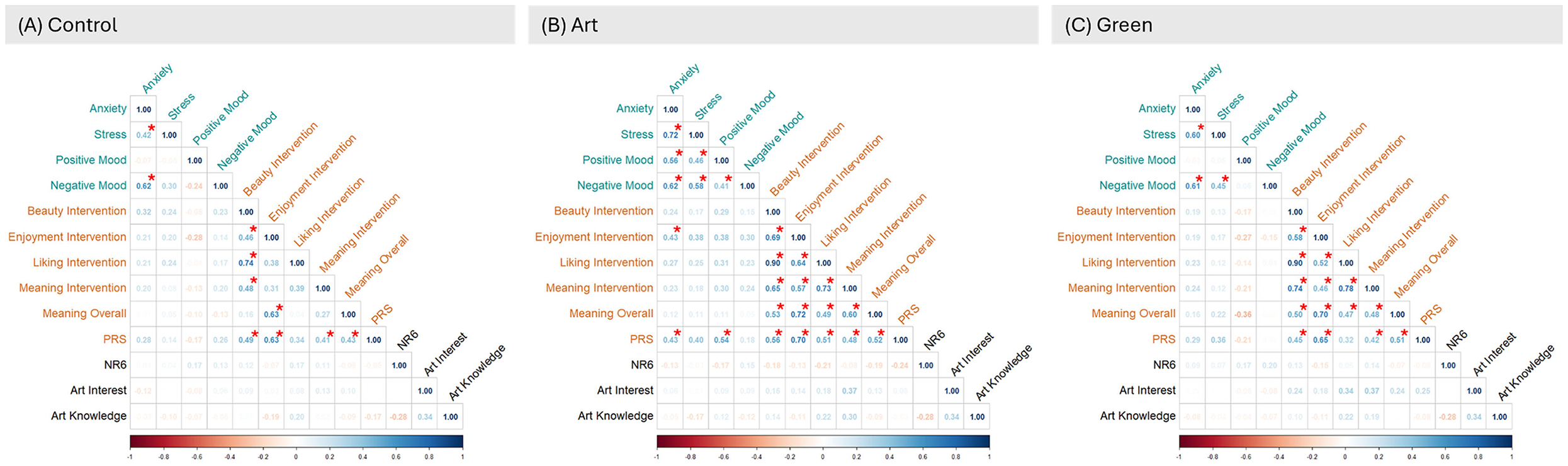
Correlation plots for experienced wellbeing improvements and other measurements.
Discussion
The present study addressed the following research questions: (RQ1) Do the Art and Green conditions show a positive impact on experienced wellbeing, compared to the Control condition? (RQ2) If positive effects on wellbeing in both the Art and Green conditions are present, are the effects similar, or are they more pronounced in one condition? We addressed these questions by comparing the experienced wellbeing scores of the participants before and after interacting with video stimuli, displaying three types of street interventions (Art, Green, and Control conditions) in a controlled and standardised laboratory setting. In an exploratory analysis, we also examined how the art and green decorations in the street interventions impact the subjective experiences of the location and the street interventions and their relationship with wellbeing outcomes.
For the first research question, which focused on comparing the Art/Green vs. Control conditions, we expected no (or significantly smaller) differences in the metrics between before and after the video interaction in the Control condition compared to the Art and Green conditions. For the second research question, more focused on the Art vs. Green comparison, we expected (1) a reduction of stress, negative mood and anxiety in both Art and Green conditions; (2) no increase of positive mood in either the Art or the Green condition; (3) no significant differences between the Art and Green conditions in any measure of experienced wellbeing (i.e., stress, negative mood, anxiety, and positive mood). In general, the present data did not support our expectations. Indeed, regardless of the condition, wellbeing measures did not improve after interacting with the video stimuli (see ANCOVAs and ANOVAs using each wellbeing scale as DVs). Present results mainly show that the positive mood decreased in the Control and Green conditions after interacting with the video. We note that our secondary analysis with ANCOVA using pre-measurement score did show a more significant decrease in stress score only in the Green condition compared to the Control condition. Nonetheless, the difference is minor, and there were no such trends in the other measures.
Overall, our study using videos displaying art, green, and control intervention showed that interacting with video did not improve the experienced wellbeing states, regardless of the intervention types presented. The primary question that needs to be answered here is, contrary to Mikuni et al. (2024), why was no improvement in wellbeing states observed (especially for the negative markers of wellbeing)? In the following sections, we first elaborate on several potential reasons why present results were obtained. We argue that one set of reasons is linked to the methodological nature of the investigation (Laboratory vs. Field). Another set of reasons is linked to the dosage of agents that are thought to improve wellbeing (art and greenery). We then further discuss the interesting results that were obtained regarding the Art condition and the potential of art as a channel for passers-by's interest.
Laboratory vs. Field Studies
In trying to explain why our results differ so much from those of Mikuni et al. (2024), we first hypothesised that their findings might reflect participants’ straightforward enjoyment of taking part in a field experiment. Considering their study was conducted right after the COVID-19 lockdown, it might explain why participants experienced the on-site experiments even more positively. There is a notable difference between the subjective experiences reported by the participants in the present study and those by Mikuni et al. (2024). In Mikuni et al. (2024), the average enjoyment score of the walk was 5.03 across conditions. In contrast, the average enjoyment scores in the present study were 2.85, 3.99, and 4.38 for Control, Art, and Green conditions, respectively (see Table 1). Hence, participants in the field-based experiment enjoyed the experience more positively, which might result in no improvement in wellbeing scores in the present study, especially when past evidence consistently highlights a link between pleasurable experiences and positive wellbeing impacts (see Mastandrea et al., 2019; Meidenbauer et al., 2020; Trupp et al., 2024, for examples).
On the other hand, the experience of a simulated walk in the laboratory might not have been effective in improving wellbeing. Although we postulated that the experiences and outcomes, we derive from field experiments and laboratory studies might be similar, this might not be the case in our specific testing situation. For example, studies where researchers tested the effect of greenery on wellbeing typically presented photographs or videos of urban parks/forests (e.g., Hartig & Staats, 2006; Mayer et al., 2008; Staats & Hartig, 2004), possibly leading to a more immersive and intense experience due to the density of the natural elements present on the pictures. Similarly, the stimuli presented to the participants in the present laboratory study might have needed to be more salient. In the video stimuli, the interventions were relatively small on the screen compared to the field experiment, and they were only visible for half of the video's duration. To further study the impact of art on wellbeing in a laboratory setting, one can consider trying different ways of presenting the stimuli, i.e., having the decorations displayed in a manner more suited to laboratory environment.
Additionally, in the current study, the portrayal of art and greenery did not merely reproduce the streets but aimed to replicate the view of a pedestrian walking down the street. This method was implemented to make the stimulus as similar as possible to the experience in the field experiment (see Gregorians et al., 2022 which also highlights this specific point). However, certain differences persist. For instance, while participants were free to walk around in the field environment, they were passively watching a video in the laboratory. They had no control over what they could explore. This lack of control may have been seen as a negative aspect, potentially reducing the overall pleasantness of the experience and further impacting wellbeing outcomes.
Moreover, in a world where interacting with videos is practised and consumed daily through any digital (social) media, one could argue that the participant's expectations of a realistic filmed environment were probably very high. This point is especially relevant as our sample was composed of relatively young university students (Mage = 23.16, SDage = 5.89) and Western individuals who are known to use social media more frequently – in an American sample of internet users, the highest level of social media use was found among users that were between 18 and 24 years old (Chou et al., 2009). Nonetheless, the videos of the present study might not be very engaging, influential, or relevant to the participants. Given our methodological limitations, we did our best to create videos that were as entertaining as possible. However, our results suggest that it is essential to consider, especially in a laboratory setting, the logical and feasible ways to create stimuli which provide a “close-to-real-life” experience.
If the field and laboratory study results are incomparable, methodological considerations must be revisited. Field experiments are becoming increasingly popular in art and aesthetic research. In addition, follow-up laboratory experiments are popular to validate/complement the findings of field experiments (e.g., Chana et al., 2023; Estrada-Gonzalez et al., 2020; Mitschke et al., 2017). In field environments, numerous environmental factors cannot be controlled. In contrast, laboratory studies allow for greater control of environmental factors, reducing the noise in the data. However, our results indicate that, the experience of participating in a field or laboratory experiment might be fundamentally different, especially when investigating the impact of specific elements in public space.
To further understand the differences between laboratory and field studies, we first need more systematic comparisons of the experiences between field environments and laboratory settings. For example, one could suggest replicating the Mikuni et al. (2024) field study by implementing a conventional Control condition in the field environments and precisely instructing participants to interact with the interventions. Replication of the present laboratory study in the field would allow a direct comparison and would clarify if the effect of art and greenery is unique or dependent on the way it is presented (Laboratory vs. Field). Second, we need more studies using different settings in urban environments with different stimuli. This suggestion would be relatively easy to implement in laboratory studies. Indeed, it is easier to show more variety in one condition in the laboratory than in the field, where the change of condition often implies heavy logistics. Having different types of greenery and artwork would strengthen the design and the conclusions that could be derived about greenery and art's effects on wellbeing. Finally, we would also suggest future studies incorporating immersive virtual reality (VR) as a middle ground between the laboratory and field settings (see Mostajeran et al., 2021 for an example where photos were compared to 360°videos). The use of VR combines the advantages of a controlled environment of laboratory settings whilst allowing participants to have a more immersive experience and more control in which way they navigate/interact with the environment in a similar way to that of a natural field study, e.g., having the possibility to make a close inspection of the locations and stimuli (Newman et al., 2022). Overall, we conclude that the visual experience is not isolated but affected by the behavior it is embedded in. The pedestrian perspective might lead to a loss of control in the participants, which overrides potential positive effects of the visual impression.
The Dosage of Art and Green
To better understand the effect of urban interventions, one could also reflect on the dose of agents – thought to improve wellbeing (art and greenery in our case) – needed to impact wellbeing. Cox et al. (2017) worked on the notion of dose-response to natural elements to determine the minimum and optimal dose recommendations to nature. Their dose-response framework has three main components: the intensity, the frequency, and the duration of the dose. In the present study, participants only had one engagement with the interventions equipped with art and greenery (low frequency) and for only one minute (relatively low duration). When looking at Mikuni et al. (2024), the frequency was still only one exposure, but the duration was five minutes. Their results regarding the wellbeing outcomes differed from those obtained in the present study. One of the many reasons could be that the participants from Mikuni et al. (2024) had more time to interact with the environment where the interventions were placed and hence potentially interact with the art and greenery elements. Upon reviewing evidence from the art and green literature, the frequencies of exposure were similar to the one we had our participant experience (one-time exposure). However, the durations were longer than a minute. For example, Clow & Fredhoi (2006) and Stigsdotter et al. (2017) had their participants interact with artworks for 35 min in a gallery exhibition area and with greenery for 15 min in a forest. Note that both the gallery exhibition area and the forest represent different levels of intensity of art and greenery, which also explains why the results of the present study were so different from the ones traditionally found in past literature. All in all, we recommend that future projects try to implement this dose-response approach to art and greenery framed as urban interventions to determine more precisely what optimal doses of art and greenery are needed in the interventions.
Art in the City: A Potent Element to Further Investigate
Interestingly, our results suggested that the Art condition showed a unique trend. First, while the positive mood decreased after watching the video in the Green and Control conditions, it did not show any change in the Art condition. Second, in our exploratory analysis, we found positive correlations between subjective experience of the video (i.e., enjoyment of the intervention and PRS) and wellbeing outcomes (i.e., anxiety and positive mood) only in the Art condition. As the results of the subjective experiences (see Table 1) consistently showed no differences in any general evaluation scores between the Art and Green conditions, the unique trend in the Art condition could not be accounted for by the subjective experiences themselves. One possible explanation might stem from the uniqueness of the artworks in terms of their presence and type in urban street contexts. Indeed, nowadays, it is becoming common to see green and natural elements in cities. Also, (hu)man-made structures made of metal pieces are prevalent in public spaces. However, seeing hung artworks in the middle of a street would be quite a novel experience, which might create a sense of surprise or unusualness. This is particularly interesting, knowing that the novelty effect induced by some types of experiences (e.g., having a holiday) is a factor indirectly influencing subjective wellbeing (Drewery et al., 2016). Further, the art stimuli in the intervention were quite abstract, which can trigger a sense of meaning-making (e.g., Pelowski et al., 2017). This uniqueness of the Art condition might have made the participants wonder and think about the situation, e.g., What is this place? What do the artworks represent? What is depicted? Engaging with the visual environment in such a manner can be stimulating, possibly preventing the decrease in positive mood observed in the other two conditions (see Table 2 and Figure 2). For future studies, it would be interesting to investigate settings where people expect to see art in public spaces (e.g., a statue in the middle of a square or specific spots known for their street art murals). Moreover, this study included only one set of artworks, which were quite abstract and were made by one group of artists. Hence, as previously mentioned, future studies need to use different genres, styles, and contents of artworks to delve into the impact of artistic elements in urban environments.
Conclusion
The present study mainly indicates a unique pattern for the video presenting artistic elements compared to the Green and Control videos. It also reveals substantially different results from the field study by Mikuni et al. (2024). Additionally, even though our hypotheses were not supported, the present laboratory study provides meaningful insights into understanding the impact of artistic elements in an urban environment on wellbeing and possible differences in experiences between field and laboratory experiments. Researchers should use such evidence to design future experiments in terms of how to present the stimuli (e.g., the use of VR) and what to consider as stimuli (stronger focus on art, as our results suggest). The results of this study also call for more collaborations between research and practitioners to conduct more laboratory and (even more) field studies. Indeed, if one wants to learn more about what happens in real life (what practitioners are mainly interested in), performing field experiments is essential, as laboratory findings might not translate. Nevertheless, the present results also highlight the importance of combining field studies with more controlled laboratory studies as they provide complementary types of evidence. Integrating the insights stemming from different methodological approaches (1) is essential to understanding complex phenomena like the experience of urban environments and (2) might be interesting to practitioners who are designing our future cities in collaboration with scientific advisory committees. Indeed, they could further explore these multi-methodological approaches – from seeing the pictures in a laboratory setting to experiencing the space in a controlled environment with VR to having the real-life effects with a field study – with the concept of parking-lot-sized built intervention, as they are flexible and relatively easy to manipulate. Having these explorations at the early stages of project conception would be especially helpful in being more efficient in the choice of designs as they provide strong evidence for the efficacy in fostering wellbeing.
Supplemental Material
sj-doc-1-art-10.1177_02762374241298878 - Supplemental material for The Impact of Urban art on Wellbeing: A Laboratory Study
Supplemental material, sj-doc-1-art-10.1177_02762374241298878 for The Impact of Urban art on Wellbeing: A Laboratory Study by Margot Dehove, Jan Mikuni, Nikita Podolin, Helmut Leder and Elisabeth Oberzaucher in Empirical Studies of the Arts
Footnotes
Acknowledgments
The authors would like to thank Christian Valuch for the creation of the video stimuli; as well as the artists Niklas Worisch, Frank Maria Furtschegger and Martijn Straatmann, for designing and building the interventions.
Declaration of Conflicting Interests
The authors declared no potential conflicts of interest with respect to the research, authorship, and/or publication of this article.
Funding
The authors disclosed receipt of the following financial support for the research, authorship, and/or publication of this article:The data collection and writing in this project were supported by the Vienna Science and Technology Fund (WWTF) [10.47379/ESR20034].

Supplemental Material
Supplemental material for this article is available online.
Notes
Author Biographies
References
Supplementary Material
Please find the following supplemental material available below.
For Open Access articles published under a Creative Commons License, all supplemental material carries the same license as the article it is associated with.
For non-Open Access articles published, all supplemental material carries a non-exclusive license, and permission requests for re-use of supplemental material or any part of supplemental material shall be sent directly to the copyright owner as specified in the copyright notice associated with the article.
