




Abstract
Given the current unprecedented multiple pandemics of COVID-19, anti-Black and anti-Asian violence, and white supremacy, we—a group of graduate students and a faculty member who hold diverse identities across disciplines, race, gender, nationality, and additional categories—came together to focus on qualitative research as an ontological, epistemological, and axiological space toward community and culture change. Specifically, we took up scholarly personal narrative, which centers postmodernism and focuses on the reality that “we see what we believe; we observe what we narrate; we transform what we reframe.” What emerged were radical interrelated understandings of privilege, guilt, and the importance of kinship. As such, this vulnerable group reflected on graduate student experiences with multiple pandemics and how the academy may enact transformative change, reframing our own understandings of qualitative space.
“Our goal is not to use differences to separate us from others, but neither is it to gloss over those differences . . . To bridge is an act of will, an act of love, an attempt toward compassion and reconciliation, and a promise to be present with the pain of others without losing themselves in it.”
The Historical Present in Context
The multiple pandemics of COVID-19, systemic anti-Black racism, and anti-Asian violence have laid bare inequities in American society that have existed since the country’s inception (Ahmed et al., 2020; Booker et al., 2020; Wang, 2020). U.S. higher education likewise has begun to reckon with the rampant injustices faced by low-income students, students of color, LGBTQ+ (lesbian, gay, bisexual, transgender, and queer or questioning) students, and other minoritized communities as a result of these multiple pandemics (Gonzales et al., 2020; Harper, 2020; Lederer et al., 2020), although these injustices also have a long history of being interwoven into the very fabric of hegemonic colleges and universities (Stewart, 2020; Wilder, 2013). Although institutions have made efforts to mandate anti-bias training, hire and retain faculty of color, and prioritize student safety and well-being (Bartlett, 2021; Fischer, 2021), these efforts have been critiqued by some for their performative nature (Cole, 2020; Diep, 2021; Flaherty, 2021). The impact of multiple pandemics continues to exacerbate these historical inequities (Carlson et al., 2021; Denzin & Giardina, 2021; Murakami, 2020; Skinner et al., 2021).
While navigating these multiple pandemics, graduate students often juggle multiple roles such as parents, professionals, and teaching assistants in addition to their roles as students (Bal et al., 2020). Graduate students from minoritized communities in particular face barriers to their success in the form of microaggressions, isolation, and a lack of effective mentorship (Brunsma et al., 2017), and these challenges may be exacerbated as a result of multiple pandemics. It is especially critical for institutions to create space for minoritized graduate student research given higher education’s purported commitment to graduate students (O’Meara et al., 2017; Rowley et al., 2002) and the public good (McMahon, 2017; Pasque, 2010/2014). Furthermore, it is critical that minoritized communities affected by these multiple pandemics are centered in efforts to promote justice and equity.
We, a research team comprised of graduate students and a faculty member with multiple minoritized and privileged identities, were compelled to interrogate this historical present as related to our interconnected personal experiences because, as qualitative scholars, we cannot ontologically, epistemologically, and/or axiologically separate ourselves from the current moment. We should also note that our faculty author created the qualitative research space from which this research emerged precisely because previous graduate students of color were vocal about not having the research team experiences afforded by White peers; thus, notably, we benefited from our more advanced peers’ experiences of research inequities. We joined this research team to engage with each other through scholarly personal narrative (SPN; Nash, 2019) to illuminate our stories through the following orienting research questions: “How do we, as graduate students with diverse social identities, experience the effects of multiple pandemics?” and “What did we learn that may be beneficial to graduate education qualitative research spaces across fields and disciplines?” In this way, we reflected on the who, what, and why of this current moment through SPN (Nash, 2019).
We lived our theoretical approach of interconnectivity (Keating, 2012) and use it to reflect upon these research questions before further describing our methodological approach of SPN in more depth. We follow this with compelling and, at times, deeply personal and tragic accounts of graduate student privilege in the midst of (inter)national violence, our collective experiences with guilt and lack of safety, and the importance of kinship. We conclude by offering implications for higher education administrators, faculty, and graduate students who are experiencing these complexities and those working to make concerted differences in qualitative research spaces across fields and disciplines.
Living Our Theoretical Framework of Interconnectivity
As people, research collaborators, and co-authors, we came to this project with divergent lived experiences and social identities that informed our approach to this research (see Figure 1). We embody differences across and between our identities and experiences, as well as the shared identity of being graduate students, which contributed to empathy and kinship networks; these interconnected relationships allowed us to build solidarity with one another over the course of an academic year. Thus, we found a theoretical home with Keating’s (2012) inherently poststructural and postmodern theory, interconnectivity, which she refers to as a methodology of love. Interconnectivity does not assert sameness across lived experiences; rather, it invites intentional relationship building by examining both similarities and differences to create pathways to empathy, coalition-building, and transformation.
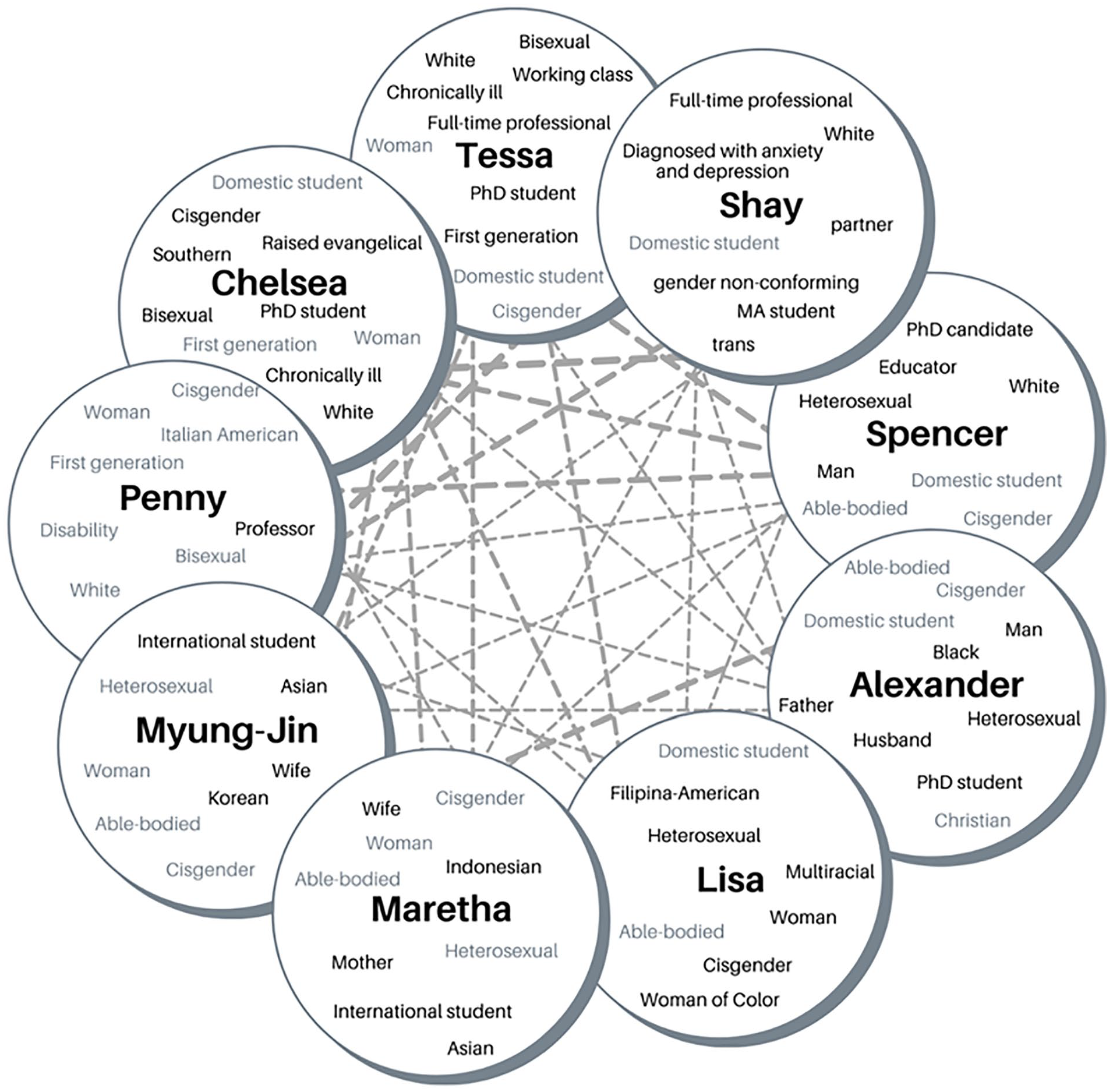
Graphical representation of the research team’s radical interrelated identities.
In this collaborative SPN, we share our stories with kinship (both within this group and within other groups) through the lens of interconnectivity. Interconnectivity posits that one should seek commonalities across and between identity experiences, not for the purpose of ignoring differences but rather for finding points of connection and solidarity (Keating, 2012). In doing so, radical interrelatedness, or examining differences with a relational lens, may be cultivated. This requires nonbinary thinking and a rejection of opposition with visceral empathy for diversity of experience. To cultivate radical interrelatedness, listening with raw openness and vulnerability is crucial; this is precisely how our qualitative research group developed and created kinship and empathy with one another. In this way, this article provides an alternative to counternarratives, or stories told among individuals with similar racial and/or gender identities that provide a counter experience to dominant White experiences (Nuñez, 2011; Rincón & Rodriguez, 2020; Solórzano & Yosso, 2002; Yosso, 2006). To be clear, this approach does not reject counternarratives, as they are quite powerful and instructive. However, this radical interrelated qualitative space provides an equally powerful and instructive experience for early career qualitative scholars that centers diversity across gender, race, nationality, sexual orientation, discipline, and additional important identities. It requires us as SPN scholars engage with each other as epistemological and ontological beings within the academy and not divorced from the current moment.
The qualitative space that we created for our research team was grounded in the notion of radical interconnectedness and multiplicity, something Keating (2016) has referred to as a postoppositional framework in Transformation Now! Toward a Post-Oppositional Politics of Change. Keating (2016) has asserted that interconnectivity is a tool to move forward toward postoppositional thought. Specifically, postoppositionality “transforms either/or thinking into the acceptance of multiplicity, contradiction, and paradox—energized by a search for complex commonalities spacious enough to contain differences” (Keating, 2016, p. 25). Furthermore, postoppositional theorizing is one method “in which qualitative inquiry can be brought to bear on issues of educational inequities” (Bhattacharya, 2016, p. 198). As early career scholars, we utilized interconnectivity to push and pull across and between our similar and different experiences as graduate students navigating multiple pandemics such as anti-Black racism, anti-Asian violence, and COVID-19 to engage postoppositional thinking and move toward liberatory transformation.
Scholarly Personal Narrative: Methodology and Methods
Our research team was organically formed as a result of our collective membership on a graduate student board of a qualitative research lab, which was created because minoritized students at our institution expressed a lack of research team experiences as compared with White peers (QualLab, 2020). Throughout the fall semester of 2020, we met twice monthly to discuss topics related to qualitative research and to co-construct a collaborative research project. As we began to share our personal experiences, explored points of connection and diversion among them, and drew implicit wisdom from our stories, SPN emerged as the ideal methodological approach to our inquiry, albeit the fact that this approach is not yet widely utilized across fields and disciplines.
Pioneered by Nash (2019), SPN uses personal storytelling as an approach to knowledge discovery. SPN is distinct from other forms of autonarrative in that writers “intentionally organize their essays around themes, issues, constructs, and concepts that carry larger, more universalizable meanings for readers” (p. 30). Rooted in postmodern epistemology, SPN asserts that “reality . . . is always and everywhere socially and personally constructed . . . [and] the best way to make sense of the ‘truth’ . . . is through the construction, and telling, of stories” (p. 7). To be sure, collaborative SPNs have been utilized sparingly in education literature (e.g., Porter et al., 2020; Reddick & Saenz, 2012). As such, we chose to build on this work and took a multifaceted approach to our writing in congruence with the postmodern epistemology inherent in SPN.
Data Collection and Analysis as Iterative
In alignment with postmodern paradigmatic approaches, our SPN data collection and analysis were iterative and fluid (Nash, 2019).
SPN data collection
We collected data through individual journals, responses to the individual journals, focus groups, and emails, and artifacts (see Table 1). Specifically, we collected individual journals from each member of the research team. Our journaling questions were grounded in those suggested by Nash (2019) and our orienting research questions, which prompted us to write about how we experienced multiple pandemics as graduate students with various identities. Specifically, we wrote about how the multiple pandemics were changing us as people, including as graduate students and qualitative research team members. We engaged individual journaling at three different times during our data collection process. As a research team, we also responded to one another’s journals through discussion board postings and responses. This dialogue across the research team was utilized as a fundamental element to the data in our study.
List of Data Sources.
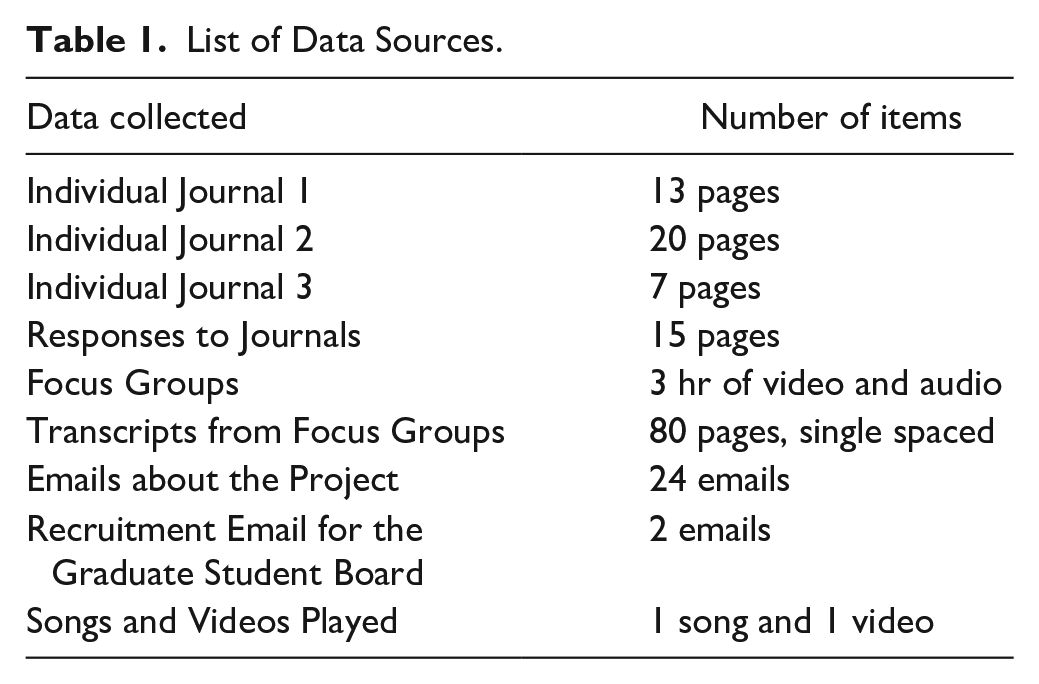
In addition, we held two in-depth focus groups where we reflected upon our journals as a group. Both focus groups were conducted via Zoom, recorded, and transcribed verbatim. Other data sources include emails regarding the project, the recruitment email for the graduate student board, and artifacts related to our journals and conversations, such as songs, videos, or community space flyers. For the purpose of our analysis in this article, we focused specifically on journal entries and focus group transcriptions.
SPN data analysis
Our data analysis process was iterative and, following the principles of SPN, postmodern by nature (Nash, 2019). First, our research team split up into five smaller groups, with three groups focusing on the online journals and interactive discussions while two groups analyzed the videos and transcripts from the focus groups. All five smaller groups engaged in open and thematic coding (Bhattacharya, 2016). In other words, all research team members utilized open coding until broader themes emerged from the data.
To filter large amounts of data, our team iteratively read, watched, or listened to transcripts and journal entries/discussions. We then identified “magic moments”—sections, stories, or concepts (Pasque, 2021). Magic moments were determined by this research team during team meetings and in practice to stay congruent with the concept that SPN “provokes, evokes, and invokes” (Nash, 2019, p. 10). To be sure, this can feel quite “dangerous” (Nash, 2019, p. 6) if engaged in honestly, and did feel that way for some of us. Last, we themed and structurally coded these particular sections of the transcripts or data (Saldana, 2016, p. 989). Within every group, each person coded individually and discussed broader themes within their team and then initial analyses were brought to the larger research team. Because qualitative data analysis is an iterative process, both the small groups and larger research team discussed and debriefed coding and themes on multiple occasions to generate findings (Jones et al., 2014).
Next, we met as a larger research team and had a team analysis discussion that focused on observations, key issues, what we believed to be true, supporting evidence, and continuing reflections about what was happening in our study. We also asked each other our lingering questions about the data and the data analysis process. Finally, based on this more extensive group analysis discussion, we focused on the data as individuals through three different isolated writing prompts that we wove together to construct our manuscript and findings. As such, this process congruently (Jones et al., 2014) follows principles from our theoretical framework and methodological framework.
To start the narrative writing process, we each wrote our own SPNs (Nash, 2019) based on our past journal entries and our own unique voice as a way to introduce ourselves to our readers (removed from this article due to space limitations). Next, as individual researchers, we reflected on findings from the entire data corpus and across every group and brought attention to the similarities and differences within the themes we found. We each wrote about findings from our individual perspectives and connected quotes from the data in conversation with one another while layering theory to paint a picture of our collective narratives, as inspired by this postmodern co-construction process. We present an amalgamation of these radical interrelated narratives in the findings portion of the article. Finally, we each wrote our own meta-analysis and reflection about the research process, including what we have learned from this group and reflections about our kinship as a way to recommend similar spaces for graduate student researchers interested in qualitative research. We share a few of these reflections in the last portion of the article to reveal the intricacies of SPN as a methodology and the inner workings of this graduate student research team.
Radical Interrelated Findings
As we constructed our collaborative and radical interrelated SPN, several findings emerged. We take these radical interrelated findings as evidence of Keating’s (2012) interconnectivity because, while each of us did not experience these themes in identical ways, sharing our experiences with each other allowed us to empathize and build coalitions, many times across difference. In this section, we demonstrate how thinking through these pandemics together made us contend with different levels of privilege, including the privilege of being a graduate student in the midst of tragic violence. These different levels of privilege give rise to our second radical interrelated finding: guilt and [lack of] safety. More specifically, White team members experienced guilt around the violence done to non-White bodies, whereas team members of color contended with difficult emotions surrounding safety or the lack of safety for their own lives and well-being. Through discussing and writing about our experiences of the first two findings together, we came to recognize our third radical interconnectivity finding on the importance of having kinship networks while working through graduate school in a racist society exacerbated by COVID-19. For us, this kinship network came in the form of a qualitative research team and the understanding of ourselves as scholars.
Graduate Student Privilege in the Midst of Violence
A core identity shared among the research team—with the exception of our one faculty team member—was our graduate student identity in the midst of the multiple pandemics of COVID-19, systemic anti-Black racism, and anti-Asian violence. COVID-19 has revealed a multitude of inequities across society, including in economies (Simet, 2020), governments (Miller, 2021), health care (Centers for Disease Control and Prevention, 2021), and within education (Miller, 2020). Our research suggests institutional and interpersonal racism in America has similarly revealed privileges and inequities inherent in graduate education.
Specifically, these pandemics brought our research team’s privileges to light in various ways. For example, Chelsea (she/her) reflected on the benefits of having had “a steady income, a safe place to live, and a network of people” with whom she could interact with virtually as well as “access to mental health support.” In thinking about the privileges she had “[i]n this moment of heightened (inter)national attunement to social inequities,” Chelsea described how her identity “as a white, cisgender, gender-conforming woman” protected her from “experiences of racism and transphobia” despite her minoritization as an LGBTQ+ person.
Shay (they/them) and Spencer (he/him) mirrored this thinking about their protection from danger due to privilege. Shay described how COVID-19 gave them an excuse to avoid clashes with their father, a White man, who was unable or unwilling to recognize the reality of systemic racism. Shay relayed a difficult disagreement they had during this time: “We actually got into a pretty heated argument over the phone in the wake of Black Lives Matter, because I had to convince him that the police straight up murdered Ahmaud Arbery and George Floyd.” These arguments were much more common between Shay and their family when they saw each other in person on a regular basis. Thus, having the excuse of social distancing from their father because of COVID-19 was in some ways a function of privilege; in other words, Shay could avoid these clashes over systemic racism because they were not forced to confront their prejudiced father.
In commenting on Shay’s experience, Spencer wondered whether he might be using the COVID-19 restrictions to avoid getting involved in the activism of the Black Lives Matter (BLM) movement. As a White man, Spencer’s body was not threatened by state violence, allowing him the privilege of being hyper-vigilant about the COVID-19 pandemic. Like Peggy MacIntosh (1988), Spencer acknowledged that he will “not have to educate [his] children to be aware of systemic racism for their own daily physical protection” (p. 3, emphasis added). Instead, he holds the privilege of being able to spend his time thinking about warding off other medical threats to his body.
Tessa (she/her) and other students thought about how being a graduate student provides cover or shelter from the pandemics. Sometimes, our positionality as graduate students provided privileges not necessarily tied to our individual identities. For example, institutional opportunities allowed some of us to maintain some levels of emotional health. Shay, for instance, wrote and talked in a focus group about the importance of having a therapist. In a time of increased isolation, having access to a reliable therapist is certainly a privilege that enables graduate students to maintain mental health (The Ohio State University Graduate School, 2021). This privilege is not necessarily available to same-aged peers outside of the academy who may struggle with maintaining a job during pandemic-induced unemployment (U.S. Bureau of Labor Statistics, 2021). For many of us, conversations about privilege were deeply connected to experiences of guilt with the interconnected embodied identities of whiteness and being graduate students.
The Experience of Guilt and (Lack of) Safety: Talking About and Beyond the Black–White Binary
Throughout our research team experience, we often found ourselves experiencing guilt, perhaps because of—but also in conjunction with—our privilege. Although nearly every group member explicitly named or alluded to their guilt, how we experienced and processed guilt was quite different. At its most basic level, guilt can be defined as “a feeling of having done wrong or failed in an obligation” (Oxford English Dictionary, 2020, para. 1). Several of us expressed feelings of guilt tied to things that we must do in addition to our graduate student responsibilities, such as professional work, parenting, and rest. For example, these questions raised by Tessa speak to a certain level of guilt associated with the depth and impact of her scholarly work: Can I really say that I am committed to a more just world when I’m actively avoiding some of the stressors that coincide with doing that work? . . . How am I serving as an ally, as Black and Brown people continue to be disadvantaged, silenced, and murdered while I move through this graduate program, sometimes feeling hopeless and disengaged from a bigger purpose?
A graduate student questioning the relevancy of their work is hardly anything new; however, in these self-reflective questions, we felt the added tension and urgency caused by the gravity of the multiple pandemics. Lisa (she/her) posed a self-reflective question, “What does it mean for me to work as a fitness instructor [during COVID-19] because I need that money to live and pay bills and put myself and others at risk?” Here again, we can see the duality of the situation: the guilt of having to press on and continue to do what is expected of us—in this case, working to pay bills—while also grappling with what obligations to prioritize.
Similarly, others looked for ways to deal with the guilt associated with privileges through our work. Spencer wondered whether he was doing enough in the undergraduate classes he taught “to fight against racial inequity.” In some ways, Spencer felt being an instructor was a platform on which he could use his privilege in a way to achieve justice through his teaching. These feelings of guilt extend further than just work and scholarship. They also seep into our family and personal lives as well, especially due to COVID forcing many of us to work from home and blurring the lines between work life and home life. Both Alexander (he/him) and Maretha (she/her) shared moments of guilt related to their roles as parents, with Alexander specifically saying he feels guilty when he is parenting because he is not studying, and when he is studying, he feels guilty for not parenting.
Shay further emphasized the layers of complexity associated with the guilt they experienced in their family life and social life: To some extent, it feels a little selfish to prioritize my health over my relationships with my parents and friends . . . Arbery, Taylor, and Floyd didn’t get the option to stay home and keep their lives, so why should I? Why should I get the privilege of staying home for fear of my physical and mental health when they didn’t?
In this way, the violence on Black and Brown people was ever-present in the daily lives of us as privileged graduate students. In addition to Alexander, Maretha, and Shay, all members of the research team in journal posts or in focus groups expressed some feeling of guilt in their professional, private, or academic lives, related to the pandemics. The fact that the guilt in all these examples seems to be self-imposed is important given the isolation and mental health strain caused by multiple pandemics.
While all members of this research team were affected in some way by the COVID-19 and anti-Black/anti-Asian pandemics through our shared identity as graduate students, our individual identities created inequities in how we experienced the pandemics. Group members discussed experiencing anti-Black and anti-Asian racism, homophobia, transphobia, xenophobia, and other systems of oppression as well as minoritization that pervade our lives (Stewart, 2020).
For instance, Alexander reflected on the impact of racism on his life as a Black man in one of his journal entries, recounting his reaction to a story of a 9-year-old girl who was pepper sprayed by a police officer (Baker, 2021). He stated, I sat in my office and cried and prayed even for a bit, and then it was time to snap out of it and get back to work. Hearing this story affected the rest of my day. I just couldn’t stop thinking about the pain that girl and her family must have felt . . . This is pretty much a microcosm of how I’ve felt a lot this school year as a graduate student. Because of this immense pressure to perform and meet deadlines, you only have a matter of minutes to process, grieve, and then compartmentalize before getting back to the task at hand.
Alexander could not relieve his mind of this incident because “knowing that specifically Black people, even 9-year-old girls, aren’t shown any compassion, patience, dignity, or respect in their time of crisis really hurts.” Alexander is a father to two young children, so he feared they could experience something similar, compounding the fear he already felt as a Black man.
Racism is embedded into the very structures of society, both in policy and in everyday interactions (Allen, 2016). In the summer of 2020 and subsequent months, institutionalized racism drew more widespread attention than ever before (Janiks & Hankes, 2021). We were not experiencing the blatant segregation that helped spur the Civil Rights Movement of the 1960s, but Black people were—and are—dying at the hands of police, the very people who were meant to keep the public safe. Hearing countless stories of police brutality against Black people wore on Alexander as a Black man and a father to Black children.
Critical race theorists have recognized racism and white supremacy as endemic to America (Ladson-Billings & Tate, 1995), but racism in America is often viewed as primarily anti-Black. While critical race theory has implications for all forms of racism, scholars of color have critiqued it as it was constructed with a Black–White binary in mind (Phillips, 1999). This binary was especially salient in the summer of 2020 as tensions spilled into action after a string of Black women and men were killed at the hands of police.
However, Maretha, Lisa, and Myung-Jin (she/her) highlighted that American race relations manifested beyond the White–Black binary; Asian Americans and Asians were also affected by white supremacy. To illustrate this, Maretha detailed her experiences as an Indonesian woman studying in America. In the early years of her PhD program, she studied racism in her classes. After the rise of the COVID-19 pandemic, she experienced racism in her daily routine. As the “China virus” and the “Wuhan virus” became nicknames for COVID-19, xenophobia against Asian Americans and Asians, particularly East Asians who were assumed to be Chinese, increased drastically (Vazquez, 2020).
Maretha witnessed anti-Asian racism as her family encountered it. Like Alexander, Maretha’s primary concern was her family—particularly her husband, as he interacted more with people in his workplace. She urged him to stay alert to his surroundings, fearing his vulnerability to a physical attack. Despite this ever-present concern, Maretha did not feel like she could talk about this fear with her family back home. She had regular video calls with her mother in Indonesia, who wanted to make sure that Maretha was doing well in the United States. Each time she was asked, Maretha would say her family was fine, even though so much was happening around her, such as the shootings that took place in Atlanta and Colorado (Chavez, 2021; Nieto del Rio et al., 2021). She pretended to be fine with her family because she did not want to make them worry.
In a similar vein, Myung-Jin titled one of her first journal entries “trauma,” as she reflected on how anti-Asian racism and xenophobia affect her sense of safety as a South Korean woman. “Someone called me Corona Bitch,” she wrote in that first journal entry, and she continued to recall countless other news stories of anti-Asian racism she had seen and experienced. She observed that these stories seemed to be largely forgotten by the public because BLM and Black stories were more prominent, and she found herself asking why that was the case. We argue this is due in part to the model minority myth, a harmful stereotype that assumes all Asians will achieve educational and financial success and serve as the model for all immigrants (Yi et al., 2020). Furthermore, it pits minoritized groups against each other instead of focusing attention on white supremacy as the culprit.
Discrimination against Black people has long been part of the American consciousness due to the country’s history of slavery and the Civil Rights movement (Allen, 2016); however, until recently, acts of discrimination against Asian Americans and Asian people have primarily been invisible as a result of the model minority stereotype. There is often a sense of historical amnesia where U.S. citizens fail to remember the internment camps that imprisoned Asian and Asian American people during World War II (WWII; Okihiro, 2005). As eight people died in the shootings in Atlanta on March 16, 2021, there has been increased attention focused on anti-Asian violence in the media (Chavez, 2021).
As anti-Black and anti-Asian racism rose in America, our research team members wrestled with how best to balance our desire to support social justice and dismantle oppressive institutions with our need to protect our health. Reflecting on the BLM protests, Shay reflected, I was pissed off and I wanted to be out there demonstrating, but we were less than three months into a COVID lockdown, and I was still terrified of getting sick. I couldn’t get a good gauge on how serious people were taking masking up at the time, and I knew it was going to be next to impossible to properly social distance in a protest as large as people were predicting the Columbus demonstration was going to be. Would a mask really protect me if others weren’t wearing them?
That fear was enough to keep Shay at home, but Lisa persevered and attended the protests in her city, despite the fact that she had been warned against it for her own safety: I remember having a feeling about going to protest during COVID, like going and being in groups, and . . . I remember living in Chicago and going and being like, “Oh dang, I’m not supposed to be around hundreds of people right now and here I am with hundreds of people.”
Many of us struggled to determine whether our personal safety or commitment to social justice should take precedence. Myung-Jin and Shay both described how guilty they felt prioritizing their physical health, although they found other avenues to support the BLM protests. Spencer did his best to work the protests and social justice issues into the classes where he served as a graduate teaching assistant. Many of us discussed BLM and social justice in our workplaces, which was a change from the pre-2020 norm. Finally, for each of us, the community we created as a part of this research team also functioned as a space of resistance, resilience, and healing amid the multiple pandemics.
The Importance of Kinship: A Space of Vulnerability and Possibility
As a group with various racial identities and lived experiences, we collectively made space to process the effects of the pandemic and hold it in conversation with our differences and commonalities (Keating, 2016). Lisa wrote about how the isolating effect of the pandemics created an impulse to connect. Through our qualitative research team, we were able to find this deep connection. We shared our stories with kinship (both within this group and within other groups) through the lens of Keating’s (2012) theory of interconnectivity. For example, as a gender nonconforming person, Shay discussed the power of kinship networks with fellow trans individuals, a reflection that connected with Alexander’s feelings of kinship and community in a Black healing circle. These and other connections between and among our experiences did not ignore our differences; rather, they highlighted “interrelatedness of being and a radical interconnectedness in our collective struggles” (Bhattacharya, 2016, p. 203). As a result, our qualitative space became a community; as Shay stated, We have our one unifying identity that we all share [as graduate students], but then we all have all of these different other identities . . . I think one of the benefits of this group is that I get to see things from a completely different perspective. I like that this space allows us to step outside ourselves and see what everyone else is experiencing . . . because it’s all affecting us differently, even though we are all graduate students.
The community we built as a qualitative research team also functioned as a space of possibility in an uncertain and politically divided time, reminding us that “another world is possible” (Pitcher, 2015, p. 1). Bhattacharya (2016) has written to this potential in postoppositional qualitative research, pointing out that “we can imagine social justice initiatives and actions . . . where we start from a place of understanding complexity of lived experiences in its various forms and functions” (p. 206). Many of us commented on the cathartic nature of our discussions, as well as the ways that our collective truth-telling came to embody the vulnerability and empathy that we sought in the world at large. Lisa spoke to the power of this space of interconnectivity, stating, [Discovering similarities in our experiences] can lead to empathy, solidarity-building, community-building, and coalition-building, which is the first part of interconnectivity . . . Another thing that builds trust and coalition-building and connectivity is acknowledging differences . . . because I’m never going to understand what it means to have a marginalized identity that I don’t have.
To Lisa’s point, Keating (2012) has encouraged seeking commonalities across and between identity experiences, not to ignore differences but to find points of radical interrelatedness or examining differences with a relational lens. This requires nonbinary thinking and a rejection of opposition. This lesson recognizes that differences are real and invites us to be intentional about these differences while also acknowledging how people may be inextricably interconnected. Shay details an example of this when they spoke of the BLM protests: I will never know what it’s like to be Black . . . like I just can’t, but I know what it’s like to lose my trans brothers, sisters, and siblings . . . and that’s why it was so hard for me to not be out there [in BLM protests], due to fears of COVID, because I know what it’s like to be scared walking down the street that maybe, maybe not me personally, but that someone that I love is not going to come home or someone who shares my identity is not going to come home.
While the organizers of the BLM protests and Shay hold different racial identities, the fear at the heart of the BLM protests allowed Shay to make a radical connection with the protesters’ cause. Thus, an exploration of similarities and differences opened the window to shared kinship and aspiring solidarity and accomplishment.
As part of interconnectivity, Keating (2012) has urged readers to listen with raw openness and vulnerability. This was crucial in how our group developed and created kinship with one another. Maretha shared an example of what inspired her to share openly with the group: “I see that this space allow[s] me to [share] something that somehow [is] personal, but the way people respond to one another is really motivating me to share.” For Maretha, the way that others responded to her in a kind and compassionate manner motivated her to share as well. Thus, the group created a space where raw openness and listening intently was a value of the shared space. Without raw openness, sharing similarities and differences across identity experiences would be a challenging task.
Building upon the importance of raw openness, Keating (2012) has also discussed the importance of empathy and coalition-building, which contributed to the kinship networks that we developed in our group of graduate students. Spencer demonstrated this empathy when he said in a focus group, When Maretha’s sharing that she’s . . . been called to do the work that she’s doing as a mother and as someone with her ethnicity . . . that’s where I start to see things, like general themes that relate to things that I am feeling. So, I don’t—I can’t—feel the things that Maretha feels when she, as a mother, is being called on to do this kind of work. But I can feel [what it feels like to] be demanded, like having my time [be] pushed to be spent in one particular way.
In Spencer’s reflection, he names that he can relate to Maretha concerning feeling as though graduate students are demanded. However, he displays empathy by acknowledging that he cannot relate exactly with the experience of being a mother. However, he illustrates the complexities and the nuance of radical relational connections by naming similarities and differences.
Chelsea demonstrated a similar sentiment when she responded to Lisa about the similarities and differences across and between bisexual and biracial communities: We’ve talked about differences and distinctions between monoracism and monosexism, or ways that multiracial people are left out and ways that bisexual or non-monosexual people are left out. So, I don’t know, that feels like a really clear point of connection for me . . . some of the things you were saying, I was like, oh yeah . . . some small piece of me can connect with that pain, even though I can’t fully understand it. I was just being reminded of Brene Brown (2016) when she talks about empathy. She says, “In order to connect with you, I have to connect with something in me that knows that feeling.” And it’s not like, “Oh, I know exactly how you feel, let me tell you what to do,” kind of thing, right, but it is that connecting with that shared experience of common humanity in some way.
Chelsea named that she might not be able to fully understand the feelings associated with monoracism, but that she channeled empathy by naming this difference, leaning into the complexities and recognizing shared humanity.
It is through expansive commonalities, radical interrelatedness, our similarities, our differences, raw vulnerability, and empathy that we as graduate students on this research team created kinship networks as we navigated the multiple pandemics as a collective. Shay summed this up by discussing in a focus group how our liberation is inextricably connected: “This [qualitative] space takes it away from how one person is experiencing the pandemics and takes it to . . . how we are experiencing the pandemics.”
The Implications of Living a Radical Interrelated SPN Qualitative Research Team
This radical interrelated qualitative space in the midst of multipandemics carries implications for the ways in which graduate programs could create research space—not haphazardly, but with authentic vulnerability and empathy in mind. In true SPN fashion, each of us reflected on the power of living this radical interrelated SPN qualitative research team in our own words. As an extremely diverse research team of graduate students, we highlighted the importance of congruent research designs, research as a member of a team, the creation and implementation of meaningful virtual platforms, the use of theory, the diversity of perspectives and experiences during multiple pandemics, self-research, racial representation, complexities of identities beyond labels (i.e., one of us feeling like “Grade A Beef” as a racially minoritized student on campus), feelings of connection, learning from each other, and being in community. In sum, we were—and are—deeply moved by how important the QualLab Graduate Student Board (GSB) Research Team became to us. In addition, we reflected on three manifestations that have implications for qualitative graduate research programs across fields and disciplines.
First, this radical interrelated qualitative space research team became a valuable source of community. Diverse across race, gender, ethnicity, and nationality, we came from different disciplines, and this research team offered an opportunity to work and build community with students across programs. In particular, this community was useful for those of us who were first-year graduate students because it quickly connected us with more experienced researchers. In addition, this community was useful to those of us who were doctoral candidates because it allowed us to think about our research from other perspectives and, in turn, aided in our candidacy for faculty positions.
Furthermore, the GSB gave us valuable research experience (we presented at the International Congress of Qualitative Inquiry and received a university research grant). Finally, we found the setting of a qualitative research lab particularly useful for reflecting on the graduate student experience. By researching and centering various qualitative research methodologies for this project, we were encouraged to think about our own epistemological, ontological, and axiological perspectives as graduate students. In this way, a qualitative research lab naturally moves toward critical self-reflection (Howard, 2003). Critical self-reflection, a part of culturally relevant pedagogy, is especially valuable for graduate students in education programs. Thus, we recommend institutions use qualitative research labs and diverse research teams like the GSB to develop community among students, expose students to new research experiences, and to develop critical self-reflection among students.
In terms of SPN, our experience has proven it a valuable approach for analyzing the experiences of graduate students. We recommend SPN for programs wishing to identify ways to better support graduate students. One of SPN’s guidelines is “to draw larger implications from personal stories” (Nash, 2019, p. 61) and attention to this guideline allowed us to contextualize our individual issues within larger institutions and societal experiences (i.e., the multiple pandemics). In addition, by sharing our SPN drafts and journal entries with each other, we were able to naturally see commonalities that pointed to these institutional and societal contexts.
Likewise, another guideline of SPN is to keep the story open to other interpretations (Nash, 2019). Throughout our writing and sharing of our individual SPNs, we remained open to feedback and questions from others that deepened our understandings of our own stories. This openness contributed to community-building and investment in the space of the new QualLab in the College of Education and Human Ecology. A department, college, or university wishing to better support graduate students would benefit from conducting collaborative SPNs with diverse groups of graduate students because it has the potential to illuminate common institutional issues while building community among participants.
Furthermore, our qualitative space became one in which we experienced the power of interconnectivity (Keating, 2012). Through honest, vulnerable conversations about topics like privilege and safety in the midst of multiple pandemics, we built a community of kinship and connection across lines of difference, despite barriers due to the virtual nature of our research team. The radical interrelatedness cultivated within our group was a function of several components: intentional community-building activities woven throughout our time together, our collective willingness to co-create a brave space (Arao & Clemens, 2013), and the diverse multiple identities represented in our group. For those who are seeking to cultivate interconnected, radically interrelated research teams, we recommend beginning with the work of Keating (2012, 2016) and Bhattacharya (2016). Ultimately, our work demonstrated the power in diverse qualitative teams when facilitated with intention, humility, and care. Moreover, our experiences emphasized that engaging interconnectivity requires both examining similarities and differences across systems of power to create points of connection and facilitate solidarity between communities.
As we collectively reflected on our experiences, many of us noted that this research team felt like a home. COVID-19 was isolating, as is graduate work. However, we co-created a virtual brave space (Arao & Clemens, 2013) where we explored weighty topics like COVID-19, violence on Black and Brown bodies (including our own), and rampant institutionalized racism. We explored how these affected each of us personally and this allowed us to create a kinship network with each other.
Kinship networks, whether on or off campus, are crucial to the success of transgender college students (Nicolazzo, 2016); based on our findings, we argue that these kinship networks are necessary for all minoritized college students. The diversity and vulnerability that each member brought to this research team contributed to the interconnectivity of this team. Our experiences and their similarities and differences helped us build a community that will outlive this particular project. Graduate students need academic and social support through collaborative research teams like this one (also see O’Meara et al., 2017). To be sure, fostering kinship networks take time and concerted effort, but radical interrelated qualitative spaces are one way to foster research experiences for graduate students that embody justice and equity.
Footnotes
Authors’ Note
All authors contributed equally. As is consistent with the focus of this manuscript, research team members of color are listed in alphabetical order first, then White team members. An earlier version of this manuscript was presented at the International Congress of Qualitative Inquiry.
Declaration of Conflicting Interests
The author(s) declared no potential conflicts of interest with respect to the research, authorship, and/or publication of this article.
Funding
The author(s) disclosed receipt of the following financial support for the research, authorship, and/or publication of this article: This work was supported by a Michael V. Drake Institute for Teaching and Learning Research and Implementation grant at The Ohio State University.
