




Abstract
Italy was one of the first European countries affected by the Covid-19 pandemic after the beginning of the outbreak in China in January 2020. Applying critical discourse analysis and theories of the mediation of suffering, this article explores the discursive strategies used by the Italian media to represent China and Chinese people in relation to the outbreak in the early stage of the pandemic. Employing the theoretical frameworks of Mary Douglas, Michel Foucault, and other thinkers on biopolitics, racism, and emergency, the results bring to light the persistent ideologies behind the media representations of an imagined Other, which reflect existing discourses toward the Chinese community in Italy. In this study, the contentious discourses around China and the Chinese amidst the pandemic reveal the role of the Italian media in presenting risks, mediating suffering as a distant event and, later, as a national concern.
On 31 December 2019, the WHO Country Office in China reported for the first time a pneumonia of unknown cause in the province of Hubei. On 9 January 2020, the Chinese Centre for Disease Control and Prevention identified a novel Coronavirus as a causal agent of the respiratory disease, later renamed Covid-19. The rapid spread of the Coronavirus – within and beyond Chinese borders – led the WHO to declare an emergency of international concern on 31 January and a pandemic on 11 March. In Italy, the first two Covid-19 cases were confirmed in Rome on 30 January and the local lockdown in Northern Italy began on 20 February. After several ministerial decrees aimed at containing the spread of the disease, Italy entered a nationwide lockdown on 9 March. The Italian case is of particular interest because Italy was among the first European countries that saw the surge of Covid-19 cases across the country. Within 1 month, Italy assumed the role that was previously assigned to China, moving from the role of spectator to that of a major actor within a global health emergency. In this article, we focus on the early stage of this pandemic (January–March 2020) and examine the discourses around ‘China’ and ‘the Chinese’ as the focus of the Italian political, media, and public debates. We aim to answer several research questions: (1) What are the discursive constructions of China and the Chinese in the Italian news media from January to March 2020? (2) How do they relate to the pre-existing attitude toward the Chinese community in Italy? (3) What is the significance of these discourses and the national policy in response to the emerging pandemic? We respond to these questions through a combination of critical discourses analysis and grounded theory, followed by a critical interpretation of the results contextualized by the Italian socio-political structures.
The Chinese community in Italy
In October 2019, 318,000 Chinese nationals lived in Italy, making it the country with the third-largest population of Chinese migrants in Europe after the UK and France (De Maio, 2020). The research on Chinese migrants in Italy has mostly come from social and economic disciplines and focused on the presence of migrants in several urban areas (Lan, 2014; Verdini, 2011), in particular, the Chinese business communities and workers in the garment manufacturing sector, and later leather, fashion accessories, and retail. The recent increase in the number of Chinese migrants in Italy was prompted by the Sino-Italian treaty of 1985 and five legalization amnesties (1990–2012), making the country a popular European destination for the Chinese (Ceccagno, 2007; Lan, 2014). The Chinese investment in Italy ranged from electricity companies to football clubs in a manner of ‘global capitalism’ (Ceccagno, 2007: 116). From the 1980s, successive Italian governments have been keen to develop trade with the Chinese, despite a backlash in the country resulting in an anti-Chinese political agenda (Wu and Latham, 2014) and efforts to curb the Chinese economic expansion through control and restrictions (Caneva, 2014; Ceccagno, 2007: 116). The political and media discourses from this time, therefore, reflect a paradox: acknowledging the benefits from the economic contribution of Chinese businesses in Italy despite the distrust of the migrants.
The popular perceptions of the Chinese in Italy are often negative since they represent competition (Verdini, 2011) from the economic perspective. They are seen to be threatening the economic sustainability of the country, largely because of the labor flexibility of the Chinese workshop: long working hours, low salaries, and the employment of illegal migrants (Ceccagno, 2007). Additionally, there was an absence of effective integration policies corresponding to the rise in Chinese immigration (Caneva, 2014), resulting in an uneasy combination of economic interaction and social exclusion of the Chinese in Italy (Marsden, 2014). The most recent development, which added to the distrust of the Chinese, was the March 2019 signing of a Memorandum of Understanding by the Five-Star League government with the People’s Republic of China (PRC), endorsing the Belt and Road Initiative. Italy is one of the 18 EU countries and the first of the G7 countries to sign a Memorandum of Understanding, an act that attracted criticism from the USA as it poses threats to its competitive advantage over access to Chinese markets (De Maio, 2020). The closer Italy-China link also raises the security risk of increasing Chinese political and economic influence in Italy (Caneva, 2014). The lack of social cohesion has further generated suspicions in public and media discourses (Verdini, 2011), including the idea that the Chinese engage in illegal and criminal activities (see Sredanovic, 2016). Nonetheless, academic research of the Chinese in Italy rarely addresses these media discourses.
Global health, risks, and suffering
In recent years, several health crises generated by viral diseases, including the Severe Acute Respiratory Syndrome (SARS) and N1H1 (Avian Flu), were discovered, and had outbreaks concentrated, in the PRC and Hong Kong. The ‘Western’ mediated communication of the events demonstrated entrenched attitudes toward the Other (Huang and Leung, 2005). The mobility of the Chinese was seen to bring potential bio-terrorist attacks, resulting in fears and blame (Ding, 2014; Nerlich and Halliday, 2007). The media discourses also employed metaphors of war and border security and, in so doing, reflected on the countries’ political authority in controlling outbreaks of diseases (Aaltola, 2012; Nerlich and Halliday, 2007). Previous research of global epidemics not only illustrates the communicative responses to human interdependence and the longstanding fear of Asia (Wald, 2008), it also shows that these epidemics raise issues of national interests and nationalism (Heffernan et al., 2011). An article about the official discourse on Covid-19 within China demonstrates a paradox of globalism (joining in international efforts to combat the pandemic) and nationalism (including the pride in the successfully curbing its spread) (Yang and Chen, 2020). A paper on the reportage of Covid in ‘Western media’ (Tzogopoulos, 2020) reveals that the pandemic ‘was seen as an opportunity to criticize the Chinese government, condemn its practices, and advocate for media freedom rather than focus on potential repercussions for global public health’. In addition, Wahl-Jorgensen (2020) points out that the British media used the sensational term ‘killer virus’ to amplify risk. The studies on media discourses around Covid-19 mostly focus on the social media networks (including Weibo, Baidu, and Twitter) within China and among the Chinese diaspora (Carvajal-Miranda et al., 2020; Kuo et al., 2020; Zhang and Zhao, 2020). We study news coverage because it continues to play a fundamental role in constructing wider cultural understanding of health and disease (Briggs and Hallin, 2016).
As a transnational event, a pandemic reveals the key features of contemporary society – its fast-paced mobility and interconnectedness – which is now built on a complex network of vital and vulnerable systems whose interdependence propagates the impact of potential threats; and how preventing and governing global emergencies have become key tasks in contemporary political life (Collier and Lakoff, 2015). Giddens (1990) and Beck (1992) similarly theorize about the significance of risks generated within globalized and modern societies. Beck (1992) recognizes the central role of the mass media in the processes of risk identification, social contestation of scientific knowledge of risk, and the challenge of risk. Cohen (2001) further argues that ‘the mass media have nearly a monopoly in creating the cultural imagery of distant suffering and atrocities’ (p. 168). Through their journalistic reportage, the media select, filter, and frame events, places, and people with the effect of not only contextualizing issues and setting the political agenda, but also connecting audiences with distant realities and feeding them knowledge and consciousness of the world (Orgad, 2012).
The practice of ‘witnessing’ (Peters, 2001) distant events draws the attention on the ethical and social role that the media assume, and on the audience’s moral and practical response toward media content. This experience, enabled by the media, has led to the emergence of support for the idea of the world as a ‘single place’ (Robertson, 1992) in which ‘there are no others’ (Giddens, 1991: 127); further, it gives rise to a ‘sort of unity in diversity’ (Tomlinson, 1994: 162). This is particularly striking with global (natural) disasters, where there is not a specific individual or group responsible for their occurrence and therefore, a sense of shared vulnerability and commitment is expected beyond national borders. According to this perspective, mediation puts the spectator ‘into a broader community of fellow-spectators’ (Chouliaraki, 2006: 26) and has the potential to ‘give rise to new communities of belonging’ (Chouliaraki, 2008a: 330) based on a global moral imagination.
While Covid-19 represents an appropriate case of transnational cooperation and humanity, the identification of a virus as a national issue might, conversely, introduce mechanisms of movement control, border defense and health protection in the pursuit of national security. The framework of biopolitics (Foucault, 1978, 2003) offers theoretical tools for analyzing the significance and consequence of national security policy and discourse. Biopolitics, understood as a mechanism of power over life, deals with the management of a population as a whole (Kelly, 2004: 62) aimed at regulating and optimizing biological life. The pursuit of the population’s well-being generates new sources of legitimacy for extraordinary technologies of security (Lemke et al., 2011), which include the control and/or expulsion of harmful elements of the society. In this study, the contentious discourses around China and the Chinese amidst the pandemic reveal the role of the Italian media in presenting risks, mediating suffering as a distant event and, later, as a national concern.
Methodology
This article applies Fairclough’s (1992) model of critical discourse analysis (CDA) to investigate the discursive strategies used by Italian media to report on the Covid-19 outbreak. Based on the assumption that ‘discourse produces the objects of knowledge’ (Hall, 2001), such an approach is relevant in revealing the relations of power behind discourse and how knowledge is applied to regulate social conduct. Fairclough’s model involves three main stages of analysis that correspond to three dimensions of discourse: description (the text), interpretation (the discourse in which the text is based on and the social context), and explanation (the social structures that determine discourse and the reproductive effects discourse may have on these structures). Adapting grounded theory (Charmaz, 2006) as a tool for analyzing qualitative data, we proceed with a phase of coding followed by a critical examination of the codes in relation to the key events and the resultant social/political reactions in Italy.
The qualitative analysis followed chronologically the development of events in China and Italy from 1 January to 31 March 2020 on traditional media (online newspapers) and social media (Facebook and Twitter). Five Italian daily newspapers were selected to investigate the recurrent themes that emerged in 230 articles (Figure 1) with the aim to conduct a comprehensive investigation. The sample includes three among the five newspapers with the highest circulation in Italy (Human Highway, 2019): Corriere della Sera (a center-oriented paper), La Repubblica (a center-left oriented paper), and Il Sole 24 Ore (a business paper) (Media Landscapes, n.d.). In addition, two national newspapers with a lower circulation that represent leftist (Il Fatto Quotidiano) and rightwing (Libero Quotidiano) political orientations (Mancini, 2015: 4) have been analyzed. The articles were selected to cover systematically the period of analysis through keywords (virus, China, Covid-19) searched on the newspapers’ search portals. After the coding process, 10 major themes emerged:
First cases in China
Previous epidemics in China/Asia
Wet markets
Suspicions over the Chinese government and its control of the virus
Emergency management in the PRC
Virus spread and Italian preventive measures
Economic risk
Italians in China
First cases and emergency management in Italy
Racism against the Chinese in Italy
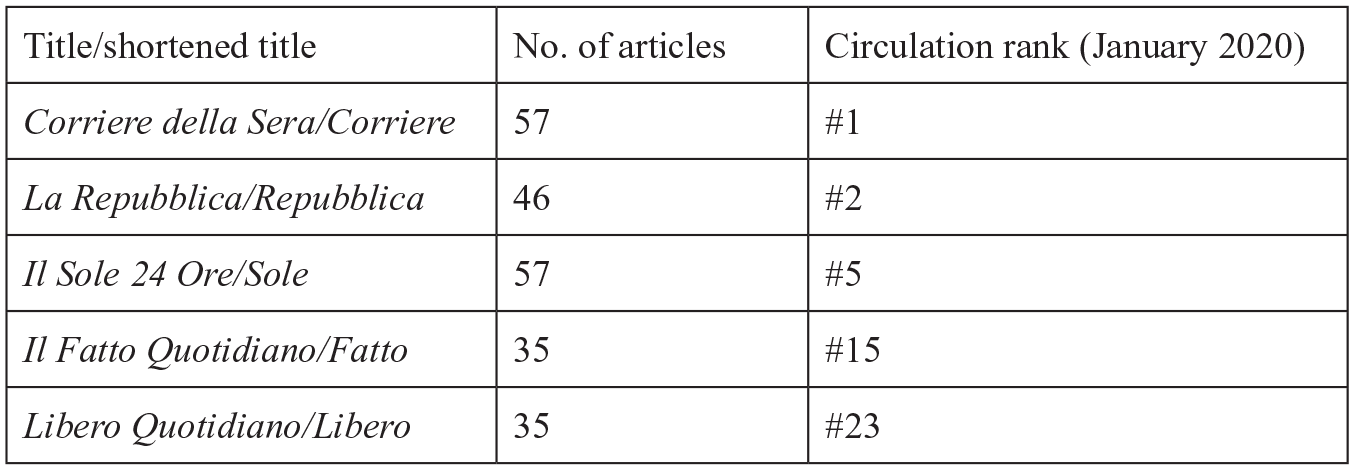
The sampled daily newspapers.
For a more effective presentation of the results, the 10 codes have been arranged into three major topics: the origin, management, and the national response to the pandemic. Furthermore, a second keyword search was conducted on Facebook and Twitter to reveal how social media reinforced and/or contested the major themes. This way, we followed the development of the events and traced the media, political, and social reaction across multiple Italian media platforms. The choice to include social media in the analysis was for two primary reasons. The first is the rise of the Internet’s informative power among the Italian population, as demonstrated by the 2018 Report of the News Consumption (AGCOM, 2018). More than a quarter of the population consider the Internet the more important means of information, even though the perceived reliability of online information sources remains on average lower than that of traditional sources. The second reason relates to the governmental commitment to fight misinformation and promote reliable information resources. Therefore, it is appropriate to include in the analysis sources that are traditional and perceived as providing reliable information (newspapers) and sources that are modern but seen as less reliable (social media). By including both types of information sources, this study can better interpret, explain, and contextualize the significance of the media discourses in Italy during the early months of the pandemic.
Emerging themes and discussion
The origin of the pandemic: far-flung risks
The news of an unknown pneumonia in Wuhan (China) reached Italy on 5 January 2020. In the earliest published news, the press predominantly used the label ‘Chinese virus’ (Cerati, 2020) and referred to a ‘mysterious pneumonia’ (Reptv, 2020). Newspapers portrayed viral outbreaks as a recurrent phenomenon in the PRC, referring to other past epidemics such as SARS (2002/03). Sole entitled an article ‘fear of Chinese virus is back’ (Carletti and Miele, 2020), while Corriere, in one article, claimed that ‘it is not the first time in the last 20 years that diseases never seen before, as the 1997 avian flu and the 2003 SARS, originate in China’ (Ricci Sargetini, 2020). Libero, referring to a dossier published by Repubblica, aimed to ‘shed light on the reason why Asia is the land of viruses’ that often become a global issue (Galluccio, 2020a). The article explains that this is due to the preservation of traditional customs, the choice of eating specific animal species and above all, the predilection for popular markets where hygiene and sanitary norms do not exist. The recurrent practice of the media to link new events to historically established health risks not only instills fear in the spectators but asserts the responsibility for the exporting of allegedly manufactured disasters (Nerlich and Halliday, 2007). Italy was not alone, as the UK newspapers in January and February also bred fear (Chaiuk and Dunaievska, 2020). The very first news about the virus exposed the Italian public to a spectacle already experienced in the past. At this stage, the media established a distance between the comfort zone of the Italian spectators and the Chinese emergency, thus nullifying the urgency of moral engagement and agency (Chouliaraki, 2008b).
As soon as more details about the possible origin of the virus in a food market became available in January, Chinese food and hygienic standards turned into a debated theme across Italian media. Newspaper articles presented the Wuhan market as the hotbed of the epidemic, where live, wild, and exotic animals are illegally sold. Repubblica, for instance, wrote about the ‘well-known problem of wild meat consumption’ (Anonymous, 2020a) and how ‘the consumption of exotic animals is considered a symbol of wealth and a panacea for health’ (Santelli, 2020) in rural China. Chinese culinary traditions overall were seen as something archaic in the eyes of the Italian people. Media attention on food markets generated the wide circulation of videos on social media to prove that these reported Chinese eating practices were not prejudices but daily habits. The most common videos portrayed street sellers who slaughtered rats (Il Grande Inganno, 2020a), people who ate mice (Il Grande Inganno, 2020b), and the killing of rats (Animaliberaction, 2020). This theme triggered a greater controversy when the President of the Veneto Region, Luca Zaia, during an interview on Antenna 3-Nord Est (a local television channel), suggested, ‘I think China paid the consequences of this epidemic because we all have seen them eating live rats’ (RaiNews, 2020). Zaia further claimed that due to the hygiene standards of Italian citizens and the advanced cleaning and nutrition systems, the hospitalization and death rates in Italy were low.
What emerged from this initial media coverage was a general attribution of the Coronavirus spread to cultural practices in China without providing the social, historical, and cultural contexts. This narrative follows an imagery that highlights how cultural habits in China do not reflect those of advanced and civilized countries with which the Italian spectators identify. Hygiene is ‘a set of behaviours that animals, including humans, use to avoid infection’ (Curtis, 2007: 11). The assumption about the alien eating habits is reminiscent of Douglas’s (1966: 48) Purity and Danger, in which she discusses pollution and the concern with contagions as an effect of contact with ‘inappropriate elements’. Anomalies, represented by rotten food and poor sanitation, become polluting when not regulated by ritualized forms of cleaning introduced to protect the community’s well-being. Douglas’s (1966: 35) classical formulation that dirt is ‘matter out of place’ points to how societies create the distinction of what is deemed exotic and therefore, does not fall into the norms that are historically and culturally prescribed for in a modern and civil society. This explains the discursive construction of China as dirty and dangerous, contrasting the civilized and safe practices found in countries such as Italy. ‘Reflection on dirt’, Douglas (1966: 14) writes, ‘involves reflection on the relation of order to disorder, being to non-being, form to formlessness, life to death’. In this sense, the emerging but distant Covid health risk becomes a metaphor for the presence of the Chinese in Italy, reflected in the next theme in reporting the management of the pandemic.
The management of the pandemic: persistent racist ideologies
The second major theme in the Italian media discourse concerns the Chinese Government’s reaction to and the management of the emergency, primarily from January to late February. The news reportage reproduced a stereotypical and conflicting image of China that also reflected the paradoxical views toward the Chinese in Italy. Distrust toward China and the Chinese comes from a historical ideology – yellow peril – that ‘combines racist terror of alien culture [. . .] and the belief that the West will be overpowered and enveloped by the irresistible, dark, occult forces of the East’ (Marchetti, 1993: 2). The yellow peril ideology can be linked to the sizeable Asian population and China’s expanding military and economic power (Kawai, 2005). As stated previously, this fear contrasts with the positive contributions of the Chinese in Italy and the international connections that the migrants have brought. This ambivalent discourse reverberated across Italian media through the developing epidemic narratives.
After disclosing the origin of Covid, the Italian media suspected China was covering up something more frightening from the rest of the world. Besides rampant conspiracy theories (e.g. an incident in a bio-weapon laboratory) (Locano, 2020a), the Italian press shared the view that the information published by the Chinese Government had been unclear, incomplete, and/or delayed (Anonymous, 2020b; Locano, 2020b). The Chinese state was accused of misinformation, which caused a great impact on the international understanding of the pandemic, and thus its prevention and treatment. While Fatto recognized that, in comparison with SARS, Chinese authorities had been prompter and more transparent in raising the alarm, it nonetheless highlighted ‘the ancestral Chinese temptation to secrecy, coverage, and unfamiliarity with advertising and divulgation’ (Gramaglia, 2020), hence evoking longstanding stereotypes of the Chinese. The assumed Chinese inclination to secrecy was further reinforced by multiple cases of censure against journalists, doctors, and citizens that were reported across Italian newspapers (Anonymous, 2020c; Galluccio, 2020b). The reports suggested that China’s ‘resounding sequence of errors in managing the crisis’ (Marro, 2020) and the delayed reaction of the authorities (Cattano, 2020a) engendered an uncontrolled situation. Fatto portrayed ‘armoured cities like a catastrophic movie set’ (Cattano, 2020b); Libero described how Wuhan plunged into ‘an apocalyptic scenario’ (Spinelli, 2020); Corriere compared the Chinese epidemic to an ‘internal war’ (Santevecchi, 2020a). The ideological leanings of the papers therefore did not substantially alter their perspectives in the initial coverage. Such an alarming picture was reinforced through footage on social media, which circulated scenes of collective panic and people collapsing on the street or in front of hospitals without help (Politically Incurrect, 2020).
The depiction of the management of the epidemic in China at this stage was mostly about discrediting China’s ability to curb the virus and willingness to assist the global community in understanding the health risks. In conjunction with the portrayal of distant suffering, the media discourses engendered a lack of interest toward the victims, both those affected and the fatalities. Instead, the reportage emphasized feelings of dismay and outrage, especially toward the Chinese Government. Such a focus contributed to the lack of an emotional engagement with the health and humanitarian aspect of the crisis, suggesting that the emergency remained distant from the then-safe space of the Italian spectators.
The pandemic within I: biopolitics and national responses
Until mid-January, Italian newspapers perpetuated the idea that there was no or low risk of the introduction of Covid-19 in the EU and Italy (Anonymous, 2020d). Italian political authorities, together with the scientific community, issued reassuring promises of the lack of serious danger to public health. One of the first concerns that arose within the Italian debate was the economic impact caused by the reduction of Chinese tourism and trade (Sacchi, 2020). Italy responded to the economic threat by promoting Italian tourism and commercial activities to avoid a potential economic stagnation, supported by all the main Italian political parties regardless of their political affiliation (see Sala, 2020). While there was a clear underestimation of the Covid-19 threat and an attempt to present an image of the country as secure, responsive, and open to tourism, established forms of xenophobic discrimination and racist incidents against Chinese and people of East Asian descent were reported in Italian cities. A bar in Fontana di Trevi (Rome) displayed a notice with the Chinese caption ‘do not enter’; a young Chinese in Turin was forced to get off the bus; stones were thrown against Chinese students at the Academy of Fine Arts in Frosinone; in Venice and Florence, Chinese tourists were assaulted with insults and spits, among many other racist acts (Anonymous, 2020e; Miyake, 2021).
Conversely, in an interview, Vittorio Feltri – journalist and founder of Libero – claimed that ‘Perhaps this is why [the Chinese] are not victims of racism. They live confined in their neighbourhoods; they mind their own business; they do not disturb. I wonder why Africans are not welcomed with such warmth in our country. And there is an answer: I’ve never seen a yellow person [sic.] dawdling on the street or begging’ (Agostini, 2020). Feltri has a history of controversies for anti-Semitism, racism, and misogyny; and this interview represented the populist Italian ambivalent attitude toward migrants of Chinese origin, and the historical and contemporary imagination of the Chinese and other ethnic groups. Nonetheless, this image of the invisible and hardworking Chinese (Gelpi and Tarantino, 2009) has been subverted since the 1990s when Chinese migrants began to be seen as a potential threat to the Italian social fabric and as economic competition. This may also be exacerbated by the populist rhetoric tinted by an anti-immigration stance, raised in Italy as a combined effect of the economic crisis and so-called refugee crisis. The Italian public and political debate increasingly shaped migrants ‘as the reason for all society’s ill, ranging from economic aspects such as unemployment and the reduction of wages to issues such as the proliferation of crime and insecurity’ (Bulli and Soare, 2018: 140). Therefore, despite the depiction of people of Asian descent as overall better than other ethnic groups – for their reticence, obedience, and efficiency – they pose a threat to the white majority because of their economic, political, and technological power (Kawai, 2005).
By the end of January, an increasing number of newspapers changed direction and recognized the existence of an alarming development of the epidemic. After the confirmation of two positive Covid-19 cases, both of which were Chinese tourists, on 30 January in Rome, the Italian Government introduced the first restrictive measures. These restrictions primarily concerned airport controls for citizens coming from the Chinese red zone, including measurement of body temperature, tests, and quarantine. In addition, celebrations for the Chinese New Year’s Eve were canceled in Milan and Rome, and all flights from and to China were suspended. Further measures of ports control were introduced in early February. The Italian Prime Minister, Giuseppe Conte, addressed the nation on 4 March announcing that ‘since January, when we had just two cases, we have implemented measures that appeared drastic but, in reality, were simply in accordance with and proportioned to the citizens’ health protection’ (Governo Italiano Presidenza del Consiglio dei Ministri, 2020).
As the pandemic is associated with risk and national security, it also legitimizes strong actions aimed at reaffirming or reinventing a sense of survival and safety within a threatened community (Aaltola, 2012). Aaltola suggests that a strong antagonist element within pandemics – such as the invisible cause of a disease – is often assigned to an established enemy. This usually corresponds to human carriers within specific geographical borders or ethnically, sexually, nationally, or culturally distinct groups of people (Aaltola, 2012). The identification of the first virus cluster in China and the embodiment of risk in Chinese people offered additional legitimacy for introducing exceptional governmental actions that were biopolitical mechanisms aimed at protecting the safety of the Italian population. Foucault (2003) presents biopolitics as one of the two key technologies of power in modern times, in addition to discipline. While discipline is exercised on individuals and seeks to control their bodies, biopolitics deals with the management of the population (Kelly, 2004). In particular, the initial forms of control exercised over the movements of Chinese people, identified as the main source of infection, reflect Gros’s (2014) analysis of the fourth stage of security, where biopolitics becomes a mechanism to control human circulation and to protect citizens from the risk of death.
In these early restrictive measures intended to reduce the risk of contagion, there was a clear racist assumption that all Chinese people were virus bearers and spreaders. Foucault (2003) discusses ‘state-racism’ as strictly linked to the emergence of biopolitics in modern societies; since the state’s primary obligation is to protect its population, everything or everyone threatening its safety must be erased. The exclusion of the Chinese from Italian society has been justified by the supposition that they were harmful to public health. The threat was identified not only as external but from the ‘Others’ within: the Chinese with Italian citizenship and Italians of Chinese/East Asian origin. The racially motivated attacks in Italy show that everything related to China and/or Asia – including shops, restaurants, and neighborhoods – were categorized as dangerous and therefore, excluded as agents and sites of contagion. In this way, as Aaltola (2012: 668) argues, pandemics propagate ‘geographies of fear’ where any perceived signs of disease must be removed or projected to distant places and/or externalized onto local out-groups (Sontag, 1998). Tuan (1979) further suggests how such scenarios of hostility are circumscribed within already existing or latent conflicting political relations and enmities, which was shown in the urgent political debates on the national responses to control the virus in Italy.
This was clear in the exploitation of the emergency by Italian sovereigntist and nationalist parties to reiterate anti-immigration ideologies and promote border securitization; in particular, the League, the Conte II Government’s opposition party, highly criticized the government for being unable to defend Italy and Italians. The former Deputy Prime Minister and Northern League politician Matteo Salvini emphasized in his social networks (Salvini, 2020) the risks of open borders for introducing the virus. The identification of an external menace has been used to reinforce and justify measures to protect the nation from polluting outsiders. Research demonstrates how, especially in relation to the rising popularity of the far right and its anti-immigration rhetoric, both institutional and main political actors have endorsed aggressive policing and militarized border control, thus inflaming public anxieties and security concerns (Castelli Gattinara, 2017). The politicians’ exploitation of the risk related to the pandemic reproduced longstanding racist ideology in the name of contagion control and national security.
The pandemic within II: from spectator to actor
Despite the regional lockdown of areas in the north of Italy on 20 February, the number of positive cases surged, leading to multiple government decrees to curb the spread of the virus. On 9 March, the Italian government imposed a national lockdown. Italy rapidly became the new Covid-19 hotbed, jeopardizing geo-political balances at the European level. The country had to deal with new challenges: the collapse of the national health system – in Northern Italy in particular – and the general marginalization that the Italians were now experiencing abroad. In one month, Italy assumed the role that was previously assigned to China, moving from the role of spectator of an Asian emergency to the role of major actor within the same emergency in Europe. While the story – the Covid-19 pandemic – remained unchanged, the countries in question and the relationships among them underwent a significant transformation. Security measures that Italy had previously issued to control Chinese people and international movements in the name of national security were criticized as they were now directed toward Italy and the Italians (Anonymous, 2020f).
The news reportage from 20 February to the end of March reflected a media discourse in Italy that highlighted the rigor and efficiency of the Chinese state’s concerted effort to fight the virus; however, the Italian newspapers cast a democratic gaze on a regime perceived as totalitarian when they reported the adoption of draconian measures implemented by the Chinese military apparatus. These included ‘death penalty for those who hide symptoms’ and indictment of public security for ‘every citizen responsible for the spreading of Covid-19’ (Anonymous, 2020g). Newspapers also reported the use of technology as a means of citizens control, referring to the police’s use of AI to locate people who did not use masks, smart helmets to identify potential coronavirus carriers, and the new Alibaba app to check the state of health of citizens. This revolutionary system of surveillance and containment was seen as a cause for concern within the Italian community, and China was described as ‘the main player within strategic sectors of data management and intelligent software’ (Biagio, 2020).
Criticism, however, subsided when the Chinese approach proved to be successful. Articles published in March contained more favorable opinions toward the PRC, which ultimately became a role model (Mereta, 2020; Santevecchi, 2020b) in the management of the pandemic. By the end of March 2020, when the rest of the world struggled against the uncontrolled spread of the virus, China declared the lowest level of infection since the beginning of the outbreak. The coordination of the Chinese Government in coping with the emergency and the compliance of Chinese citizens in respecting strict protocols reconfirmed the contradictory attitude toward the Chinese in Italy, highlighting rigor and discipline of the Chinese regime and its people yet confirming the stereotypes of people of Chinese descendent we discussed previously. These contradictions were reinforced when, on 13 March, China sent medical supplies and a team of medical staff from the Chinese Red Cross to help Italy fight the epidemic. At the beginning, there was praise and publicly shared gratitude toward this humanitarian gesture. Chinese people were no longer depicted as a threat, but, conversely, as a rescuer and a partner within a shared struggle. After this initial phase of emotional engagement that linked Italy and China, however, multiple sources evaluated the Chinese aid with suspicion again. Several articles argued that China took advantage of its success in tackling the pandemic and commitment to send aid to European countries to improve its image, regain credibility, and reaffirm its power worldwide (D’Argenio, 2020).
By the end of March, the news about China became almost irrelevant for the Italian struggle, and discriminatory language against Chinese people was no longer a major pattern in Italian media. Instead, a sense of commonality in the Italian struggle reinforced nationalist narratives. After the national lockdown and the severe loss of lives, public signs of national belonging and pride were visible: citizens singing the national anthem from their balconies, Italian flags hung at windows, applause, exclamations of encouragement for Italian doctors and the shared use of the hashtag #everythingwillbefine.
Conclusion
Our analysis shows how, during the early stage of the pandemic, Italian media narratives were dominated by pervasive racial stereotypes, which are part of the long-lasting imagery of China fueled by discourses along the lines of those conceptualized in Douglas (1966)’s work and the yellow peril ideology. The media’s depiction of the events in the PRC led readers to compare the country and its government (the Communist Party of China and its leader Xi Jinping) to the civic and democratic values that are attributed to the Global North. Furthermore, the labeling of the virus as a Chinese disease, the attribution of blame for the spread of the virus to Chinese disinformation, and the identification of the contagion risk from China have encouraged xenophobic acts against the Chinese and East Asians in Italy (see Miyake, 2021). These negative views reflect the status of the Chinese in Italy, who are welcome as economic contributors but distrusted because of their perceived lack of social and cultural contributions. These views explain why the production of knowledge about the Covid-19 pandemic as a distant event did not lead to processes of identification and emotional engagement in Italy with the challenges facing China.
This case demonstrates how mediation fails to engender a space for the emergence of cosmopolitan empathy – transnational emotional bond (Beck, 2006: 5); rather, it reinforces biopolitical power relations. The Italian Government’s protective measures, which at the beginning targeted Chinese people and their movements, are an extraordinary mechanism of state power legitimized by pursuing Italian public health security. A sense of shared vulnerability only arose within the Italian population when the Covid-19 emergency struck Italy. The Italian response is an exemplary case in which the mediation of a humanitarian crisis appeals to the spectators only in so far as it is articulated to their community of belonging. Our study ended at a stage when these nationalistic sentiments were overtaking the narratives that justified the vilification and the elimination of the contagious other. The current analysis of the media stories in Italy as they pertain to the imagery of China and the Chinese serves to remind us of the significance of the longstanding discourses of discrimination and prejudices against the other among many nations of the Global North. While the challenge launched by a global emergency would require a collective response through the recognition of shared humanity and transnational cooperation, this analysis shows how it has conversely introduced mechanisms of national protection without leaving space for the rise of a common commitment aimed at promoting global healthcare.
