




Abstract
This article is about the role of the media in the phenomenon of contemporary racism. More specifically, it outlines the discursive mechanisms through which insidious, hidden forms of racism are able to exist “invisible in plain sight,” even in the media and public discourse of countries, like Norway, that regard themselves as democratic and tolerant. The study is part of a broader investigation into the role of the media in the life-experience of immigrants. It addresses the question: How did Norwegian media portray immigrants during the Covid-19 pandemic? Based on a discourse analysis of media coverage, the study demonstrates how racism is hidden “between the lines,” in the assumptions behind a text. It also explains how racism is produced and reproduced covertly, yet systematically, through a media text’s small, even “irrelevant”-looking details. The analysis, importantly, reveals the presence of already existing and widely shared racist scripts which, although they became more noticeable during the Covid-19 crisis, actually underlie public- and media discourse at all times. The results of the study, while related to the case of Norway and the pandemic crisis, help us more broadly understand how and why racism, under the shape of “normality,” tends to remain practically unchallenged.
Introduction
Although the concept of race is discredited and “blatant racism” has been described as being “on the wane” (Sniderman et al., 1991: 423; Van Dijk, 1991) for decades, it still exists in covert forms (Kyllingstad, 2023). Explicit expressions of racism, in fact, have been replaced by alternative forms of it that are “more indirect, more subtle, more procedural, more ostensibly non racial” (Pettigrew, 1979: 118) –what Sniderman et al. (1991: 423) have called a “new racism”: “a racism that has new strength precisely because it does not appear to be racism.”
The media are known to play a key role in this process of “camouflaging.” Stuart Hall, who has produced significant work on race, representation, ideology, and discourse, argues that media help constructing racial ideologies as “common sense” through representations characterized by both “overt” racism and “inferential” racism – the latter consisting in “a set of unquestioned assumptions” that “enable racist statements to be formulated without ever bringing into awareness the racist predicates on which the statements are grounded” (Hall, 2003: 20). The media, as he writes, are not only a “powerful source of ideas about race,” they are also a “place where these ideas are articulated, worked on, transformed and elaborated” (Hall, 2003: 20). Yet, as he points out, this is the outcome neither of a “unifidly conspiratorial media” nor of a “unified and racist ‘ruling class’” (Hall, 2003: 20). How can we explain, then, the continued existence of racism? How do media exactly contribute to its establishment?
This article is about the insidious, hidden forms that racism takes in the media and public discourse of a contemporary democratic society. More specifically, it outlines the discursive mechanisms through which racism continues to be “invisible in plain sight,” even in countries, like Norway, that regard themselves as democratic and tolerant. The study is part of a broader investigation into the influence of media into the life-experience of the population with an immigrant background 1 in Norway during the Covid 19-pandemic. 2 It addresses the question: How did Norwegian media portray immigrants during the Covid-19 pandemic?
The way the media presents minorities, including immigrants, has far reaching consequences on the political fabric of our society and on the lives of immigrants. When it comes to the most obvious political effects, Eberl et al. (2018), find that immigrants are regularly presented negatively: a comparative study of 16 Western democracies by Esser et al. (2017), just to name one of the studies they draw on in their analysis, identifies “immigration and integration” as the third most negative topic in political news coverage. Not only that, immigrants are often portrayed as invading “masses” or “hordes,” and as “threats” (Balch and Balabanova, 2016; Eberl et al., 2018: 214; Meeusen and Jacobs, 2017; Van der Linden and Jacobs, 2017), when they are not stigmatized (Etchegaray and Correa, 2015; Lubbers et al., 1998). A range of studies further finds a correlation between negative coverage of immigration, negative attitudes toward immigrants and often, as a further result on behavior, support for populist anti-immigration parties (Boomgaarden and Vliegenthart, 2007; Eberl et al., 2018; Scherman et al., 2022).
Based on a discourse analysis, the study we conducted shows that the coverage of immigrants during the pandemic in Norway was not merely negative: it presented features of racism. Teun Van Dijk (1991: 27) argues that racism is both “structural” and “ideological”: “It embodies both political, economic, and socio-cultural structures of inequality, and processes and practices of exclusion and marginalization, as well as the socio-cognitive representations required by these structures and processes.” Here we focus on the “socio-cognitive representations” that underpin and, in fact, enable structural racism. The analysis demonstrates how racism in Norwegian media discourse is not explicit, rather hidden “between the lines,” in the assumptions behind the text. It also explains how it is produced and reproduced covertly through the small, even “irrelevant”-looking details of a text. Importantly, the analysis reveals the presence of already existing and widely shared racist scripts which, although they became more noticeable during the Covid-19 crisis, actually underlie public- and media discourse at all times.
The results of the study, while based on the specific case of Norway during the pandemic crisis, make three contributions to our understanding of the role of the media in the phenomenon of contemporary racism. First, they are a contribution to the emerging area of enquiry related to the representational politics of race during the pandemic. There are a number of studies that have documented the rise of a mixture of xenophobia, nationalism, stigmatization, and racism against minority groups during the Covid-19 emergency across the world (Clissold et al., 2020; Devakumar et al., 2020; Elias et al., 2021; Haokip, 2021; Rytter, 2023; Tan and Umamaheswar, 2022). Media narratives appear to have played a significant part in these processes, but it is not clear what their role precisely consisted in. Media, across a range of studies, are found to have contributed to as varied and as potentially overlapping phenomena as othering, racialization, constructing a negative image of Muslim, Asian, and immigrant communities, and reinforcing the dominant representational frameworks (Ittefaq et al., 2022; Ivić and Petrović, 2020; Poole and Williamson, 2023). Overall, there remains a dearth of rigorous empirical evidence when it comes to explaining how, during the pandemic, racial discourses exactly manifested themselves and how they functioned in practice. Our analysis is a step in the direction of filling this gap in current research by systematically outlining the semantic structures that underpinned racist representations of immigrants in mainstream media. More specifically, we explain how “new racism,” an already “adaptable” form of racism (DiAngelo, 2016), in the social and discursive climate of the pandemic, camouflaged so seamlessly under the guise of apparently “neutral” representations that it became almost invisible.
Second, the analysis challenges arguments, within Norwegian public debate and research, that racism does not really exist in Norway. Although many studies find evidence of ethnicity- (or perceived-ethnicity) based discrimination against immigrants and their descendants in contexts as varied as school, the workplace, the healthcare system and the housing market (for a review see Midtbøen and Lidén, 2016: 15–17), there is a strong reluctance in the country to acknowledge that this consists de facto in racism (Kyllingstad, 2017; Wiggen, 2021). This situation echoes the “denial of racism” that occurs in other democratic countries like the US, the UK, or Australia (Lentin, 2018). Based on our findings, we argue that racism, not only does exist, but that it also does so under the shape of “normality” and what is taken for granted, which helps explain why it continues to exist, practically unchallenged. The media plays a key role in this “normalization” of racism.
Thirdly, and from a methodological perspective, the article makes the point that detecting hidden racism in media discourse is a challenge: first because it is not connected to obviously “racist” themes; second because it requires attention to the microdetails of discourse, how they relate to broader social and political material- and discursive structures, as well as their cumulative effect over time. While the findings we present, as we will describe in greater detail later, relate mostly to a discourse analysis of Norwegian mainstream media texts, they are more broadly informed by interviews we conducted with 21 immigrants 3 to gain an insight into their reading of the media coverage and the effects this had, cognitively, emotionally, and practically, on their everyday life.
Media and immigration: beyond reporting about immigrants
Our study focused on the media portrayals of immigrants. This subject of analysis is not at all new. Yet, while the literature might look extensive (see Eberl et al., 2018 for a review), at a closer scrutiny there are limited angles from which the relationship between media and immigration has been investigated. On the one hand, as we will see, is research that builds on framing theory, which tends to focus on which manifest words, subjects, and themes are most common when media talk about immigrants and immigration (see, e.g. Hovden and Mjelde, 2019; Lawlor and Tolley, 2017). On the other hand, are approaches rooted in discourse analysis that aim to move beyond the surface representations of immigrants to address, instead, the relationship between media texts and the broader political/social context (see, e.g. KhosraviNik, 2010; Taylor, 2014; Van Dijk, 1988). We are now going to briefly review these strands of research, pointing out their limitations and explaining why there is a need to combine their respective concerns.
The branch of literature on media framing of immigrant groups mostly focuses on how immigrants are portrayed. Although there is evidence of some positive framing when it comes to the economic benefits of immigration (Eberl et al., 2018), most often media portray immigrants as burdens and threats (Eberl et al., 2018; Hovden and Mjelde, 2019). Eberl et al. (2018), for example, write that “[g]enerally speaking [in European media], Eastern Europeans are more often depicted as a threat to the economy and welfare system, while non-Europeans are seen as a threat to the host countries’ culture” (p. 212). These studies also highlight the lack of voice given to immigrants, and suggest that the perspectives of immigrants are rarely present, and they are often represented by others who tend to stigmatize them (Etchegaray and Correa, 2015; Lubbers et al., 1998; Smets and Bozdağ, 2018; Van Dijk, 1991).
When it comes to the specific case of Norway, current literature on media and immigrants is mostly limited to quantitative studies and three main aspects: media coverage and framing of immigrant groups and immigration issues (Aalberg and Beyer, 2015; Berg-Nordlie, 2018; Olsen and Grønning, 2019); political rhetoric about immigration (Andersson, 2012; Hagelund, 2020); public perceptions about immigrants (Beyer and Matthes, 2015). Few studies focus on the representation of immigrants. Lindstad and Fjeldstad (2005) argue that the press helps reinforce the population’s perception that many immigrants are criminals, and a danger to society. Wiggen (2012), examining political rhetoric in Norway before the July 22 attacks (a bomb attack in Oslo and a shooting on the island of Utøya by a far right extremist in 2011), argued that the media and political debate were characterized by anti-immigration rhetoric, xenophobia, and widespread demonization of the members of other cultures, particularly Muslim and Arab immigrants.
Moving on to the strand of research related to discourse analysis, there are a number of studies that use this methodology to map how political and social influences might lead to bias in media texts about immigrants, particularly how news textual features contribute to the reproduction of discrimination (Aliaga Sáez et al., 2022; Musolff, 2022; Reitmanova, Gustafson and Ahmed, 2015). It is now well-established that the media not only are institutions with the power of creating the reality we live in (symbolic power), but they also construct and reproduce racially coded messages (Armstrong and Neuendorf, 1989; Eberl et al., 2018; Van Dijk, 1991). Studies within this strand tend to address the role of the media in the “maintenance and legitimation of ethnic power relations” (Van Dijk, 1991: 4; Wodak, 2009). Van Dijk (1988), whose approach we adopt in this study, in this respect, proposes a theoretical and practical framework for mapping the way properties of the news text (micro-structures) like stylistic, semantic and rhetorical features of news articles’ texts contribute to the daily reproduction of a broader racist discourse (macro-structures). Through this approach, he demonstrates how news is characterized by “unsaid semantic implications, presuppositions, suggestions, and associations” that are routinely taken-for-granted unless they are revealed through the analysis of implicit features (Van Dijk, 1988: 69).
Van Dijk’s (1991) systematic study, importantly, also shows that taken-for-granted elements of a journalistic text – such as the use of evidence from eyewitnesses or “reliable,” official sources, the use of quotations by authorities, or statistics – actually help reproducing racist bias. To put it in other words, it is often through apparently legitimate journalistic practices that are meant to ensure “objectivity” that “the justification/legitimization of inclusion/exclusion” happens in the media (Wodak, 2009: 319), and is consequently “accepted as the truth or at least as the possible truth” (Van Dijk, 1988: 83). However, because it is so counterintuitive that objectivity might lead to its exact opposite, very few scholars (see, e.g. Boudana 2016; Wallace 2019) have attempted to analyze how journalistic routines, the use of facts, of apparently “neutral” language, and “professional” reporting techniques contribute to bias in the coverage.
To summarize, the extensive research on media coverage of immigration and immigrant groups, by focusing on the “presence and absence of certain words, themes, or actors,” has resulted, as Hackett (1984) puts it, in “the quantification of bias” (p. 241). Little attention (or none, in the Norwegian context) has been paid to how we can identify mechanisms through which bias and discrimination materialize in media coverage, and which features of a news article might covertly contribute to constructing racial messages.
This is why in this study we combine the concerns of both the framing analysis and discourse analysis approaches. We examine both what themes and topics the Norwegian media explicitly talked about when they talked about immigrants during the pandemic (later under “subject and themes”), but we also systematically analyze why the coverage was that way: how we can read bias in the news, and through which semantic practices racist discourse materializes, regardless of the intentions of journalists.
Methodology
The study is mostly qualitative and revolves around a discourse analysis of media coverage by Norwegian media during the Covid-19 pandemic. 298 articles were initially retrieved through the keywords “norskfødt* [born in Norway],” “utenlandsfødt* [born abroad],” “importsmitte [imported infection]” in Aftenposten, VG, Klassekampen from 1 March 2020 to 15 May 2021: the timeframe spans the coverage, in Norway, from the beginning of the emergency to the easing of the anti-infection measures following a vaccination campaign. Importantly, it captures the ongoing debate on how to deal with the virus in specific groups in society where the infection is proportionally higher than among the majority and the management of travellers’ arrival into the country.
The keywords were selected after a range of trials on the coverage. Searching with the term “innvandrer* [immigrant]” yielded articles that tended to relate to immigration as a more abstract issue. The terms we selected yielded the most relevant sample about immigrants and their experience in the context of the pandemic. For the discourse analysis we further selected the 220 articles that contained the richest representational frames. Aftenposten and VG are the most read newspapers in Norway and representative of the mainstream media content in the country. Although commercial imperatives often blur this distinction, Aftenposten is regarded as more of a broadsheet, while VG leans toward the tabloid. Based on the existing literature, we were expecting most articles to portray immigrants negatively. Klassekampen (literally, “class struggle”) was selected for the potential, through its left-leaning political orientation, to provide a more supportive coverage for immigrants. This was also to get a sense of how consistent and widespread negative (or positive) portrayals of immigrants were across the spectrum of public debate.
We adopted the analytical framework outlined by Van Dijk (1991) in Racism and the Press. Discourse analysis, in Van Dijk’s work, is not just a method, but a whole ontological approach to the nature of reality: discourse exists in society and politics not only as rhetoric and narrative, but also in terms of concrete policies and actions. Policies and actions are underpinned by rhetoric and narratives and, in turn, contribute to further solidify and institutionalize them, making them the very taken-for-granted fabric of society. Text is a domain in which discourse manifests itself, is constructed and re-constructed. In the case of Van Dijk’s study and ours, we examine the news text.
Although Van Dijk scrutinizes, in his extremely detailed analysis, a wider range of textual features, within our sample we have focused on the following main aspects of discourse: headlines, subjects and topics, news schemata, sources, models, meanings, and ideologies. As we will see shortly, while some of these features (like “subjects and topics”) cover explicit aspects of the text that most closely align with the framing approach in the literature we have described earlier, they also expand into a more implicit dimension: what is not stated, yet still communicated, to the reader.
“Headlines” have both “textual and cognitive functions” (Van Dijk, 1991: 50). They contain the information readers are more likely to recall later and suggest “a subjective definition of the situation, which influences the interpretation made by the readers” (Van Dijk, 1991: 51). As Van Dijk explains, this influence is so strong that “readers would have to make an extra effort to derive an alternative main topic from the text” (Van Dijk, 1991: 51).
As for “subjects and topics,” they matter because they signal what is “the most important information about a news event” (Van Dijk, 1991: 71). In our analysis, we include not only the themes in the coverage related to immigrants, but also what was missing from the coverage. We were guided in this by the data collected through interviews with immigrants who consumed the coverage during the pandemic and who consistently outlined what they felt would have been relevant and, yet, was not addressed by the media at the time.
“News schemata” covers the organization of the information that is presented to the reader: “What tends to be given prominence, what information is presented first, and what information last?” (Van Dijk, 1991: 121).
The examination of “sources” addresses the question: “Who is speaking, how often and how prominently, and about what are quoted news actors allowed to give their opinions?” (Van Dijk, 1991: 151).
“Models” are “mental representations of events” (Van Dijk, 1991: 74): “mental structures of information which, besides the new information offered in a news report, feature information about such a situation as inferred from general knowledge scripts” (Van Dijk, 1991: 74). In other words, when readers consume the news text, they get much more information than it is explicitly in the content because they “are able to infer large parts of the relevant knowledge themselves” (Van Dijk, 1991: 74). Such knowledge is derived from “socially shared knowledge scripts” and might include ethnic and racial prejudice. For Van Dijk the task of critical news analysis – this was also our aim – is precisely to reconstruct “the ‘underlying’ models, and especially the underlying knowledge and scripts shared by those who wrote the news.”
“Meanings and ideologies” cover the “presuppositions” (Van Dijk, 1991: 177), the assumptions behind the text. As Van Dijk explains, they are an “often-used strategic means to conceal controversial claims and are less easy to challenge by an uncritical reader than a straightforward assertion” (Van Dijk, 1991: 177). In our study, we were looking for semantic strategies through which stigmatization and racism is denied, mitigated, excused, and concealed, as well as tacit assumptions about “immigrants” (their identity, features, and presumed motives) and “ethnic Norwegians.”
Results 4 : unveiling racist discourse
As Van Dijk (1991) points out, even if in Western societies there is a belief that notions of “racial superiority” are discredited and even, on the surface, rejected, this does not mean that “social constructions of race” (p. 25) have disappeared: they are just expressed differently. More specifically, they are extremely subtle. In this respect, while the coverage did not contain explicit discriminatory language – like openly denigratory terms – our examination of the assumptions underlying the media texts shows that these fell into already existing and well-established racist scripts. The findings, as we will see, also reveal the relevance of seemingly harmless, even “irrelevant” details, as well as messages “between the lines” which produce, cumulatively and over time, a discriminatory discourse. Contrary to our expectations, we did not observe substantial variation in the way different media outlets portrayed immigrants, which is indicative of how deeply racist standpoints that oppose “the other” are entrenched in public discourse.
Headlines contributed a sharp focus on immigrants by explicitly mentioning individuals and groups with an immigrant background. Although their phrasings might appear objective, they actually emphasize the most negative aspects of the contents later presented in the article. Examples span from “Immigrants in Corona-time” (Aftenposten 7.4.20), “Heavy increase in infection among immigrants” (Aftenposten 16.04.2020), “More foreign-born people die from Covid-19” (Klassekampen 17.12.2020.) to “Four out of 10 Corona-patients are born abroad” (VG 18.07.2020), “NEARLY HALF [Corona-patients] BORN ABROAD” (VG 26.08.2020), “We need a new strategy for immigrant-health [innvandrerhelse]” (Aftenposten 13.11.2020), “Corona-cultures in conflict” (Klassekampen 27.11.2020), “The government needs help to reach out to immigrants” (Aftenposten 12.01.2021), “Nine times as high infection among Pakistanis. Why?” (Aftenposten 22.04.2021). The title “Immigrant-infection [innvandrersmitte, a newly created word] causes concern” was initially used on the first page by Aftenposten (20.11.20) and later removed as a result of complaints. Although these examples might look like tabloid-like sensationalism, they reflect in fact a common trend among all media outlets we examined.
When it comes to the subjects and topics we identified in the coverage, immigrants were largely presented as a problem and associated to virus infection. This was particularly evident in the use of terms like importsmitte (imported-infection), smittefly (infectious-flight), and even innvandrersmitte (immigrant-infection), as well as in reference to the districts of the city of Oslo with the largest immigrant population (referred to as innvandrertette bydelene or “immigrant-dense districts”). It is interesting to note that also ethnic Norwegians did travel in and out of the country – it was Norwegians who returned from skiing trips in the Alps that first brought the virus to Norway – and could have contributed to importsmitte, yet this notion was never explicitly associated to them. Media reports, in this perspective, consistently juxtaposed a “pure,” “healthy,” inside of the country (norsk), to an “infectious” and threatening “outside” (ikke-norsk).
Those responsible for the infection were largely referred to as “non-Norwegian” and “born abroad.” This group included foreign travellers, like tourists, but most often guest workers, especially from Poland. It also extended to citizens who were perhaps born in Norway, yet belonged to an ethnic minority and might not have “looked” Norwegian. The latter case involves especially black and Asian communities from Somalia and Pakistan respectively, who not only stand out from the “ethnic Norwegians” (who self-identify as white) for their skin color, but also often through clothing signalling religious affiliation, particularly to Islam. Other terms that, in the coverage, contributed to constructing a binary division between in-groups and out-groups include “Norwegians who are descendants of immigrants,” “Norwegian born with a foreign mother,” and “Norwegians who are descendants of Norwegians.”
The most prominent themes and topics in the coverage in relation to immigrants were references to their religion, culture, and lack of trust in authorities. Other prevalent topics were immigrants’ failure at integrating, poor knowledge of Norwegian, not being able to read and follow the news, pressure among immigrants for family visits and traveling abroad. While family visits and traveling abroad were framed as “unnecessary leisure trips [unødvendige fritidsreiser],” traveling to mountain cabins, which is common among wealthier ethnic Norwegians, was never described as such. Infection among immigrants was often claimed to happen “at home [hjemme],” and “inside the family [innen familien]” (see, e.g. “Almost half [of the infected] born abroad” (VG 26.08.2020) blaming immigrants for getting sick in their own private spaces, implicitly suggesting that the infection was coming from within their communities. Immigrants were seen as an obstacle to authorities’ communication for not being able to read, not understanding Norwegian, and not taking the pandemic and the authorities’ advice seriously. 5 Authorities, instead, were rarely criticized and, to the contrary, were mostly praised for the effort and amount of resources they spent on reaching out to immigrants.
There were aspects of the coverage that were conspicuously missing. Throughout the timeframe we analyzed there are contrasting positions on whether poverty or being employed in public-facing jobs could be the reasons for some immigrants’ groups presenting proportionally higher infections rates than in the majority population (e.g. of opposite stances see “One city, two worlds” VG 26.03.2021; “Social inequality still not the main explanation” Aftenposten 04.05.2021). Nearly one year into the pandemic, the socio-economic factors, living conditions, and risky jobs were explicitly denied as possible explanations while biological factors (genetics) were emphasized, in particular for Covid-related deaths among those born in Africa and Asia (see, e.g. “Do we dare to talk about Covid-19 and genetics?” Aftenposten 05.05.2021). It is striking that virtually no questions are asked or further explanations provided in the coverage as to why immigrants are living in poverty in the first place. Although background health conditions of affected individuals were mentioned sporadically, the reasons behind the poor health of immigrants and the measures that could improve it were never addressed.
In relation to sources, what emerges from the coverage are largely the voices of officials and institutions. They also express a selective perspective that tends to “blame” the immigrants. This worldview goes largely unchallenged until the beginning of 2021, nearly one year into the pandemic. Even then, however, voices that suggest, effectively, a different framing to the main narrative, tend to be marginalized, either through “burying” them into hidden sections of newspaper editions, or far down in the articles’ text. Both of these aspects are well illustrated in “Now the infection-hunters are knocking on people’s doors” (Aftenposten 21.01.21). The text refers, toward the end of the article, to the role of inequality in the differential spreading of the infection. Robert Steen (representative of Arbeiderpartiet, the Workers’ Party) is quoted stating: “Differences in infection in the East and in the West [of Oslo, immigrants living mostly in the East, wealthier ethnic Norwegians in the West] can relate to language and culture, but most of all they are related to socio-economic differences.” This article is published at pp. 24–25.
In another example, a doctor (Patji Alnæs-Katjavivi), raises criticism against the article “Immigrant-infection causes concerns” (Aftenposten 20.11.21) in a letter to Aftenposten (“Aftenposten’s concern” 3.02.21). He writes that there are official statistics that clearly show that “ethnic differences in mortality are largely due to occupational exposure, geography (city versus countryside) and socioeconomics.” Yet, since the beginning of the pandemic, Aftenposten has assigned the “blame” and “responsibility” for the infection “on individuals born outside Norway.” The newspaper, as he continues, “rarely asks why immigrants are over-represented among those infected, nor the consequences.” These important points are published at p. 26, between a letter about the nature of obesity and another one about how the Industrial Revolution began.
When immigrant voices are integrated in the coverage, they tend to offer support to the mainstream narrative, as in the case of “Many immigrants plan to spend Easter abroad” (Aftenposten 25.03.2021). Immigrant voices sometimes even consist in self-accusation, as in the case of “Risk of bringing Corona back with us” (Aftenposten 24.12.2020). In this article, the director of the Norwegian International Health and Social Group (IHSG), who also is a member of an ethnic minority, is reported stating that “it is immigrants with background from different countries that plan to travel abroad,” thereby underlying (either intentionally or as a result of the journalist’s editing), yet again, the implied responsibility of immigrants in the circulation of the virus. When religious figures and Imams are used as sources, they tend to reproduce the established stereotypes about Muslims: they advise the members of their religious communities to follow the rules, implicitly reinforcing the notion that they are not following them (see, e.g. “The imams’ advice to the Muslims: Follow the rules, take the vaccine” Aftenposten 06.05.2021). In fact, giving voice to immigrants functions as a strategy to assign blame and deflect discriminatory bias: negative remarks about immigrants are not made by ethnic Norwegians, rather they are based on an “objective evaluation of their activities and creed” by other members of immigrants communities, which implies that they are “condemned even by their own people” (Van Dijk, 1991: 196).
Models help explain how textual features “carry” information, and even whole arguments, without these being explicitly stated. Although one would think that presenting facts and statistical figures is part of objective reporting, it is precisely these features that contribute to the reproduction of blame toward the immigrants for the pandemic situation. Figures, in this respect, are presented most often without an explanatory framework, as if they were self-evident. In “Covid-19 and immigrants” (Klassekampen 08.02.2021), for one example, it is written: “Among those born abroad, 1.173 per 100.000 have been infected by Covid-19. Among those born in Norway, the figure is 468 per 100.000.” The reader, effectively, is expected to draw one’s own conclusion. This is, in fact, possible: these floating facts do fall into the tracks of already established narrative of “immigrants as a problem” we have previously pointed to.
It is in this context that other features, like seemingly “irrelevant” details acquire their meaning. In relation to this we have already mentioned the constant reference to being “non-Norwegian” and “born-abroad”: why should one’s ethnic origin (various articles refer to genes and biology, too) or birthplace matter, especially considering that practically a quarter of all regarded by the Norwegian state as “immigrants” are in fact born in Norway? (Statistisk Sentralbyrå, 2023). Even more puzzling on the scale of potential irrelevance is the emphasis in the coverage, with reference to statistics from the Norwegian Institute of Public Health and without further contextualization, that “[a]lmost every second person who has tested positive in Norway was born abroad or was born in Norway to a foreign mother” (“Nearly half of the infection has happened in an immigrant environment,” Aftenposten 04.02.2021, emphasis added).
News schemata help reveal that the way different components of a news item are organized has ideological implications. The information about proportionally higher infection among some immigrant groups than in the majority, not only in Norway, but also in other countries, was often placed in the opening paragraphs and in the lead. This included references, for example, to high infection among the Somali community in Sweden, and the “non-white” (ikke-hvit) population in the UK (see “Every third Corona patient in hospital was born in another country” Aftenposten 17.07.2020). Opening paragraphs also covered information about the countries to which immigrants were claimed (often in other articles) to travel during the pandemic: “At the weekend, many people in the Middle East celebrated the Persian [sic] new Year. Pictures from the celebration of Nowruz by Kurds in Turkish Diyarbakir shows thousands gathered close together, where only a few use masks” (Aftenposten 25.03.2021). Such descriptions implicitly serve to justify the main argumentation offered later in the text, and make it acceptable for the reader.
The main argumentation in the articles tends to blame the immigrant community for the spreading of the virus. The implied explanation is that immigrants are fundamentally different from ethnic Norwegians because of their culture, religion, and the political systems of their countries of origin. Even an article like “Together to fight infection among immigrants” (Aftenposten 12.11.20) reiterates arguments about lack of trust in authorities, clan culture, poverty, and having to live in crammed conditions (the latter, again, without explaining why that is the case). Culture, within this logic, is the reason why “they” might not trust the authorities: “they” come from non-democratic countries where this might be dangerous. That is why, following the reasoning in the coverage, “they” do not follow the rules, and “they” might not even be aware of them: “they” might not want to integrate (and learn Norwegian), and prefer to consume news from their own country of origin. All these ideas were largely dismissed by the experience of our interviewees, who consumed news both from Norway and their own countries of origin, were able to discern the difference between health authorities in Norway (which they did trust) and Norway’s government (which they trusted less because they felt not cared for), and made huge efforts to keep up to date with the constantly changing regulations. In the argumentation we could identify in the coverage, further to this, immigrants are driven by culture: in the coverage they are practically denounced for planning to visit family abroad or to visit relatives and friends when they are ill. These behaviors are presented as evidence of immigrant “traditions” that contribute to spreading the infection. Yet, these are hardly unique behaviors to any specific culture. Also Norwegians were described as planning holidays or wishing to visit family members who were ill, yet this was not explained in cultural terms. Culture, effectively, is presented as a driving force on the thinking and behavior of immigrants, removing their agency and, again implicitly, requiring a controlling intervention by the state. “Solutions” that were advocated in the coverage to this “problem” were more restrictions by authorities, quarantine, testing at the borders, stricter policing, and issuing fines (see, e.g. “Those who do not test themselves after a stay abroad should be fined” VG 12.01.2021).
Meanings and ideologies, like the stigmatization of immigrants and racism in the case of this study, are concealed in the text through semantic structure. Stigmatization, more specifically, is often hidden behind its very denial. This, in the coverage, takes the form of implicitly “responding to possible objections, or counter-arguments, of a real or imaginary opponent, or simply of the reader” (Van Djik, 1991: 121). We are going to illustrate these distancing strategies (which might be more or less conscious) through a range of examples.
A first strategy is signalling the intention to address stigmatization while, in fact, contributing to more of it. In reading the headline “Some people feel shame when they get sick. That’s why they don’t test themselves” (Aftenposten 02.12.2020), one would expect a discussion that might put into perspective why immigrants might be more affected by the virus. Instead, the body of the text puts the blame on them for not testing themselves.
Another example shows the length to which media professionals (in this case an editor) go to discursively distance themselves from racism. Political editor of Aftenposten, Kjetil B. Alstadheim, writes the commentary article “This illustration was stopped” (Aftenposten 13.02.2021, article published in the section “freedom of expression”) (Figure 1), where he discusses a drawing which he decided not to publish just a few days earlier on the ground that it could have been perceived as offensive. The illustration should have accompanied the article “What have you done all year, IMDi [Directorate of Integration and Diversity]?” (Aftenposten 10.02.2021) 6 by commentator Therese Sollien. Sollien, under the stated aim (at least in the title) of discussing what authorities are doing to deal with Covid-19 and which measures are not working, effectively lays the blame for the higher infection rates on immigrants. After mentioning that IMDi “has responsibility to implement the government’s integration policy” and that integration, during the pandemic, “has shown visible challenges,” she openly describes immigrants as, practically, not caring about prevention measures: “One would think that the part of the population that is hardest affected would take the infection measures most seriously.” The illustration, one could argue, would have been effective in capturing the stigmatizing tone of the article. In the words of the editor himself (who in the following phrasing shows how completely unaware he is of his own discriminatory language): “it shows two women on a zebra crossing. One wears a chador, an item of clothing that is used by some Muslim women also in Norway. The other [presumably Norwegian and wearing casual “Western” clothes] has a face mask. One covers most but the face. The other takes responsibility not to spread the infection.” The editor uses the strategy of mitigation and excuse to deny stigmatization and the negative connotation of the drawing. He justifies its publication on the ground that “it is made in a light tone. It is good. The usage of the chador and the mask is a play with form. The drawing is not malicious in any way [. . .] it is satire. It sharpens things. It caricatures. It is the take of the cartoonist, and the cartoonist must have the freedom to use such tools.” As he further argues, “this is about what freedom of expression and freedom of the press should mean in our society today.” In his conclusion, he goes as far as writing: “I write this because I have a serious concern that we are going to become too careful or too preoccupied to offend someone.”
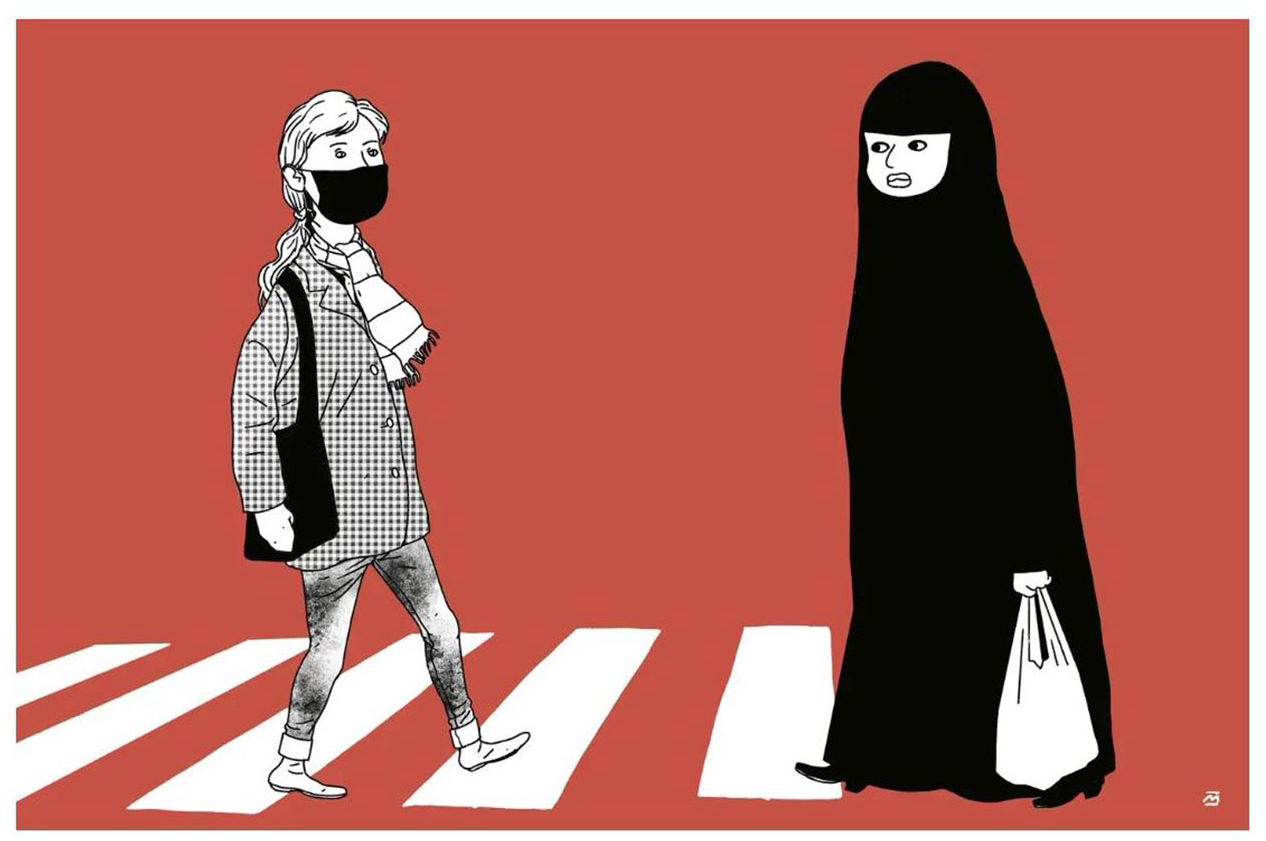
Drawing (by Marvin Helleraker, Aftenposten 13.02.2021).
Another strategy we identify in the articles consists in the employment of disclaimers that run along the widely-used “I’m not a racist, but. . .”. In “Almost half of the infections have occurred in immigrant communities” (Aftenposten 04.02.2021) a journalist asks a politician from the Progress Party: “Do you know why they [immigrants] are overrepresented? Do you think it is because immigrants do not take it seriously?” (An example, by the way, of how a journalist echoes the perspective of the dominant group). The politician responds using contradictory propositions: “No, no one knows enough about this yet [denial of stigmatization], and I know it is complex. But [strategic move] the big differences have probably to do with the fact that many immigrant communities do not take this seriously enough” [emphasis added].
Conclusion
Racism in Norway exists as discriminatory practice (Moe and Døving, 2023), but it also operates as and is indeed enabled by, the assumptions “in between the lines” of media stories, in the way information is presented in news reports, under the surface of what looks or sounds “natural” to the “majority.” While we examined the covert manifestations of racism within the timeframe of the pandemic, the features of coverage we have identified and the othering assumptions underlying the media texts are part of the long term “ordinariness” of media discourse in the country. While the public debate in Norway on the stigmatization of immigrants during the pandemic considered the presentation of facts and statistics essential for “transparency” (Norsk Redaktørforening and Helsedirektoratet, 2023), this study shows that stigmatization and racism often are at work behind what is considered as mere “facts” and “information.”
The results of the study raise a range of urgent questions, both methodological and practical: How to detect racism and discrimination that is hidden “between the lines”? How to educate journalists to be more mindful of diversity, when discrimination is in-built in one’s assumptions about the world rather than in one’s words? How to expect trust in the media, or authorities, or even integration, when a racist worldview is the backdrop to one’s life?
Our analysis shows the way in which a very selective – certainly not objective – presentation of information has led to a narrow range of arguments within the coverage and racist representation of immigrants. Media discourse mostly blamed “non-Norwegians” for the spreading of the infection. By contrast, the findings encourage thinking about what alternative narratives and lines of enquiry could have been pursued by journalists: For instance, why are some groups more vulnerable than others? How and why are they being let down by the rest of society? How is it possible that some communities, in a society supposedly characterized by equality, are suffering more than others?
By identifying which media practices and which features of content might contribute to racism, this study ultimately contributes to a more nuanced understanding of how media can best function as a unifying arena for public discourse, especially at a time of global uncertainty and turmoil. Beyond the timeframe of the pandemic and the specific case of Norway, the results of the study also help us more broadly understand how “new racism,” especially in democratic societies, hides under the disguise of “normality,” thereby remaining practically unchallenged.
