




Abstract
Political communications research has found that elites enjoy wide latitude to shape mass opinion but also identified important constraints on opinion leadership in competitive democracies. To win over the public, political leaders must generally mobilize party loyalties, secure interest group endorsements, and make persuasive arguments to support their views. Influential research (Broockman & Butler, 2017) calls these constraints into question by raising the possibility that elected officials can sway their constituents’ opinions about policy merely by declaring their own stances, without providing substantive justifications or group cues. Such “position adoption,” in which ordinary citizens simply defer to politicians’ authority, would mean that the public is more pliant than previous research suggests. To examine this possibility, we report on four experimental studies that assess the effect of unelaborated “position-taking cues” from elected representatives on their constituents’ policy opinions. We find no evidence that the bare articulation of a representative’s position changes constituents’ opinions, whereas many of the group cues and substantive arguments included in these experiments have sizable influences on opinions measured in our studies. These results cast doubt on the most pessimistic interpretation of elite opinion leadership.
Political communications research has identified a reliable array of systematic and heuristic factors in elite messages that shape public opinion (Chong & Druckman, 2007; Zaller, 1992). Citizens rely on party cues and group endorsements to guide their views on policies (Arceneaux & Kolodny, 2009; Barber & Pope, 2018; Bartels, 2002; Cohen, 2003; Druckman et al., 2013; Klar, 2014; Lenz, 2012; Lupia, 1994; Rahn, 1993; Riggle et al., 1992; Slothuus & de Vreese, 2010). They are also influenced by the frames and arguments that elites use to describe issues and justify their positions (Chong & Druckman, 2010; Iyengar, 1991; Iyengar & Kinder, 1987; Jacoby, 2000; Nelson et al., 1997). Although the public’s vulnerability to elite manipulation is at odds with “bottom-up” models of democratic representation, the findings from communications research nonetheless suggest limits on elite control (Nicholson, 2011), especially in competitive settings where citizens have access to arguments and information from multiple sources (Chong & Druckman, 2007; Sniderman & Theriault, 2004). Elites enjoy considerable latitude in the policy stances they adopt, but they still need to win over the public by mobilizing party loyalties, securing interest group endorsements of their positions, and making persuasive arguments that align with the values and interests of their constituents.
The results from two innovative field experiments conducted by Broockman and Butler (2017) raise questions about whether these ostensible prerequisites for elite influence are necessary. The experiments appear to demonstrate that obscure state legislators can shift constituents’ issue opinions toward their own by “essentially announcing their positions” (p. 209) or “merely staking out their positions” (p. 218) in a general district mailer. These mailers supplied no party cues or interest group endorsements, and they had similar effects regardless of whether they included or omitted extensive justifications for the positions taken (cf. Grose et al., 2014). Strikingly, respondents in these experiments shifted their views even on salient issues on which they would be expected to have stronger opinions and on policies that bore clearly and directly on their material self-interest.
Broockman and Butler use the term “position adoption” to describe this surprising display of public deference to elite position-taking: “citizens often defer to politicians’ policy judgments and do not require persuasive arguments to change their views on issues…they may even adopt representatives’ positions as their own even in the absence of persuasive justifications…Such position adoption, to the extent it occurs, implies that citizens are inclined to defer to politicians’ judgment without demanding justifications. Consequently, public opinion may not constrain politicians’ decisions much at all” (p. 209).
The dour view of position adoption is contrasted with the more conventional “elite persuasion” account of top-down influence, in which “elites shape public opinion primarily by highlighting how their policy proposals are consistent with citizens’ pre-existing values or by arguing they will accomplish shared goals…Such theories generally imply that politicians’ accountability to public opinion remains relatively robust” (p. 208). Although both of these perspectives concede significant latitude for elites to shape opinion, the position adoption model further undermines democratic accountability by suggesting that citizens simply defer to authority.
Broockman and Butler’s work is often cited as one among many examples of elite influence on mass opinion 1 (or, erroneously, of the influence of partisan cues 2 ). But their results have also been frequently and prominently interpreted as a demonstration not only that politicians can shape mass opinion but that they can do so merely by publicizing their views. 3 Such scholarly interest in the implications of the position adoption perspective on elite influence is understandable: if a bare position-taking statement by a little-known elected official can significantly influence mass opinion, even the most skeptical scholarly judgments on the public’s ability to hold elected officials accountable may have been too hopeful. Past research has faulted the public’s easy susceptibility to party cues, issue frames, and national leaders with known partisan and ideological affiliations (e.g. Lenz, 2012; Barber & Pope, 2018; cf. Arceneaux, 2008; Chong & Mullinix, 2018). Respondents have at times been shown to ignore substantive policy details in favor of party cues that lead them to support policies that contradict their values (e.g. Cohen, 2003; cf. Bullock, 2011). While these studies question the public’s ability to properly evaluate cues and arguments in choosing candidates and policies (e.g. Dancey & Sheagley, 2013; Kuklinski & Quirk, 1998), they nonetheless assume such informative signals and communications are necessary to marshal public opinion.
In addition, prior research has found source cues to be effective only when they are associated with communicators who have established reputations, known partisan affiliations, and familiar agendas (Iyengar & Valentino, 2000; Lupia & McCubbins, 1998; Mondak, 1993; Popkin, 1994). It is notable that the representatives in Broockman and Butler were not famous national figures but local officials whose records, reputations, experience, partisan affiliations, and agendas would have been largely unknown to the public. Prior research, therefore, would not lead us to anticipate that voters would so readily follow such individuals.
As Broockman and Butler discuss, position adoption is consistent with multiple mechanisms that support a range of evaluations of the public’s democratic competence and ability to enforce accountability. The most pessimistic interpretation invokes the psychology of obedience to authority to explain citizens’ conformity (Milgram, 1974; see Broockman and Butler p. 209). In this view, citizens will blindly follow those endowed with the trappings of legitimate authority against their own better judgment. A more benign explanation is that they may adopt representatives’ positions because they assume elected officials have greater expertise or knowledge (p. 209, 219). Such trust in representatives may be acquired through experience or stem from an assumption that one’s representative simply knows better. A third, more effortful, possibility is that voters are able to discern useful information from auxiliary cues embedded even in bare position-taking messages that persuade them to change their opinions.
We are unaware of any subsequent research that has sought to confirm whether an unelaborated “position-taking cue” – i.e., the mere articulation of an issue stance by an unfamiliar elected official – is sufficient to sway constituents’ issue opinions. Subsequent field experimental research found no evidence of conformity to local officials’ stated issue priorities (Butler & Hassell, 2018).
In this paper, we study this question using four survey experiments administered over the phone and Internet on six political issues. We have two main purposes. First, we take up Broockman and Butler’s call for additional research to clarify the conditions under which a position-taking statement from an elected official moves constituents’ opinions (p.219). To this end, our experiments are designed to isolate the causal impact of a bare position-taking cue from the effects of other cues and arguments generally found in political communications and to assess whether the impact of position-taking varies depending on the presence of additional cues, arguments, and information about the legislators themselves. Broockman and Butler’s mailers included biographical information pertaining to representatives’ self-presentation and background. Also, their representatives’ position-taking statements were accompanied at least by “minimal” or “basic” justifications invoking substantive policy implications that might have persuaded some constituents to re-evaluate their positions when administered without competing arguments (Boudreau & MacKenzie, 2014; Chong & Druckman, 2007; O’Keefe, 2002). For example, in one position-taking treatment with an ostensibly minimal justification, a legislator’s support for relaxing constraints on raising property taxes was defended with the rationale that, “quality public schools and police and fire protection are the epitome of good government.” Respondents in the placebo condition, by contrast, were not informed about which public goods a tax increase could generate.
Our experiments are designed to explore whether position adoption persists in communications stripped of these informative appendages. If obedience to authority or overriding trust in representatives’ superior judgment explain position adoption, effects such as those found in Broockman and Butler’s experiments should manifest even in the absence of auxiliary cues that bolster politicians’ trustworthiness and expertise or provide substantive policy information.
Second, we examine whether the effects of a bare position-taking cue on citizens’ issue opinions can be recovered in the context of survey experiments. If such effects are robust, they should manifest in different contexts. Although interventions embedded in surveys are arguably less realistic in some respects than those administered in the field, survey experiments are particularly well suited to the purpose of disentangling the effect of position-taking per se from accompanying cues. Constituency mail that simply states a position might confound recipients and be unappealing for representatives to send. A survey experiment can administer this treatment more naturally to observe its impact on responses. Survey experiments also give the researcher greater control over the post-treatment environment. Recipients of a mailer might have been prompted to learn more about the issue or their representative during the days between receipt and participation in the post-treatment survey. During that time, they could have been exposed to arguments or partisan cues that caused them to align more closely with their own representatives. While this possibility does not undermine the validity of inferences about the causal effect of the mailers per se, it admits mechanisms that rest on the proximate influence of persuasive cues that were not provided or implied in the treatments themselves.
Taken together, our four experiments found that respondents often reacted in predictable ways to an assortment of party cues, interest group endorsements, and issue frames and arguments, but they failed to show that the mere articulation of a state legislator’s issue position changes constituents’ opinions. Even when augmented with biographical information meant to shore up representatives’ competence, trustworthiness, relevant experience, and interest in the issue in question, position-taking cues had no effect. In contrast, respondents in our studies often reacted in predictable ways to an assortment of party cues, interest group endorsements, and issue frames and arguments. In our final experiment, we successfully reproduced a significant joint treatment effect of position-taking when paired with a “basic” justification on an issue that Broockman and Butler reported in their study. But this effect vanished among respondents who received only the position-taking cue, without the justification. This suggests that brief justifications for representatives’ positions are crucial drivers of opinion change on the types of issues included in Butler and Broockman’s experiment. While our survey experiment is by no means a direct replication of Broockman and Butler’s field experiments, it highlights how citizens can be swayed by the kinds of minimal justifications that will inevitably accompany even the most austere position-taking by elected officials, even if they are unmoved by position-taking per se.
Hypotheses
The primary hypothesis we test is that state representatives can move public opinion simply by revealing their policy position without elaboration or justification:
Informing constituents only about the position their state representative took on a political issue will increase the correspondence between the legislator’s and constituents’ positions on the issue.
Three other hypotheses test whether these effects vary with the characteristics of the source, the recipient, and the availability of additional informative cues. H2 assumes that the value of the unadorned position-taking cue, and the public’s propensity to conform to it, will increase with the credibility of the source:
The bare position-taking cue will have a larger effect when it is reinforced by positive biographical information about the representative’s background and legislative priorities.
We also expect individual variation in susceptibility to source cues. Less informed individuals will rely more heavily on endorsements because they tend to have weaker attitudes on issues (Converse, 1964; Petty & Krosnick, 1995; Zaller, 1992) and to evaluate information less systematically (Kam, 2005; Petty & Cacioppo, 1986), both of which should increase the value and impact of the position-taking cue. Therefore, the third hypothesis is that:
The bare position-taking cue will have a larger effect on less politically engaged individuals.
On the assumption that a heuristic is more likely to be used when there is little else to rely upon (Gigerenzer & Goldstein, 1996), the effect of the bare position-taking cue on the public should increase when group cues and other information are unavailable. The fourth hypothesis we test is that:
The bare position-taking cue has a larger impact when party cues, group cues, or substantive policy arguments are absent than when they are available and provide alternative bases for decision-making.
The main alternative hypothesis to H1-H4 is that systematic opinion change occurs only when position-taking cues from state legislators are accompanied by other informative cues, which would be consistent with standard information-processing models of elite opinion leadership. If opinions respond to group cues and substantive arguments but not to bare position-taking cues, we can conclude that mere position-taking is ineffectual in contexts where opinions are malleable.
Experimental Tests in Live-Caller Telephone Polls
Our first two studies tested these hypotheses in experiments embedded in Los Angeles Times telephone polls. The LA Times experiments followed similar formats for testing the position-taking cue. In each, respondents were randomly assigned to learn the vote that their own state legislator had taken on an issue recently decided in the California state legislature. Because LA Times policy required us to provide only truthful information, all treatments reflected the actual positions taken by the state legislators in recent roll call votes. Subsequent to our treatments, we measured respondents’ own opinions on the issue. The main dependent variable is the degree to which respondents hold the same position as their representatives, which we call the legislator-constituent agreement on the issue. If constituents conform to the unelaborated policy positions staked out by their representatives, the position-taking cue will increase agreement by causing constituents in districts where the legislator supported a policy to increase their support and those in districts where the legislator opposed a policy to decrease their support. Each of the surveys also included measures of political engagement so that we could test the moderating effect of respondent sophistication.
The two LA Times experiments also differed in the administration of a variety of additional information treatments that allowed us to test hypotheses about factors that might moderate the strength of the position taking effect. Study 1 tested the effect of providing biographical information about the representative and brief substantive justifications for the representative’s position. Study 2 added partisan cues, interest group cues, and substantive arguments for and against the policy. All of these treatments were randomly and independently assigned, allowing us assess the relative impact of position-taking cues against these other treatments in the same experimental setup, and to gauge whether the effect of the position taking cue was diminished by the availability of additional cues and information.
Study 1: Water Use Regulations and Medi-cal for Illegal Immigrants
Our first study tested whether providing information to California voters about their State Senator’s roll call vote on a recent issue, with and without a basic justification, would increase their agreement with that position (H1), whether positive biographical information (but no explicit partisan cue) about the State Senator would enhance this effect (H2) and whether this position-taking effect would be stronger among less politically engaged voters than those more attuned to politics (H3). The experiment examined the issues of state discretion to fine violators of water use regulations, and whether Medi-Cal or similar benefits should be extended to some illegal immigrants. It was embedded in a Los Angeles Times live telephone interview survey of 1,500 California voters that was conducted in September 2015. However, the effective sample is slightly smaller because we excluded respondents whose State Senators had abstained in recent roll-call votes on these two issues. 4 Interviews were conducted in English and Spanish. Details about the sample are provided in the online appendix.
To test H2, half of the respondents were given brief biographies of their State Senator as part of this question. These biographies, which included personal and professional histories and policy agendas, were drawn from each legislator’s website on the assumption that legislators knew best how to portray themselves positively to their constituents (see online appendix for a list of these biographical treatments).
Respondents were then randomly assigned to a control condition in which no other information was provided, or to one of the following two treatments in which they were informed about the position taken by their state senator on either the Medi-Cal program or the water conservation program:
Half of the respondents who received the position-taking cue were randomly assigned to receive a brief justification (text in online appendix) for this position phrased as a persuasive communication. Respondents who did not receive the position-taking treatment also did not receive this justification; therefore, we cannot test the strength of the argument against a pure control baseline but only relative to the position-taking cue
After receiving these treatments and answering an intervening battery of questions on other unrelated topics, respondents were asked their opinions about both the water use violations fines issue and the Medi-Cal extension issue, with the order of these questions randomized. We classify the slightly more than half of voters who said they were very or somewhat interested in following politics as more engaged voters (high interest) and the rest as less engaged voters (low interest). The dependent variable, agreement between legislators and respondents, is scored 0 if the two had opposite post-treatment opinions on the issue, .5 if the respondent was not sure about the issue, and 1 if the two agreed.
Effect of Position-Taking Cue on Respondent-Legislator Convergence (LA Times: Water Use Fines & Medi-cal Extension)
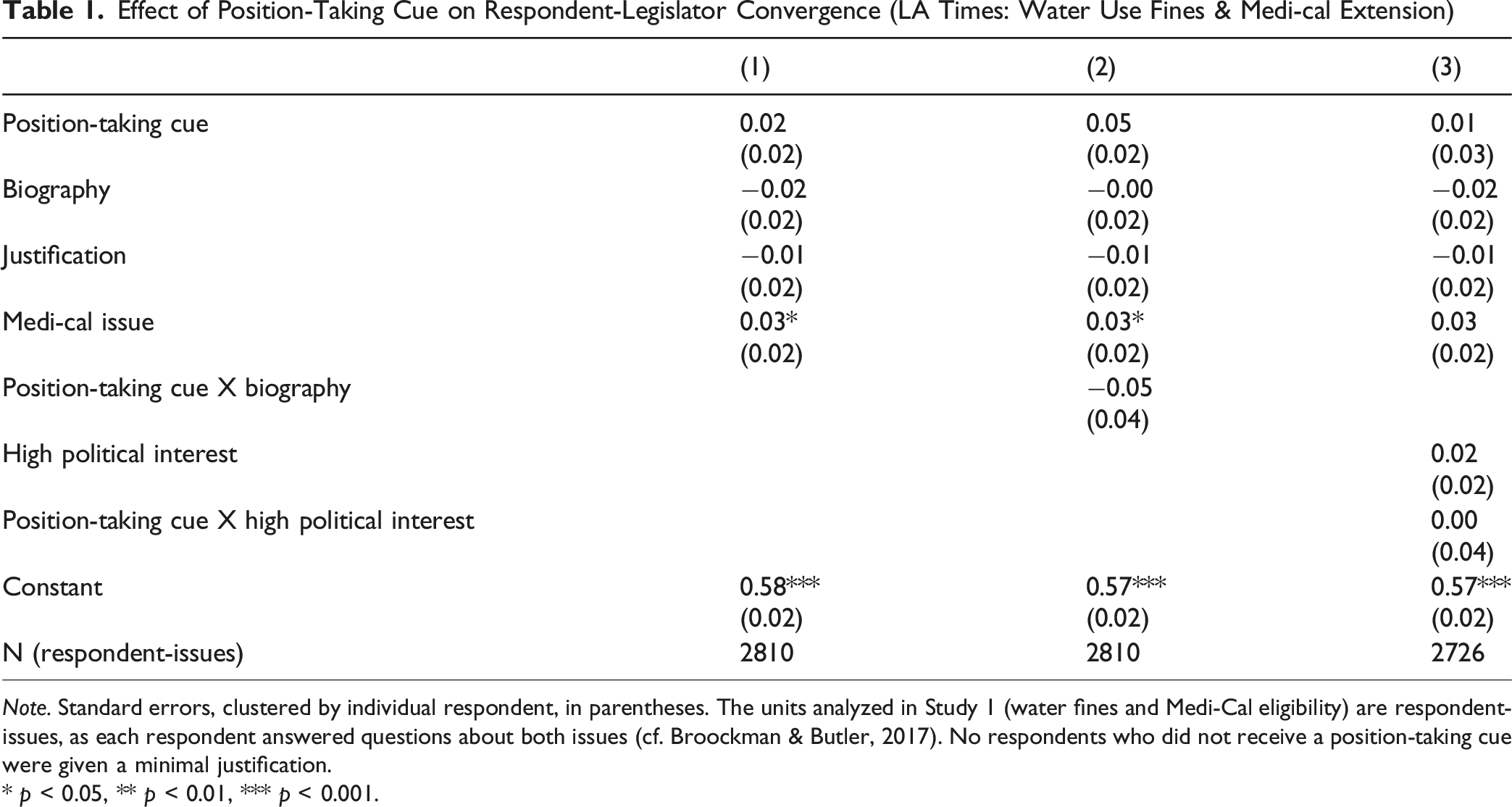
Note. Standard errors, clustered by individual respondent, in parentheses. The units analyzed in Study 1 (water fines and Medi-Cal eligibility) are respondent-issues, as each respondent answered questions about both issues (cf. Broockman & Butler, 2017). No respondents who did not receive a position-taking cue were given a minimal justification.
* p < 0.05, ** p < 0.01, *** p < 0.001.
The second column of Table 1 tests H2 – our expectation that positive biographical information would increase the impact of a position-taking cue by bolstering the legislator’s expertise and credibility. On the contrary, the coefficient on the interaction between the biography treatment and the position-taking cue is negative, though insignificant. In short, respondents who learned about the qualifications of their elected representatives were nonetheless, on average, unmoved by information about how they had voted on these two issues.
Column 3 reports whether the bare position-taking cue’s effect strengthened among less engaged voters (H3). The coefficient on the interaction between the dichotomous measure of political interest and the position-taking cue is zero, meaning the insignificant average effect of this cue applied to both high- and low-interest respondents. Even among the least sophisticated respondents who arguably have the greatest need to rely on a position-taking cue, we find no evidence that state representatives induced conformity to their issue positions.
Although the position taking cue was ineffective in Study 1, providing a minimal justification for the representative’s position also did not significantly alter opinion (third coefficient in column 1). Given the absence of significant effects overall, it is possible the experimental design we employed minimized treatment effects of any kind. Fortunately, a general lack of malleability is ruled out in our subsequent studies.
Study 2: Regulations on Smoking
Our second study provided an opportunity to test the influence of a position-taking cue on two additional issues, in comparison to a broader set of auxiliary treatments associated with standard information-processing models. This study was designed to mimic salient features of public debate on two issues pertaining to the regulation of smoking -- a proposal to raise the minimum legal age for purchasing cigarettes, and a proposal to impose a new tax on tobacco products. The sample consisted of the 1,500 respondents in a May 2016 Los Angeles Times live interview telephone poll, 1,349 of whose representative in the State Senate had voted “yes” or “no” in recent roll-call votes on these two measures.
As in Study 1, respondents were randomly assigned to answer questions on only one of the two issues. Those assigned to the control condition of each issue were provided a short description of the proposal while those randomly assigned to the treatment condition learned how their representative voted on the issue.
To measure the impact of the position-taking cue in different information contexts, we also randomly and independently assigned respondents to receive no other cue or one of three additional pieces of information: (1) a partisan cue telling them that “Democratic Governor Jerry Brown supported (opposed) the bill” (Brown signed the bill raising the minimum age and vetoed the tax increase); (2) a “group cue” telling them that the California Medical Association supported the bill and the California Retailers Association opposed it (randomly rotating the order in which these positions were presented); or (3) a pair of substantive arguments expressing reasons for supporting and opposing the bill (the order of the arguments was also rotated at random). 6 In addition to permitting us to compare the effect of position-taking to the effects of these more standard persuasion devices, including these additional treatments also allows us to test H4 – that the position-taking cue has a stronger effect in their absence than when they are provided together.
We measure political engagement with a question about respondents’ self-reported interest in that year’s Senate primary election. The slightly more than half of voters who said they were very or somewhat interested are classified as more engaged voters (high interest) and the rest are considered less engaged voters (low interest).
Effect of Position-Taking Cue, Study 2 (LA Times: Tobacco Min. Age & Tax)
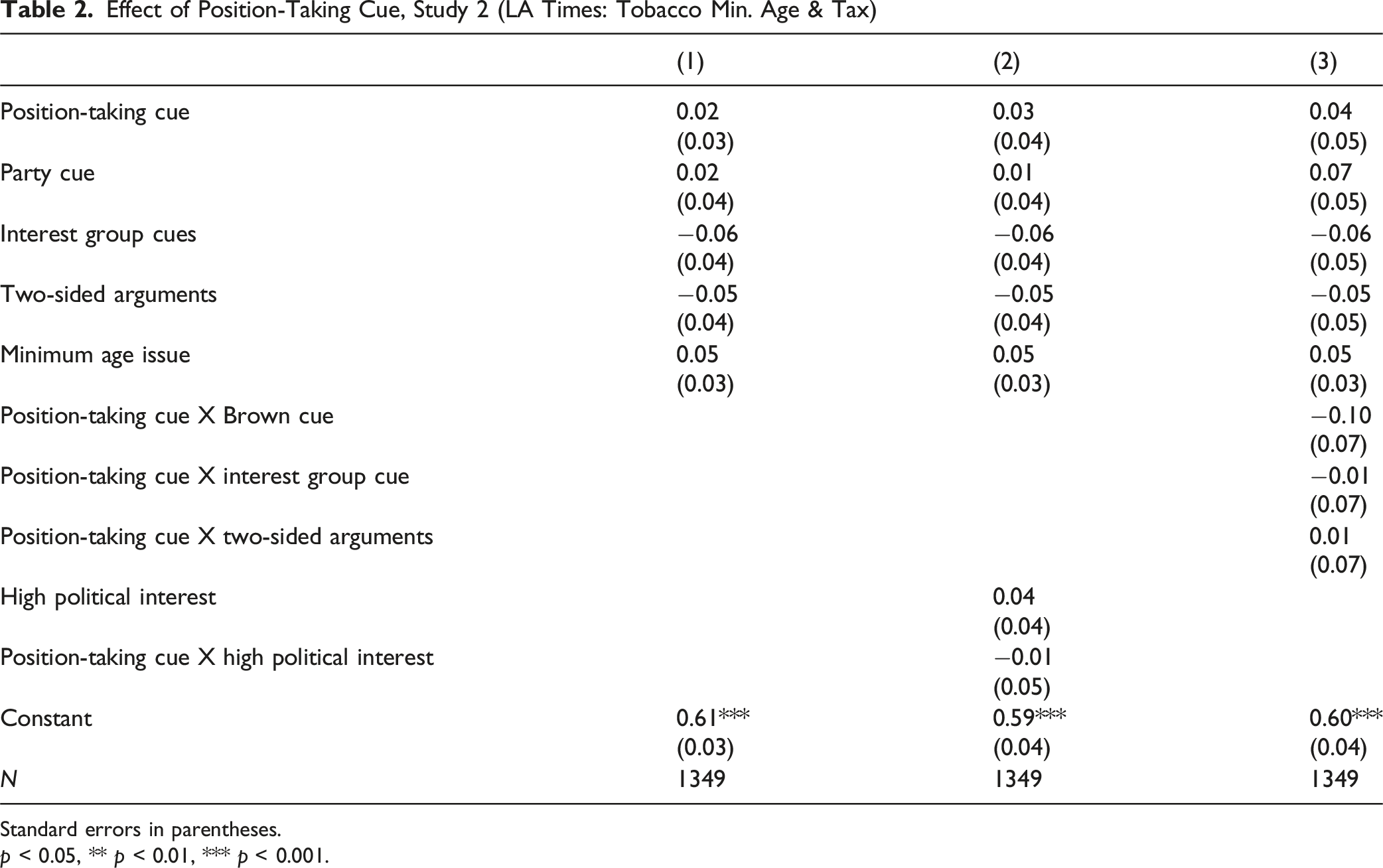
Standard errors in parentheses.
p < 0.05, ** p < 0.01, *** p < 0.001.
Column 3 represents our test of H4 – whether the position-taking cue would be less influential in the presence of additional information that could guide respondents’ opinion formation. The failure to corroborate H1 in study 2 obviates this test, as posed: one cannot erase an effect that failed to register in the first place. Nonetheless, the estimates in column 3 point to little variation in the size of the position-taking effect with and without competition from additional cues and suggest a small and insignificant impact on agreement even when no additional cues are present. In sum, contrary to H4, there is no significant difference between the effect of the position-taking cue in the presence or absence of additional information of the sort that is commonly available in news coverage of political issues like these.
Effects of Other Cues on Opinion About Tobacco Issues, Study 2
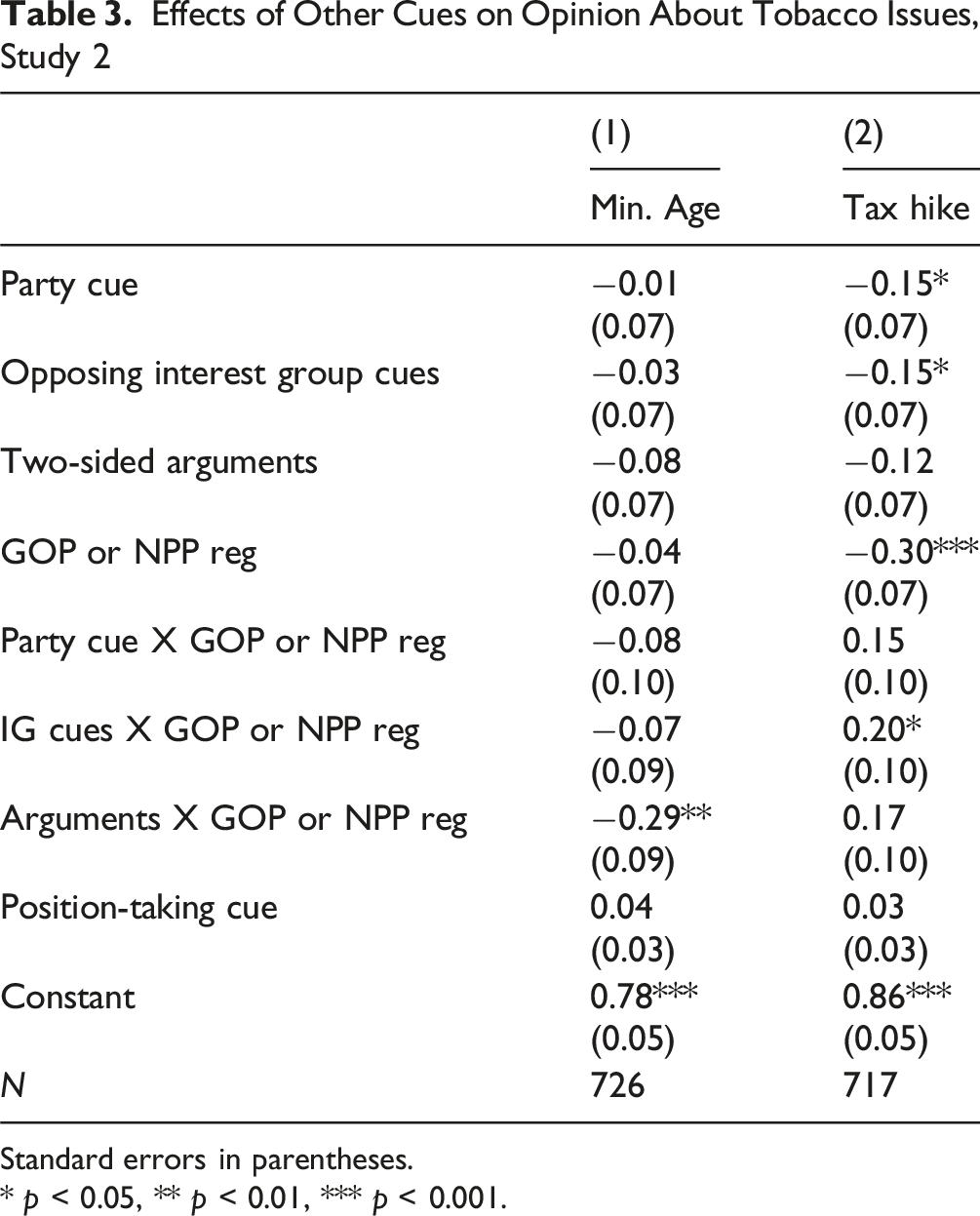
Standard errors in parentheses.
* p < 0.05, ** p < 0.01, *** p < 0.001.
On the minimum age issue (column 1 of Table 3), the arguments had an enormous impact on Republican and no-party preference voters despite no significant impact on Democrats. This cue polarized voters dramatically even though the parties were surprisingly close to one another on this issue at baseline. Of course, there is no expectation that all treatments associated with conventional models have significant effects in all cases. Neither the party cue nor the interest group cues had much impact – perhaps because voters perceived both the party and interest group cues as stereotype-consistent and therefore unilluminating.
On the tax issue (column 2 of Table 3), which showed greater initial polarization between the two parties at baseline, the counter-stereotypic information about the Jerry Brown veto substantially and significantly reduced Democratic support for the tax. So too did the interest group endorsements. The opposition argument about the tobacco tax’s cost to consumers and small businesses reduced Democratic support for the policy, though the estimate falls just short of statistical significance. None of these cues had any significant effect on Republican voters and those who registered without a party. Republican voters may have more rigid positions generally on issues of taxation and therefore may have been less susceptible to any of the treatments. The party cue specifically was unlikely to turn them against a tax they opposed initially simply because they disliked the idea of agreeing with the Governor of the opposing party. While there is some variability in the effects of these treatments, the overall picture suggests that opinions about these issues were substantially influenced by the sorts of heuristics and policy details emphasized in standard information-processing models, and not at all affected by the bare position-taking cue.
Experimental Tests in Online Surveys
The results of the experiments embedded in LA Times live-caller polls offer little reason to believe that a position-taking effect exists in the experimental format we used, even when representatives’ reputations are bolstered with biographical information, among less politically attentive respondents, or in information-poor contexts where voters have little else to go on. In our third and fourth studies, both conducted in surveys administered online, we modified the experimental format to maximize the chances of observing a substantial effect of the bare position-taking cue. In both studies, to minimize any decay of the effect of this cue, we placed it, and all other manipulations, immediately before the dependent variable soliciting respondents’ issue opinions. In Study 3, we amplified the intensity of the position-taking cue by expressing that the state representative had featured the issue in his or her last campaign, a statement intended to convey importance and also perhaps subject-matter expertise. We also designed this experiment around a political issue – management of the Air Traffic Control system -- that we assumed few people would have strong or settled opinions about.
In Study 4, we used one of the political issues from Broockman and Butler’s field experimental study – whether a non-partisan commission should be appointed to draw legislative districts. We precisely duplicated their phrasing of the dependent variable question and the “basic justification” that accompanied position-taking on this issue in their study. Notably, this was the issue in their study that generated the largest estimated effect of the position-taking cue (see their online appendix, Figure A1), though formal tests they conducted could not reject the null hypothesis of no difference in effects across issues. To partial out the effect of the position-taking cue per se from the basic justification that accompanied it, we randomized whether respondents received (1) only a bare position-taking cue that stated the position their state representative had taken or (2) this position-taking cue paired with the justification. Study 4 was also pre-registered at EGAP with a pre-analysis plan that our analysis below follows (#20200623AB).
Study 3: Administration of Air Traffic Control
Study 3 used a sample of 1,453 U.S. adults recruited by Amazon’s MTurk between August 23–25, 2017. 8 Respondents were assigned with equal probability to the Control (no position-taking cue), a supportive position-taking treatment or an opposing position-taking treatment on the issue of whether management of the Air Traffic Control System should be transferred from the federal government to a non-profit corporation. Independently, all respondents were also randomly assigned to receive no additional cue, a partisan cue, or one of two two-sided informational cues. The partisan cue pitted President Trump’s support for the issue against Congressional Democrats’ opposition. One of the paired information treatments contained arguments for and against the policy that were intended to be balanced in strength: the pro argument that the GAO found non-profit management would reduce delays and preserve safety was provided alongside the con argument that the new management would be captured by the airline industry and used to weaken customer service and protections. In the other, unbalanced information treatment, the pro argument remained the same while the con argument, stating that fees might increase in certain rural areas, was designed to be weaker.
Our assumption that management of the Air Traffic Control System would be an obscure issue to voters is supported by our finding that only about 20% of respondents across all conditions claimed they had heard something about this issue, which is significantly lower than the percentages who had heard of the issues used in Studies 1-2, even though MTurk samples tend to be far more politically engaged than representative cross-sections of the electorate.
The design of Study 3 stacked the deck in favor of finding an effect of the position-taking cue by using an unfamiliar and arcane political issue, representing the issue as a priority in the elected official’s agenda, “hitting respondents between the eyes” with the position-taking treatment, and immediately asking their policy preference to minimize decay of the treatment effect.
Effects of Position-Taking and Other Cues, Study 3 (MTurk Survey)
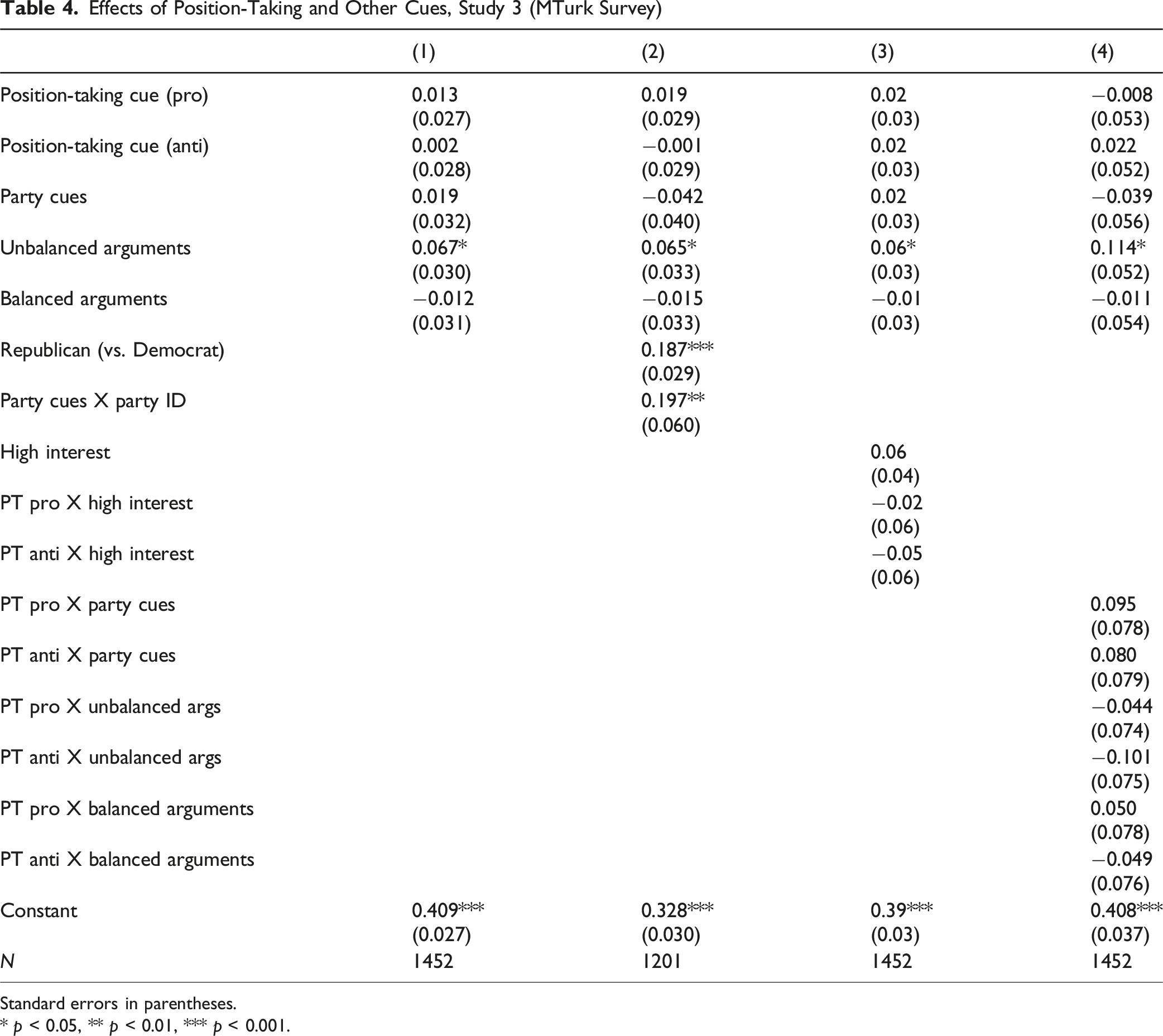
Standard errors in parentheses.
* p < 0.05, ** p < 0.01, *** p < 0.001.
Additionally, as shown in Column 3, there is no evidence that the position-taking cue had larger effects among less politically engaged respondents (contrary to H3). There is also no evidence, for H4: the position-taking cues had no significant effect even when they were administered in the absence of party cues or arguments (Column 4).
By contrast, the other treatments all influenced responses in ways anticipated by conventional information-processing models of opinion leadership, underscoring the broad latitude for attitude change in this experimental setup. The partisan cue significantly polarized responses by party identification. Similarly, the average effect of the unbalanced two-sided information cue across experimental conditions significantly bolstered support for privatization, while the balanced information restored roughly the baseline level of support.
Therefore, the standard tools of persuasion in policy debates – partisan cues and substantive policy arguments – had large and significant effects that are consistent with prior research (Chong & Druckman, 2007; Zaller, 1992). The position-taking cue was the only treatment that failed to move opinion. This is strong evidence against the thesis that representatives can move their constituents’ opinions by “essentially announcing” their positions and in favor of standard information-processing models of elite opinion leadership.
Study 4: Adaptation of Broockman and Butler’s Redistricting Commission Mailer Text
Our final study was conducted on a sample of nearly 4,000 U.S. adults provided by Lucid Labs in July 2020. Respondents were assigned at random to one of five conditions. Those in the Control condition were simply asked the following dependent variable question, reproduced verbatim from Broockman and Butler’s follow-up survey in which they measured the effects of their mailers: Now, changing topics, some people say that a state agency should be given the authority to draw the boundaries for legislative districts in your state. Others say that the state legislature should remain in charge of drawing boundaries for legislative districts. Do you think a state agency should be given the authority to draw the boundaries for legislative districts instead of the state legislature?
As in Broockman and Butler’s study, convergence with the legislator was coded 1 (support for creating the state agency), divergence was coded 0 (opposition to the state agency) and not sure answers were coded .5.
Those assigned to receive an unadorned position-taking cue (PT Cue), were also told:
Your representative in the state legislature recently issued a statement in support of giving a state agency the authority to draw the boundaries for legislative districts in your state.
Those assigned to receive a party cue were further assigned with equal probability to conditions in which the words “, a Democrat” or “, a Republican” were inserted after the word “legislature” in the PT Cue condition.
Finally, those assigned to the “Basic Justification” condition were given the position-taking cue along with the verbatim text of the “basic justification” employed in the mailers that Broockman and Butler sent out:
Your representative in the state legislature recently issued the following statement in support of giving a state agency the authority to draw the boundaries for legislative districts in your state: “I am working to make the legislative redistricting process nonpartisan, and put a neutral agency in charge of drawing boundaries for legislative districts instead of political parties. Specifically, I am supporting legislation that would put the responsibility of redrawing Congressional and legislative district maps in the hands of a non-partisan advisory council, with final approval voted on by the legislature. We must work together to restore the public trust in good government.”
Crucially, this justification includes substantive arguments and policy information that clarify and defend the idea of giving authority over redistricting to a “state agency.” Those who received the basic justification were informed that the change would shift decision-making to an agency that was “nonpartisan” and subject to legislative oversight, and that this reform would also shore up public trust in good government. This basic justification thus offers a substantive defense of the position staked out by the legislator. The key question is whether this justification might generate a persuasive effect even if the position-taking cue on its own, stripped of the accompanying justification, does not.
Effects of Position-Taking and Other Cues, Study 4 (Lucid Survey)
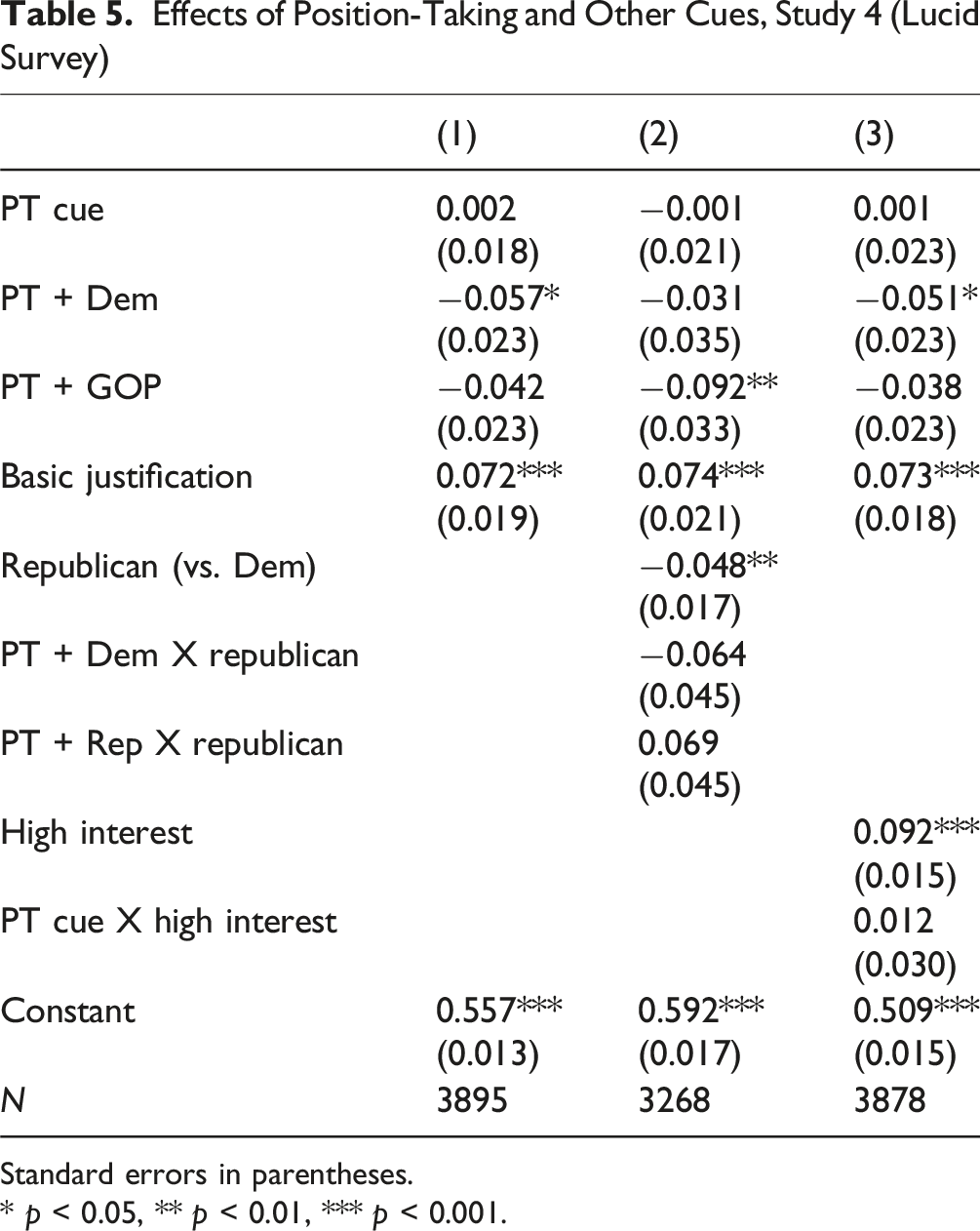
Standard errors in parentheses.
* p < 0.05, ** p < 0.01, *** p < 0.001.
Most notably what proves highly effective in moving opinion is the addition of the justification, which increases convergence by approximately 7 points. The position-taking cue is ineffective while the accompanying minimal justification included in Broockman and Butler’s mailers is highly persuasive. This result weighs against position adoption mechanisms rooted in obedience to authority and trust in elected representatives and is instead consistent with well-established information-processing models in which elites persuade via arguments and frames.
Discussion and Conclusion
The four studies reported here probe whether citizens conform to their state representatives’ unelaborated issue stances. Across six issues and four experiments that spanned a variety of information contexts, we found no evidence that constituents conform to the unadorned positions adopted by their elected representatives. At the same time, our respondents often, though not always, gave significant weight to policy arguments, as well as party and interest group cues, in their evaluations of public policies, confirming that respondents were open to persuasion but required information to change their positions on these issues. These results are consistent with established information-processing models of elite opinion leadership that identify many routes of elite influence and manipulation through the use of cues, frames, and policy details. They offer no support to more pessimistic interpretations of position adoption that entail broad deference driven by the psychology of obedience to authority or unquestioning trust in elected officials.
Effects of the mere position-taking cue failed to materialize even on issues that we assumed many citizens would have little basis for evaluating in the absence of information. Notably, the MTurk survey experiment was designed around an obscure air traffic control issue to maximize the chances of observing a sizable effect of the bare position-taking cue, yet failed to provide any evidence of such an effect, even among the least politically engaged respondents. In the Lucid survey experiment, which employed an issue and treatment wording drawn directly from Broockman and Butler’s field experimental study, we found that the basic justifications used in their mailers were not incidental, but quite influential even when the position-taking statement itself had no impact.
That citizens do not conform to the unelaborated opinions of obscure elected officials by no means rescues classical models of bottom-up democracy, which assume unrealistically strong levels of democratic accountability. Voters can also be misled by the standard tools of elite persuasion, as an extensive literature on party labels and framing has demonstrated. But those who rely on the tools of persuasion emphasized in conventional information-processing models are arguably making better informed decisions than those who simply adopt their representatives’ stated issue positions. Voters who mimic a single elected official depend on that individual’s trustworthiness, expertise, and claim to represent their interests. By contrast, substantive arguments often explain how a policy works and signal its anticipated effects on particular constituencies as well as the public good. Partisan cues generally indicate that an issue position is supported by a broad coalition of prominent elected officials and groups, rather than the potentially idiosyncratic or self-serving views of an individual representative. Citizens are also more likely to know something about the priorities of the two major parties and the groups they represent than be aware of the identity and preferences of a particular representative (Delli Carpini & Keeter, 1996; Green et al., 2002; Songer, 1984; Treadway, 1985). Likewise, interest group endorsements furnish clearer information than mere position-taking about the beneficiaries of a policy, though the utility of this type of information is quite susceptible to voter misperceptions of interest groups’ stances and agendas (Broockman et al., 2024). The evidence from our studies shows that voters resist conforming to political leaders’ opinions that do not line up with their party’s position or are inconsistent with their evaluation of the available policy information. This constraint ought to place a check on elite opinion leadership because, as a rule, in competitive democracies these additional cues are available except when the issue in question is consensual or uncontroversial.
The latitude for elite opinion leadership of mass opinion is clearly a topic that merits further scrutiny, as is the role that the authority and prestige of the source play in shaping citizens’ responses to persuasive messages. If our study provides evidence against what could be considered a “worst case scenario” for democratic accountability, it does not tell us where citizens do draw the line and why. Future research might examine the threshold for position adoption effects by varying the notoriety and trustworthiness of endorsers. Here, we followed Broockman and Butler (2017) in using state representatives as position-takers because we assumed their unfamiliarity to the great majority of respondents would allow us to identify the impact of status as representatives alone, separate from personal reputations. It is possible that the effects would have been stronger if we had informed people about the positions that their better-known national representatives took. One challenge for studies that seek to examine the impact of representatives’ notoriety and prestige on the persuasiveness of their communications is that as these factors increase, so does the likelihood that voters will know or be able to infer their representative’s partisanship. This makes it hard to disentangle the effects of position-taking itself from partisan and other cues.
Although Study 4 suggests that the position-taking effects in Broockman and Butler’s study may actually have been driven by the brief but often substantive arguments that accompanied them, several other design differences between their study and ours merit further attention. Survey experiments have the virtue of guaranteeing that respondents receive the information, whereas mailers in a field experiment can be discarded unread. But mailers also permit repeat exposure to the treatment and entail a lag between delivery and measurement of the dependent variable. During this post-treatment period, some recipients might have been prompted to learn more about the focal issue, exposing them to partisan or group cues or arguments that changed their opinions. This mechanism would be consistent with a causal effect of elite position-taking but in line with standard “elite persuasion” theories rather than deferential “position adoption.” A mailer from a representative might also signal greater authenticity, credibility, or prioritization of the issue by the representative than can be achieved in a survey experiment – even when the treatment features an ostensible statement issued by the representative, as in our Study 4. Future research could, in principle, determine whether bare position-taking effects can be manifest in mailers by replicating Broockman and Butler’s study but without the accompanying basic justifications, or with justifications that truly lack substantive information.
Top-down influence raises important questions about the public’s capacity to enforce democratic accountability from elected officials. The results presented here should make us wary about concluding that the public will conform to the preferences of their representatives without seeking reasons or justifications for doing so.
Supplemental Material
Supplemental Material - Will Constituents Simply Take Their Elected Representatives’ Word for It?
Supplemental Material for Will Constituents Simply Take Their Elected Representatives’ Word for It? by Dennis Chong, Morris Levy in American Politics Research
Footnotes

Funding
The authors received no financial support for the research, authorship, and/or publication of this article.
Declaration of Conflicting Interests
The authors declared no potential conflicts of interest with respect to the research, authorship, and/or publication of this article.
Supplemental Material
Supplemental material for this article is available online.
Notes
References
Supplementary Material
Please find the following supplemental material available below.
For Open Access articles published under a Creative Commons License, all supplemental material carries the same license as the article it is associated with.
For non-Open Access articles published, all supplemental material carries a non-exclusive license, and permission requests for re-use of supplemental material or any part of supplemental material shall be sent directly to the copyright owner as specified in the copyright notice associated with the article.
