




Abstract
Recent elections have featured various politicians directly appealing to the working class, yet we know little about how citizens react to class appeals from candidates. We investigate this question using survey experiments conducted in the United States and Denmark. We show that symbolic class rhetoric substantially influences candidate evaluations and ultimately polarizes these evaluations across class lines. We also unpack how class appeals work and find that while they increase perceptions of representation among working class voters, they have a more limited effect on perceptions of candidates’ ideological position. Our results help explain how class affects voter decision-making and contribute to broader discussions about the role of political elites in activating social cleavages.
Keywords
Introduction
Social class was the dominant political cleavage in most industrialized societies for much of the 20th century and appeals to class constituencies, notably appeals to the working class by leftist politicians, were a standard feature of most elections. Nonetheless, election results became less dependent on the shrinking working class as the millennium approached. Politicians, especially those on the left, talked less about class in their campaign rhetoric and voting behavior depolarized along class lines (Best, 2011; Evans & Tilley, 2017; Thau, 2019). This led some to argue that class politics was dying if not dead already (Beck & Beck-Gernsheim, 2002; Clark et al., 1993; Listhaug, 1997; but see Bartels, 2016; Hout, 2008, and Piston, 2018 for a contrasting take).
Recent elections provide a reason to revisit the role of social class in candidate evaluations. On a number of occasions, high-profile politicians have talked about class politics and appealed directly to the working class in their campaign rhetoric. In the US, Senator Bernie Sanders characterized his run for the Presidency as a “campaign of the working class, by the working class, and for the working class” (Medina & Ember, 2020). In Britain, former Labour leader Jeremy Corbyn declared that Labour was “back as the political voice of the working class” and would “put the interests of working-class people center stage” (BBC, 2018). These examples are not particularly rare. In fact, class rhetoric is still quite common among left-wing political elites in the US, Britain, and Scandinavia (Horn et al., 2020; Rhodes & Johnson, 2017; Thau, 2019). Working class appeals also figure prominently in debates concerning the success of right-wing populist politicians such as Marine Le Pen in France, Luigi Di Maio in Italy, and Donald Trump in the US (Lamont et al., 2017; Mutz, 2018; Rydgren, 2013). What effect does this type of rhetoric have on public evaluations of candidates?
Existing work does not provide direct evidence about this important question. While there is a burgeoning literature about on the effects of group appeals in campaign rhetoric, this work focuses primarily on gender, race, and religion, not class (Hersh & Schaffner, 2013; Holman et al., 2015; Kam et al., 2017; Ostfeld, 2019; Philpot, 2007; Swigger, 2012; Weber & Thornton, 2012). 1 Likewise, recent work about how the class background of a candidate influences voter preferences says little about whether politicians can effectively use appeals to social classes and specifically the working class (Carnes & Lupu, 2016; Carnes & Sadin, 2015; Evans & Tilley, 2017; Heath, 2015, 2018; Vivyan et al., 2020). This impedes our understanding of electoral strategies as politicians can strategically alter their campaign rhetoric, but not their social background.
We argue that candidates can shape voter perceptions through direct and symbolic working class appeals. Specifically, we show that appeals to the working class attract working class voters and that this has the almost inevitable effect of increasing class polarization in voters’ candidate evaluations. Our evidence comes from two studies (total N = 5,415). In Study 1, respondents in both Denmark and the US were asked to evaluate either a candidate who either made no appeal to any social class or a candidate who made a policy-less symbolic appeal to the working class containing only an assertion that it is time to ‘prioritize’ the working class over the upper middle class. We find that such working class appeals substantially influenced subsequent candidate impressions in both countries. Working class voters rate candidates more positively if they make an appeal to the working class, whereas upper middle class voters barely react to such class rhetoric. The result is a polarization of perceptions across the class structure. In Study 2, we replicate this initial finding in Denmark using a different dependent variable and examine the relative influence of symbolic appeals to the working class compared to policy statements. Here, we find that symbolic appeals are as effective as policy-centered appeals. Finally, we use evidence from both studies to consider why symbolic working class appeals influence impressions. We show that symbolic appeals matter mainly due to their influence on perceptions of candidates’ willingness to represent the group rather than their influence on perceptions of candidates’ left-right policy positions.
We make three contributions. First, we extend the literature on group-based campaign appeals concerning racial, gender, and religious groups by expanding the focus to social class groups. Second, we provide stronger causal evidence for the role of political elites in structuring the relationship between social class and vote choice, thereby going beyond studies using observational data (Evans & Tilley, 2012a, 2012b, 2017; Thau, in press). Third, we identify a novel way through which symbolic group appeals work: perceptions of group representation. We thus also contribute to the broader literature on group cleavages in voting behavior by emphasizing the role of political elites in cultivating group polarization (Achen & Bartels, 2016).
Symbolic Group Appeals
Politicians frequently appeal to social groups. Recent studies on political rhetoric in the US, Britain, and the Scandinavian countries report that party manifestos, political speeches, and campaign advertisements are, to a substantial degree, dedicated to group appeals (Elder & Phillips, 2017; Evans & Tilley, 2017; Horn et al., 2020; Nteta & Schaffner, 2013; Rhodes & Johnson, 2017; Thau, 2018). Our primary concern is with the effect of symbolic group appeals on subsequent voter preferences. By symbolic appeals, we mean a political communication in which a politician casts themselves as an ally of some social group but absent much, if any, elaboration of policy. Consider two real examples of direct mail candidate communications cited by Hersh and Schaffner (2013, pp. 524–525): “A Voice for Working America” and “Standing up for Maine’s Working Families.” In neither case does the message convey what this “voice” will say on behalf of working Americans or what the politician “stands” for. Symbolic appeals of this sort may be particularly attractive to politicians insofar as they enable them to communicate information that bolsters their electoral fortunes, while also avoiding alienating voters by maintaining ambiguity about policy positions (Dickson & Scheve, 2006; but see, Hersh & Schaffner, 2013). Although candidates also appeal to groups via policy statements, a focus on symbolic appeals provides a direct window on the effect of specifically appealing to a social group. 2
Although politicians make symbolic appeals to groups in their campaign rhetoric, our knowledge regarding the influence of these appeals is still limited in at least three important respects and particularly so when it concerns class-based appeals. First, existing work has primarily explored the prevalence of class-based appeals rather than their influence (Evans & Tilley, 2017; Rhodes & Johnson, 2017; Thau, 2019). Second, we know little about how such appeals compare to the traditional ‘currency’ of the political market, that is, appeals explicitly focused on policy (Kitschelt, 2011, p. 620; but see, Thau, 2020). Are they more or less effective? Prior studies on targeted group appeals in campaign rhetoric typically randomize the presence or absence of a group appeal but do not separately randomize whether a policy statement is also presented and thus do not speak to this question (Hersh & Schaffner, 2013; Kam et al., 2017; Ostfeld, 2019; Swigger, 2012; Weber & Thornton, 2012). Finally, we do not know how symbolic class appeals influence voters. What is it that voters infer from such appeals? To what extent are class appeals used to infer candidates’ policy positions and/or their willingness to represent working class voters? These are the questions that we wish to answer.
Do Class Appeals Work?
In considering whether and how symbolic class appeals influence candidate evaluations, we ground our theory in the literature on group-centrism and public opinion (Achen & Bartels, 2016; Conover, 1988; Converse, 1964; Green et al., 2004; Lupu, 2014; Nelson & Kinder, 1996). Attitudes toward a social group such as the working class will influence opinions when two conditions are met. First, people need to have some beliefs about the social group. They need to either like or dislike the group, or at least have a view about the group’s interests. People can then use these beliefs to form evaluations of a political object, such as a candidate. Second, people need “some interstitial ‘linking’ information indicating why a given party or policy is relevant to the group” (Converse, 1964, pp. 236–237). Class-related attitudes are unlikely to substantively influence subsequent behavior if these two conditions are not met.
Various studies show that most people in Western democracies meet the first condition as they still maintain attitudes toward, and beliefs about, social classes. Social class continues to structure people’s lives including their education, friendships and marriages, health, and lifestyle choices (Bennett et al., 2009; Elo, 2009; Goldthorpe & Jackson, 2008; Schwartz & Mare, 2005). Meanwhile, the vast majority of people still identify with a particular class and think about society in class terms (Bartels, 2016; Hout, 2008; Piston, 2018). People also vary quite markedly in their emotional reactions to different social classes. The working class, for instance, is consistently rated more positively on group stereotype measures pertaining to warmth than are the rich (Fiske, 2019; Robison & Stubager, 2018). Likewise, the working class is consistently the most positively evaluated social group asked about by the ANES in its feeling thermometer battery (Bartels, 2016, p. 114). In 2012, for instance, the average rating for the working class was 82 compared with 76 for the middle class and 50 for the rich. A wide array of evidence thus suggests that people still possess attitudes towards classes that they can use in decision making.
While there is good reason to think that people possess beliefs about classes that they could use to inform their impressions of candidates, the class politics literature suggests greater skepticism about their application. While some scholars maintain that class is still politically important (Hout, 2008), others point to a decline in class voting to argue that social classes have lost much, if not all, of their psychological relevance for political behavior (Beck & Beck-Gernsheim, 2002; Clarke et al., 2004; Franklin, 1992; Kingston, 2000). Dalton (2008, pp. 156–157) sums up this latter perspective when arguing that “the political cues provided by traditional class groups” are “simply less relevant to today’s voters.” This relevance, however, is influenced by politicians. Class may be seen as less important when parties converge to the ideological middle or emphasize post-material issue concerns (Elff, 2007, 2009; Evans & Tilley, 2012a, 2012b). Likewise, a declining share of working class politicians robs voters of a class cue that could activate class attitudes (Carnes, 2013; Heath, 2015, 2018). Or, as we argue, a declining focus on class in campaign rhetoric could undermine its perceived relevance for voting behavior (Evans & Tilley, 2017; Thau, 2019). Voting based on class, or any other relevant social cleavage, thus has an important “top-down” component.
Politicians may be reluctant to move away from the ideological center lest they alienate voters (Adams & Somer-Topcu, 2009; Hall, 2015). At the same time, politicians cannot change their class background to cue people to think in class-based terms. However, politicians can appeal to a particular class in their political communications. We argue that these appeals should influence subsequent candidate impressions. The use of phrases such as ‘the working class’ should automatically activate associated mental constructs (Lodge & Taber, 2013). In turn, these class attitudes will be linked to the candidate when the candidate signals they are allied with the class. 3 Symbolic appeals provide the opportunity to apply one’s class-related beliefs to political evaluations and a reason to do so.
We expect that the impact of symbolic working class appeals will vary by voters’ own class identification with important consequences for the presence of class polarization in candidate evaluations. Individuals who identify as a member of the working class tend to report more positive views of their social group than those who identify higher up the class ladder due to identity-based motivations to favor one’s in-group (Huddy, 2013; Robison & Stubager, 2018). Consequently, appeals to the working class should translate into greater levels of support among members of the working class, while those at the opposite end of the class spectrum are unlikely to be moved or may even react negatively (Hersh & Schaffner, 2013; Ostfeld, 2019; although, see Holman Schneider and Pondel 2015 and Kam et al., 2017). The result is greater class polarization in candidate evaluations. This leads to our first two hypotheses:
Note that H2 can find support if only the working class changes its evaluations in response to a working class appeal while higher classes are unaffected or if the two classes move in opposite directions. Given the absence of prior knowledge on this point, we are agnostic as to which pattern might materialize.
We expect that symbolic working class appeals will influence subsequent candidate evaluations. But how do these messages compare to appeals more explicitly focused on the policies of candidates? On the one hand, it is plausible that symbolic appeals will be less influential. Politicians believe that policy matters as they strategically highlight issues when they hold popular positions, but change the topic or remain ambiguous otherwise (Canes-Wrone, 2006; Grimmer, 2013). Voting behavior is also not as policy-less as some accounts might allege (Ansolabehere et al., 2008). On the other hand, there is reason to expect that symbolic appeals may match, or even outweigh, the influence of explicit policy appeals. A long line of research demonstrates the power of social groups in affecting policy opinions and candidate evaluations particularly for an electorate lacking knowledge about how to connect policy particulars to underlying interests (Achen & Bartels, 2016; Conover, 1988; Nicholson, 2011). In addition, the symbolic nature of symbolic appeals enables a politician to potentially avoid alienating voters who disagree with them on policy particulars (Dickson & Scheve, 2006). Because there is no prior evidence with direct bearing on this question, and because the arguments on both sides appear reasonable, we pose two contrasting hypotheses:
How Do Class Appeals Work?
A politician who claims that they are “A Voice for Working America” presumably does so because they believe this message communicates something appealing to voters. But what kind of information do voters infer from symbolic (working) class appeals? There are two possibilities. First, class appeals may lead people to consider the policy consequences of supporting the candidate as they call upon their class stereotypes to infer the policy priorities of the candidate (Carnes & Sadin, 2015; Hersh & Schaffner, 2013; Swigger, 2012). Appealing to the working class may be taken as a commitment to leftist policy positions. If a class appeal changes a candidate’s evaluation, it may therefore be due to the perceived ideology of the candidate.
At the same time, class appeals may not link that neatly to ideology since most voters have diffuse understandings of political ideologies (Bauer et al., 2017; Caughey et al., 2019; Converse, 1964). A recent comment by then Labour leader Jeremy Corbyn suggests an alternative mechanism that may also be at work. He claimed that a fire in a London tower block revealed that “working-class people’s voices are ignored; their concerns dismissed by those in power” (Morley, 2017). Corbyn’s remarks are not an attempt to signal that he has the correct policy position, but that he has the correct representational position towards the working class. The importance of these types of beliefs frequently appear in the literature on voter decision making. For example, Cramer (2016) highlights how a sense that policy is made elsewhere and “communicated outward” without consultation is key to class-tinged discontent among rural people. Elected officials are keen to burnish a sense of identification between themselves and constituents via self-presentational strategies (Fenno, 1978). And beliefs about the intentions of candidates and elected officials, that is, how hard they will work on behalf of constituents, are an important influence on subsequent evaluations (Bittner, 2011; Laustsen & Bor, 2017). From this standpoint, a working class appeal may signal to working class voters that the politician stands for “their sort of people” and thus can be trusted to act in the broader interests of the group.
Note that this mechanism is different from the representational logic investigated by Heath (2015, 2018). Heath focuses on how the potential for descriptive representation—that is, that working class voters can vote for candidates from their own class—influences the strength of class on vote choice and turnout. In contrast, the logic we are investigating is more akin to Pitkin’s (1967) concept of ‘symbolic representation’ where the focus is not on the sociodemographic similarity between voters and candidates, but on whether candidates are “being-believed-in or accepted-as” class representatives (Pitkin, 1967, p. 104).
Study 1: Working Class Appeals in Denmark and the United States
We fielded survey experiments in Denmark and the United States to explore how symbolic working class appeals influence candidate evaluations. The two countries are similar in that individual candidates play a role in elections. 4 Nonetheless, Denmark and the US differ greatly in almost every other way. The US is a much more ethnically diverse country. This may weaken class divisions, especially insofar as it may incentivize right-leaning elites to focus on alternative social cleavages as an electoral strategy (Solt, 2011; Tavits & Letki, 2014). The US is also much more economically unequal. While an intuitive argument would hold that higher levels of inequality would increase class conflict (Meltzer & Scott, 1981), recent work suggests that inequality may actually depress support for government redistribution (Benabou, 2001; Kelly & Enns, 2010). Finally, the US party system is much more polarized (Elder et al., 1998; Iyengar & Krupenkin, 2018). The salience of partisanship in the US case may act as a drag on potential class appeal effects. If we find evidence that class rhetoric matters in these two rather different contexts, it suggests that this is a generalizable phenomenon.
The Danish survey took place in June 2017 with a national sample recruited from YouGov (n = 2,025). We oversampled both working class and upper middle class respondents to ensure sufficient variation in our key moderator variable: social class identity (Druckman & Kam, 2011). The US survey, meanwhile, took place in March 2018 using a sample recruited from Amazon’s Mechanical Turk (MTurk) crowdsourcing platform. MTurk has become a common method for generating broadly representative convenience samples, especially as validation studies have shown that treatment effects in MTurk studies closely resemble those found using national random samples (Mullinix et al., 2015). The MTurk experiment was conducted as a two-wave panel study. We first recruited 3,031 respondents to take a survey in which they answered questions relating to their social class, partisanship, ideological views, and demographic characteristics. To maximize variation in social class we then invited all lower, working, upper middle, and upper class respondents, as well as a random sample of lower middle and middle class respondents, to take a second survey a few days later. Ultimately, 1,884 respondents took part in both surveys. We provide sample characteristics in Supplemental Appendix A (Tables OA1 and OA2).
In both settings respondents were randomly assigned across a 2 (Candidate Partisanship) × 2 (Class Appeal: None, Working Class) design wherein they were asked to evaluate a candidate for the Danish parliament/the US House of Representatives named Klaus Hansen (Denmark) or Dennis Williams (the US). 5 The partisanship of the candidate was randomly assigned such that he was from either the main right-wing party (Venstre in Denmark; the Republicans in the US) or the main left-wing party (the Social Democrats in Denmark; the Democrats in the US). The presence of the party cue is crucial. It provides an anchor against which respondents can evaluate the candidate in the absence of a class appeal (Goggin et al., 2020). More importantly, as people are likely to already have some beliefs about the relationship between parties and social classes (Nicholson & Segura, 2012), the party cue also means that we can tell whether candidates from left and right parties can both appeal to the same class or if their existing reputations swamp such appeals.
Our most important manipulation concerns the class appeal the candidate did, or did not, make. Below is the full text that respondents were given. Those assigned to the No Class Appeal condition only got the first paragraph while respondents assigned to the Working Class Appeal condition received both.
[Dennis Williams/Klaus Hansen] is running for a seat in the [U.S. House of Representatives/ Folketinget] as a member of the [Democratic/Republican or Social Democratic/Venstre] Party. [Williams/Hansen] recently said: “Too much attention has been given to the upper middle class in recent political debates. We in the [Democratic / Republican or Social Democratic / Venstre] Party believe it is time for politicians to prioritize people from the working class like construction workers and cleaners.
6
This type of appeal echoes the language of Bernie Sanders and Jeremy Corbyn mentioned above. Importantly, it contains no overt policy language, enabling us to ascertain whether respondents still meaningfully respond to the group as a symbol.
Our core dependent variable is the respondent’s overall evaluation of the politician. Respondents were asked how they would “rate a candidate with political views like those of [Klaus Hansen/Dennis Williams]” on a 0 to 10 scale where 0 “means that you think very poorly of him and 10 means that you think very highly of him” (the scale is recoded to 0–1 in the analyses). 7 Our hypotheses also require a measure of social class to investigate whether the class appeal treatments prompt greater class polarization relative to the no class appeal baseline. Since the processes implicated by our hypotheses are subjective in nature—that is, they work through voters’ mental processing of the candidates’ appeals—we opted for a subjective measure of class. Thus, we asked respondents about their class identification at the beginning of the Danish survey, and therefore before the experiment, and on a previous wave of the US survey to avoid issues of post-treatment bias (Montgomery et al., 2018). 8 Specifically, respondents were asked to indicate whether they belonged to the lower, working, lower middle, middle, upper middle, or upper class. Following previous work (Robison & Stubager, 2018), we collapse these responses into four categories: lower/working, lower middle, middle, and upper middle/upper class. 9 We concentrate on the comparison between lower/working and upper middle/upper respondents in the analysis that follows, but Supplemental Appendix A (Table OA15 and Figures OA3 and OA4) also shows the results for those who identify with the lower middle or middle class. The effects for these groups are somewhere in between the two extreme groups included in the figures below.
We also investigated two other types of class variables as moderators. First, we replaced class identification with two measures of respondents’ objective class position: income and occupation (coded according to the EGP class schema). As shown in Supplemental Appendix E (Figures OE1–OE5 and Tables OE1–OE4) our results are very similar using these two alternative measures of objective class. Second, we used a measure of class affect: sympathy for either the working or upper middle class (Piston, 2018). This is shown in Figure OE6 and Table OE5 in Supplemental Appendix E. Class identification is still important even when controlling for class affect (see Figure OE7). We return to the results of these additional analyses in the conclusion.
Results
Figure 1 plots the average difference in candidate evaluations between those receiving a working class appeal and those in the baseline condition by candidate partisanship and separately for working and upper middle class respondents; the regression analyses behind the figures are in Supplemental Tables OA3/4. Consistent with Hypothesis 1, working class respondents evaluated the candidate significantly more positively when a working class oriented appeal was present than when it was absent. The effect of the working class appeal is substantially large in all four cases, with working class respondents evaluating the candidate making a working class appeal 0.2 to 0.3 points higher on the 0 to 1 scale. While the working class appeal had a large substantive effect regardless of party, there is some evidence in Figure 1 that ‘unexpected’ appeals, for example, a right-wing party appealing to the working class, matter more. This may be because these counter-intuitive appeals acted as more costly signals.
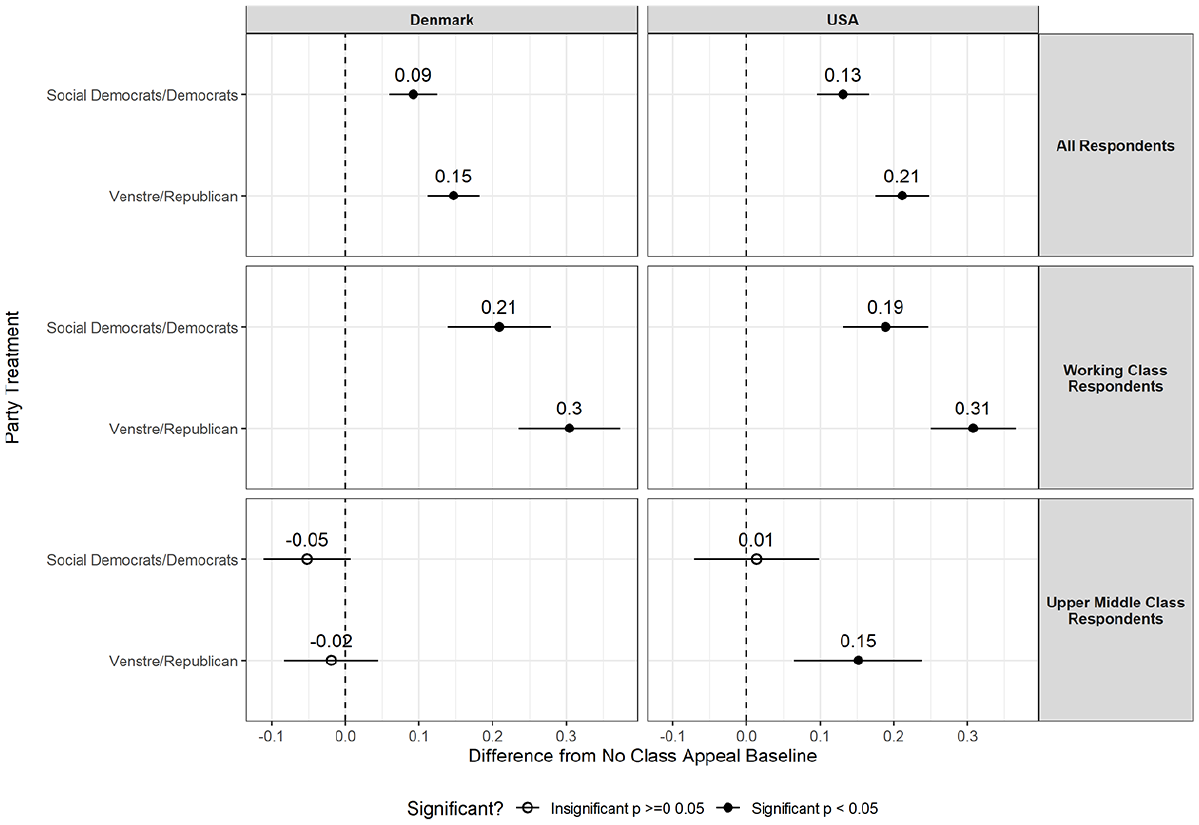
Symbolic working class appeals influence candidate evaluations, study 1.
One notable deviation does stand out in Figure 1. While upper middle class respondents were not significantly affected by the working class appeal in Denmark and when a Democrat in the US made it, a positive effect emerges when a Republican offered this appeal in the US. However, this positive effect only reliably manifested on the thermometer item; upper middle class respondents did not report significantly higher vote intentions when the Republican candidate appealed to the working class (mean = 0.48 [0.41, 0.56]) than when no appeal was made (mean = 0.42 [0.34, 0.50]). Overall, Figure 1 shows that working class rhetoric had a positive impact on candidate impressions among working class people, consistent with our Hypothesis 1, but had relatively little effect on people at the other end of the class hierarchy.
Another way of thinking about the results in Figure 1 is that class appeals polarize support for the candidate along class lines, as we expected in Hypothesis 2. Figure 2 plots the predicted evaluation of the candidate for working and upper middle class respondents by treatment condition. 10 There is little to no class polarization in evaluations in the baseline condition for left-wing parties in both countries and the difference in means between working and upper middle class respondents is statistically insignificant in both cases. However, in both countries, the candidate from the left-wing party clearly polarizes respondents along class lines when he appeals to the working class. The substantive positive growth in evaluations among working class respondents results in statistically significant differences in both cases with the resulting difference in difference (e.g., WC-UMCBaseline – WC-UMCWC Appeal) also statistically significant (USA: F = 11.80, p < .001; Denmark: F = 33.87, p < .001). There is more polarization between respondents in the baseline condition, on the other hand, when evaluating the candidate from the right-wing party: the upper middle class has a stronger preference for right-wing candidates than the working class does. The size and precision of this difference is larger in Denmark (UMC – WC = 0.14 [0.07, 0.21], p < .001) than the USA (0.07 [–0.01, 0.14], p < 0.10). The direction of this polarization, however, reverses when a class appeal is present with working class respondents now reporting significantly more positive evaluations than upper class respondents. The size of this difference, meanwhile, is greater than in the baseline condition much as with the WC appeal condition comparisons above (USA: F = 8.69, p < .01; Denmark: F = 46.85, p < .001). In other words, polarization increased. Figure 2 provides strong support for our argument in Hypothesis 2 that class rhetoric leads to class polarization when it comes to candidate evaluations.
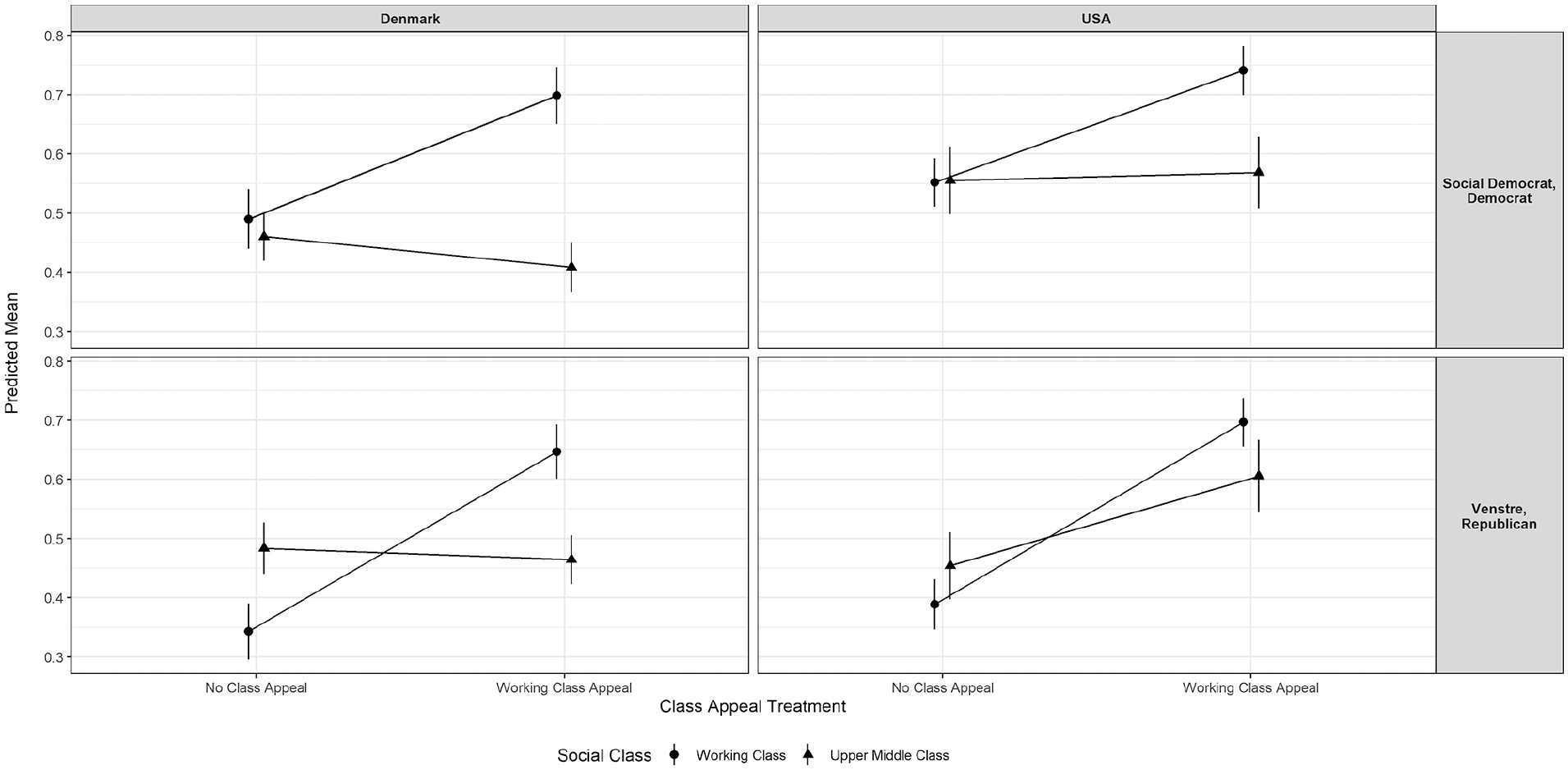
Symbolic working class appeals polarize respondents, study 1.
Discussion
Study 1 shows that candidates can successfully appeal to the working class in two different political contexts by targeting them in political communications. This in turn polarizes candidate evaluations between working and upper middle class respondents. In Study 2, we replicate and extend these findings in two ways. First, we measure vote intention rather than candidate evaluation. This is likely to be a harder test for the efficacy of class appeals. After all, one might evaluate a candidate positively due to a class appeal but have second thoughts about voting for the candidate. Second, and more importantly, the experiment in Study 2 is designed to address the question of whether symbolic appeals are more or less effective than policy-centered appeals.
Study 2: Symbolic Class Appeals Relative to Policy Appeals in Denmark
Our second study was fielded in December 2017 using a Danish sample recruited via YouGov (n = 1,506). In this study, respondents read two candidate vignettes, one about a Social Democratic candidate and the other about a Venstre candidate (the order of the vignettes was randomly varied). Respondents then indicated “how likely or unlikely” it was that “you would vote for a candidate like [Klaus Hansen/Dennis Williams]” on a 0 to 10 scale (higher = stronger intention to vote for the candidate; rescaled to range from 0 to 1 in the analyses below). 11
Respondents were randomly assigned to one of four conditions within each candidate vignette experiment. The first condition is a baseline where no information beyond the partisanship of the candidate is provided. The second condition includes a symbolic class appeal without substantive policy content. Here, the two candidates made party-stereotypical appeals, for example, the Social Democratic candidate appealed to the working class while the Venstre candidate appealed to the upper middle class, using the same language as in Study 1. The third condition features the candidates advocating for a specific change in tax policy: the Social Democratic candidate advocates a tax cut on incomes less than 300,000 DKK and the Venstre candidate advocates a tax cut on incomes more than 500,000 DKK a year. We selected these amounts to roughly match the self-reported median income levels in the working and upper middle classes, respectively. Finally, the fourth condition featured the candidates combining the symbolic and policy appeal. We focus just on evaluations of the Social Democratic candidate in the following analyses. This enables us to ascertain whether the symbolic working class appeal from Study 1 has a similar effect as a more explicit policy-based appeal speaking directly to the material interests of the working class; see Supplemental Appendix B for analyses of the Venstre candidate experiment.
Results
Figure 3 plots the average difference in vote intentions between those in the treatment groups and the baseline; see Table OA7 in Supplemental Appendix A for the full model results. There are two key points to take from Figure 3. First, the findings here confirm much of what we found in Study 1 concerning the policy-less, symbolic class appeals. Working class respondents again report evaluations approximately 0.2 points higher on the 0 to 1 scale when they are given a symbolic appeal compared to when they are not. Conversely, upper middle class respondents are barely affected by the treatments. The result is once more increased polarization across class lines. For instance, while vote intentions for the Social Democratic candidate did not significantly differ between the two classes in the baseline condition (0.02 [–0.06, 0.09]; positive = WC > UMC), they substantially polarized in the symbolic appeal condition (0.24 [0.17, 0.32]; F = 17.3, p < .001; see Figure OA1 in Supplemental Appendix A). This replicates one of the key findings from Study 1 with a separate Danish sample and a measure of vote intention rather than candidate impression.
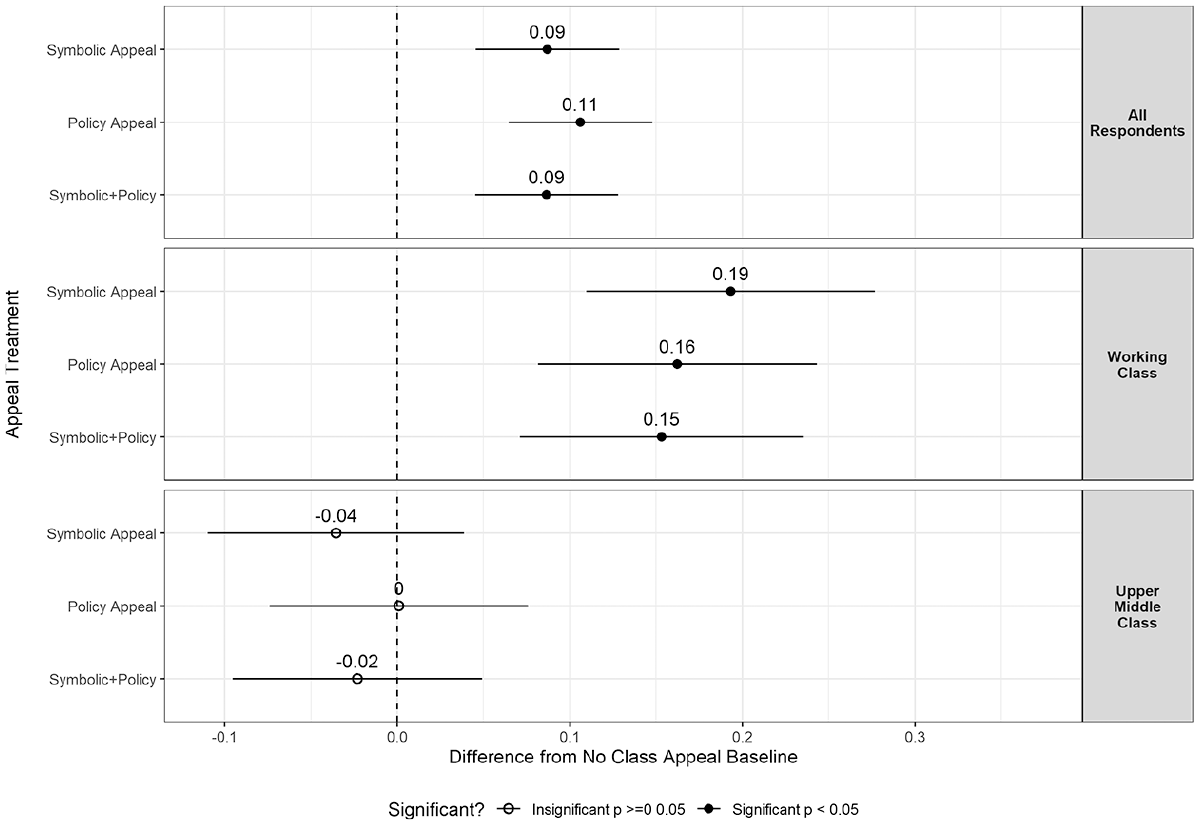
Symbolic appeals are interchangeable with policy appeals, study 2.
A second key result shown in Figure 3 concerns Hypotheses 3a and 3b and the relative impact of the policy-less and policy-centered appeals. Working class respondents reacted similarly to the symbolic and policy-centered appeals voiced by the Social Democratic candidate while upper middle class respondents did not react to any of the appeals. This suggests that candidates could plausibly use either type of appeal to the same effect particularly among working class voters. Interestingly, the fourth condition that combined the two appeals yielded similar effects on vote intentions as when the appeals were made separately. This may stem from the relatively large effect of both appeals among the working class. With effects of up to 0.2 points on the 0 to 1 scale we may have exhausted the potential for experimentally manipulating candidate evaluations particularly with the anchoring effect of partisanship present. This question notwithstanding, Study 2 shows that symbolic and policy appeals are similarly effective in influencing candidate vote intentions. We next discuss how the appeals work with a focus on whether working class respondents infer policy and/or group representational information from such appeals.
Studies 1 and 2: Why Do Symbolic Appeals Work?
Symbolic appeals to the working class substantially impacted candidate evaluations, and levels of class polarization in these evaluations, across three experiments in two different national contexts. We argued in Hypotheses 4 and 5 that such effects might derive from voters inferring two different, albeit non-exclusive, lessons from symbolic appeals. First, respondents might infer something about the policy views of the candidate (Hypothesis 4). To examine this possibility, we asked respondents on all three experiments to place the candidate on a 0 to 10 economic ideology scale where lower values indicate more left-wing placements. If class appeals contain policy information, then we would expect to see candidates making a working class appeal rated as further to the left than the candidate in the party baseline.
Figure 4 plots the marginal effect of the symbolic treatment from all three experiments from OLS models using a version of this measure scaled to range from 0 to 1. Overall, respondents tend to see the candidate appealing to the working class as significantly more left-wing than the baseline candidate. However, working class respondents do not appear to be driving this overall effect as their reactions were muted and inconsistent. In only one instance did the symbolic appeal, by itself, lead to a significant effect on perceptions of the candidate’s ideology:
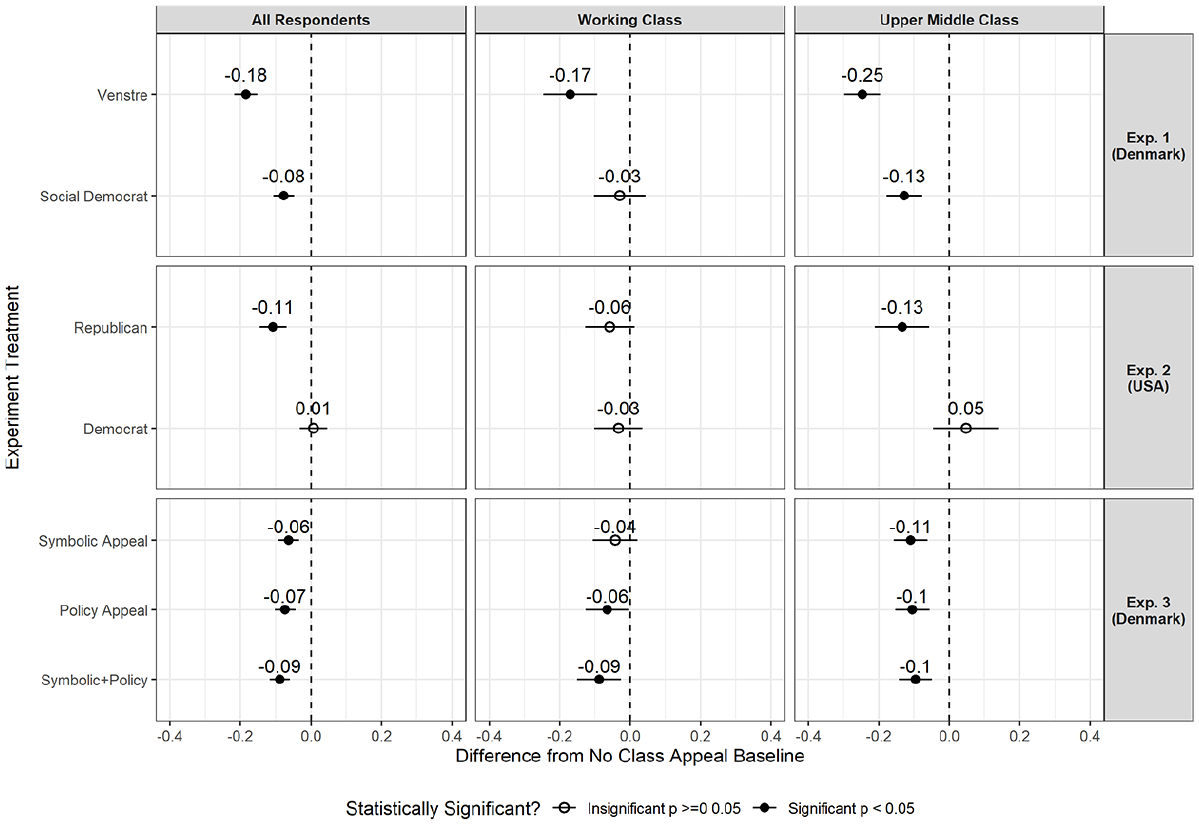
Symbolic working class appeals inconsistently influence ideological placements, studies 1 and 2.
when the Venstre candidate made a counter-stereotypical appeal in Experiment 1. 12 This stands in contrast to the upper middle class respondents who, except in the case of the Democratic candidate in the US, react by consistently placing the candidate further to the left. Thus, while working class respondents consistently evaluated the candidate making a symbolic working class appeal more positively, it does not appear that policy inferences were responsible for this effect. 13
In Hypothesis 5 we suggested an alternative possibility: that people would infer something about the representational posture of the politician, for example, how the politician would interact with the group, even if they did not infer something about the policy particulars of that relationship. We asked respondents to indicate on a 0 to 10 scale how well each of five statements describes the candidate: that he cares about people like me, listens to people like me, respects people like me, does not care about people like me, and does not prioritize people like me. We use an index that averages the five items (rescaled: 0–1, αDenmark, Exp 1 = 0.85; αUS, Exp 2 = 0.93; αDenmark, Exp 3 = 0.81).
Figure 5 corresponds to Figure 4 but focuses on these representational perceptions. Overall, the candidate symbolically appealing to the working class tends to be rated more positively on this measure. However, important differences emerge between the classes and in relation to the analyses provided in Figure 4. In accordance with Hypothesis 5, the symbolic appeal has a positive impact on this outcome in all cases among working class respondents. One way to understand the relative impact of the appeal on perceived ideology and representation is to consider the absolute value of the treatment’s effect averaged across all experiments. On average, working class respondents who received the symbolic appeal reported attitudes on the representational measure nearly 0.2 points higher on the 0 to 1 scale than did those in the baseline. This is almost three times the average effect on ideological placements (0.07). Working class respondents thus consistently believed that the politician making a working class appeal—albeit symbolically and without explicit policy content—would listen to, respect, prioritize, and care about them, but did not seem to necessarily infer much about what this would entail policy-wise. 14
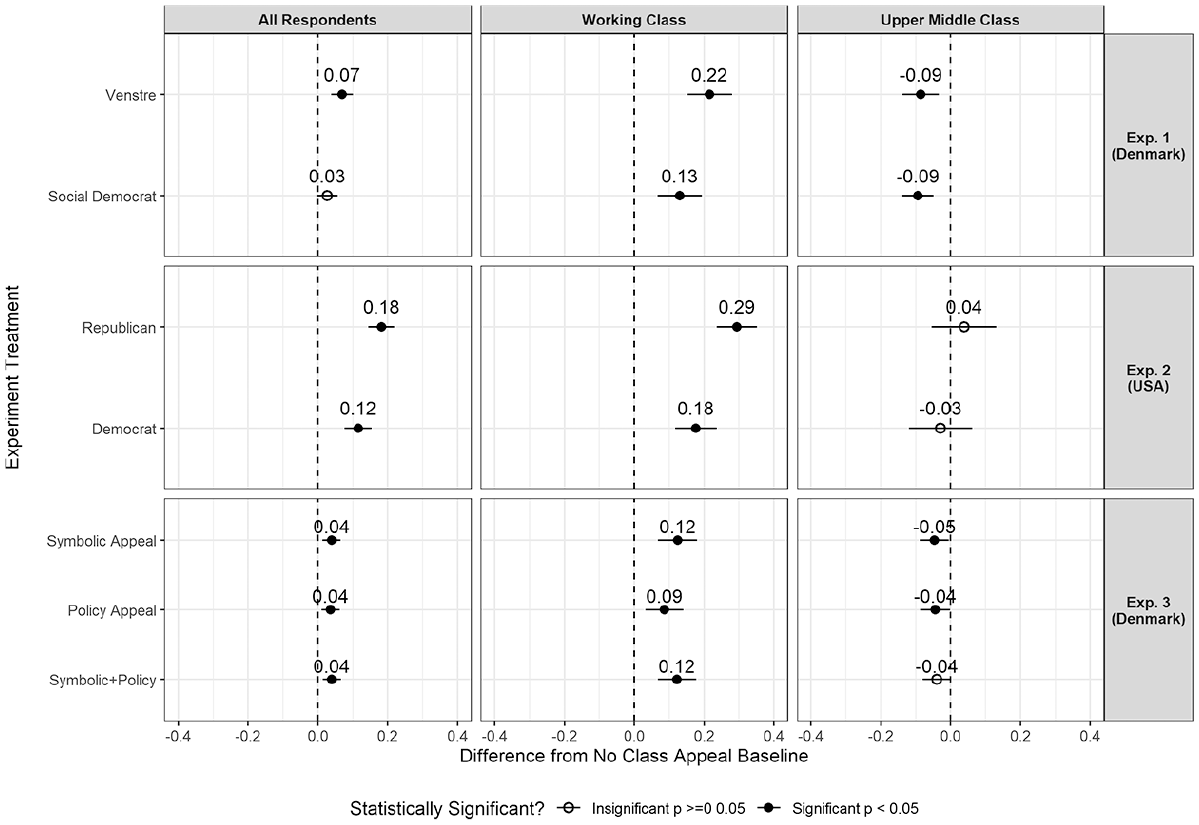
Symbolic working class appeals influence representation attitudes, study 1 and 2.
Conclusion
While the relationship between social class and voting behavior has weakened in many countries, some politicians continue to make symbolic appeals to the working class in campaign communications. Do voters respond to class-based campaigning and, if so, with what strength and how? Across three experiments, in two different countries, our evidence suggests three important conclusions. First, in accordance with Hypothesis 1, we see clear evidence that symbolic appeals to the working class lead to greater overall support from working class voters. And since upper middle class respondents’ reactions are negative or zero, we find, as Hypothesis 2 suggested, that the presence of working class appeals polarizes candidate support along class lines. Second, we show that policy-centered appeals are no more, but also no less, effective than symbolic appeals. Neither Hypothesis 3a nor 3b is supported as it turns out that both types of appeals work equally effectively as campaign tools. Third, while a working class appeal allows people to infer something about the ideology of a candidate (Hypothesis 4), these inferences are inconsistent in magnitude and importance among the group driving the effects on candidate evaluations, that is, the working class. Class appeals seem to matter more for what they potentially say about the candidate’s representational priorities (Hypothesis 5). Here, perceptions among working class voters consistently responded to the nature of the candidate’s class rhetoric.
Our results have an immediate implication for the literature on class politics and, particularly, for the ongoing debate concerning the role of social class in voting behavior. The past three decades have seen a recurring debate over whether class voting is dead, in hibernation, or alive but only in some electoral contexts (Bartels, 2016; Brooks et al., 2006; Clark et al., 1993; Elff, 2007; Evans & Tilley, 2017; Franklin, 1992; Heath, 2015, 2018; Kingston, 2000; Kriesi, 1998). Social class did not structure evaluations of candidates from left-wing parties in the baseline conditions in our survey experiments, but class rhetoric reinvigorated class divisions. It may be that class voting is in hibernation in some contexts, but ready to be activated if political elites started talking more about class. Our experiments thus provide new, and causally persuasive, evidence in favor of a top-down perspective on class voting: the relationship between social class cleavages and voting behavior varies according to elite behavior signaling the relevance of these cleavages (Evans, 2000; Evans & Tilley, 2017; Przeworski & Sprague, 1986; Thau, 2020). Moreover, and following up on work by Heath (2015, 2018), our results show that working class voters react more strongly to symbolic representation than policy (or substantive) representation. This is an important nuance to Heath’s finding that working class voters react to descriptive representation (i.e., they prefer working class candidates) as it is much easier for candidates to change their symbolic group appeals than their class background. Overall, we help to substantiate the idea, recently highlighted again by Achen and Bartels (2016), that electoral choice follows from group-based reasoning. However, our results also suggest that group-centrism is not constant, but varies depending on elite cues.
Our results create something of a paradox. Working class appeals were a politically sound strategy for the candidates in our studies, as they attracted working class voters and had little backlash effect on upper-middle class voters. But even though leftist parties and candidates continue to use class appeals, they target classes less than previously (Thau, 2019). Why has this type of elite rhetoric been toned down over the last few decades? One answer is that given limited media coverage, and scarce attention from voters, parties can only appeal to so many groups. Faced with a shrinking working class, leftist parties choose to appeal across class boundaries or focus on other cleavage groups altogether (Best, 2011). However, this calculation may have been misguided, since the working class still makes up a sizable fraction of the electorate and working class appeals do not repel middle class voters, at least not currently. Appealing to the working class could thus be less of an electoral albatross than some politicians and party consultants might have thought.
One important line of future research concerns who can offer what type of class appeal. We showed that both left- and right-wing candidates can profit electorally, but recent work on group appeals suggest that these may be most effective when offered by a fellow group member given the increased credibility of the message (Holman et al., 2015). If working class appeals can only be used by working class candidates, then they are hardly universally applicable. After all, most parties in most countries have almost no legislators who previously held working class jobs (Carnes, 2016; Carnes & Lupu, 2015; Heath, 2015; O’Grady, 2019). We left the class background of the candidate unstated. However, a survey conducted in February 2018 with 109 MTurk respondents provides some indirect insight. Respondents on the survey were randomly assigned to read either the working class or the upper middle class vignette without the partisanship of the candidate. We asked respondents to place the candidate on the same social class measure used in the main studies. Approximately 91 per cent of respondents in the upper middle class appeal condition indicated that this candidate would likely be in either the upper middle or upper class. Respondents who read the working class appeal instead were far more torn in their class categorizations. While the modal response was working class, only 27 per cent of respondents selected this option. Indeed, nearly as many respondents placed the candidate in the lower middle class (22 per cent), the middle class (22 per cent), or the upper middle class (18 per cent). This suggests that candidates from a broad array of backgrounds may be able to use working class appeals effectively.
Future work might also explore another question raised by our results. The class appeal treatments used in our experiments always contained a contrast between two classes, that is, an acknowledgment of one class alongside a repudiation of the other. This means that our class appeals were conflictual by construction. A more one-sided appeal may be somewhat weaker since it does not directly present a class conflict. Yet, given recent findings of continuing awareness of class and class conflict in modern societies (Hout, 2008; Piston, 2018; Rhodes & Johnson, 2017; Robison & Stubager, 2018), it may be that an appeal to one class is enough to produce the effects we observe.
Although our focus has mainly been on the working class, our results also pose a puzzle concerning the upper middle class. While the working class was attracted by working class appeals, the upper middle class was largely unaffected. Moreover, while the working class was alienated by upper middle class appeals, upper middle class respondents were again largely unaffected. We believe there are a few potential explanations for these asymmetric reactions that future work could address. First, the working class has historically had a special role in politics in many countries as seen in the frequent invocation of this group in party and candidate appeals (Evans & Tilley, 2017; Lipset & Rokkan, 1967; Przeworski & Sprague, 1986; Rhodes & Johnson, 2017). It may be that upper middle class individuals simply see appeals to the working class as part of the background of politics even if they discount their actual relevance due to the upper-class favoritism in policymaking (O’Grady, 2019; Schlozman et al., 2017). Second, it is possible that members of the working class have a stronger sense of linked fate due to a lack of resources and power relative to other class groups. Working class respondents may therefore be particularly likely to consider this identity as relevant for their political behavior, leading to differential responsiveness to symbolic group appeals across class groups (Huddy, 2013). Third, sympathy for the working class among upper middle class individuals may be a complementary factor as we discuss in Appendix E using evidence from a supplementary survey. The mean working class sympathy score for the upper middle class is 7.2 among those who identify with the upper middle class compared to an overall mean of 7.6. This high level of working class sympathy might explain the lack of negative reactions to the working class appeals among upper middle class respondents (thereby underlining our point above that such appeals have broad resonance in the electorate; see also Piston, 2018). Our data cannot delineate which explanation is more likely, nor properly take apart the relationship between class identity and class sympathy, but this is surely a question worth addressing in future research.
Finally, our results also speak to the broader literature on candidate group appeals and candidate strategy, where the focus has been largely on other social cleavages such as gender, race/ethnicity, and religion (Hersh & Schaffner, 2013; Holman et al., 2015; Kam et al., 2017; Philpot, 2004). We find that class appeals seem to work as effectively as other group appeals. A key question for future attention, however, is how the specific group matters for the efficacy of group-based campaigning. The groups studied in the existing literature for the most part maintain rigid boundaries between in- and out-group members. Perhaps not surprisingly, appeals to these types of groups sometimes lead to backlash effects (Hersh & Schaffner, 2013; but see: Holman et al., 2015; Kam et al., 2017). But class-based identities, like national identities, are potentially more akin to supra-identities that envelop other cleavages. Here, the boundaries of inclusion may be more porous. This means that the ability of political elites to structure political conflict along group lines (Achen & Bartels, 2016; Huddy, 2013), as well as the effectiveness of group-based rhetoric for vote-seeking candidates, could vary by the nature of the group identity in question.
Research Data
Class_Appeals_Dataverse – for Does Class-Based Campaigning Work? How Working Class Appeals Attract and Polarize Voters
Class_Appeals_Dataverse for Does Class-Based Campaigning Work? How Working Class Appeals Attract and Polarize Voters by Joshua Robison, Rune Stubager, Mads Thau and James Tilley in Comparative Political Studies
Supplemental Material
Class_CPS_Supp_RR_Final – for Does Class-Based Campaigning Work? How Working Class Appeals Attract and Polarize Voters
Class_CPS_Supp_RR_Final for Does Class-Based Campaigning Work? How Working Class Appeals Attract and Polarize Voters by Joshua Robison, Rune Stubager, Mads Thau and James Tilley in Comparative Political Studies
Footnotes
Acknowledgements
We are grateful for all comments received at these occasions (not least from Christopher Johnston, Noam Lupu, and Spencer Piston) which have helped improve the article. The same applies to the comments and suggestions from the three anonymous reviewers and the editors of Comparative Political Studies. All errors and omissions remain our responsibility.
Authors’ Note
Previous versions of this article have been presented in workshops or conferences at the University of Zürich, the University of North Carolina at Chapel Hill, Strathclyde University and Aarhus University as well as at the annual conferences of the Midwest Political Science Association and the Danish Political Science Association.
Declaration of Conflicting Interests
The authors declared no potential conflicts of interest with respect to the research, authorship, and/or publication of this article.
Funding
The authors disclosed receipt of the following financial support for the research, authorship, and/or publication of this article: Research for the article was funded by grant no 1327-00113 from Independent Research Fund Denmark to Rune Stubager and by a minor grant from Aarhus University Research Foundation to Mads Thau.

Notes
Author Biographies
References
Supplementary Material
Please find the following supplemental material available below.
For Open Access articles published under a Creative Commons License, all supplemental material carries the same license as the article it is associated with.
For non-Open Access articles published, all supplemental material carries a non-exclusive license, and permission requests for re-use of supplemental material or any part of supplemental material shall be sent directly to the copyright owner as specified in the copyright notice associated with the article.
