




Abstract
The purpose of this study was to investigate the heat transfer of fire-resistant fabric and to propose an objective-driven optimization approach for parametric design. A finite volume method (FVM) model was developed to predict the thermal response within the fabric-air gap-skin system under flash fire exposure. Parametric correlations were conducted to identify crucial variables, and optimization designs were performed using surrogate models combined with non-dominated sorting genetic algorithm II (NSGA-II) based on numerical simulations. The results demonstrated that the numerical model accurately predicted the skin temperature with a relative error of 5.0% for single-layer fabrics and 1.8% for muti-layer combinations. Fabric thickness was the dominant parameter affecting skin burns, followed by air gap width and thermophysical properties. Emissivity and transmissivity were not significantly correlated with second-degree burn time. Multi-objective optimization revealed an optimal configuration for single-layer fabric: a 22.0% increase in thickness and a 20.0% increase in porosity, which extended second-degree burn time by 32.1% without compromising weight efficiency. Additionally, textiles with a thickness of 1.38 mm (MB) and a volumetric heat capacity of 1.16×10⁶ J/(m3 K) (TL) exhibited considerable potential for high thermal protection and lightweight design. Research findings in this study will provide a novel approach for intelligent optimization of firefighter protective clothing, and the proposed methodology can also be extended to the development and multifunctional applications of industrial textiles.
Keywords
Introduction
In fire and explosion disasters related to industrial manufacturing, firefighters are often exposed to various thermal hazards, such as flash fire, thermal radiation, hot gases, and hot liquids. 1 Flash fire poses one of the most serious thermal threats in hazardous situations with high intensity, short duration, and potential for severe injury. The adequate thermal protection provided by firefighter protective clothing is essential for ensuring the personal safety and operational effectiveness of firefighters during emergency rescue operations. Therefore, the development of high-performance protective clothing necessitates a comprehensive and systematic investigation, as multiple factors affect thermal protective performance.
Experimental methods have been widely employed to evaluate the protective performance of firefighter clothing over the past decades. Although laboratory test protocols should be recognized for authenticity and objectivity, they are also limited to the destructive nature and excessive cost. Numerical simulation can provide a rigorous mathematical description of energy transfer among the heat source, protective clothing, and human body, hence offering a viable method for investigating heat and mass transfer, fluid dynamics, and material properties. Torvi and Dale 2 proposed a foundational heat transfer model for fabric-air-sensor systems on the finite element method (FEM), which simulated the in-depth radiation absorption in porous fabrics utilizing the extinction coefficient. Ghazy and Bergstrom 3 further developed a coupled conductive-radiative model for multi-layer fabrics and air gaps, and it provided a theoretical foundation for the individual contributions to overall thermal insulation. Chitrphiromsri, 4 Fu et al., 5 and Su et al. 6 proposed coupled thermal and moisture transfer models in protective fabric considering the phase change, molecular diffusion and Darcy’s flow, to predict the risk of steam skin burns when subjected to hot steams. Subsequently, a computational fluid dynamics (CFD) model was developed by Udayraj et al.7,8 to analyze the influence of positioning, orientation, and dynamically varying widths within the air gap. Han and Weng, 9 Jiang et al., 10 and Tian et al. 11 integrated a three-dimensional model with CFD for flame manikins in combustion chambers, enabling the repeatable simulations of fire scenarios and heat transfer.
Numerical simulation to predict thermal responses and skin burn injuries under various thermal hazards has become an effective tool for thermal and moisture transport analysis. Previous numerical studies mainly focus on the performance prediction of thermal protective clothing. However, variations in model assumptions and material properties can lead to significant discrepancies in simulation results, thereby limiting the widespread application in temperature prediction and performance evaluation. In addition, performance optimization with the traditional trial-and-error method is inadequate for accurately identifying crucial factors, nor can it provide globally optimal configurations. These limitations reveal a research gap in the adaptive performance tuning of firefighter protective textiles. Therefore, in the context of the rapid development of intelligent algorithms, there is a need to explore a more efficient and scientific method for performance optimization.
Recent advances in computational optimization technology have effectively promoted the thermal management design of functional textiles. Xu and Cui 12 proposed the inverse problem of thickness, porosity, and thermal conductivity determination of single-layer fabric systems. The weighted least-squares method and particle swarm optimization (PSO) algorithm based on the thermal-moisture transport model were employed to optimize fabric comfort. Wang et al. 13 extended this framework to multi-layer assemblies in cold climates, where the PSO algorithm was performed to determine the optimal thickness and porosity configuration of the inner layer. Hu et al. 14 developed a simulated annealing ant colony (SA-ACO) intelligent model to improve the accuracy and calculation efficiency of thickness optimization. Majumdar 15 further introduced the non-dominated sorting genetic algorithm (NSGA-II) to achieve multi-objective optimization of air permeability and thermal conductivity for knitted fabrics. The Pareto optimal solutions provided critical references for the optimal parameter configuration of knitting and yarn. Akhlaghi et al. 16 formulated workwear fabrics with TiO2 nanoparticle coatings, and determined the optimal volume of titanium isopropoxide and the time of ultrasonic reaction utilizing response surface methodology (RSM). These studies leveraged optimization algorithms to solve the problem of optimal combinations, providing new perspectives and methods for performance enhancement in functional textiles.
Therefore, this study employed numerical simulation and goal-driven methodologies to optimize the parameters of firefighter protective clothing. Firstly, a heat transfer model was developed for the fabric-air gap-skin system under high heat conditions. Systematic parametric studies were then conducted to identify the critical factors influencing thermal protective performance, including the influence mechanisms and sensitivities of material properties. Finally, optimization designs for thermal protection and structure weight under specific application requirements were achieved by combining the numerical model with surrogate models and intelligent optimization algorithms. This design-analysis-optimization integrated methodology will provide an economical and efficient approach for performance optimization and innovation materials development of firefighter protective clothing.
Methodology
This paper demonstrates a standardized procedure for material development and industrial application of advanced fire-resistant textiles. The study is divided into three main components: numerical modeling data collection, surrogate model construction, and the scenario application. Figure 1 illustrates the general framework of this study. General framework of this study.
Heat transfer modeling in thermal protective fabric systems
In this paper, the heat transfer for both single- and multi-layer fabric systems was investigated utilizing numerical simulation, and the numerical model served as an instrument for the identification of potential parameters influencing thermal protective performance. A typical multi-layer fabric system consists of an outer shell (OS), a moisture barrier (MB), and a thermal liner (TL). This study investigated the parametric design of both single-layer (OS) and multi-layer (OS + MB + TL) fabric systems under a high heat flux of 84 kW/m2, representing standard flash fire conditions encountered in firefighting operations. The energy conservation equations for thermal protective fabric can be given as,
17












Heat transfer within skin tissue is analyzed through Pennes bio-heat equation,
20
and the energy equation for skin tissues is given as,


The time to second-degree burn can be calculated by incorporating the skin temperature distribution into the Henriques burn integral model,
21
expressed as,

Numerical simulation
Numerical simulations were conducted to analyze the heat transfer for the fabric system. The commercially available CFD software based on the Finite Volume Method (FVM) was employed to discretize the computational domain. In this study, the fabric layers were modeled in direct contact, with an air gap of 6.4 mm between the fabric assembly and human skin. Radiation effects were exclusively simulated at the OS, where approximately 95% of the incident radiation could be absorbed within three fiber diameters. 23 The thermal energy transport through the OS and the air gap involved the conductive and radiative coupling, whereas the MB and TL exhibited conductive heat transfer. The Discrete Ordinates (DO) method was adopted to solve RTE, including absorption, scattering, and emission in fibrous materials. The absorption and scattering coefficients of the fabric were obtained from literature, 24 while the air absorption coefficient was set to 5 m-1. The boundary conditions for the heated surface were defined as a combination of convective and radiative thermal coupling, equivalent to a typical heat flux of 84 KW/m2 from flash fire. The thermal boundary conditions incorporated a flame temperature of 2000 K, a convective heat transfer coefficient of 40 W/(m2 K), and a radiative heat flux of 18144 KW/m2. Pennes bio-heat equation was adopted for backside boundary conditions of the fabric-air gap-skin system, with the core temperature set to 306.65 K. The initial conditions were an ambient temperature of 299.65 K and an initial skin temperature of 305.65 K. The time step was 0.001 s, and a total of 10000-time steps were calculated for a 10 s fire exposure solving the energy and radiation equations.
Basic properties of fabric system.

Parametric design and optimization
This study employed the heat transfer model to identify potential factors related to skin burn injuries. These parameters affect thermal transmission and burn risks through participating in energy conservation equations, radiation transfer equations, or boundary conditions. In this section, a systematic parameter study of the factors affecting the thermal protective performance was conducted, including the parameters related to thermophysical, optical, and structural properties.
Range of input parameters.

This study developed an objective-driven optimization framework to determine optimal fabric configurations in thermal protective clothing. The methodology integrated surrogate modeling with intelligent optimization algorithms to efficiently explore solutions within multi-dimensional design spaces, overcoming the inefficiencies and blindness of traditional trial-and-error experiments. By conducting all optimization iterations through the surrogate model, the framework eliminated the need for computationally intensive numerical simulations. Furthermore, the coupled surrogate-optimization approach offered exceptional flexibility that enabled adaptive selection of objectives functions and constraints tailored to specific design requirements. Although initial construction of the surrogate model required certain numerical experiments, subsequent optimization iterations incurred negligible computational cost once the model was established.
The surrogate model-based optimization process included the following steps: Firstly, the input parameters were sampled throughout the design space using the design of experiments (DOE), and the corresponding second-degree burn time responses were calculated through numerical simulations. Advanced surrogate modeling techniques enabled the approximation of complex systems with a limited number of sample points. Multiple typical surrogate models were then constructed to capture the functional relationships between inputs and outputs. The goodness-of-fit of the surrogate models was evaluated to select the model with the highest predictive accuracy for surrogate-driven optimization. Ultimately, the chosen surrogate model was integrated with the appropriate optimization algorithm to efficiently search for the Pareto frontier, determining the optimal configuration tailored to diverse operational scenarios. In this study, surrogate modeling and optimization procedures were performed within a process integration and design optimization (PIDO) software environment. The detailed optimization design process for thermal protective fabrics is illustrated in Figure 2. Parameter optimization design process for thermal protective fabrics.
In the performance evaluation of thermal protective textiles, the weight-to-performance ratio often serves as a critical metric, quantifying the thermal protection capacity per unit mass and reflecting the protective effectiveness of the functional materials.27,28 Traditional strategies for thermal protection have undoubtedly sacrificed the weight-related comfort of the textiles. For instance, additional insulation or thickened fabrics in extreme environments might lead to heat stress and restricted human movement. Therefore, this study introduced fabric weight (mass per unit area) as an additional output, selected for both its measurability and fundamental role in the protection-comfort trade-off characteristic in fire-resistant fabrics. Through multi-objective optimization, this research investigated the synergistic balance between thermal protection and weight efficiency, with the expectation of achieving the optimal protective performance with minimal material weight. The structural weight was determined by the density and thickness of the fabric. Furthermore, for the extension of other performance optimizations, the dataset for surrogate model construction can alternatively be obtained through experimental measurements.
Results and discussion
Numerical simulation validation
Figure 3 shows the numerical simulation results of the temperature distribution in the fabric system. Temperatures in the fabric and air gap sharply increased initially and then reached a stable state. In the single-layer fabric system, the limited insulation medium allowed heat to rapidly penetrate through the fabric to the skin surface. The temperature of the fabric surface, fabric backside, and the epidermal surface peaked at 620.5°C, 549.5°C, and 86.1°C after heat exposure of 10 s, respectively. A temperature difference of 71.0°C was formed within the fabric layer, while a sharp temperature drop of 463.4°C (86.7% temperature gradient proportion) occurred in the air gap, verifying the significant contribution to the overall thermal resistance. The multi-layer structure (68.2% of the temperature reduction) effectively shared the thermal load of air gap (31.8% of the temperature reduction) with the additional thermal resistance. After 10 s of exposure, peak temperatures at the multi-layer fabric surface, back and skin surface were 638.1°C, 228.6°C, and 37.4°C, respectively. Temperature distribution cloud along with the time and z-axis (a) single-layer fabric (b) multi-layer fabric combination.
Figure 4 presents model validation results, and it is clear that the numerical predictions were in good agreement with the literature’s results. For a single-layer fabric system, the simulated skin temperature in this study was 86.1°C after 10 s of thermal exposure, resulting in relative errors of 4.0% compared to the literature value of 82.8°C
29
and 5.0% compared to the experimental result of 82.0°C.
2
The predicted second-degree burn time from the temperature rise curve and the skin burn model was 6.6 s. The maximum relative error for second-degree burn time was less than 5.7% when compared to the experimental data of 7.0 s (shuttered) and 6.6 s (manual).2,30 In bench-top tests with shutter, a duration of 0.2 s was required for the shutter to open, so the fabric could not have been exposed to the flame up to 0.2 s, resulting in prolonged second-degree burns. For multi-layer structures, numerical simulations indicated that no skin burns occur during 10 s of heat exposure. The predicted skin surface temperature was 37.4°C, showing a relative error of 1.8% compared to the 38.1°C reported by Ghazy et al.
3
Validation of the numerical model (a) single-layer fabric (b) multi-layer fabric combination.
The numerically predicted temperatures were slightly higher than those from experimental measurements. The differences were mainly attributed to the model assumptions that neglect thermal energy exchange between the fabric and surroundings, as well as moisture transfer effects. In addition, the RTE model employed in this study incorporated additional emission and scattering effects, beyond the simplified Beer’s law adopted in Ghazy’s model, 29 thus increasing the rate of heat transfer. For multi-layer fabric combinations, the temperature variations could be attributed to the minor differences in thermal properties of the OS. The simulation results of the multi-layer structure showed reduced agreement with verified data compared to the single-layer system, potentially due to the boundary conditions uncertainties. Future research could improve model accuracy by integrating fire combustion reaction models and implementing adaptive convection-radiation parameters in CFD simulations, enabling more accurate predictions of heat transfer and fluid dynamics for thermal protective clothing. Furthermore, both single- and multi-layer systems demonstrated good correlation with data from the flame manikin model under 4 s of fire exposure. 11 Despite these limitations, the numerical predictions showed overall consistency with the experimental results, confirming the reliability of the developed numerical model in predicting thermal response for fabrics under flash fire exposure.
Parameter analysis
Figure 5 illustrates the influence of thermal properties on thermal response for firefighter protective clothing. The impact of fabric thermal conductivity on heat transfer is depicted in Figure 5(a). With the increase of the fabric’s thermal conductivity, the time to second-degree burn consistently decreased. Thermal conductivity quantified the ability of textiles to conduct thermal energy, and a higher thermal conductivity promoted more efficient energy transfer. The most significant reduction in second-degree burn time occurred within the range of 0.05 W/(m K)–0.075 W/(m K). This phenomenon indicated that materials with lower thermal conductivity should be prioritized in the design of thermal protective clothing, with special attention to the critical range where slight variations in material properties could significantly affect the risk of skin burns. Figure 5(b) illustrates the predicted second-degree time under different specific heat capacity conditions. It was obvious that the time to second-degree burn increased with the higher specific heat capacity. This could be explained through the thermodynamic theory that the specific heat capacity characterizes the material’s ability to absorb and store energy. Fabrics with higher specific heat capacity enabled greater thermal energy absorption per unit mass, thereby reducing energy transferred to the human body. When the specific heat capacity raised from 500 J/(kg K) to 3500 J/(kg K), the second-degree burn time for the OS, MB and TL increased by 18.0%, 35.5% and 54.4%, respectively, which demonstrated that parameter optimization of the TL and MB layers can more effectively enhance protective performance. Figure 5(c) depicts the impact of fabric density on heat transfer. When the fabric density increased from 200 kg/m3 to 500 kg/m3, the second-degree burn time for OS showed an increase of 11.6%, while the MB and TL layers exhibited greater improvements of 15.9% and 30.9%, respectively. The mechanism by which density affected heat transfer was analogous to that of specific heat capacity, since the elevated density enhanced the volumetric heat capacity. Effect of thermal properties on heat transfer (a) fabric thermal conductivity (b) fabric specific heat capacity (c) fabric density.
Figure 6 illustrates the effect of fabric optical properties on thermal response. In multi-layer fabric systems in this study, the interlayer self-emission effects were neglected. Therefore, only the surface emissivity of OS and the back emissivity of TL affected the heat transfer. As shown in Figure 6(a), variations in the extinction coefficient produced negligible effects on second-degree burn time. The model calculated minor temperature reductions of 0.3°C (single-layer, 10 s exposure) and 0.2°C (multi-layer, 30 s exposure) when the extinction coefficient increased from 4000 m-1 to 24000 m-1. Although the extinction coefficient characterizes the fabric’s ability to attenuate radiative energy, with increased values corresponding to stronger absorption and scattering effects, its impact on the protective performance was limited. Figure 6(b) describes the predicted second-degree burn time under various surface emissivity conditions. As the surface emissivity of the OS rose from 0.6 to 0.9, the second-degree burn times were shortened by 11.0% for single-layer fabrics and 6.5% for multi-layer fabrics. In this situation, Kirchhoff’s Law could explain that the ratio of emissivity to absorptivity remains constant under thermal equilibrium. A higher emissivity corresponded to a higher absorptivity, allowing more thermal energy to be absorbed from the radiative flux. Moreover, elevated surface emissivity or absorptivity was associated with a decrease in fabric reflectivity. This reduction in reflectivity might result in a larger amount of the incident radiation flux being transmitted, which in turn heightened the risk of skin damage. Figure 6(c) further reveals the effect of the backside emissivity on heat transfer. Increasing the backside emissivity of the TL from 0.6 to 0.9 reduced second-degree burn times by 27.9% in single-layer fabrics and by 13.5% in multi-layer configurations. This phenomenon could be interpreted that the fabric’s backside acted as a high-temperature radiator between the fabric and the body, so the increased emissivity would augment radiative emission and exacerbate the potential for skin injuries. Effect of optical properties on heat transfer (a) fabric extinction coefficient (b) fabric surface emissivity (c) fabric backside emissivity.
Figure 7 illustrates the influence of structural properties on heat transfer. The predicted second-degree burn time in Figure 7(a) demonstrated a strong dependence on fabric thickness. The time to second-degree burn prolonged when the thickness increased from 0.5 mm to 2.0 mm. This was because the increased thickness provided a longer heat transfer path. Meanwhile, thicker fabrics offered a larger void volume, which could accommodate more trapped air and enhance the energy absorption capacity of the porous medium. The thickness of OS had a relatively weak influence on thermal protection, as the increment in the second-degree burn time of MB (96.7%) and TL (89.8%) was greater than that of OS (50.2%). Figure 7(b) presents an overall increment in second-degree burn time with increasing air gap width. As the air gap width expanded from 0.1 mm to 6 mm, the times to second-degree burn of single-layer and multi-layer fabrics extended by 3.6 s and 9.7 s, respectively. This phenomenon was primarily attributed to the additional insulating medium provided by air volumes expanding, which enhanced the blocking and absorption capacity of energy, thus reducing the heat flux transferred to human body. The result indicated the fact that thermal protective performance was strengthened with an appropriate increment of the air gap width under coupled conduction-radiation mechanism. Notably, the most significant increases were observed within the 0.1 mm to 1 mm range, accounting for 66.7% and 73.2% of the total burn time extensions for single- and multi-layer systems, respectively. This effect was attributed to the dominance of conduction in extremely thin air gaps, where thermal resistance increased linearly with thickness. However, as the air gap width was further enhanced, its positive protective effect diminished with growing temperature gradients. Effect of structural properties on heat transfer (a) fabric thickness (b) air gap width.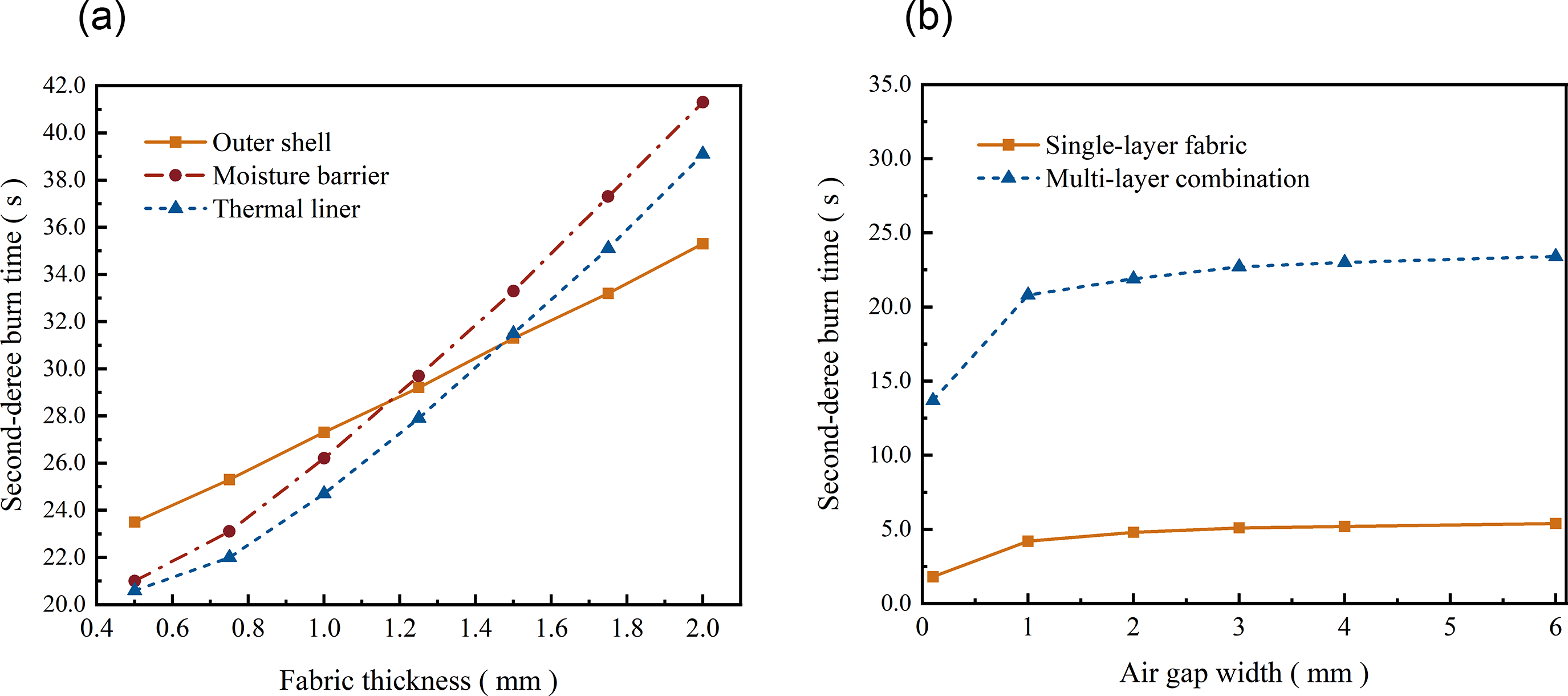
Parameter optimization
Parameter correlation
Correlation analysis for selecting crucial factors of single-layer fabrics.

Note: **, p < 0.01 (relevance); R2 = 0.828, p < 0.01 (regression analysis).
The correlation analysis showed that fabric thickness exhibited a dominant and positive effect on second-degree burn time (r = 0.75, R2 = 0.553). Subsequent thermophysical factors including volumetric heat capacity (r = 0.36, R2 = 0.124), thermal conductivity (r = −0.27, R2 = 0.071). The huge difference in R2 contribution might be attributed to the synergistic effect of the additional thermal conductive resistance and volumetric heat capacity provided by the augmented thickness. While the latter was dealt with in only one respect. While the air gap width exhibited a marginal R2 contribution (r = 0.25, R2 = 0.061), it was manipulable for adjusting volume changes within the air gap rather than other parameters. Additionally, the heat transfer behavior of the air gap may not always be stable and positive. The mobility, openness, and homogeneity of air spaces can significantly affect the heat transfer efficiency within microclimate systems, which need to be investigated in further research.
The absolute value of the correlation coefficient and R2 for fabric backside emissivity (r = −0.10, R2 = 0.009) were higher than those of surface emissivity (r = −0.09, R2 = 0.007). These distinctions primarily arose from the fact that backside emissivity directly regulated the energy exchange between fabric and human organisms, where radiation exhibited the main heat transfer mechanism. In contrast, fabric surface emissivity affected the thermal transport between the fabric and the high-temperature environment. Although a low surface emissivity was beneficial in reducing the energy absorption from the heat source, it simultaneously suppressed the thermal energy dissipation to the external environment, which compromised overall thermal protection. Moreover, a small proportion of radiation in the flash-fire condition of this study might also account for the lesser significance of surface emissivity. This finding aligned with Tian’s study on the effect of emissivity on thermal protection during flash fire exposure from a flame manikin model. 31 Similarly, the extinction coefficient exhibited negligible influence with a correlation value of 0.06 and R2 of 0.002. Although the extinction coefficient affected radiative transmission through the fabric, thermal protective performance depended more critically on fundamental thermo-physical properties and surface emissivity since they can directly affect the predominant conductive heat transfer and the amount of incident radiation flux.
Figure 8 presents the ranking of parameters by R2 contribution, along with the cumulative contribution percentage. The cumulative R2 for fabric structural and thermophysical properties was 0.809, accounting for 97.8% of the total R2 value of 0.828. In contrast, the sum of R2 of the three optical properties was 0.019, and merely 2.24% contributed to the total value. This disparity indicated that structural and thermal properties were dominant factors in skin damage and deserved far more critical attention than optical properties. In addition, the R2 contribution of multiple parameters was 0.828, indicating that primary linear relationships capture the limited descriptions, and future optimizations could be improved by increasing the model fitting order. Sensitivities analysis of single-layer fabrics.
Correlation analysis for selecting crucial factors of multi-layer fabric combinations.

Note: **, p < 0.01 (relevance); R2 = 0.853, p < 0.01 (regression analysis).

Sensitivities analysis of multi-layer combinations.
Advanced development in novel thermal protective materials represents an extension of the above optimization methods, with parameter importance analysis guiding the development of high-performance insulation fabrics. For instance, bio-inspired porous structures such as honeycomb sandwich fabrics,33,34 three-dimensional spacer fabrics, 35 and bump fabrics, 36 enhance thermal insulation by structurally reorganizing fabric thickness and optimizing air distribution. The TL was the preferred functional layer for such three-dimensional fabrics, as its thickness (r = 0.429, R2 = 0.181) and volume heat capacity (r = 0.296, R2 = 0.085) showed stronger correlations to thermal protective performance compared to the MB, which must concurrently satisfy waterproof-breathable requirements and PTFE membrane integration constraints. Shape memory alloys have been designed to dynamically adjust the enclosed air gap in response to thermal excitation, which significantly improved the functionality and comfort of the composites. The temperature-sensitive property is attributed to the austenitic and martensitic crystal structure. Similarly, the configuration of shape memory materials depends on the contribution of the interlayer air gap.37,38 The utilization of aerogel prolongs the solid-phase conductivity pathways through a unique three-dimensional grid, which enhances the internal skeleton structure transfer channel. The nanoscale pore sizes below the average free range of the gas molecules further inhibit the gas-phase thermal conduction, demonstrating significant potential for thermal protective applications. 39 With the unique microstructures of ultralow thermal conductivity and high porosity, hollow glass microspheres, 40 ceramic microspheres, 41 as well as polyimide aerogel fibers inspired by the porous structure of polar bear hair42,43 can achieve exceptional thermal insulation.
The integration of temperature-regulating Phase Change Material (PCM) into fire-resistant fabrics utilizes their endothermic phase transition properties under fire conditions, effectively modulating micro-environment temperature and mitigating skin burns. This study emphasized the importance of TL in terms of volumetric heat capacity (r = 0.296, R2 = 0.085). This finding was consistent with the observation by Zhang et al. 44 and Hu et al., 45 which demonstrated that positioning PCMs near the skin optimized the heat storage capacity for superior protection. This advantage raised from the TL’s direct regulation of skin temperature rise rate, where higher volumetric heat capacity enhanced energy storage-release equilibrium during thermal exposure. It should be noted that the heat capacity values are constrained by an upper limit and need to be distinguished from the additional enthalpy effects of PCMs on overall heat transfer. In addition, applying high-reflective coatings of aluminum, silver, or titanium dioxide to the OS can suppress radiative absorption while enhancing the reflection against infrared radiation.46,47
Surrogate model construction
Correlation analysis revealed that the structural and thermal properties of fabric systems significantly affected the skin burn time, while optical properties such as emissivity and extinction coefficient, had relatively insignificant effects. Meanwhile, optimal radiative protection associated with surface characteristics could be achieved through high-reflectivity and low-emissivity surface treatments. Therefore, the input parameters were systematically selected based on the ranking of parameter contributions. For single-layer fabrics, 4 key parameters were identified: thermal conductivity (k OS ), volumetric heat capacity ((ρ × C) OS ), fabric thickness (L OS ), and air gap width (L air ). Multi-layer fabric combinations incorporated 10 parameters, including the thermal conductivity (k fab ), volume heat capacity ((ρ × C) fab ), and thickness (L fab ) of each layer, along with the air gap width (L air ). The time to second-degree burn and the fabric weight were designated as the response to construct the surrogate model, where quantitative relationships between the input parameters and the output responses were expected to be established.
Fit statistics of the surrogate model for single-layer fabrics.

Fit statistics of the surrogate model for multi-layer fabric combinations.

Parameter optimization for various applications
The surrogate model constructed in this study, combined with the different optimization algorithms, provided an effective approach for the optimal design of thermal protective fabrics. The framework would be applied to the following scenarios, as shown in Figure 10. Performance optimization for firefighter protective clothing under different requirements.
Scenario I: In order to meet the thermal protective performance (TPP) standards of the single-layer fabric system under flash fire conditions, the fabric thickness was optimized. Thermal protective fabrics shall achieve an average TPP rating of not less than 35.0 cal/cm2 according to the NFPA 1971. 48 In this scenario, the second-degree burn time should be at least 17.5 s under an external heat source of 84 kW/m2 (2 cal/(cm2 s)), as TPP value could be derived from the multiplication of the heat flux and second-degree burn time. Therefore, a minimum value of the second-degree burn time of 17.5 s was taken as the target output and a single-objective optimization was then performed using the non-linear programming quadratic linear programming (NLPQLP) optimization algorithm. The parameter settings for NLPQLP were as follows: maximum number of iterations set to 500, termination accuracy to 10−8, relative step size to 10−4, and minimum absolute step size to 10−6. This situation mainly focused on the fabric properties, so the heat transfer within air gap was ignored and an air gap thickness of 1 mm was adopted to represent the equivalent contact thermal resistance during the TPP testing. 3 The optimization results showed that a fabric thickness (L OS ) of 2.53 mm could achieve a second-degree burn time of 17.5 s, while resulting in a fabric weight of 865.26 kg/m2. The accuracy of the optimization model could be confirmed when compared with multi-layer fabrics in literature. For instance, Ref. 49 reported a thickness of 3.05 mm within muti-layer composites accessing a second-degree burn time of 20.0 s, and Ref. 50 identified a 3.04 mm fabric providing 18.8 s protection.
Scenario II: Parameter optimization to meet thermal protection and lightweight requirements for the single-layer protective fabric. A multi-objective optimization approach was employed, in which k OS , (ρ × C) OS , L OS , and L air were taken as input parameters, with objectives to maximize second-degree burn time and minimize material weight. Meanwhile, the k OS and (ρ × C) OS were considered to be constrained by fabric porosity(φ), so the optimization was simplified to identify the optimal combination of L fab and φ. In this paper, NSGA-II was implemented to obtain the Pareto front of the two conflicting objectives, and the parameters were set as follows: population size of 40, maximum number of generations of 200, and crossover probability of 0.9. The optimal configuration yielded k OS = 0.05 W/(m K), (ρ × C) OS = 3.93 × 10⁵ J/(m3 K), L OS = 0.854 mm, and L air = 5.82 mm, achieving a second-degree burn time of 8.7 s and a fabric weight of 239.98 kg/m2. This solution extended the second-degree burn time by 32.1% while maintaining an identical weight, with a 21.4% increment in fabric thickness (from 0.70 mm to 0.85 mm) and a 20.0% increase in porosity (from 0.80 23 to 0.96) compared to the initial design of Nomex® IIIA. It can be inferred that simultaneously increasing in thickness and porosity could optimally balance thermal protection and weight. It is noteworthy that although porosity enhancement benefited thermal performance, increased radiative spectral transmittance through OS might potentially weaken the insulation effectiveness. Thus, porosity optimization was more suitable for inner layers to ensure overall thermal protection.
Optimal combinations of thermal protective fabrics based on NLPQLP/NSGA-II.

Note: K, fabric thermal conductivity; ρ × C, fabric volumetric heat capacity; L, fabric thickness; Lair, air layer width.
Verification of the optimization results on second-degree burn time.

Limitation and suggestion
The FVM-based heat transfer model integrated with an optimization framework was developed to determine the optimal fabrics parameters under flash fire conditions. Although the optimization results were validated using literature results, there remained necessary for experimental validation. Future improvements could involve the experimental calibration of critical parameters and the development of more realistic numerical models, particularly by incorporating coupled air flow and heat transfer effects within the air gap beneath the clothing. The current optimization was conducted under a flash fire exposure of 84 KW/m2, with parameter bounds constrained by the intrinsic properties of the selected fabrics. The predicted second-degree burn times ranged from 4.7 s to 20.2 s for the single-layer structures and from 28.2 s to 97.4 s for multi-layer combinations. These parameter ranges require further evaluation for other applications. Additionally, future research could be extended to address high-dimensional and multi-modal requirements, such as thermal and moisture comfort, breathability, or mechanical durability, enabling synergistic optimization with functionality and comfort. In summary, the proposed methodology offers an innovative approach for multifunctional equilibrium and advanced material development, particularly under conditions involving uncertain factors.
Conclusion
This study presented a methodological framework for the parametric design of industrial textiles. The FVM heat transfer model was developed for the fabric-air gap-skin system. The prediction errors of skin temperature were 5.0% for single-layer and 1.8% for multi-layer fabrics, validating the accuracy of the numerical model in predicting the transient heat transfer under high heat exposure. Correlation analysis revealed that the fabric thickness were predominant factors that affected human skin burns. The thickness contributions of OS (r = 0.335, R2 = 0.109), MB (r = 0.429, R2 = 0.181), and TL (r = 0.385, R2 = 0.145) accounted for 51.0% of the total explained variance. The thermophysical properties of BM and TL exerted greater impact than those of OS, particularly the volumetric heat capacity of TL (r = 0.296, R2 = 0.085) and the thermal conductivity of MB (r = −0.287, R2 = 0.081). These results emphasized the critical importance of optimizing inner-layer properties in protective material design. While air gap width exhibited lower sensitivity than fabric thickness, its practical adjustability offered operational advantages. Optical properties were not significantly correlated with second-degree burn time, although reducing fabric emissivity or increasing extinction coefficient could alleviate the risk of skin burn.
High-accuracy surrogate models were constructed for single-layer (R2 = 0.994, RMSE = 0.027) and multi-layer combinations (R2 = 0.985, RMSE = 0.024) based on numerical simulations, enabling efficient prediction of second-degree burn time. Single- and multi-objective optimizations were performed using the NLPQLP and NSGA II algorithms integrated with surrogate models. An optimal configuration (k OS = 0.05 W/(m K), (ρ × C) OS = 3.93 × 10⁵ J/(m3 K), L OS = 0.854 mm, L air = 5.82 mm) achieved a 32.1% enhancement in second-degree burn time without compromising the weight flexibility. This solution underscored the effectiveness of thickness and porosity increasing for high-performance applications. Additionally, the optimized combination of MB thickness (1.38 mm) and volumetric heat capacity of TL (1.16 × 10⁶ J/ (m3 K)) also possessed significant potential to balance thermal protection and lightweight design. This research will provide a theoretical foundation for the performance optimization and highlight the significance of an integrated design-analysis-optimization methodology for the intelligent development of advanced thermal protective textiles.
Footnotes

Funding
The authors received no financial support for the research, authorship, and/or publication of this article.
Declaration of conflicting interests
The authors declared no potential conflicts of interest with respect to the research, authorship, and/or publication of this article.