




Abstract
This study characterizes the thermal protective fabrics of firefighters’ clothing under the exposure of hot surface contact. For this, thermal protective performance of different fabrics was evaluated using a laboratory-simulated hot surface contact test, and various factors affecting the performance were statistically identified. Additionally, heat transfer mechanisms during testing were analytically and mathematically modeled. It has been found that fabric’s constructional features and properties are the key factors to affect its thermal protective performance. In this study, the presence of a thicker thermal liner in a layered fabric system resulted in higher performance; in contrast, a multi-layered fabric system incorporating a moisture barrier in its outer layer displayed the lowest performance. Furthermore, it was demonstrated that a fabric’s air permeability has a minimal impact on performance, whereas weight, thickness, and thermal resistance have a significant positive impact on performance. Based on the analytical and mathematical models developed, it was apparent that conductive heat transfer mainly occurs through fabric during testing, and this conductive heat transfer depends upon the surface roughness and thermal properties (thermal conductivity, density, and specific heat) of the tested fabric. Here, thermal contact resistance between the hot surface and fabric also plays a crucial role in the heat transfer or thermal protective performance of fabric. Moreover, the heat transfer gradually decreases across fabric thickness, which can substantially affect thermal protective performance. This study can advance the theory of textile/materials science through better understanding of heat transfer in fabrics. This understanding can help in developing an integrated knowledge of fabric properties, heat transfer through fabrics, and thermal protective performance of fabrics. The findings from this study can also assist textile/material engineers with the development of a high performance thermal protective fabric for clothing to provide better occupational safety and health for firefighters.
Keywords
Introduction
Recent surveys show that every year nearly 1,000,000 fire incidents occur in the USA. These incidents cause injuries to more than 70,000 firefighters [1,2]. Among these injured firefighters, almost 2000 of them sustained burn injuries while working at the fire site [3]. While the majority of such injuries were classified as minor, a significant number are debilitating and career-ending. These injuries may also cause severe illnesses (e.g. heart disease, cancer) to firefighters over longer periods of time [3]. One of the solutions to mitigate burn injuries and fatalities is the use of thermal protective clothing by firefighters. This type of functional clothing helps to reduce the rate of overheating of the skin in order to provide the time that firefighters need to react, escape, avoid, or minimize their burns [4–8].
In the last few decades, various thermal protective polymer-based fibers such as aramid (e.g. Nomex®, Kevlar®), polyamide-imide (e.g. Kermel®), polyimide (e.g. Lenzing®), and polybenzimidazole (e.g. PBI®) have been developed to assemble firefighters’ clothing [9–11]. These thermal protective fibers are used in the spinning process to manufacture yarn, which is used in a weaving process to manufacture woven fabrics; alternatively, these fibers can be used directly to manufacture fabrics through a nonwoven process [4,5]. These woven and/or nonwoven thermal protective fabrics are used as raw materials in the garment manufacturing process to assemble firefighters’ clothing. The thermal protective performance and/or heat transfer characteristics of fabric/clothing varies widely upon a particular type of thermal exposure faced by on-duty firefighters [12–16].
Firefighters are often exposed to hot surfaces of various non-combustible solid substances (e.g. iron or steel furniture/windows) while rescuing fire victims and/or property in a structural fire hazard [17–19]. In these exposures, direct physical contact is established between hot surfaces and the fabrics that make up firefighters’ clothing. At the area of contact, heat is imposed from hot surfaces onto fabrics, and this heat gradually transmits through the fabrics towards firefighters’ bodies [20]. Considering this exposure, Mandal et al. analyzed the thermal protective performance of fabrics (used in firefighters’ clothing) under laboratory-simulated hot surface contact [21]. They used a modified ASTM (American Society for Testing and Materials) standard to evaluate thermal protective performance (ASTM F 1060, 2008) [22]. It has been found that fabric’s thickness significantly impacts conductive heat transfer through the fabric; in turn, fabric thickness has a strong effect on thermal protective performance. By employing fabric’s thickness and thermal resistance, Mandal and Song also developed Multiple Linear Regression (MLR) and Artificial Neural Network (ANN) models to predict thermal protective performance [23,24]. In summary, while a few studies have analyzed the thermal protective performance of fabrics under hot surface contact [20,21,23,24], these studies only investigated a few factors (e.g. fabric properties, heat transfer mode) affecting thermal protective performance. Contextually, although Barker et al. studied the thermal protective performance of fabrics during hot surface contact, it is notable that they only considered the single layered shell fabrics [25]. Eventually, Barker et al. did not shed any light about the impact of fabrics with different constructional features on performance [25]. Additionally, these studies have not performed rigorous analysis of heat transfer mechanisms through thermal protective fabrics under hot surface contact. Thus, previous research is too limited and fragmented to holistically understand the characteristics of thermal protective fabrics under hot surface contact.
This study aims to characterize thermal protective fabrics of firefighters’ clothing under hot surface contact. To fulfill this aim, the thermal protective performances of various fabrics are examined and different factors affecting thermal protective performance are statistically explored. Furthermore, heat transfer mechanisms during hot surface contact with thermal protective fabrics are analytically and mathematically modeled for better understanding of thermal protective performance. This study may help to engineer a new thermal protective fabric for firefighters’ clothing.
Materials and methods
Selected thermal protective fabrics.

CV, coefficient of variation.
Measured according to the ASTM D 3776: 2009 with a CV of 1–1.5%.
Measured according to the ASTM D 1777: 1996 under 1 kPa pressure with a CV of 1–1.5%.
Assembled fabric systems (outer layer is facing thermal exposures and inner layer is in contact with wearers’ skin).

Properties of the assembled fabric system.

Measured by the ASTM D 737: 2004.
Measured by the ASTM D 1518: 2011.
For this study, three specimens (10 × 15 cm) of each selected fabric system were prepared and preconditioned in a standard atmosphere (temperature = 21℃ and relative humidity = 65%) for 24 h. To characterize fabric systems under hot surface contact, the conditioned specimens were tested using the modified ASTM F 1060 test standard. Here, the modification from the original test standard was mainly related to the used sensor for evaluating the thermal protective performance of fabrics. The original standard used the copper sensor in order to evaluate the thermal protective performance of fabrics; however, the present study used the skin simulant sensor for testing and evaluating the thermal protective performance of fabrics. According to this test configuration (Figure 1), an assembly of the test specimen and skin simulant sensor with 1 kg load (∼96 kPa) was horizontally placed on a flat and smooth (free from pits and cavities) hot surface plate of electrolytic copper. Here, the sensor was mounted in an insulated board and its measuring surface (in contact with fabric) was painted black. This sensor (a slab of 32 mm length and 19 mm diameter) was made up of an inorganic material, colorceron, a mixture of various compounds such as calcium, aluminum, silicate, asbestos fiber, and a binder. This inorganic material does not have the same values of density (ρ), thermal conductivity (k), or specific heat (Cp) when compared with human skin. However, the thermal inertia [a product of ρ (kg/m3), k (W/m℃), and Cp (J/kg℃)] or thermal absorptivity (a square root of thermal inertia) of the material is similar to that of human skin [30]. Here, a type-T thermocouple (copper-constantan) was held on the surface of colorceron slab by an epoxy-phenolic adhesive that can tolerate temperatures up to 370℃, to measure the temperature increase of the slab during hot surface contact. The temperature of the hot surface plate was uniformly controlled at 400℃ using a hot plate and thermocouple, and the temperature rise(s) of the sensor was recorded at every 0.1 second since the specimen came in contact with the hot surface. These temperatures were employed to calculate the time required to generate second-degree burns on wearers’ bodies using the Henriques’ Burn Integral algorithms. The average (Coefficient of Variation=2.5%) second-degree burn time of three specimens of each fabric system was interpreted as the thermal protective performance of that fabric system.
A schematic diagram of the hot surface contact test.
Thermal protective performance of selected fabric systems.

Results and discussion
In the following section, thermal protective performance of the selected fabric systems obtained from the above-mentioned hot surface contact test is analyzed, and various factors affecting the performance are thoroughly explored. This is followed by analytical and mathematical modeling of heat transfer mechanisms during hot surface contact with thermal protective fabrics.
Thermal protective performance of fabric systems
Thermal protective performance of selected fabric systems in flame and radiant heat exposures [adopted from Mandal et al. [21]].
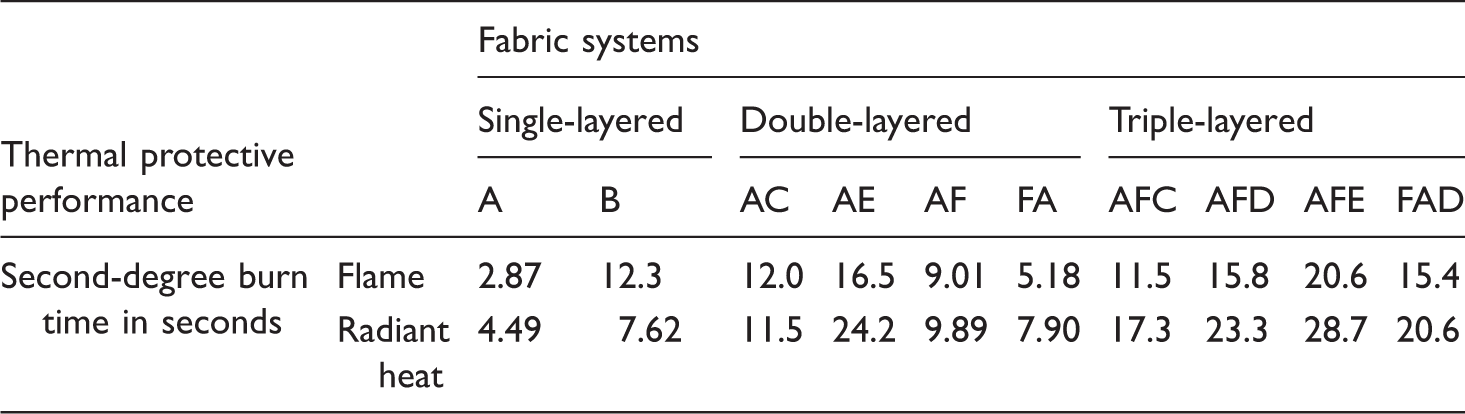
Furthermore, the results (T-stat and P-value) of the t-test between normalized values of the fabric systems’ properties and thermal protective performance are shown in Table 6. Table 6 shows that T-stat value between air permeability and thermal protective performance is negative. It means that air permeability has a negative relationship with thermal protective performance (Figure 2). This is because a highly air-permeable fabric can transmit the heat through its constituent pores. This heat transmitted can generate a quick burn on wearers’ bodies and lower the thermal protective performance of the fabric. In this regard, it is notable from Figure 2 that the R2 value between air permeability and thermal protective performance is not close to 1 (R2 = 0.19); hence, a weak negative relationship exists between air permeability and thermal protective performance. Table 6 also demonstrates that the P-value of air permeability is 0.22, which is much greater than 0.05; consequently, air permeability is an insignificant property to affect thermal protective performance. Moreover, the T-stat values of weight, thickness, and thermal resistance are positive (Table 6). This indicates that a positive relationship exists between these properties (weight, thickness, and thermal resistance) and thermal protective performance (Figures 3 to 5). This is because fabric systems become compressed between hot surfaces and wearers’ bodies; in this compressed situation, a fabric with high weight and thickness can trap more dead air within its structure than a fabric with low weight and thickness. As the dead air acts as a thermal insulator, the thermal resistance of the weighty and thicker fabric is high; eventually, the thermal protective performance of such fabric becomes high. In this context, Figures 3 to 5 confirm that R2 values between these properties and thermal protective performance are all close to 1 (>0.7); hence, a strong positive relationship exists between these properties and thermal protective performance. Table 6 also exhibits that the P-value of thickness 0.001 is the minimum among all these properties; thus, thickness is the most significant property to affect the thermal protective performance of fabrics under the exposure of hot surface contact.
Relationship plot between air permeability and thermal protective performance. Relationship plot between weight and thermal protective performance. Relationship plot between thickness and thermal protective performance. Relationship plot between thermal resistance and thermal protective performance. Results of t-test.


Heat transfer mechanisms during hot surface contact with thermal protective fabrics
Previously, Torvi [31] and Song [32] analyzed heat transfer mechanisms through thermal protective fabrics under flame and radiant heat exposures. They corroborated that modes of heat transfer vary in different thermal exposures. They further affirmed that convection and radiation modes of heat transfer usually predominate in flame and radiant heat exposures, respectively. Considering this, the present study primarily identifies the mode of heat transfer in hot surface exposure. Based on the hot surface contact test shown in Figure 1, heat transfer occurs from the uniform high temperature hot surface plate towards the low temperature skin simulant sensor (or human body) via fabric. In this heat transfer process, the hot surface plate and the sensor act as solid bodies. On the other hand, the fabric acts as a porous medium because its structure is a combination of solid fiber and gaseous air phases (Figure 6) [33]. As all the objects (hot surface plate, fabric, and sensor) are in intimate contact with each other in the test configuration (Figure 1), conduction is the primary mode of heat transfer. Analytically, this conductive heat transfer takes place mainly through four regions (R1 to R4): (i) R1 = between the hot surface plate and fabric (q′); (ii) R2 = within the fabric (q″); (iii) R3 = between the fabric and sensor (q‴); and (iv) R4 = within the sensor (q″″). In a typical scenario, the heat flow (q to q″″) and temperature (T) distribution during the test can be represented by Figure 7. In this study, it can be assumed that the conductive heat transfer is one dimensional, i.e. in the X-direction along the objects’ thickness (plate thickness = XP, fabric thickness = XF, and sensor thickness=XS), and that the thermal properties, i.e. thermal conductivity (for plate = kP, fabric = kF, and sensor = kS), density (for plate=ρP, fabric=ρF, and sensor =ρS), and specific heat (for plate=CPP, fabric = CPF, and sensor = CPS) of each object do not change with temperature. Additionally, it is hypothesized that all the objects are in a condition of thermal equilibrium (i.e. temperature within the object is spatially and temporarily uniform at any time, where plate temperature = TP, temperature of fabric’s outer surface = TF1, temperature of fabric’s inner surface = TF2, and sensor temperature = TS). In the following section, mathematical modeling on conductive heat transfer through each region (q′ − q″″) is discussed.
Fabric as a porous medium. Heat flow and temperature distribution during the hot surface contact test.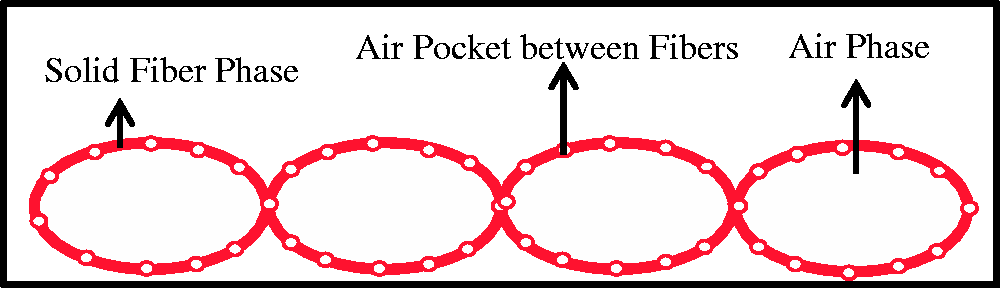

Mathematical modeling on heat transfer between hot surface plate and fabric (R1)
According to Figure 7, it is clear that a temperature drop (ΔPF1) occurs at the interface of the solid hot surface plate and the outer surface of the porous fabric (F1). This phenomenon is the result of thermal contact resistance (an inverse of thermal conductance coefficient, hPF1) acting between the hot surface plate and fabric (Figure 8). Here, thermal contact resistance (1/hPF1) can be defined as the ratio between the temperature drop and average heat transfer across the interface; this finite resistance is principally due to surface roughness of the plate and/or fabric [34,20,21]. For the surface roughness of the plate and/or fabric, the contact spots (between the plate and fabric) are generally interspersed with air-filled gaps; as a consequence, the heat transfer occurs due to conduction across the actual contact spots (q′contact), and also conduction and/or radiation occurs across the air-filled gaps (q′gap). Overall, it can be inferred that thermal contact resistance is a combination of two parallel resistances: one due to contact spots and another due to air gaps. If the surface roughness of a fabric is high because of its protruded fibers and yarns, it can trap more dead air than a fabric with low surface roughness. This trapped air acts as a thermal insulator that enhances thermal contact resistance. By considering the thermal contact resistance, the heat transfer (q′) between the solid hot surface plate and porous fabric at a particular time (t) can be mathematically modeled by equation (1), where A = face area between the solid hot surface plate and porous fabric. In equation (1), thermal conductivity of the porous fabric (kF) can be represented by equation (2), where P is fabric porosity, kγ is thermal conductivity of a fabric’s solid phase, and kα the thermal conductivity of a fabric’s gaseous air phase; here, the porosity (P) can be defined as the ratio of fabric’s air volume (VA) to total volume (VF). By substituting equation (2) in equation (1), the heat transfer model can be constituted as equation (3). According to equation (3), it may be inferred that q′(t) can be decreased by increasing 1/hPF1; this may help to enhance the thermal protective performance of the fabric used in firefighters’ clothing.
Heat flow and temperature drop due to thermal contact resistance between the hot surface plate and fabric.


Mathematical modeling on heat transfer within the fabric (R2)
The previous section discussed that fabric is a porous medium (a combination of solid fiber and gaseous air phases) and conductive heat transfer mainly occurs from the hot surface plate towards the outer surface of fabric (F1) [21]. From Figure 7, it is clear that a significant amount of temperature drop (ΔF1F2) occurs from the outer surface (F1) to the inner surface (F2), indicating that heat flow (q″) reduces along fabric thickness (XF). From this, it can be assumed that fabric has (i) constant porosity (P); (ii) isotropic structure; (iii) negligible radiative effects, kinematic viscosity, and pressure changes in the gaseous air phase; (iv) constant properties in both solid fiber and gaseous air phases; (v) identical temperature in both solid fiber (Tγ) and gaseous air (Tα) phases, i.e. Tγ = Tα; (vi) constant rate of heat conduction; (vii) parallel heat conduction through both solid fiber and gaseous air phases, i.e. no net heat transfer from the solid fiber to gaseous air phases; and finally, (viii) negligible changes in kinetic and potential energy. Keeping these assumptions intact, the conductive heat removed (Hout) from the tested fabric at a time (t) can be represented by equation (4), where Hin = heat added to the fabric, Hg = heat generated within the fabric due to thermochemical reactions of solid fibers/yarns, and Hst = heat storage within the fabric. By using the Fourier law on heat conduction through the solid fiber and gaseous air phases of fabric [34], Hin can be represented by equation (5). Additionally, Hg and Hst can work according to equations (6) and (7), respectively, where E is the rate of heat energy generated per unit volume of fabric; ργ and ρα are the densities of the solid fiber and gaseous air phases of the fabric, respectively; CPγ and CPα are the specific heat values of the solid fiber and gaseous air phases of the fabric, respectively. Now, equation (8) can be generated by substituting equations (5) to (7) into equation (4). Based on equation (8), it can be inferred that the heat transfer out of fabric in hot surface contact tests mainly depends upon fabric thickness and thermal properties (thermal conductivity, density, and specific heat) of the solid fiber and gaseous air phases of the fabric. In equation (8), the products of density and specific heat, ργCPγ and ραCPα, are referred to as the heat capacity of the solid fiber and gaseous air phases, respectively; and the heat transferred through the fabric can be lowered by enhancing the heat capacities, which could help to increase the thermal protective performance of the fabric.



Mathematical modeling on heat transfer between fabric and sensor (R3)
Figure 7 shows that a temperature drop (ΔF2S) occurs at the interface of the inner surface of porous fabric (F2) and solid sensor (S). This drop is marginal due to low thermal contact resistance (an inverse of thermal conductance coefficient, hF2S) between the fabric and sensor (Figure 9) [34]. Generally, the microscopic surface roughness of a solid black painted sensor is very low. Additionally, the outer surface of the fabric is directly loaded with a 1 kg weight attached with the sensor, which greatly compresses protruded fibers and yarns on the inner surface of fabric. Eventually, the roughness of the inner surface decreases. The lower surface roughness between the fabric’s inner surface and the sensor results in low dead air trapped between them. As a consequence, 1/hF2S between the fabric’s inner surface and sensor becomes low, resulting in reduced ΔF2S. By considering 1/hF2S, q‴ at a time (t) can be modeled according to equation (9), where A′ is the face area between the porous fabric and solid sensor.
Heat flow and temperature drop due to thermal contact resistance in between the fabric and sensor.

Mathematical modeling on heat transfer within sensor (R4)
According to Figure 7, the sensor can maintain a uniform temperature along its thickness at a time. Assuming that no heat loss occurs from the back of the insulated sensor, the instantaneous heat flux on the surface of the sensor at each time step can be determined from the temperature data using Duhamel’s theorem (equation (10), where Ti (at t=0) is the initial surface temperature of the sensor, and Ts(t) is surface temperature of the sensor at time t during testing) [30,31]. Here, as the surface of the sensor acts as human skin, based on equation (10) it can be inferred that the heat flow characteristics of human skin depend upon its thermal conductivity, density, and specific heat.

Conclusions and recommendations
Hot surface exposure critically differs from any other regular thermal exposure (flame, radiant heat) faced by firefighters because fabric systems become compressed between hot surfaces and wearers’ bodies in this exposure. As a result, thermo-physical properties of fabric systems change and heat transfer through these fabric systems become high. Here, the mode of heat transfer also differs significantly from that of other thermal exposures. In flame and radiant heat exposures, convection and radiation are the primary modes of heat transfer, respectively, whereas, conduction is the primary mode of heat transfer in hot surface exposure.
In this study, it has also been found that the constructional features and properties of fabrics affect their thermal protective performance in hot surface contact. Generally, a multi-layered fabric system comprised of thicker thermal liners has high thermal protective performance. Moreover, a fabric system having a moisture barrier in the outer layer can easily ignite, which can lower thermal protective performance. Additionally, a fabric system with low air permeability, high weight, high thickness, and high thermal resistance can possess commendable thermal protective performance for firefighters’ clothing. By controlling the thickness of a fabric, its thermal protective performance can be varied. It can also be concluded that conductive heat transfer towards firefighters in this exposure is mainly dependent upon the surface roughness of the hot surface and/or fabrics, thermal properties of fabrics, and/or heat flow characteristics of human skin. Thermal contact resistance between the hot surface and fabric does play a crucial role on the heat transfer or thermal protective performance of the fabric. Within a fabric, temperature and heat flow gradually decrease along its thickness in a hot surface contact.
The findings from this study could help textile/material engineers to develop fabrics that can provide better occupational safety and health for firefighters. Although this study extensively researched thermal protective fabrics under hot surface contact, the changes in thermo-physical properties of the fabrics are not taken into account. A further detailed study on changes in the thermo-physical properties of a multi-layered fabric system could enhance the understanding of characteristics of thermal protective fabrics under hot surface contact.
Footnotes
Authors’ note
The findings in this research are based on laboratory tests conducted in simulated and controlled thermal exposures of hot surface contact. These findings do not represent fabric performance in actual fire conditions, where the nature of thermal exposure, clothing conditions, and human body response can be physically complicated and unqualified. Conclusions about the safety benefits derived from the results of these experiments should be employed with caution.
Declaration of Conflicting Interests
The author(s) declared no potential conflicts of interest with respect to the research, authorship, and/or publication of this article.
Funding
The author(s) disclosed receipt of the following financial support for the research, authorship, and/or publication of this article:Sumit Mandal thanks University of Alberta, Canada, for providing him the prestigious Alberta Innovates Scholarship and Izaak Walton Killam Memorial Scholarship.