




Abstract
Product configuration is the key to mass customization, which is based on configuration modeling and solutions. A customer-oriented optimal configuration model is built to achieve an optimal configuration for a product scheme. Based on a product platform and customer requirements, a dual-objective “performance-cost” optimization model for customized products is proposed. This model is based on the Pareto genetic algorithm for configuration optimization through which optimal solutions for customer requirements can be obtained, including multiple choices for selection as well as reference to schemes that can enable customers to participate in the product design. In this study, a case is studied to prove the feasibility and effectiveness of the proposed model.
Introduction
Product configuration is the key to mass customization, which is based on configuration modeling and configuration solution, although configuration solutions can vary with different configuration models. 1 A generative bill-of-material model representation (generic bill of materials (GBOM)) has been previously proposed, which is utilized for product configuration. 2 A layered product configuration model based on product features has also been described using qualitative analysis and constraint satisfaction to configure products. 3 A previous study proposed a product ontology-based configuration model for configuration design. 4 These studies were designed to seek one optimal configuration scheme that would meet the needs of customers. For complex products, customers are often sought to participate in the product design in order to develop a variety of solutions as well as propose additional demands. Pareto genetic algorithm (PGA) is always used for optimal selection; however, GA operations tend to converge.5,6
In this study, we describe a customer-oriented optimal configuration of a product scheme using PGA with two points that have partial crossover for configuration optimization. Using this approach, optimal solutions for customer requirements can be obtained (as well as multiple choices for selection) and redesign requirements can be proposed with reference to the schemes provided. This approach also allows customers to participate in the product design.
Customer-oriented optimal modeling for product configuration
Customized requirement transformation
Our proposed model is described here based on the following specifications:
Let
“Customer requirements–technique” relation matrix.

Column vector correlation can be calculated using a uniform formula expressed as
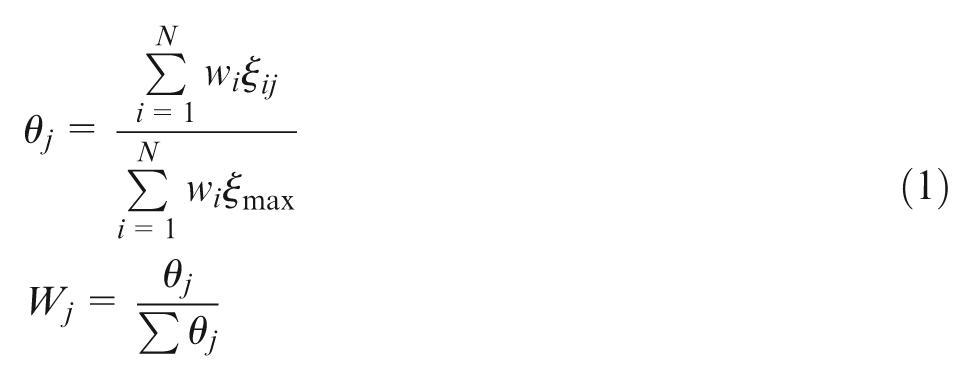
where
The correlation between
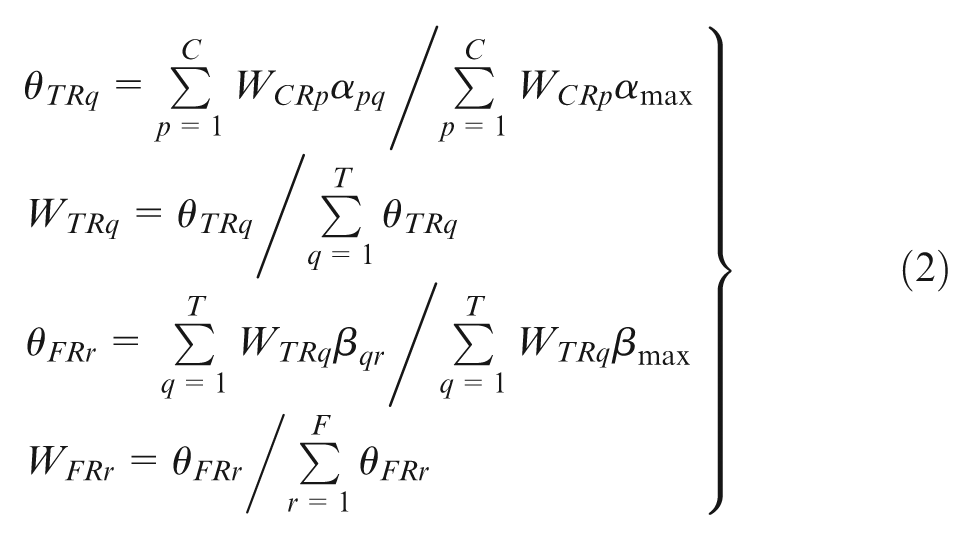
Functions need to be judged whether they are demanded by customers:
if θFRr>θκ, then select it;
if θFRr<θκ, then make decisions based on rules regardless of whether it is selected or not (θκ denotes the preset correlation threshold).
A customized function set is then established. This set can be mapped onto production modules to form customized configuration unit sets by “function–structure (case plate)” mapping on a product platform to map the “function” (i.e. template). When configuring products, the configuration unit is not selected from a product module library, but rather from configuration unit sets with a narrow search range, which reduces identification of the configuration effectiveness and consistency and improves configuration efficiency.
Expression of configuration unit constraints
The constraints of a configuration unit can be categorized into the following: constraints between two configuration units, constraints between one configuration unit and another configuration unit attribute, constraints between two attributes of different configuration units, and constraints between two attributes of the same configuration unit.
The configuration unit is denoted by CMijk, which means that the design case k of structure j can determine the function i. In the case library, j refers to the case plates of a different structure and k refers to variable case plates with a series of design parameters of j.
The first step of product configuration is to determine whether the structures are compatible and whether the issue of parameter compatibility can be solved by parametric design. Thus, the constraints between CMij must first be established (i.e. the constraints between case plates). Let
Customer-oriented optimal model for product configuration
The main idea of the proposed optimal product configuration can be summarized as follows:
Based on the product platform built and customer requirements, a dual-objective “performance-cost” optimization model for customized products can be established. 5 As shown in Figure 1, the constructed product platform, as proposed by previous research, is composed of a common product platform (function field and structure field), customized sets (function field and structure field), and a knowledge system.
Utilize the optimization strategy of PGA and configure the product design according to customer requirements, constraints, and rules for obtaining a group of Pareto optimal solutions for product configurations.
Select a product configuration scheme according to the customer’s preferences.
Obtain the final solution after redesign, analysis, and structural optimizations of the above selected product configuration.
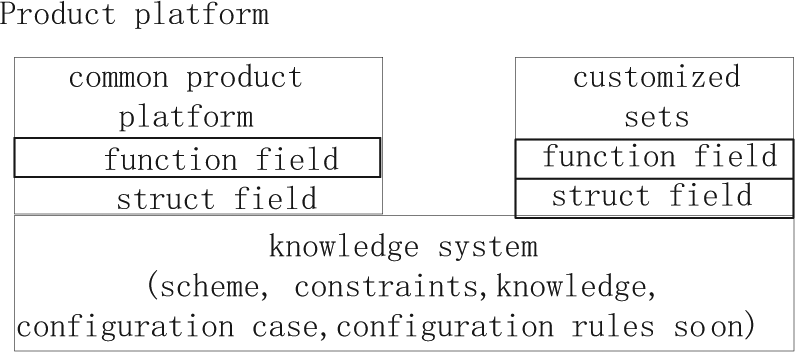
Product platform illustration.
The optimal model of a product configuration is illustrated in Figure 2.
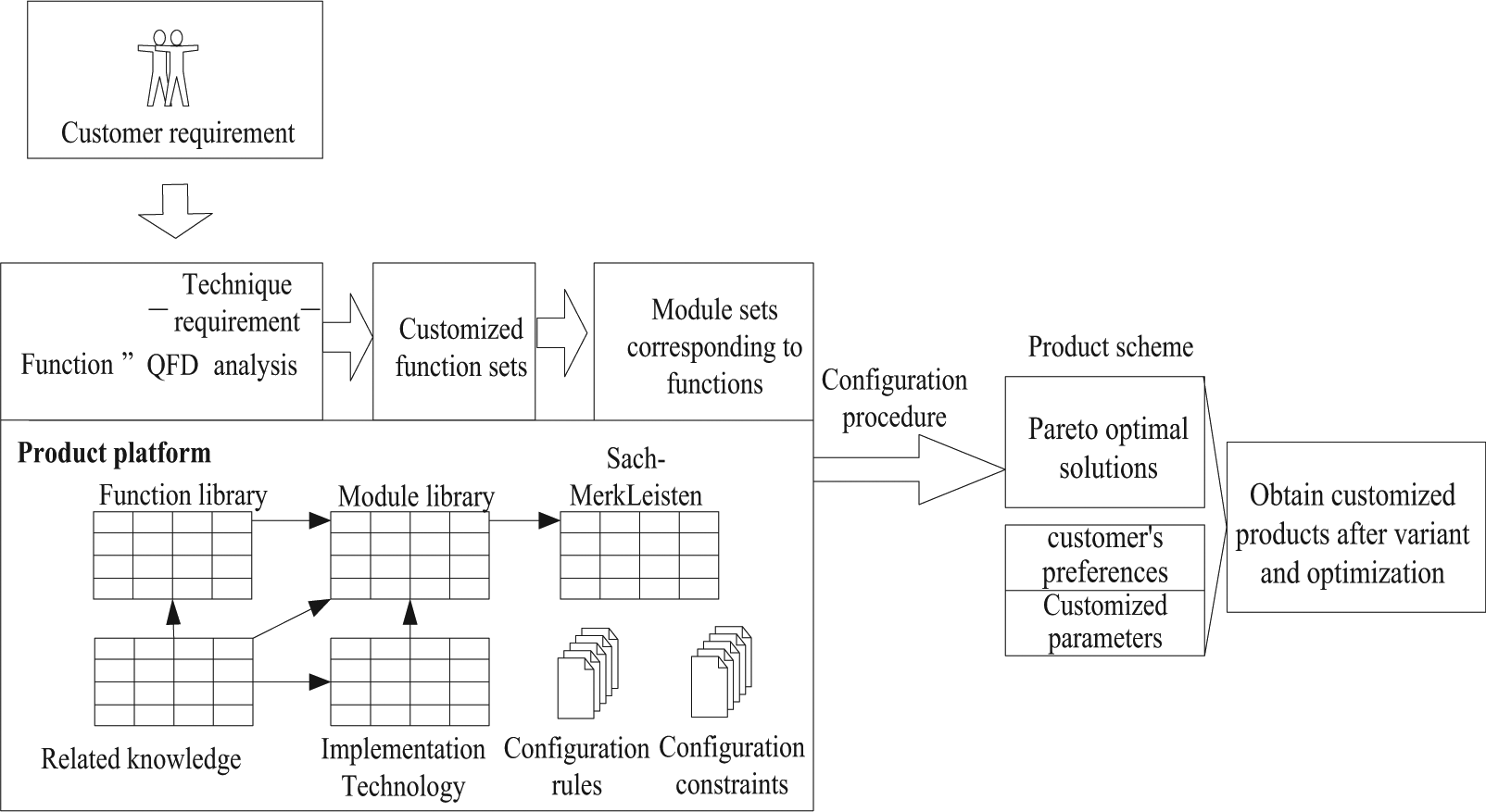
Customer-oriented optimal model for product configuration.
Optimal configuration implementation of a product scheme
Mathematical optimization model
1. Optimization objectives and constraints. The optimization model is proposed based on optimization objectives for maximum performance as well as minimum cost to provide customers with multiple product configuration schemes from which to select. The optimization constraint occurs where the cost needed is less than the threshold of which customers can afford. The mathematical optimization model of product configuration is expressed as
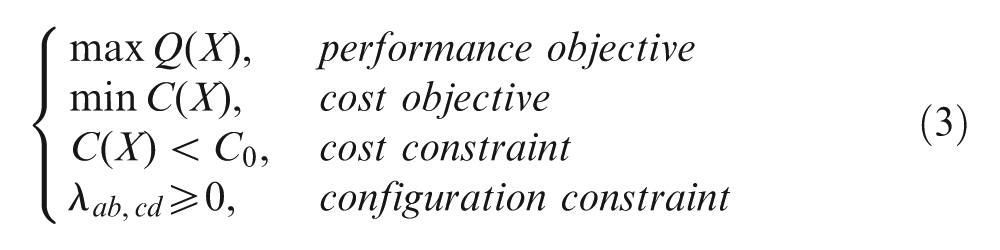
where X denotes a configuration scheme, Q(X) denotes the performance of scheme X, C(X) denotes the cost of scheme X, C0 denotes the maximum cost customers can accept, and
2. Evaluation model of Q(X). Let performance index set ZQ = {ZQ1, ZQ2, …, ZQz} (where ZQi denotes the ith performance index) and CMij denotes case plate of configuration unit (here, the number of structures available for function i is j). The AHP can be utilized to determine the weight of structure scheme j to the same function i. There are u functions in a configuration function set, and the number of schemes available for each function is v (1), v (2), …, v (u), respectively. After scoring on a 1–9 scale by pairwise comparisons in order to calculate a single-factor evaluation matrix, an overall evaluation matrix of each scheme can be obtained (details regarding the AHP will not be discussed here). The overall evaluation matrix requires fuzzy transformation. For example, take the first element of the first overall evaluation matrix
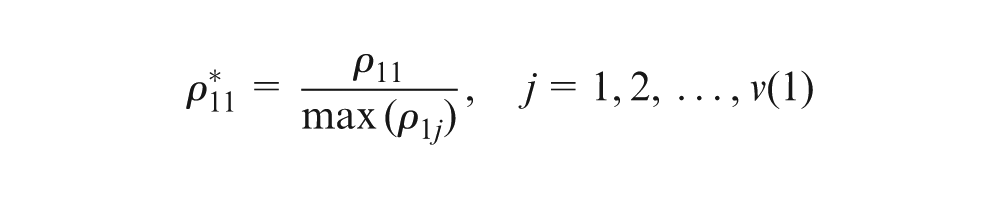
The remaining elements of the other overall evaluation matrices can be treated in a similar manner
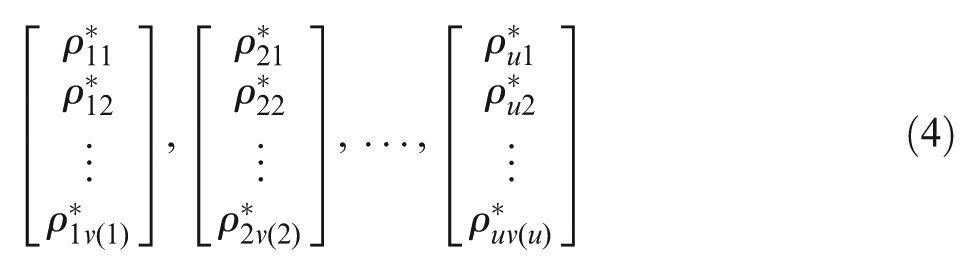
The example above considers only the merits of different structure schemes to achieve certain functions, while the merits of different feature parameters of the same structure can be measured by similarity. Let the feature parameter set
Take structure 1 of function 1, for example, to illustrate the calculation of similarity.
In order to establish the relationship matrix
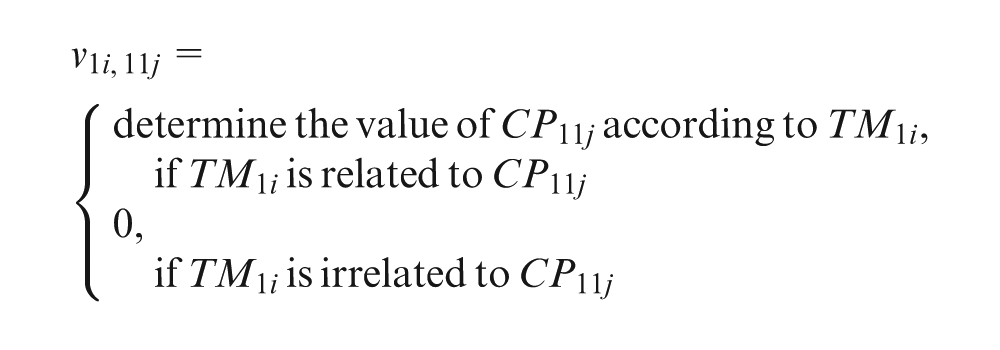
After conflict resolution between parameters, the parameter variable value
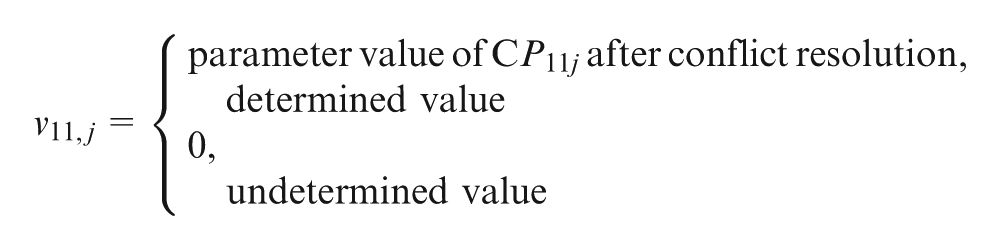
Similarly, the parameter value
The variable value
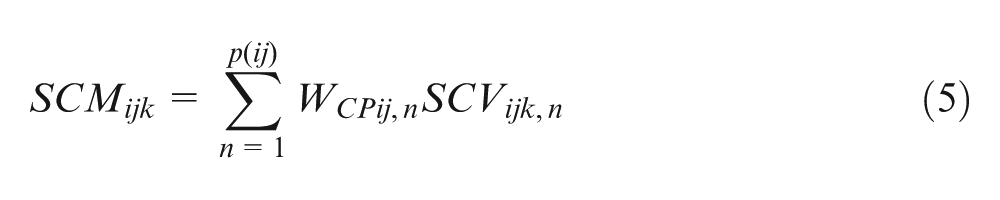
where SCVijk, n denotes the similarity of each customized parameter.
Thus, the evaluation value of performance can be calculated as formula (6)
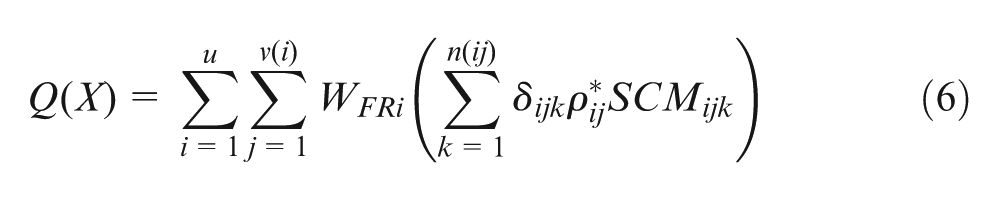
where u denotes the number of functions, v(i) denotes the number of different structures available for function i, and n(ij) denotes the number of cases with different parameters of structure j

and
3. Estimation model of C(X). The components involved in products can be categorized into common parts, general parts, and customized parts. Thus, the total cost of a customized product can be estimated according to manufacturing costs, assembly costs, and other costs. The cost CMijk of configuration unit can be estimated by formula (7)
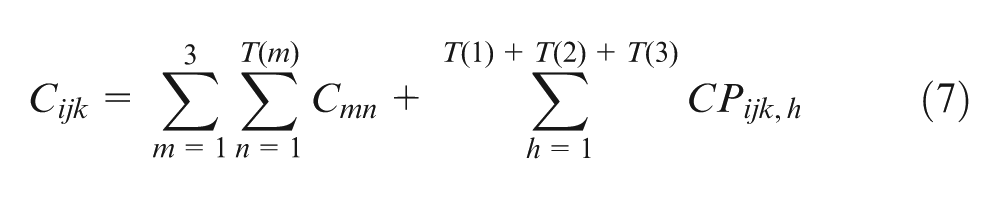
where CPijk, h denotes the assembly costs of each assembly part; C1n, C2n, and C3n denote the manufacturing cost of common parts, general parts, and customized parts involved in configuration units, respectively; and T(1), T(2), and T(3) denote the number of common parts, general parts, and customized parts involved in configuration units, respectively
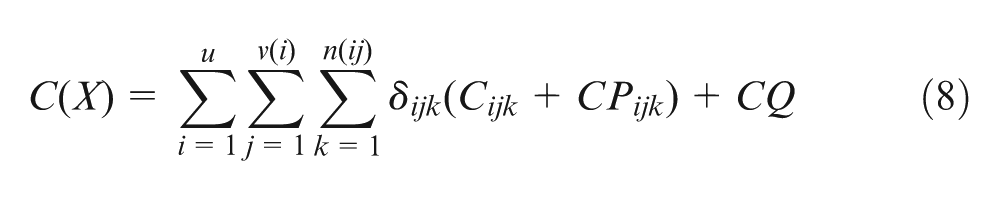
where CPijk denotes the assembly costs of CMijk and CQ other costs.
Optimal configuration implementation based on PGA6,7
1. Optimization model transformation. According to the above analysis, the optimization model expressed as forum (3) can be transformed to a multi-objective optimization (MO) problem, as expressed in formula
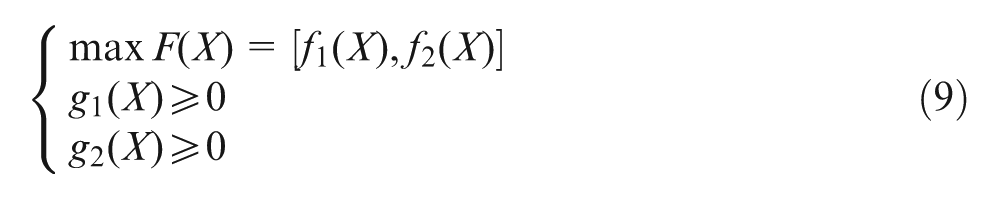
where
2. Penalty function. The methodology of penalty function is an indirect method for solving constrained optimization problems, the core of which is to transform an optimization problem with constraints into a series of optimization problems without constraints. 8
An individual penalty function for constraints can be expressed as

where

where G denotes the grade of individuals, Gmax denotes the maximum grade, and κ denotes the penalty factor. Thus, the penalty function is modeled as
Dual-objective constrained problems can be transformed into unconstrained problems

3. Fitness of each grade. Due to the difficulty of evaluating the fitness of single individuals for parallel MO, the objective function (a vector space) and the idea of population grading of Pareto optimal solutions are also presented here. 9 In MO, the probability of being selected as individuals belonging to the same grade is equal. Regarding dual-objective maximization, the fitness of each grade is defined as the area enclosed with the objective value of corresponding chromosomes and the coordinate axis constructed by f1 and f2
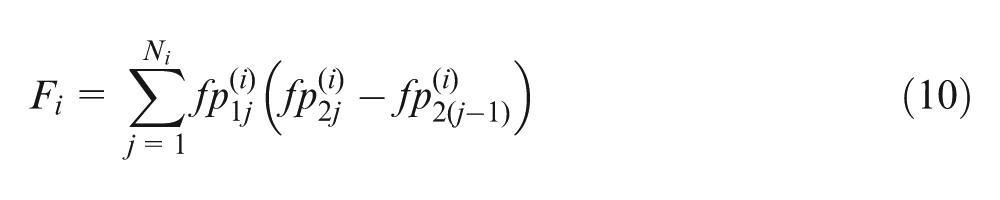
where Ni denotes the number of ith grade chromosome sorted by f2 from small to large,
4. Genetic coding. Genes are expressed as configuration units, where the length of a chromosome is equal to the number of functions in a customized function set. CMuy(u) z(u) denotes the case with function u and each chromosome represents a configuration scheme.
5. Genetic operation
Selection
The probability of being selected as individuals belonging to the same grade is equal and the roulette algorithm is adopted to select individuals.
Crossover
Two points of a partial cross-recombination method are adopted to crossover with a probability of Pc (Pc denotes the crossover probability, which is usually expressed as an experience value).
Mutation
Mutation refers to the change in genes within each chromosome with a probability of Pm (Pm denotes the mutation probability, which is also usually expressed as an experience value). The detailed operations are as follows: Randomly by Pm: select the gene from the chromosome for an upcoming mutation. As shown in Figure 3, there are genes from a chromosome corresponding to the configuration unit CM2y(2) z(2), and the white arrow indicates a mutation. The selected CM2y(2) z(2) will be replaced by another case retrieved from the case library in order to achieve the same functions belonging to different case plates. The mutation is illustrated in Figure 2.
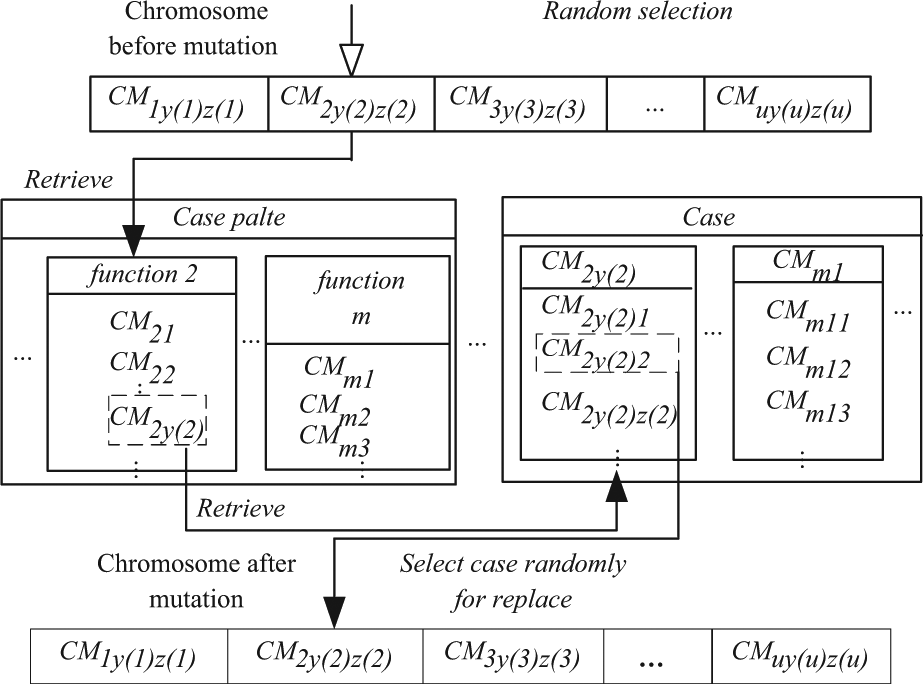
Mutation operation.
Case study
The purpose of this case is to observe and monitor space debris using a customized astronomy telescope. After induction and extraction of customer requirements, the following main requirements were identified:
Effective field of view: 1.0° with chromatic aberration and field curvature;
Auto focus with focus range ± 10 mm;
Be able to cover the sky from north azimuth to south azimuth within ±10° (altitude > 15°), as well as another azimuth (altitude > 10°);
Good optical quality;
Ability to detect celestial bodies with 15 magnitude;
Fast and accurate tracking of celestial bodies;
Detectors using a charge-coupled device (CCD);
Cost of $250,000 or less (not including costs of control systems, installation, and commissioning).
The seventh item directly determines the scope of the configuration unit for detectors and the eighth item is related to costs without relevance to functional determination. Therefore, only items 1–6 need to be analyzed to obtain customized configuration function units.
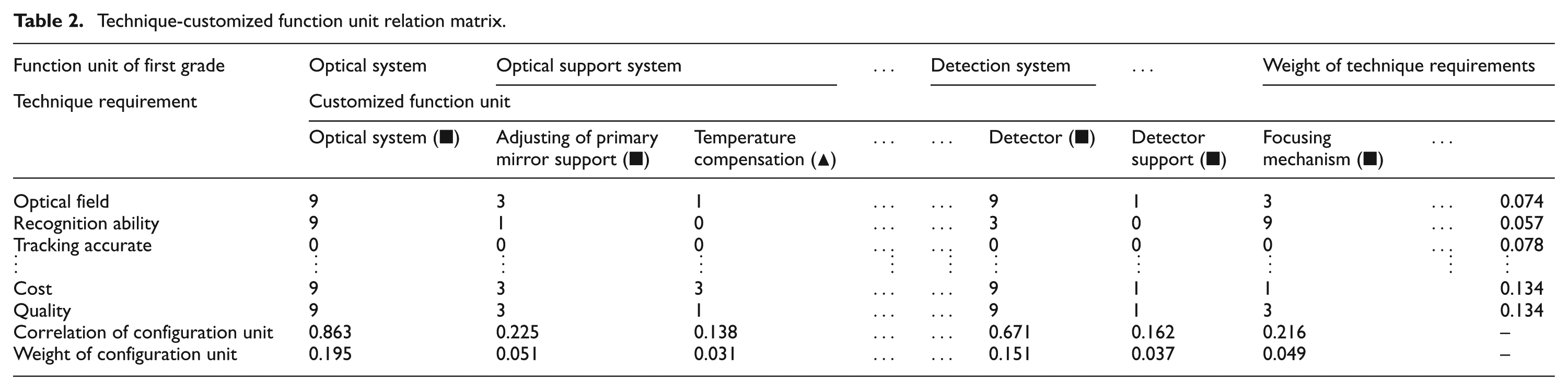
After selection, 18 customized function units are obtained as shown in Table 2, where “■” represents basic yet required configuration function units and “▲” represents optional configuration units depending on customer requirements, configuration constraints, and other conditions for configuration. The correlation and weight of the technique requirements (shown in Table 2) to function configuration units can be calculated using formulas 1 and 2.
Technique-customized function unit relation matrix.
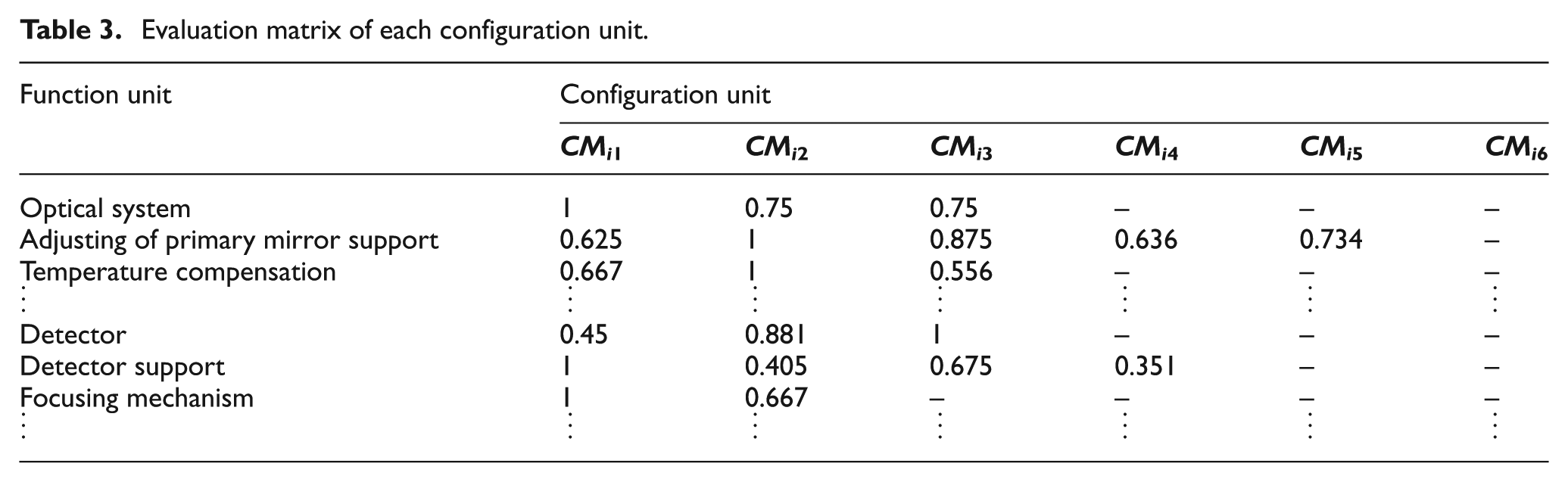
Configuration function units in Table 2 can be achieved using different structures by mapping function units to case plates that correspond to factual cases with variable parameters. Among the 18 function units of this presented case, the astronomical dome has the most, which corresponds to 6 different structures. The pros and cons of each structure to function can be determined by the building evaluation matrix of each configuration unit using fuzzy transformation (4). Each row in Table 3 represents the column matrix corresponding to each function unit as formula (4).
Evaluation matrix of each configuration unit.
Based on the analysis of assembly, unit attributes, and correlation of telescopes, the degree of compatibility matrix can be established according to the methods discussed in section “Expression of configuration unit constraints.” The parameters of the presented optimal model are provided in Table 4.
Parameters of genetic optimization.

Customers require that the costs are below $41,000, and thus, the product costs must be limited to $34,426 RMB, so C0 is taken as $34,426. Each chromosome represents a configuration scheme, and the length of chromosome, I_length, equals the number of configuration function units. Using the parameters of product optimization described above to run the configuration program, the fitness converges to the maximum value when iterating to the 302th-generation frontier (the first grade) as shown in Figure 4.
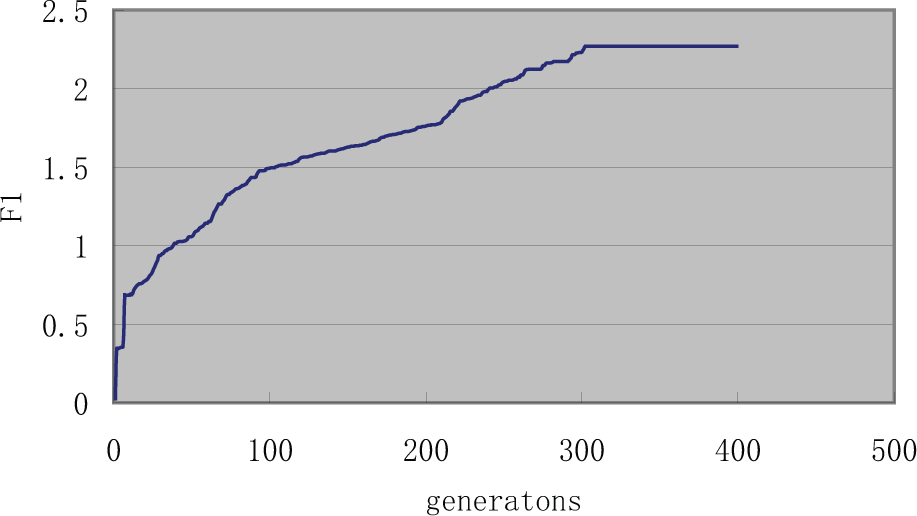
Fitness curve with iteration.
All the chromosomes and their corresponding optimization objective values of each generation frontier are stored during the iteration process. Data from the initial frontier, 50th-generation frontier, 100th-generation frontier, 150th-generation frontier, and 300th-generation frontier are selected, and the values closest to the objective value or coincident are removed. Five chromosomes (configuration schemes) are retained for alternatives. Since the initial chromosomes are randomly selected and only three chromosomes exist in its frontier, all three are retained. Finally, the actual value can be obtained after chromosome decoding. The optimization objective value of each generation and the corresponding curve are shown in Figure 5.
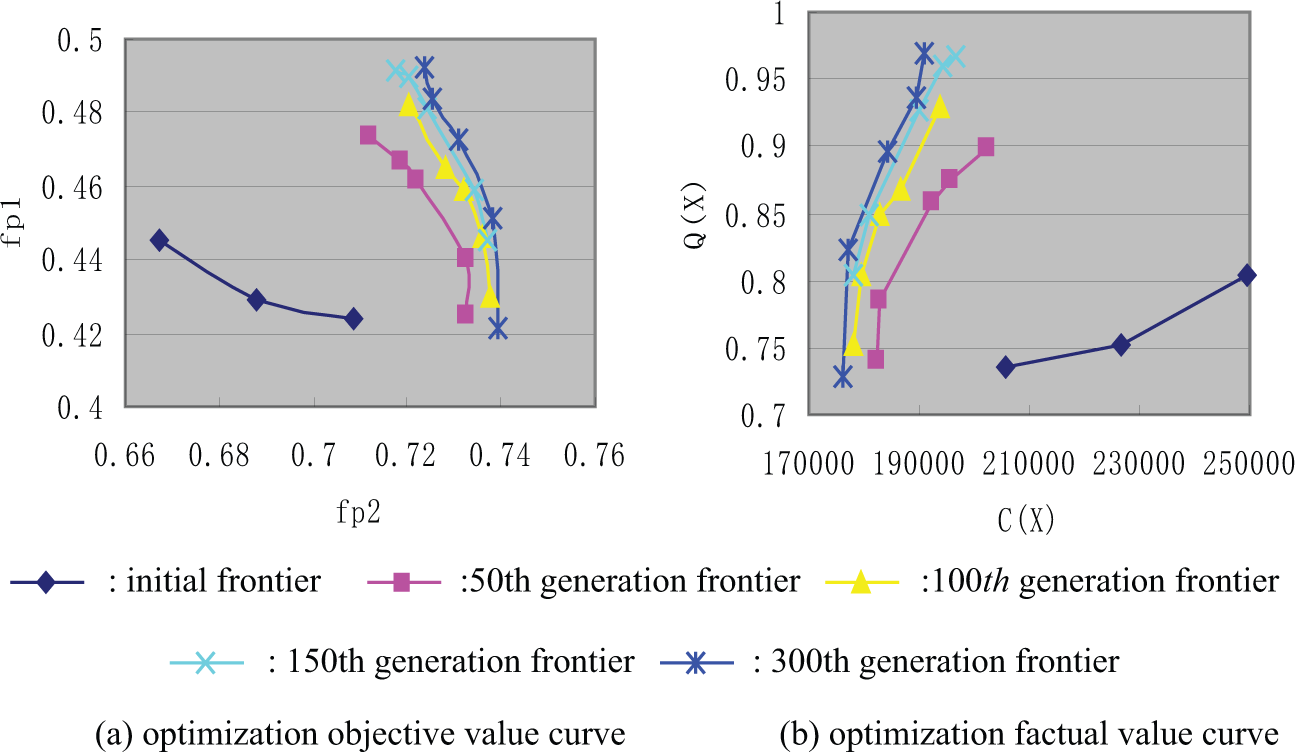
Optimization results: (a) optimization objective value curve and (b) optimization factual value curve.
When iterating to the 302th generation, the maximum objective values converge and the performance and cost are optimal. The five configuration schemes of the 302th generation are then provided to customers as the optimal solution set.
The performance indicators of the five schemes are provided in Table 5. The telescope field of view and detection capabilities are calculated using a theoretical formula, and the optical quality is evaluated using expert experience.
Performance of five optimal configurations (here, CMi,j,k = CMijk).
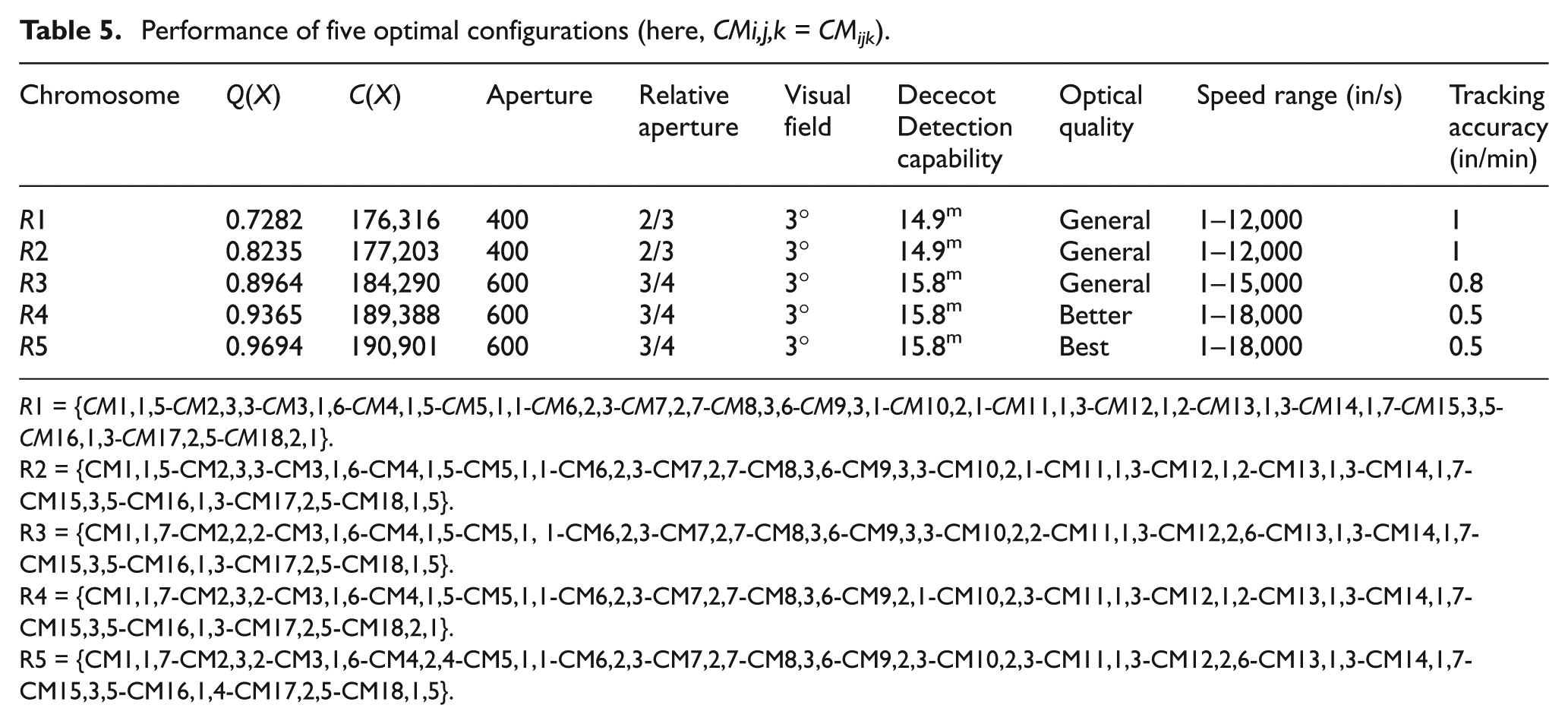
R1 = {CM1,1,5-CM2,3,3-CM3,1,6-CM4,1,5-CM5,1,1-CM6,2,3-CM7,2,7-CM8,3,6-CM9,3,1-CM10,2,1-CM11,1,3-CM12,1,2-CM13,1,3-CM14,1,7-CM15,3,5-CM16,1,3-CM17,2,5-CM18,2,1}.
R2 = {CM1,1,5-CM2,3,3-CM3,1,6-CM4,1,5-CM5,1,1-CM6,2,3-CM7,2,7-CM8,3,6-CM9,3,3-CM10,2,1-CM11,1,3-CM12,1,2-CM13,1,3-CM14,1,7-CM15,3,5-CM16,1,3-CM17,2,5-CM18,1,5}.
R3 = {CM1,1,7-CM2,2,2-CM3,1,6-CM4,1,5-CM5,1, 1-CM6,2,3-CM7,2,7-CM8,3,6-CM9,3,3-CM10,2,2-CM11,1,3-CM12,2,6-CM13,1,3-CM14,1,7-CM15,3,5-CM16,1,3-CM17,2,5-CM18,1,5}.
R4 = {CM1,1,7-CM2,3,2-CM3,1,6-CM4,1,5-CM5,1,1-CM6,2,3-CM7,2,7-CM8,3,6-CM9,2,1-CM10,2,3-CM11,1,3-CM12,1,2-CM13,1,3-CM14,1,7-CM15,3,5-CM16,1,3-CM17,2,5-CM18,2,1}.
R5 = {CM1,1,7-CM2,3,2-CM3,1,6-CM4,2,4-CM5,1,1-CM6,2,3-CM7,2,7-CM8,3,6-CM9,2,3-CM10,2,3-CM11,1,3-CM12,2,6-CM13,1,3-CM14,1,7-CM15,3,5-CM16,1,4-CM17,2,5-CM18,1,5}.
Conclusion
In this study, PGA was used to provide an optimal configuration of multiple schemes according to customer requirements and to provide customers with a variety of options. The proposed automatic configuration is achieved using genes for parts, chromosomes for the configuration scheme, two points of partial cross-recombination crossover, and rule-based mutation for different schemes. This approach can avoid prematurity as well as generate optimal generation and result in a reduction of human intervention. We also describe a case study to prove the feasibility and effectiveness of the proposed model. By utilizing a PGA-based customer-oriented optimal configuration of a product scheme, optimal solutions for customer requirements can be obtained, and multiple options for selection and redesign requirements are available. This approach allows customers to participate in the product design.
Several questions remain and therefore further research is needed. First, it will be important to guarantee the diversity of solutions and convergence of the algorithm by determining the population size, crossover rate, and mutation rate. In addition, variant design and optimization are needed based on customers’ preferences.
Footnotes
Acknowledgements
The authors would also like to acknowledge the Editor of Proceedings of the Institution of Mechanical Engineers, Part B: Journal of Engineering Manufacture.
Declaration of conflicting interests
The authors declare that there is no conflict of interest.
Funding
This work was financially supported by the National Natural Science Foundation of China (61104171), Postdoctoral Program of Science Foundation of Jiangsu Province of China (0901041C), and Zijin Star of Outstanding Program of NJUST.