




Abstract
In medical science, thermotherapy is a way to reduce the pain and discomfort in lower back, muscles or joints. This is because heat stimulates sensory receptors in a specific area of the body, reducing the transmission of pain signals to the brain. In this study, the objective is to develop a wearable heating belt through the utilization of embroidery technology. The principal aim is to alleviate lower back pain, while simultaneously prioritizing the human body’s flexibility and comfort. To accomplish this, the heaters were embroidered onto a cotton textile using Silver-Tech + 100 conductive threads. The heater temperature was monitored with infra-red camera under applied voltages of 3.3 V, 5 V and 9 V. Observed temperatures with applied voltages of 3.3 V, 5 V and 9 V were 29°C, 33°C and 47°C, respectively. The heater response time and recovery time at 9 V are 41 s and 98 s respectively. The heater stability was observed for 15 min at 9 V and corresponding temperature around 47°C was achieved. A portable electronic device for user control of the heating level, as well as smartphone application were also developed and tested. The developed heaters can also be used as a heating patch to alleviate joint and muscle pain.
Introduction
The application of heat to reduce or alleviate discomfort and inflammation in patients is a common practice in the medical sector. It has been known for a long time that heat applied to muscles reduces pain, and static stretching and PNF (proprioceptive neuromuscular facilitation) stretching, whether combined with heat or cold, are effective in reducing delayed muscle pain. 1 In the past, many treatments2,3 have been introduced to relieve these symptoms. Among various physical methods, the thermotherapy is the most popular treatment. Thermotherapy reduces the pain and stiffness through supplying/providing heat in the temperature range of (40–45)°C. 4 Heat in the range of (40–45)°C treats the application site to a depth of roughly 1 cm. Although deep heat, such as shortwave and microwave diathermy, treats deeper structures at depths of (2–5) cm, it also causes circulatory and metabolic alterations in deeper tissues and organs. 5 An appropriate thermotherapy in the suitable temperature range with proper time of application can be effective to relief the pain. Our skin temperature is not the same throughout the body and it also changes with environmental temperature. An external temperature in the range of (33–37) °C is considered as warm whereas (40–43) °C is very hot for the human body. A temperature of 44°C is safe for the application of effective thermotherapy for about 20 min to 30 min depending on the patient’s comfort level.6,7,8
Traditionally, thermotherapy in various forms (e.g., hot water bags, towels, or bottles) has been used to relieve pain. 9 The most conventional heat therapy is in the form of heat packs. However, the heat packs are rigid and heavy which reduce their use in conventional therapy. In addition, the temperature regulation depending on patient needs is also a major challenge. Hence, to meet the patient’s requirements, a flexible, non-toxic, mechanically stable, wearable uniform heating belt or heating patch with temperature regulator is imperative for health care and personal thermal management.
To develop the wearable stretchable heaters, numerous efforts have been shown by researchers. They have utilized nanowires, nanoparticles, carbon based 2D materials as conductive filler in the elastomers, 10 coating material on the stretchable textile 11 and silver nanoparticles based electrospun flexible fibers. 12 However, the incorporation of nanomaterials may cause toxicity as they can enter the human body through inhalation and skin penetration.13,14 Another issue is the cost of nanomaterials and carbon-based materials which may cause the economic problems and make them incompatible for industrial scale application. In the recent years, the textiles incorporated with conductive threads or yarns have gained tremendous attention in the field of wearable smart textile due to their flexibility, breathability and skin comfortability.15,16
When it comes to wearable technology, especially in the context of medical applications, it is crucial to prioritize the accuracy of simulations. A recent study conducted by researchers 16 highlights the significance of precise simulations in predicting real-world behavior and improving the safety and effectiveness of wearable devices, particularly in terms of thermal protection performance in textiles. Similarly, another study 11 highlights the utilization of simulation techniques to ensure consistent performance and reliability in self-sensing textile heaters.
In this paper we suggest a heater made from silver conductive thread using embroidery technique which caters to the growing demand for unobtrusive wearable technology, addressing concerns related to comfort, aesthetics, and versatility in everyday use. Additionally, this technique preserves the inherent qualities of the fabric, such as breathability, weight, flexibility, customization, seamless integration into textiles, scalability, wearability, and localized, efficient heating for specific body parts. By using simple embroidery techniques, this approach enables the fabrication of heated garments and accessories, enhancing wearability and comfort. What makes it particularly appealing is its manufacturing process, which requires only a sewing machine—eliminating the need for specialized equipment and allowing for cost-effective, accessible mass production. The proposed textile heater for the back offers a comfortable solution for thermotherapy. This paper provides an in-depth analysis of its design principles, manufacturing process, testing, and user experiences, focusing on the development and characterization of the wearable heating belt and its corresponding electronic heating control device. The findings align with the critical need for reliability in textile electronics, particularly in healthcare applications like thermotherapy, where safety is paramount.
Materials and methods
Materials for heater fabrication
The cotton textile was sourced from a local market supplier (Novi Sad, Republic of Serbia). The conductive thread, known as Silver-Tech + 100, was acquired from the Amann Group. 17 The thread is marketed as having a resistivity of less than 200 Ω/m. 17 The tex size of the Silver-Tech + 100 thread, composed of silver-coated polyamide, is 33. Consequently, the recommended needle size for this thread ranges from 75 to 90 in number metric (Nm). Therefore, the expected diameter of the thread should be less than 0.75 to 0.9 mm.
Flexible heater fabrication
The heater was embroidered utilizing the JCZA 0109 technical embroidery machine manufactured by ZSK, a reputable company from Germany. The design for the heater was initially crafted using AutoCAD software and subsequently converted into a machine stitch file employing the GiS BasePac 10 software integrated within the embroidery machine. A cotton thread was employed as the bobbin thread, while the needle was threaded with a Silver-Tech + 100 thread. The selection of the silver thread was deliberate, based on its documented antimicrobial properties as disclosed in the supplier’s datasheet, rendering it highly suitable for seam positions necessitating such characteristics. Three patches of the heater were embroidered to embed into the belt. Figure 1(a) represents the dimensions and heater design whereas Figure 1(b) shows the embroidered heater. The selected heater design is optimized for specific electrical and thermal resistance properties, ensuring stable performance across different operating conditions. This design has been chosen because it provides more uniform heat dissipation compared to other tested designs. To embroider the heaters, the machine speed was set to 300 rpm. The bobbin thread tension was adjusted to 50 mN, while the top thread tension was set to 42 mN. A complex stich was used for embroidering the heaters due to variation in length and width of the design, with a minimum stitch length of 3 mm and a maximum stitch length of 12 mm. Total dimensions of the developed heater are chosen to be smaller than needed to cover the complete back of average adults, because we wanted to enable that heater also fits to children and to have modular approach in which more heaters can be connected in parallel to fulfill the specific need. Heater design (a) heater layout with dimensions (b) embroidered heater on textile.
Embroidered heaters configuration for heating belt
The performance and efficiency of the heating belt as a thermotherapy device depend on the design and configuration of the embroidered heaters. In this section, we will elucidate how the embroidered heating devices are strategically integrated into a flexible belt to administer targeted heat treatment for alleviating back pain. The heaters are deliberately positioned to encompass specific regions of the lower back that are commonly afflicted by muscle pain. This positioning ensures that the heat is directly administered to the areas requiring relief, thereby maximizing the therapeutic advantages. While the heaters are designed to be smaller than the overall coverage of an adult’s back, they can be assembled modularly. This feature enables a customized fit and application that is suitable for both adults and children. The Silver-Tech + 100 conductive threads were utilized for the efficient conduction of heat while simultaneously maintaining flexibility and comfort. The embroidered pattern has been meticulously designed to ensure the equitable distribution of heat, thereby preventing any discomfort or burns resulting from localized hotspots. Cotton has been specifically chosen as the primary textile material to guarantee comfort and breathability. The flexible embroidered construction of the belt enables it to conform to various body shapes and sizes, ensuring close proximity to the skin for optimal heat transfer. The heating elements are interconnected through the use of conductive threads that are also connected to a power source. This integration has been engineered to prioritize safety and discretion, with insulated and safeguarded connections that minimize the risk of electrical hazards. The proposed heaters can be connected in parallel (Figure 2(a)), affording users the ability to customize the heating area and intensity in accordance with their individual requirements. This adaptability facilitates easy repair or replacement of individual components as and when necessary. The belt is accompanied by a handheld electronic device that allows users to effortlessly switch between low, medium, and high heat settings (Figure 2(b)). Additionally, an emergency off switch is included to swiftly deactivate the equipment, thereby enhancing user safety. Heating belt (a) 3 heaters connected in parallel, (b) IR image of the belt (c) belt connection with voltage regulator and power supply.
Testing of embroidered heating patches and heating belt
Three embroidered patches were tested using EX350 Multimeter by means of the DC resistance (Rdc). The heaters resistance was also characterized by electrical impedance spectroscopy with Hioki IM3590 Impedance Analyzer in the frequency range of (0.01–0.2) kHz at 1 V. The temperature of the heating patch was monitored by HIKMICRO pocket thermography camera. Ultrafast Doppler imaging was performed using SuperSonic MACH 30.
Portable electronic device
Handheld electronic device was developed to enable portability of the heating system, user comfort (treatment can be initiated and performed in chosen position) and heat level control. Heat level is controlled with a slider of the linear potentiometer that enables that by moving the slider from left hand side (label “0%”) to the right-hand side (label “100%”) and vice versa user can decrease or increase heating voltage VH from 0% to 100% of the power supply voltage. The level of the heating voltage is derived from the connected battery that also supplies the electronic module. The electronic module is based on the microcontroller nRF52840 that is interfaced through the analog to digital converter (ADC) to the linear potentiometer and the voltage divider R-5R that lowers the battery voltage VBAT to the range that can be safely measured by the ADC. Based on the actual battery voltage and the position of the slider x [0,100] on the linear potentiometer, the heating voltage can be determined as follows:

Based on the reading of the slider position x of the linear potentiometer, the microcontroller controls the power MOSFET (IRLZ44N) by pulse width modulation (PWM). The MOSFET is connected in a series with the heating belt. The PWM frequency in our case was 500 Hz. Finally, there is a Bluetooth low energy (BLE) link between the microcontroller and the in-house developed smartphone application that shows the actual position of the slider, heating voltage and the voltage of the connected battery. The block-schematic of developed portable electronic device is shown in Figure 3. The schematic of developed portable electronic device (hardware outcome is shown later in Figure 8).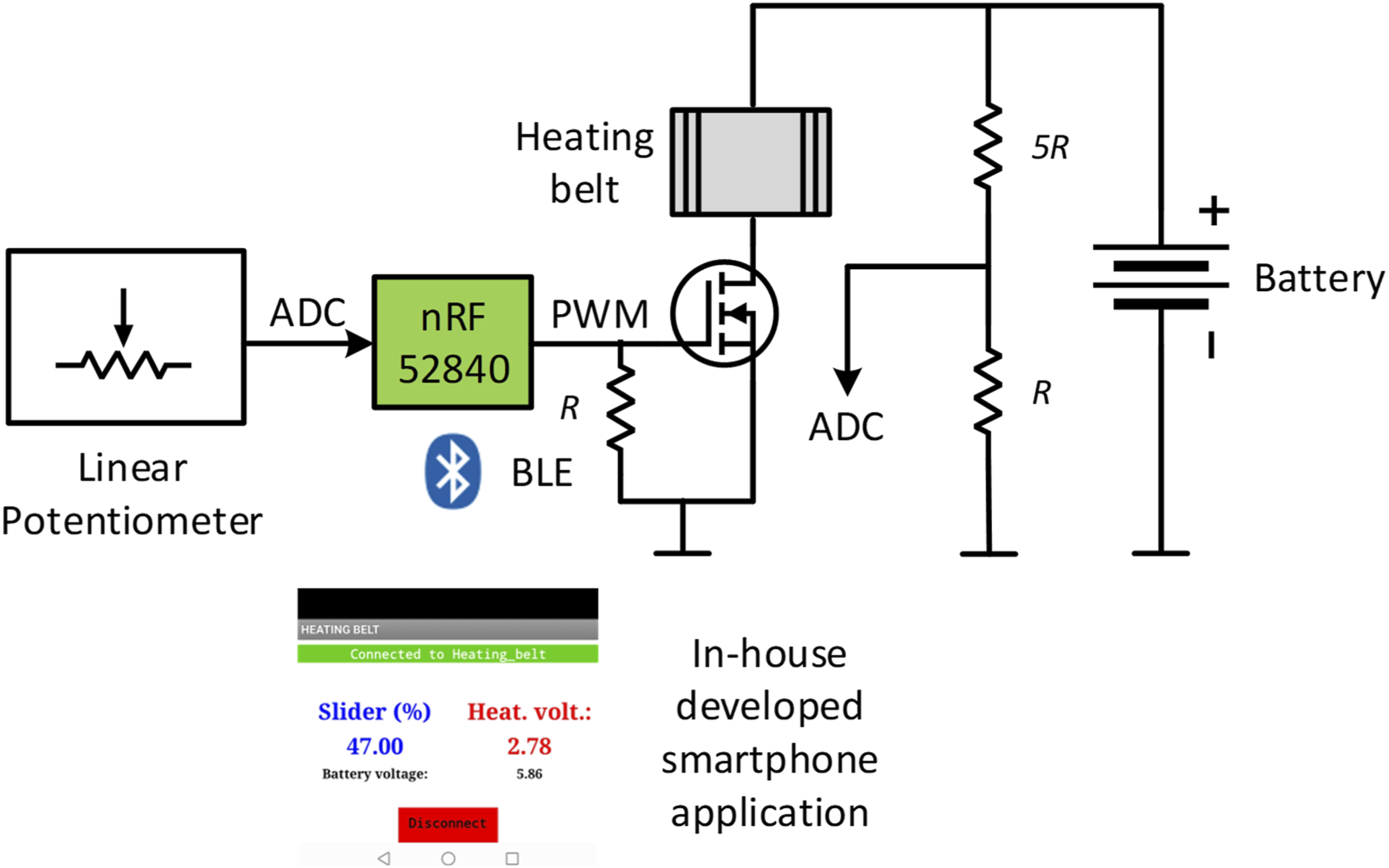
Results and discussion
Electrical characterization
Rdc and impedance modulus (Z) in the frequency range of (0.01-0.2) kHz.

Temperature variation in embroidered heaters testing at different voltages
The purpose of this investigation is to examine how temperature changes in response to different voltage applications, specifically in relation to a wearable heating belt designed for thermotherapy. The study involved testing the belt at three different voltages (3.3 V, 5 V, and 9 V), and temperatures recorded at each stage were thoroughly evaluated to ensure safety and proper operation. These voltage values were chosen as typical in nowadays electronics, so there is a variety of possible solutions, such as voltage regulators or batteries, to provide these supply voltages. Moreover, Figure 4 represents the behavior of a heating patch as it undergoes temperature changes in response to applied voltage. The maximum applied voltage was 9 V. The voltage was increased and decreased in steps from 3.3 V to 9 V and holding time at each step was 2 min and same it was decreased in steps. Change in temperature (blue solid line) and voltage (red dashed line) with respect to time.
Furthermore, the heaters have the capability to reach temperatures as high as 50°C when a maximum voltage of 9 V is applied. This is important because it falls within the safe and effective therapeutic temperature range (40–45°C) for pain relief in thermotherapy.
18
The effectiveness of the device in providing therapy relies on its ability to consistently achieve and maintain specific temperatures. The temperature measurement accuracy of HIKMICRO pocket thermography camera is ± 2°C or ± 2%, within an ambient temperature range of 15°C to 35°C. This ensures precise thermal assessment, maintaining consistency across various environmental conditions. Additionally, Figure 5 presents infrared (IR) images of the heaters. Table 2 presents the maximum temperature achieved for the corresponding voltages whereas the plotted graph is presented in supplementary file (Figure S1). While capturing these IR images, a cotton emissivity factor of 0.68 was selected to ensure accurate thermal measurements.
19
Here should be noted that the emissivity of the material depends on the high number of parameters, and special attention should be given for further uses and applications due to the complexity of material and coatings. One possible approach is also to use comparative measurement, in which the multiple external sensors are placed on the top of fabricated heater and temperature readings are checked against the IC camera. Setup used in this work is very similar to the one used in our previous work,
20
in which we used multiple thermistors and IC camera to verify the reported temperature in the operating conditions. In real word scenario, the exact readings from thermometer or IC camera depends also on thermal contact pressure between the proposed heating belt and the body of the subject. In the testing phase presented later, the pressure of the belt was on the level to provide comfortability to the wearer and can be adjusted using Velcro (a type of fastener). Infrared thermal images of the heater at (a) 3.3 V (b) 5 V (c) 9 V. Maximum temperature for different applied voltage.

Thus, the heater’s functionality in relation to voltage changes shows its capacity to generate different levels of heat. This characteristic is crucial for customizing therapy to meet individual needs and tolerances, guaranteeing effectiveness and user comfort.
Simulation results and discussion
The primary objective of performing the simulation in this study was to evaluate the heating efficiency of the embroidered patches. To achieve this, we employed COMSOL Multiphysics, a sophisticated predictive tool, to analyze the patch’s thermal behavior across a range of electrical inputs. Our approach involved constructing a comprehensive model of the embroidered patch and investigating its thermal response at three distinct voltage levels: 3.3 V, 5 V, and 9 V.
In our study, COMSOL Multiphysics 6.0 was employed to investigate the thermal performance of the patch. The results of simulations are presented in Figure 6. For the purpose of these simulations, the heater patch was fabricated using silver material, while copper material was utilized for the two ends of the design where the input voltages were applied. To ensure precision, the resistance of the patch was set to 38.8 Ω, aligning it meticulously with the resistance of the embroidered patch. In Figure 6(a), we found that the patch reached a maximum temperature of 33.8°C when an applied voltage of 3.3 V was used. Similarly, in Figure 6(b), we observed a maximum temperature of 38.3°C with an applied voltage of 5 V. Finally, in Figure 6(c), the patch achieved a maximum temperature of 50°C when the applied voltage was 9 V. Temperature/Heating performance of the patch under different input voltages: (a) 3.3 V, (b) 5 V, and (c) 9 V.
These findings are important because they show that the heater can provide a wide range of therapeutic temperatures suitable for different stages of thermotherapy. The temperatures generated by the simulations closely align with those observed in experiments, confirming the accuracy of the simulation model. This correlation indicates that the simulations can reliably predict the device’s performance in real-world scenarios, which is essential for designing and optimizing these devices before production.
Response and recovery time of the heater at 9 V
Analyzing the reaction and recovery durations of the embroidered heating belt at 9 V is important in determining its practical value in thermotherapy applications. These parameters provide information about the speed at which the heater can reach the therapeutic temperature and return to the baseline temperature. This information is essential for ensuring both safety and effectiveness. At 9 V, the heater took 41 s to reach 90% of its highest temperature, as can be seen in Figure 7. This quick heating capability is crucial for thermotherapy, as a faster response time greatly enhances comfort and effectiveness. The recovery time, which is the duration it takes for the heater to cool down to 90% of a safe temperature after being switched off, was 98 s. This swift recovery is significant for user safety, as it prevents burns and enables immediate reapplication if needed. (a) Response and (b) recovery time of the heater at 9 V.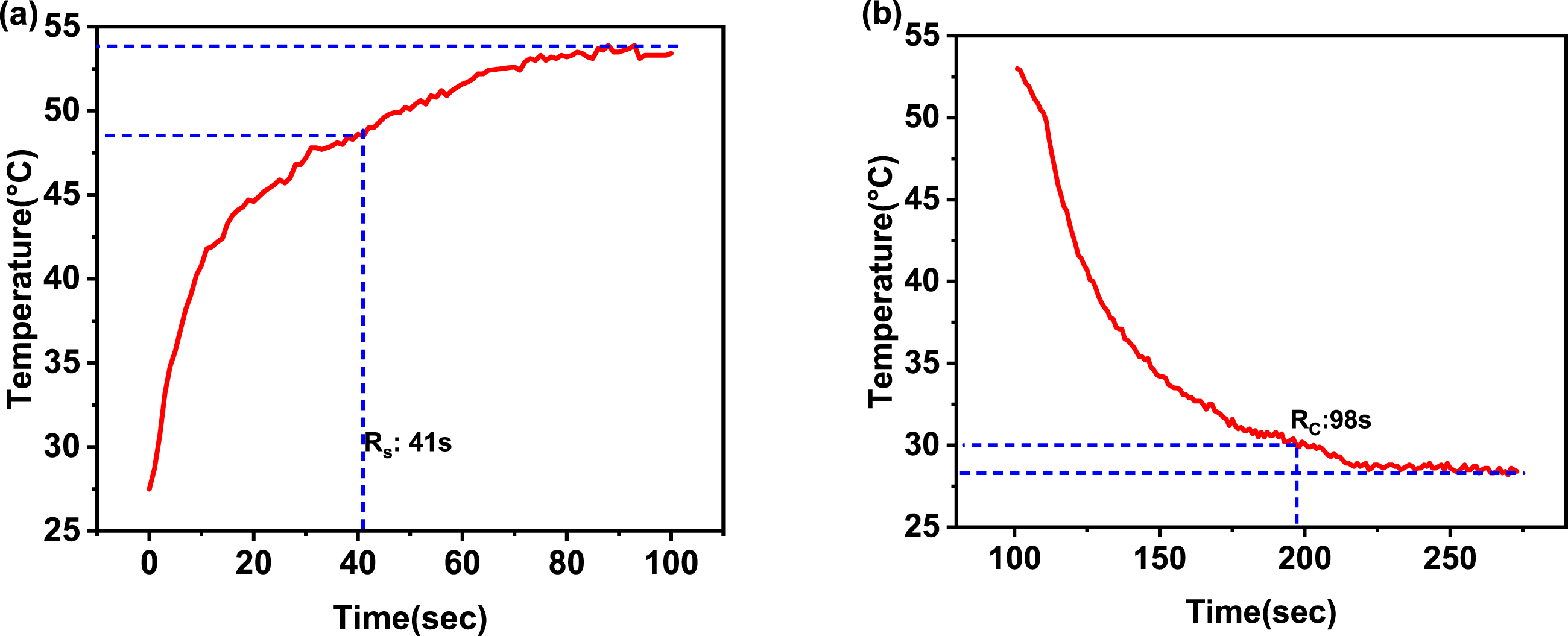
The response and recovery time frames of thermotherapy are advantageous because they enable users to start treatment promptly, and end it safely, without prolonged exposure to high temperatures. These characteristics have been found to be advantageous in mitigating the potential for thermal injuries, which is a matter of great importance in the context of wearable heating applications. Furthermore, the performance of the heater exhibits commendable thermal conductivity and insulation, primarily attributable to the utilization of conductive threads.
The hardware realization of the portable electronic device
The hardware realization of the portable electronic device is shown in Figure 8(a), while the main screen of the developed smartphone application for the monitoring of the heating belt is shown in Figure 8(b). The captured screens of the Siglent SDS1102CML + oscilloscope for different slider positions and regulated voltages of 0 V, 3.3 V, 5 V and 9 V for power supply of 9 V are shown in Figure 8 (c)-(f) (a) The hardware realization of the portable electronic device, (b) the main screen of the developed smartphone application for the monitoring of the heating belt, (c)–(f) captured screens of the Siglent SDS1102CML + oscilloscope for different slider position and regulated voltages of 0 V, 3.3 V, 5 V and 9 V.
The supplementary video demonstrates the functionality of the developed system and cross validation against the reference device (Siglent SDS1102CML + digital oscilloscope). Rather than typically used battery-based power supply, we applied programable power supply (Siglent SPD 3303C) as it provided a verification of implemented ADC-based module for the determination of power supply voltage. It should be noted that for the shown video-verification, we used resistor with the nominal resistance of 51 Ω.
We also performed a calculation as shown in supplementary file Figure S1, Tables S1 and S2 regarding the adjusted heating power, battery service lifetime, battery type, thermal insulation and power generated. For a typical 9 V alkaline battery with 1000 mAh capacity 21 an expected heating time (with assumption that other battery imperfections can be neglected) at 3.3 V, 5 V and 9 V is 80.17h, 22.52h and 3.89h respectively.
Heating belt bending and washing test
The bending test is critical for determining the performance of heating belts under various bending circumstances. The heater resistance is proportional to the output power; understanding how bending affects resistance is critical to ensuring the heater delivers the desired heat output even when subjected to mechanical stress. Figure 9 illustrates the resistance of heating belt that is stretched out (not folded, marked with bending angle 0°) and under different bending angles (45°,90°,135°,180°). It can be observed that the percentage increase in resistance is 11.9%, when calculated between 0° and 180° angles. The increase in resistance can be explained with respect to change in cross sectional area. Bending can decrease the material’s cross-sectional area, particularly along the bend. This essentially lowers the accessible space for electrons to move, resulting in increased resistance, as shown in Figure 9. Heating belt performance under different bending angles.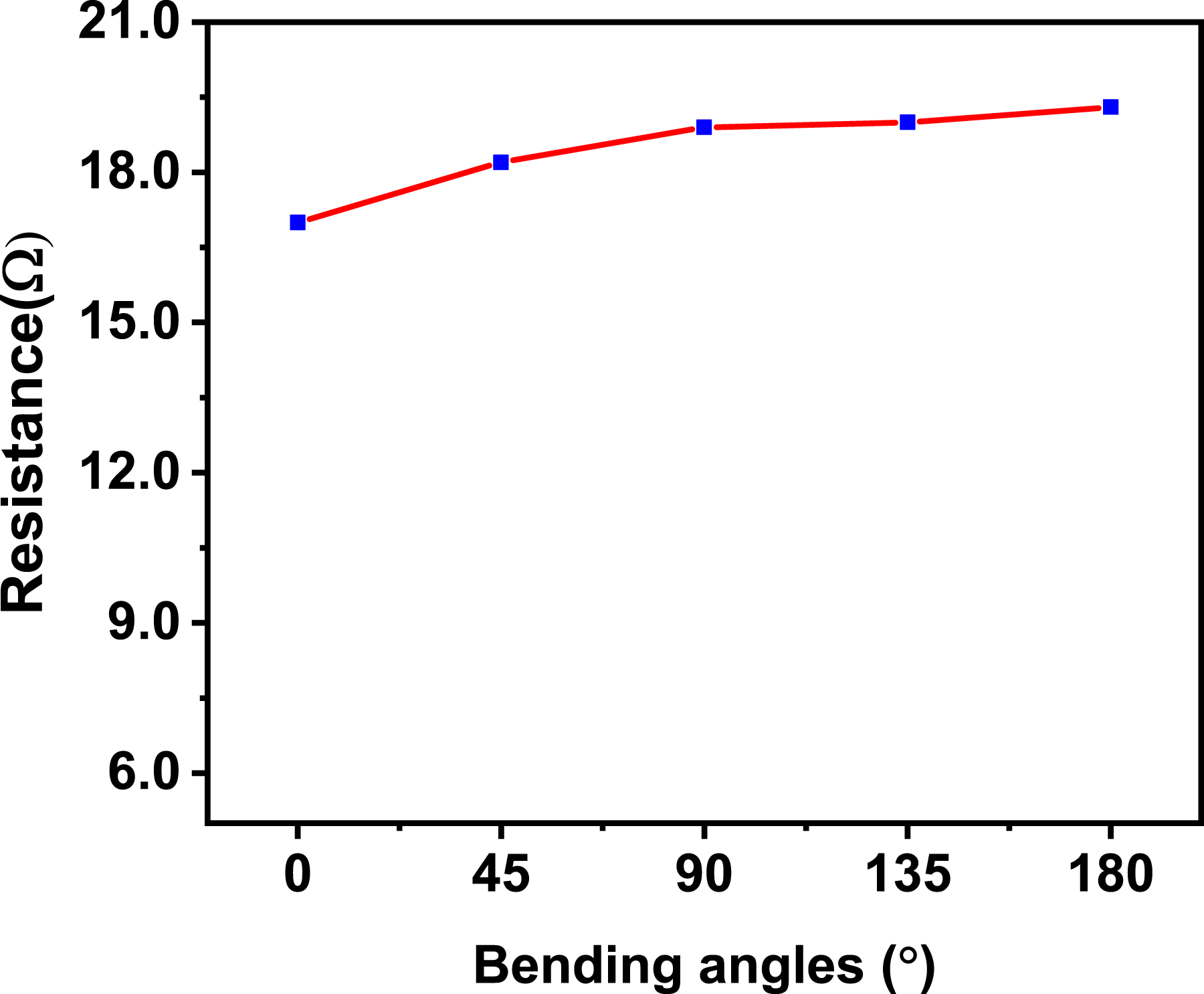
Figure 10(a)–(c) shows the IR images of the belt in bending and folding. The time graph corresponding to each image is also presented. As soon as the applied voltage is set to 9 V, surface temperature increases to maximum value and with turning off the voltage the corresponding temperature also starts to decrease. The variation in resistance due to bending and folding causes the increase in surface temperature. IR images of heating belt (a) bending (b) vertical folding (c) horizontal folding.
Washing tests are critical because they determine the device’s capacity to endure the rigors of regular washing, assuring functionality and stability of heaters. In the present research, the heaters were detached from the belt and then hand washed with regular detergent and lukewarm water. After every wash, the resistance was checked and plotted against washing cycles as shown in Figure 11. Washing test of the heating belt.
The reason for the resistance increase could be attributed to the delamination of the silver coating due to force applied during washing. The similar behavior was also observed by the researchers. 22
Figure 12 represents the relation between power density and temperature. Understanding the relationship between power and temperature allows the heater’s design to be improved to save energy while maintaining the required temperature. This results in more energy-efficient and cost-effective heating systems. The graph indicates a roughly linear relationship between power density and temperature within the specified range. This means that as power density increases, the temperature rises by a relatively consistent amount. The linear relationship makes it easier to control and regulate the heater’s temperature by adjusting the power input. The variation in temperature with power density.
Medical application of the developed heating belt for enhanced microcirculation in the back of human volunteer
Recent research has explored similar designs, such as utilizing carbon nanotubes (CNTs)
23
and other conductive polymers in wearable heaters.
24
While these materials offer enhanced conductivity and flexibility, they are also pricier and more challenging to produce. In contrast, the use of embroidered conductive threads in this study strikes a balance between cost, manufacturing simplicity, and functional performance. Therefore, it represents a viable approach for broader therapeutic applications. The blood flow of the human body can be improved by the effect of thermal expansion of the micro-circulation.
25
We applied the presented heating belt on the back of a healthy volunteer (M, 53), as can be seen in Figure 13(a), in order to compare Doppler imaging before heating (Figure 13(b)) and after heating (Figure 13(c) and (d)). It can be concluded from these ultrasound images that microcirculation is significantly enhanced, demonstrating promising application of presented heating belt in back thermotherapy. (a) Healthy volunteer applying heating belt in duration of 15 minutes at around 45°C, (b) Doppler ultrasonic image before heating, (c) color image after heating, (d) Doppler ultrasonic image after heating.
Enhanced microcirculation plays a crucial role in accelerating healing processes by improving blood flow to affected tissues. Studies suggest that heating therapies, such as Tecar therapy, can significantly increase skin and muscle microcirculation, leading to better oxygenation and nutrient delivery. 26 This improved circulation helps reduce inflammation, promote tissue repair, and enhance overall recovery. Additionally, research on microcirculation in wound healing highlights its importance in supplying oxygen and essential mediators necessary for tissue regeneration.
Conclusion
The use of Silver-Tech + 100 conductive threads in the embroidered heating belt on cotton fabric marks a significant advancement in wearable technology. This approach ensures efficient heat conduction while preserving essential textile properties like flexibility and breathability for optimal comfort. The device’s ability to consistently reach therapeutic temperatures—47°C at 9 V—addresses a critical need in thermotherapy for pain relief. A detailed analysis of temperature variations at different voltage levels (3.3 V, 5 V, and 9 V) confirms the belt’s capacity to safely deliver therapeutic temperatures (28°C–48°C) for 15 min to 20 min. Electrical characterization and simulation validate the reliability of the heating components, while performance tests highlight rapid response and recovery times, ensuring user safety and effectiveness. This research showcases the design, fabrication, and testing of embroidered heaters attached with commercial belt specifically developed for thermotherapy, with a focus on alleviating lower back pain. Future design improvements may incorporate the complexity of heat exchange dynamics with a more comprehensive assessment including realistic body contact conditions, full-system thermal modeling and measuring the thermal contact pressure between the belt and the body.
Supplemental Material
Supplemental material - A robust and flexible embroidered heating belt for thermotherapy
Supplemental material for A robust and flexible embroidered heating belt for thermotherapy by Saima Qureshi, Anđela Lakić, Mitar Simić, Sohail Sarang, Hafiz Abdul Mannan, Muhammad T. Khan, Goran M. Stojanović in Journal of Industrial Textiles
Supplemental Material
Footnotes
Acknowledgement
We would like to thank Dr Kristina Koprivica from New Hospital, Novi Sad, Serbia for conducting ultrasound imaging.
ORCID iDs

Funding
This research was supported by European Union’s Horizon Europe research and innovation program HORIZON-MSCA-2021-SE-01, (grant no. 101086348) as well as STRENTEX, Horizon 2020, WIDESPREAD-04-2019: ERA Chairs, project no. 854194.
Declaration of conflicting interests
The authors declared no potential conflicts of interest with respect to the research, authorship, and/or publication of this article.
Supplemental Material
Supplemental material for this article is available online.
References
Supplementary Material
Please find the following supplemental material available below.
For Open Access articles published under a Creative Commons License, all supplemental material carries the same license as the article it is associated with.
For non-Open Access articles published, all supplemental material carries a non-exclusive license, and permission requests for re-use of supplemental material or any part of supplemental material shall be sent directly to the copyright owner as specified in the copyright notice associated with the article.
