




Abstract
Despite enormous benefits of UV radiation, exposure to it stimulates skin and eye damages. In occupational health sciences, modification of cotton fabrics by biodegradable nanomaterials is a new approach to overcome this problem. So, the aim of this study is to investigate green synthesized ZnO nanoparticles effect on UV-protection for nano-cotton fabrics using meta-analysis, computational method and simulation. This study was conducted based on Cochrane systematic review guideline. Meta-analysis was provided by CMA Software. Regression Model was applied to describe the relationship between the size of nanoparticles and Ultraviolet Protection Factor (UPF). Also, Crystal Ball software was used for simulation. After screening, 15 studies were regarded as appropriate, until Jun 2023. Pearson’s coefficient confirmed a good correlation between UPF and size of nanoparticles (p = 0.013). The results of meta-analysis showed that odd ratio (UPF) was 11.29 (confidence interval 95%) for treated cotton fabrics. Regression model for nanoparticles whose size ranges from 3.98 to 107 nm was predicted with UPF between 52.76 and 53.17 (Excellent protection), with a certainty of 78.015%. Estimations show that the nano-cotton fabrics have an excellent UPF value, and by optimizing the particle size in the synthesis process, the highest level of UPF can be achieved
Introduction
Ultraviolet (UV) radiation is a portion of the electromagnetic spectrum. 1 It lies between visible light and X-ray and includes three bands; 320-400 nm (UV-A), 280-320 nm (UV-B), and 200- 290 nm (UV-C). 2 Main source of UV radiation is sun 3 and artificial sources such as UV light bulbs. 4 The solar radiation that reaches the Earth’s surface ranges from 280 to 3000 nm. 5 So, the Earth’s surface frequently receive UVA and a part of UVB. 6
UV has the positive effects on vitamin D synthesis 7 and it is recently known as a destruction of COVID-19 virus. 8 In fact, UV radiation can have different applications, based on its wavelength. UVC zone has the highest energy and is used specifically for germ removal. With the outbreak of COVID-19, the radiation-based decontamination was accessible in the form of UV lamp-based technology, which could be used to inactivate microorganism in air. 9 However, it is a big threat for exposed people. Exposure to UV radiation stimulates skin and eye damages. 10 Chronic exposure can motivate aging, DNA damage, skin reddening, acne, and skin cancer.11,12 So, UV protection is an especially important for exposed people in workplace settings or people who spend a lot of time outdoors. 13
Investigations show that clothing is the most efficient equipment for protecting against UV.14–17 People’s usual tendency is to use clothes that can provide the greater comfort and freedom of action in the workplaces. 18 In this line, cotton fabrics are generally used due to softness, hygroscopicity, affinity to skin, biodegradability and regeneration properties in workwear. 19 But these fabrics often have poor protection against UV rays. So, modifying and developing them is an important approach for controlling occupational exposures to UV. 20
Recently, new technologies have been able to influence on well-being and quality of life. 21 Nanotechnology is one of the most important technologies used in field of fabrics. 22 Several types of nanomaterials have got a lot of attention for their potential UV protection properties.23,24 One of the commonly used nanoparticles in fabric industries is zinc oxide (ZnO). ZnO is almost absorbing all UV wavelengths in the absorption spectrum, it means that it can absorb all wavelengths of 400 nm or less. 25 It is a low/non-toxic, bio-safe and bio-compatible material 26 and it has good electrical, optical, chemical and biological properties. 26 So, in textile industries, in order to develop optical characteristics of textiles, ZnO nanoparticles have been given special attention. 27 In classical synthesis methods, a chemical substance, which are probably toxic, is used as the reducing agent. 28 Due to the proliferation of nanomaterials, these chemical substances will enter the environment through fabrics; So, manufacturing enironmentally friendly fabrics is necessary to prevent environmental damage and pollution. 29
Plants and plant wastes are currently used in green synthesis. They can play an important role in circular economy. 30 In green synthesis, toxic substances are replaced with plant extracts, this condition can lead to a reduction in the use or elimination of chemical solvents. In addition, because the reaction is mainly carried out in normal environmental conditions, it leads to a reduction in energy consumption. 31 Investigators believe that metabolites from the extracts are able to act as a reducing, capping and stabilizing agents. For example, the presence of phenolic compounds with large number of hydroxyl groups, as the good reductants, in a natural extract is an important strategy for successful synthesis.32,33
Due to the importance of this issue, it is necessary to review the results of published studies in the field of manufacturing biofabrics with nanomaterials. Knowledge of the structure of cotton fabrics developed with nanomaterials synthesized in green processes for UV protection and the role of influencing factors such as physicochemical properties of nanomaterials can help to improve construction of them as a new step toward controlling occupational exposures to UV. In recent decades, new studies have relied on computational modeling and data analysis, which can provide a framework to summarize existing knowledge and facilitate the interpretation of complex data. So, the aim of this study is to conduct an investigation of green synthesized ZnO nanoparticles effect on UV-protection for nano-cotton biofabrics using meta-analysis, computational method and simulation.
Materials and methods
Search strategy
Systematic review was conducted based on the Cochrane method. 34 Databases such as PubMed, Scopus and Web of Science (WOS)were firstly researched for accessing to relevant articles. The search strategy was managed with the main search terms of “UV-protective”, “UV-protection”, “UV-resistance”, “Fabrics”, and “Textiles” combined with the terms of “ZnO” and “Zinc Oxide”. The search strategy was performed on the following databases:
Web of science
TI or AB= ((“ultraviolet protective” OR “ultraviolet protection” OR “ultraviolet resistance” OR “ultraviolet resistive” OR “UV protective” OR “ UV protection” OR “ UV resistance” OR “ UV resistive”) AND (“fabrics” OR “fabric” OR “textile” OR “textiles”) AND (“ZnO” OR “Zinc oxide”))
PubMed
((“ultraviolet protective” [tiab] OR “ultraviolet protection” [tiab] OR “ultraviolet resistance” [tiab] OR “ultraviolet resistive” [tiab] OR “ UV protective” [tiab] OR “ UV protection” [tiab] OR “ UV resistance” [tiab] OR ″ UV resistive” [tiab]) AND (“fabrics” [tiab] OR “fabric” [tiab] OR “textile” [tiab] OR “textiles” [tiab]) AND (“ZnO” [tiab] OR “Zinc oxide” [tiab]))
Scopus
((TITLE-ABS-KEY (ultraviolet protective) OR TITLE-ABS-KEY (ultraviolet protection) OR TITLE-ABS-KEY (ultraviolet resistance) OR TITLE-ABS-KEY (ultraviolet resistive) OR TITLE-ABS-KEY(UV protective) OR TITLE-ABS-KEY(UV protection) OR TITLE-ABS-KEY(UV resistance) OR TITLE-ABS-KEY(UV resistive)) AND (TITLE-ABS-KEY (fabrics) OR TITLE-ABS-KEY (fabric) OR TITLE-ABS-KEY (textile) OR TITLE-ABS-KEY (textiles)) AND (TITLE-ABS-KEY(ZnO) OR TITLE-ABS-KEY (Zinc oxide))).
After identifying and screening the related articles in these databases, Google Scholar, ResearchGate and manual search through references of articles were used as supplemental approaches to database searches to identify additional studies. Finally, related articles were selected for this study, until August 10, 2024.
Selection criteria and screen of studies
This study was aimed to answer the following questions: - What are the factors influencing the performance of the nano-cotton biofabrics? - How much UPF value can be improved by green synthesized ZnO nanoparticles for nano-cotton biofabrics? - How much is the degree of certainty for improvement of nano-cotton biofabrics using simulation model?
For responding these questions, the PECO statement (“Population,” “Exposure,” “Comparator” and “Outcome”), were stated as follow; - Population: Cotton fabrics - Exposure: Cotton fabrics coated by green synthesized ZnO nanoparticles - Comparators: Coated and uncoated cotton fabrics - Outcomes: Improving and developing of UPF value of cotton fabrics
Preferred Reporting Items for Systematic Reviews and Meta-analyses (PRISMA) was applied as an approach for analyzing the articles. EndNote X9® software (Thomson Reuters, Toronto, Canada) 35 was used to prepare a list of articles. Firstly, title and then abstract of the articles were reviewed. Finally, full text of the related-articles was downloaded. Review articles, modeling studies, books and unpublished articles were excluded. Screening was managed by two investigators, separately and disagreements were resolved through discussion.
Meta-analysis
Comprehensive Meta-Analysis Software (CMA) (Version 2.2.064) was used to meta-analysis. 36 For calculation, odds ratio (OR) was used as effect size index in analysis. Meta-analysis was estimated by random effect model (REM). 37 Finally, the p-value <0.05 was regarded as statistically significant.
Heterogeneity was identified by I-square and funnel plot was applied to assess the potential publication bias through calculation of p-value (p < 0.05 considered significant).
Statistical analysis
After data extraction, by using of Minitab software version 21.1.0, detecting and removing of outlier’s data was done by outlier boxplot at a 95% confidence level. Also, Kolmogorov Smirnov test was used to determine the normality of data. Pearson’s correlation coefficient was used to measure the degree of linear relationship between two variables of UPF and other variables such as concentration of extract, concentration of ZnO nanoparticle, the amount of phenol in the extract, calcination temperature and size of nanoparticles. Finally, Fit Regression Model was applied to describe the relationship between UPF and each of related variables using the ordinary least squares method.
Because some articles did not mention the size of the synthesized nanoparticles, we used the optical absorbtion graphs/wavelength recorded by the spectrophotometer. In this approach, firstly graphs of all articles was extracted, then by using of GetData Graph Digitizer software, wavelength of maximum absorbance and amount of absorbance were determined. In fact, by using of this software, images of data visualizations or graphs via extraction algorithms reversed to numerical data. According to absorbance peak (

This estimated size was used in data analysis.
Since wavelength 310 nm is responsible for the peak of the erythema and redness susceptibility of the skin, an optimized UFP for biofabrics was predicted in this wavelength.
Moreover, Microsoft Excel 2019 software program was used to data management, statistical analysis and graphing.
Simulation model under uncertainty
The Monte Carlo simulation was applied by using Crystal Ball software. In fact, the Monte Carlo method is capable of modeling large-scale complex systems based on simulation and random sampling from probability. 39
Result and discussion
Based on PRISMA analysis, firstly, 589 articles were identified. After removing duplicates and considering the inclusion criteria, 15 articles recognized as suitable (Figure 1). The output data of the articles in which the plant extract was as a reducing agent (n = 11) were used for meta-analysis (Table 1). Finally, from a total of 11 articles, 17 data were entered to meta-analysis. PRISIMA flowchart for selection articles. Summary of reviewed articles in meta-analysis and computational models.

These articles were published from 2016 to Jan 2023. They were conducted in eight countries including Egypt (n = 5), Slovenia (n = 4), South Korea, South Africa, Pero, India, Thailand and Saudi Arabia. Egypt’s textile industry is known as the second largest industry and one of the five important industries of the Egyptian economy. 40 It seems that with the development of technology, this industry has been developing, in recent years, in Egypt. This trend is also seen in the review of studies. However, reviewed studies in Slovenia show that they are mainly related to the researches of an author.
In 11 selected articles, synthesis process was provided in two methods; In-suit (n = 6) and Ex-suit (n = 5). Three materials were used as Zinc precursor including Zn-acetate (n = 8), Zn-nitrate (n = 1), and Zn-chloride (n = 1) and in one article both Zn-acetate and Zn-nitrate 41 were used. The results of Verbic’s study suggests that Zn-acetate is more proper precursor than Zn-nitrate, because it has a pH greater than six in in situ synthesis of ZnO on cotton fabrics. 41 According to Verbic et al. study and the reviewed-articles, it can be concluded that Zn-acetate is the most appropriate precursor for ZnO synthesis and it can be used for coating cotton fabrics.
In synthesis processes an alkali source such as chemical (NaOH)42–44 or natural material (wood ash extract)41,45,46 is used. It is important to mention that alkali sources are essential for the successful reduction of zinc precursor to ZnO. All alkaline sources were used in the reviewed studies were chemical substances and only in the studies conducted by one author, alkali source was a natural material (wood ash extract).45,46 Therefore, further research is still needed to develop the completely green synthesis.
Various plant extracts including green tea leaves,
41
pomegranate peels,41,45 staghorn sumac,
41
drupes,
41
Averrhoa carambola,
47
Date seed,
42
Japanese Knotweed Leaves,
46
Acalypha indica leaf,
48
Psidium & guajava Linn (guava),
43
Seaweed,
44
and orange peel
49
were used as the reducing agent in green synthesis of ZnO nanoparticles. As shown in Figure 2, modified-fabrics by sumac leave extract had the highest UPF value. Some articles refer to the content of phenolic compounds as a main factor in improving UV-protective properties for nano-biofabrics. In this line, Verbic et al. measured the content of phenolic compounds in the different extracts and reported that sumac have the highest content of phenol comparing other extracts.
41
For this reason, we evaluated the relationship between UPF and the content of phenolic compounds in extracts. Pearson’s coefficient showed that there is a correlation in this line (p = 0.026). These finding are consistent with the study of Zayed et al.
49
Zayed et al. reported that fabrics modified by extracts with more phenol content show a better UPF value comparing less phenol content. In accordance with these findings, some studies show that phenolic compounds have a good barrier against ultraviolet radiation.50,51 It can be understood that phenolic compounds are good antioxidants, and because antioxidants are excellent reducers of metal ions, which are essential for the reduction process, they can play an important role in synthesis process. In relation to nanotechnology, there are many studies that confirm the existence a relationship between the content of phenolic compounds and the size of nanoparticles. As the size of nanoparticles decreases, the amount of phenolic compounds increases.52–54 As shown in Table 1, extracts with more phenolic compounds can produce the smallest nanoparticles and as a result, these nanoparticles can increase UPF. Comparing UPF in nano-cotton biofabrics treated by different plant extracts.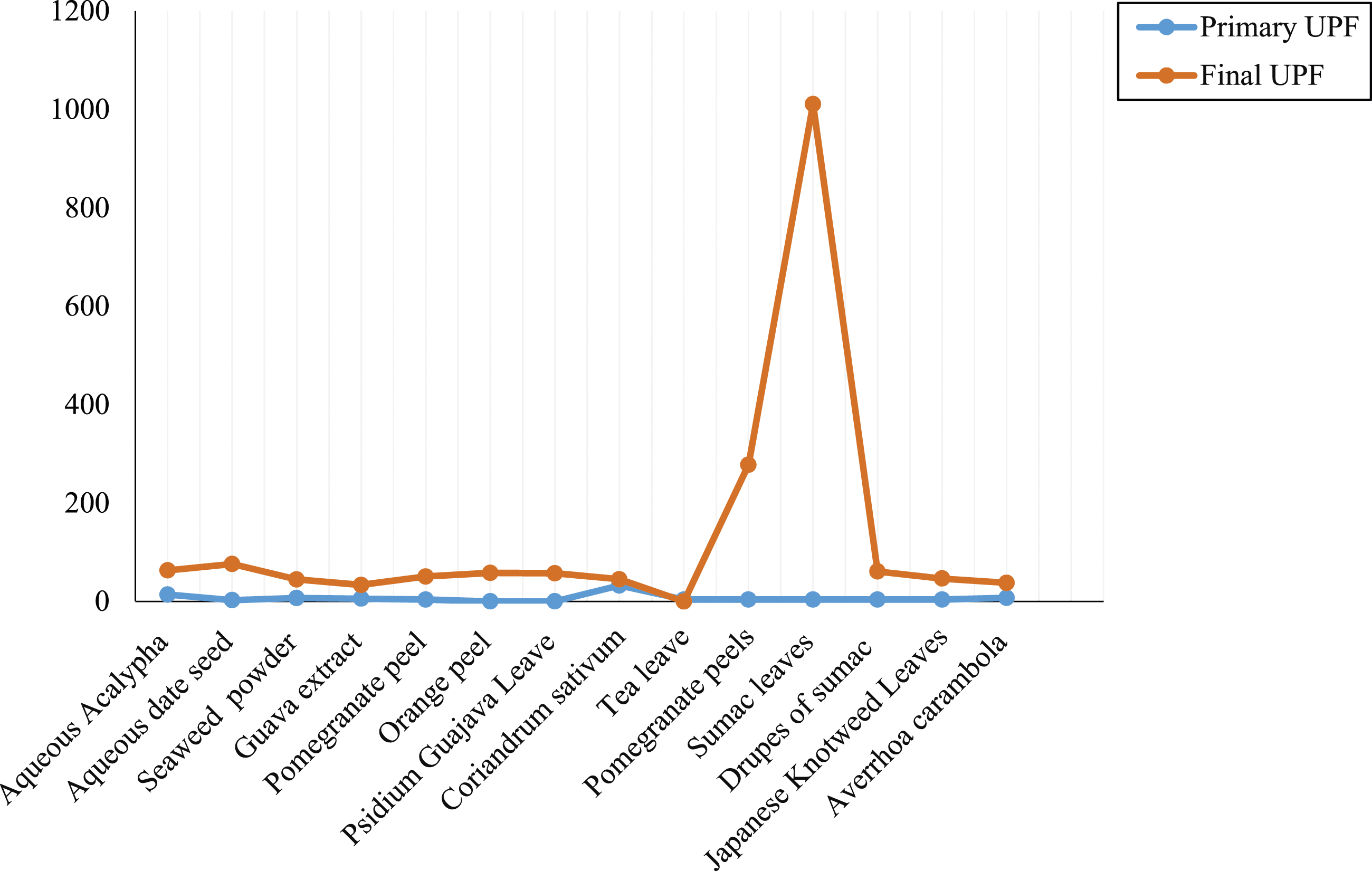
An overview of extracts as the biocompatible agents in the reviewed articles.

The results of meta-analysis showed that the effect size (UPF) was 16.12 (Figure 3). According to I-square index, heterogeneity was observed among studies (I2 = 85.5). Also, funnel plot confirmed that there was publication bias (Figure 4). The results of meta-analysis. Funnel plot shows publication bias; A (All studies), B (After removing studies), C (After removing subgroups).

The studies of Karthik et al.,
48
El-Nagger et al.,
42
Asmat-Campos et al.,
56
and Verbiˇc et al.
41
had effect on publication bias. After removing these studies, the effect size was estimated 12.009 (Figures 4 and 5). It showed that subgroups (extracts) have large effect on the results (Figure 3). Extracts of date seed,
42
tea leave
41
and coriandrum sativum
56
had effect on publication bias. After removing these subgroups, the effect size was calculated 11.29. It seems that the studies of Asmat-Campos et al. and Mehrez E et al.42,56 had the largest effects on the size effect. Nevertheless, it can be concluded that UPF for nano-cotton biofabrics treated by green synthesized ZnO nanoparticles can increase 11-16 times compared to untreated-fabrics. A similar study about UV protection by metal nanoparticle shows that the effect size was 7.32. However, no distinction was reported between the types of produced-metal nanomaterials, in this study.
62
Current study shows that due to the existence of fewer studies on nano-fabrics treated by green synthesized ZnO nanoparticles, there is not a meta-analysis study about UV protection for fabrics. So, further researches are still needed to achieve better results. The results of meta-analysis after removing biased studies (A) and subgrouping (B).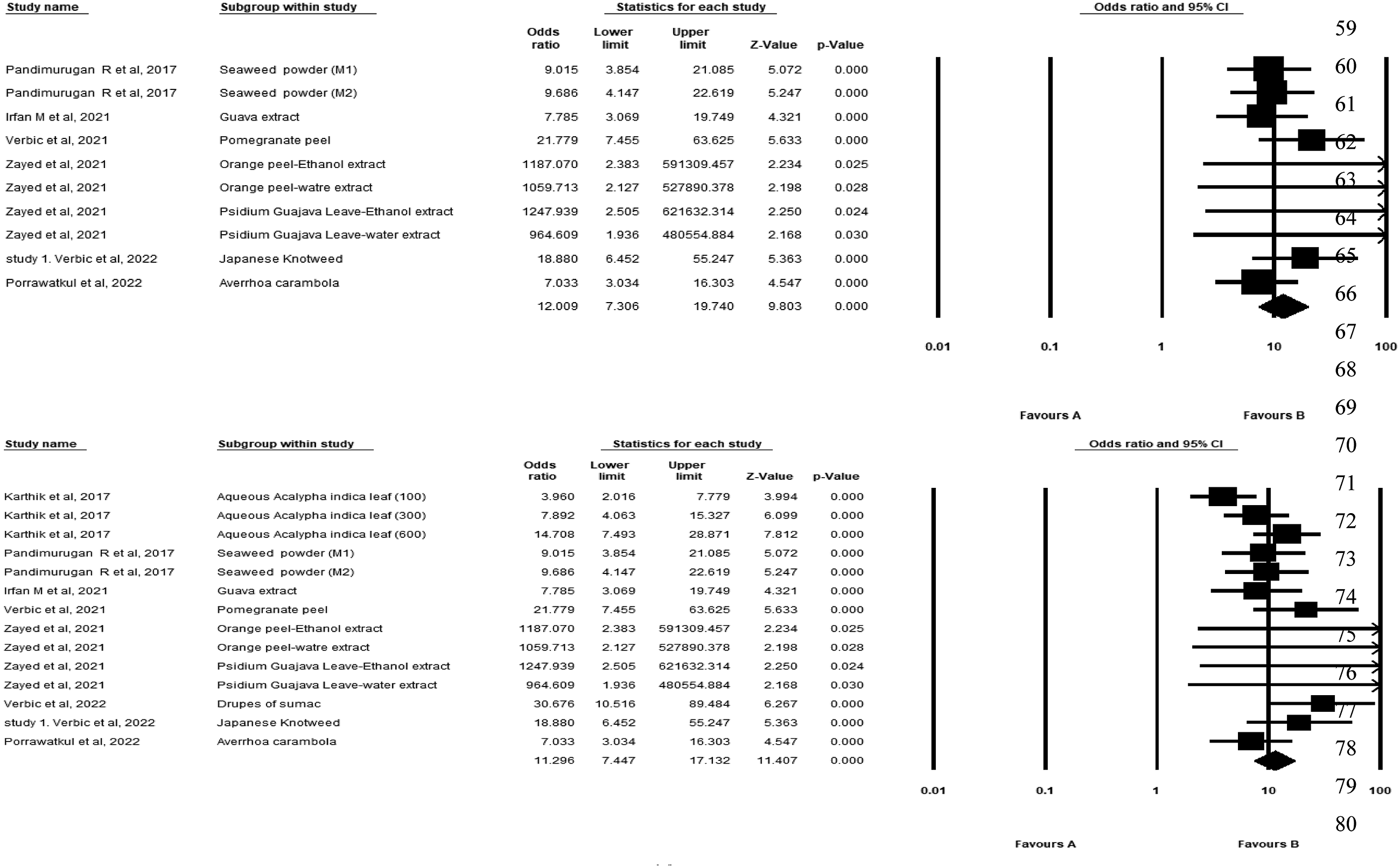
Kolmogorov Smirnov test showed that only the size of nanoparticles (p = 0.195) and the amount of phenolic compounds (p = 0.228) follow a normal distribution and UPF has a lognormal distribution. Outlier boxplot showed that there are four data outliers. These data was related to the studies of Verbic et al. 41 and Karthik et al., 48 which was also made known in the meta-analysis as the studies with publication bias. After removing data outliers, UPF followed a normal distribution (p = 0.69). Pearson’s coefficient was significant for size of nanoparticles (p = 0.013). Given that the amount of phenol was reported in the studies that had data outlier, we could not use a regression model for predicting the relationship between UPF and the amount of phenol. This indicates that there is a need for more data to determine this relationship and more future studies in this field are necessary. However, Fit Regression Model was applied for the size of nanoparticles as follows; “UPF = 53.19 - 0.004 Size”
This model is predicted for nanoparticles whose size ranges from 3.98 to 107 nm. In this range, UPF will be between 52.76 and 53.17, which means excellent protection against UV rays for nano-cotton biofabrics. Also, this model illustrates that UPF increases with decreasing the size of nanoparticles, which has already been discussed. Moreover, in a wavelength of 310 nm, the size of nanoparticles was estimated 2.83 nm and UPF value was 53.17. So, if we use this size of ZnO nanoparticles for modifying of biofabrics, we can achieve a good UPF value. These nanoparticles can most probably be suitable absorbers for UV-radiation to prevent the occurrence of erythema and redness susceptibility of the skin.
Figure 6 shows the results of the Monte Carlo simulation. According to this simulation, with a 99.66% certainty, UPF is higher than 52.76 and with a 15.66% certainty, it is higher than 53.17. Also, with a 78.015% certainty, UPF can be estimated between 52.76 and 53.17. Popov et al. investigated the effect of size of TiO2 nanoparticles embedded into the skin on UV sun-blocking properties. The results of this study was consistent with our study. In their study it was also reported that fine particles can protect skin against harmful UV radiation. Also, for the 310 nm wavelength, the best protective particle sizes were 56 and 62 nm, reducing transmission through the horny layer to 1%.
63
Although the nature of two materials is different, it seems that, for UV protection, the size of nanoparticles for modifying of nano-cotton biofabrics should be smaller than nanoparticles embedded into sunscreens. The Monte Carlo simulation shows with a 78.015% certainty, UPF is between 52.76 and 53.17.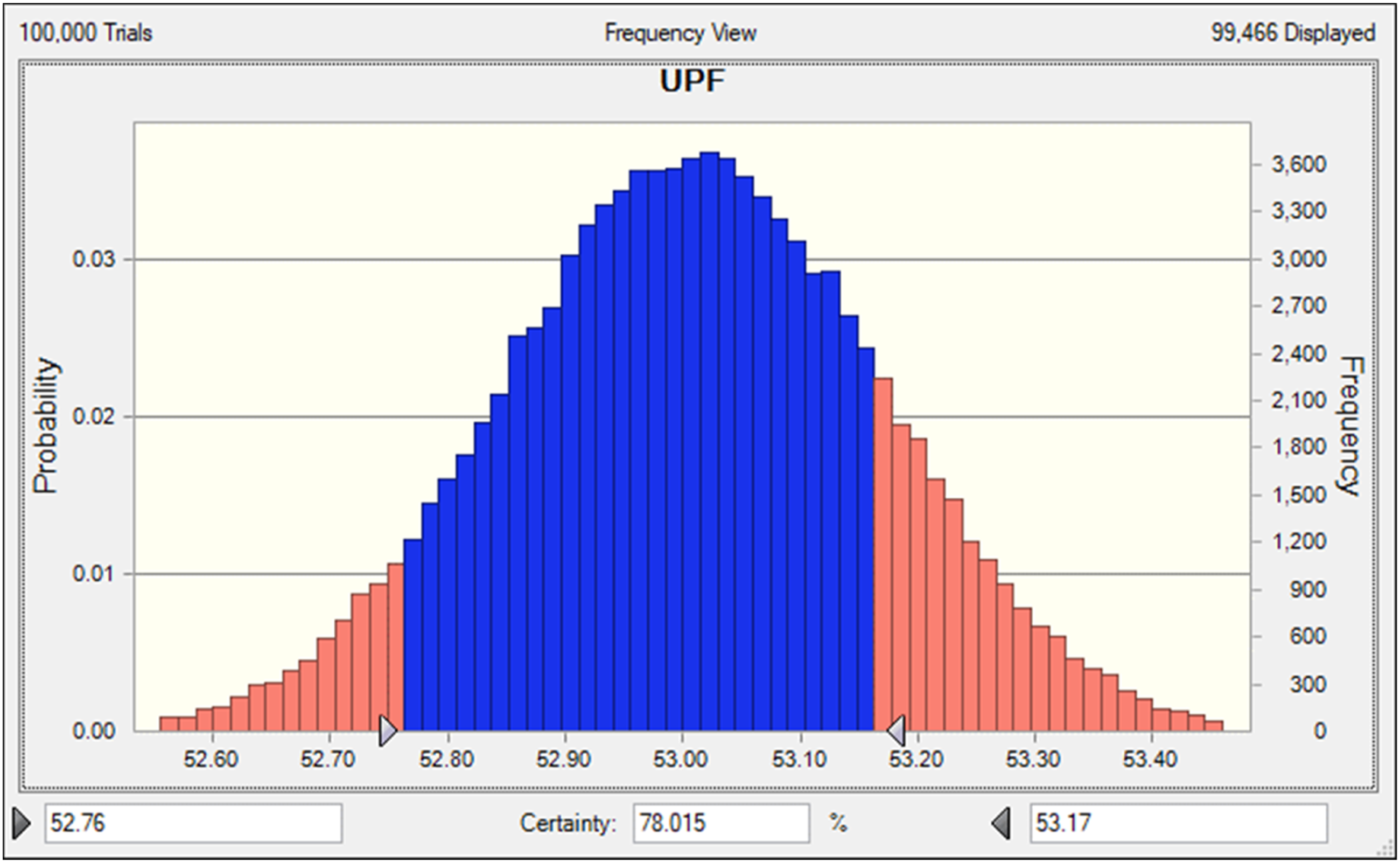
Conclusion
The aim of this study was to conduct an investigation of green synthesized ZnO nanoparticles effect on UV-protection for nano-cotton biofabrics. This computational study was based on a systematic review. Data extraction were used to meta-analysis and simulation. The results showed that Zn-acetate is the most appropriate precursors for ZnO synthesis on cotton fabrics and the presence of an alkali source can help to make successful reduction of zinc precursor. Also, extracts with more phenol content can produce the smallest nanoparticles and as a result, they can increase UPF. The results of meta-analysis showed that odds ratio was 11.29 for treated cotton fabrics. Moreover, Regression model for nanoparticles whose size ranges from 3.98 to 107 nm was predicted with UPF value between 52.76 and 53.17 (Excellent protection). Simulation also showed that this prediction is with a 78.015% certainty.
Uncertainty stimulation with various computational models such as fuzzy analysis, Monte Carlo, etc. provides metrics to study the relationship between imprecisely prescribed model inputs and the model’s predictions. In this study, computational estimations confirmed that nano-cotton biofabrics have an excellent UPF value and by optimizing the particle size in the synthesis process, the highest levels of UPF value can be achieved. So, the results of this study can help to develop experimental studies and achieve better results.
However, it should be noted that many phenomena in engineering sciences such as nanotechnology involve multiple variables, the development of numerical techniques for multi-scale problems is a major challenge. In this study, the existence of limited data, especially for the content of phenolic compounds, is known as the limitation/challenge of this study. In fact, the biggest problem with little data is that the distribution of data does not adequate to estimate the prediction in regression analysis. It should be noted that completing these data requires more the original studies. Therefore, more studies are still needed to overcome this challenges in the future.
Footnotes
Acknowledgments
We would like to express our thanks for people who helped to data collection in this study, Narges Moghadasi, Department of Environmental Engineering, Politecnico di Torino, Turin, Italy, and professor Sirlene Maria da Costa, School of Arts, Sciences and Humanities, Textile and Fashion Course, São Paulo, Brazil. Their enthusiasm to give their time is commendable.
Declaration of conflicting interests
The author(s) declared no potential conflicts of interest with respect to the research, authorship, and/or publication of this article.
Funding
The author(s) disclosed receipt of the following financial support for the research, authorship, and/or publication of this article: This work was supported by the Tehran University of Medical Sciences, Tehran, Iran, under Grant number IR.TUMS.SPH.REC.1401.294.
Ethical statement

Data availability statement
All data generated or analyzed during this study are included in this published article.