




Abstract
Electrical heated clothing (EHC) is a revolutionary concept that combines garment with electrical technology to create garments capable of actively regulating and providing warmth to the wearer, especially for the elderly. To develop an EHC for the elderly with both aesthetics and functionality, the technique of knitted Jacquard is employed for fabrics and Bluetooth module is applied to realize user interaction (UI) design. Firstly, 16 different heated fabrics were fabricated by choosing different silver-coated yarns and knitted Jacquard patterns. The heating temperatures of the fabrics were simulated, and the actual heating performance was observed through infrared thermal image. Suitable materials and patterns were selected to produce the EHC. Secondly, in order to meet the demands for the elderly, a prototype was developed by combining the characteristics of the elderly clothing design and UI design. After the design of a Bluetooth module with a PCBA, the heating temperature and heating time of the clothing can be adjusted through the WeChat mini-program on the mobile phone. It has been verified that the developed prototype meets the heating requirements. This study can serve as an excellent guide for the advancement of EHC and electrical wearables.
Keywords
Introduction
Global aging is an increasingly severe trend, impacting the social and economic structures of various countries and regions. 1 According to United Nations projections, by 2050, the global population aged 65 and older is expected to reach 1.5 billion, accounting for 16% of the world’s total population. 2 The quality of life and health issues of the elderly have become a focal point of societal concern.3,4 Compared to young people, the elderly have a greater need for clothing with heating.5,6 With the development of electrical wearables, electrical heated clothing (EHC) is created that combines garment with electrical technology to make garments capable of actively regulating and warming the wearer. 7 Unlike traditional clothing, EHC integrates electronic components and advanced materials to offer a customizable and responsive heating experience. 8 The evolution of EHC has been dynamic and multidisciplinary, and takes advancements in materials science, electronics, and textile engineering into consideration. 9 One of the most practical attempts to apply electrical heating technology to clothing dates back to World War II, when bomber crews were equipped with leather flight jackets fitted with electrical element cables similar to those in blankets. 10 A number of research studies have contributed to the development of EHC, with the aim to promote their durability, 11 safety, 12 heating efficiency, 13 and wear comfort.14,15 For instance, Choi 16 produced composite heating element to meet the requirement of power consumption, rapid heating, stable warmth, and high durability.
One pivotal aspect of this progress involves the exploration of innovative heating elements. Traditional non-fabric elements, such as metallic films and carbon fiber panels, have been extensively studied. 17 For example, Wu et al. 18 developed a heated element by carbon fiber panels for the elderly which can automatically adjust the underwear microclimate according to different thermal condition.
However, the drawbacks associated with these components, including discomfort and safety concerns, have prompted researchers to seek alternative approaches. 19 In recent years, there has been growing interest in integrating conductive yarns directly into the fabric structure as electrical elements. 20 This approach not only preserves the aesthetics and wear comfort of the garments but also addresses safety issues related to traditional heating elements. The methods of integration include weaving,21,22 knitting, 23 and embroidering, 24 coating and printing conductive materials into the fabric. 25 For instance, Pragya et al. 26 developed and evaluated an electrically heated fabrics using a braiding-cum-weaving technique, demonstrating their effective heating performance and durability for wearable electronics and active heating garments. Cui et al 27 developed highly integrated multifunctional textiles using PEDOT and CuS coatings on elastic nylon fabrics, offering dual-mode heating and sensitive sensing properties for advanced applications such as smart mountaineering clothing, personal thermal management, and soft robotics. Li 28 developed an electrical heating knitwear with single jersey structures. Among these methods, knitting is a good option which offers the advantages of flexibility, stretchability, softness, fewer processing steps, safe and comfort. 29 When integrating conductive yarns directly into the fabric structure as electrical elements, the materials used as conductive yarns normally includes silver-coated yarns, carbon nanotube fibers, conductive polymers and metal fibers. Among these materials, silver coated yarns are highly conductive, more flexible, soft and pliable compared to others. 30
The electrical performance of electrical heating elements formed by knitted fabrics differs due to variations in the knitted structure, which lead to different types of conductive paths formed by the conductive yarns in the knitted fabric. Consequently, the electrical properties of conductive knitted fabrics are influenced by the knitted structure. To investigate the impact of knitted structures on the electrical properties of conductive knitted fabrics, our research team has examined the effects of float, tuck, and simple knitted structures.31–33 However, there has been little research on complex knitted fabric structures to date. Yet complex knitted fabric structures, particularly double-faced Jacquard knits, are commonly used in knitted garments for the aim of a better appearance.34–36
In sum, the elderly are less tolerant of cold temperatures compared to younger individuals so EHC is even more essential to them.37,38 Technological advancements are revolutionizing the methods of care and medical treatment for aging populations.39–41 Nevertheless, commercially available heated clothing commonly uses heating wires, fibers, or films which are embedded in fabric, and can cause discomfort and inconvenience. 42 Therefore, this study proposes a new type of clothing specifically designed for the elderly, which uses knitted Jacquard fabric for a superior appearance and an easy control system. First, the relationship between Jacquard patterns, conductive yarns and the heating performance of knitted fabric is investigated to design the Jacquard pattern for this type of heated clothing. Secondly, due to the widespread use of smartphones, a Bluetooth module is developed to facilitate interactive functionality between clothing and user, to realize the convenience of temperature control. Lastly, a prototype of UI-based EHC for the elderly is fabricated based on the demand of user requirements and universal design. This study fills a research gap in the field of EHC and provides new insights into the design of knitted electrical clothing.
Methodology
Development of knitted heating elements
Structure selection
2-color knitted Jacquard with a Birdseye backing is used as the main structure to form the colorful pattern in this study. Jacquard knitting is a popular technique used to create double sided patterns and form colorful patterns in knitwear. Among of numerous kinds of Jacquard, 2-color Birdseye backing is the most popular technique due to its production stability and good appearance. The Jacquard knitting technique for 2-color Birdseye backing involves creating patterns with two different colors of yarn. The front side of the fabric shows the pattern, while the backside displays a Birdseye texture that results from interlacing the two colors. The design is plotted on graph paper or a digital grid where each dot represents a stitch. Different colors are assigned to different squares to create the desired pattern. Two yarn feeders supply yarn of different colors. Two-colored yarns are knitted alternately to create the desired pattern. One pattern course is consisted by two technical courses, which are knitted by the two different yarns, respectively. For each technical course, the yarn form front stitches according with the designed patterns, and form back stitches by interlacing the two colors in a specific sequence.
43
As shown in Figure 1, the pattern is a square grid pattern with size of four dots×4 dots. The technical knitting course can be derived according with formed front stitches and back stitches. 2-Color Birdseye backing Jacquard method.
Material selection
Specifications of yarn materials for experiments.


E-SEM micrographs of Conductive Yarn B: (a) side view; (b) cross-sectional view and (c) cross-sectional view for a single fiber with coated silver.
Among these conductive yarns, the resistance per cm of Conductive Yarn A is very low, which can be used as the electrode area to connect to external powers. The knitting structure used in the electrode area is interlock, which is a knitted structure with better dimensional stability. While, the resistance per cm of Conductive Yarn B and C is relatively high, thus, they are used to be knitted with ordinary yarns to form the part of resistor area, which can generate heating when loading external powers. Figure 3 indicates the employed yarns in different parts of Jacquard pattern. Yarn employed for electrical heated fabrics based on 2-color Jacquard: (a) pattern; (b) yarn employed in different parts; and (c) illustration of plated technique.
Prototype parameters and devices
All of the samples and prototypes were fabricated and finished by using the same parameters. The knitting process was conducted by using a flat knitting machine at a temperature of 20°C ± 2°C and under a relative humidity of 65% ± 5%. This controlled environment is crucial because variations in temperature and humidity can significantly influence the material properties. By maintaining consistent conditions, consistent electrical resistance and mechanical properties can be achieved in the final product, reducing the risk of discrepancies caused by environmental factors. In the field of knitting, STOLL knitting machines are well-known due to their excellent performance. These machines offer a multitude of advantages as they are equipped with advanced technology that enables precise and intricate knit patterns, thus ensuring the production of high-quality and detailed fabric. In this study, CMS 502 ki E7.2 (Karl Mayer Limited, Germany) is used with Create Lite V2.6, a knitwear design software. The needle position (NP) value is a stitch cam setting on the STOLL knitting machine, where a higher NP value means a less dense fabric. The winding moment (WM) value is a parameter of the takedown tension and a higher value means a higher tension. For this kind of structure, the NP value was adjusted to 9.5 (front bed) and 11 (back bed) and the WM value was adjusted to 2.0 to ensure a smooth production process.
After removing the knitted samples from the knitting machine, they were conditioned at a temperature of 20°C and relative humidity of 65% ± 5% for at least 24 h. Then all of the measurements done to test the resistance were carried out in accordance with AATCC Method 76 - Electrical Surface Resistivity of Fabrics. The resistance measurements of the samples were carried out by using a Digital Bench Multimeter. The temperature measurements of the samples were carried out by using an Infrared Thermal imager with an adjustable DC power supply as shown in Figure 4. The instruments for measuring the electrical properties of the samples are listed in Table 2. Setup to measure temperature of knitted Jacquard fabrics. Instruments to measure electrical properties.

Selection of Jacquard pattern
The criteria for selecting patterns are based on aesthetic appeal, cultural significance, elegance, and freshness. The patterns should align with the preferences and temperament of elderly individuals while also providing a refreshing look that makes the wearer appear more vibrant. The patterns selected for this study were characterized by their gentle, soft, clean, and neat attributes, aligning well with the preferences of the elderly. The color scheme included a combination of white and blue, which conveys a sense of leisure, sportiness, and health. On the other hand, the color proportions of the patterns were also considered. To analyze the relationship between color proportions and the conductivity of jacquard knitted fabrics, attention was given to the distribution of colors when selecting patterns. Based on these reasons, different patterns were designed to form Jacquard fabrics for the elderly. As shown in Figure 5, the patterns were digitally simulated on 3D virtual clothing by using Style 3D software developed by Zhejiang Lingdi Digital Technology Co., Ltd (China). Finally, after engagement and discussions with elderly individuals to assess the visual appeal and suitability of each pattern, eight different patterns were selected. (a) Example of 3D virtual clothing with selected pattern; (b) eight different Jacquard patterns suitable for the elderly.
Based on the part of Structure selection, the knitted Jacquard pattern is formed by using stitches. The front stitches knitted with different colors show different patterns. Due to that a stitch is represented by a dot, the image of the pattern can be converted into a pattern of dots, which is known as text art.
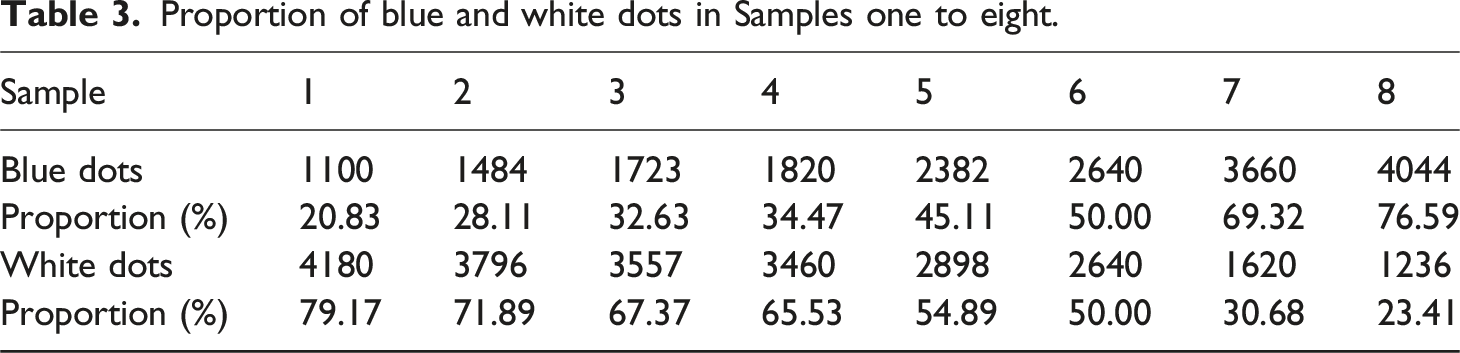
To confirm the number of dots in both the horizontal and vertical directions, a pilot was carried out to test the density of the 2-color knitted Jacquard with a Birdseye backing. A sample was produced based on two parameters – the NP and WM values, and the density was found to be 66 stitches for every 10 cm in the horizontal direction and 80 stitches for every 10 cm in vertical direction. Therefore, to obtain fabric dimensions of 10 cm × 10 cm, the size of the selected images was 66 dots in the horizontal direction by 80 dots in the vertical direction. As a result, the JPEG images can be converted into images with 66 dots in the horizontal direction by 80 dots in the vertical direction as shown in Figure 6. The eight images were made of blue and white dots (blue dots are front stitches with Color B Ordinary Yarn plated with Conductive Yarns B or C; and white dots are front stitches with Color A Ordinary Yarn) which cover 20% to 80% of the space, respectively, as shown in Table 3. Converted images with 66 dots in horizontal direction by 80 dots in vertical direction based on: (a) Sample 1; (b) Sample 2; (c) Sample 3; (d) Sample 4; (e) Sample 5; (f) Sample 6; (g) Sample 7; and (h) Sample 8. Proportion of blue and white dots in Samples one to eight.
Electrical properties of conductive knitted Jacquard fabrics
The resistance value of fabrics 
Therefore, the heating temperature of different Jacquard fabrics can be determined. From equation (1), 
Results and discussion
Fabrication of conductive Jacquard fabrics
Conductive Jacquard fabric samples were fabricated by following the procedures discussed in Section 2.1, and shown in Figure 7. To ensure that the results could be repeated, each sample was replicated 30 times to measure its mean and deviation. Knitted fabrics based on: (a) Sample 1; (b) Sample 2; (c) Sample 3; (d) Sample 4; (e) Sample 5; (f) Sample 6; (g) Sample 7; and (h) Sample 8.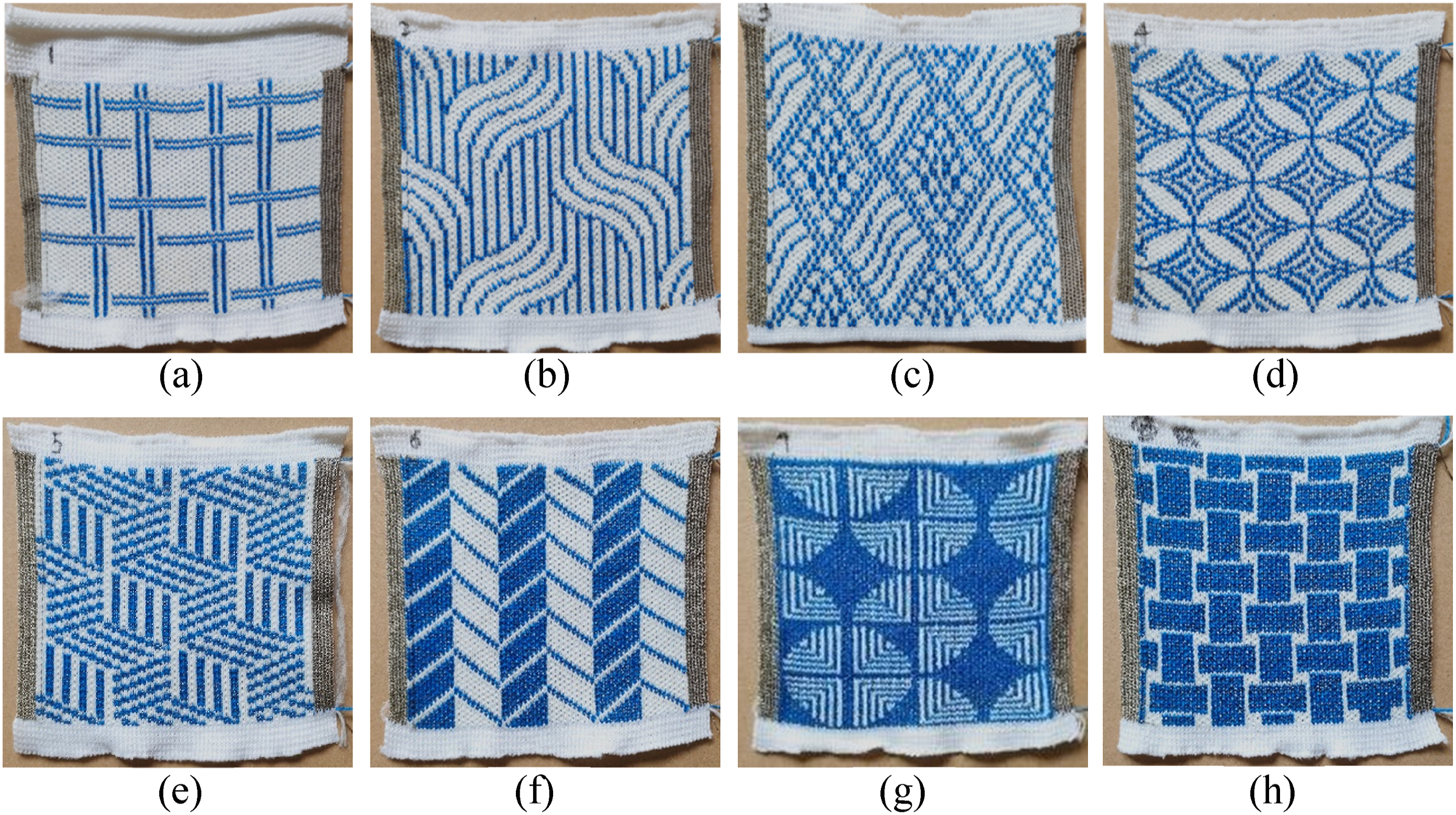
Resistance of conductive Jacquard fabrics
Resistance of samples: Ordinary yarn B plated with conductive yarn B
Resistance values of samples: Ordinary Yarn B plated with Conductive Yarn B.

Resistance of samples: Ordinary yarn B plated with conductive yarn C
Resistance values of samples: Ordinary Yarn B plated with Conductive Yarn C.

Discussion
It can be observed from Tables 4 and 5 that when different conductive yarns are used, the effect of different patterns on resistance remains consistent. For the same pattern, the greater the resistance per centimeter of the conductive yarn employed, the greater the resistance of the fabric will be achieved. Sample 1 exhibits the highest resistance, whereas samples 3, 4, 7, and eight exhibit lower resistance. This indicates that, in addition to the conductive yarn used, the design of the knitted Jacquard pattern also has a certain impact on the electrical resistance performance of the fabric. After applying a 5V voltage for an hour, the change in the resistance value of the sample is minimal and can be neglected, as shown in Figure 8. It can be reasonably assumed that the variation of resistance during the heating process is negligible, and hence equation (1) can be employed to calculate the heating temperature. The resistance value applying a 5V voltage for an hour: (a) Sample 1-8 with Conductive Yarn B; (b) Sample 1-8 with Conductive Yarn C.
Heating properties of conductive knitted Jacquard fabrics
The temperature of the conductive knitted Jacquard fabric samples was obtained by using the method outlined in Section 2.1.3. Figure 9(a) and (b) showed Infrared Thermal Imagers after loading external voltage 1 min, 5 min, 30 min and 60 min, for Sample 1-8 with Conductive Yarn B (U = 5V) and Conductive Yarn C (U = 3V), respectively. All of the temperature values were obtained from the center of the fabric and an infrared thermal image. It can be observed that, after loading external voltage 30 min, the heating temperature tends to stabilize. Different Jacquard patterns have different levels of heating uniformity. Sample 1, 2 and four have poor heating uniformity compared to Sample 3, 5, 6, 7 and 8. Infrared Thermal Imagers after loading external voltage 1 min, 5 min, 30 min and 60 min, for Sample 1-8 with (a) Conductive Yarn B (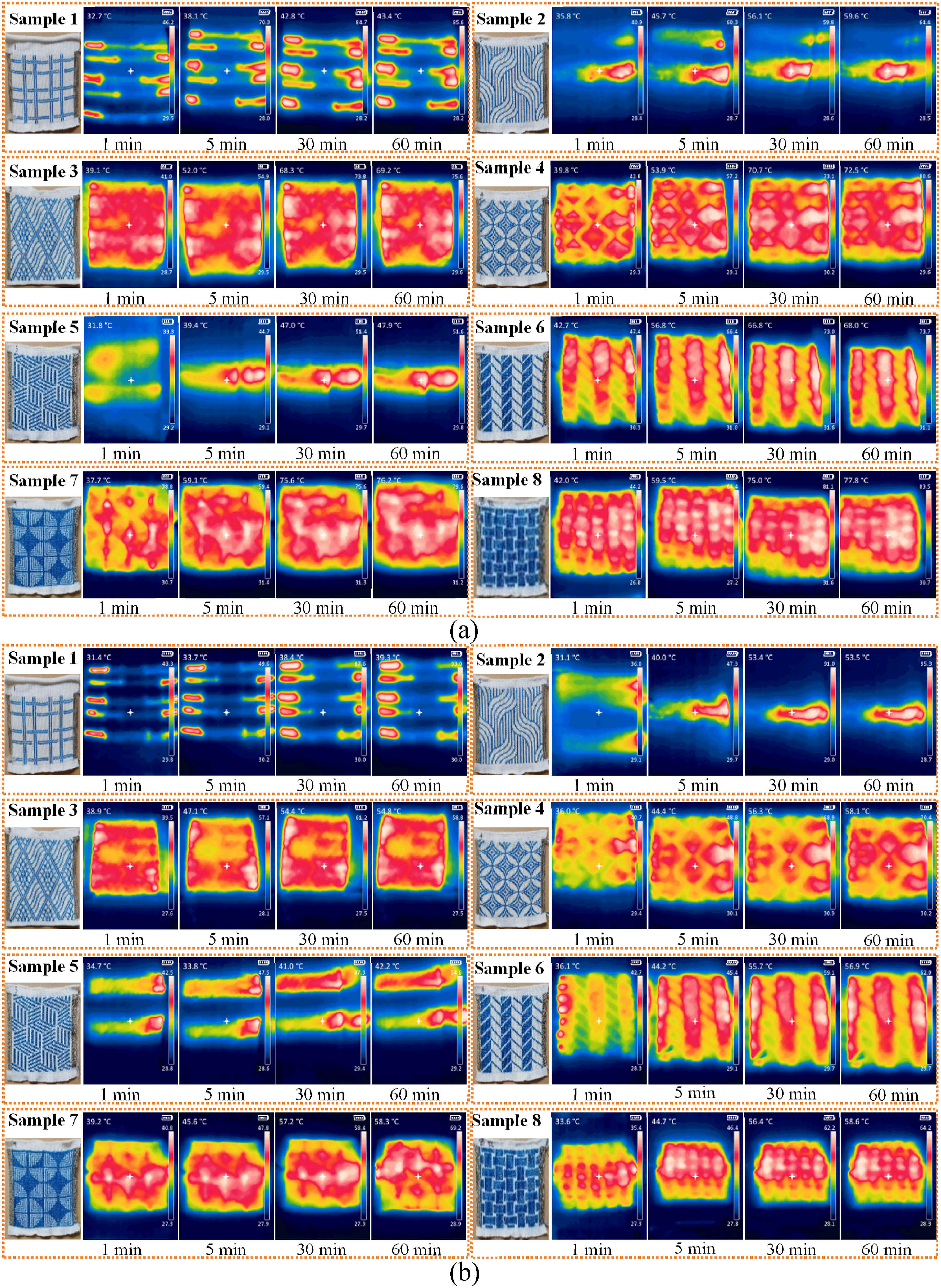
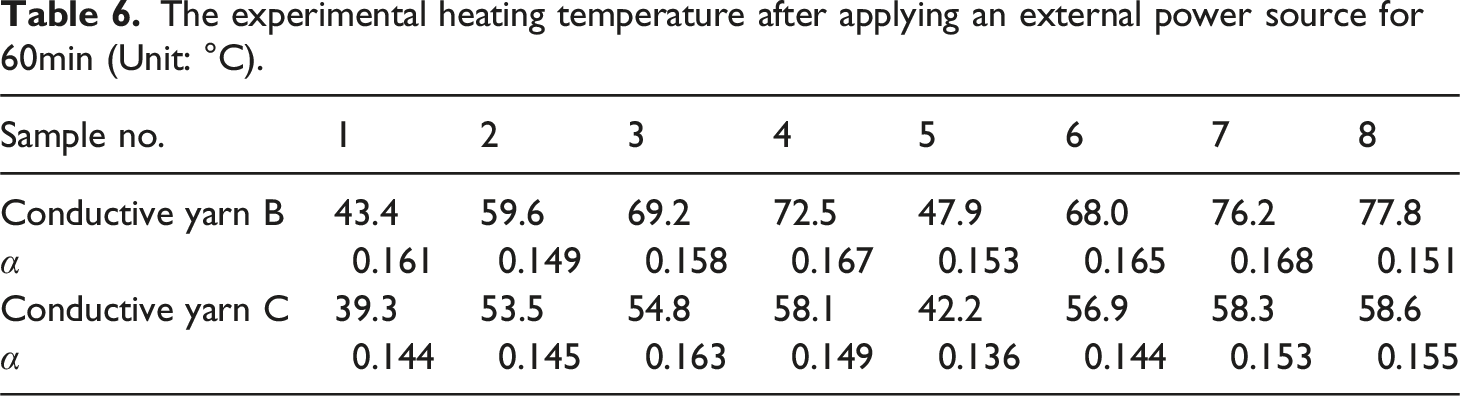
The experimental heating temperature after applying an external power source for 60min (Unit: °C).
Experimental (

Additionally, it can be observed that there is an inverse relationship between the temperature and resistance value. As the number of blue dots increases (in Samples 1 to 8), the resistance decreases, and the heating temperature rises. However, when the proportion of blue and white dots within a pattern is close to 50%, the resistance will increase, and the temperature will decrease. For general Jacquard patterns, as the number of blue dots increases, the contact resistance generated by two conductive yarns’ contact in the fabric increases, resulting in a decrease in resistance. However, most blue dots are blocked by white dots in Sample 5 in the course direction, so the contact resistance reduced, thus, the resistance of the fabric becomes larger. Overall, the higher the proportion of blue dots, the more contact resistance of the resistance network, the smaller the resistance of the entire fabric, and the more uniform the heat generation of the entire fabric. However, with the increase of blue dots, the more stitches of conductive yarn are knitted, which also leads to the use of more conductive yarn. Therefore, the heating effects of Sample 3, Sample 7, and Sample 8 are superior. But among these three patterns, Sample 3 uses less conductive yarn. Therefore, considering the cost, Sample 3 is selected to manufacture the electrical heated clothing.
It can be seen that for 5 V of external voltage, the temperature of the samples plated with Conductive Yarn B is suitable for heating the body (40°C-80°C). Therefore, in the following step, Conductive Yarn B is used for the prototype of EHC.
Prototype of EHC for the elderly
Design of EHC style
According to the requirements on the interactive design of EHC for the elderly, and taking into account various aspects including customer characterization, functional requirements, physiological requirements, functional design, garment attributes, etc., the methods to design the product style are summarized by using a mind map as shown in Figure 10. It can be seen in the figure that the surveyed individuals would like heating functionality, with equal emphasis on wear comfort, durability, and cost-effectiveness. The surveyed individuals are most interested in fashion styles such as loungewear, workwear, and casual wear. They would like to have heating elements primarily around the neck, joints, and waist. Moreover, they prefer darker colors. In accordance with the principles of universal fashion, there are specific recommendations for elderly clothing. Firstly, silhouette designs such as H-type and O-type are recommended to effectively conceal the waist and hips. To ensure the heating elements adhere effectively to the body, an H-type silhouette is chosen. Secondly, since elderly individuals often have rounder faces, a V-neck collar is selected to create a lengthening effect on the facial lines. Finally, regarding fabric and color choices, as mentioned earlier, selecting a soft and thick wool knitted Jacquard fabric with a small pattern design aligns better with the fuller figure of the elderly. Mind map of UI-based EHC for the elderly.
As a result, EHC for elderly men is designed and shown in Figure 11. The style of this type of clothing features a cardigan design with a double-breasted front, adorned with Jacquard patterns based on Sample 3. The pocket design is intended to conveniently accommodate the power bank that provides an external power source. The heated area is placed in the back of the waist. Sketch of UI-based EHC for the elderly (men).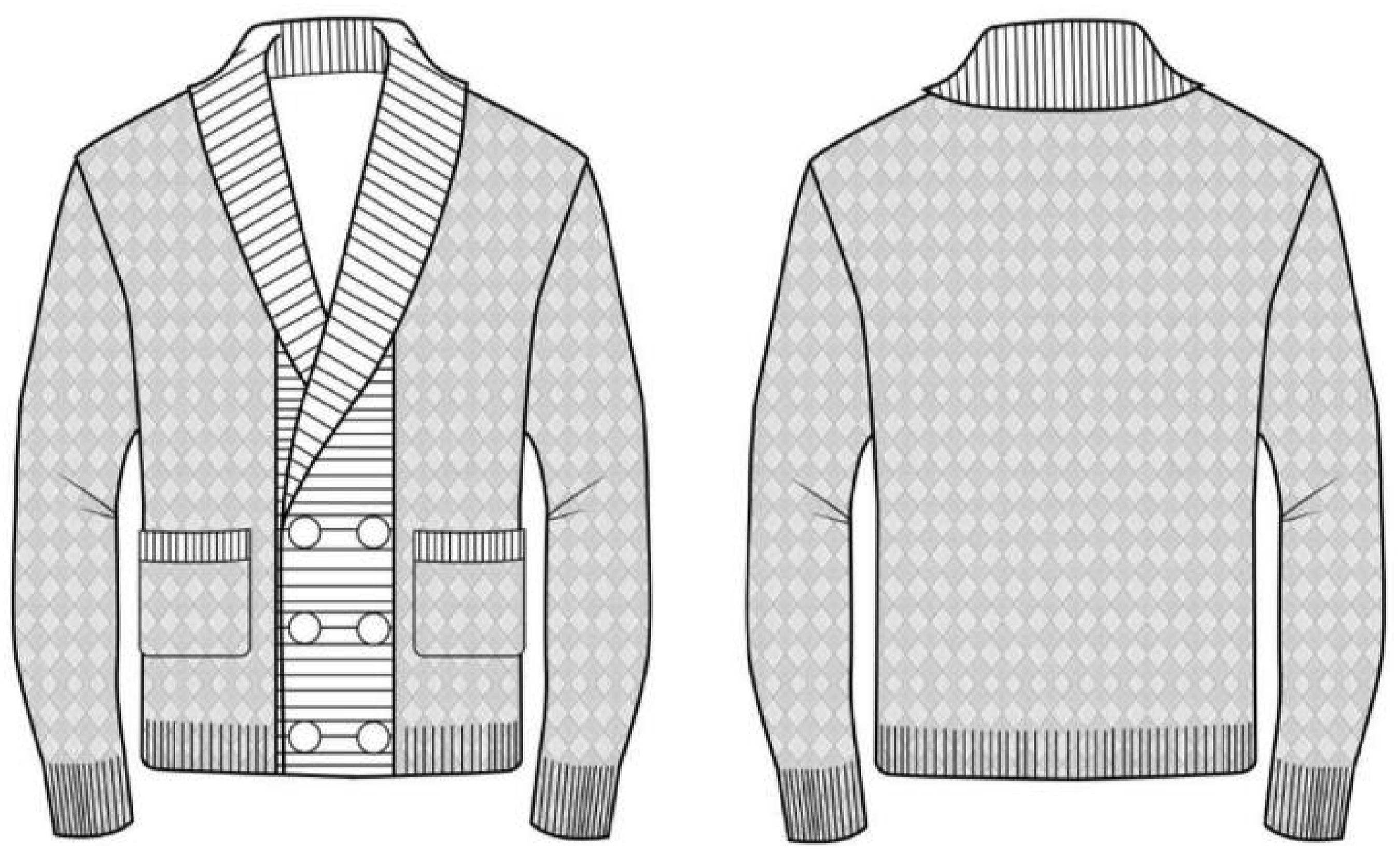
Development of user interaction design
In modern society, mobile phone is very widespread. In order to embody an age-friendly design, a WeChat mini-application (mini-APP) is developed in this study that allows the elderly to control the heating temperature and duration on their smartphone, which is a form of human-machine interaction. By the mini-APP, not only the elderly themselves could control the intelligent heating function, but also their guardians could control the mini-APP if the elderly unable to care for themselves. To realize the functionality of this mini-APP, a Bluetooth module was developed. The user interaction (UI) of this mini-APP was based on special designs that are user-friendly to the elderly, such as enlarged fonts, using warm colors that are favored by the elderly,
45
and ensuring simple and intuitive means of operation, as shown in Figure 12. The interface of the APP was designed with bright red and yellow color and the main part of the source code for the mini-APP is in the Appendix. UI design for WeChat Mini-APP.
The Bluetooth module is integrated into a Printed Circuit Board Assembly (PCBA) with size of 5 cm × 3 cm. The operational flow of the PCBA involves a sequence of complex yet well-organized procedures as shown in Figure 13. Initially, power input is managed, and when utilizing a power bank, it is crucial to short-circuit the D+/D− lines of the USB 2.0 A plug to ensure adequate current output to the control board. The DC-DC circuit, plays a critical role by converting 5V input to 3.3 V to power the microcontroller and the Bluetooth data transmission module, with a maximum output of 2 amperes. The microcontroller, equipped with an 8-bit pulse width modulation peripheral, utilizes a proportional-integral-derivative algorithm to calculate and adjust duty cycles, driving the P-channel MOSFET to regulate the heating of the conductive cloth. Concurrently, the negative temperature coefficient voltage divider circuit monitors temperature, with capacitor filtering to improve performance. During the design phase, relevant microcontroller pins are connected to a simulator for simulation and software download, ensuring functionality and reliability. The working flow of Printed Circuit Board Assembly (PCBA).
Design of wires connected to external sources
To ensure that the conductive wires can be hidden in the garment, two channels of 1 cm in width were placed on the inside back of the garment; see Figure 14. The conductive wires can be threaded into the channels to connect the heating area and Bluetooth module together. A power bank was connected to the other side of the Bluetooth module to afford an external power supply. The heated area was established with dimensions of 10 cm in height and 15 cm in width, which was a larger heated area, and supported a heating temperature of maximum 53°C when loading a 5V external voltage based on the calculations in Section 3.3. Connection of Bluetooth module, power bank and heated area in view of inside back of garment.
Prototype of EHC
The fabrication of the EHC was also carried out on a CMS 502 ki E7.2 computerized flat knitting machine. The prototype for the EHC is shown in Figure 15(a) and 15(b). From the appearance, the garment appears to be an ordinary knitted garment. Thus, the Birdseye backing side of fabrics contact with human body. This flexibility is due to the versatility of knitting machine technology, which is also why this garment technique is chosen for this study. Not only can intricate pattern designs be created, but the design details can also be more flexible. The power bank with size of 6 cm × 4 cm × 2 cm can be placed in the pockets and taken out or stored as needed. When the power bank fully charged to 20,000 mAh, it can power the EHC for over 3 h, meeting the heating requirements of the garment. Figure 15(c) shows the infrared thermal images for the heated area when not loading an external power supply. By using the WeChat mini-APP, the temperature of the heated area can be controlled. The prototype of EHC: (a) front view; (b) back view; (c) infrared thermal images for heated area; (d) infrared thermal images for without heating, heating 1 min, 5 min and 10 min, and EHC removed 1 min when the heating temperature was set to 50°C and the heating duration to 30 min.
A male elderly subject with height 180 cm was selected for the study. Before heating, the temperature of subject without EHC is 30.5°C as shown in Figure 15(d). When the heating temperature was set to 50°C and the heating duration to 30 min by the mini-APP, the infrared images showed that the temperature of heated area is 32.6°C after 1 min, 44.7°C after 5 min and 50°C from 10 min until 30 min as shown in Figure 15(d). When temperature reaches 50°C, the system, controlled by the program, stops further power supply, preventing the temperature from rising further. If the heating duration exceeds 30 min, the heating stops. After removing the EHC, the temperature of subject is 39.3°C as shown in Figure 15(d). It is evident that the heat has transferred to the body from the EHC.
Conclusion
This research work affords a method that develops EHC for the elderly. The following conclusions are obtained: 1) When different conductive yarns are used, the effect of different patterns on resistance remains consistent. For the same pattern, the greater the resistance per centimeter of the conductive yarn, the greater the resistance of the resulting fabric will be achieved. As the number of blue dots increases, the resistance will decrease, and the heating temperature will rise. However, when the proportion of blue and white dots is close to 50% respectively, the resistance will increase, and the heating temperature will decrease. Considering both the heating effects and yarn costs, Sample 3 is selected as the pattern for EHC. 2) The heating temperature can be estimated based on the Jacquard pattern and the resistance of the conductive yarn used, with the error falling within an acceptable range. For 5 V of external voltage, the temperature of the samples plated with Conductive Yarn B is suitable for heating the body (40°C-80°C). Thus, Conductive Yarn B is selected to be used for the prototype of EHC. 3) The prototype of EHC was designed according to the requirement of users and universal fashion. The integration of a Bluetooth module could conveniently control the temperature and duration of heated area for elderly and their guardians; thus, it realizes the interaction between user and garment by a WeChat Mini-APP.
In summary, this study proposes a method to develop the EHC for the elderly which achieves user interaction with garments. This method ensures that the heating components seamlessly blend with the fabric, thus preserving both the wear comfort, heating effects and aesthetics of the garment. This can provide a valuable approach for the development and research of knitted wearable clothing.
Footnotes
Declaration of conflicting interests
The author(s) declared no potential conflicts of interest with respect to the research, authorship, and/or publication of this article.
Funding
The author(s) disclosed receipt of the following financial support for the research, authorship, and/or publication of this article: The authors would like to acknowledge the funding support from Research Project of Humanities and Social Sciences of the Ministry of Education, China (22YJCZH108). And we would also like to thank Ou Yan and Zhen Gao for their kind help on manufacturing intelligent heated clothing.

Appendix
1. <template> 2. <view class=“hot-container”> 3. <view class=“minue-button” @click=“minus”></view> 4. <view class=“text-style”><text>{{initValue}}</text>°C</view> 5. <view class=“operate-button” @click=“add”>+</view> 6. </view> 7. </template> 8. <script> 9. export default { 10. name:“temperatureControl”, 11. props:{ 12. // 13. minValue:{ 14. type: Number, 15. default:40 16. }, 17. // max 18. maxValue:{ 19. type:Number, 20. default:60 21. }, 22. // default 23. initValue:{ 24. type:Number, 25. default:50 26. } 27. }, 28. data () { 29. return { 30. value:this.initValue, 31. }; 32. }, 33. methods:{ 34. add (){ 35. if (this.value=== this.maxValue){ 36. return; 37. }else{ 38. this. value++; 39. this.$emit (“getCurrentValue”,this.value); 40. } 41. }, 42. minus (){ 43. if (this.value === this. minValue){ 44. return; 45. }else{ 46. this. value--; 47. this.$emit (“getCurrentValue”,this.value); 48. } 49. } 51. } 52. } 53. </script> 54. <style scoped> 55. .hot-container{ 56. display:flex; 57. align-items: center; 58. justify-content: space-between; 59. padding: 30rpx 50rpx; 60. } 61. .text-style{ 62. color: #EF8434; 63. } 64. .text-style text{ 65. font-size: 60rpx; 66. font-weight: bold; 67. } 68. .minue-button{ 69. width: 60rpx; 70. height: 18rpx; 71. background: linear-gradient (#bbcbec 10%, #40A4F2 50%); 72. } 73. .operate-button{ 74. font-size: 100rpx; 75. line-height: 60rpx; 76. font-weight: bolder; 77. background: linear-gradient (#f6bfc6 10%, #e13448 50%); 78. -webkit-background-clip: text; 79. -webkit-text-fill-color:transparent; 81. /* color: #; */ 82. /* text-shadow: 0 0 6rpx#8E9295; */ 83. } 84. </style>