




Abstract
Coated fabrics can experience mechanical performance degradation due to environmental factors and long-term stress during service. Hence, studying the mechanical behaviors of these materials after aging is crucial. While PTFE (polytetrafluoroethylene)-coated fabrics are more commonly used than PVC (polyvinyl chloride)-coated fabrics, limited research exists on their performance after aging in practical engineering applications. PTFE-coated fabrics are primarily used in large-span fabric structures, where their mechanical performance under tensile-shear stress is crucial. This study aims to investigate the mechanical behaviors of PTFE-coated fabrics after practical aging under tension-shear stress. Test materials included decommissioned Saint-Gobain Sheerfill-II PTFE-coated fabrics, which had served for 23 years at Shanghai Stadium, and identical new fabrics. Monotonic tensile, central tearing, and cyclic tensile tests were conducted at seven different off-axis angles to compare the mechanical properties of aged fabrics with new fabrics, including tensile strength, tearing strength, modulus of elasticity, and ratcheting strain. Additionally, this study explored changes in failure mechanisms, tearing mechanisms, applicability of strength criteria, and suitability of the orthotropic model after aging. This provides a comprehensive understanding of the mechanical behaviors of aged PTFE-coated fabrics and valuable insights for engineering design.
Keywords
Introduction
Coated fabrics with high-strength fibers and high-performance coatings are widely used in permanent outdoor structures like canopies, warehouses, and stadiums. 1 These fabrics are mainly made with either a PVC (polyvinyl chloride) coating or a PTFE (polytetrafluoroethylene) coating. They possess distinct mechanical properties due to different yarn fibers: polyester for PVC-coated fabrics and fiberglass for PTFE-coated fabrics. Coated fabrics are increasingly used in civil engineering due to their high strength, light weight, and cost-effectiveness. 2 Despite their advantages, prolonged exposure to environmental factors and continuous loads can cause these materials to age.3,4
Literature review summary.
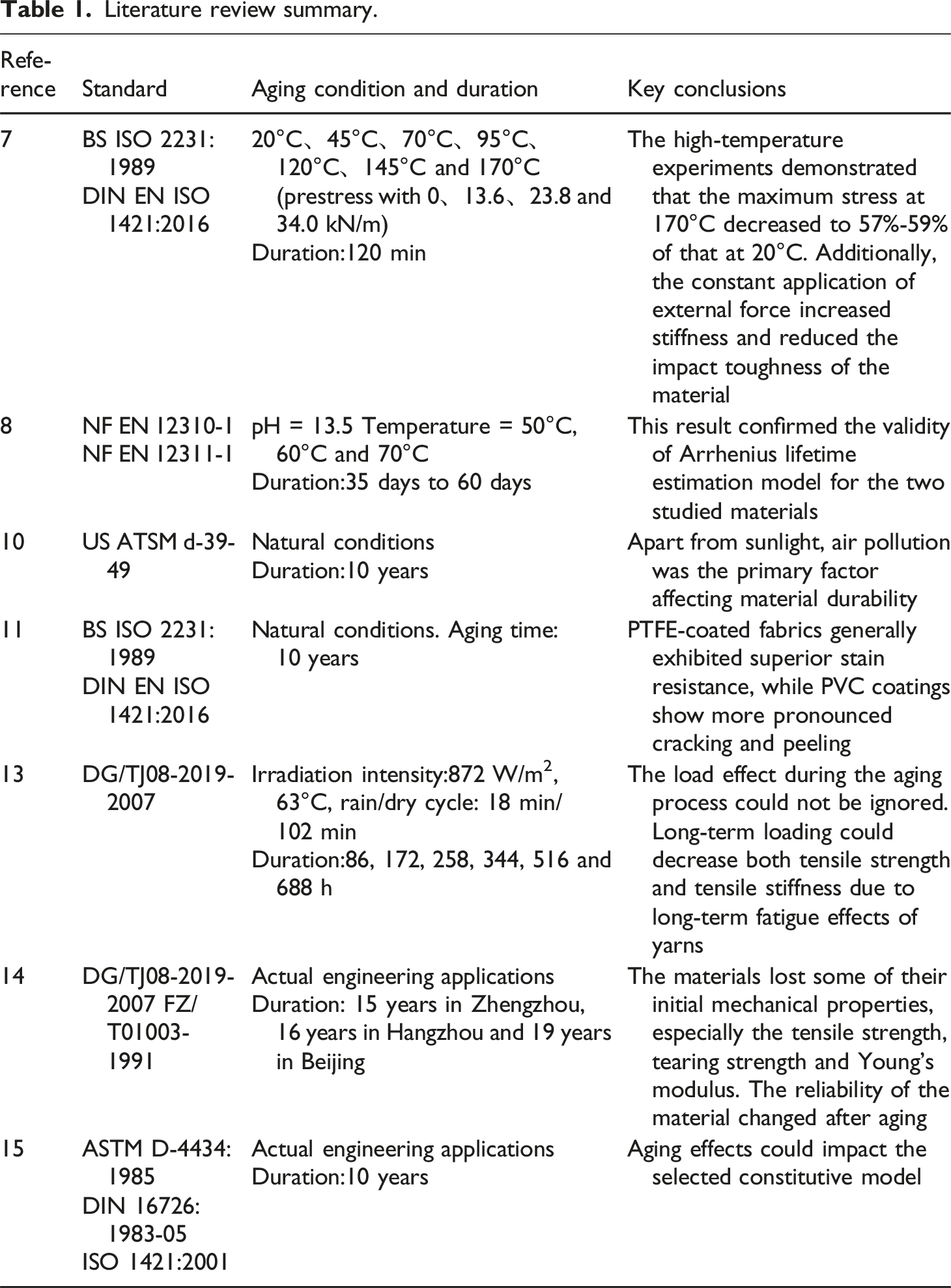
Due to the complexity and variability of natural environments, research under different climatic conditions is necessary to comprehensively reveal the intrinsic relationships between multi-scale degradation behaviors and their interactions with various weathering factors.
8
In recent decades, researchers have conducted global studies in regions with characteristic climates. Figure 1 provides an overview of natural exposure and field aging tests conducted globally over the past decades. It details the materials used, maximum aging duration, and local climate types. This comprehensive analysis shows that the natural aging of coated fabric materials has been extensively studied, especially in locations like Beijing,
11
Zhengzhou,
12
Hangzhou,
12
Japan,
16
Malaysia,
11
Poland,
15
Germany,
10
India,
17
Portugal,
18
and Miami, USA.
10
Aging research on coated fabrics around the world.
The basic mechanical properties of PTFE-coated fabrics are well described in these references 19–22. Due to its inert nature, strong UV resistance, non-aging characteristics, and long lifespan, PTFE-coated fabric has become the most reliable material for large-span fabric structures under harsh loading conditions.23–26 PTFE-coated fabrics have been developed more recently than PVC-coated fabrics. 2 Because of their relatively recent development, only natural exposure tests have been conducted on PTFE-coated fabrics so far. As PTFE-coated fabric structures gain prominence, there is a pressing need for field aging tests on these materials. Such research will provide valuable insights, enrich the knowledge base on PTFE-coated fabrics, and enhance the design of more durable and reliable fabric structures. As the span of coated fabric structures expands, understanding their mechanical behavior under complex shear-induced stress becomes increasingly important. 23 Off-axis tests serve as the simplest method for examining complex stress situations. 27 Consequently, off-axis mechanical tests are gaining attention in the evaluation of new coated fabrics.28,29 However, current research on the mechanical behavior of aged materials mainly focuses on changes in the warp and weft directions, overlooking broader aspects.24,25 Additionally, the tearing resistance of aged coated fabrics is frequently assessed using the trapezoidal tearing method,12,13 a technique originally developed for the apparel industry, which is not tailored for structural fabrics. 26 Consequently, the strength values derived from this method are rarely incorporated into design specifications. In contrast, the central tearing test aligns more closely with actual structural tearing in terms of stress distribution and crack opening shapes. 30 This test provides data on the tearing resistance of coated fabrics, which are more pertinent and directly applicable to real-world scenarios. Therefore, it is an appropriate method for investigating the tearing resistance of aged PTFE-coated fabrics and offers valuable insights for the design and assessment of fabric structures.
To address the research gaps, this study focuses on the off-axis mechanical behaviors of aged PTFE-coated fabrics, specifically Saint-Gobain Sheerfill-II. These fabrics were removed from Shanghai Stadium, the first large-span PTFE-coated fabric structure in China, which was dismantled after 23 years of service. Analyzing the mechanical performance of this aged fabric provides crucial insights for designing large-span fabric structures, particularly in understanding their longevity and durability under practical engineering conditions.
Experimentation
Materials and methodology
Shanghai Stadium (Figure 2),
31
inaugurated in 1997, features a distinctive roof comprising 57 umbrella-like cable fabric units spanning a horizontal projection area of 37,000 m2. This roof utilized Saint-Gobain Sheerfill-II PTFE-coated fabrics, marking China’s first use of fabric structures for large-span permanent buildings. This groundbreaking application laid the foundation for the widespread adoption of fabric architecture across the nation. After 23 years, coinciding with the stadium’s renovation for the World Cup, the iconic roof fabric structure was dismantled. The fabric investigated was removed from the western cantilevered portion of the stadium’s saddle-shaped roof, covering an area of 20 m2 (Figure 2). Throughout its service life, it endured significant wind suction forces and underwent coupled weathering and mechanical aging. Table 2 shows the annual climate characteristics of Shanghai over the past 20 years. Shanghai Stadium. Shanghai’s climatic characteristics.

Material properties of Sheerfill-II PTFE-coated fabrics.

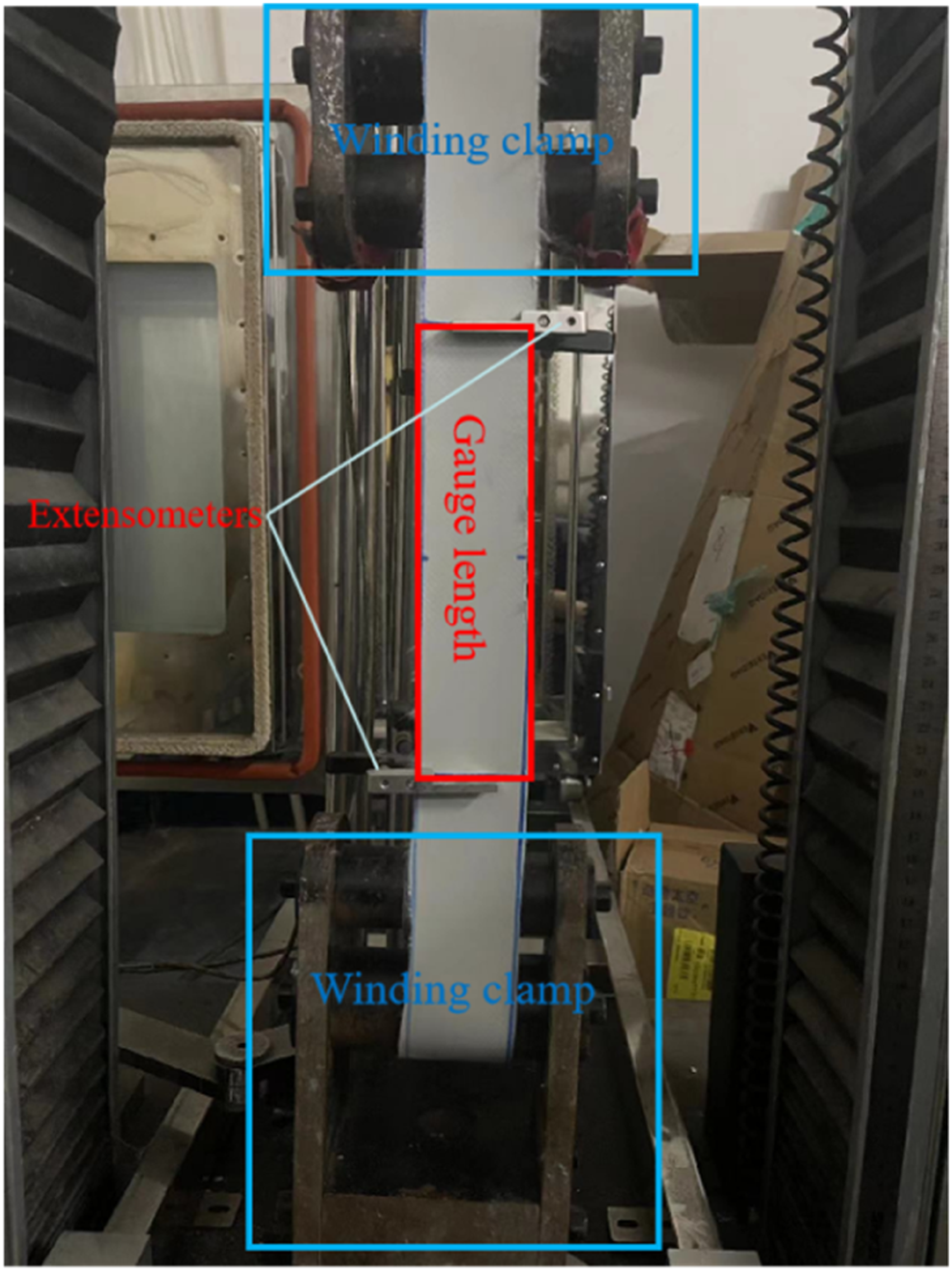
Figure 3 shows the dimensions of the test samples. For cyclic tensile tests, standard rectangular specimens measuring 50 mm in width and 200 mm in gauge length were employed for strain measurements. In the central tearing test, an initial crack of length 2a (25 mm in this study) was introduced at the center of each specimen. In the monotonic tensile tests, an improved rectangular specimen with winding clamps (Figure 4) was used to prevent slippage. The gauge length was 200 mm, and two extensometers fixed at both ends of the gauge length were used to measure deformation. Both new and aged fabrics were prepared into test specimens at various off-axis angles of θ (θ = 0°, 15°, 30°, 45°, 60°, 75°, and 90°), with the warp direction serving as the reference. The specimens were cut into dimensions suitable for the aforementioned tests (Figure 3). Specimen size (Unit: mm). Winding clamps.
Experiments
In this study, basic experimental conditions were kept the same. These conditions included maintaining a room temperature of 24 ± 0.5°C and a relative humidity of 65 ± 3%. The specific experimental parameters for the off-axis monotonic tensile test, central tearing test, and cyclic tensile test are detailed in the following subsections.
Off-axis monotonic tensile test
In each test, force was measured with a force sensor with an accuracy of ±1.0 N. Deformation was measured with extensometers attached to both ends of the specimen, with an accuracy of ±0.01 mm. The loading speed was set to 100 mm/min according to the DG/TJ08-2019-2019 33 standard. Each off-axis angle was tested five times. At least five repeated tests were conducted for each off-axis angle to obtain an average value, ensuring result reliability.
Off-axis center tearing test
According to Sun, 21 as the crack length increases, coated fabrics transition from a strength-controlled fracture to a toughness-controlled fracture. This study focused on the impact of real-world aging on the fracture toughness of fabrics. Therefore, long cracks of 25 mm were selected for this study. At least five repeated tests were conducted.
Off-axis cyclic tensile test
Many studies agree that the fabric stress during the service life of practical fabric structures is generally less than one-fourth of the uniaxial ultimate tensile strength. 34 Therefore, in this study, the upper limit of stress amplitude for each off-axis angle was set to one-fifth of the tensile strength, corresponding to the respective off-axis angles of the new fabrics. The stress lower limit was set to the commonly used prestress value for PTFE-coated fabric structures, which is 4 kN/m22. In this study, a loading speed of 10 mm/min was selected based on ISO standards for uniaxial cyclic tests, 35 and 15 cycles were used according to ASTM standards for cyclic test duration. 36 At least three repeated tests were conducted.
Results and discussion
Off-axis monotonic tensile results
Off-axis tensile curve
Figure 5(a) and (b) show the typical off-axis load-displacement curves for new and aged PTFE-coated fabrics. As the off-axis angle ranged from 0° to 45° and reverted from 90° to 45°, both new and aged fabrics showed a consistent pattern: a gradual decline in tensile strength and an increase in elongation at break. This trend corroborates the conclusions drawn in this study.
28
Off-axis monotonic tensile results. (a) Load-displacement curves (new) (b) Load-displacement curves (aged), (c) Relationship between tensile strength and off-axis angle.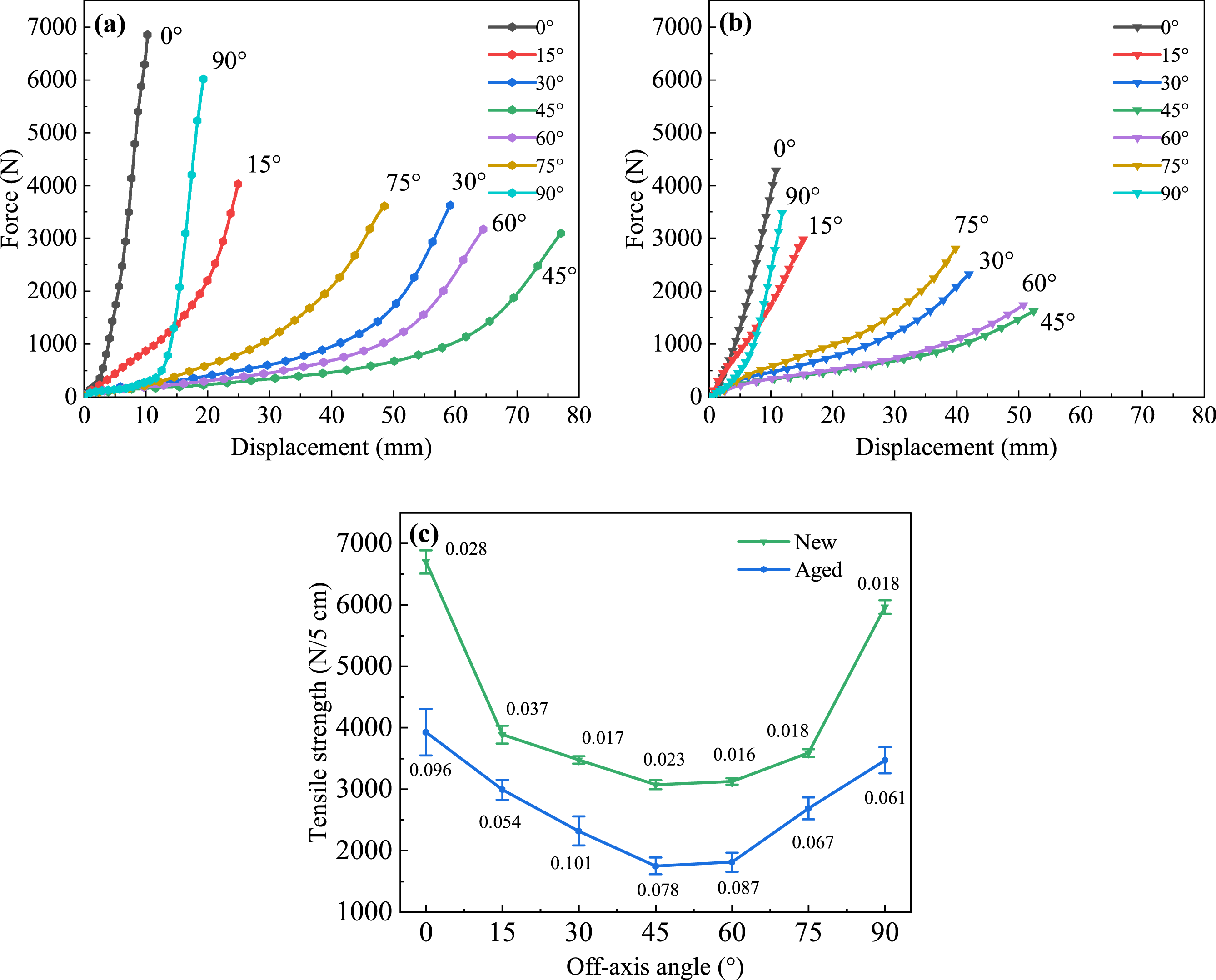
Off-axis tensile test results.
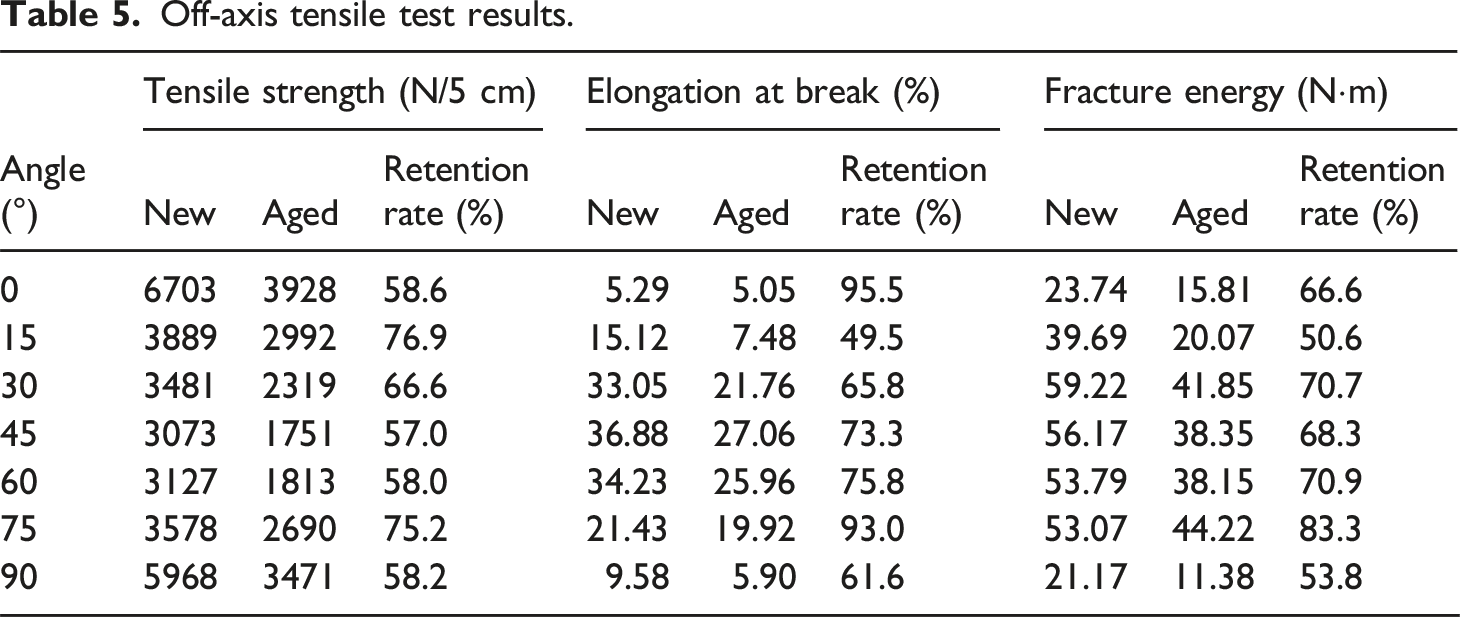
Figure 5(c) shows the tensile strength of both new and aged fabrics, with error bars representing the standard deviation. The standard deviation indicates the variability in tensile strength data. Additionally, the coefficient of variation is shown. For the new fabrics, a notable decrease in strength was observed at lower off-axis angles, particularly at 15° and 75°. This decrease appears as a sharp drop; for example, the tensile strengths at 15° and 30° exhibit reductions of 42% and 6%, respectively, compared to those at 0° and 15°. This significant decline is associated with a shift in the fracture mode. As the off-axis angle increased, the extent of strength reduction diminished, reaching a minimum at 45°. The coefficient of variation in tensile strength of aged fabrics is notably higher than that of new fabrics, indicating that the aging process increases the variability of tensile strength. Therefore, relying solely on average tensile strength values as the evaluation index is deemed unscientific. Consequently, reliability calculations should be integrated into the durability design of fabric structures.
In contrast, the strength of the aged materials did not show a sharp decline with the change in fracture mode; rather, the reduction in strength was more gradual. For instance, the tensile strengths at 15° and 30° decreased by 24% and 17%, respectively, compared to those at 0° and 15°. This behavior and its implications are further explored in the subsequent subsection.
Fracture mechanism
Zhang
28
identified three primary failure modes for PTFE-coated fabrics under off-axis tension, as shown in Figure 6: In the warp and weft directions, failure predominantly occurred due to the breakage of the base fabric fibers, resulting in pure tensile failure. At an off-axis angle of 45°, the material experienced pure shear failure. This mode is characterized by high-strength yarns being pulled out from the coating, with failure occurring at the yarn-coating interface. At 45°, the tensile strength depends on the bonding strength of the interface. In tests at other angles, the failure was a mix of tensile and shear; the yarns at the edges were pulled out from the coating (shown as the blue debonding area), while the central yarns broke (shown as the red fracture area). The tensile strength in these instances correlates with the number of broken high-strength yarns at the center, representing the utilization rate of these yarns.
27
The higher the utilization rate (indicated by a larger red fracture zone), the higher the tensile strength. Tensile failure mode. (a) Pure tensile failure (b) Tensile shear mixed failure (c) Pure shear failure.
Figure 7 shows the fracture morphologies of new and aged fabrics at various off-axis angles after tensile testing. In mixed tensile-shear failure, aged fabrics exhibited fewer yarns pulled out compared to new fabrics, indicating a higher utilization rate of high-strength yarns. This is shown in Figure 7 by the smaller area of the red fracture zone, possibly due to changes in yarn properties and the interface induced by aging. Consequently, the strength reduction in aged fabrics was more gradual than in new fabrics. Tensile fracture morphologies.
Observations reveal significant differences in the fracture morphology of aged and new fabrics at 45°. In the fracture section of aged fabrics, all yarns are pulled out from the interface. Conversely, due to the influence of the coating on crack propagation, the fracture section of new fabrics presents a jagged appearance. Here, the center yarns are fractured, while the edges show yarns being pulled out from the yarn-coating interface. Compared to new fabrics, aged fabrics exhibit a significant decrease in their ability to resist pure shear. Consequently, assessing the safety factor of fabric strength due to aging should not rely solely on warp and weft tensile tests. For a comprehensive evaluation, especially in worst-case scenarios, the post-aging bonding strength at the interface must be considered to accurately calculate the safety factor.
Strength criterion
Strength criteria are essential for understanding material failure, especially under complex stress states. They are integral components of both theoretical research and practical engineering. These criteria are determined by the intrinsic properties of the materials as well as by factors such as aging and sustained stresses over time. A combined state of stress develops in an anisotropic material when the axes of anisotropic symmetry do not align with the directions of the applied loads. Off-axis testing is the simplest method to generate a complex stress state, and it can be used to investigate failure criteria. 28 To assess the predictive accuracy of various strength criteria for both new and aged fabrics, four widely recognized yet straightforward criteria were selected: Tsai-Hill, 37 Norris, 38 Yeh-Stratton, 39 and Hashin. 40 Using these criteria, we can gain insights into how effectively each one predicts the failure behavior of new and aged fabrics, providing valuable information for structural engineering design and analysis.
Tsai-Hill criterion
Yeh-Stratton Criterion
Norris Criterion
Hashin Criterion
It is possible to substitute 
The shear strength 
Figure 8 presents a comparative analysis of the experimental results for both new and aged fabrics, along with predictions made using various established strength criteria. Corresponding error values are shown in Table 6 and 7. For new fabrics, the Tsai-Hill, Norris, and Hashin criteria provided accurate predictions. However, significant deviations were noted at smaller off-axis angles, specifically at 15° and 75°. Conversely, the Yeh-Stratton criterion exhibited high accuracy at smaller off-axis angles but was less accurate at larger off-axis angles. Comparison of prediction results of several existing criteria with experimental data. (a) New coated fabrics (b) Aged coated fabrics. Comparison of predicted and experimental values of new fabrics under several existing criteria. Comparison of predicted and experimental values of aged fabrics under several existing criteria.


For aged fabrics, the Tsai-Hill, Norris, and Hashin criteria perform well at smaller off-axis angles but are less reliable at larger angles, resulting in greater errors. Interestingly, the Yeh-Stratton criterion, effective for new fabrics at small angles, is not accurate for aged fabrics. This disparity in predictive accuracy may stem from the more intricate failure modes observed in aged fabrics. This finding underscores the complexity of predicting the behavior of aged fabrics and emphasizes the need for criteria that accurately reflect changes induced by aging and long-term service.
Off-axis center tearing results
Load–displacement curve
Figure 9(a) and (b) illustrate the typical tearing load–displacement curves for both new and aged fabrics at various off-axis angles, with an initial crack length of 25 mm. These curves identify the tearing strength and displacement for each fabric, where the maximum load indicates the tearing strength and the corresponding displacement represents the ultimate tearing displacement. Table 8, provided alongside the figures, summarizes these values for various off-axis angles. Off-axial center tearing results. (a) Load-displacement curves (new) (b) Load-displacement curves (aged), (c) Relationship between tearing strength and off-axis angle. Off-axis center tearing results.
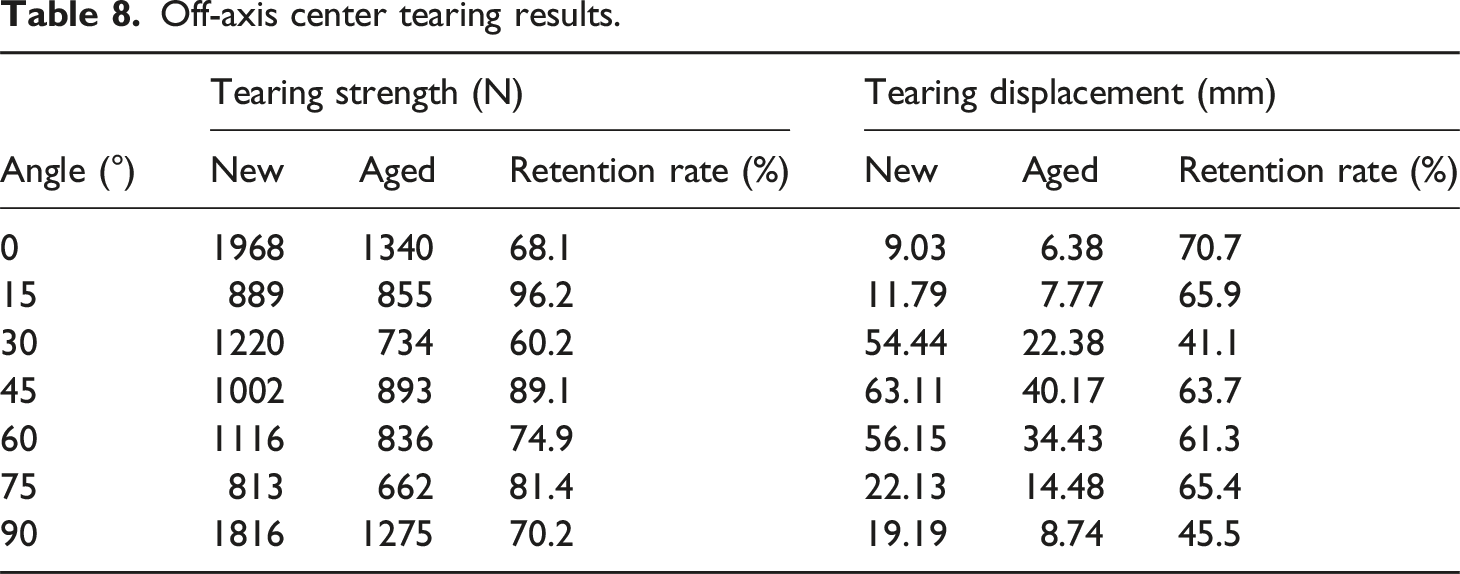
The tearing performance of the PTFE-coated fabrics showed significant anisotropy, but the overall characteristics of the curves remained consistent across various angles. As displacement increased, the load initially peaked and then showed local fluctuations before rapidly decreasing to a minimum value. Both new and aged fabrics can be categorized into two distinct failure modes based on their localized fluctuation characteristics. Progressive failure is characterized by an extended plateau stage after peak load with steady crack propagation and curve fluctuations. Brutal failure is identified by a sudden, overall collapse immediately after peak load, with little to no plateau stage, bypassing the stable crack propagation phase. Brutal failure typically involves larger displacement at failure compared to progressive failure. At various off-axis angles, the load associated with brutal failure is higher than that associated with progressive failure. For new fabrics, brutal failure was observed at 30°, 45°, and 60° off-axis angles, while progressive failure occurred at other angles. For aged fabrics, brutal failure was observed at 45° and 60° off-axis angles, while progressive failure occurred at other angles. A distinct variation in the failure modes of new and aged fabrics was noticeable at an off-axis angle of 30°.
Figure 9(c) provides a detailed analysis of the tearing strength variations in both new and aged fabrics influenced by the off-axis angle, with the standard deviation depicted as error bars. The coefficient of variation is also shown. This comparison reveals that the tearing strength and associated displacement at each off-axis angle were consistently lower for aged fabrics than for new ones. Moreover, the patterns of change for the two types of materials displayed distinct differences. For new fabrics, a notable decline in tearing strength was observed when transitioning from the warp and weft directions to smaller off-axis angles, specifically 15° and 75°. However, an interesting rebound in strength occurred at 30° and 60°, where local peaks in tearing strength were observed. At an off-axis angle of 45°, there was a slight fluctuation in strength, characterized by a minor decrease, yet the strength remained higher than at angles of 15° and 75°.
For aged fabrics, the strength does not recover at 30° but instead reaches its lowest value, indicating a change in the failure mode compared to new fabrics. This decrease was attributed to a shift in the failure mode from that observed in new materials, warranting further discussion. Notably, at 45°, aged materials exhibited a local peak in tearing strength.
Tearing mechanism
This section delves deeper into the findings of the previous subsection, using Figure 10 to illustrate the typical damage modes of the central tearing specimens and Figure 11 to show the fracture morphologies of new and aged fabrics. Central tearing damage model diagram. Fracture morphologies of center tearing specimens in different tensile directions.

In the warp and weft specimens (Figure 10(a)), the loading process caused inelastic deformation and slippage of the yarns, leading to a large deformation area (highlighted in blue in Figure 10(a)). The strain energy accumulated in this zone helps reduce stress concentration at the crack tip. Concurrently, two areas of stress concentration, termed delta zones (shown in red in Figure 10(a)), gradually emerged within the large deformation area. When the initial yarns in the delta zone fail due to intense stress concentration, the subsequent yarns take on the load, leading to an ongoing expansion of the delta zone until the specimen ultimately fails. This expanding delta zone correlated with fluctuations around the peak in the load curve. For specimens oriented along the warp and weft directions, the delta zone was fully developed, resulting in the breakage of all yarns within the cross-section of the crack, as shown in the red yarn fracture area in Figure 11.
As the off-axis angle increased, larger deformation zones arose due to shear deformation (Figure 10(b)), restraining the expansion of the delta zone and preventing it from reaching its full extent. When the delta zone reached a certain size, the yarns in the large deformation area, laden with significant strain energy, failed to support the transferred load, causing rapid yarn pull-out (shown as the blue debonding area in Figure 11). Approaching the off-axis angle of 45°, the debonding area progressively enlarged while the delta zone diminished, culminating in a shift from gradual to abrupt failure, as reflected by the sharp decrease following the peak of the curve. For new fabrics, at large off-axis angles of 30°, 45°, and 60°, the delta region was completely suppressed, causing all yarns in the cracked section to fail simultaneously, maximizing strength utilization. Consequently, at 45°, the tearing strength decreased due to an overall reduction in tensile strength. In contrast, for aged fabrics, the diminishing delta region at 45° leads to improved strength utilization and enhanced tearing strength.
The tearing morphologies reveal that the debonding areas in aged materials are smaller than in new materials, indicating a lower slippage capacity of yarns in aged fabrics. This results in smaller large deformation areas, larger delta zones, and more broken yarns. Particularly at an off-axis angle of 30°, the limited shear deformation capacity causes the delta zone to exceed the threshold for various failure modes, leading to a marked decrease in tearing strength compared to new materials.
The substantial reduction in the tearing strength of aged fabrics can be attributed to three primary factors: first, decreased yarn breakage strength; second, reduced slippage ability of the yarns, resulting in smaller large deformation areas and less effective stress concentration mitigation at the crack tip; and finally, a change in the failure mode at specific angles, where the most significant drop in tearing strength is observed in aged fabrics.
Off-axis cyclic stretching results
Cyclic tensile stress–strain curve
Typical off-axis cyclic tensile stress-strain curves are shown in Figure 12(a) and (b). Noticeable nonlinearity was observed at all seven off-axis angles. As the number of cycles increased, both the ratcheting strain and the elastic modulus increased slowly, with a larger proportion of this increase occurring in the initial cycles. As the off-axis angle approached 45°, the number of cycles required to reach a near-stable value increased. These characteristics were consistent for both new and aged fabrics. However, after 15 cycles of tensile stretching, the residual strain in aged fabrics was smaller at each off-axis angle compared to new fabrics. Off-axis cyclic stretching results. (a) Stress–strain curve (New) (b) Stress–strain curve (Aged), (c) Ratcheting strain differences (New) (d) Ratcheting strain differences (Aged), (e) Elastic modulus (New), (f) Elastic modulus (Aged).
Ratchet strain
Figure 12(c) and (d) show the progression of the ratcheting strain difference in both new and aged PTFE-coated fabrics relative to the number of loading cycles. The graphs reveal a noteworthy trend: as the cycle count increases, the ratcheting strain difference decreases and begins to stabilize. This change is most pronounced during the first and second cycles. For example, in new fabrics along the warp direction, the ratcheting strain difference was 0.022 in the first cycle but dramatically reduced to 0.0006 in the second cycle. The aged fabrics exhibited a more gradual change in ratcheting strain difference compared to new fabrics.
Ratchet strain of new and aged coated fabrics.

The overall trend in the change in ratcheting strain is consistent for both new and aged fabrics, showing an increase at an off-axis angle of 45°. This trend highlights significant residual deformation accumulating in fabrics under real-world conditions, with the most substantial accumulation observed at 45°. In practical engineering applications, particularly in large-span fabric structures, high residual deformation indicates an increased risk of fatigue failure. Consequently, to mitigate the risk of fatigue damage in these structures, special attention must be given to areas experiencing high shear stress.
Modulus of elasticity
To achieve a more precise measurement of the elastic modulus during the cyclic tensile tests, the loading curve was segmented and analyzed using the least-squares method. This segmentation was based on the commonly used prestress of 4 kN/m for PTFE-coated fabric structures. Figure 12(e) and (f) show the variation in elastic modulus across different loading cycles. Notably, there was a significant increase in the elastic modulus during the initial cycles, followed by stabilization after several cycles. Compared to new fabrics, aged fabrics exhibit a less pronounced increase in elastic modulus and reach a near-stable state more quickly. This suggests that aging and prolonged stress result in more linear tensile behavior in fabrics.
Comparison of theoretical and experimental values of elastic modulus.
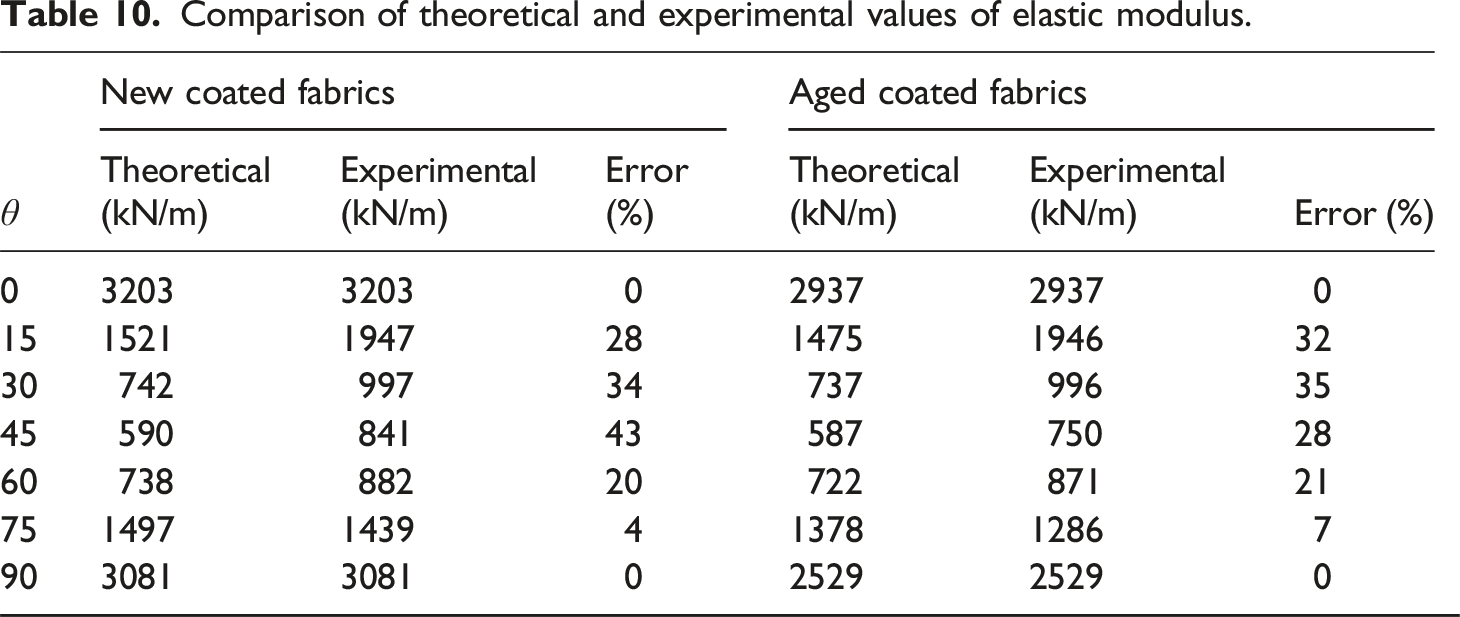
The PTFE-coated fabrics exhibited an anisotropic elastic modulus. In engineering design, orthotropic linear elastic models are commonly used for structural analyses. Consequently, this study compared the theoretical elastic modulus values derived from the orthotropic model with the actual values for both new and aged fabrics. This comparison aims to evaluate the applicability of the orthotropic model to PTFE-coated fabrics and examine the impact of aging on orthotropic behavior. The tensile orthotropic behavior should satisfy the following constitutive relationship:
Poisson’s ratio is essential for calculating the theoretical elastic modulus of composite materials, but it can be challenging to obtain. Given its stable mechanical characteristics, Poisson’s ratio is best determined from cyclic tensile tests. IIn this study, Digital Image Correlation (DIC) technology was used to obtain Poisson’s ratios for both new and aged fabrics at off-axis angles of 0°, 45°, and 90°. Images for the analysis were captured during the 15th cycle, as mechanical properties tended to stabilize at this stage.40–42
Figure 13 shows the interface of the Ncorr
43
software used for image processing. The software calculates the displacement and coordinates for all points along the boundaries of the Region of Interest (ROI). It obtains the average lengths and average displacements of two vertical lines, denoted as Methods for determination of Poisson ratio with DIC technique. (a) Horizontal direction (b) Vertical direction.


The shear modulus 
Substituting the values yields shear modulus of 123.9 kN/m for new fabrics and 144.8 kN/m for aged fabrics. Practical aging results in an increase in the shear modulus of the fabrics.
Figure 14 compares the theoretical and actual values of the elastic modulus, while Table 10 summarizes the corresponding data and error values. At an off-axis angle of 75°, the actual elastic modulus closely matches the theoretical value. However, significant differences were observed at other off-axis angles, with the greatest discrepancy at 45°, where the error reached 43%. The accuracy of predicting the elastic modulus for both new and aged fabrics was similar at most off-axis angles. However, aged fabrics showed notably higher prediction accuracy at 45°, with an error of only 28%. This may be attributed to aged fabrics exhibiting a significantly lower degree of nonlinearity in tensile behavior at 45° compared to new fabrics. Experimental and theoretical elastic modulus against loading directions. (a) New coated fabrics (b) aged coated fabrics.
These findings suggest that aging does not reduce the applicability of the orthotropic model to fabrics. Due to the increased linearity at certain angles, the applicability of the model improves. Therefore, when using an orthotropic model for design in practical engineering applications, aging does not decrease the model’s suitability. However, this does not eliminate the impact of potential rotation of the orthogonal warp and weft yarns, which can influence the behavior of the fabrics and should be considered in design and analysis.
Conclusions
This study presented an in-depth analysis of the mechanical behaviors of Sheerfill-II PTFE-coated fabrics used in practical applications, focusing on the longest-serving decommissioned PTFE-coated fabrics in China. The findings indicate a general decrease in the fundamental mechanical properties at various off-axis angles for aged fabrics compared to new ones. In the monotonic tensile test, due to the increased utilization of high-strength yarns, the tensile strength of aged fabrics does not decrease as sharply with changes in failure mode as in new fabrics. It can also be observed that the prediction accuracy of different strength criteria for various off-axis angles shows significant differences between new and aged fabrics. In the tear test, a shift in the tearing failure mode at certain off-axis angles due to aging was observed, leading to a significant decline in tearing strength. In the cyclic tensile test, aged fabrics exhibit significant residual deformation. A downward trend was observed in the elastic modulus of aged materials across all off-axis angles, with the most notable reduction in the weft direction. Evaluating the applicability of the orthotropic model to aged fabrics revealed that the increased linearity of the tensile curve after aging enhances the model’s fit, especially at 45°.
Current research on the aging properties of coated fabrics, including PTFE-coated fabrics, primarily focuses on evaluating material performance. Integrating micromechanical models to examine the internal structures of aged fabrics has significant potential for advancing this field. This approach will bridge the gap between the evolution of mechanical properties and structural performance, extending its relevance at the structural level. To gain a more nuanced understanding of aging performance under complex stress states, biaxial testing is instrumental.
Footnotes
Declaration of Conflicting Interests
The author(s) declared no potential conflicts of interest with respect to the research, authorship, and/or publication of this article.
Funding
The author(s) received no financial support for the research, authorship, and/or publication of this article.
