




Abstract
This paper presents the research on off-axial tensile behaviors of polytetrafluoroethylene-coated woven glass fibers under different loading rates. First, groups of off-axial tensile tests were carried out, and the corresponding failure mechanisms were analyzed. Then, the effect of loading rate on the tensile behaviors of off-axial specimens was studied. Finally, several current strength criteria were compared to predict the material failure strength under different loading rates. Results show the tensile behaviors of polytetrafluoroethylene-coated woven glass fibers are typical orthotropic. The material failure strength is strongly related with failure modes and yarn orientations. Three typical failure modes are observed in the tests, including interface failure, yarn breakage, and composite failure. The loading rate has significant effects on the material tensile strength and the elongation at break. With loading rate increasing, the tensile strength increases and the elongation at break decreases. The tensile strength shows a good linear correlation with the loading rate’s logarithm. Most of current quadratic strength criteria can be used to predict the material failure strength, except for the specimens of small bias angles. This is because traditional quadratic criteria are always based on the strain energy theory of homogeneous materials, which may not reflect the failure mechanisms of coated fabrics and other important details.
Keywords
Introduction
As an environmental friendly and sustainable construction, the membrane structures have been widely used in the large-span buildings, such as stadiums, gymnasiums, exhibition halls, and airport lounges [1]. Coated fabrics can offer a high ratio of strength to weight, which makes them suitable to cover large spaces. It has virtually little bending stiffness and can only resist in tension [2]. There are many types of coated woven fabric, for example, glass fibers coated with polytetrafluoroethylene (PTFE), polyesters coated with polyvinyl chloride (PVC) silicone-coated glass-fiber fabric and PTFE-coated ePTFE (Tenera) [1,3]. Among them, PTFE-coated glass fibers are the most reliable for large membrane structures under severe loading conditions. It has good fire, heat resistance and self-cleaning properties. However, the glass fibers are brittle and hard to fold, which may lead to the degradation of mechanical properties in transport and construction.
Due to complex architectural forms and non-linear material behaviors, the design and analysis of membrane structures are more dependent upon computers than most of other structural systems, for example, concrete or steel structures [1]. The key to achieve these high levels of performance is accurate modeling of the form and behavior of the structure, especially the material behaviors [4,5]. As one of the key issues for safety evaluation, the research on the resistance of membrane material under different loading rates and dynamic loadings has lagged behind. As typical polymer composites, the mechanical responses of coated fabrics may be sensitive to loading rate. Unlike metals, which have been studied over a wide range of loading rates, only a limited amount of information is available about the effects of loading rate and temperature on the response of coated fabrics [6–9]. Lack of understanding the mechanical properties of membrane materials limits the development of membrane structures [10–12]. Therefore, it is necessary to understand the mechanical properties of coated fabrics under different loading rates.
In the current design specifications, the limit state is always justified by comparing the maximum principal stress with the design strength [1]. The design strength is obtained by dividing the uniaxial tensile strength by a total safety factor formed by considering different component factors. However, the safety factor is always obtained by experience or simple tests, and in the current level, it is difficult to cover the effects of all influence factors based on the theory of structural reliability [13]. For example, the membrane materials are always under biaxial loading, and its biaxial tensile strength is lower than the uniaxial tensile strength [9]. Then, the difference between uniaxial tensile strength and biaxial tensile strength can be considered as “the model uncertainty for material strength”. However, the biaxial tensile strength cannot be directly obtained by simple tests. Some researchers presented the biaxial failure tests of coated fabrics, but they also mentioned that the biaxial failure strength obtained in the tests is the strength of biaxial specimens, not the material biaxial strength. However, the reduction of biaxial strength is seldom directly presented in the current design specifications [1]. Only in DIN4134, a reduction factor taking into account that the small width strip tensile test produces a higher value than the biaxial strength was presented. Meanwhile, other design specifications always combine the effects of several factors into a large resistance partial coefficient or safety factor [1]. Therefore, the relationship between uniaxial tensile strength and biaxial tensile strength is required to solve this problem. Then, the strength criterion which can reflect the material failure behaviors may be a good way to solve this problem.
As we know, the strength and failure mechanism of coated fabric is a complicated and important issue. It depends on not only the inherent nature of the material but also the loads, environmental factors, and others [14,15]. The strength criterion is to confirm that, by knowing only the basic material properties, the strength under any stress state could be predicted. The strength criteria for composites can be references for the design of coated fabrics. Experimental investigations have been made on the strength of materials under complex stress states, along with recent developments of numerical methods and computer application [16–33]. Nowadays, with the development of computer and technology, the current experts have recently completed three world-wide failure exercises to study the degree of maturity of the current capabilities of several internationally recognized methods for modelling various aspects of damage in three-dimensional composite materials [34,35]. Their achievements can be references for the analysis of coated fabrics. The off-axial tensile test is the easiest way to generate a complex stress state, and it can be used to study the failure criteria. Several researchers have conducted the off-axial tests to study the failure mechanism and strength criteria of coated fabrics. The results show that the classical quadratic strength criterion with quadratic terms, for example, Tsai-Hill criterion can make a good prediction of most of the material off-axial strength, except for the specimens of small bias angles [18–20]. Besides, the current tests always contain the tests about the angles of between 0° and 90° with the interval of 15°. More experimental data about other bias angles are necessary to verify the strength criterion.
This paper carried out a series of off-axial tensile tests under different loading rates and presented the fracture failure analysis of PTFE-coated woven glass fibers. First, the off-axial tensile behaviors of PTFE-coated woven glass fibers are studied, for example, tensile strength and elongation at break. Then, the effects of loading rate on the tensile strength and failure mechanisms are discussed. Finally, several current strength criteria are compared to predict the material failure strength. The results can be used as references for the utilization of coated fabrics in engineering and the development of design theories of membrane structures.
Materials and methods
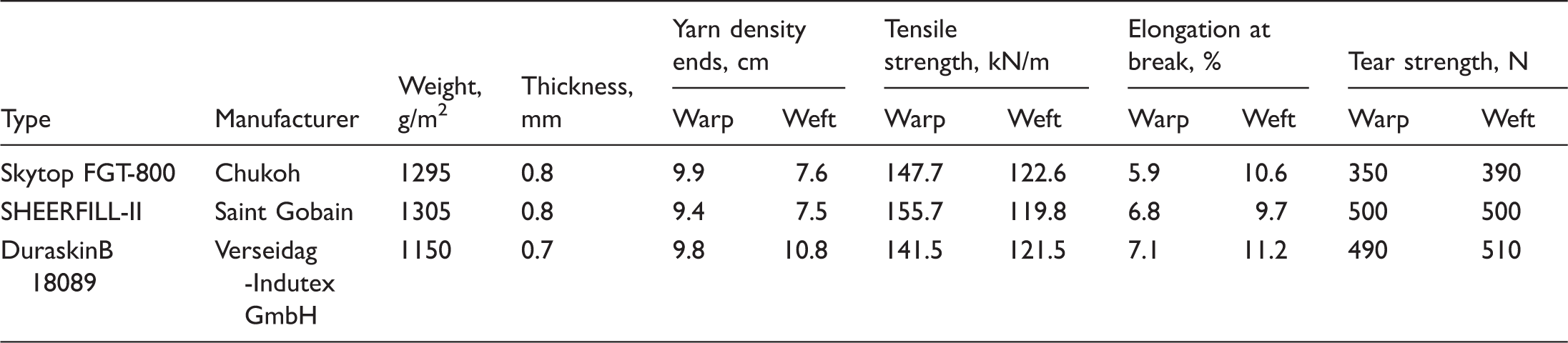
Specifications of test materials.
The off-axial specimens are prepared by cutting the specimens with bias angles of 0°, 5°, 15°, 25°, 35°, 45°, 55°, 65°, 75°, 85°, and 90° from the weft direction. Different from the previous tests, more bias angles are used in order to obtain more available data. For each specimen, at least 25 specimens are tested. The loading rates are 10, 25, 50, 100, 200, and 500 mm/min, respectively.
The uniaxial tests are carried out using the electromechanical universal testing machine. The conventional clamp for membrane materials is the flat fixed clamps. However, when using the flat fixed clamp, the slippage always appears in the gripped ends, which leads to invalid data. Therefore, the winding clamp is conducted in the tests, as shown in Figure 1.
Uniaxial tensile test.
The whole test processes of all specimens are recorded by the high-resolution cameras. The uniaxial tensile machine is manufactured by MTS, which can record the data well under high and low loading rates. The load can be recorded by the test machine. Considering the uniform stress and strain, it is difficult to get the accurate stress and strain by experiment. Therefore, the definition of nominal stress and nominal strain are used in this analysis. The nominal stress is got by dividing the tensile force by the width of the specimens, while the nominal strain is got by dividing the displacement by the gauge distance of gripped ends, as shown in Figure 1.
As shown in Figure 2, the biaxial tensile tests are carried out to get the elastic modulus and Poisson ratio. The test method is based on the method proposed in MSAJ/M-02:1995 [38]. First, tension each sample with the ratio of 1:1 to 1/4 of the tensile strength and release at the same speed as loading. Then, after three cycles, the samples are tensioned to fracture with different stress ratios and the stress and strain are recorded. The ratios of warp stress to weft stress are 1:1, 2:1, 1:2, 1:5, 5:1, 0:1, and 1:0, respectively. The square least method is used to get the elastic modulus and Poisson ratio. Besides, the four-part frame method is carried out to get the shear modulus according to MSAJ/M-01-1993 [39].
Biaxial tensile test.
Results and discussions
Tensile stiffness
The test results show that due to similar woven method (plain woven) and woven density (as shown in Table 1), the mechanical properties of three materials are similar, where the tear strength is obtained by the method of trapezoidal samples [37]. Therefore, limited by the layout, only the test results of FGT-800 are presented. The off-axial nominal stress–nominal strain curves of PTFE-coated woven glass fibers under different loading rates are shown in Figure 3. It can be observed that the tensile behaviors depend strongly on the yarn orientation angles. The tensile strength and the elongation at break of the specimens are related with the bias angle. The tensile strength gradually decreases and the elongation at break increases with bias angle increasing.
Nominal stress–nominal strain curves of off-axial tests under different loading rates (FGT-800). (a) 10 mm/min, (b) 25 mm/min, (c) 50 mm/min, (d) 100 mm/min, (e) 200 mm/min and (f) 500 mm/min.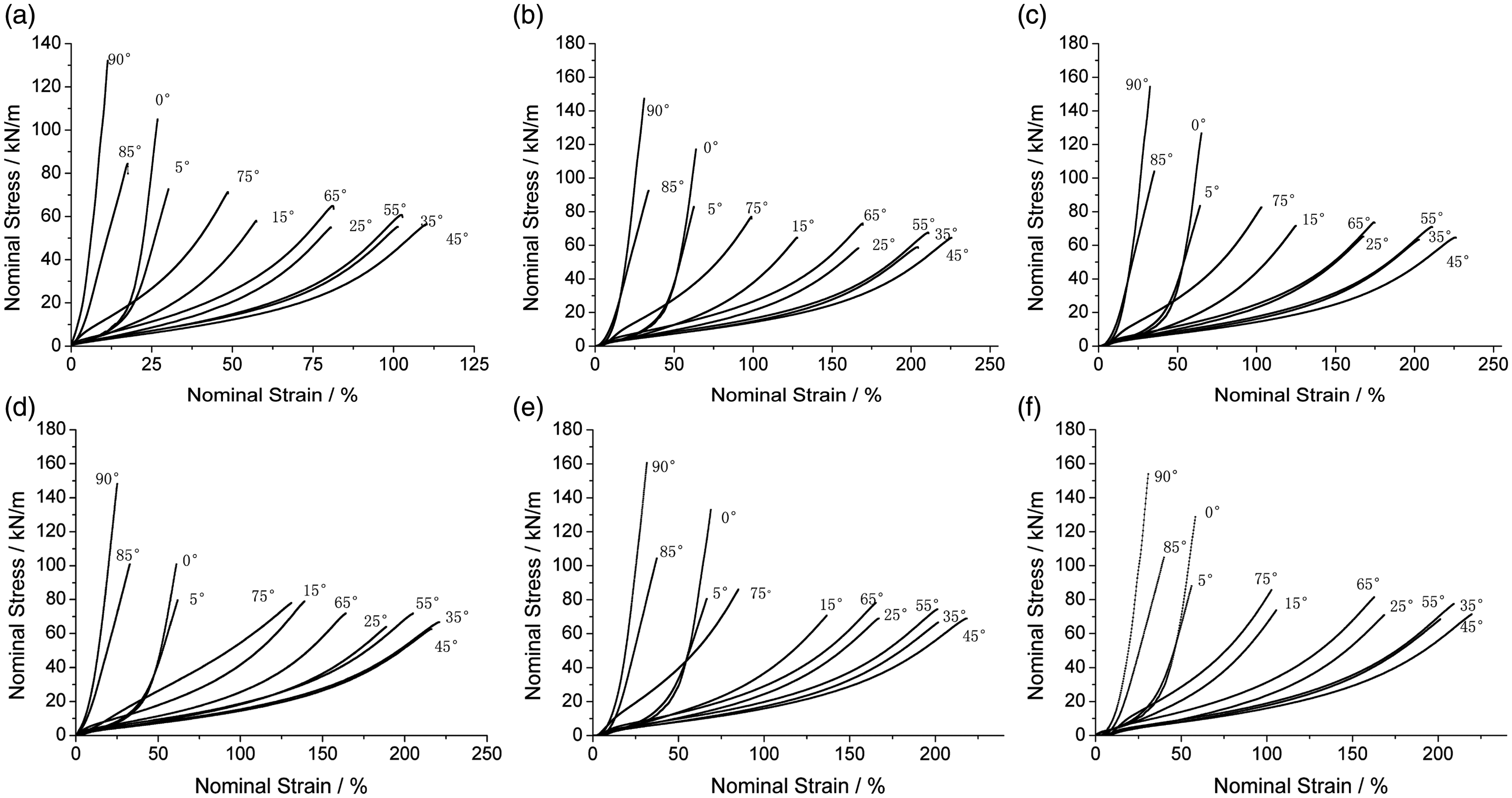
Figure 3 shows the tensile stiffness of the off-axial specimens is strongly related with the bias angles, where the tensile stiffness is the secant slope of the tensile curves. The secant slope of tensile curves in the initial phase is always lower than that in the ultimate phase. In the initial phase, the tensile stiffness in weft (0°specimen) is lower than that in warp (90°specimen), which is related with the crimp interchange of the woven substrate. In the ultimate phase, the tensile stiffness in warp is close to that in weft. After the yarns are stretched straight, the tensile stiffness is mainly determined by the woven density and properties of yarns and coatings.
Failure modes and tensile strength
Figure 4 shows three typical failure modes in the tests, interface failure (type 1), yarn breakage (type 2), and composite failure (type 3), where “0–100” means “bias angle is 0°, and tensile rate is 100 mm/min”. For the specimens parallel to yarn directions (0° and 90°), most of failure modes is yarn breakage (type 2) and part of failure modes are composite failure (type 3). The failure mode is related with the strength of yarns, coatings, and the interface of them. The failure always appears in the weakest part of the material. When some brittle yarns fracture first, the stress concentration will appear in the adjacent yarns. Due to high adhesive strength, it is difficult to pull the yarns out of the coating. Most of the yarns will fracture at the same cross-section, which is typically “yarn breakage”, as shown in Figure 4 (a) and (b).
Failure modes of off-axial specimens (FGT-800). (a) 0–50, (b) 0–25, (c) 5–200, (d) 75–500, (e) 90–100 and (f) 0–50.
With bias angle increasing, the tensile strength decreases significantly as shown in Figure 5. As shown in Figure 4, with bias angle increasing, the failure modes change from “yarn breakage” to “mixed failure of interface and yarns”. For the specimens with small bias angles (5°, 15°, 75°, and 85°), most of the failure modes is interface failure (type1), and the remaining is composite failure. Then, the tensile strength decreases significantly compared with those of the on-axial specimens (0°, 90°). The decreasing rate of that from 90° to 85° is higher than that of from 0° to 5°, which is related with the woven density and the failure modes. With bias angle increasing, the decreasing rate gradually slows down. Most of the yarns fracture and few of the yarns are pulled out from the coating, which is a mixture of tensile and shear failure. Therefore, the tensile strength of off-axial specimens is lower than that of on-axial specimens. Additionally, the elongation at break of some off-axial specimens may be lower than that of the on-axial specimens due to complex failure modes.
Relationship of off-axial angle and material tensile strength under different loading rates (FGT800).
Further, in the tests of intermediate angles, the shear strength becomes the dominant strength component and the main failure mode is interface failure. In the fractured cross-section, the middle section was fractured and the others in the edge were pulled out from the interface of yarns and coating (Figure 6). The failure occurs in the yarn/coating interface, and the shear stress is the dominant stress component. Then, the tensile strength of those specimens is the lowest and the corresponding elongation at break is the highest, for example, 35° and 45° specimens. No matter what failure modes, it can be seen that most of the failure always takes place parallel or perpendicular to the yarn direction, as shown in Figures 4 and 6.
Failure modes of off-axial specimens (FGT-800). (a) 25–25, (b) 35–10, (c) 45–10, (d) 45–100, (e) 45–500 and (f) 65–500.
There are some initial micro-flaws with random distributions in the substrate and coating. Due to the random-distributed micro-flaws, some yarns may break ahead, which will lead to debonding and buckling of substrate in a local region. When the exterior load increases, the randomly distributed damage regions propagate fast until the whole cross-section fracture. This is “interface failure” or “yarn breakage”. Sometimes, the damage is limited in a smaller range and the damage is accumulated gradually. The continuous yarns become discontinuous and part of yarns are pulled out in the cross-section. Then, the specimen with this failure mode can achieve a higher strength. This is “composite failure” as shown in Figure 6(e). Above all, the tensile strength is also associated with the random distribution of internal micro-flaws in the specimens.
Results of off-axial tensile tests (FGT-800).
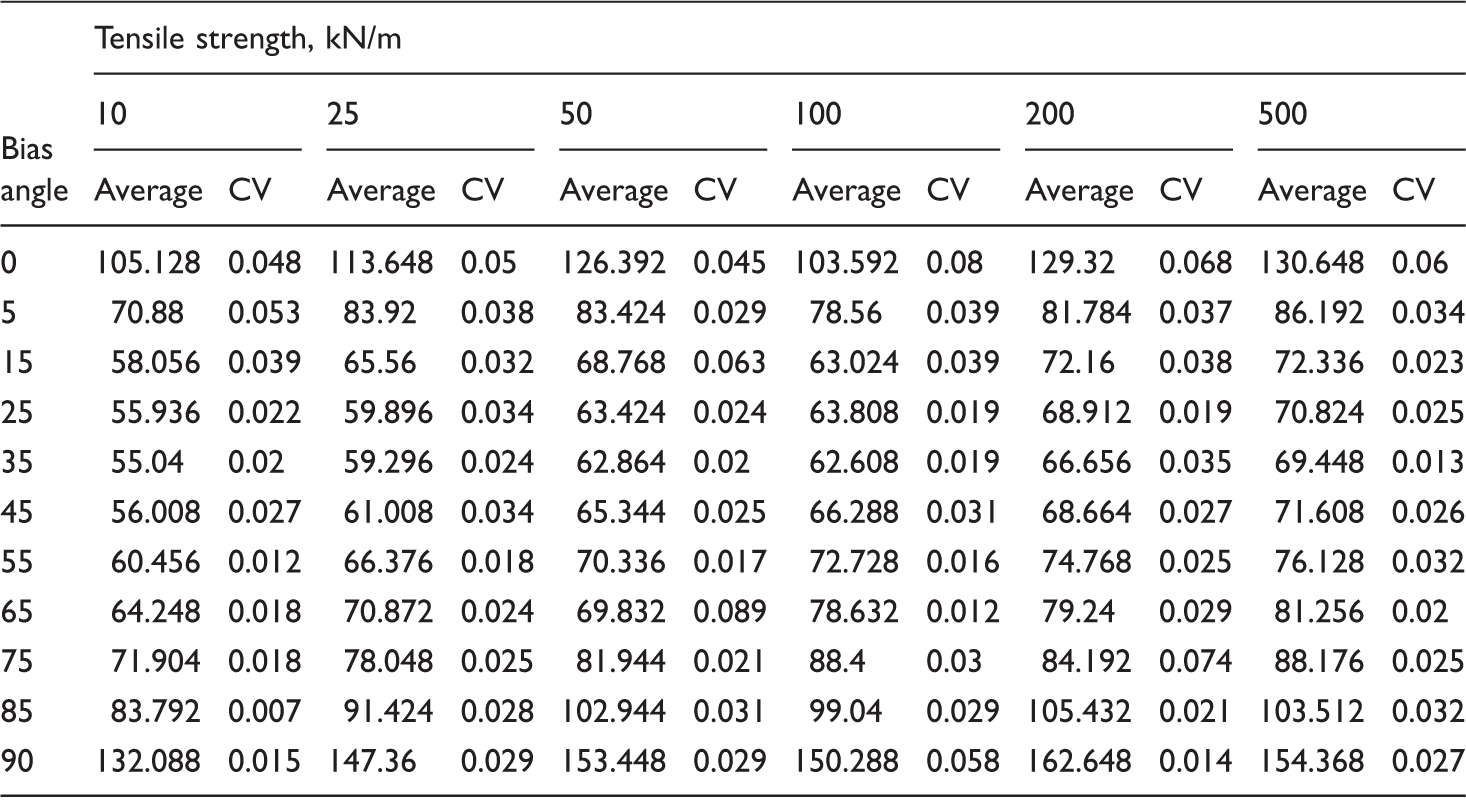
average: average value; CV: coefficient of variation.
Loading rate
The off-axial tensile results under different loading rates are shown in Figure 5. As shown in Figure 4, all three typical failure modes can be observed in the tests of different loading rates, interface failure, yarn breakage, and composite failure. The changing of loading rate has no significant effects on the failure modes of off-axial specimens. However, with loading rate increasing, the possibility of yarn breakage is increasing while that of interface failure is decreasing.
The failure mechanisms of coated fabrics are a complex combination of energy absorption principle. The material fails when the energy absorption reaches the limit value. The crack first appears in the weakest part between coating, substrate and the interface, and then propagates fast along the yarn orientations. The effects of loading rate on most polymers may be explained by the Eyring theory of viscosity, which assumes the deformation of polymers involve the motion of a chain molecule over potential energy barriers [7,8]. When the loading rate is low, there is enough time for the material to achieve enough deformation. However, when the loading rate is higher, the ultimate absorption energy is higher and the tensile strength increases. The elongation at break always decreases with loading rate increasing. Then, it is easy for the energy absorption to achieve the limit value, while the deformation cannot develop completely [7].
Figure 7 shows that the tensile strength slightly increases with loading rate increasing. From 10%/min to 500%/min, the strength increases by 16.8% and 24.2%, respectively, in warp and weft. The relationship between tensile strength and loading rate can be described as follows
Effect of loading rate on the material tensile strength (FGT 800).

It can be observed that when the loading rate is low, the effect of internal flaws on the material strength is obvious. The crack always appears in some parts with internal flaws. The propagation of crack is related with the fracture toughness. Here, the failure mode “Composite failure” is taken as the example. When the loading rate is low, the yarns in the edge are pulled out from the coating easily and the yarns in the middle fracture. When the loading rate is high, the number of fracture yarns increases and the number of pulled out yarns decreases. Therefore, the application efficiencies of yarns increase and the ultimate tensile strength increases.
Fitting parameters in the relationship between tensile strength and loading rate (FGT800).

Strength criterion
Prediction comparisons between several strength criteria and experiment data (10 mm/min).

For coated fabric, it is similar to a plane orthotropic material, and a two-dimensional criterion is essential. Among the current strength criteria, the failure criteria with quadratic terms, for example, Tsai-Hill criterion, Hoffman criterion, Norris criterion, are recommended by many researchers, because they are single-valued functions with smooth and continuous failure envelope, particularly suitable for the numerical solution [21]. In the existing strength criteria, the Tsai-Wu criterion is an improvement over most existing quadratic criterion because of the use of strength tensors. It can be transformed to the polynomial equation [28]. If all the stress components are included, the expressions will be extremely complex and too many coefficients limit its application efficiency. Further, not all the stress components play the same role in predicting the failure strength [40,44,45]. It is necessary to include the stress components which have a significant correlation with the material strength, in order to obtain a concise and accurate expression for the prediction of material strength [42,43]. The correlation level between the stress components and the material strength can be obtained by the SPSS software [41,46].
Here, we choose five common strength criteria with simple expressions to predict the material strength under complex loading states, including Tsai-Hill Criterion [22], Norris Criterion [20], Yeh-Stratton Criterion [29], Hashin Criterion [31], and Zhang Criterion [18].
The equations of five strength criteria for plane orthotropic materials are shown as follows
Deformations of drawn pictures. (a) 5°, (b) 45° and (c) 75°.


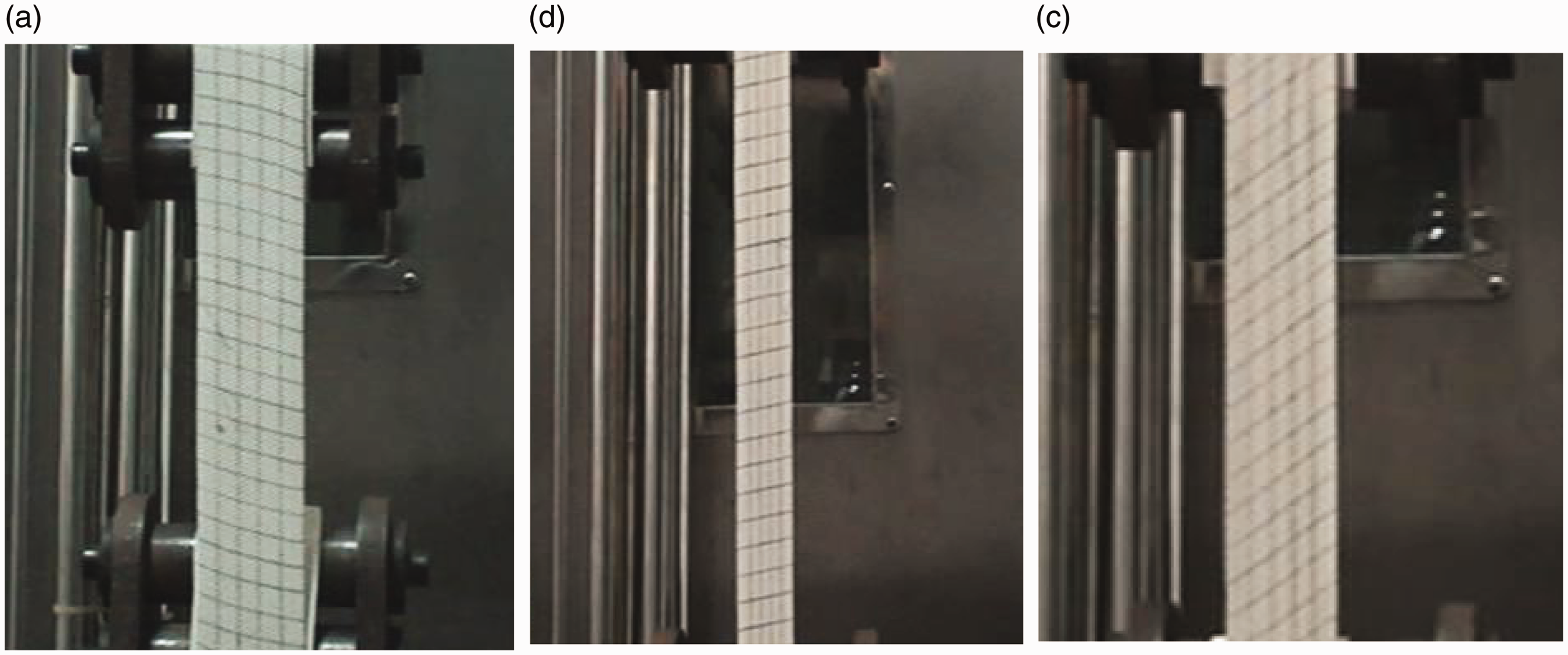
Figure 9 shows the comparison between experiment results and the predictions of several existing strength criteria. The error analysis is also conducted to study the comparison between experimental data and predictions of several strength criteria, as shown in . In most cases, the current strength criteria (Tsai-Hill Criterion, Norris Criterion, Yeh-Stratton Criterion, Hashin Criterion, and Zhang Criterion) can make a good prediction of the failure strength of PTFE-coated fabric. However, slight deviations appear in the tests of small bias angles, such as 15° and 75°. This is perhaps related with complex failure modes and woven structures. This characteristic cannot be reflected in the traditional criterion equations. Compared with other current strength criteria, the predictions of Zhang criterion are relatively compatible with the experimental data. It includes the terms F12 (the interaction item of Comparisons of predictions of several existing criteria and experimental data (FGT 800 with the tensile rate of 10 mm/min).
In the tests of on-axial specimens, the normal stress is the main stress components and the shear stress is close to 0. Then, the main failure mode is yarn breakage. In the design of membrane structures, especially for the conic shape, the warp yarns are always located in the radial direction. Based on the above analysis, this location will not only facilitate to form the proper stress distribution but also achieve higher failure strength under extreme loading.
Finally, we should note that there are still significant difference between experiment data and the predictions, for the specimens with small bias angles. The traditional quadratic criteria are always based on the strain energy theory of homogeneous materials. Strictly, coated fabric is not a continuous homogeneous material in meso or micro-scales. In the process of weaving and coating, the yarns and coating are aligned regularly depending on weaving method. Therefore, in the macro scale, it can be taken into account as a homogeneous material. This is why most of the data can agree well with the predictions of current macroscopic strength criteria. The transfer of force in coated fabrics is mainly through the yarns. The failure always appears at the weakest point and propagates quickly through the yarns. The failure cannot be explained completely by the energy theory, especially in the off-axial tests. Therefore, the traditional quadratic criteria may not reflect the failure mechanisms of coated fabrics. Further research should be carried out to obtain a simplified equation, which is related with failure modes.
Conclusions
This paper presents the research on the off-axial failure analysis for PTFE-coated woven glass fibers under different loading rates. The following conclusions are drawn from the present study.
The tensile behaviors of PTFE-coated woven glass fibers are typically orthotropic. The tensile stiffness depends strongly on the bias angles between yarn orientations and loading directions, which is related with the woven density and properties of yarns. With bias angle increasing, the tensile strength and the tensile stiffness gradually decrease, while the elongation at break increases. The failure always appears in the weakest part of the whole structure, yarns, coatings, or the interface of them. The propagation of crack always appears parallel or perpendicular to the yarn directions. The failure strength is significant related with the failure modes and weaving density of substrates. Three typical failure modes can be observed in the tests, including interface failure, yarn breakage, and composite failure. In the tests with small bias angles, with bias angle increasing, the decreasing of tensile strength in warp is higher than that in weft, which is related with the woven density and failure modes. With bias angle increasing, the failure mode changes from “yarn breakage” to “yarn breakage or interface failure”, while the degradation rate of material strength decreases. The lowest tensile strength appears in the specimens of 35°, rather than that of 45°. This phenomenon can be seen in all the tests under six different loading rates, which is different from the results in other existing references [18,19]. The loading rate has significant effect on the mechanical properties of PTFE-coated woven glass fibers. There are slightly differences between the failure modes of off-axial specimens under different loading rates. With loading rate increasing, the tensile strength increases and the elongation at break decreases. The results show good linear relationship between tensile strength and logarithm of loading rate. Furthermore, due to complex failure modes, the effect of loading rate on the elongation at break is not significant. Under high loading rate, a significant increases of the material strength can be observed, which is favorable for the safety of membrane structures. Most of the current strength criterion, for example, Tsai-Hill criterion, Norris criterion, Zhang Criterion, can make a better prediction of the material off-axial strength, except for the specimens of 15° and 75°. This is perhaps related with complex failure modes and woven structures. The traditional quadratic criteria are always based on the strain energy theory of homogeneous materials. Strictly, coated fabric is not a homogeneous material. The transfer of force in coated fabrics is mainly through the yarns, not the same as that in continuous homogeneous materials. Therefore, the traditional quadratic criteria may not reflect the failure mechanisms of coated fabrics. Besides, in the failure analysis of PTFE-coated fabrics, the interaction of shear stress and normal stress, as well as the interaction of normal stress and normal stress plays an important role, which should be considered in the failure analysis.
It should be noted that the research can be only considered as a qualitative analysis and not a quantitative analysis, because it is difficult to get the accurate stress and strain due to the non-homogeneous deformation. Besides, the variation of shear modulus during the failure process should be studied, which is important for the analysis.
Footnotes
Acknowledgements
The authors acknowledge the editors and reviewers for their valuable comments on an earlier draft of this paper.
Declaration of Conflicting Interests
The author(s) declared no potential conflicts of interest with respect to the research, authorship, and/or publication of this article.
Funding
The author(s) disclosed receipt of the following financial support for the research, authorship, and/or publication of this article: This work is supported by the Fundamental Research Funds for the Central Universities (2015XKMS012), and a Project Funded by the Priority Academic Program Development of Jiangsu Higher Education Institutions.