




Abstract
Thermal protection systems (TPS) are vital for re-entry vehicles for their safe passage into the atmosphere from space. Hence, researchers took a keen interest in improving the thermal and ablative properties of composites to be used in making thermal protection systems. Therefore, an attempt was made to improve the thermal and ablative properties of composites made of carbon fibers (Cf) and resorcinol formaldehyde phenolic (Ph) resin with the incorporation of silicon carbide (SiC) particles. The filler was added in various percentages (0 wt% - blank, 1 wt%, 3 wt%, and 5 wt%), and the composites were tested for ablative, thermal and mechanical properties. The results demonstrate that the SiC-modified PAN-based carbon fiber reinforced phenolic (SiC-PANCf-Ph) composite with 3 wt% SiC enhancement exhibited ideal properties. The post-ablation phase composition and microstructure were examined through X-ray diffraction (XRD), Scanning electron microscopy (SEM), and energy-dispersive X-ray spectroscopy (EDS). The surface morphology evidences the formation of a silicon dioxide (SiO2) layer on the composites. The SiC-PANCf-Ph composites demonstrated the lowest ablation rate, enhancing their potentiality for effective TPS applications.
Introduction
The ablative composites play a pivotal role in the realm of aerospace and defense industries, providing indispensable thermal insulation for thermal protection systems (TPS). These materials will go through a process known as sacrificial protection, and undergo recession, thus providing essential thermal insulation. 1 Their high specific heat, low thermal conductivity, and robust thermomechanical properties, combined with their lightweight nature, make them a prominent element in the aerospace 2 and automobile 3 industries. A key example of such materials is the carbon fiber-reinforced phenolic (Cf-Ph) resin composites, which have proven to be high-performance ablative materials, finding extensive applications in spacecraft heat shields and solid propellant rocket motor nozzle liners. 4 The production of these carbon fibers (Cf) predominantly revolves around three core materials: polyacrylonitrile (PAN), rayon, and petroleum pitch. 5 Out of these, PAN-based carbon fibers have been favoured due to their superior mechanical properties. 6 Consequently, the aerospace industry has increasingly veered towards PAN-based carbon fiber and Ph resins. 7
Researchers have advanced efforts to improve the mechanical, 8 thermal, 3 and anti-ablative characteristics of Cf-Ph composites by incorporating different amounts of fillers such as silicon carbide (SiC), aiming to enhance the physical, mechanical, and thermal attributes of these composites 9 through diverse fabrication methods. 10 The aerospace industry’s interest in SiC-modified Cf-Ph composites has been fueled by promising findings from plasma wind tunnel testing, which revealed that composites incorporating a 5 wt% SiC filler when subjected to a heat flux of 160 W/cm2 for 50 s showcased exemplary characteristics, especially in reducing the ablation rate. 11 A novel SiC precursor, derived from boron Ph resin and tetraethyl orthosilicate hydrolytic solution, has allowed the creation of C/C-SiC composites, 12 opening a new horizon for studying the microstructure of these composites, their ablation characteristics, and the precursor material’s pyrolysis process. 13 Studies have been conducted into the potential benefits of integrating mesoporous silica and carbon black into resole-type Ph resin. 14 The investigations revealed intriguing results, demonstrating that composites consisting of 30 wt% carbon black led to the most significant reduction in linear erosion rate, measured at 0.058 mm/s. Conversely, when 20 wt% mesoporous silica filler was incorporated into the composites, the mass erosion rate was minimized, reaching a value of 0.129 g/s. These findings highlight the strategic utility of these fillers in tailoring the erosion characteristics of resole-type Ph resin composites. 15 Dong Huang and colleagues successfully produced a unique three-dimensional carbon/carbon-silicon carbide (C/C-SiC) composite using mesophase-pitch-based carbon fibers and pyrocarbon (PyC) thermal diffusion channels. Findings reveal that the highly thermally conductive C/C-SiC composite, with a thermal conductivity of 221.1 W/m·K in the ablation direction, exhibits a smaller temperature gradient and a surface temperature 470°C lower than the weakly thermally conductive composite. Moreover, the highly thermally conductive C/C-SiC composite displays a mass ablation rate of 0.56 mg/cm2 sec and a linear ablation rate of 0.11 μm/sec, respectively. 16 The C/C-SiC composite underwent thermal and ablation assessments in a plasma ablation facility on a small scale. Exposure to heat flux values of 3593.54 kW/m2 and 644.86 kW/m2 resulted in determined ablation rates. The average mass rates for the two specimen groups were 0.01735 and 0.10620 g/sec, while linear rates were 0.00680 and 0.09407 mm/sec, respectively. 17
PAN-based Cf-Ph composites, 18 known for their robust mechanical strengths, have significantly contributed to advancements in the aerospace industry.19,20 Despite their recognized benefits, a key gap in our current knowledge pertains to the influence of SiC filler on the interlaminar shear strength (ILSS), flexural strength, and Barcol hardness properties of Cf-Ph composites. Moreover, there remains considerable scope for enhancing the ablation resistance of SiC-modified PAN-based carbon fiber phenolic (SiC-PANCf-Ph) resin composite laminates. Existing methodologies, including the commonly utilized oxyacetylene torch test for SiC-PANCf-Ph resin composite laminates, often feature low heat flux and short ablation operation time. However, these conditions fall short of effectively simulating the rigors of spacecraft re-entry scenarios. Therefore, to bridge this gap, there is a pressing need to examine the ablative properties of SiC-modified PAN-based (SiC-PANCf-Ph) composite laminates in high heat flux environments, coupled with extended ablation operation times.
The current research focuses on the fabrication of SiC-modified PAN-based Cf-Ph resin composites using a hot compression moulding process. The study meticulously explores the impact of the novel SiC addition on thermal, mechanical, and ablation resistance properties of PAN-based Cf-Ph composite laminates, with a particular emphasis on investigating ablation behaviour under high heat flux conditions (400 W/cm2) using an oxyacetylene torch over extended durations. The insights gained are expected to significantly contribute to the development of more efficient and durable thermal protection systems, specially designed for defense, aerospace, and extreme re-entry conditions in space exploration.
Materials and methods
Materials
The fabrication and characterization of SiC-PANCf-Ph resin composite laminates involved meticulous material selection. SiC fillers, categorized as Ultra-High Temperature Ceramics (UHTCs), enhance thermal insulation by forming a protective layer during oxidation at elevated temperatures. 21 The matrix utilized Ivarez ISRO GRADE resorcinol formaldehyde phenolic (Ph) resin, known for its 65 wt% solid content, a maximum of 3.0 wt% free formaldehyde, and 6.0 wt% free phenol. Ph resin, an initial thermoset polymer, is chosen for its low flammability, high char yield, strong mechanical properties, and excellent ablative features, fitting aerospace applications. 22
PAN-based carbon fibers, extensively used for their exceptional strength and stiffness, were employed as reinforcement. The PAN-based carbon fiber fabric (Torray Co., Japan, model T300, Tow type-3K) in a 0–90° plain-woven pattern with an areal density of 200 g/m2, a density of 1.80 g/cc, and thickness of 0.30 mm exhibited outstanding mechanical properties, including a tensile modulus of 230 GPa and a tensile strength of 3530 MPa, making it ideal for durable composites. This selection aligns with PAN’s reputation as the optimal precursor substance for carbon fiber production. 23 The orientation and specifications of the fabric were carefully chosen to meet the specific demands of aerospace applications.
To enhance the ablation resistance and thermal stability of the composite, a Silicon Carbide (SiC) filler was incorporated, purchased from Otto Chemie Pvt. Ltd, located in Mumbai, India. The hardness, high-temperature resistance, heat dissipation, low thermal expansion, and light weight of SiC fillers are employed to reduce polymer composite weight. The selection of this filler was governed by its known ability to impart improved thermal and mechanical properties to composites, rendering them more capable of withstanding the extreme conditions of aerospace applications. The key properties of the SiC filler used in this study are density falls within the range of 3.2-3.3 g/cm³. In terms of thermal conductivity, the powder exhibits values ranging from 120 to 240 W/m·K. The particle size is specified as 400-mesh, equivalent to 35 microns. The crystal structure of the SiC powder is described as tetrahedral/hexagonal. Visually, the colour of the powder is noted as ranging from grey to black. These detailed properties offer a comprehensive understanding of the SiC powder, crucial for assessing its suitability and potential impact in various applications.
Methodology
The process of developing and characterizing SiC-PANCf-Ph resin composite laminates involves a meticulous sequence of steps as shown in Figure 1. Initially, PAN-based carbon fiber fabric and Ph resin, reinforced with varying concentrations of SiC (0, 1, 3, 5 wt%), are selected. The literature guides in selecting the weight ratio of fillers. Therefore, composites are fortified through atomic or molecular interactions between the matrix and filler, aiming to improve packing efficiency by minimizing the void space between the composites. To ensure an even distribution, SiC particles are dispersed into the Ph resin using a mechanical stirrer for 10 min. Following this, the SiC-infused resin is impregnated onto the Cf fabric at room temperature to create a ‘prepreg’. The prepreg is then left to cure for 48 h to secure the bonding of the resin and fibers. Illustration of methodology for the fabrication of SiC-PANCf-Ph composite for thermal protection systems.
Subsequently, the cured prepregs are cut to the desired dimensions, and using a hydraulic hot compression machine, they are stacked into 19 layers. The stack is then subjected to a pressure of 15 bar and cured for 5 h, resulting in the formation of durable and compact composite laminates. After fabrication, the laminates undergo a series of tests to examine their properties. An ablation test is performed under an oxyacetylene torch at a high heat flux, mimicking re-entry conditions. Thermal properties, including conductivity, diffusivity, and heat capacity, are analyzed. Thermogravimetric analysis (TGA) is conducted to evaluate thermal stability and degradation characteristics. Various physical and mechanical properties of the laminates, such as density, resin content, Barcol hardness, ILSS, and flexural strength, are also assessed. Additionally, X-ray diffraction (XRD), scanning electron microscopy (SEM), and energy dispersive X-ray spectroscopy (EDS) analyses are carried out to characterize the laminates’ phase composition and microstructure. Lastly, a thorough evaluation of the results obtained from the testing phase is performed. The effect of SiC filler on the thermal, mechanical, and ablation resistance properties of the PANCf-Ph composite laminates is studied in detail. This comprehensive analysis is pivotal for understanding the performance of these composite materials in high heat flux environments.
Fabrication of SiC-PANCf-Ph composites
Ensuring uniformity, structural integrity, and desired qualities in the preparation of SiC-PANCf-Ph resin composites for TPS applications is crucial. 24 Achieving this involves eliminating air and preventing agglomeration during composite material preparation. For homogeneous compositions, polymer resin and filler ingredients undergo vacuum-assisted degassing before hot compression moulding. The reduction in pressure during this process causes air bubbles to expand and escape, resulting in a more homogeneous, air-free starting material. 25 Mechanical mixing of filler material in incremental proportions, with careful control of particle size distribution, is essential to prevent agglomeration. 26
The selection of the hot compression moulding method is underpinned by several key advantages. This process facilitates the shaping and compression of polymer composites with enhanced efficiency. The application of heat during compression serves to improve material flow, ensuring the meticulous replication of intricate details within the mold cavity. Moreover, elevated temperature and pressure contribute to superior material compaction, reducing the occurrence of voids and fortifying the overall structural integrity in a shorter cycle time, underscoring its practical advantages in our study.
The sequential stages of the fabrication process are illustrated in Figure 2, highlighting the precise methodology employed in creating various weight percentages of composite laminates. The fabrication process for the SiC-PANCf-Ph resin composite laminates began with the integration of the SiC into the phenol-formaldehyde resin. This step was crucial to evaluate the influence of SiC filler content on the thermal, mechanical, and ablative characteristics of the composite. SiC was added to the resorcinol phenol-formaldehyde mixture in varying concentrations of 1, 3, and 5 wt%, providing a range of SiC concentrations for testing. The mixture was subjected to mechanical stirring to ensure the even dispersion of SiC filler within the solution. Following this, the prepared solution was applied to the PAN-based carbon fiber fabric and left to dry under ambient conditions. Various phases of the fabrication process of SiC-PANCf-Ph composites.
The process then proceeded to the prepreg formation, where the resin-impregnated carbon fiber fabric was allowed to rest for 48 h at room temperature. This curing period facilitated the bonding between the resin and the fibers, enhancing the composite’s integrity and performance. Following the curing process, the prepregs were then shaped into composites. A metallic mould with a cavity size of 200 mm × 200 mm x 4 mm was employed to form the prepreg into the desired composite dimensions. The prepregs were stacked using the wet layup method, ensuring even distribution and orientation of the PAN-based carbon fiber cloth (Cf-cloth). To achieve the desired composite thickness of 4 mm, 19 layers of carbon fiber prepreg cloths were utilized. The layering was subjected to a hydraulic hot compression machine, exerting a pressure of approximately 15 bar to consolidate the layers and expel any trapped air or excess resin. The mould was then maintained at a constant temperature of 155°C for 4 h to cure the composite. This process resulted in the fabrication of three different SiC-PANCf-Ph composite laminates, each featuring different wt.% of SiC, alongside the control sample composed of Cf-Ph composites without any SiC filler.
Characterization of SiC-PANCf-Ph composites
To evaluate SiC-PANCf-Ph resin composites for thermal protection applications, a variety of characterization techniques were used. Mechanical properties, including ILSS, flexural strength, and Barcol hardness, were examined to understand the composite’s load-bearing capacity, resistance to bending, and toughness, respectively. Thermal attributes were analyzed through thermal conductivity and thermogravimetric analyses (TGA), determining the composites’ heat conduction abilities and their stability under increasing temperatures. Ablation studies further gauged the composites’ resistance to high heat flux conditions, critical for space re-entry scenarios. Lastly, microscopic characteristics were studied using X-ray diffraction (XRD), Scanning Electron Microscopy (SEM), and Energy Dispersive Spectroscopy (EDS), providing insights into the composites’ crystalline structure, surface morphology, and elemental composition. This detailed characterization offered vital insights into the potential of SiC-PANCf-Ph composites as effective thermal protection systems.
Physical and mechanical characterization
The physical and mechanical properties of both the Cf-Ph and various SiC-PANCf-Ph composites were rigorously examined using established methods. For density determination, the Archimedes method was employed as per ASTM D 792. This method is recognized for its accuracy in estimating the density (
ILSS and flexural strength are pivotal properties in understanding the load-bearing and bending resistance capabilities of the composites respectively. The specimens with dimensions of 4 mm × 10 mm x 35 mm for ILSS test and 4 mm × 13 mm x 100 mm for flexural test were derived from the developed composite laminate. These tests were performed following the ASTM D 2344 and ASTM D 7264 standards, respectively, using universal testing machine (UTM) equipment (M/s FIE group- Model UTS-20-HGFL, 10Tonn, USA). The use of UTM facilitated precise measurements in compliance with the defined ASTM standards. For each property, up to six test specimens were assessed, and the average of these values was taken into consideration for evaluation, providing a balanced and representative understanding of these mechanical properties. According to the standards the samples were tested for density, barcol hardness, ILSS and flexural strength, their mean values are reported in Table 2.
Thermal characterization

Experimental values of physical, mechanical and thermal properties of blank and various wt.% of SiC-PANCf-Ph composites.

The thermal stabilities of composites were evaluated using Thermogravimetric Analysis (TGA) equipment (M/s TA, USA, Q500). The testing was conducted under a controlled environment from room temperature to 1000°C, escalating at a steady rate of 10°C per minute under a nitrogen atmosphere, this environment ensured consistent, reliable results. A sample from the composites, precisely weighing 10 ± 2 mg, was carefully obtained and weighed against the standard reference samples, namely calcium oxalate and nickel. Before the actual thermal stability testing, the repeatability and accuracy of the instrument were thoroughly verified, ensuring the reliability of the obtained results. Once the preparatory steps were meticulously completed, the TGA instrument was used to evaluate the thermal stability of both the blank-Cf-Ph and SiC-PANCf-Ph composites with various SiC contents.
Ablation testing of SiC-PANCf-Ph composites
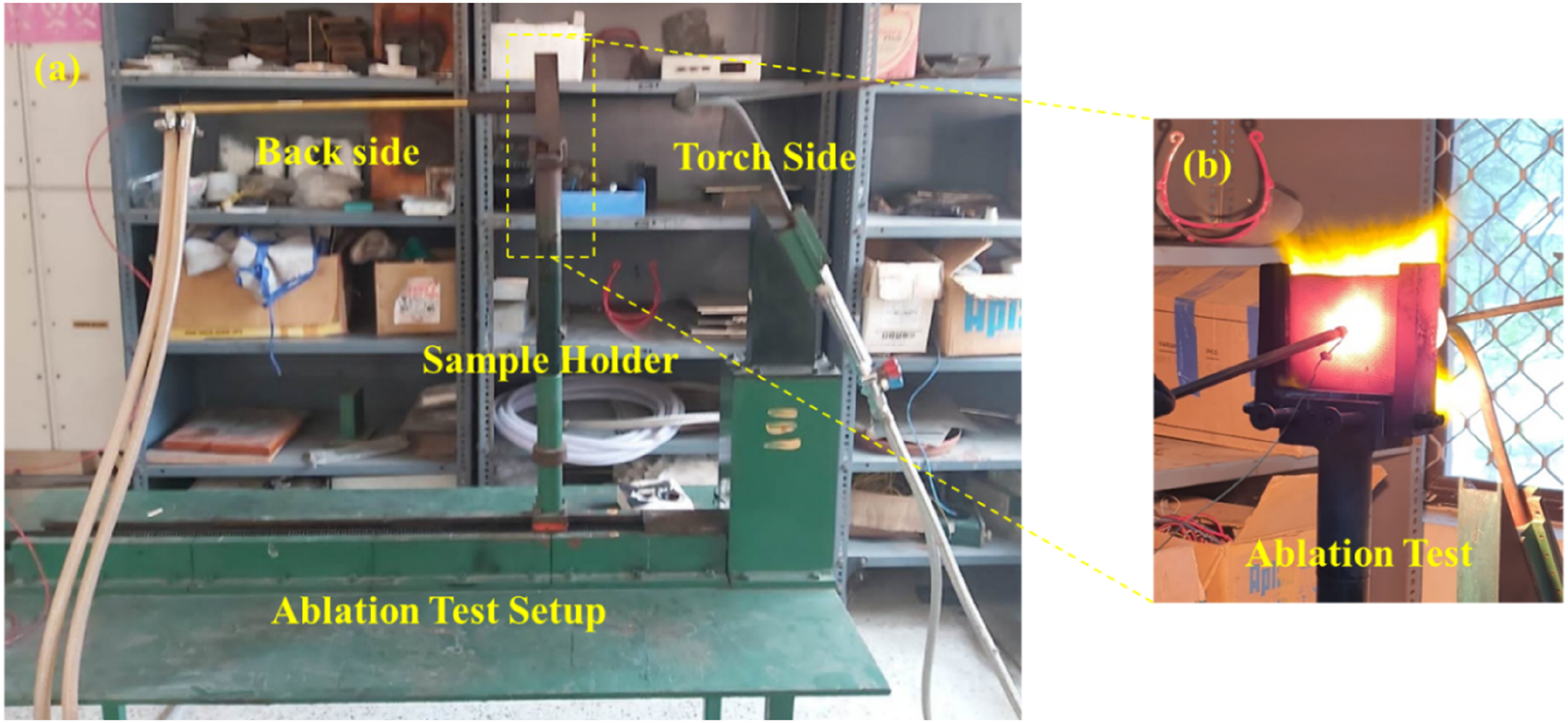
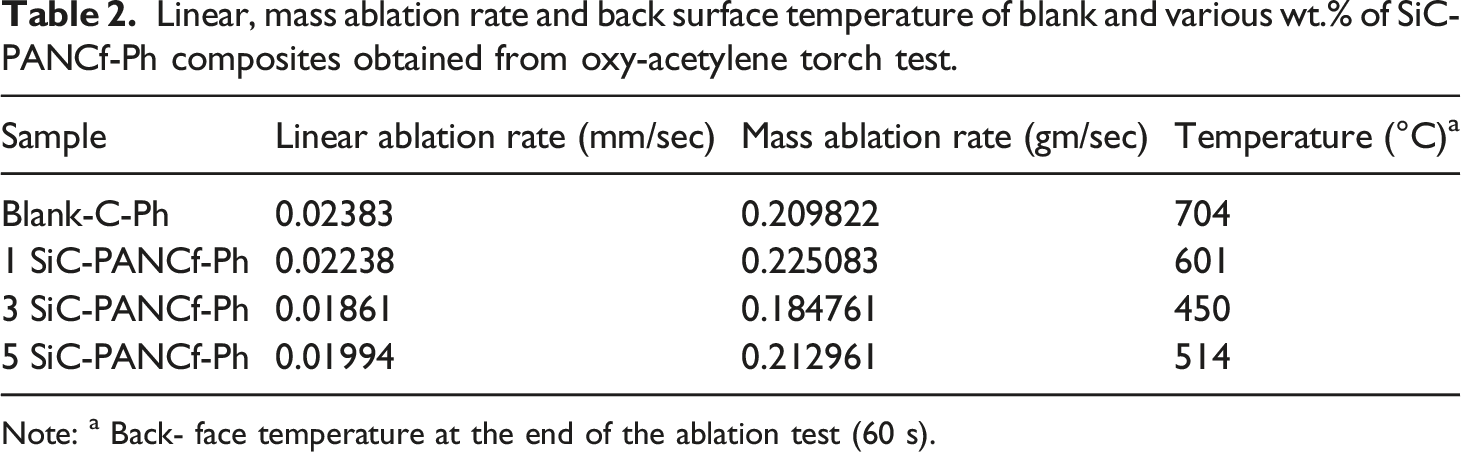
The ablation performance of the fabricated composites was evaluated following ASTM E 285 guidelines by employing an oxy-acetylene torch test. This test was administered to both the blank Cf-Ph composites and those infused with various quantities of Silicon Carbide (SiC) such as SiC-PANCf-Ph. Figure 3 graphically demonstrates the ablation test rig setup, which shows the sample holder to hold the composite test specimen, the torch side to perform the ablation test, back side to measure the back-face temperature values. Sample composites, each measuring 100 mm × 100 mm x 4.0 mm, were exposed to a consistent maximum heat flux of 400 W/cm2 for an ablation duration of 60 s. The ablation characteristics of the composites were subsequently determined through the calculation of the Linear Ablation Rate (LAR) and Mass Ablation Rate (MAR). These rates were derived from changes in weight and thickness of the samples pre and post-flame exposure. More specifically, the LAR and MAR were calculated with precision as per the following equations (2) and (3) [36]: (a) Oxy-acetylene torch testing equipment for the ablation test, (b) Ablation testing of the composite specimen. Linear, mass ablation rate and back surface temperature of blank and various wt.% of SiC-PANCf-Ph composites obtained from oxy-acetylene torch test. Note: a Back- face temperature at the end of the ablation test (60 s).

Ablation testing evaluates a material’s endurance under high heat flux conditions, crucial for space re-entry. Key parameters like Linear Ablation Rate (LAR), Mass Ablation Rate (MAR), and back face temperature are measured. LAR and MAR signify the material’s heat resistance, while the back face temperature indicates its insulation effectiveness. In this study, these tests were performed on blank-Cf-Ph and SiC-PANCf-Ph composites. The materials were exposed to a high-temperature torch, and images of their surfaces before and after exposure were captured and illustrated in Figure 4. These images, along with the measured parameters, are crucial in determining the performance of SiC-PANCf-Ph composites for thermal protection applications. Illustration of digital images captured for the sample surfaces (a-d) samples before ablation test, (e) sample under ablation test, and (f-i) samples after ablation test of blank-Cf-Ph and various wt.% of SiC-PANCf-Ph composites respectively.
Crystallography and morphology of SiC-PANCf-Ph composites
To analyze the phase composition, microstructure, and chemical composition of the fabricated composites both before and after exposure to an oxy-acetylene flame, a combination of X-ray Diffraction (XRD), Scanning Electron Microscopy (SEM), and Energy Dispersive Spectroscopy (EDS) techniques were employed. X-ray diffraction studies were performed utilizing PANalytical XRD equipment, providing valuable insights into the crystallographic nature and phase composition of the blank-Cf-Ph composites as well as those infused with varying quantities of Silicon Carbide (SiC-PANCf-Ph). For a detailed understanding of the microstructure of the fabricated composites, scanning electron microscopy was executed using a ZEISS EVO 18 Scanning Electron microscope from the EVO series. This high-resolution imaging technique helped in identifying the morphology and topographical features of the composites at a microscopic level. Lastly, the energy dispersive spectroscopy, conducted using an X-MAX 20 mm detector integrated with an INCA 250 energy dispersive X-ray system, was utilized to execute a thorough elemental analysis of the composites. This allowed for a comprehensive understanding of the chemical composition of the composites, providing additional insight into the material characteristics and behaviour under thermal stress.
Results and discussion
The study explores comprehensively the results and discussion, centering on the fabrication and ablation performance of SiC-PANCf-Ph resin composites tailored for thermal protection applications. It provides a thorough analysis of the composite’s fundamental characteristics, encompassing a range of parameters such as Interlaminar Shear Strength (ILSS), flexural strength, Barcol hardness, thermal conductivity, and thermogravimetric analysis. Furthermore, the investigation delves into the examination of linear and mass ablation rates of the composites, enriched by insights gleaned from X-ray diffraction (XRD), Scanning Electron Microscopy (SEM), and Energy Dispersive Spectroscopy (EDS) characterization techniques. Each facet is meticulously discussed in subsequent sections, offering a deeper understanding of the composite’s behaviour and performance under various conditions. Table 1 presents the experimental findings of SiC-PANCf-Ph composites across different SiC loadings and blank samples, providing detailed insights into their physical, mechanical, and thermal properties, including fiber volume fraction (%Vf), density (g/cc), barcol hardness, ILSS (MPa), flexural strength (MPa), thermal diffusivity (cm2/s), specific heat (J/kg·K), and thermal conductivity (W/m·K).
Density and barcol hardness of SiC-PANCf-Ph composite
Figure 5 depicts the influence of varying SiC content on the composite’s density and hardness, highlighting a similar trend in density with increased SiC incorporation. As reported in Table 1, the initial density of the blank-C-Ph sample is 1.52 g/cc. With the introduction of 1 wt% of SiC into the composite, the density drops to 1.50 g/cc. This slight decrease could be attributed to the SiC particles requiring more space during the compaction process, reducing the overall density. When the SiC content is further increased to 3 wt%, there’s a small increase in density to 1.51 g/cc. This might suggest a more efficient packing or better dispersion of SiC particles within the composite. Finally, at the highest SiC concentration tested, 5 wt%, the density remains constant at 1.51 g/cc compared to the 3 wt% SiC sample, indicating a possible saturation point for the influence of SiC on the composite’s density. The SiC-PANCf-Ph composites have exhibited negligible changes in density when compared to the blank composites, suggesting superior compressibility in the SiC-PANCf-Ph prepregs. Graphical representation of experimental results of Barcol hardness and Density compared over the blank-Cf-Ph and various wt.% SiC-PANCf-Ph composites.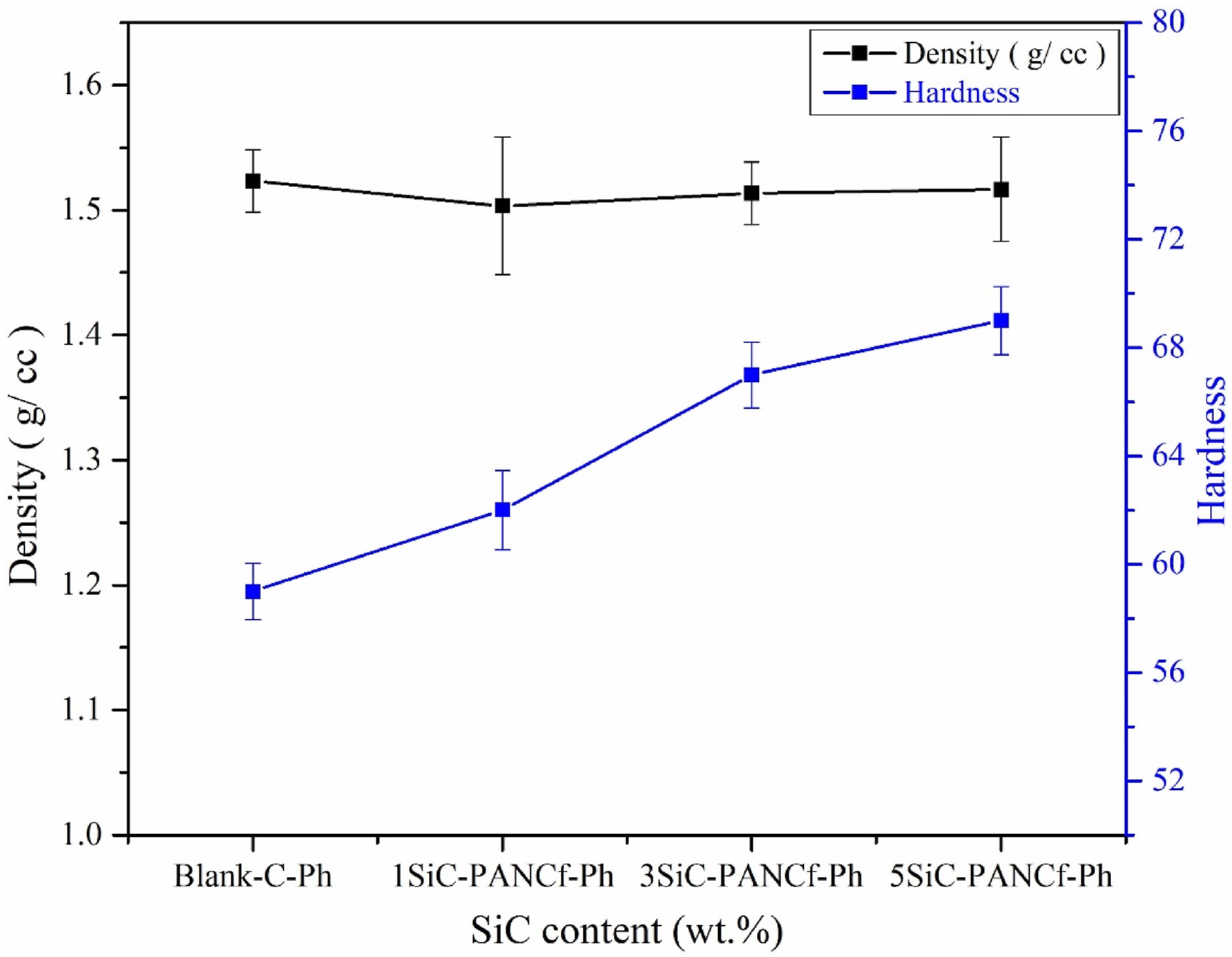
Hardness is used to measure the degree of curing resin and plastics. The Barcol impressor provides a direct reading on a scale ranging from 0 to 100. The Barcol hardness of the composites, on the other hand, shows a continuous increase with the addition of SiC as illustrated in Figure 5. As reported in Table 1, the baseline Barcol hardness for the blank-C-Ph sample is 59. The introduction of 1 wt% SiC enhances the hardness to 62, implying that the SiC filler contributes to the hardness of the composite. With an increased SiC content of 3 wt%, the Barcol hardness further increases to 67, reinforcing that the presence of SiC contributes positively to the composite’s hardness. When the SiC concentration is maximized to 5 wt%, the hardness value continues to rise, reaching 69. This further underscores the trend of enhanced hardness with an increasing SiC concentration, this is due to the presence of filler material in between the layers. The incorporation of SiC filler into the matrix diminishes the porosity of the composite, implying improved matrix integrity, and resulting in increased hardness. In essence, the introduction of SiC into the composite appears to slightly decrease, then stabilize the density, while consistently boosting the Barcol hardness.
Interlaminar shear strength, flexural strength, and flexural modulus of SiC-PANCf-Ph composite
Figures 6 and 7 illustrate how an increase in the weight percentage of SiC in carbon fiber composites correlates with a noticeable outcome in ILSS and flexural properties, respectively. As evident from Table 1, the Interlaminar Shear Strength (ILSS) decreases with the incorporation of SiC into the composite. For instance, the ILSS of the blank-C-Ph composite is 28 MPa, which decreases to 26 MPa with 1 wt% SiC. This decreasing trend continues with 3 wt% SiC, resulting in an ILSS of 24 MPa. However, there is a slight increase in ILSS to 25 MPa when the SiC content is increased to 5 wt%. This increase is attributed to the overlapping weave patterns of the fabric, mechanically interlocking neighbouring interfaces, and enhanced chemical bonding within the matrix. The mechanical locking between layers intensifies with the higher fiber volume fraction of the composite. Conversely, the ILSS reduction with SiC incorporation may compromise interlayer bonding due to reduced mechanical locking as the composite’s fiber volume fraction decreases when compared to the blank-C-Ph composites (Figure 16(a)). Experimental values of Interlaminar shear strength compared over the blank-Cf-Ph and various wt.% SiC-PANCf-Ph composites. Experimental values of flexural strength and modulus compared over the blank-Cf-Ph and various wt.% SiC-PANCf-Ph composites.

The flexural properties of the composites exhibit an increase with the addition of SiC as illustrated in Figure 7. The data indicates that as the SiC content increases, there is a rise in the flexural strength of the composites compared to the blank-C-Ph composites. For instance, while the blank-C-Ph composite displays a flexural strength of 404 MPa, this value increases to 406 MPa with the inclusion of 1 wt% SiC. Further improvement is observed with 3 wt% SiC, resulting in a flexural strength of 453 MPa. The enhancement in flexural strength can be accredited to the adequate dispersion of SiC, which strengthens the fiber-matrix interface and stiffens the matrix, thereby effectively resisting bending strength. 7 Nonetheless, the increased flexural strength at 3 wt% SiC could be due to a more uniform distribution of SiC particles (Figure 16(b)–(g)), potentially leading to enhanced bonding within the composite matrix. However, at 5 wt% SiC, the flexural strength shows a decline of 411 MPa and this can be attributed to the presence of excess filters leading to the formation of agglomerations in the composite. Agglomerations can result in the decline in the properties of the composite.
The load-displacement curves for flexural properties, as depicted in Figure 8, illustrate the behaviour of Blank-C-Ph and SiC-C-Ph composites with varying weight percentages of SiC. Each curve represents the average displacement (mm) and load (N) at which the material fractures. The x-axis indicates displacement (mm), reflecting the extent of material bending under applied load, while the y-axis denotes load (N), representing the applied force.
27
Comparing the curves reveals the impact of SiC addition on the flexural properties of the C-Ph composite. From the graph, it is observed that the flexural strength increases with the addition of SiC in the composites and the highest value was observed for the composites with 3 wt %. The increase in flexural strength can be due to the good interfacial interactions of the SiC with the resin and carbon fibers. Good interfacial interactions will help in the proper transfer of load from the matrix to the carbon fibers and hence observed improvement in the flexural strength. Furthermore, an increase in SiC content has resulted in the decrement of flexural strength. The addition of higher concentrations can result in improper dispersion and hence may cause agglomerations, and these can introduce some defects that lead to the failure of the composites.
28
Due to this the composite with 5 wt % has shown a decrease in flexural strength. The results can also be verified with a load versus displacement diagram. Composites with 1 and 3 wt % have more displacement than blank-C-Ph composites and 5 wt % composites. Load-displacement curves of Flexural properties compared over the blank-C-Ph (a) and various wt.% SiC-C-Ph composites.
Thermal properties of SiC-PANCf-Ph composites
The thermal properties, namely thermal diffusivity, specific heat capacity, and thermal conductivity, of blank-Cf-Ph and various SiC-PANCf-Ph composites were evaluated at room temperature (30°C), the results of which are presented in Table 1 and illustrated in Figure 9. The thermal conductivity of the composites was computed using equation (1), based on experimentally determined thermal diffusivity and specific heat capacity.
5
The necessary density for this calculation was derived using Archimedes’ principle at standard room temperature (30°C).
29
The data indicates that the composites formulated with 3 wt% SiC demonstrate the lowest thermal conductivity, showcasing a reduction of 28% when compared to the blank-Cf-Ph composite laminate, equating to 0.57 W/m K. This decrease in thermal conductivity further amplifies as the thickness of the insulating layer and the wt.% of SiC increase. It can be seen from Figure 9 that the thermal diffusivity increases from 0.0033 cm2/s for the blank-C-Ph sample to 0.0041 cm2/s when 3 wt% of SiC is added. However, it decreases slightly to 0.0038 cm2/s when 5 wt% of SiC is added. This could be due to an increase in the compactness and the conduction path for heat flow caused by the addition of SiC. Experimental values of thermal diffusivity compared over the blank-Cf-Ph and various wt.% SiC-PANCf-Ph composites.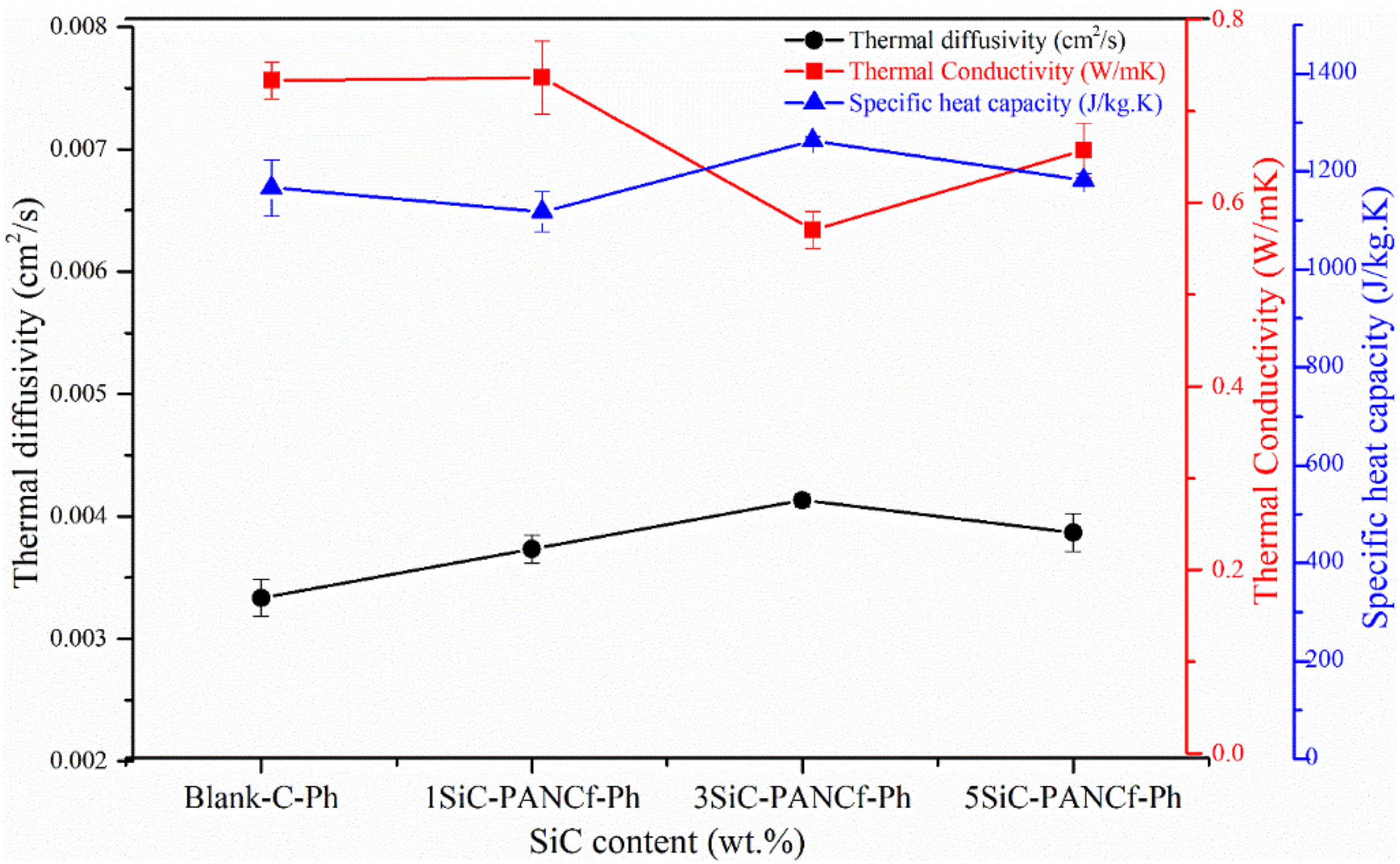
The specific heat of the composites varies with the content of SiC. It is seen from Figure 9 that the specific heat is decreased from 1166.62 J/kg·K for blank-C-Ph to 1117.43 J/kg·K when 1 wt% of SiC is introduced. However, it increases to its maximum value of 1262.79 J/kg·K at 3 wt% of SiC and then slightly decreases to 1182.19 J/kg·K at 5 wt% SiC. This could be attributed to the high specific heat capacity of SiC which causes an increase in the overall specific heat capacity of the composite. A peak in thermal diffusivity and specific heat capacity is observed with the 3 wt% SiC content, marking an increase of 24% and 8% respectively when compared to the blank-Cf-Ph composite laminate, with corresponding values of 0.0041 cm2/s and 1262.79 J/kg. K. This increase can be attributed to the thermally stable SiC filler, which significantly enhances the thermal diffusivity and specific heat of the SiC-PANCf-Ph composites.
The thermal conductivity of the composites is also impacted by the SiC content. It is observed from Figure 9 that the thermal conductivity slightly increases from 0.7333 W/m·K for blank-C-Ph to 0.7366 W/m·K for 1 wt% SiC. However, it significantly decreases to 0.57 W/m·K for 3 wt% SiC and then increases to 0.6566 W/m·K for 5 wt% SiC. The addition of SiC influences the thermal properties of the composites, with the magnitude of the impact dependent on the weight percentage of SiC. The decrease in thermal conductivity despite the addition of SiC, which is a good thermal conductor, could be attributed to an increase in the porosity of the composite or disruption in the conduction path due to the distribution of SiC particles in the composite. The diminished thermal conductivity of the composites can be explained by the presence of SiC fillers, which act to reduce the thermal conductivity of the matrix, decrease the contact area between fiber and matrix, and serve as thermal bridges between filaments or fibers, thereby inhibiting the conducting networks within the composite laminate. 30 In the context of spacecraft operation under high-speed and high-heat flow conditions, this reduction in thermal conductivity is beneficial as it enhances the operational longevity of the spacecraft.
Thermal stability of SiC-PANCf-Ph composite
The objective of the experiments was to evaluate the thermal stability and char yield produced by the pyrolysis of phenolic resin and SiC-modified phenolic resins through thermogravimetric analyses (TGA) and differential scanning calorimetry (DSC). TGA analyses were conducted on Cf-Ph composites with varying SiC levels, ranging from room temperature to 1000°C under controlled conditions. Pyrolysis is a process well-established in literature that is initiated once the temperature of the Ph resin surpasses 300°C. During this temperature range, leading to mass loss or charring is predominantly due to the release of small molecular substances resulting from the curing of the Ph resin. 31 The temperature bracket of 400°C–700°C marks the onset of resin pyrolysis. 32 The fracturing of crosslinked bonds during this stage results in the emission of a gas mixture comprising CO, CO2, H2O, and CH4. 33 Furthermore, in the temperature range of 450°C–1000°C, hydrogen is primarily released due to the interactions among aromatic rings, forming a carbonaceous tridimensional structure. 34
According to Figure 10, the TG curve illustrates the formation of char from both Ph resin and SiC-modified phenolic resin composites under oxidizing conditions. This reaction leads to an increase in weight compared to the blank composite. The residual yield of the blank and 3 wt% SiC composites at temperatures of 300°C, 700°C, and 1000°C is 97.50%, 84.0%, and 80.85% for the blank, and 98.0%, 86.0%, and 84% for the 3 wt% SiC composites, respectively. Consequently, the pyrolysis of Ph resin produces SiC-modified composite materials with a higher residual weight than the blank composite, indicating improved oxidation resistance and enhanced thermal stability. These SiC-modified composites act as a barrier against oxygen diffusion, thereby protecting the composites from oxidation. The TG curves also depict the thermal degradation mechanism of Cf-Ph composites with varying SiC concentrations, showing a minimal impact on the degradation behaviour despite the presence of fillers. Thermogravimetric curve of blank-Cf-Ph and various wt.% SiC-PANCf-Ph composites.
Interestingly, it is observed that the SiC filler, under oxidation conditions, reacts to form SiO2. As indicated by the XRD patterns in Figure 15, this product is an amalgamation of reactions between SiC and the pyrolysis products of the phenolic resin in a N2 atmosphere. This reaction is characterized by weight gain, leading to a higher residual weight in SiC-PANCf-Ph composite materials compared to their blank-Cf-Ph counterparts. Consequently, carbon fiber-reinforced polymer composites containing 3 wt% SiC displays superior thermal stability compared to their pristine blank-Cf-Ph polymer composite counterparts. SiC-modified composites enhance oxidation resistance, possess excellent thermal stability, and serve as a barrier to oxygen diffusion, thus safeguarding the composites from oxidation.
The DSC analysis was conducted to assess both the glass transition temperature (Tg) and the curing characteristics of the samples, as illustrated in Figure 11. The DSC findings for the blank-C-Ph composite and SiC-PANCf-Ph composites with 1 wt%, 3 wt%, and 5 wt% indicate Tg temperatures of 137°C, 132°C, 172°C, and 118°C, correspondingly. The Tg of the 3 wt% SiC-PANCf-Ph composites exceed that of the blank-C-/Ph composites, and no exothermic reactions were detected, indicating complete curing of the composites. The Ph resin begins to decompose at 230°C, with a 10% weight loss occurring at 300°C. In this temperature range, both the blank-C-Ph and SiC-modified composites experience a similar degree of weight loss. The residual weight char yield of the material post-complete decomposition at 1000°C was examined. The experimental TGA and DSC analyses conducted on the blank-C-Ph composites and its SiC-modified composites are well-suited for use as an ablative thermal protection layer. DSC curve of blank-C-Ph and various wt.% SiC-C-Ph composites.
Ablation of SiC-PANCf-Ph composite
Table 2 reported the Linear Ablation Rate (LAR), Mass Ablation Rate (MAR), and back face temperature results for blank-C-Ph and SiC-PANCf-Ph composites under oxy-acetylene torch testing, and the same are illustrated in Figures 12 and 13. The assessment of LAR and MAR of both blank-Cf-Ph resin composites and SiC-PANCf-Ph composites involved the measurement of sample thickness and weight before and after exposure to an oxy-acetylene torch test, LAR and MAR were computed using equations (2) and (3). The curve for the LAR initially declines, then progressively ascends beyond 3 wt% of SiC as shown in Figure 12. The LAR for all SiC-PANCf-Ph composites was found to be lower than that of blank-C-Ph, indicating that adding SiC enhances the material’s resistance to high heat flux conditions. This improvement is due to the formation of a more stable char layer in the presence of SiC, which acts as a protective barrier slowing down the material’s degradation. Linear ablation rate and Mass ablation rate of blank-Cf-Ph and various wt.% of SiC-PANCf-Ph composites. Illustration of temperature curves of the back-face for blank-Cf-Ph and various wt.% of SiC-PANCf-Ph composites.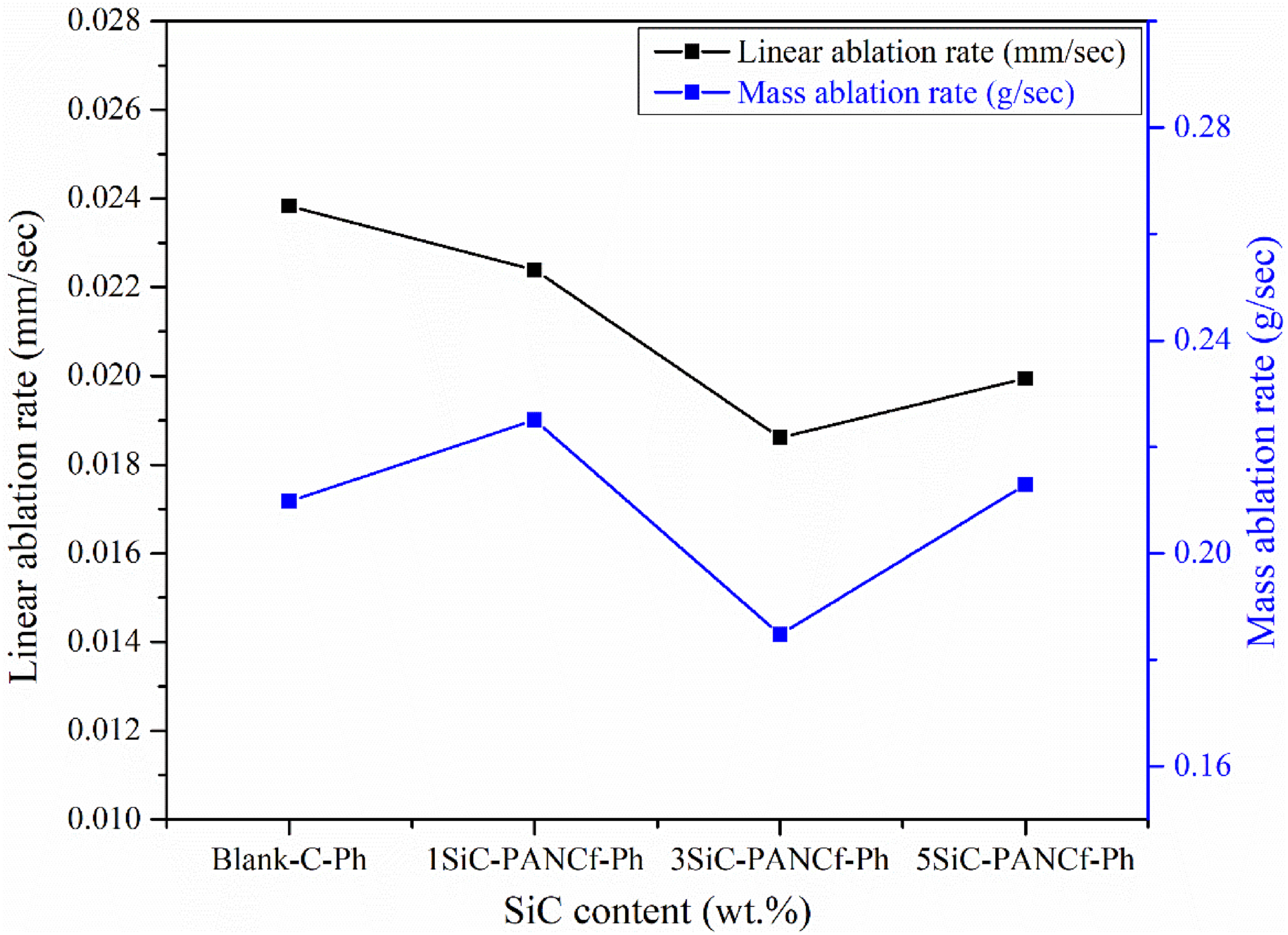

The MAR also decreased with SiC addition as illustrated in Figure 12, although the 1 wt% SiC composite showed a slight increase. The decrease in MAR suggests that the incorporation of SiC helps in maintaining the material’s structural integrity under extreme heat, potentially due to the same reasons as for LAR. The slight increase observed at 1 wt% SiC could be due to a less stable char formation at this concentration, necessitating further investigation. The LAR and MAR for SiC-PANCf-Ph composite samples containing 3 wt% of SiC were notably dropped to 0.0052 mm/sec and 0.025,061 gm/sec respectively, compared to those of the blank-Cf-Ph samples.
The reduction in Linear Ablation Rate (LAR) and Mass Ablation Rate (MAR) is demonstrated in Figure 17(c) for the 3 wt% SiC ablated surface, indicating that the matrix charring occurs before fiber erosion. When the char formed during ablation is maintained for a prolonged duration, minimal damage and erosion of the fibers occur. This preservation of char offers radiative cooling on the surface and directs one side of the fiber face towards the oxyacetylene torch flame by enveloping the individual fibers. Consequently, there is a corresponding decrease of 28% and 13% in LAR and MAR, respectively.
Figure 13 portrays the back-face temperature trend during the high heat flux oxy-acetylene torch ablation tests for both blank-Cf-Ph and various SiC-PANCf-Ph composite laminates. The final back-face temperatures of the samples post-ablation (60 s) are listed in Table 2. Notably, during the initial 10-30 s of the ablation test, both SiC-modified and blank-Cf-Ph composites exhibit lower back-face temperatures, ranging between 200°C and 250°C. As the SiC content increases, there is a corresponding decrease in the back-face temperature of the Cf-Ph composites. The back face temperature decreased significantly with the addition of SiC.
The most substantial drop was observed for the 3 wt% SiC composite, indicating that this concentration provides the most effective thermal insulation. The reduced temperature could be attributed to SiC’s ability to form a denser and more thermally insulative char layer. This layer prevents the transmission of heat to the back face, keeping the temperature lower. This feature is critical for thermal protection applications where the goal is to keep the heat away from the vehicle’s structure. Significantly, SiC-PANCf-Ph composites display a substantial reduction in back-face temperatures when compared to the blank. The back-face temperature rises in line with surface temperature, thermal conductivity, and the linear ablation rate.28,35 SiC-PANCf-Ph composites demonstrate superior thermal insulation capabilities, evidenced by the thinner char zone depth from the ablated surface, creating a ring-like structure as illustrated in Figure 4. 36 Specifically, the 3 wt% SiC-PANCf-Ph composites have a significantly thinner char depth (1.18 mm) compared to that of the blank-Cf-Ph composites (1.37 mm). Post-ablation, SiC-PANCf-Ph composites maintain a substantially lower back-face temperature than the blank-Cf-Ph composites, with a difference of 250°C. Therefore, it is inferred that under rigorous test conditions, the back-face temperature remains higher for blank-Cf-Ph composites than for SiC-PANCf-Ph composites.
XRD analysis
Figures 14 and 15 depict X-ray diffraction (XRD) investigation of an un-ablated and ablated samples of blank-Cf-Ph and SiC-PANCf-Ph composites (1 wt%, 3 wt%, and 5 wt%) respectively. In the context of thermal protection system (TPS) applications, SiC-PANCf-Ph composites undergo structural and phase transition under severe heat temperatures. It reveals different peaks at certain 2θ angles, indicating crystalline phases. The XRD pattern shows the presence of carbon-phenolic and SiC filler composition in the prepared SiC-PANCf-Ph composites as evidenced in Figure 14. A considerable SiC peak (broad) was observed in 3 wt% SiC-PANCf-Ph composites at 2θ angles of 24.92°, 35°, and 43.50°, corresponding to the (112), (222), and (134) lattice planes. The blank-Cf-Ph composites peaks (broad) at an angle of 25.90°, 34.63°, and 44.72°, corresponding to the (111), (211), and (221) lattice planes. These peaks when compared with ablated specimens of blank-Cf-Ph and 3 wt% SiC-PANCf-Ph composites, the broad peaks and concerned lattice planes change is observed. This is attributed to the ablation and its phenomena. The other compositions, such as carbon and phenolic compositions were also observed as a combined phase. Since the SiC is present in the structure of these composite, the mechanical properties may decrease. XRD patterns of the un-ablated surfaces of both blank-Cf-Ph and various wt.% of SiC-PANCf-Ph composites. XRD patterns of the residual material from the ablated surfaces of both blank-Cf-Ph and various wt.% of SiC-PANCf-Ph composites.
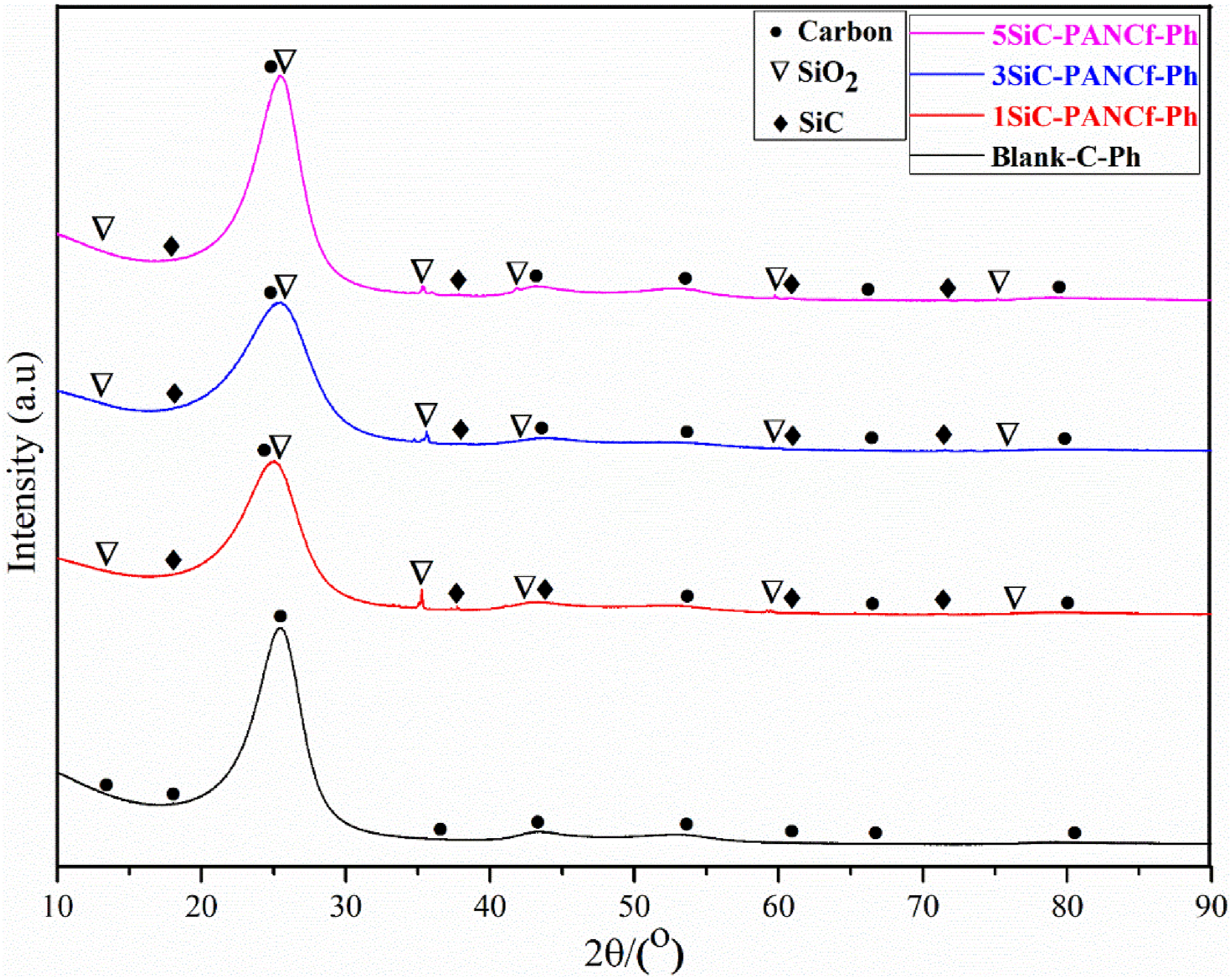
The SiC-modified composites prompt an interaction with the charred matrix under high thermal stress. This interaction leads to the production of silicon dioxide (SiO2), carbon monoxide, and hydrogen gas, evident through the examination of EDS analysis as evidenced in Figure 18. Show the crystalline phases of SiO2. For instance, for 1 wt% SiC-PANCf-Ph, the peaks occur at 2θ angles of 14.16°, 24.65°, and 35.14°, corresponding to the (011), (112), and (222) lattice planes. Similar observations are made for 3 wt% and 5 wt% SiC-PANCf-Ph composites, with peaks at 2θ angles of 14.17°, 24.68°, and 35.19°. These peaks are indicative of the crystalline phases of SiO2 (Refs: 98-006-6118 and 98-006-6119).
On the other hand, the XRD patterns for the unmodified, blank-Cf-Ph composites show different characteristics, devoid of these SiO2 peaks. Instead, significant peaks appear at 19.02°, 24.34°, and 38.61°, corresponding to the (110), (012), and (220) lattice planes. These peaks indicate charred crystallites (Ref: 98-015-1224), showing that the phenolic resin in the blank composites has undergone high-temperature pyrolysis. Pyrolysis transforms carbon into “char” by heating it, causing gases to rise to the surface and transferring energy from solid to gas, thereby protecting the insulating material. The noticeable contrast in XRD patterns between SiC-PANCf-Ph and blank-Cf-Ph composites underscores the significant influence of SiC as a filler in altering the composite’s reaction to extreme thermal conditions. This XRD analysis illustrates the thermal resilience of SiC-PANCf-Ph composites, confirming the formation of SiO2 on the ablated surfaces and offering a clearer insight into the phase transitions and structural alterations of the composites under high thermal stress.
Morphology and ablation mechanism of SiC-PANCf-Ph composites
SEM analyses were employed to investigate the microstructure of both un-ablated and ablated cross-sectional surface layers, with variations corresponding to SiC content, as depicted in Figures 16 and 17, respectively. The cross-section images of un-ablated composites reveal well-dispersed blank-Cf-Ph and varying wt.% of SiC fillers, as depicted in Figure 16(a)–(g). Additionally, the images show the presence of the matrix and carbon fiber fabric filaments, indicating the intact interfacial chemical and mechanical bonding between the layers, which may contribute to favourable mechanical and thermal properties. SEM images of various SiC content samples, before oxyacetylene torch test (a) blank, (b and e)1, (c and f) 3, and (d and g) 5 wt% SiC- Cf-Ph composites respectively showing SiC filler dispersion, matrix layer. Surface SEM images of various SiC content samples after oxyacetylene torch test, (a-d) blank, 1, 3, and 5 wt% SiC- Cf-Ph composites respectively showing fiber damage, porous char, matrix damage and SiO2 layer forming.

Ablated surfaces are subjected to high temperatures, the blank-Cf-Ph composite undergoes partial porous matrix charring, and for SiC-PANCf-Ph revealing broken carbon fiber filaments, damaged matrix, SiO2 traces on the composite surface as shown in Figure 17(a)–(d). Fiber damage is extensive, resulting in significant erosion losses. However, shortening the char formation period during ablation minimally increases the ablation rate. 37 The ablated surface of the 3 wt% SiC-PANCf-Ph composite demonstrates less matrix loss and fiber damage, indicating a lower ablation rate.
Ablation involves two main degradation processes happening concurrently. Mechanical degradation, driven by high aerodynamic shear forces from the oxyacetylene torch, results in char layer and carbon fiber removal from the ablating surface. Chemical (carbon (C), methane (
The ablated surface of the 3 wt% SiC-PANCf-Ph composite demonstrates less matrix loss and fiber damage, indicating a lower ablation rate. This decrease can be attributed to the interplay of passive and active oxidation reactions as exemplified by equation (5). SEM analysis of the charred area further substantiates this proposed reaction, demonstrating SiC’s consumption of solid char and production of liquid and gaseous by-products (eqations (5) and (6)). Notably, the porosity in the blank-Cf-Ph composite (Figure 17(a)) is significantly higher compared to SiC-PANCf-Ph composites (Figure 17(b)–(d)).
To fundamentally understand the changes in the Cf-Ph composites, SiC is incorporated as a filler. The subsequent reactions between SiC and the charred matrix yield silicon dioxide (
Concurrent with the reaction indicated in equation (4), EDS results illustrated in Figure 18(b)-(d), shows a high silicon and oxygen concentration in the reaction layer, suggesting equation (6) may also be active.
40
SiO2 formation results in substantial char volume reduction due to gaseous and liquid byproduct creation, leading to a highly porous structure in the remaining SiC-PANCf-Ph composite matrix as shown in Figure 18, similar findings were reported by S. Wang et al.
8
EDS images of samples that have undergone oxyacetylene torch testing, (a-d) represent the EDS spectrums of blank, 1, 3, and 5 wt% SiC- Cf-Ph composites respectively along with micrographs.

Better fiber protection is afforded by the slower matrix removal rate from the SiC-PANCf-Ph composites as illustrated in Figure 18(c)–(d), indicated by needle-like structures with fewer fiber breakages. 28 Conversely, blank-Cf-Ph composites, due to greater matrix removal, expose fibbers to intense heat flux and shear forces from the oxyacetylene torch, resulting in substantial fiber damage. The combined result of lower matrix and fiber removal rates reduces the ablation rate of SiC-PANCf-Ph composites.
Elemental composition analysis
The Energy-Dispersive X-ray Spectroscopy (EDS) analysis was performed to assess the elemental composition of the SiC-PANCf-Ph composites for the Thermal Protection System (TPS) work as shown in Figure 18(a)–(d). The analysis involved the detection of carbon (C), oxygen (O), and silicon (Si) across the different composite samples.
For the blank-C-Ph sample, the elemental composition was found to be 98.29 wt% C and 1.71 wt% O, with no detectable Si. Upon the introduction of SiC, there was a notable shift in the elemental composition. For the 1 wt% SiC sample, C content dropped to 82.5 wt%, while O and Si were present at 17.12 wt% and 0.38 wt% respectively. This trend became more pronounced with increasing SiC content. The 3 wt% SiC sample exhibited a significant reduction in C content to 6.49 wt%, with O and Si constituting 57.48 wt% and 36.03 wt% respectively. Finally, the 5 wt% SiC sample showed a slight increase in C to 11.21 wt%, while O and Si were present at 49.57 wt% and 39.22 wt%, respectively. In summary, these results indicate a reduction in carbon content and a simultaneous increase in oxygen and silicon content with increasing SiC concentration. This suggests a successful integration of SiC into the composite structure, significantly altering the composition and possibly influencing the thermal and ablative properties, which are critical for TPS applications.
Conclusions
This research synthesized SiC-PANCf-Ph composites with varying SiC weight percentages through the hydraulic hot compression moulding technique, which has led to significant insights. It explored the effect of SiC content on the mechanical, thermal, and anti-ablative properties of the Cf-Ph composites. • Flexural strength improved with the addition of SiC until a certain concentration and after achieving the optimized concentration, strength started to decline with a further increase in the wt. % of SiC in the composites. • A reduction in interlaminar shear strength (ILSS), and thermal conductivity was observed due to SiC’s introduction, which subsequently lowered the back-face temperature under high heat flux (400 W/cm2) and extreme temperature conditions. • Thermogravimetric (TG) analysis also suggested a weight gain reaction in SiC-PANCf-Ph composites compared to the blank-Cf-Ph composites. • The XRD, SEM and EDS analyses unveiled distinct microstructural and crystallographic alterations, including the formation of oxides on the ablated surface. These transformations were attributed to the interaction between SiC and the oxygen present in the oxyacetylene flame environment, creating SiO2, which leads to protecting the surface of the composites. • It was observed that the composite’s ablation resistance was optimized with a SiC presence of 3 wt%. Such a composition demonstrated a notable reduction of 28% and 13% in linear and mass ablation rates, respectively, compared to blank-Cf-Ph composites. • The study thus reveals an effective method to substantially boost the ablation performance of Cf-Ph composites. The characteristics observed indicate less matrix loss and fiber damage, suggesting enhanced durability under harsh conditions. With a slower matrix removal rate, the composites offer better fiber protection against high heat flux and shear forces.
Hence, SiC-PANCf-Ph composites can be a potential candidate for thermal protection systems in aerospace applications due to their improved ablation resistance and thermal properties. Future research holds considerable potential in the exploration of alternative fillers, SiC percentage optimization, and testing under realistic scenarios such as hypersonic flights. Implementing advanced material characterization techniques and computational studies can offer deeper understanding and improvements in the fabrication of even more advanced thermal protection systems.41,42
Footnotes
Declaration of conflicting interests
The author(s) declared no potential conflicts of interest with respect to the research, authorship, and/or publication of this article.
Funding
The author(s) received no financial support for the research, authorship, and/or publication of this article.
