




Abstract
Government policies focus on the textile sector to follow a tendency towards sustainability and circular economy, thus, raising the use of recycled textiles which require further performance improvement to be completely competitive with other textile products while using secondary treatments that are also environmentally friendly. In this study, a 100% recycled polyester weft-knitted fabric, currently used by commercial brands in the apparel and sport textile industry, is calendered and its properties are examined before and after such treatment. This research investigates variations in the physical (appearance and thickness), mechanical (tensile strength and elastic recovery), and physiological (water vapour resistance, spray test, and wettability) characteristics of the samples. The calendering treatment reduces water vapour resistance up to 23%, which is particularly interesting for garments used in sports. Additionally, the contact angle is increased by the calendering process which translates in poorer wettability. Novel findings of this work include that, whereas in the original fabric sweat marks are visible, sweat stains do not appear on the calendered fabric and moisture management improves, while mechanical properties do not undergo significant changes. These results have not been previosly found in the literature, giving a particular interest to a conventional process in this type of recycled fiber that can contribute to the advancement of knowledge in the textile industry and enhance the performance of treated fabrics. All these aspects make the treatment particularly interesting to improve the technical performance of the textile material while using an economic treatment with low effect on the environment.

Introduction
One of the many interesting aspects of the textile industry is the availability of numerous treatments and processes designed to change, improve, or adjust the properties of a fabric. Whether it is shifting hand-feel,1,2 changing coloration,3,4 or applying functional additives,5–7 the options are plentiful. Knowing how these procedures influence a fabric’s performance is key to selecting the most appropriate processes for each type of textile and specific application.
According to Kumar and Sundaresan, 8 calendering consists of passing the fabric through a series of rollers under controlled conditions of time, temperature, and pressure. Through calendering, it is possible to fix dimensions, 9 improve appearance, 10 sublimate, add coatings,8,11 optimize bursting behavior, 12 or even upgrade the ultraviolet protection factor of textiles. 13 However, it is important to note that textile processes involving pressure and temperature can potentially lead to fabric degradation if the parameters used are not correctly optimized.
Nowadays, polyester remains unrivaled as the most produced textile fiber due to its availability, versatility, and low manufacturing costs. 14 In terms of recycling, it is considered one of the most viable materials to recycle. 15 Moreover, by adjusting its yarn count, cross-sectional shape, and texture, polyester can transform into a material that performs comparably to cotton, mimicking its wicking and breathable characteristics.16–18
Despite the widespread adoption of calendering within the textile sector, there exists a notable gap of comprehensive scientific exploration in this field. Existing investigations, primarily centered on technical applications like filtration, are limited in scope and fail to fully address the broader implications of calendering on garment fabrication.19–27 For instance, Bernhard and colleagues 13 address the influence that calendering has on the performance of fabrics for garments manufacturing using 100% polyester and 87% wool-13% polyamide blends, while Mert and colleagues 21 examine various wool, polyester, polyamide, and viscose combinations. Remarkably, some scholars have highlighted the absence of thorough examination into how calendering alters textile properties.12,23 Surprisingly, none have delved into crucial aspects like elastic recovery and resistance to water vapor. This manifest gap underscores the necessity of the current research, highlighting its novelty and significance. Furthermore, the long-term impact of calendering on fabric remains largely unexplored in existing literature. This manuscript addresses a substantial portion of the identified gap, thereby emphasizing the relevance of this research.
This paper studies a processing alternative for a recycled textile that presents greater environmental sustainability, allowing it to achieve a substantial improvement in terms of its functionality. The paper fulfills the knowledge gap existence in the use of a non-environmental harmful processing technique to confer new technical capabilities to a fabric with 100% recycled polyester, that is, improving the performance by not affecting the fabric sustainability. In this line, the understanding of the influence of the calendering process on recycled polyester is crucial to ensure its proper utilization and avoid any negative effects, which requires scientific study as the current uncertainty is high due to possible negative consequences when changing the morphology of the fabric during the treatment, which has not been previously studied for this type of fabric and it is an actual requirement from the industry.
For this investigation, a 100% recycled polyester weft-knitted pique with anti-stain finishing is calendered and its physical (appearance and thickness), mechanical (tensile strength and elastic recovery), and physiological (water vapour resistance, spray test, and wettability) properties are analyzed before and after undergoing such process. This study aims to investigate the unexpected performance results concerning comfort achieved by calendered fabric. Initially, it is hypothesized that calendering would lead to fabric compaction, hindering water vapor evaporation and substantially impacting fabric elasticity. However, the obtained results contradict this hypothesis. Specifically, the study findings confirm that water vapor evaporation actually improves in calendered fabric. Additionally, the influence of the calendering process on mechanical properties is found to be minimal. The main objective of this research is to provide useful information about the influence of the calendering process on a polyester weft-knitted fabric, providing guidelines and recommendations to enhance the performance of polyester weft-knitted fabrics through calendering.
Experimental
Materials
The fabric used for this research is a 100% recycled polyester with a mass per unit area of 155 g/m2, chemically bleached and dyed in an industrial process, with a fluorocarbon-based anti-stain treatment applied by foulard impregnation. The yarn is produced at a large-scale industrial facility, using discarded PET bottles as the raw material for the filaments. It consists of filaments with a multilobed cross-section and silver nanoparticles, embedded in the extrusion process, to impart antimicrobial and anti-odor properties. The structure of the fabric is a weft-knitted pique. Figure 1 includes an image from the source material, and the fabric obtained after knitting (both sides). (a) Source material after shredding; (b) knitted fabric side A; (c) knitted fabric side B.
Calendering
The fabric is calendered at a large-scale industrial facility specialized in finishing clothing and home apparel textiles, using a calender from the brand Tacome, custome-designed for the company for textile sublimation, at 195°C and a pressure of 300 bar, with a speed of 5 m/min. Figure 2 provides an overview of the calendering process. Diagram of the calendering process.
Samples characterization
SEM analysis and cross-section measurement
Scanning Electron Microscopy (SEM) is used to determine the main morphological aspects of the fibers and fabrics. Due to the micrometric size of the individual fibers, high-resolution and magnification images by SEM are used to determine the potential changes in the cross-section of the fibers. Additionally, the images are used to check the layer thickness variation of the fabrics as well as for qualitative evaluation of the differences observed in the fiber content per ply as a result of the calendering process. The microscope used is an S-3400N model from Hitachi taking images in secondary electron mode. The thickness of the fabrics is measured following the international standard Determination of the thickness of textiles and textile products (ISO 5084:1996). Three samples of each fabric are examined, and the arithmetic mean is calculated.
Resistance to water vapour
Resistance to water vapour (RET) of the samples is calculated following the international standard Textiles - Physiological effects - Measurement of thermal and water-vapour resistance under steady-state conditions (sweating guarded-hotplate test) (ISO 11092:2014 section 7.4), using a Sweating Guarded Hotplate from SDL Atlas. Three specimens are tested per fabric and the average result is calculated. Specimens are orientated lengthwise, aligned with airflow direction. The environmental test conditions are temperature 35.0 ± 0.1°C and humidity 40 ± 3%. The hotplate temperature is 35.0 ± 0.1°C
Spray test and wettability
A spray test of both fabrics is performed following the standard Textile fabrics - Determination of resistance to surface wetting (spray test) (ISO 4920:2012). Wettability is evaluated by measuring the contact angle of distilled water droplets on the surface of the fabric, using Ramé-Hart 200 contact angle goniometer and the software ImageJ.
Mechanical characterization
Tensile strength
The maximum force and elongation at maximum force are determined by tensile testing of the fabrics before and after calendering using the strip method (ISO 13934-1:2013). According to the standard, five strips of 200 × 50 mm are cut in the course and wale direction and mounted in a universal mechanical testing equipment Z100 from Zwick Roell equipped with a 500 N load cell. The load and standard travel of the grips are recorded during the test until the breakage of the strips is produced. Maximum tensile force and displacement at this point are taken to evaluate differences in course and wale direction and the use of the calendering process.
Elastic recovery
The elasticity of the fabrics is determined by adapting the strip method proposed in the ISO 20932 1:2018 standard. 50 mm width strips are cut to perform a cyclic tensile test on them. They are tested on a universal test machine Z100 from Zwick Roell equipped with tensile test grips. An initial gauge length of 100 mm is marked in the strips and after performing five load cycles with an amplitude of 12 N at a 50 mm/min displacement rate, the strips are left unloaded to recover. The distance between the initial marks, gauge length, is again measured after 1 and 30 min.
Results and discussion
Samples characterization
SEM analysis and cross-section measurement
Figure 3 shows the microscopic images of the original and the calendered fabrics, in front and cross-sectional views, to analyze the influence of the calendering process on the structure of the weft-knitted textile. At a macroscopic scale, no visual difference is observed between the calendered and non-calendered fabrics, although a subtle change in the texture of the calendered fabric is noticeable, exhibiting a certain stiffness. When examining the samples at a microscopic scale, in Figure 3(a) and (b), the three-dimensional structure that forms the weft-knitted pique seems more flattened in the calendered fabric, there is less relief in the texture and the filaments forming the yarn look more disordered. When observing the cross-sectional images of the fabrics, the measurements indicate that there has been a decrease in thickness in the calendered fabric, Figure 3(d) compared to the non-calendered fabric, Figure 3(c). However, when analyzing the polylobed filaments with higher magnification, no significant difference is found in their cross sections, maintaining the shape of the channels that allow more efficient moisture transport in the yarn. Filaments with a polylobed cross-sectional shape can effectively transport moisture,28–30 thereby enhancing the wearer’s sensation of comfort.
31
With recycled polyester, different cross-sectional geometries can be extruded, providing diverse characteristics, and the feasibility of producing a specific cross-sectional form is intricately intertwined with the rheology of the polymer used in the manufacturing process.
32
SEM Images of: (a) original fabric x25; (b) calendered fabric x25; (c) original fabric x50; (d) calendered fabric x50; (e) original fabric x450; (f) calendered fabric x450.
The thickness of the regular fabric is 0.557 ± 0.015 mm while the thickness of the calendered fabric, tested following the same standard is 0.447 ± 0.020 mm. The thickness variation between the original fabric and the calendered fabric is 20%; while calendering the fabric is expected to reduce the thickness of the treated textile, 13 this difference is quite significant and can affect various properties of the fabric, such as breathability, which is analyzed in the next section, or mechanical properties. These findings are in accordance with what was observed in the SEM images seen in Figure 3. This decrease in thickness is not associated with a change in the geometry of the fiber, as seen in Figure 3(e) and (f), but it is instead associated with a reorganization of the filaments in the thread and in the fabric itself. It can be considered that this may affect some of the properties of the fabric during use, including UPF, 13 thermal resistance, 24 or smoothness. 23
Resistance to water vapour
Resistance to water vapour test results of original al calendered fabric.

Spray test and wettability
The results of spray tests for both original and calendered fabrics are ISO 5. Said results are expected due to the anti-stain finishing both textiles have, and there is no significant change found after calendering the fabric. However, there is indeed a subtle change in the wettability behavior of the fabrics: as can be seen in Figure 4, the contact angle of a distilled water droplet (α) is around 95 ± 5°, meanwhile, in the calendered fabric the contact angle (β) is slightly bigger, around 120 ± 5°. Furthermore, according to Young’s equation, as stated by Minch,
37
the interfacial tension between solid and liquid (γSL) can be calculated using the formula: Wettability evaluation of (a) Original fabric and (b) calendered fabric.

This behavior can be explained by the phenomenon identified in Figure 3(b), where it has been observed that the calendered fabric has a more flattened surface, where the characteristic holes of the pique structure have lost a certain depth, at the same time as the filaments of the thread have become disordered, resulting in a more compact structure and a rougher surface where it is more difficult for water molecules to penetrate as depicted in Figure 5. Phenomena like static charges, chemical treatments, and rougher surfaces have been found to change contact angle.41,42 Graphic depiction of water droplets in contact with (a) original surface and (b) calendered surface.
This finding conflicts somewhat with the previous section, in which a lower resistance to water vapor is obtained in the calendered fabric compared to the original fabric, however, as mentioned, this difference is explained by the change in thickness of the specimens tested. In practical terms, this means that garments made with the original fabric show, after a certain time of use in conditions of high temperature or intense activity, sweat marks, while garments made with the calendered fabric do not show this behavior.
Mechanical characterization
Tensile strength
Figure 6 depicts the maximum force and elongation at breakage achieved after mechanical characterization of the original and calendered fabrics. The calendered fabric experiences a maximum force reduction of 20.10% in the wale direction compared to the original fabric, which aligns with the observed decrease in thickness. In contrast, the decrease in maximum force in the course direction is lower, at 10.80%. This difference can be attributed to two factors: firstly, weft-knitted fabrics typically exhibit greater elasticity in the course direction which is observed in the yellow line of Figure 6; secondly, during the calendering process, the fabric is pulled in the wale direction, resulting in a greater force and deformation in that particular direction. Furthermore, it is worth noting that the standard deviation for calendered fabric is higher, which suggests certain heterogeneity in the treated textile, higher in the wale direction as it is the most affected by the treatment. Additionally, as the fabric gets mainly stretched in the wale direction during calendering, the differences in tensile strength between both directions increased with the treatment applied. The decrease in the maximum elongation of the calendered fabric is 10.83% in the wale direction and 14.10% in the course direction. Maximum strength and elongation or original and calendered fabrics.
ANOVA results for original and calendered samples in the wale direction.

ANOVA results for original and calendered samples in the course direction.

Elastic recovery
The objective of this test is to analyze how the elastic recovery of both fabrics behaves after five load cycles. The goal is to determine whether the calendering process modifies the elasticity of the fabric, which is an inherent property of weft-knitted fabrics.43,44
When analyzing the size of the specimens tested after 1 min, it is observed that practically all the samples exhibited similar recovery with differences lower than 1% for all the samples. The sample calendered in the course direction stood out slightly, showing a lower recovery, but the difference is not significant compared to the rest of the samples, as depicted in Figure 7. In the measurement taken after 30 min, the calendered samples displayed a slightly lower recovery compared to the uncalendered samples. However, when examining the loading and unloading cycles of both calendered and uncalendered samples in the course and wale directions, it can be observed that these cycles are virtually identical. Therefore, Figure 7 highlights calendering does have a certain influence on the elastic behavior of the analyzed fabric, although the magnitude of the effect is relatively small. This finding supports the notion that calendering can induce slight changes in the fabric’s properties, like enhancing anti-stain behaviour, while simultaneously facilitating improved water vapor permeability without significant compromise on elasticity. Furthermore, Figure 8 showcases images captured from the experiments of mechanical properties, including (a) Tensile strength and (b) Elastic recovery. Elastic recovery of original and calendered fabrics, measured after 1 and 30 min. Images of the experimental setup for (a) tensile strength and (b) elastic recovery experiments.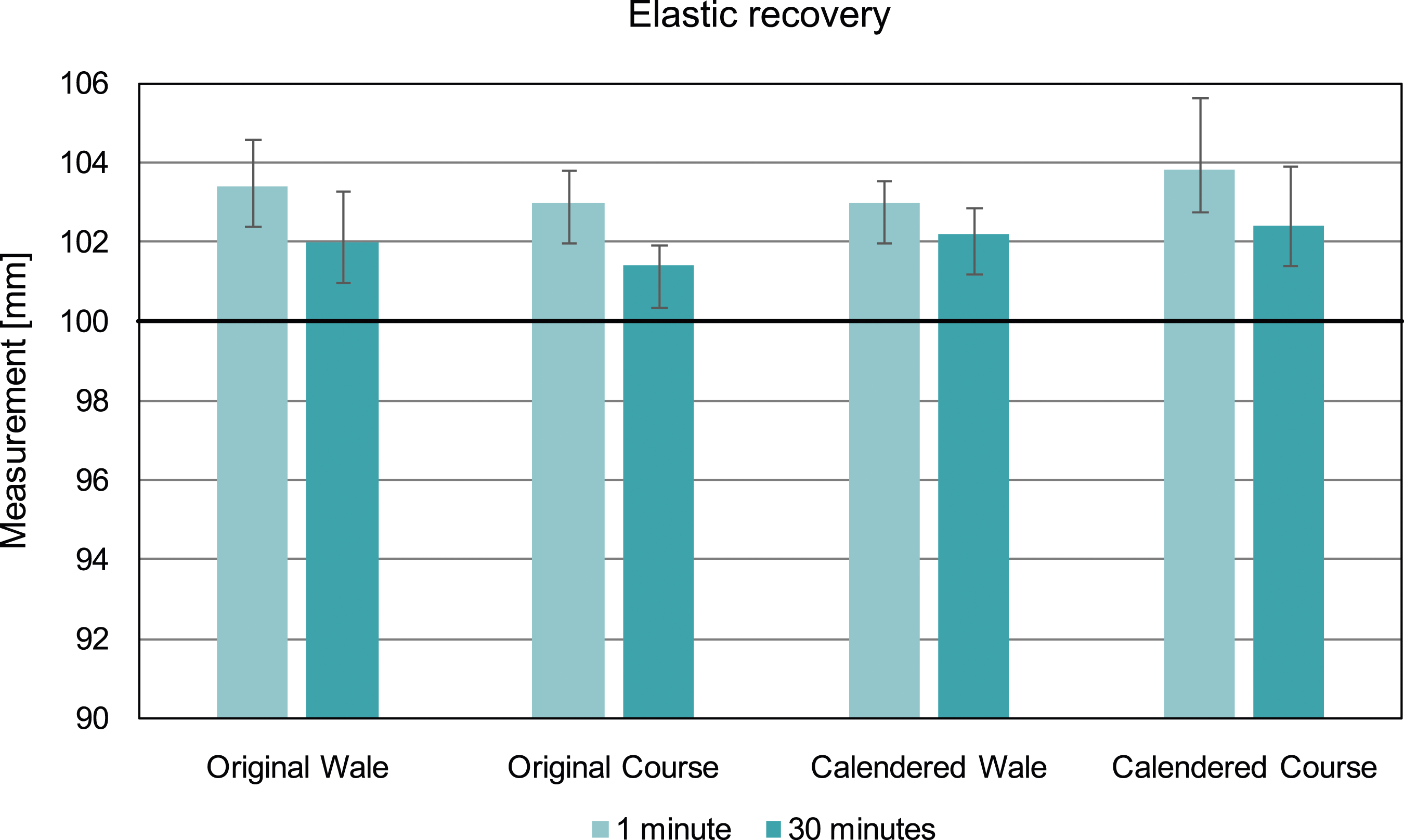

Conclusions
This study analyzes the impact of calendering as an after-treatment on a 100% recycled polyester weft-knitted pique fabric, focusing on changes in physical, mechanical, and physiological properties. Contrary to the original hypothesis, calendering improved water vapor evaporation and minimally affected tensile strength and elasticity. These novel findings challenge conventional assumptions and contribute to a wider understanding of textile processing. • Calendered fabric exhibits a 20% decrease in thickness compared to the original fabric and microscopic examination confirms a more flattened surface with disordered filaments, while fibers remain undegraded, inducing a change in the contact angle and reducing wettability of the treated fabric. • Calendered fabric shows a 23% decrease in water vapor resistance due to reduced thickness, at the same time, the changes in tensile strength and elasticity are minimal for the use and performance of the fabrics. • Garments manufactured with the original fabric exhibit sweat stains in areas such as the underarms or back, however, garments produced with the calendered fabric do not show sweat marks. The use of this well-known and economic procedure allows for improving the sweat stains appearance of a sustainable fabric, rendering this process a suitable option for enhancing the performance of fabrics intended for clothing. • The durability of this treatment and its potential long-term impact on the fabric should be further investigated, representing an important area for future research on calendering.
Footnotes
Declaration of conflicting interests
The author(s) declared no potential conflicts of interest with respect to the research, authorship, and/or publication of this article.
Funding
The author(s) received no financial support for the research, authorship, and/or publication of this article.
