




Abstract
Intelligent wearable devices for security detection integrate flexible electronic components into protective equipment, enabling the detection of metals, explosives, human physiological conditions, and hazardous chemicals. While numerous studies have investigated various security detection technologies, a systematic literature review providing a comprehensive overview of the preparation and applications of intelligent wearables for security detection is lacking. Therefore, this paper aims to fill this gap by conducting a comprehensive examination of the application of intelligent wearables for security detection in specialized and temporary disposal environments. Additionally, the paper addresses existing challenges and discusses future directions for achieving greater progress in this domain.
Introduction
Since the 9/11 event, counter-terrorism has become a significant international issue. The ongoing incidents of shootings, bombings, and attacks involving dangerous chemicals have compelled the international community to prioritize safety and security. 1 The identification and detection of prohibited items such as regulated firearms, knives, explosives, and hazardous chemicals are crucial measures to mitigate public risks in various public spaces.2,3
Metal detectors are primarily utilized for detecting various types of metallic firearms, terrorist tools, and sharp-edged metal knives. 4 In fixed locations such as airports, railway stations, and important conference venues, metal detectors predominantly rely on X-ray technology, which is bulky, expensive, and involves imaging techniques, thereby posing challenges for on-site and timely detection. 5 To address the need for portable metal detectors, handheld metal detectors quickly gained attention. Researchers such as Paulter et al. 6 recognized that the detectability of metal threat objects depends on their electromagnetic properties and shape. They proposed the use of spherical test objects to mitigate the influence of different metal threat objects on detection performance. These test objects can be employed to evaluate the performance of handheld metal detectors. Furthermore, this research group later developed a walk-behind metal detector capable of more accurate detection of metal threat objects based on their shape and structural characteristics. 7
Traditional techniques in explosive detection have undergone significant advancements, finding notable applications in ports, national border locations, airports, and battlefield scenarios. One widely recognized method is bio-based detection, which employs explosive search dogs to aid patrol officers in identifying explosive hazards. Additionally, the introduction of X-ray detectors has enhanced the detection of explosives, with ion mobility spectroscopy being the most well-known technique. 8 Non-contact detection techniques are crucial to avoid direct injury and Raman spectroscopy is gaining increasing attention as a non-contact technique capable of identifying the vapors emitted by explosives and providing corresponding characteristics. 9
Body temperature serves as a valuable indicator of various health aspects and plays a crucial role in assessing whether a person is carrying a virus. Therefore, it is essential to measure the body temperature of individuals entering public places where people gather. Commonly used thermometers include glass body thermometers, infrared thermometers, and electronic thermometers in solid form. Recently, a new type of sheet thermometer has emerged, capable of producing color changes corresponding to the measured person’s body temperature. These sheet thermometers offer the advantage of easy portability. 10
Chemical class detectors serve as the final line of defense against harmful compounds, preventing direct contact between hazardous chemicals and the skin, especially in situations where specialized personnel are carrying out their duties. They also play a crucial role in averting the entry of dangerous chemical gases through the nasal and oral cavities into the human respiratory system.11,12 Optical sensors have been widely employed in traditional chemical detection methods. For instance, Kumar et al. 13 developed an open-hole photoacoustic-optical method using ultrasonic sensors, which proved effective in forensic work scenarios and the screening of suspicious materials. Similarly, Mohebbifar et al. 14 designed a photoacoustic spectroscopy system for online monitoring of trichloromethane, resulting in the creation of a fully functional gas sensor.
However, the aforementioned detectors used for identifying various security hazards are considered traditional and rigid tools. Their large size restricts them to fixed locations, and in most cases, individuals need to approach the detectors for detection. Recent advancements in smart wearable technology and smart textile technology have facilitated the development of large, multifunctional components that can be transformed into flexible units and integrated onto the human body, animals, machines, and even buildings. These wearable components possess characteristics such as light weight, comfort, and portability, making them valuable in safety detection applications.15,16
Wearable security detection devices have been previously utilized for monitoring human health data and detecting external threats. 17 In a recent review by Awolusi et al., 18 wearable technologies for physiological monitoring and perimeter environment detection were examined, with a particular focus on the application of kinematic and physiological sensors. However, the detection technologies employed in perimeter environment detection can provide valuable insights for wearable safety detection. Nanofiber materials, known for their extensive specific surface area and high pore volume, have demonstrated outstanding capabilities in biosensing and environmentally friendly applications. These materials hold promise for wearable safety detection and contribute to the development of emerging smart sensing devices. 19 Wearable safety detection technology fills the gap in real-time and rapid detection, presenting significant market potential.
The advantages and disadvantages of wearable technologies over the traditional ones. 20-22

In the following sections, wearable safety detection technologies based on textiles and flexible materials will be discussed. These technologies primarily focus on flexible sensor components as they play a crucial role in integrating wearable technologies with smart electronic detection systems. Furthermore, smart textiles are object of study of the European research Action “CONTEXT”.23,24 Based on this foundation, particular emphasis will be placed on the implementation of portability and flexibility of security detection technology, which will enhance its application in outdoor or temporary disposal scenarios, areas of our specific interest.
Metal detection
Metal detection technology finds primary application in fields such as travel security checks, transportation, and counter-terrorism. Its main purpose is to detect illicit metal objects, including firearms and restricted knives. 25 Since most of these dangerous objects are predominantly made of metal, their detection relies on the principles of metal detection. There are two main methods based on these principles: X-ray and electromagnetic induction.
X-ray type
X-ray detection is based on imaging technology and typically requires the use of large-scale equipment, resulting in high costs. As a result, achieving low-cost and convenient security checks remains challenging at present. 26
Electromagnetic induction type
When referring to smart textiles, flexible electromagnetic induction equipment is primarily utilized in medical monitoring, wireless charging equipment, and gesture tracking systems. 27 These devices operate based on the electromagnetic induction principle, converting non-electrical quantities into changes in coil self-inductance or mutual inductance. Through circuit design, the results are output as voltage or current, also known as flexible inductive textile sensors. While flexible inductive textile sensor systems are less commonly used in security checks for metal detection, their sensing mode is similar. By modifying the system architecture, including flexible inductive coils, flexible electronic circuits, and flexible conductive technologies, they can be applied to the field of security checks. 28
The working mechanism of inductive sensors relies on changes in the geometry, size, and number of inductive coils. Typically, inductive coils are made using rigid magnetic cores and conductive metal wires. The rigid magnetic cores enhance magnetic conductivity, while metal materials, such as low-resistance copper-coated wires, are chosen to minimize the impact of resistance on magnetic field strength and inductance, thus enhancing detection sensitivity. However, traditional inductive coils are unable to withstand excessive mechanical strains without deforming. The advantages of conductive yarns and conductive fabrics, such as flexibility, deformability, and wear resistant, can effectively compensate for the shortcomings of rigid conductive materials in flexible inductive coils. 29
Schuler et al. 30 developed a metal detection model using the eddy current principle and a high-pass filter to create a conductive textile inductor coil. They compared the enamel wire inductor coil with the conductive textile inductor coil and discovered that, within a certain detection range, the conductive textile inductor coil can partially replace the enamel wire inductor coil to perform metal detection. Apart from the coil material, factors such as coil size, shape, and frequency also influence the detection range and sensitivity. Therefore, it is necessary to evaluate the impact of textile coil manufacturing technology on its transmission capability. 31
Traditional techniques such as weaving, sewing, embroidery, screen printing, and laser cutting have been employed in the development of flexible inductor coils. However, when using conductive fabrics as raw materials for laser-cut inductor coils, maintaining the desired shape and size becomes challenging, leading to unstable electrical performance.
32
Weaving the wire into the structure during production enables the formation of a conductive pathway, but it restricts the circuit to the warp and weft directions, limiting the potential for changes in coil geometry.
33
Sewing technology, on the other hand, utilizes conductive sewing threads to construct textiles with a conductive path. Patino et al.
34
sewed conductive threads in a zigzag pattern into elastic fabrics, effectively enhancing coil inductance. The diameter and shape of the zigzag pattern enabled the fabric to stretch fully, adapting to human movement and facilitating back movement monitoring, as depicted in Figure 1. Embroidery, as a technique, necessitates considerations of various properties of the conductive yarn, including strength, wear resistance, and compatibility with automatic embroidery machines. Liu et al.
35
designed a circular spiral inductor coil using conductive stainless steel wire for embroidery and employed an appropriate thickness of cotton fabric as a non-electric substrate for two interconnected coils. Experimental results demonstrated the seamless integration of the embroidery inductor coil with clothing. Smart garment: (a) Optical marker placement on the sensor. (b) Sensor attached to the waist. All figures are reproduced from.
34
under the terms and conditions of an open access CC-BY license agreement.
Screen printing is a technique that utilizes conductive ink to create a conductive path on a fabric substrate. Different types of conductive ink exhibit varying conductive properties. Li et al. 36 designed a flat circular spiral inductor coil with a constant width to minimize the impact of conductive ink on system sensitivity. The coil interface layer is printed on a 65/35 polyester/cotton fabric, creating a flat and smooth surface that prevents the conductive ink from seeping into the fabric. However, the higher resistance of conductive ink compared to various types of conductive yarn and fabric make it challenging to accurately assess the electrical performance of the coil.
When applying flexible inductor textile sensors to intelligent metal detection textile products, it is necessary to design sensors of different sizes, shapes, and quantities to fit specific parts of the human body. These sensors should possess a certain degree of flexibility to accommodate body movements and to investigate the effects of stretchability and wear on electrical properties. 37
Teichimann et al. 38 investigated a monitoring system for cardiac functioning using four textile-based coils based on induction. The system relies on the coordinated electromagnetic coupling between the coil and the chest, where one coil is used for magnetic activation and the other for measuring electromagnetic field. However, precise alignment of multiple coils in a geometrically aligned manner is required, which makes it challenging to integrate into textiles. To enhance flexibility, a single coil-based approach is adopted. In a separate study, Fobelets et al. 39 conducted a comprehensive assessment of curved weft-knitted coils. Their findings confirmed that knitted coils exhibit higher inductance compared to coiled coils with the same turn-to-turn spacing, providing valuable insights into flexible wearable detection techniques.
Other flexible detection techniques are utilized as a tool for nondestructive testing and evaluation. Flexible eddy current probes are designed to better conform to the object being detected, thereby achieving higher detection accuracy. Jerance et al. 40 developed a flexible inductive device by printing inductors using conductive ink on a backing. This fabrication method allows for the embedding of sensing elements on curved surfaces, expanding the potential applicability of the device. Another advantage is the high accuracy and reproducibility achieved through low-cost inkjet printing. Daura et al. 41 proposed a flexible printed circuit board array based on transmit-receive methodology, employing a wireless power transfer method with dual resonance response to sense defect characteristics of the target, surface peeling conditions, and its own characteristics. The flexible coil layout enables the representation of intricate surface formations, making it suitable for curved surface inspection and confirming its bendability.
Stretchable strain sensing textiles play a pivotal role in real-time monitoring of movement and physiological information. Unlike commonly used resistive strain sensing textiles, inductive sensors are less susceptible to electromagnetic interference, wear, and baseline drift. This makes them suitable for the development of integrated wearable motion sensors. Wu et al.
42
developed a novel highly stretchable and flexible inductive sensor. They achieved this by spirally wrapped copper fiber filaments around the core of a polyurethane yarn and creating specific intervals between the spiral coils of the outer casing. The resulting composite conductive yarn exhibits strong self-inductance characteristics and demonstrates good elastic recovery with the assistance of the flexible yarn core, as shown in Figure 2. This material allows for creation of a flexible inductive coil that can be wrapped around a person’s finger, making it suitable for wearable electronic devices. Highly scalable and flexible inductive sensors: (a) Magnetic field dispersion when the equipment is self-inducting. (b) Magnetic field distribution during mutual inductance operation of the sensor. (c) Characteristic inductive response during motion. (d) Resonant response for different elongated composite yarns.
42
© 2020 Elsevier Ltd. All rights reserved.
Explosives detection

Chemical type
Among the explosive substances listed by the Bureau of Alcohol, Tobacco, and Firearms, the most commonly used military explosives are nitroaromatics. This category includes 2, 4, 6-trinitrobenzyl (TNT), picric acid, and 2, 4-dinitrotoluene (DNT). Additionally, peroxide-based explosives like ammonium nitrate and ammonium phosphate are gaining popularity in industrial application due to their ease of production and economic value. These explosives are the primary focus of chemical-based detectors.47,48
While the chemical detection methods listed in Table 2 have been widely utilized, their large size, complex equipment, and inability to provide immediate field detection pose challenges for their implementation in wearable chemical-based detectors.
Initially, chemical detection methods were primarily designed for analyzing chemical vapor mixtures, and gas sensors are commonly used to detect the vapors emitted by explosives. Tasawan et al. 49 developed a Nitroreductase (NTR)-hydrogel gas sensor that detects the presence of TNT by utilizing the reaction of NTR. However, the low volatility of TNT and the limited reusability of such gas sensors hinder their effective application in wearable detection technologies.
To address the limitations of poor reversibility and reproducibility, the utilization of nanomaterials in a stable state has gained prominence in the field of explosives detection technology. Nanomaterials possess high sensitivity due to their extensive surface area and a significant proportion of surface atoms, which exhibit unique electron motion states and excellent electronic properties, thereby enhancing selectivity.50,51 Among these nanomaterials, single-walled carbon nanotubes (SWCNTs) have garnered attention due to their high surface volume and numerous adsorption sites that undergo significant changes in electrical properties when detecting trace chemical elements in explosives. This distinctive structure provides an advantage in detection. Kumar et al.
52
were the first to employ vacuum filtration to fabricate a thick SWCNTs resistance sensor on a flexible polycarbonate film. This sensor exhibited a selective response to NO2, and its response rate increased with increasing NO2 concentration,
53
as shown in Figure 3. However, these gas sensors demonstrated poor reversibility. To overcome this limitation, the researchers investigated the sensing behavior of a thin film of SWCNTs prepared via vacuum filtration on the primary component of explosives. This flexible chemical sensor demonstrated a higher response and a better signal-to-noise ratio compared to the flexible resistance sensor, providing an improved detection capability.
54
Schematic diagram of SWCNT gas sensor: (a) Resistive gas sensor. (b) Heterogeneous SWCNTs bundle. (c) Analyte molecules and empty side on nanotubes.
53
© 2016 Elsevier B. V. All rights reserved.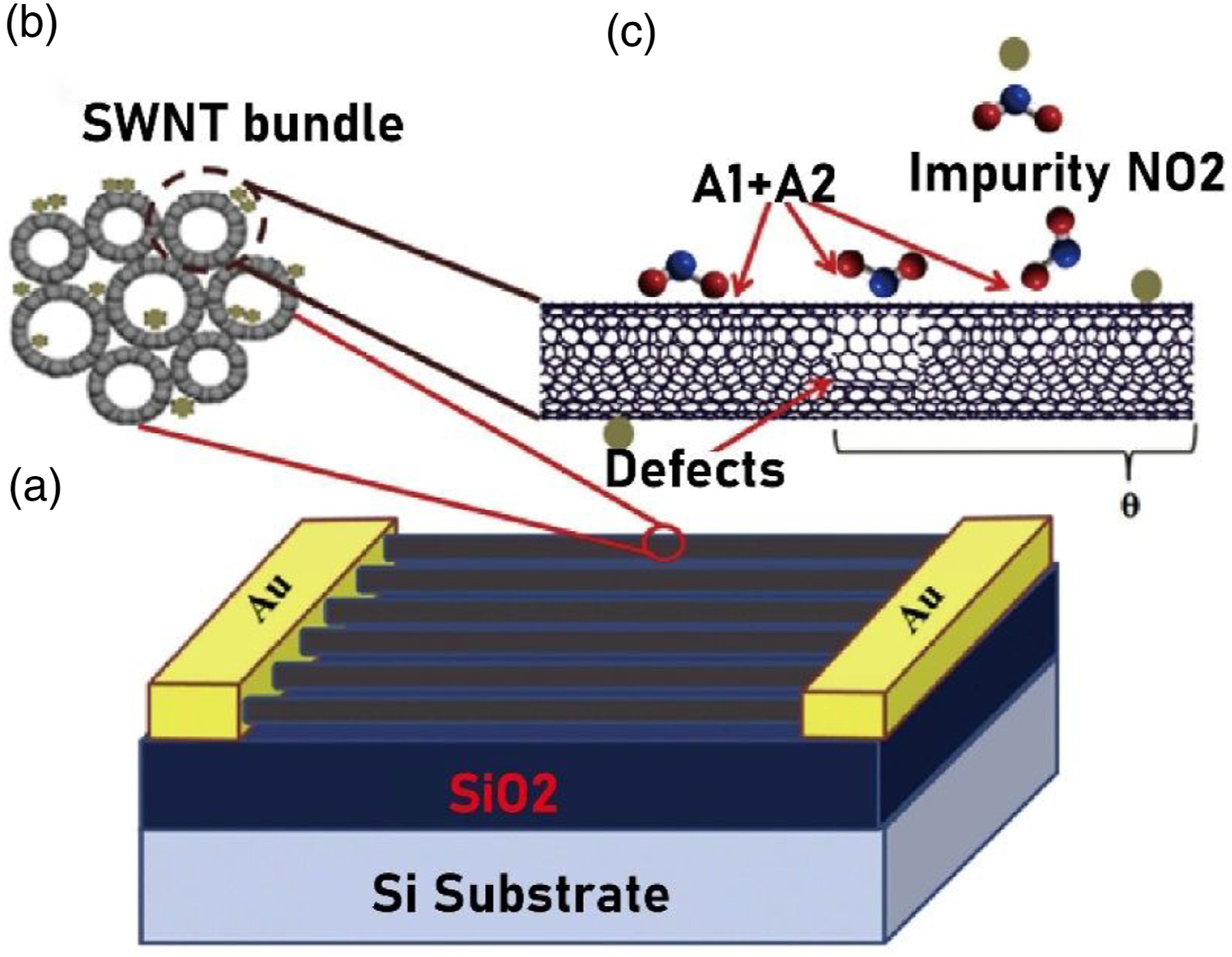
Recently, an economical spraying technique has been developed. Spray technology has gradually matured, providing a new low-cost solution for wearable explosive chemical-based detectors. This technique enables rapid coating of polymer solutions onto various substrates to prepare polymer films. Zhang et al. 55 utilized spraying technology to prepare polyaniline-coated filter paper and employed its flexible chemical sensor properties to create a detector capable of non-contact and rapid detection of nitroaromatic explosives.
Currently, many researchers are employing optical principles for explosives detection, which holds great promise for wearable explosives detectors. Optical sensors, with a focus on fluorescence-based detection, not only offer significant performance advantages but also lend themselves to easier integration into portable devices. 47 Metal-organic frameworks are composite materials that combine organic and inorganic elements, characterized by pores generated within the molecular structure through the self-organization of organic ligands and metal ions or clusters into a structured system via coordination bonds. Their photoluminescent properties make them particularly promising for chemical sensors. Hence, these materials exhibit great potential for chemical sensors. 56 Sun et al. 57 reported on a nanometer-sized pyrene-based fluorescent probe capable of rapidly detecting TNT in liquid media across various real-time detection environments. However, most nitrobenzene compounds emit extremely low concentrations of explosive gases. Consequently, gas sensors for such compounds exhibit poor reversibility, limited sensitivity, and lack reusability. Eduardo et al. 58 presented a molecularly imprinted polymer (MIP) sensor using silver nanoparticles (NPs) nanocomposites synthesized with MIP for selective detection of TNT. MIP possesses advantages such as low cost, easy preparation, and integration capabilities with portable equipment. However, it suffers from slow response times and limited application scenarios. To address these limitations, they incorporated CsPbBr3 nanocrystals into the MIP, resulting in a new sensor that achieves a detection speed of 3 s and can detect explosives at a concentration of 0.218 μg mL−1. 59
Physical type
Spectral analysis methods are the most common techniques used in physical detection. Previously, chemical detection methods were predominantly employed for on-site explosives detection. While effective, these methods require direct contact with explosives, posing a safety threat to personnel. Raman spectroscopy offers the advantages of rapid and accurate sample identification, as well as non-destructive detection through sealed containers such as vials or plastic bags, thereby reducing or eliminating the risk of exposure to hazardous materials for inspectors.60,61
Surface-enhanced Raman scattering (SERS) is an optical enhancement effect observed in systems with nanoscale rough surfaces or particles. It involves the adsorption of samples onto the surface of colloidal metal particles such as silver, gold, or copper, or onto the rough surfaces of metal sheets, enabling the use of conventional Raman spectroscopy methods. However, SERS has its limitations, and exploring the enhancement mechanism of SERS requires the preparation of SERS-active substrates. Portable Raman detection devices based on SERS have been developed for in situ detection, offering advantages such as sample preparation-free operation, high sensitivity, speed, and convenience compared to conventional methods.62–64
Given the wide variety and complex composition of explosives, it is necessary to explore different flexible detection devices for different components. TNT, one of the most well-known and hazardous explosives, poses environmental and health risks due to its stable structure. Gao et al. 65 developed a highly sensitive TNT detection method utilizing a novel flexible SERS substrate that provides uniform hotspots and enhances sensitivity.
A superhydrophobic bionic surface has been utilized as an active substrate for SERS, enabling the detection of the chemical composition of explosives. He et al. 66 reported the application of a superhydrophobic three-dimensional layered bionic Ag micro/nano-pillar array surface as a SERS backing. This substrate allows for reproducible detection of picric acid and 3-nitrophenol through a simple and efficient hydrophobic condensation strategy. To broaden the range of detectable substances, He et al. 67 developed an efficient method for preparing sensitive SERS substrates based on Ag-NP-modified ZnO-MNS heterogeneous silicon column arrays through grafting. Furthermore, these heterogeneous silicon column arrays can be employed to construct superhydrophobic detection systems for a wide range of explosives and their derivatives.
In addition to the aforementioned approach, there is a conventional type of flexible resistance sensor. Graphene and reduced graphene oxide (rGO) exhibit changes in resistance in the presence of various gases. Notably, rGO demonstrates highly conductive properties and experiences resistance changes upon contact with NO2. Since the explosive TNT and its precursor DNT contain NO2 groups, they induce a decrease in the resistance of graphene. Green et al.
68
developed a flexible resistance sensor for the detection of DNT and TNT using hydrazine graphene as a resistive layer. The conductive paste was prepared and applied onto channel circuit electrodes using a sprayer. Subsequently, a mobile detection platform straightforward electronics was created, as depicted in Figure 4. The electronic components and process details of a resistive sensor: (a) A conductive paste in the resin channel. (b) Flexible electrode. (c) Electrodes after removal of silver paste. (d) Portable electronics.
68
Copyright © 2020, Korean Society for Precision Engineering.
Body temperature detection
Body temperature is an obvious sign of health that points to the dynamic and complex pathological state of an individual. In the current pandemic, body temperature serves as a critical reference for initial medical diagnosis and evaluation, and is measured in various safety testing scenarios. Based on the signal transformation principle, there are various types of temperature detectors, including expansion type, pressure type, resistance temperature detector (RTD) type, thermocouple type, infrared detection type, and optical fiber temperature measurement. When considering usage, they can be roughly classified into three groups, including mercury glass thermometers, proximity-based sensors and touchless sensors. 69
Mercury glass thermometers operate based on the principle of thermal expansion and contraction, taking advantage of the linear relationship between the volume of mercury and temperature. Due to their high thermal conductivity, low specific heat capacity, and uniform coefficient of expansion, this type of thermometer offers a simple structure, ease of use, a wide measurement range, and relatively accurate readings. However, they have a lengthy measurement time, and the fragility of the glass poses environmental pollution and the risk of cross-infection as they require contact-based measurement. Therefore, they are not suitable for high-traffic security check areas. 70
Contact temperature type
Traditional thermocouples and RTD-type temperature sensors are known for being bulky and inconvenient to carry. However, there is an increasing demand for small and portable flexible temperature sensors to overcome the limitations of traditional body temperature measurement, which only allows for single-point measurements. 71
Contact flexible temperature sensors have been developed using thermosensitive materials that exhibit electrical signal changes in response to temperature variations. These sensors can be attached to clothing or applied to the skin. The resistance thermometer, a type of semiconductor resistance temperature sensor, shows an increase in current and a decrease in resistance with rising temperature, and vice versa. 72 By harnessing the resistance changes in conductive materials or surface charges in thermoelectric materials, flexible temperature sensors can be designed to offer high sensitivity, precision, and rapid response times.
In practical applications, flexible temperature sensors should possess desirable features such as high sensitivity, flexibility, and reliability. Achieving such high-performance sensors requires meticulous attention to materials and components.
73
Researchers have explored the use of various active materials, including graphene, carbon nanotubes, and multi-walled carbon nanotubes, as conductive fillers for these sensors. For instance, Huang et al.
74
demonstrated the feasibility of a single carbon fiber beam (CFB) sensor for external temperature detection by utilizing the principles of transverse piezoresistance and longitudinal thermal resistance. In their study, two CFBs of diverse dimensions were mounted into a flexible printed circuit board, serving as sensing layers. Furthermore, an integrated system was developed by incorporating this sensor into a glove, simulating a Chinese medicine pulse diagnosis method as shown in Figure 5.
75
Additionally, other researchers have also conducted new research in this field. Turkani et al.
76
proposed a novel conductive composite material and successfully fabricated a flexible nickel-based RTD on a flexible ceramic platform using a screen printing preparation process. Wearable temperature detection device: (a) Schematic diagram for the flexible sensor. (b) A glove equipped with three flexible sensors. All figures are reproduced from
75
under the terms and conditions of an open access CC-BY license agreement.
Currently, organic polymer materials such as polydimethylsiloxane, polyurethane, and polyimide are widely utilized for preparing flexible substrates for wearable contact temperature sensors. These materials exhibit excellent properties, including good stretchability, insulation, and chemical stability. Additionally, fiber materials offer advantages such as lightweight, affordability, and simplified fabrication processes, making them ideal for large-scale production of temperature sensors. Wu et al.
77
proposed a highly flexible multimodal electronic textile by utilizing functionalized silk-wound yarn and weaving technology. This innovative approach incorporates durable, thermally conductive, insulating, and biocompatible silk fibers, as shown in Figure 6. The temperature sensor developed in this study, embedded with a mixture of carbon nanotubes and ionic liquids, demonstrates outstanding temperature sensing performance and stability. Integration of this type of temperature sensor into gloves enables real-time monitoring of body temperature. Schematic diagram of temperature-pressure sensor: (a) Support yarn coiled with silk fibers. (b) Coating the yarn coiled with silk fibers with temperature or pressure sensing material. (c) Coating the functional yarn/fibrous sensor with a protective or dielectric layer. (d) Weaving the fibrous sensors into a combined two-layer multi-mode sensor textile.
77
© 2019 WILEY‐VCH Verlag GmbH & Co. KGaA, Weinheim.
In terms of fabrication, inkjet printing is recognized as an economically efficient method for manufacturing sensors on polymer substrates. Sui et al. 78 employed inkjet printing and plasma treatment techniques to fabricate silver-based thermistors on a polyethylene substrate. This flexible temperature sensor can also be configured as a wireless sensor by incorporating radio frequency identification technology. It not only possesses temperature detection capabilities but also enables real-time transmission of measurement data to compatible devices.
Non-contact temperature type
Non-contact temperature measurement is primarily achieved through heat and light radiation, utilizing radiation temperature sensors and optical thermometers. Radiation thermometers encompass two types: infrared and microwave radiation. Currently, infrared thermometers dominate the field due to their wide temperature range, rapid response, and high sensitivity, enabling accurate non-contact temperature detection. The underlying principle relies on the intensity variation of refracted light rays at different temperatures. The measured wavelength is converted into a corresponding electrical signal by a photodetector, and the controller calculates the average temperature and temperature distribution. 79
Flexible infrared electronic sensors find extensive applications in military and medical fields. However, many existing flexible optoelectronic detectors involve complex and expensive manufacturing processes, making them unsuitable for low-cost and convenient safety testing.
Dayeh et al. 80 empolyed a bridge structure surface micromachining technique to fabricate a thermal infrared sensor on a flexible polyimide substrate. They utilized semiconductor Yttrium Barium Copper Oxide, which is a radiation-sensitive material, to create a 1×10 mechanical infrared sensor array. This flexible infrared thermometer seamlessly integrates with textile structures. Sahatiya et al. 81 also utilized a flexible polyimide substrate and employed rGO and graphene flakes as sensing materials to enhance sensitivity. Their device exhibited high sensitivity to the human body and holds potential applications in safety monitoring. Additionally, it can be easily integrated into various surfaces, such as leaves, skin, paper, and clothing.
Pencil drawing has emerged as a popular and cost-effective method for fabricating novel optoelectronic detectors. Cao et al.
82
utilized subdimensional CsPbBr3 microcrystals, pencil graphite, and paper to prepare the active materials, electrodes, and substrates for a new optoelectronic detector configuration. Their experimental results demonstrated that this innovative optoelectronic detector achieved an impressive external quantum efficiency of up to 485% and exhibited a response at a low working voltage of 9V. Liu et al.
83
reported a novel type of flexible infrared optoelectronic detector utilizing liquid-exfoliated Bi2Se3 nanosheets as photosensitive materials, pencil graphite as electrodes, and paper as the substrate. The prepared optoelectronic detector demonstrated high photocurrent, outstanding responsivity, and enduring stability when exposed to 1064 nm infrared light. Furthermore, it exhibited good stability and durability under bending conditions, thanks to the utilization of a flexible paper substrate, as shown in Figure 7. Flexible infrared optoelectronic sensor: (a) Diagram illustrating the manufacturing process for directly depositing graphite and traditional Chinese brush on paper. (b) Diagram depicting the structure of the flexible sensor device. All figures are reproduced from.
83
under the terms and conditions of an open access CC-BY-NC license agreement.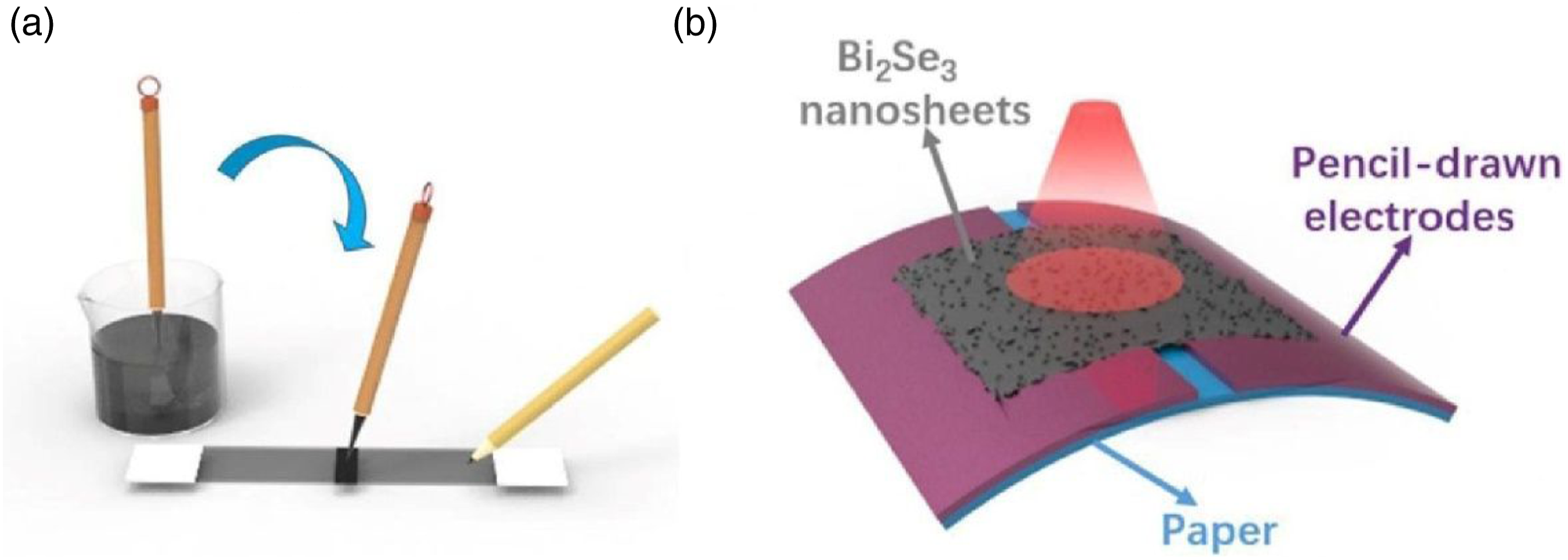
Hazardous chemicals detection
Dangerous chemicals, whether in liquid or gas form, pose a challenge when it comes to their detection during safety inspections. Prolonged exposure to these compounds can result in drug resistance, weakened immunity, and irreversible damage to human organs. Moreover, certain chemicals contain flammable or explosive components, thereby carrying the potential for severe consequences in public spaces. Thus, there is an immediate need to develop fast and sensitive ways for detecting hazardous chemicals.
Hazardous liquids type
The storage of liquid chemicals typically requires the use of solid containers due to their physical properties. To address this challenge, Chahadih et al. 84 proposed and validated an economical, highly sensitive X-band microfluidic sensor. This sensor comprises multiple short-circuited stubs coupled to a microstrip line, enabling the characterization of liquids from both chemical and biological perspectives. Manufactured on a flexible Kapton substrate using printing techniques, the sensor enables non-contact sensing with high speed and sensitivity through microwave detection. However, it should be noted that microwave detection is generally limited to plastic bottles and can be influenced by external pressure and detection location. To overcome this limitation, the dielectric constant can be employed as a measurement parameter. The principle involves applying an electric field to the target being measured and assessing the conductivity and dielectric constant of the liquid. Shi. 85 designed a capacitive sensor based on this principle, wherein the difference in dielectric constant is reflected in the capacitance value. Shi's study focused on a capacitive sensor and its corresponding detection circuit capable of distinguishing water from other flammable and explosive liquids. However, it should be noted that the measurement of dielectric constant is subject to electromagnetic shielding effects when applied to metallic containers, making it suitable only for non-metallic containers holding liquids.
The accuracy of detection can be compromised by interfering substances such as metals and organic elements when detecting hazardous liquids inside the container. Therefore, for precise detection of the hazardous components, it is necessary for the dangerous liquids to come into direct contact with the sensing device. Contact detection methods are based on the principles of biosensors, which typically consist of a bio-recognition element and a signal transducer. Bio-recognition elements can be enzymes, enzyme components, organisms, tissues, cells, antibodies, nucleic acids, organic molecules, or other substances that selectively interact with the target substance, thereby identifying it. The signal transducer's primary function is to convert the physical and chemical effects resulting from the interaction between the bio-recognition element and the target substance into an output electrical signal. Mahmoudpour et al.
86
employed gold@silver modified graphene quantum dot nano-ink to create conductive patterns on rubber gloves, enabling the design of an intelligent glove capable of highly sensitive detection of the pesticide fluometuron. This glove allows for the analysis of pesticide components on the surfaces of leaves, apples, and in liquids through touch and immersion, as shown in Figure 8. Conductive inks based on carbon and metal nanoparticles offer excellent conductivity, low toxicity, affordability, and biocompatibility, which make them widely used in the design of wearable sensors. These glove-type sensors have the potential to be utilized for all-in-one detection of other hazardous chemicals and can be extended to liquid and environmental samples. Schematic diagram of the fabrication process of glove-based wearable sensing systems based on core-shell Au@Ag/GQDs nano-ink.
86
© 2021 John Wiley & Sons Ltd.
Furthermore, nanocomposite-based molecularly imprinted electrochemical sensors have gained significant attention in pesticide detection. 87 Karimi et al. 88 developed core-shell Co3O4@MOF-74 nanocomposites and demonstrated that these sensors exhibit high sensitivity and excellent electron transfer rates for the detection of the organophosphorus pesticide fenami.
Hazardous gas type
Compressed and liquefied gases, due to their flammable components, pose significant safety hazards in air and high-speed rail transportation.
In the past, gas detection techniques such as gas transconductance, optical, thermal, and chromatographic methods were predominantly fabricated on rigid substrates, requiring large detection systems and complex operations. In contrast, wearable gas detectors offer real-time detection of dangerous gases in a portable, convenient, and economical manner. These devices find extensive applications in environmental, medical, and food sectors. In safety detection scenarios, individuals may carry such gases in canisters, posing a threat to public environments. Wearable gas detectors can play a crucial role in real-time detection of these hazardous gases. 89
Wearable gas detectors are typically designed to be worn on the skin or integrated into clothing and accessories to ensure portability. 90 These devices consist of a stretchable elastic substrate, sensing elements, and gas-sensitive materials. The gas-sensitive material interacts with harmful gases in the surrounding environment, leading to changes in the physical and chemical characteristics of the sensing material, which are then converted into readable signals.
One category of hazardous gases includes gaseous pollutants that pose a threat to human health, such as NO2, SO2, NH3, H2S, CO, NO, etc. 91
NH3 has been classified as a hazardous gas that threatens aquatic life in water and can also be harmful to human organs. 92 Therefore, it is crucial to develop a wearable gas sensor with high sensitivity for NH3. 93 Lee et al. 94 designed a chemical sensor consisting of rGO and organic dye molecules to provide high mechanical flexibility. They utilized a flexible PET substrate, and the resistance of the sensor increased with increasing NH3 concentration, showing a response at a concentration of 5 ppm. This sensor can be integrated into wearable devices, such as the human hand. Most NH3 wearable detectors require an external power supply, limiting their wearability. Wang et al. 95 developed a friction self-powered sensor. They established a theoretical model and verified the feasibility of self-powered sensing behavior using the finite element method.
Flexible devices specifically designed for NO2 detection have already been developed through research. Conductivity is a crucial factor for electronic textiles as it affects their sensitivity. To achieve highly conductive flexible gas sensors, Lee et al.
96
designed a dopamine-graphene hybrid electronic yarn, using dopamine as a biomimetic adhesive to attach graphene to the yarn’s surface. Compared to traditional graphene-based electronic yarns without adhesive, it exhibited better conductivity and electric performance in terms of reaction time, clarity, and detection of NO2. To further enhance its performance, Lee et al.
97
wove the flexible one-dimensional graphene-based electronic yarn into a pattern, forming a two-dimensional sheet. They fabricated a polyester sheet with a uniform grid pattern and applied a graphene-based electronic sheet (GES) onto it, as shown in Figure 9. The two-dimensional graphene-based electronic sheet demonstrates high conductivity and higher sensitivity to NO2 and NH3. A prospective outlook on the utilization of GES includes: (a) Implementing an LED-based alert system for detecting NO2 gas leaks along gas pipelines in industrial regions. (b) Developing a wearable breath sensor for monitoring or diagnosing diseases by analyzing the breath of patients.
97
© 2021 Elsevier B. V. All rights reserved.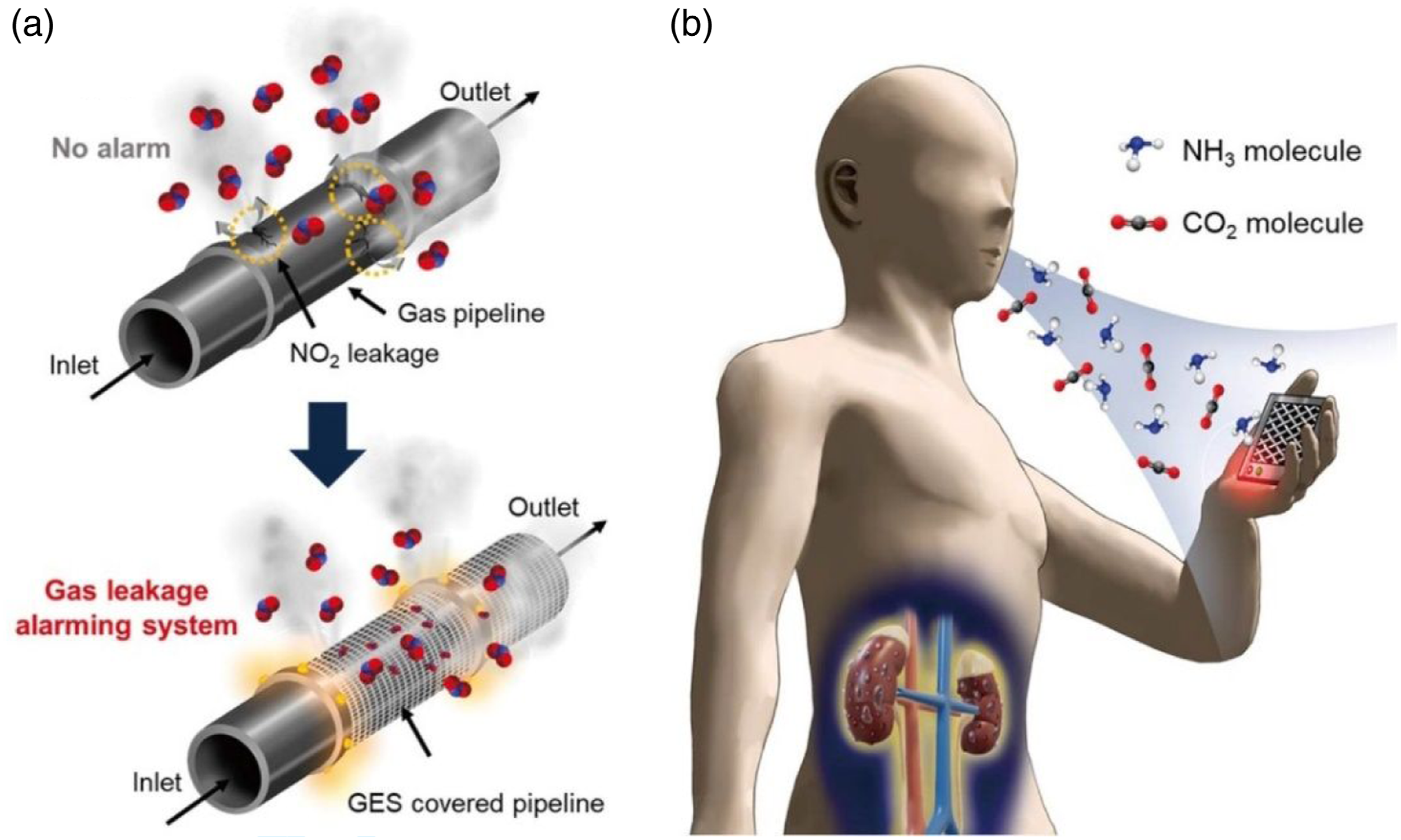
H2S is an extremely hazardous gas that is highly corrosive and flammable, posing significant risks to human health. Zheng et al. 98 developed a novel colorimetric chemical sensor capable of detecting H2S at concentrations below 1.2 μm within 15 s, demonstrating fast and highly sensitive detection. Furthermore, the researchers applied this sensor to coat paper strips and dye nylon textiles, highlighting its potential for wearable applications. To further explore the possibilities of converting such gas sensors into breathable and washable wearable e-textiles, Zhang et al. 99 fabricated a flexible gas sensor primarily used for detecting H2S.
In terms of manufacturing technology, this sensor combines NO2-UiO-66 with electrospun nanofiber membranes. It exhibits improved surface properties, washability, and suitability for conversion into wearable products. Notably, it achieves low concentration detection and demonstrates high sensitivity.
The detection of liquefied gases, including corrosive chemical reagents like strong acids and bases, can be effectively achieved using colorimetric sensors. This non-invasive method detects the presence of danger through color changes. Colorimetric analysis, also known as spectrophotometry, is based on selective absorption of light by a solution. The color of the colorimetric sensor darkens with increasing concentration, allowing for the distinction of hazardous properties based on the unique characteristics of liquefied gases. Hong et al. 100 prepared a continuous halochromic fiber that retains pH sensing properties even under constant contact with chemical and physical stimuli. Through the manipulation of the outermost layer of the fiber with phosphate and the incorporation of a dye capable of detecting both acid and base into the fiber pore, this approach facilitates the development of salt-responding fabric sensors suitable for practical security inspection work. Giannakoudakis et al. 101 developed a nanocomposite material with non-uniform pore size by combining Cu-BTC and g-C3N4-ox, which was then deposited on cotton fabric to create an intelligent textile with colorimetric sensor and detoxification capabilities. Due to the high corrosivity of strong acids and bases, Ma et al. 102 developed a class of all-fiber single-electrode triboelectric nanogenerators with a core-shell structure. This design not only exhibits high sensitivity to corrosive liquids such as acids and bases but also enables the detection of sudden chemical gas leaks.
Conclusion
This article provides a conclusion on the current developments in safety detection methods, with a specific focus on their application in intelligent wearable textiles. It identifies key technologies and explores future possibilities for safety detection using smart textiles.
In the domain of metal detection, the integration of micro-electromagnetic induction electronic components into textiles is possible through heterogeneous system integration technology. However, the current level of integration is generally low, and existing inductive flexible non-contact sensors are primarily used in medical monitoring, wireless data transmission, motion, and gesture capture systems. To apply metal detection in smart textiles, modifications to the internal circuit, enhancement of the detection coil, or the replacement of rigid circuit boards with flexible ones can be explored based on the electromagnetic detection principle of metals.
On the other hand, the detection of explosives is time-consuming and relies on complex and sophisticated experimental equipment. Integration with textiles is challenging due to the complexity of the system. However, the analysis of gases and residues released by explosives can be used to detect them through the use of electrochemical and resistance-type flexible sensors. By combining these sensors with textiles, fast and real-time detection of explosives can be achieved.
In the field of healthcare, resistance-type flexible temperature detection technology has witnessed significant development. However, it typically requires direct human interaction and is more suitable for long-term monitoring rather than real-time acquisition. For safety detection using smart textiles, flexible infrared detection is the primary technology for fast and non-contact real-time detection.
Regarding hazardous chemicals, they are classified based on aviation and high-speed railway standards for prohibited items, encompassing a wide variety of types and technological differences. Most hazardous chemicals cannot be seamlessly integrated into smart textiles. However, some progress has been made in liquid pesticide detection and the detection of liquefied gases.
Looking ahead, the development of smart textiles for safety detection would benefit from the availability of conductive or semi-conductive materials with adjustable conductivity. These materials should be easily integrated into textiles without compromising their inherent properties. Additionally, there is a need to expand the range of flexible electronic components to accommodate the demand for non-contact detection in safety applications.
Footnotes
Declaration of conflicting interests
The author(s) declared no potential conflicts of interest with respect to the research, authorship, and/or publication of this article.
Funding
The author(s) disclosed receipt of the following financial support for the research, authorship, and/or publication of this article: This work was supported by the National Natural Science Foundation of China under Grant 52105153, the Natural Science Foundation of Jiangsu Province under Grants BK20221378, the Natural Science Foundation of Jiangsu Higher Education Institutions of China under Grants 20KJA540001, 21KJA490001, and 22KJA540001, Science and Technology Project of Nantong City Grant MS12021005, MS22021003, and JB2022004.
