



Abstract
Terahertz (THz) nondestructive testing has emerged as a promising tool for public security check due to its superior detection accuracy and sensitivity for hidden objects under clothing. However, it is unknown if material composition and textile structure of clothing will influence the THz spectrum of the hidden objects. In this paper, the THz time domain spectroscopy (THz-TDS) was used to detect several natural and artificial fabrics containing pure amino acids with characteristic absorption peaks between 0.2 and 1.6 THz. The results show that the absorption peaks of AAs of various cloth materials have different degrees of decrease and redshift. In addition, the absorption peaks of the THz spectrum disappear when the textile structure is destroyed. Moreover, the simulation results also verify that the textile structure has an obvious effect on the THz field distribution. In this sense, it is necessary to analyze the material composition and textile structure when detecting hidden objects under clothing using the THz signal.
Introduction
With the broadening and deepening of the understanding of terahertz (THz, frequency range, 0.1–10 THz) electromagnetic wave, 1 new spectral detection technologies are emerging. 2 Due to its advantages of low energy without ionization damage, considerable penetration depth and broadband and high sensitivity with unique spectral characteristics in the detection of material composition, THz electromagnetic wave shows great potential in the application of nondestructive testing (NDT) and security check. 3 A number of studies regarding NDT of fiber composites using THz time domain spectroscopy (THz-TDS) have been conducted. Rutz et al. 4 examined and described the fiber orientation of composites by using THz-TDS. Ryu et al. 5 successfully detected, localized and evaluated hidden multi-delamination defects (i.e., a three-level multi-delamination system) in multilayered fiber composite laminates. Wang et al. 6 employed THz-TDS technology to detect hidden inclusions of various shapes and materials in fiber composites. Moreover, it is known that the THz imaging system has been employed in security screening to detect and identify the threats of dangerous goods carried by individuals. Gombo et al. 7 used the THz sensing technique to realize the real-time visualization of the threats hidden under the clothes of people. Knipper et al. 8 investigated the influence of moisture content of outer textile clothing on the detection of inner hidden objects by the THz absorption spectrum. Zhang et al. 9 identified hidden contraband based on the contrast of imaged targets in the THz band, and suggested that different clothing textures lead to a diversity of high-contrast detection frequencies within the THz band. However, they did not delve into how material composition and textile structure of clothing affected the inner hidden objects. Actually, for a long time, more attention has been paid to the detection and classification of THz spectral characteristics of pure samples. But in the actual environment, objects are packaged. Since the accuracy of THz detection is strongly affected by the measurement environment, for better application, it is essential to clarify the influence of packaging on spectral detection results.
Generally, THz has low absorption in nonconducting materials, such as plastic, paper, and cloth.10,11 Among them, the THz absorption of plastic always shows an extremely low value and monotonic change, and is considered to have little influence on characteristic absorption peaks when detecting THz-based materials, and plastic is usually used as a sample holder in THz-NDT experiments.12,13 Besides, some research has reported that different types of fibers, such as cellulose fibers, wool fibers, and some chemical fibers, have unique fingerprints of absorption spectra.14–16 Moreover, the conclusions on the THz spectral characteristics of the fabrics woven with the same fiber are not consistent.14,17,18 Cloth is usually used as a packaging or clothing material. Since those mixed substances with different THz fingerprints would cause THz spectral characteristics to interfere with each other, 19 the absorption peak curves originating from packaging and clothing would interfere with the absorption fingerprints in the THz frequencies of concealed objects during NDT, which would restrict the application of this approach in the actual security check. But there are few reports on the impact of packaging on the THz spectrum.
To clarify this issue, this paper intends to combine experiment with the numerical analysis method.20–22 Systematic detection and analysis of the THz spectrum of different textiles were carried out, and then the targeted wrapped objects were tested by using amino acid (AA) to reveal the effect of fabric packaging on absorption characteristics. Moreover, a preliminarily finite-difference time-domain (FDTD) simulation was performed to calculate the electromagnetic field distribution of the THz wave after passing through the reticular structure of cloth using an adaptive mesh.23,24 At 0.2–1.6 THz, the absorption spectrum of standard samples of different kinds of woven textiles had various absorption peaks. And changes could often be seen in the distribution characteristics of peaks on the absorption curves of corresponding actual samples. Besides, not all these characteristics were supported by the previous reports. Furthermore, the absorption coefficients of the tablets prepared from cloth powder and pretreated by liquid nitrogen with freeze-grinding did not show any characteristic peaks. When testing the composite structure by combining the AA tablets with the cloth, the frequent location of the absorption peaks of AA showed displacement, as sometimes new features would appear and sometimes the supposed features of AA would disappear. Moreover, multi-layer packaging has a more obvious effect than single-layer packaging. These experiment results have revealed that the fabric package can affect the THz absorption spectral characteristics of concealed objects and the possible interference in the process of NDT and security check should be carefully considered.
Materials and methods
Cloth, fiber tablet, AA and THz system
There are two major types of samples in this paper. First, standard and actual cloth samples were provided and identified by the National Center for Quality Supervision and Inspection of Clothing and Household Textile Products (Chongqing), including eight kinds of natural/artificial standard fabric samples (cotton, linen, woolen, silk, viscose, dacron, acrylic, and chinlon) and several cotton actual samples (see Supplementary Figure S1). Second, the fiber powder tablets were prepared to further understand the effect of fabric structure on THz spectrum. About 0.2 g fabric from the corresponding cloth was cut into pieces and placed in a grinding machine. And then, liquid nitrogen was added to make it easier to grind the fabric into powder. The AAs, such as leucine (Leu), isoleucine (Ile), phenylalanine (Phe) and polyethylene (PE) were purchased from Sigma-Aldrich (St Louis, MO, USA). About a total of 50 mg powder, including pure fabric powder, or PE and AA mixture powder (radio 1:1), was put into a mold with parallel and smooth sides. Tablets with a diameter of 15.0 mm and a thickness of around 1.0 mm were prepared by a tablet machine. The thickness of each tablet was measured accurately by a spiral micrometer. (Figure 1) In order to avoid the effect of the moisture on the hygroscopic fibers, these samples were stored in the drying cabinet after drying in the oven at 40°C. Composite photograph of fabric samples: the bottom layer is a complete presentation of the standard fabric; the mesosphere is a microscopic view of the standard textile, and the millimeter-scale structure of the fabric can be observed; the top layer is an image of the standard fabric that was ground and pressed into a tablet.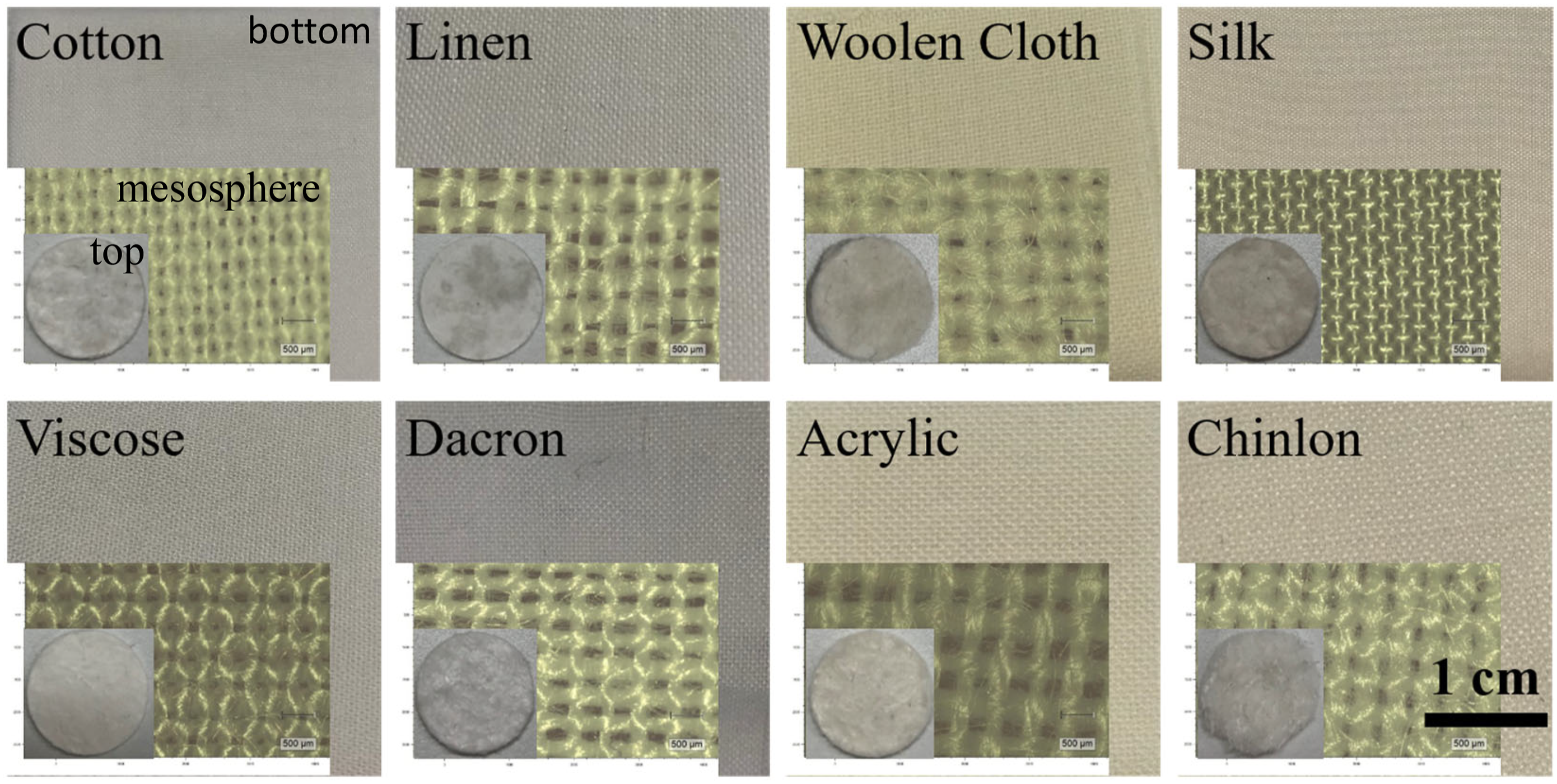
THz spectral measurements were performed using a Picometrix T-ray 5000 fiber-coupled THz time-domain spectrometer (THz-TDS, Advanced Photonix, Inc., MI, USA) in transmission mode. The spectrometer used femtosecond near-infrared laser pulses and LT-InGaAs photoconductive antenna chips to generate and continuously detect the electric field of ultra-short THz electromagnetic pulses in the time domain, and more details could be obtained from previous reports. 25
Testing flow and data analysis
The THz experimental measurements were conducted at an ambient temperature of 21.0 ± 0.4°C and at a relative humidity of around 50.0% representing normal indoor environments. This kind of test condition was more consistent with the daily testing environment. The effect of water vapor on the THz absorption peak was also excluded in the subsequent analysis.
The single-layer standard and actual cloth samples were tested first, and then the powder tablets were successively measured, and finally the cloth and pure AA tablets were placed together (including single-layer cloth and multi-layer structure) for measurement. The schematic diagram of THz-TDS, the real test instrument of THz-TDS, the real grinding machine, and the real tablet machine are shown in Figure 2(a)–(d), respectively. The standard testing process followed that in the previous study.
26
In order to obtain correct transmission spectra and prevent scattered radiation from reaching the detector, an iris was placed between the sample and the detector. THz time-domain waveforms of the sample and the reference (air blank background) were measured under the same experimental conditions. The frequency-domain spectra of measured signals were obtained by Fourier transform (FT). The effective frequency region was 0.2–1.5 THz for THz-TDS measurements. The spectral frequency resolution of the spectrometer is 12.5 GHz. (a) The schematic diagram of the THz-TDS and the sample, (b) the real experimental diagram of the THz-TDS, (c) the real grinding machine, and (d) the real tablet machine.
The THz optical refractive index

The absorption coefficient

Results and discussion
THz absorption curves of cloth samples have structure-induced peaks
There are usually no characteristic peaks appearing in the absorption curves on macromolecules in the THz band due to the overlap and average of various molecular vibration modes.
28
However, as can be seen from the measurement results, the absorption curves of these standard cloth samples did not change monotonically but showed some peaks; the peaks did not locate in any absorption windows of vapor or originate from the total internal reflection (Figure 3(a)).
29
In order to further understand the nature of these spectral characteristics, more actual samples, such as different pieces of cotton cloth were tested, but the features were not completely consistent with those of the corresponding standard samples (Supplementary Figure S2). The absorption coefficients of (a) standard cloth samples and (b) pressing tablets of fabric powder.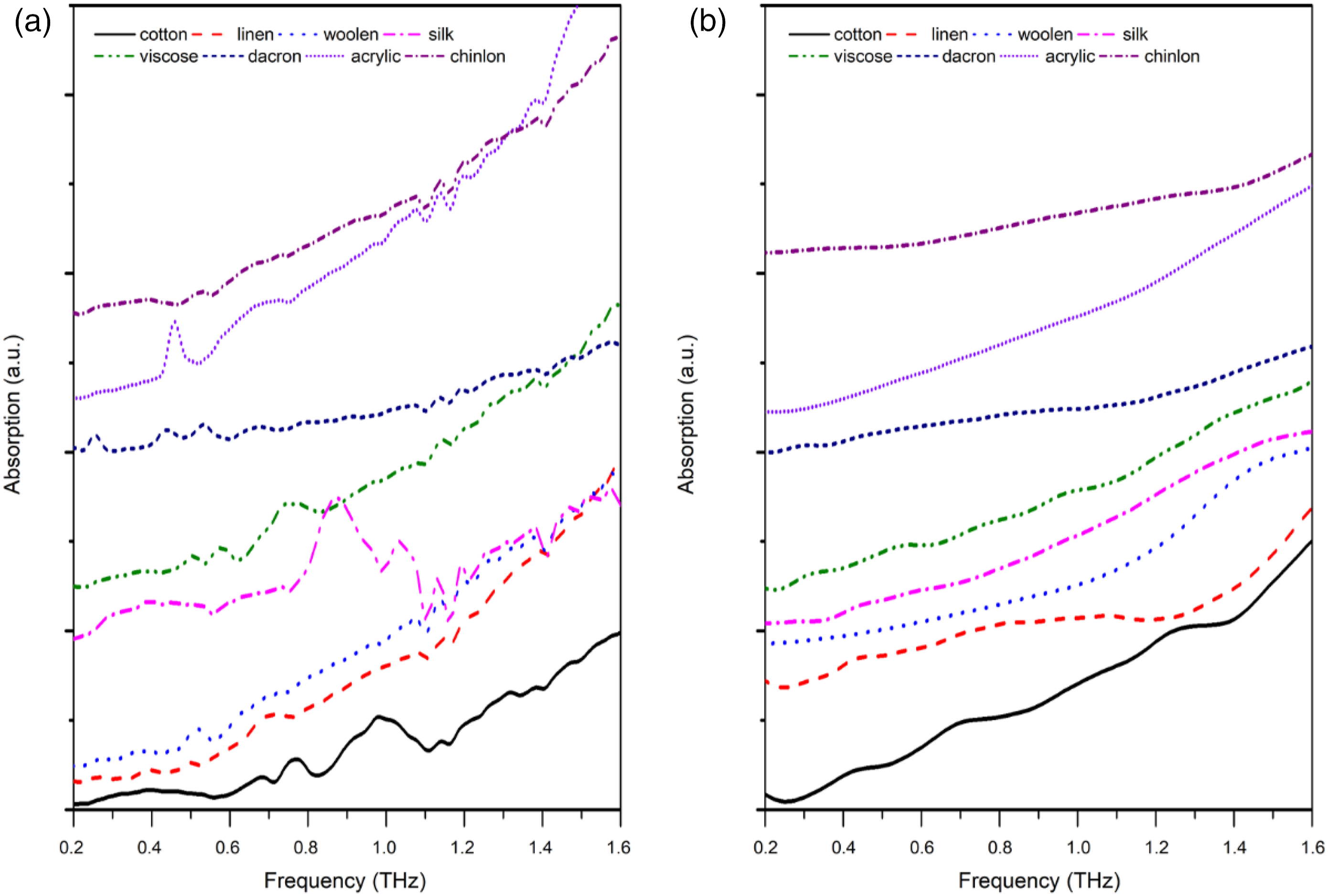
As is known, when the width of the hole or the size of the obstacle is similar to or smaller than the wavelength, obvious diffraction phenomena could be observed. 30 Since cloth is made of yarn, many holes of different sizes are apparent on the cloth concerning the density and weaving methods of the cloth. As can be seen from Supplementary Figure S3, the diameter of the hole on the cloth is similar to the THz wavelength, and that could lead to diffraction. Besides, when measuring the transmission of THz wave in carbon fiber and glass fiber, the arrangement direction of fiber in the sample affects the THz spectral characteristics of the fabric, which suggests that the texture structure impacts the spectral absorption characteristics and forms some structure-induced peaks.29,31 Accordingly, it is speculated that the absorption curves of cloth samples might be a certain factor affected by the higher-order structure of textile weaving. In order to confirm this conjecture, the fiber powder tablets without grid structure were prepared and tested. As expected, the absorption peaks disappear, and only a monotonic increase of both the absorption coefficient and the frequency can be observed, as shown in Figure 3(b). The absorption increases with growing frequency. The reason is that with the increase of the frequency, the THz wavelength is reduced, making THz wave easier to be blocked and absorbed.
Furthermore, the absorption coefficient values of cloth all distribute in the range of 20–30 cm−1 at 1.0 THz and the refractive index values are about 1.2 (Supplementary Figure S4 and Supplementary Table S1), which are close to the general values of other solid materials. The differences in numerical values of the average refractive index values among different pieces of cloth are limited and most of them are between 1.2 and 1.3. Comparatively, the absorption values of powder pieces are obviously smaller than those of corresponding cloth, which might be attributed to the elimination of the diffraction effect.30,32 Additionally, the refractive indexes of different tablets demonstrate bigger value and variation than those of the original cloth (Supplementary Figure S4). The reason may be that these fiber powder tablets are more compact compared with cloth, making the proportion of air lower and the air show the lowest refractive index. 12 The relationship between the disappearance of the THz characteristic absorption peak and the destruction of the fabric structure showed the potential effect of the fabric structure on the THz spectrum.
To further understand the influence of the cloth structure on THz absorption spectra, a preliminarily FDTD simulation was carried out to calculate the electromagnetic field distribution of THz wave after passing through the reticular structure of cloth samples using an adaptive mesh. In this simulation, the refractive index of cloth was set based on the above experimental results and on the cloth parameters obtained under visible light, and a net interwoven model with warp and weft was established with a plate without such a structure as a control comparison. The electromagnetic wave propagation was simulated based on the Perfectly Matched Layers (PML) boundary condition. The line width of the structure was set to 130, 150 and 170 microns, and the corresponding gap side lengths were 70, 50 and 30 microns, respectively. The simulation results indicated that the hole of the cloth influenced optical transmission to some extent, which resulted in uncertainty in measuring the electric field distribution with the receiving end and was related to the size of the hole (Supplementary Figure S5). It might be the possible reason for the diversification of absorption curve patterns.
THz absorption spectroscopy features of concealed objects would be affected by fabric package – a case of AA
Recently, THz spectroscopy has shown great application potential in distinguishing chemical materials hidden under packages or clothing without ionization damage. 33 But little research attention has been paid to the impact of the package or clothing on fingerprint spectral diagnosis, and studies on the influence of the outer package on the qualitative and quantitative analysis of THz were very scarce. 34 To analyze this impact, AA model samples with obvious absorption peaks were used to simulate the real scene.
By and large, the additional cloth exerted some effects on the characteristic absorption peaks of AA (Figure 4). The main features in the absorption curves of the model sample Ile, Leu and Phe correspond almost exactly to those in previous reports.
35
After adding a layer of cloth, the absolute frequencies of most of the main characteristic absorption peaks showed no movement or little redshift. It is noteworthy that there is usually peak dwarfing in the THz absorption curves. Also, some peaks with new relative positions and combination modes were detected. Besides, in a few cases, the absorption peaks almost disappeared, such as the one appearing in the spectrum of Leu at around 1.46 THz. In short, when testing co-existing AA and cloth, although the main features still exist, the comprehensive change of peak number and position would affect the judgment on AA based on the THz absorption curves. The THz absorption curves of (a) Ile, (b) Leu and (c) Phe with fabric clothes, including cotton, linen, woolen, silk, viscose, dacron, acrylic and chinlon.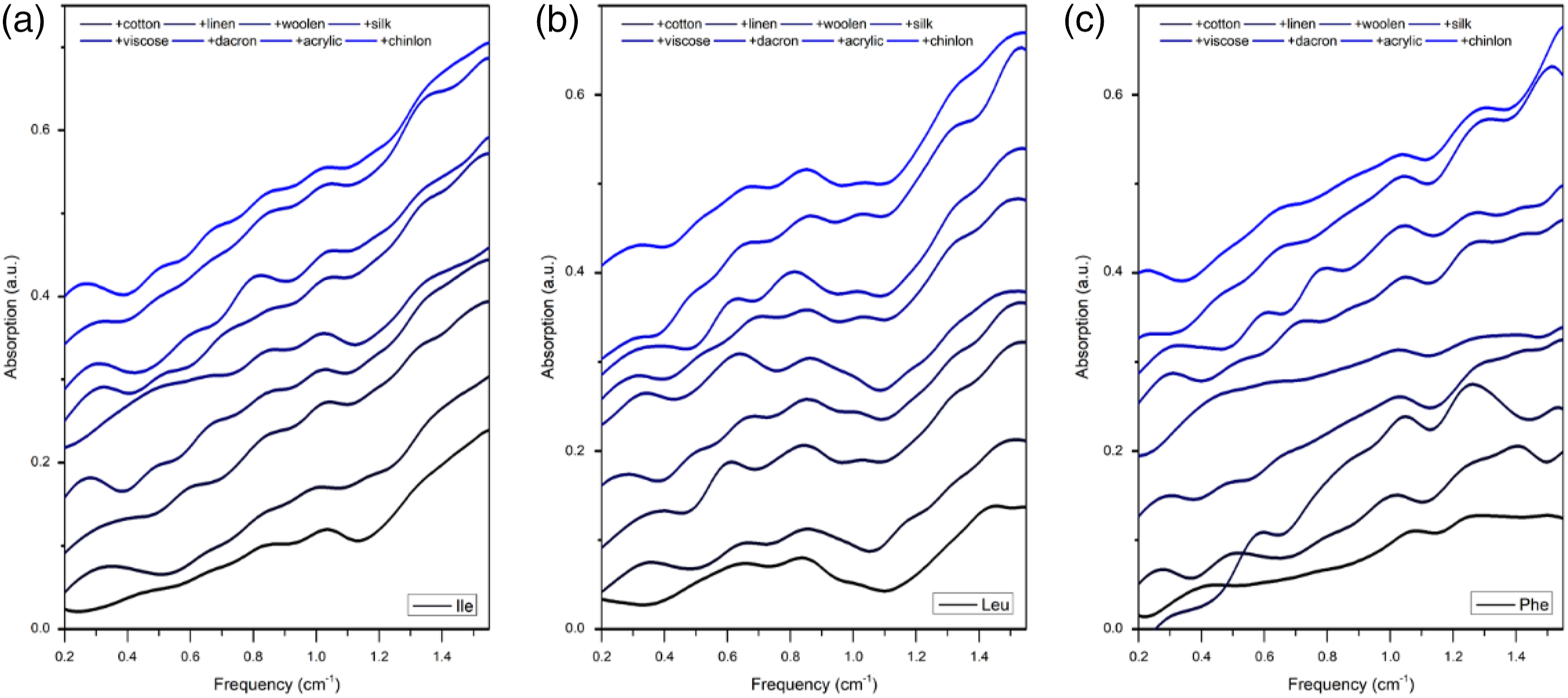
There are many factors affecting the propagation characteristics of THz wave and changing THz characteristic absorption peaks. Basically, a decrease in the relative content of the testing substance would reduce the height and sharpness of the absorption peak. 36 The absorption of cloth had a significant increase compared to that of the air, and it appears in the light path, which would produce an energy transmittance reduction. This was the possible reason why the cloth-based packages would lead to similar effects as diluted AA content, such as peak dwarfing. Especially, the increasing THz frequency would lower the signal-noise-radio, and cause the small absorption peak to hide in the large envelope. It might also be shown as the disappearance of some peaks sometimes. 37 Considering the poor signal-noise-ratio in both low and high-frequency bands, the useful signal measured in this paper was intercepted at 0.2–1.6 THz to ensure the signal quality. Furthermore, the reflection inside the medium would cause periodic oscillation of the absorption curve at THz radio, which is similar to that of the scattering phenomenon.26,27 The above might be the possible triggers of the new peaks in the THz absorption curves. Besides, different research reports sometimes would show slight differences in the frequency of the THz characteristic absorption peaks of the same materials, which probably stemmed from the complex vibration modes affected by the sample properties and the experimental environments.35,38,39 For these reasons, the influences of the outer package on the detecting and distinguishing process cannot be ignored, and the combination and relative position of these characteristic absorption peaks might be selected as a key index in the THz-NDT.
Generally, textile is easy to deform, and the structure of warp and weft usually appears differently in weaving patterns. Moreover, packaging such as bag, box or cloth is made up of at least two layers of textiles. In order to be closer to the testing reality, more experiments were designed to investigate the influences due to the interacting angle between the THz wave and the sample, the layer number, and the differences between and within material categories, etc.
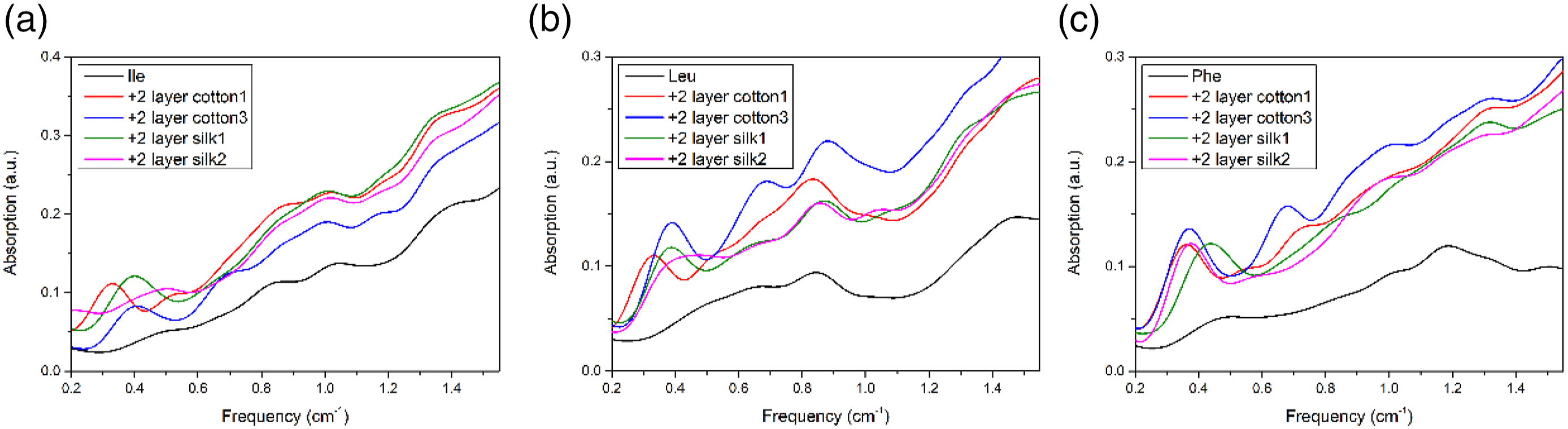
When changing the intersecting angles between the propagation direction of the THz wave and fabric longitude and latitude, three kinds of AAs retained the main features in the THz absorption curves, with only some distinct feature changes detected at the low frequency around 0.4 THz. For the same kind of samples, the change trends of absorption curves obtained under different angle conditions were usually divided into two cases, similar change trends of the same group or generally different trends of two groups (Figure 5). For example, the former case included Ile and Phe with actual cloth sample cotton 1 and the latter included Ile, Leu and Phe with actual cloth sample silk 2. Compared to single-layer cloth, the multi-layer structure brought greater impacts (Figure 6). At around 0.4 THz, there appeared new peaks in all these absorption curves of the testing samples. Additionally, there were also some other peaks appearing at different frequencies in the curves for each AA, and different actual samples have different results. In addition, when increasing the number of layers of cloth, the adjacent characteristic absorption peaks of AAs gradually merge into an envelope, including the peaks at 0.85 and 1.08 THz in the absorption curve of Ile, 0.68 and 0.85 THz to Leu and 1.23 THz to Phe. Although the main features are retained, the additional fluctuations on the curve would have a great impact on the judgment. Furthermore, unlike the characteristic absorption changes of different AAs under the same testing conditions, to Ile and Leu, the principal characteristics remain intact, but some tiny changes often occur in other parts of the curve. But to Phe, there are much greater changes in the THz absorption curve, and the main peaks at higher frequency were almost invisible (Figure 5 and Figure 6). In short, the influence of packaging on the THz spectral characteristics of its contents is related not only to the packaging material but also to the sample itself. The THz absorption curves of AA tablets with various fabric clothes under different included angles, (a) Ile with cotton, (b) Ile with silk, (c) Leu with cotton, (d) Leu with silk, (e) Phe with cotton and (f) Phe with silk. Sequence number 1 and 2 represent two different actual fabric samples in the same kind of cloth. The THz absorption curves of AAs with several layers of different kinds of fabric clothes, (a) Ile, (b) Leu, (c) Phe with two-layer cotton and silk cloth, and (d) Ile with different layers of cloth, with the number representing different samples. Cotton 1, 3 and silk 1, 2 represent different actual cloth samples.
The structure constructed by longitude and latitude lines in cloth was very like the THz metamaterial, causing the resonances in THz absorption and influencing absorption peaks, which would be one of the main reasons for the phenomenon and was affected by the structural shape parameters. From the simulation results and theory, the characteristics of radiated THz wave have different diversification when the parameters, such as the size and deformation angle of the hole on the cloth, which would cause the various peak distribution patterns in the curve to different samples. 40 When the complexity and diversity of real structure in the actual cloth samples were enhanced with different THz fingerprints, new THz spectral characteristics 19 and the diversification of patterns would emerge. Furthermore, the effect of layer differences in the THz transmission was also observed in carbon-fiber-reinforced plastic. Due to the carbon-fiber-reinforced plastic acting as a Fabry-Pérot cavity for the THz wave, there were some resonances in various frequencies, which would result in formant generation. 27 Generally, the increasing frequency would increase the energy loss continuously, leading to the relatively lower signal-noise-radio in the higher frequency of THz wave and more susceptible to external factors.1–3 When the absorption peaks of Phe located at a higher frequency, the influence of cloth packaging on Phe identification through THz-TDS is much greater than that of Ile and Leu.
Conclusion
In this study, THz-TDS was used to detect the THz spectral characteristics of representative cloth packaging and its influence on the THz spectrum of internal inclusion. The THz absorption curves of different fabric clothes have obviously different characteristic peak distributions, and the THz absorption curves of the same fabric from different manufacturers are also different. However, the absorption peaks on the THz absorption curve disappear when the fabric structure is damaged. According to the simulation results, the structure of heterogeneous media will affect the propagation characteristics of THz waves and the characteristics of absorption curves. The THz characteristic absorption peaks of the inner concealed object are affected to some extent when the cloth is used to simulate the packaging and the AA is used to simulate the inner objects. The results show that the absorption peaks of AAs have different degrees of redshift and peak dwarfing when the AA tablets are coated with a single-layer cloth. After the AA tablets are wrapped with two layers, their main characteristic absorption peaks show more marked changes, some new characteristic peaks appear, and some adjacent characteristic absorption peaks merge into one. In conclusion, the outer wrapping cloth can seriously interfere with the characteristic absorption peaks of the inner objects and impact NDT. However, further analysis is needed to recognize the underlying causes. Combined with large sample test result data sets, certain mathematical tools and machine learning recognition technology, 41 THz-TDS still has the potential to identify targeted objects theoretically.
Supplemental Material
Supplemental material - Study on terahertz spectrum variation of inner package with different wrapped objects
Supplemental material for Study on terahertz spectrum variation of inner package with different wrapped objects by Jie Wang, Shihan Yan, Liang Peng, Hua Zhang, Long Sha, Hao Wu and Xuan Xiao Zhang in Journal of Industrial Textiles Journal
Footnotes
Acknowledgements
Special thanks to the essentialslink for polishing the language.
Author contribution
The manuscript was written through contributions of all authors. All authors have given approval to the final version of the manuscript.
Declaration of conflicting interests
The author(s) declared no potential conflicts of interest with respect to the research, authorship, and/or publication of this article.
Funding
The author(s) disclosed receipt of the following financial support for the research, authorship, and/or publication of this article: This work is supported by the Natural Science Foundation of Chongqing, China (cstc2021jcyj-msxmX0752) and Scientific research projects of Chongqing Market Supervision Bureau (CQSJK2020003), and the National Natural Science Foundation of China (NSFC) under grants 61875051 and 62271439, and the Natural Science Foundation of Zhejiang Province (ZJNSF) under grant LR21F010002.

Supplemental Material
Supplemental material for this article is available online.
References
Supplementary Material
Please find the following supplemental material available below.
For Open Access articles published under a Creative Commons License, all supplemental material carries the same license as the article it is associated with.
For non-Open Access articles published, all supplemental material carries a non-exclusive license, and permission requests for re-use of supplemental material or any part of supplemental material shall be sent directly to the copyright owner as specified in the copyright notice associated with the article.
