






Abstract
In studies of ballistic impact, the materials used in body armor must have high hardness, light weight, fatigue resistance, corrosion resistance, and other high performance characteristics. Aramid fibers are widely used in anti-ballistic materials. To facilitate the further development of aramid materials, this study reviews aramid research in recent years and analyzes the main factors affecting, and new methods for optimizing, anti-ballistic performance, with the emphasis on bulletproof fabrics. This review provides suggestions for future research and use of aramid materials for anti-ballistic performance.
Keywords
Introduction
Body armor is divided into two types: hard and soft body armor. 1 Traditional body armor is made of multiple layers of metal or multiple layers of a single fabric, reducing flexibility and increasing weight that are inconvenient to the wearer's movements. There are various materials suitable for body armor, and many new high-performance materials stand out, such as ultra-high molecular weight polyethylene,2-6 basalt,7-12 poly(p-phenylene-2,6-benzobisoxazole) (PBO),13,14 and carbon fiber.15-19 The advantages of aramid fabric include softness, light weight, high strength, and corrosion resistance. Aramid fabric is widely used in human body protection.20,21
However, there are shortcomings for a single layer aramid fabric. To reach the anti-ballistic standard, the layers of aramid fabric are overlapped. Obviously, this approach cannot improve its weight and flexibility. Accordingly, many researchers have carried out the control of different parameters to further explore aramid fabric capabilities. In this review, various tests on the anti-ballistic performance of aramid fiber are summarized, and the results achieved by the relevant tests are compared. Some influencing parameters of aramid fabric are listed and summarized.
In addition to research on the influence of different parameters, there are many studies on modifications of aramid fabric. It is a common practice to apply shear thickening fluid 22 to the surface of aramid fabric. The treated aramid fabric is not only soft and light, but also can impart improved anti-ballistic performance to the fabric. Nanofibers 23 can also be used for modification, and graphene24-27 materials have been compounded with aramid fabric to impart high strength, ultra-thinness, and other characteristics. They effectively improve the strength of these fabrics. The analysis of model and mechanical properties of aramid fabrics are also summarized. Energy loss is shown and verified by the finite element method.
Finally, future development trends in aramid material research and use and improvements in aramid staple fiber preparation are reviewed.
Anti-Ballistic Performance
When an armor panel is impacted by a projectile at high-impact velocity, the impact energy of the projectile is mainly converted into the kinetic energy, strain energy, and frictional energy in the fabric. The projectile does not stop immediately until all kinetic energy is dissipated. This is related to yarn pull-out, yarn bowing, transverse deformation of fabric, and other failure mechanisms. Fig. 1 shows a typical yarn pull-out test. In addition, the friction levels between yarns significantly affects the anti-ballistic performance of flexible fabrics. Bai et al. 28 carried out the yarn pull-out test on Kevlar 29 plain woven fabrics under different preloads and rates of pull-out yarn. Digital image correction (DIC) technology was used to measure the in-plane shear deformation of flexible fabrics in the yarn pull-out test. A bilinear stress transfer model of pull-out single yarn was proposed, and the energy consumption mechanism was analyzed, which showed the effectiveness of the method. On the basis of simple experiments, the model analysis of the anti-ballistic mechanism was added. As shown in Fig. 1, a schematic diagram of shear deformation of flexible fabric, the yarn pull-out test is the most extensive method to evaluate the adhesive slip and friction properties of fabric yarns.29-32
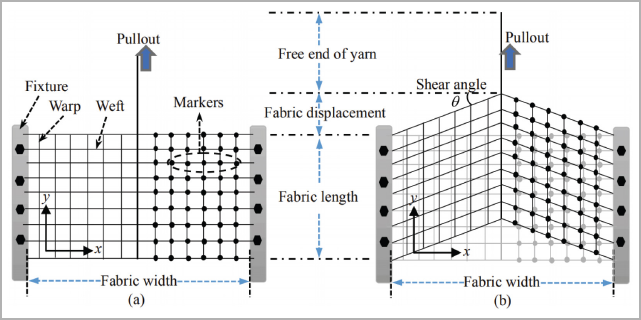
Schematic diagram of the shear deformation measurement mark of the flexible fabric (a) before tensile deformation and (b) after tensile deformation. 28
There are many ways to test for anti-ballistic performance including tensile tests, compression tests, and shearing tests. These tests can be carried out on an Instron universal testing machine (model 3382). As shown in Fig. 2, the samples are randomly cut from different areas of the board. Kevlar KM2 woven fabric, with higher pretension, absorbs more energy, but fails 33 earlier than fabric with lower pretension. For pre-stretching aramid fibers with more energy absorption, the strength or fracture strength can be improved to prevent premature failure. In the yarn pull-out test of Kevlar, 29 after the yarn is completely drawn out, the fabric shear deformation is still obvious. 29 The obtained load-displacement curve contains typical physical phenomena, such as crimp extension, crimp exchange, yarn friction slip, and fabric deformation, all of which are the behaviors of aramid fiber that consume energy and transmit stress.
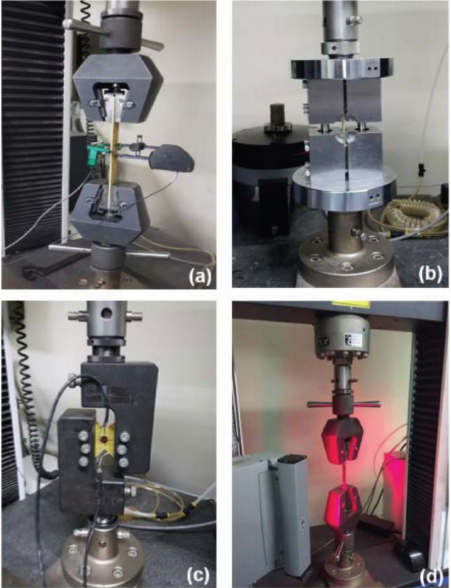
(a) Tensile, (b) compression, and (c) V-notched rail shear tests performed in the thin five-layer composite, and (d) tensile testing of the epoxy resin. 34
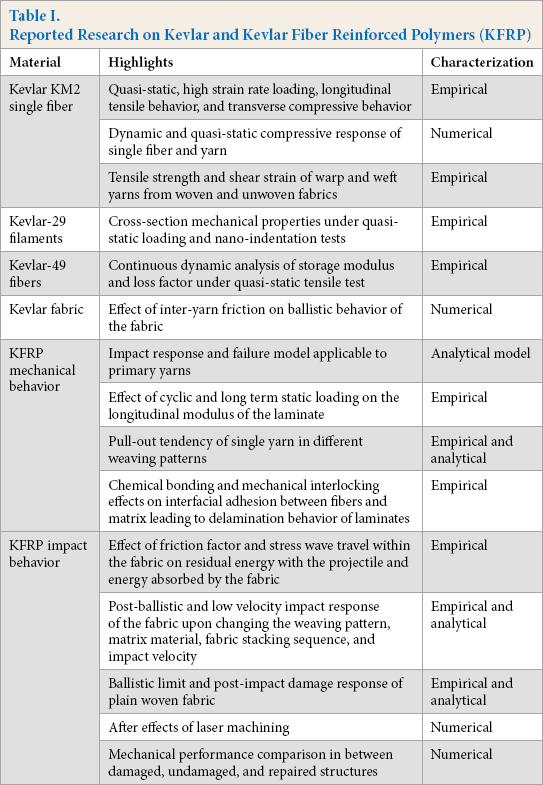
The anti-ballistic behavior of aramid fabrics and aramid fiber reinforced composite materials is expressed by responses to empirical tests, and theoretical and numerical analysis (Table I).
Reported Research on Kevlar and Kevlar Fiber Reinforced Polymers (KFRP)
Factors Affecting Anti-Ballistic Performance
Material
Material properties are one of the main factors in fabric anti-ballistic performance. Butola et al. 35 found that samples of Kevlar fabrics had higher impact energy absorption than all ultra-high molecular weight polyethylene (UHMWPE) and various composite materials. Moreover, the peak force and energy absorption of aramid fabrics are higher than those of UHMWPE and composite materials. Due to the low density of polyethylene as the matrix, its adhesion to UHMWPE is good, which will cause serious damage when the failure occurs. Kevlar composite materials have a high total energy absorption because of yarn pulling. Roy et al. 36 studied the impact resistance of aramid and UHMWPE fabrics coated in the same manner, and found that the pull-out force increased by 480% and 360% on natural rubber (NR)-coated p-aramid and UHMWPE fabrics, respectively. Due to the different materials, the increased tensile force is also different.
Cordeiro Konarzewski et al. 37 and Moure et al. 38 respectively found that the changes in physical, mechanical, and morphological properties, as well as weight and density of fibers and types of fabrics, would affect the degree of degradation of body armor made of aramids after natural aging. At low impact energies, the energy absorption capacity of aramid sheets is greater than that of thick plates. However, at high impact energies, the area density is related to the energy absorption capacity. To maximize the utilization rate of body armor over a limited period (the fabric ages before failing), failure processing is judged by the changes in mechanical properties, and the relevant influencing parameters would be adjusted to provide ideas for the improvements of body armors in later periods. Therefore, the structures, mass and thickness of the fabrics, temperature, and time under objective conditions are discussed in the following sections.
Structure
To enhance the effect of protection, many researchers have carried out experiments on the multilayer armor system (MAS), which is generally composed of three different materials. The middle layer is mostly made of high-performance materials such as aramid.39,40 The function of aramid fiber is to reduce damage to the outer debris after being impacted and to enhance the protection coefficient (a reference value for protection performance). Palta et al. 41 found that the ballistic performance of layered steel and mixed plate is greatly influenced by layered structure. Compared with monolithic steel plate, the structural weight of hybrid steel/aramid fiber with better anti-ballistic protection is reduced by 26%. It not only highlights the light weight of aramid, but also reflects the ballistic advantages of the layered structure. And in a multilayer structure, with the increase of fabric layers, the energy absorption capacity of Kevlar 29 woven fabric is improved. The energy absorbed by multilayer fabric increases slightly at the beginning, and then decreases greatly with pre-stretching. 42 It shows that the energy absorption capacity of the aramid fabric depends not only on the number of layers, but also on pre-stretching. It also indirectly shows that, with the increase of the number of layers, the absorption energy reaches a peak value. Afterwards, the increase in layers no longer increases protection, but instead decreases it. Under the same impact energy, the energy dissipation of sandwich structure of aramid fabric under ballistic impact is 63% greater than that under low-speed impact. It must be caused by shear hardening. 43 At the same time, the sandwich structure is more suitable for bulletproof fabrics, and other structures of aramid can be used for the low speed test of anti-puncture.
In addition to common multilayer configurations and sandwich structures, there are also anti-ballistic woven fabrics. Jambari et al. 44 found that the composite material of woven fabric kenaf/Kevlar blended yarn with a ratio of 30/70 has the highest energy absorption rate of 148.8 J, which is 28% less than that of pure Kevlar. There are potential combinations of natural and synthetic fibers that can be used as composite materials for high-performance products. For mixed yarns, the woven structure is selected. Although the tensile strength and Young's modulus will increase with increased Kevlar composition, the conclusions are based on the woven structure, this being a factor that cannot be ignored. In addition to the woven structure of mixed yarns, Yahaya et al.45,46 studied Kevlar/kenaf hybrid composites to obtain the best layer configuration of the two fibers. Obviously, the configuration between layers affects the overall performance of the fabric. To improve the anti-ballistic performance of aramid fabrics, researchers have done more research on aramid hybrid composites and multilayer armor systems than on single-layer aramid fabrics.
Other Factors
Common geometric parameters and objective influencing factors include weight, thickness of fabric, temperature, and time. The anti-ballistic performance of aramid fabric is related to its weight. Stopforth et al. 47 studied the effects of three different grades of Kevlar bulletproof gel layers of 160, 200, and 400 GSM, and found that Kevlar 200 GSM is more effective in blocking projectiles of 9-mm caliber. The bulletproof performance of aramid fabric does not depend on lighter or heavier weight, but has a critical value. Once it exceeds or falls below the critical value, the anti-ballistic performance will decline, but the influence of weight will be different for bullets of different sizes.
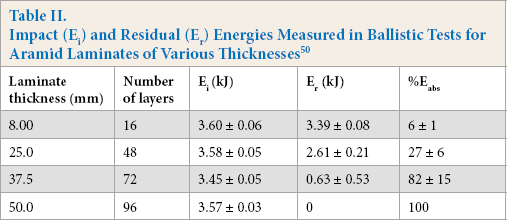
It is important that the anti-ballistic performance is affected by the thickness 48 of the aramid fabric. Armor vests made of steel or single layer of aramid fabric require greater thickness. 40 The mechanical properties which mainly affect bulletproof properties depend on the yarn geometry and the thickness of the layer. 49 For bulletproof laminates, especially as body armor, the goal is to achieve the same excellent bulletproof performance while being thin. For the aramid fabric with the minimum thickness to avoid perforation, as the thickness of the laminate increases, 96 layers are required for the laminate to completely prevent bullet penetration (Table II). Therefore, when aramid fibers are used as anti-ballistic materials, the thickness is also a factor that needs to be improved, and subsequent research can be carried out to make it light and comfortable.
Impact (Ei) and Residual (Er) Energies Measured in Ballistic Tests for Aramid Laminates of Various Thicknesses 50
With bullet impacts, the change of fabric temperature is affected. Liu et al. 51 found that with the increase in temperature, the thickness of Kevlar/epoxy composites increases. The tensile mechanical behavior is sensitive to curing temperature as well as other factors. Due to the complexities of temperature change, it is often not considered, especially in simulation experiments. However, ignoring this factor does not mean that it has no effects. At present, there are few studies on this aspect. Bullet impacts will generate heat energy, and cause fabric changes, which will also affect fabric performance. Similarly, time is also an important variable. Under relevant standards, body armor generally lasts for five years, and will continue to age with time. The degree of aging under different environments must be considered to continuously improve aramid fabrics.
New Methods for Optimizing Anti-Ballistic Performance
By modifying and mixing the materials, the shortcomings of these materials can be improved to complement each other and give the best anti-ballistic performance. Modification of aramid fabrics is also very common. Zhao et al. 52 studied new conductive shear thickening gel/Kevlar wearable fabrics with impact resistance and dynamic mechanical sensing properties. The preparation process is shown in Fig. 3. During the high-speed anti-ballistic test, the single-layer a novel sheer thickening gel-Kevlar (c-STG)/Kevlar fabric can absorb 21.6% of the impact energy. There is no doubt that modified aramid fabrics have extensive potential in the next generation of body armor materials and wearable devices. For other relatively simple performance tests, Ye h et al. 53 found that the maximum pull-out force of the sheer thickening fluid (STF)/ Kevlar composite was 3.17 times as large as that of Kevlar, and the physical properties of the fabric were significantly improved. Besides the enhancement of energy absorption and strength, Liu et al. 54 studied a new type of carbon nanotube (CNT)/STF/Kevlar-based wearable electronic material, having excellent protection and sensing properties.
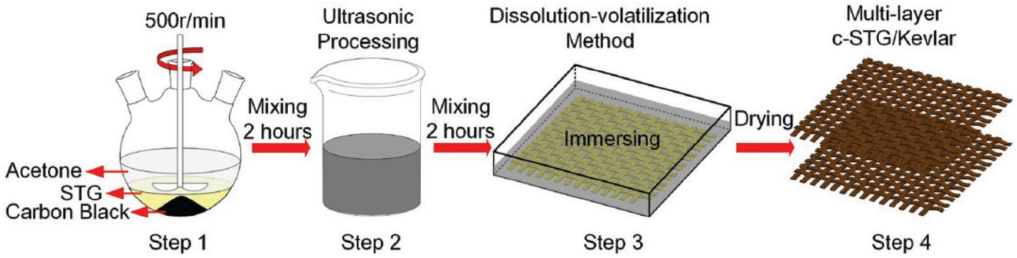
The schematic of the dissolution-volatilization method to prepare multi-layer c-STG/Kevlar composite. 52
Aramid modifications are no longer limited to reducing the damage to the human body caused by bullets. It optimizes other applications more comprehensively. Aramid fibers treated with shear thickening solution increase the friction between yarns, viscosity, and the value of the pullout force. 55
In addition to shear thickening fluid treatment,56-61 there is a relatively new way to induce graphene fiber formation on aramid fabrics by laser. As shown in Fig. 4, various surface morphologies of aramid fabrics which are induced are observed by scanning electron microscopy (SEM). With an increase in output power, the surface roughness increases until the graphene fiber is firmly embedded into the matrix. The interaction surface area of the aramid fabric increases, and the interlayer area is enhanced by the microstructure with improved mechanical properties. Microfiber porosity can also be used to keep the resin more easily moist and injectable, and the anti-ballistic performance of aramid fiber is enhanced.
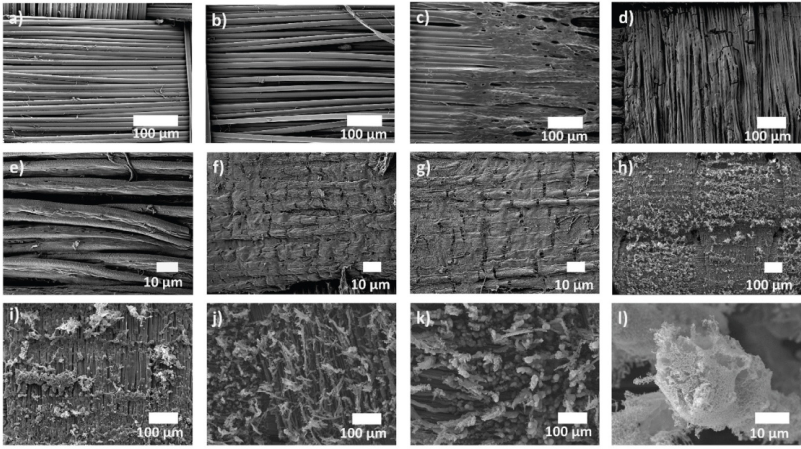
Surface morphology of laser induced graphene on aramid fabric surface at various power outputs: (a) and (b) 0%, (c) 8%, (d) 10%, (e)-(g) 12%, (h) and (i) 16%, and (j)-(l) 20%. 62
The improvement in anti-ballistic performance of aramid fibers is not limited to coating and laser treatments; there are other chemical or physical ways to achieve the same effect. These not only consider ultimate performance improvements, but also pay attention to the relative decline of other properties, such as transverse shear force and tensile fracture, to find the optimal method.
Mechanical Modeling and Performance Analysis
The main performance criteria for body armor are 1) armor must be able to stop the expected threat without penetration and 2) the back deformation of armor during impact must be mild enough to reduce blunt trauma to the wearer. 63 Therefore, reducing the depth of the back surface and expanding the stress propagation range is a research focus. First of all, the range of stress propagation is explored. Yang et al. 64 studied the modes of energy absorbed by penetration and non-penetration, the stress distribution and the energy absorption efficiency of each layer of aramid fabric, and also the detailed energy absorption mechanism. 65 It was found that the penetration layer absorbed the most energy, and the stress distribution of the front, middle, and rear layers were different in various situations. Secondly, the aramid fabric is treated in four ways, tested with two bullets, and the experimental data related to the back depth of deformation is shown in Table III. The composite modification of aramid fabric was investigated with various layers of back depth under various impact speeds. The fabric deformation degree is obtained by the back depth, and the best performance scheme is obtained.
Results of Anti-Ballistic Tests 66
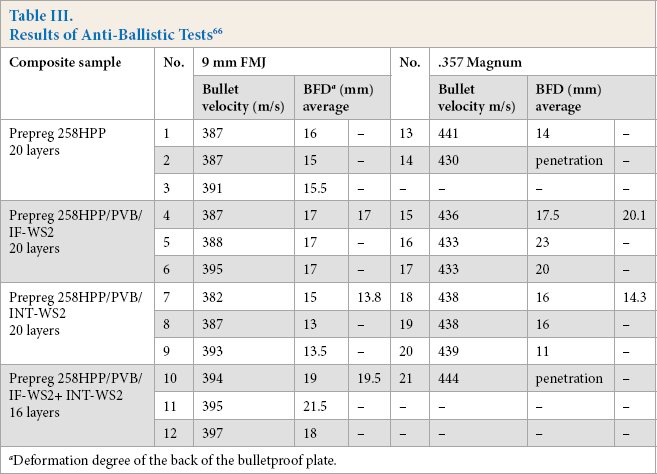
Deformation degree of the back of the bulletproof plate.
According to current research, it is generally believed that in the impact test of ordinary fabrics, there are mainly three forms of dissipation of kinetic energy in fabrics to projectiles: yarn strain energy (elastic strain generated by yarns), yarn kinetic energy (momentum exchange with projectiles), and friction energy consumption between yarns (yarn withdrawal and mutual slippage).67-69 Due to the small proportion of friction energy, many cases will be ignored to simplify the model. Anti-ballistic performance is related to the combination of the following mechanisms that affect energy sources: debris capture, fiber separation, fiber pullout, compound stratification, fiber breakage, and matrix fracture. 70
Similar to the ballistic transverse compression model, 71 the dynamic mechanical properties at a high strain rate, 72 ballistic experiments and model verification of the laminated armored model,73-75 the prediction and verification of penetration response, 76 and energy conversion of rife bullet impact are shown in Fig. 5, which includes the whole energy conversion and internal energy distribution of the system. This is carried out by finite element analysis and software verification through experimental data with the commonly-used analysis software LS-DYNA,77-79 ABAQUS33, 80 and ANSYS.81-83 The distribution of material properties and the behavior of the applied force to the parts are simulated to explore the mechanical properties of the fabrics.
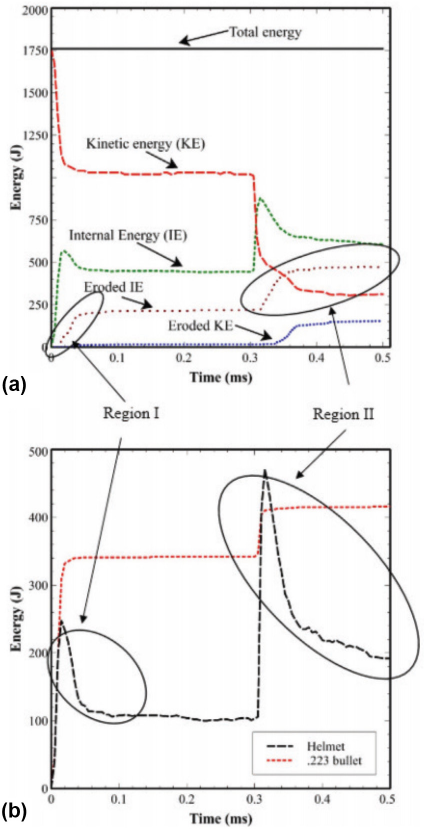
Energy conversion of the .223 rife bullet impact. (a) Global energy conversion of the system and (b) the distribution of the internal energy. 84
Summary and Prospects
Aramid fabrics are very popular in anti-ballistic protective materials because of their excellent properties. These fabrics will continue to be modified and compounded with excellent high-performance materials such as graphene and carbon fiber, improving both the anti-ballistic performance and mechanical properties of aramid fabrics, and research on related shear thickening fluid use will continue. The mixed prefabricated part of aramid fiber and resin is also a sustainable development method. Most of these use filaments. Later, the research into and preparation of staple fibers can also be considered. The mixed use of aramid and natural fibers can also be studied, with the goal of saving energy and reducing expenses.
The anti-ballistic performance of aramid fabrics is quite outstanding, and this article reviews aramid fabrics according to their characteristics. Related tests are briefly described. The influencing parameters of aramid fabrics are divided into material, structure, mass, thickness, temperature, and time, as well as other factors. With regard to structure, most of them are mixed materials, and the performance improvement and complementary advantages of these mixed aramid fabrics are studied compared to a few single layers of aramid fabric. In the realm of material modification, chemical methods such as application of shear thickening fluid and laser induction of graphene are discussed. The experimental data can be verified by mathematical methods such as model analysis, in which energy consumption is a classical problem. The mechanical properties of aramid fabrics after ballistic impact are analyzed by physical methods. In this paper, the anti-ballistic performance of aramid materials is reviewed to pave the way for later research and provide some ideas for the design of composite materials.
Footnotes
Acknowledgements
This work was supported by the National Natural Science Foundation of China (Grant No. 11702169), the Scientific Research Staring Foundation of Shanghai University of Engineering Science (Grant No. 2017-19), and the Talents Action Program of Shanghai University of Engineering Science (Grant No. 2017RC522017). This work was also supported by the Talents Action Program of Shanghai University of Engineering Science (Grant No. 2017RC432017), the Natural Science Foundation of Hubei Province (Grant No. 2018CFB309), and the School Start-up Fund Project of Shanghai University of Engineering Science (Grant No. 0242-E3-0507-20-05093-2019-95).