




Abstract
Human perspiration significantly affects heat and mass transfer in clothing systems and absorbs thermal energy on the skin, especially in radiant exposure and high-intensity work. However, few testing devices simulate human sweating for assessing heat transfer under thermal radiation exposure. Thus, a test device that could realistically simulate specific sweat rates was developed to evaluate the influence of continuous sweating on thermal protective performance (TPP). The TPP of single-layer fabrics at dry (No-sweating) and three constant sweating rates was studied based on the calibrated tester. It was indicated that the new testing apparatus effectively evaluated fabrics’ dry and wet thermal protective properties. Furthermore, compared to continuous sweating, the traditional pre-wet method may overestimate the TPP of the single-layer fabric depending on sweating rates. The continuous sweat rates played a dual role in the second-degree burn time and absorbed thermal energy, which is related to the moisture management performance of fabrics. The research provides an effective method to characterize the TPP of materials under continuous sweating/wetting, which will help optimize clothing performance and update relative standards.
Keywords
Introduction
Firefighters and industrial workers wear thermal protective clothing for protection against environmental and work-related thermal hazards.1,2 However, the garment impedes heat dissipation from the human body, causing heat strain. 3 Thus, it is essential to combine and balance heat dissipation and thermal protection aspects of thermal protective clothing in developing evaluation methods.4,5 Compared to physiological testing, the physical devices could be used to quantify the heat transfer performance and, thus, evaluate the effectiveness of these systems in improving human prevention of thermal injury. 6 There are two types of test apparatus for the heat transfer performance assessment: thermal manikin and thermal protective devices.
Although the thermal manikin has been extensively used to investigate the heat transfer between the human body and the environment from the point of heat dissipation, few studies were conducted to assess the thermal comfort considering the radiant exposure. The thermal manikin could be used to estimate the heat transfer from the human body to the environment with constant skin temperature and power modes.7,8 However, these physical manikins can only simulate the dry and sweating state of the human body under a uniform thermal environment, where the difference between air temperature and radiant temperature is below 1°C.9–11 Although some researchers measured the heat loss of the whole and local body from the thermal manikin under radiative exposure, the air temperature is still below 40°C. 12 However, it was reported that the air temperature in the most common fire ground ranged from 60 to 300°C when the heat flux values increased from 5 to 21 kW/m. 13 The lower air temperature will underestimate the heat transfer from the environment to the skin14,15 and further overestimate the thermal protective performance (TPP) of clothing, which increases the risk of heat injury.
The standard testing devices of TPP are limited to the dry (No-sweat) state when measuring the thermal protection of flame-retardant clothing. Various thermal sensors have been developed and applied to the bench-top testers and flame/radiation manikins, 15 including copper sensors, thermoset polymers, etc. The incident heat flux on the skin surface could be applied to calculate the skin burn degrees at different skin depths by numerical models. 16 As reported in standard evaluation methods (such as ASTM F1930 11 and ISO 13506 17 ), the two heat transfer models, the Fourier equation and Pennes bioheat model 18 are assumed to be transient one-dimensional thermal diffusion problems where the temperature varies with depth and time. The Pennes model further considered blood perfusion and metabolic heat production. However, the above numerical models mainly consider sensible heat transfer, ignoring the effect of the human sweat caused by the high temperature and high thermal insulation clothing. The updated numerical models were further established, considering the diffusion and vaporization of the moisture in the skin.19,20 These models typically simulate the evaporation of sweat from the skin surface by assuming complete saturation of the skin surface. However, these model validations were conducted with experimental data with live skin but did not consider the influence of active liquid sweating or heat injury.
In practice, people usually sweat profusely, especially in industrial sites and in firefighting rescues. The clothing could continuously absorb the liquid sweat up to the maximum moisture content and increase the relative humidity of the microclimate between the skin and inner clothing, especially under physiological perspiration.1,21 The absorbed water quickly evaporates into hot steam, penetrating through the protective clothing and condensing on the skin’s surface, releasing thermal energy.22,23 The liquid and evaporative moisture transfer and phase change can result in skin steam burn or scald, especially for the poor sealing regions of clothing, such as the neck and hand. 24 Additionally, the protective clothing can absorb hot water, thus changing the fabric’s thermo-physical and optical properties.25–27 The present common simulation method of physiological sweat is by pre-wet the materials before heat exposure. 28 However, the moisture in the material evaporates during heat exposure, and the material gradually dries. This method is still challenging to analyze the influence of the continuous liquid sweat rates and the sweating start time on the heat transfer.
The effect of moisture on heat transfer is still controversial. Some studies28,29 showed that the internal moisture could intensify the heat transfer, while other researchers30,31 illustrated the negative impact by a percentage of less than 15%. The change in the heat transfer could be attributed to the amount of moisture. When the amount of added absorbed moisture is at a comparatively low level (e.g. 15–20% 32 and 30–40% 31 of the clothing weight), the moisture enhances the heat transfer most and weakens the TPP. The realistic simulation of human sweating is critical to differentiate the influence of sweat rate on heat transfer33,34 and give reasonable data. The thermal torso was developed with an active liquid sweating system. 35 The thermal torso could be used in radiant exposure conditions with an intensity limited to 1 kW/m2, which is far lower than the typical intensity (5–21.00 kW/m2). Previous studies 36 have demonstrated that the radiant intensity significantly influences the absorbed heat energy of skin; thus, further studies could pay more attention to the more common fire rescue condition. In addition, the heat and moisture transfer of the thermal torso and manikins involves non-planar clothing material and/or air gaps, making it difficult to understand the basic mechanisms of heat and mass transfer within clothing.
Therefore, this study aimed to characterize the TPP under continuous sweating conditions under high radiant intensity exposure. Based on ASTM F2731-18, a test device was developed for simulating the actual fire rescue conditions. The repeatability and reliability of the testing apparatus were analyzed. The effects of sweat rate combined with moisture management performance of fabrics on the thermal protection of single-layer fabrics were investigated to provide proper guidance to improve the thermal safety of the firefighter’s clothing and reduce steam burn or scald.
Methods
Instrument development
Design and configuration
To evaluate the TPP of materials under different sweat rates, an improved testing device based on ASTM F2731-18
37
was developed, as shown in Figure 1. The test device comprises an exposure box, specimen holder, skin simulant with a continuous sweating system, and data acquisition system. The exposure box includes a heating source that can produce thermal radiation from 0 to 21 kW/m2 by temperature control of a black ceramic thermal flux source and temperature sensor. The test specimen is insulated from the heating source before the test using an insulation board to ensure accurate exposure time. Actual picture (a) and schematic diagram (b) of measuring device for thermal protective performance of fabrics under the continuous sweating condition.
In this research, the temperature change on the skin surface is simulated using a simulant sensor under thermal radiant exposure. The skin-simulant sensor comprises a skin-simulant element, a K-type thermocouple (Omega: 5TC-GG-K-30-36), a sensor base, and a handle (Figure 2(a)). The skin-simulant element is installed in the sensor base and connected with a data collection system to measure the temperature change on the skin surface. The diameter of the sensor base is 166 mm. The material of the sensor base is aluminum silicate ceramic fiber coated with an epoxy resin adhesive to avoid water absorption on the surface of the sensor base. The total sensor base could still be stable till 287°C. It is worth mentioning that the material can be easily modified into other shapes to simulate different local segments of the human body, such as spherical surfaces of elbows and knees, frustum surfaces such as limbs, etc. The skin-simulant element is made in Macor ®, which has stable performance and similar thermal inertia (1704 J/m2°C·S1/2) to the human skin (1647 J/m2°C·S1/2), which is the most critical parameter for testing the heat flux.38,39 All thermal sensors are connected to a data acquisition system to record heat flux or temperature histories versus time continuously. Schematic of the skin-simulant sensor. (a) Structure; (b) distribution of perspiration pores.
Twelve sweating channels were drilled with needle tubes through the back to the skin simulant surface to simulate sweating. The corresponding sweat channels were also developed for connecting the sweat nozzles with a peristaltic pump (Kamoer, SI4-6). The sweat holes were distributed uniformly on the sensor base for sweating, as shown in Figure 2. Every sweat simulation channel was equipped with an independent sweat rate control device to avoid uneven flow distribution in each channel caused by gravity and pump lifts. The inner diameter of sweat pores was 1.0 mm. In addition, the sweating volume can be set in the range of 0–145 ml/min with an accuracy of ±0.1 mL/min. Assuming that the density of sweat (moisture) is 1 g/mL, this device fully meets the test requirements of the human sweating rate range from 0 to 25.5 mg/(min cm2) reported in previous studies.40–42 This means that the total supplied rate of water is within the range of 0–7.03 g/min for the whole fabric system with a surface area of 155 mm × 155 mm. A thermostatic water tank with water of 32.5°C was used for sweat release according to the studied results of Pennes et al. 18 on the forearm skin surface of male adults and the backplane temperature setting of the sensor in ASTM F2731-18. The skin and sweat temperature increase caused by activity is considered by the skin heat transfer model, as shown in the calculation section.
Skin burn prediction model
This collected temperature change (TC) was used to calculate the heat flux through the sensor using Duhamel’s theorem
43
(equation (1)). The sampling rate was 10 samples per second. Three replications of the experiment were conducted with good consistency between replicas.

Heat transfer within the skin tissues is supposed to be a transient 1D heat diffusion problem without considering enhanced heat transfer due to changing blood flow in the dermis and subcutaneous layers. However, the skin parameters, such as specific heat and thermal conductivity, account for a significant degree of the blood flow obtained by ASTM F2731-18. The governing equation of the human tissues is written as



The above heat transfer model can give the temperature histories versus time in different skin layers. A skin burn injury occurs when the basal layer or dermal layer temperature reaches 44°C
44
According to the ASTM F2731-18,
37
the time required to receive the second (t2nd) and third-degree skin burn (t3rd) is predicted by adopting the skin bio-heat transfer model and Henriques burn integral model as follows.

Evaluation indices
Evaluation indexes include the simulant skin temperature change (TC, °C), the second-degree (t2nd, s), and third-degree (t3rd, s) skin burn time calculated using the skin burn prediction model (s), and absorbed thermal energy of skin (kJ/m2).
The skin temperature change was calculated by equation (7), and the corresponding relative change rate (RCR) from one second to the next was calculated by equation (8).


The absorbed thermal energy under a no-sweating and sweating state was calculated with the following methods. The absorbed thermal energy during the exposure stage (EAE) was derived by integrating the sensor heat flux with the corresponding exposure time (equation (9)). The energy absorption during the cooling stage (CAE) was calculated by equation (10).


The EAE and CAE variations with increasing sweat rate. The absorbed thermal EAE and cooling stage at a sweat rate of A ml/min (SRA) was denoted as EAESRA and CAESRA. The variation rate of EAE and CAE from sweat rate A (SRA) to sweat rate B (SRB) were denoted as ∆EAESRB-A and ∆CAESRB-A. The calculated methods were shown as equations (11) and (12). The corresponding variation rate per sweat rate during exposure (∆EAESRB-A*) and cooling stage (∆CAESRB-A*) were calculated as equations (13) and (14).


Calibration of the test device
Calibration of radiant heat exposure
According to the calibration procedure of ASTM F2731-18, the data collection sensor (Schmidt-Boelter heat flux sensor, Medtherm Corporation, USA) was fixed behind the specimen holder. The distance between the specimen holder and the heating source was 95 mm. The radiation heat flux was controlled at 8.5 ± 0.5 kW/m2 by adjusting the temperature of the heating source. The stipulated time of the calibration in standard ASTM F2731-18 was more than 15 min, while the total time of the calibration was set at 20 min to make the heat flux reach stable. The calibration procedure was performed three times to ensure repeatability and reproducibility.
Calibration of the skin simulant sensor
According to the calibration procedure of ASTM F2702-15, 45 the heat source intensity (8.5 kW/m2) and heat exposure distance calibrated in Calibration of Radiant Heat Exposure were set constantly. And the following process was set: the exposure time was 10 s, and the cooling time was 20 s; the experiment was repeated three times. The heat flux density on the skin surface was calculated according to the skin surface temperature change based on equation (1). Then the average value of the data of heat exposure for 3–10 s was selected. Moreover, according to ASTM F2731-18, the sensor should be calibrated before testing by the water-cooler sensor. And then acquire the calibration coefficient based on equation (5), which is applied to calculate the heat flux of the skin surface and the skin burn injury.
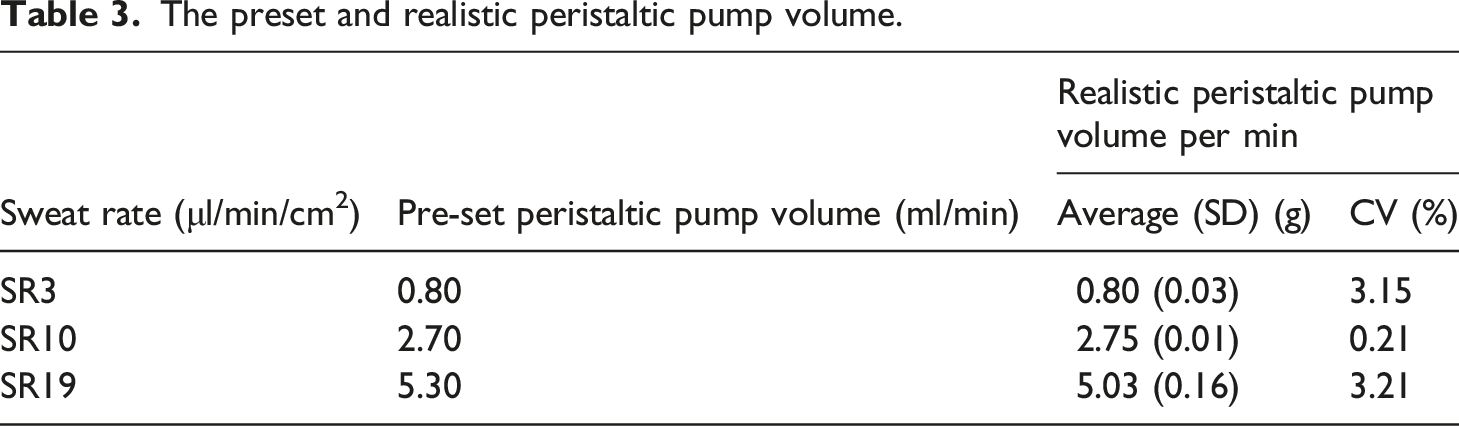
Based on the relationship between the local sweat rate and the whole-body sweat rate, we estimated the maximum local sweat rate to be 25.5 mg/(cm2·min),40,41 corresponding to a 3 L/h maximum whole-body sweat rate 46 (assuming a 1.80 m2 body surface area). In this study, the corresponding sweat rates were set as 0, 3.02, 9.68, and 19.35 μL/(cm2·min) for each nozzle denoted as SR0, SR3, SR10, and SR19. The flow rates of the peristaltic pump were set as 0, 0.80, 2.70, and 5.30 g/min for this device, respectively. The calibration experiment is done by testing the moisture weight of the sweat hole flowing out within 1 min, and the balance accuracy is 0.01 g. Before starting the system, the air in the entire sweating path was removed to ensure the target sweat rate. Each specimen was tested three times, and the average value was obtained.
Validation of the test device
Although some theoretical models19,20 described water vaporization by mentioning the saturated vapor pressure on the epidermis, these were still validated by comparing them with experimental data from living skin without considering the continuous liquid sweating. The comparison between the models and our skin simulant sensor (controllable sweat rates) is limited and could not provide reasonable results. Thus, two steps were applied to validate the skin simulant sensor to evaluate heat transfer under radiant heat exposure. Firstly, the calibrated SSS was validated under a dry (without sweating; No-Sweating) state by comparing it with the tested results with the Schmidt-Boelter sensor according to ASTM F2731-18 (SET). Secondly, an experiment with continuous sweating was conducted to validate the influence of sweating on heat transfer and compared with pre-wetted experimental results by temperature change, absorbed thermal energy, and skin burn.
Comparison with the standard results under dry state
For the validation of sensible heat transfer without sweating, the second-degree burn time was compared with the results of the standard sensor of the SET device. The experimental protocol consisted of two phases. In phase 1 (exposure stage), the shutter was open, and the skin simulant exposure to the radiant heat for the 60 s (single fabric). In phase 2 (cooling stage), the shutter was quickly closed and still collected the data for the 60 s. The data collection system recorded the thermal histories behind the fabric system. It was employed to calculate the time to second-degree skin burn for evaluating the thermal protection of the fabric system. These specimens (155 mm × 155 mm) were conditioned in a standard atmosphere (20°C and 65% relative humidity) for at least 24 h and sealed in a plastic bag before testing. Each fabric was tested thrice for the specific sweat rate to verify the test device’s precision, reliability, and repeatability.
Continuous sweating method evaluation
Specifications of the tested fabrics.

Moisture management performance of materials.

Wetting time (WT): the time periods in which the top (WTt) and bottom surfaces (WTb) of the fabric start to be wetted; defined as the time in seconds when the slopes of total water contents on the top and bottom surfaces become greater than tan 15°; Maximum absorption rates (MAR): the maximum moisture absorption rates of the fabric’s top and bottom surfaces; Maximum wetted radii (MWR): the maximum wetted ring; Spreading speeds (SS): the speeds of the moisture spreading on the top and bottom fabric surfaces to reach the maximum wetted radius; Cumulative one-way transport capacity (OWTC): the difference in the cumulative moisture content between the two surfaces of the fabric in the unit testing period; Overall moisture management capacity (OMMC): the overall ability of a material to manage the transport of liquid moisture, which includes three aspects of performance: MAR of the bottom side (MARb), OWTCb, and SSb. 47
Results and discussion
Calibration of the test device
Calibration of radiant heat exposure
Figure 3(a) shows the radiant heat flux of the simulated skin sensor during the calibration process and compares it with the calibration results of the standard SET (shaded parts and dotted line) of ASTM F2731-18. Overall consistency can be seen in the new device’s calibration results and the standard SET (SET calibration). The radiant heat flux of the newly developed test device gradually stabilized after 800 s of thermal exposure. Heat exposure levels were determined by calculating the average over the last 50 s. The results for the three calibrations were 8.46 kW/m2, 8.49 kW/m2, and 8.46 kW/m2, respectively, while the calibration result for the standard SET device was 8.25 kW/m2. These calibration results are in accordance with the radiation standard ASTM F2731-18 (8.50 kW/m2). In addition, when the temperature exceeds 200°C, the heat flux density of the newly developed device will fluctuate to a certain extent because the temperature controller automatically adjusts the temperature of the heat source, increasing the safety of operation. Variation in the heat flux of radiant heat source (a) and temperature of the exposure box (b) with time during the calibration.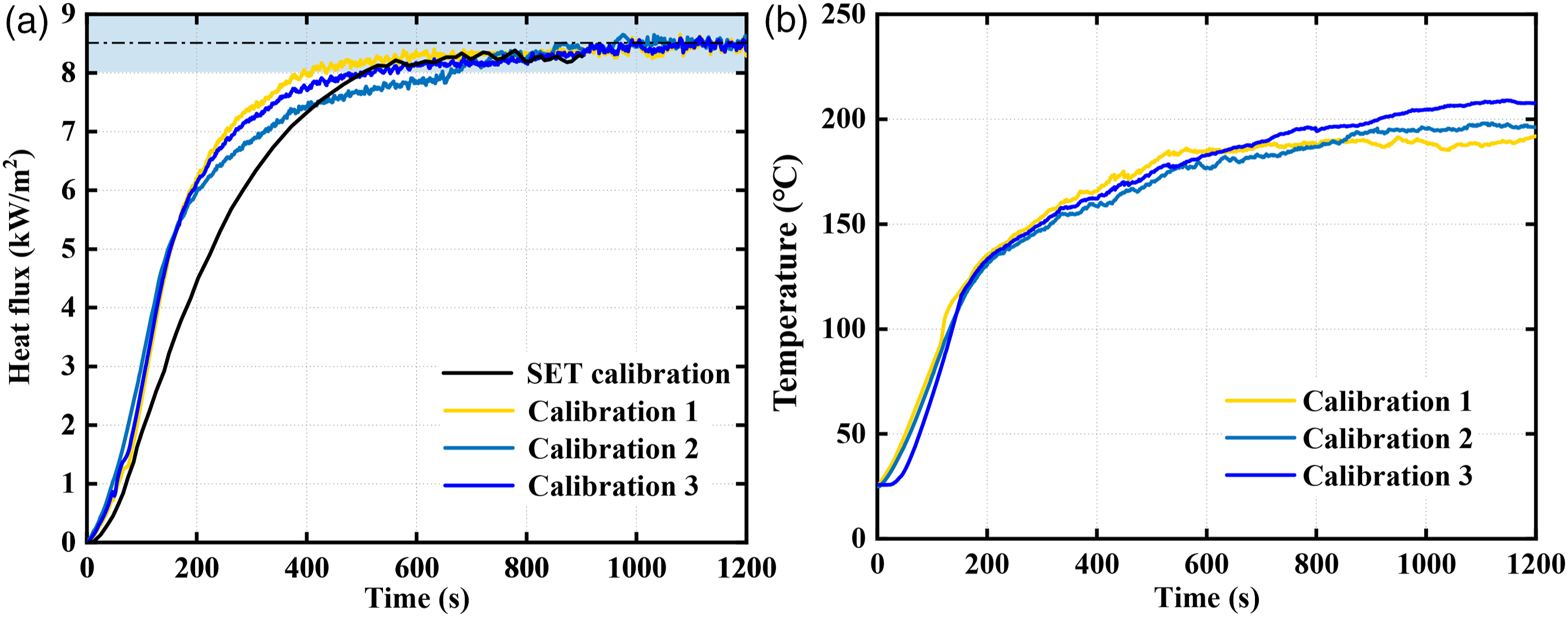
In addition, when the heat flux density of the fire environment is between 2.10–21 kW/m2, 37 the ambient temperature faced by firefighters is between 60–300°C. 14 Therefore, by adopting a sealed environment in the new test device, the ambient temperature can be increased to simulate the actual high-temperature environment further. The air temperature in the exposure box during repeated calibrations is shown in Figure 3(b). In three repeated thermal exposures, the temperature of the last 50 s of thermal exposure was in the range of 190.18–207.97°C, with an average value of 198.20°C, indicating that the heat flux is transferred from the environment to the human body under the actual test conditions. Therefore, to improve the experimental accuracy and control the heat exposure start time, the heat source and the temperature inside the heat exposure chamber must be strictly controlled.
Calibration of the skin simulant sensor
To calibrate the skin simulation sensor (SSS), three radiation intensities were selected to test the surface temperature change of the SSS, as shown in Figure 4(a). Under all radiation exposure, the coefficient variation (CV) among three times repeated experiments of skin surface temperature change ranged from 0.00% to 3.97% at all testing times. The CVs were far less than 5% of the standard requirement that meets the requirements,11,37 meaning that the dispersion degree of the three repeats was low. According to equation (1), the heat flux of the SSS surface was acquired, and then the average of 3–10 s was calculated, expressed as HF_SSS. A linear relationship was established between the calculated results and the measured value of the standard sensor of ASTM F2731-18 (denoted as HF_SET), as shown in Figure 4(b). According to the standard calibration method, the calibration coefficient (f) is set as 0.77. Temperature change (a) and heat flux (b) on the SSS surface during the standard calibration.
The preset and realistic peristaltic pump volume.
Validation of the test device with/without sweating
Measure reproducibility
The second-degree skin burn time under different sweat rates.

Accuracy validation for dry (no-sweating) state
The second (t2nd) and third-degree skin burn time (t3rd) with the standard and skin simulant sensor.

Accuracy validation for continuous sweating
Skin temperature
The typical commercially available thermal protective clothing material (SF1) was selected to evaluate the effect of continuous sweating on skin temperature and compare it with the previous experiments with prewetted methods. Figure 5(a) and (b) show the temperature change (TC) and the corresponding relative change rate (RCR = TRt
i
-TRti-1, t
i
is the time (s), i = 1,2, …, n) when the sweat rate is SR0, SR3, SR10, and SR19, respectively. The RCRs at the high sweat rates (SR10 and SR19: 1.61, 1.40°C/s) were higher than the low sweat rates (SR 0 and SR3: 0.56, 0.89°C/s) within 3–9 s. Moreover, the maximum temperature difference among the various sweat rates reaches 2.3°C. This increasing trend may be due to the positive effect of wet heat conduction in the wetting state of the fabric at higher perspiration rates.
50
Compared with the TC in the no-sweat state (SR0: 10.97°C), the maximum TC of the continuous sweating state was 11.97°C, which is 9.12% higher than the dry state caused by wet heat conduction. This result is consistent with the previous research results, which demonstrated that the limited wet heat conduction was in the range of 3%–9%.51–53 When the absorbed moisture is lower within 40%31,32 of the weight of the fabric, the heat transfer rate from ambient to the skin surface is more significant in sweating conditions than without sweating. This is mainly because of the wet thermal conductivity of moisture, which is much more excellent than the materials.
31
Temperature change (a) and the corresponding change rate (b) at the skin surface under the four sweat rates.
After the fast-rise stage, the RCR begins to slow down. the RCR decreased from 0.99°C/s to 0.42°C/s (11–60 s), from 0.76°C/s to 0.46°C/s (23–60 s), from 0.72°C/s to 0.50°C/s (27.7–60 s) at SR19, SR10, and SR3, respectively. It can be clearly shown that the RCR decreased with the sweat rate at the end of the exposure. This could be attributed to the fact that as the moisture content in the fabric gradually increases, the heat transfer rate decreases compared to the lower moisture content. For example, when the water content in the material was increased from 15% to 50%, the t2nd increased by 27%. 32 The increase of t2nd, the intensity of the TPP, can be explained by the large heat capacity of moisture (4200 J/kg/°C), which can store much heat, thereby reducing the heat transfer rate from the heat source to the skin. It can be seen that the device can simulate the heat transfer of several different prewet moisture levels in a single experiment of a continuous sweating period. Therefore, this research device can be used to explore the mechanism of the influence of moisture in the fabric on heat transfer caused by human sweating.
Absorbed thermal energy
The thermal energy absorbed by the skin tissues was composed of the latent heat of sweating and the sensible heat, including convection, conduction, and radiation. Figure 6 illustrates absorbed EAE and the cooling (CAE) of the various sweat rates under thermal radiation. Absorbed thermal energy of skin surface during exposure and cooling under four sweat rates. (a) The absorbed thermal energy of the exposure condition (EAE); (b) the absorbed thermal energy of the cooling condition (CAE).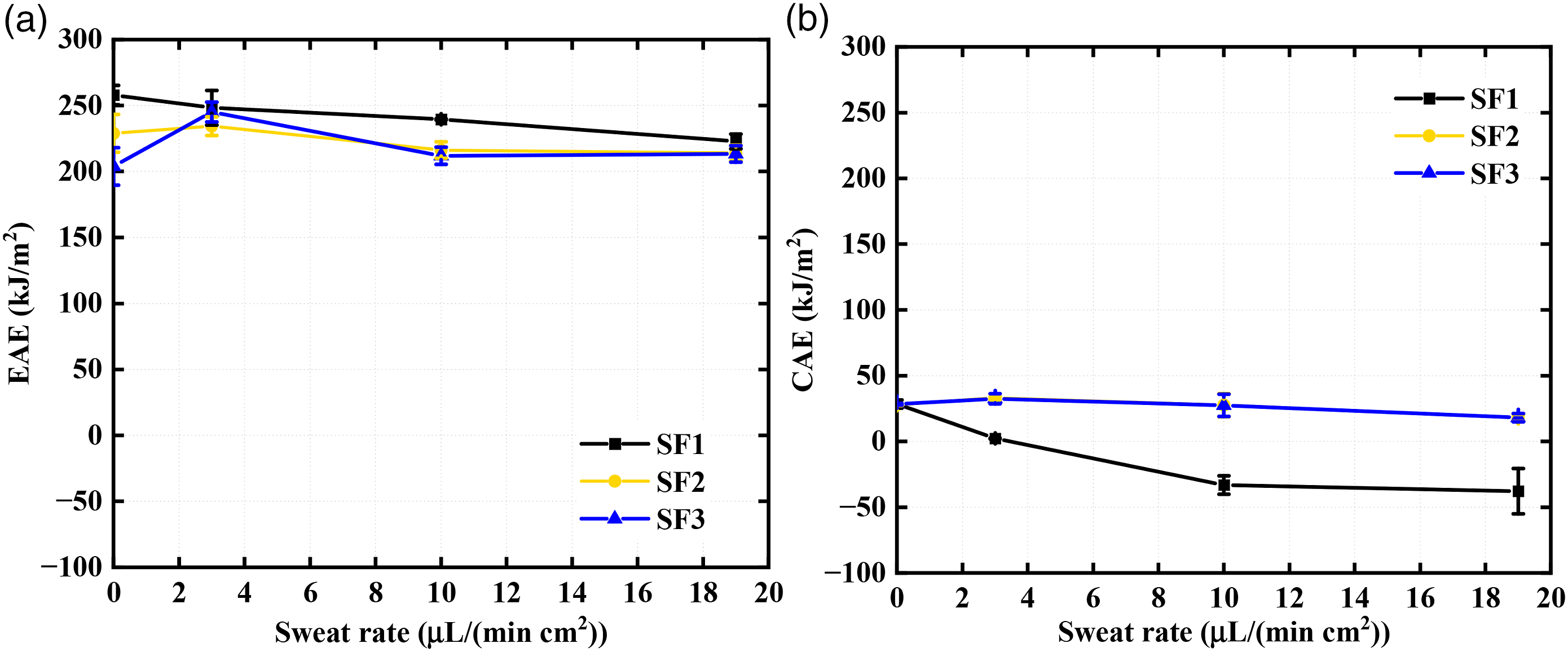
During the dry exposure (SR0), the EAE was proportional to the thickness and weight of the fabrics, indicating that the bigger the still air volume, the higher the TPP of the fabrics. With the sweat rate increasing, the EAE of SF3 (MMP- fabric) increased at SR3, but the EAE decreased for MMP + fabric, especially for SF1. This could be attributed to the higher MMP with lower wetting time (SF1-WTt: 2.54 s; SF3-WTt: 7.80 s), which could absorb the sweat outflow from the skin surface. At the same time, the OWTC of SF1 is significantly higher than that of SF3, which could transfer the moisture from the skin surface to the fabric’s outer surface, increasing the skin surface’s evaporative cooling. Moreover, the EAE decreased at SR10 and SR19 for SF3 (MMP- fabric); all are still higher than SR0 under the CSW. This is consistent with the previous study by Barker 32 and Su 13 with the PWM, which demonstrated that the sweat rate played a negative role in the TPP. Furthermore, the ∆EAESR19-0 (relative change rate, ∆EAESR19-0 = EAESR19-EAESR0)/EAESR0) of SF1, SF2, and SF3 were-13.64%, −6.51% and 2.62%, respectively. The decreasing of SF1 and SF2 indicated that the moisture (sweat) evaporates and takes away the thermal energy, which means the moisture played a significantly positive role for MMP + fabrics during the exposure.54,55 When the sweat rate increased from SR10 to SR19, a more significant relative decreased rate of unit sweat rate (∆EAESR19-10* = (EAESR19-EAESR10)/EAESR10/(19-10)) occurred for SF1 (−0.78%) than SF2 (−0.11%). This phenomenon could be explained by the differences in the in-plane and trans-planar wicking of liquid moisture, 56 which is related to the moisture transfer performance among various fabric types. Higher sweat rates led to increasing clothing wetting area (in-plane wicking) (MWR in Table 2 for moisture management performance) and clothing wetting depth (trans-plane wicking) (comparing OWTC and OMMC in Table 2). 57 A larger clothing wetting area causes more evaporation and thus increases the evaporative cooling, which may explain the decrease of the EAE. Furthermore, the bigger OWTC of SF1 could transfer the moisture at the inner surface (close to the skin) to the outer in the depth direction and then increase the evaporative heat loss under thermal exposure. The result is inconsistent with the previous studies under moderate and high temperatures (20°C or 35°C), 58 demonstrating that the evaporative heat loss when moisture wetted the outer layer was less than the loss of skin surface. The contradiction could be attributed to the fact that the tested temperature, in which the exposure temperature is up to 200°C combined with direct radiant exposure in this study, is significantly higher than in the previous studies. 57 The higher temperature makes it easier for the moisture on the outer fabric surface to evaporate. The concentration of water vapor in the outer layer decreases, prompting water transfer from the inner layer to the outer layer. Thus, this study confirmed that high temperatures and directly radiant exposure help to improve the evaporative heat loss when moisture is transferred along the trans-plane. It is worth mentioning that the rescue time is usually as high as 15 min in actual fire rescue, 59 much longer than the actual experimental heat exposure time. At this time, the moisture inside the fabric gradually reaches saturation, especially since at high sweat rate. Therefore, the trend of heat transfer during prolonged rescue is close to that at the end of heat exposure under a high sweat rate.
During the cooling, the heat transfer in fabric should not be ignored as the thermal energy stored in the fabric system could transfer to the skin tissues and continue to cause skin burn injuries. 13 Meantime, liquid moisture (sweat) could reduce the absorbed thermal energy of skin as the evaporative heat loss of the skin surface, as shown in Figure 6(b). In this experiment, the SF1 evaporated more thermal energy than the others and even reduced the skin surface temperature. The increased heat loss is because the still air volume between the yarns (higher air permeability) and viscose fibers could absorb more moisture, increasing the heat conductivity from the human skin to the environment. In addition, Figure 6(b) shows that the variation of CAE per sweat rate linearly decreased with rising sweat rates from 0 to 19 μL/(min cm2), except SF1 in the sweat rate from SR10 to SR19. This may be because the absorbed moisture in the fabric is saturated for SF1, which could provide constant cooling performance for the skin due to the added moisture that will flow down. Above all, the actual sweat and exposure environment simulation could provide more comprehensive information on the heat transfer of fabrics during the exposure and cooling stage.
Second-degree skin burn time
The second-degree skin burn time under four sweat rates (including the dry state and three continuous sweat rates) were analyzed to explore further the variation of TPP. As shown in Table 4, the results illustrate that the t2nd is significantly influenced by the sweat rate (One-way ANOVA: p < 0.05). Compared with SR0, the changes in t2nd under the continuous sweating state showed two trends in this study. For high sweat rates SR10 and SR19, the t2nd of SF2 and SF1 increased by 4.23%–9.84% because the excellent moisture management performance of SF2 and SF1 with high OMMC and WA could transfer the moisture to the outer surface and evaporate, according to Fick diffusion law and the capillary effect. 60 The result is consistent with the study of Zhang et al., 61 which demonstrated that the burn times at 100% saturated wetness (equivalent to SR19) were improved by 34.70% for the fabric content composed of 70.00% meta-aramid/30% flame-retardant viscose. The reduction of the relatively increased rate (9.84% < 34.70%) could be explained by the lower thickness, which either decreases the absorbed moisture content or increases the conductive heat transfer coefficient by moisture. This illustrated that the previous prewet method (PWM) overestimated the TPP of MMP + fabric. However, the t2nd of SF3 decreased by 4.72%–6.38% under the high sweat rates SR10 and SR19. The t2nd of SF1, SF2, and SF3 decreased by 0.05%–19.25% at a low sweat rate SR3, and thermal protection performance diminished. The reduced trend in TPP is contrary to the previous results of a single fabric with the prewet method when simulating the human sweating. These results for three sweat rates all demonstrated that the prewet way might underestimate the negative effect of moisture. The underestimation could be attributed to the wet heat conduction facilitating heat flux transfer from the heat source to the skin surface, caused by low sweat rate and poor MMP of SF3. All in all, the PWM overestimated the TPP of a single fabric, which may result in heat strain on the human body. Thus, it is crucial to realistically simulate human perspiration, which may give a reasonable and accurate evaluation of perspired moisture effects on heat transfer. However, there are still some differences in heat transfer between single- and multilayer fabrics. The multi-layered firefighting clothing systems containing a moisture barrier layer are usually used in the building’s fire rescuing, resulting in increased sweating condensation in fabrics. Therefore, the moisture content added in multilayer fabric systems is higher than in single-layer fabric under the same sweat rate. Thus, the decreased vapor concentration difference between skin and fabric reduces the evaporative rate, which may further reinforce the negative influence of continuous sweat on absorbed thermal energy. Furthermore, the heat flux transfer from the multilayer fabric’s outer surface to the skin surface can be higher than that for a single fabric because the condensation increases fabric surface temperature due to the heat pipe effect. Above all, the influence of sweat rate on the TPP of multilayer fabrics needs to be further systematically analyzed.
Conclusion
A test device was established to efficiently characterize the TPP of fabrics under active sweating to understand the influence of continuous sweating rates on the heat transfer of the clothed human body under radiant exposure. The three single-layer fabrics under dry (No-sweating) and three continuous sweating rates were selected to prove the repeatability and accuracy of the test method and evaluate the effect of continuous sweating on the TPP. The results demonstrated that the second and third-degree skin burn time of the skin simulant sensor shows a good agreement with the standard sensor of ASTM F2731-18 under the dry state (No-sweating). For the continuous sweating situation, the temperature change of the skin simulant sensor is consistent with the heat transfer of the traditional prewet method. However, the traditional prewet method overestimated the second-degree skin burn time and TPP of a single fabric, which may result in skin burn and heat strain on the human body. In addition, it was found that the dual effect of sweat rate on the absorbed thermal energy depends on the fabric’s physical material, particularly the moisture transfer performance. These findings suggest that the established test device is an effective tool for characterizing the TPP of fabrics under active sweating states. Furthermore, the study contributes to updating the evaluation standards of TPP and engineering thermal protective clothing to decrease the risk of skin injury.
Footnotes
Declaration of conflicting interests
The author(s) declared no potential conflicts of interest with respect to the research, authorship, and/or publication of this article.
Funding
The author(s) disclosed receipt of the following financial support for the research, authorship, and/or publication of this article: This work was supported by the Fundamental Research Funds for the Central Universities (Grant No. 2232022 G-08), International Cooperation Fund of Science and Technology Commission of Shanghai Municipality (Grant No. 21130750100), and National Natural Science Foundation of China (Grant No. 52004066).
