




Abstract
Protection from steam burns is beneficial to reduce the nonfatal injuries of firefighters in firefighting and rescue operations. A new multifunctional testing apparatus was employed to study heat and steam transfer in protective clothing under low-pressure steam and low-level thermal radiation. Single-, double-, and triple-layered fabric assemblies were selected in this experiment. It is indicated that the existence of hot steam weakens the positive influence of the fabric’s thickness, but increases the importance of the air permeability on the thermal protection. The fabric assemblies entrapping moisture barrier can better resist the penetration of steam through the fabric system, and significantly improve the thermal protection in low steam and thermal radiation exposure due to the low air permeability. Additionally, the total transmitted energy (Qe) and dry thermal energy (Qd) under low steam and thermal radiation are dramatically larger than that under thermal radiation (p < 0.05), while hot steam insignificantly reduces the thermal energy during the cooling (p = 0.143 > 0.05). The understanding of steam heat transfer helps to provide proper guidance to improve the thermal protection of the firefighter’s clothing and reduce steam burns.
Keywords
Introduction
Even though thermal protection in battling fire has been extensively studied, the fire occupation is still one of the world’s most dangerous industries [1]. Firefighters while suppressing a fire encounter not only with the fatal injuries, but also with nonfatal injuries, such as skin-burn injuries, strain, bruise, and smoke or gas inhalation [2]. Over the past decades, the majority of studies about thermal protection concentrated on the fatal injuries, such as flash fire [3,4] and high-intensity thermal radiation [5,6]. The death toll suffered by firefighters annually was reduced from 150 to 100 [7]. However, the total amount of nonfatal injuries was not properly controlled. It was reported that 65% of skin-burn injuries were steam burn or scald due to hot steam and hot water penetrating through firefighting protective clothing [8]. However, most skin-burn injuries happened in low-level thermal radiation [9]. When radiant heat flux increases from 2.1 to 21.0 kW/m2, the air temperatures in fireground ranges from 60℃ to 300℃ [10]. Thus, liquid water from a hose spray and dew or rains can be evaporated into hot steam [11]. But the performance of firefighter’s clothing is usually to provide flame retard and heat insulation so that it is insufficient to provide thermal protection again hot steam and hot water.
The steam heat transfer is different from dry heat transfer that is composed of radiation, conduction, and convection. Steam is capable of inflicting direct thermal damage to the skin as steam has a heat-carrying capacity 4000 times compared with hot air [12]. In previous studies, steam burns could be found when the test specimen was pre-wetted before the exposure, especially at low-level radiant heat fluxes [9]. These pre-wetted method based on bench-top tester could be employed to simulate moisture distribution within fabric assemblies in fire environment [13–20]. Water at a constant temperature was splashed or immersed to moisten the outer shell (OS) of multilayer fabric, which could be used to simulate the ambient moisture absorbed by the OS [13,14]. The absorbed perspiration in multilayer fabric system could be simulated using the splashed water to wet thermal barrier and then placing the specimen in a plastic bag for 12 hours [15,16]. In addition, the multilayer fabric was immersed in constant temperature water, which was to some extent treated as the mutual interactions between external moisture and skin perspiration [14]. These studies showed that moisture within multilayer fabric system had a complex effect on thermal protection of the clothing, depending on the moisture content and distribution [14,17], the type of heat source [11,18], and the essential properties of flame-resistant fabric [15,19] and the air gap size [20].
Even though the pre-wetted methods can be used to mimic the moisture distribution in multilayer fabric systems before heat exposure, it is still difficult to analyze the influence of the temperature and pressure of hot steam or hot water, and the continually adding moisture on the thermal protection during heat exposure. Therefore, some preliminary studies in recent decades were conducted to measure the protective capacities of fabrics and clothing under hot steam conditions, such as bench scale tests [21–23] and full-scale thermal manikin tests [22,24].The transmission electron microscopy (TEM) could also be used to analyze the thermal insulation or protective performance of fabric [25]. The horizontal bench-top testers developed by Liu et al. [21] and Ackerman et al. [23] were used to investigate the performance of fabrics under hot-steam exposures. Liu et al. chose different steam pressures (50.6 and 152 kPa) to expose the specimen while Ackerman et al. differentiated the performance of fabrics under steam pressure of 200 and 650 kPa. The test apparatus was also employed by Murtaza [26] and Mandal et al. [27] to compare the thermal protection of fabric exposed to various thermal exposures. It was found that impermeable fabric systems can reduce mass transfer and enhance the protective performance of the fabric system, and the fabric’s thickness and density were the important fabric characteristics in providing protection against pressurized steam. However, the main difference between the two test apparatuses was the direction of steam flow, upward and downward, respectively. This is because different directions of steam flow can affect the rate of heat and moisture transfer in the fabric system [28]. But horizontal steam flow more conforms to the actual fireground. Therefore, a vertical test device was developed by Desruelle and Schmid [22] in order to adjust the splashing distance and pressure of steam, which can simulate different experimental conditions. Also, Sati et al. [24] presented the test device of cylindrical shape to study heat transfer in the fabric while exposing it to moderately high-pressure steam (69 and 207 kPa). The fabric could be mounted with or without a space to provide an air gap between the cylinder and the fabric. Moreover, a thermal manikin in a steam climatic chamber was employed to evaluate the thermal protective performance of the clothing in steam exposure [22]. The results demonstrated that steam penetration and heat transfer in protective clothing mainly depended on resistance to water vapor diffusion, air permeability, thermal insulation, and total heat loss.
It is clear that the previous studies for the hot steam are mainly focused on high-pressure steam conditions for military and petrochemical industry without considering thermal radiation. Despite the fact that Rossi et al. [29] used the pre-wetted method and a sweating cylinder to analyze the steam transfer in protective clothing exposed to low-pressure steam, the thermal radiation and hot environment were also ignored in their study. It is reported that the firefighters in the fire environment easily encounter with low-pressure steam and thermal radiation [30,31]. So, the objective of this paper is to develop a multifunctional testing apparatus to evaluate the thermal protective performance of various fabric assemblies in low steam and thermal radiation exposure. The steam penetration and transmitted thermal energy through the fabric system are studied in order to better understand the mechanisms associated with heat and moisture transfer during and after the exposure.
Experimental
Materials
Specifications of the one-layer fabrics.

Basic physical properties of the fabric system.

Testing apparatus
The stored energy tester developed by Barker et al. [19] was widely used to evaluate the thermal protective performance of multilayer fabric system against low-intensity thermal radiation. However, the testing apparatus was not suitable to characterize steam burns. Based on ASTM F2731-11, an improved testing apparatus was developed to evaluate the thermal protective performance provided by fabric under hot steam and thermal radiation. The advantages of the tester was to efficiently control the pressure and the flow rate of hot steam and radiant heat flux for mimicking the actual fireground, as shown in Figure 1.
Schematic diagram of thermal protective performance tester under low steam and thermal radiation.
A steam generator with 20 L was used to produce hot steam with the temperature from 100℃ to 150℃ and the pressure from 0.01 to 0.4 MPa. A spray nozzle with 11.5 ± 0.3 mm internal diameter through the center of radiant heater was employed to transport the hot steam. The flow rate of steam was 0.56 ± 0.06 g/s and the distance between nozzle and specimen was fixed at 6 cm. The steam temperature from steam generator was measured using a type K thermocouple with a diameter of 0.5 mm (OMEGA, Engineering, USA) fixed near the steam nozzle. A black ceramic thermal flux source could produce a constant radiant heat flux to simulate low to medium fire scenario. A 152 mm × 152 mm testing sample at the right of 95 ± 10 mm from heat source was modeled in a vertical orientation, required by ASTM F2731-11. The testing specimen was insulated from heating sources before the test by moving an insulation board in order to ensure accurate exposure duration.
In this study, a water-cooled Schmidt–Boelter thermopile type sensor (Medtherm Corporation, USA) was used to record the temperature rise at the rear of the specimen over time. According to the standard ASTM F2731-11, water with 32.5℃ from water tank at a constant temperature was introduced into the data collection sensor at a rate of no less than 100 mL/min, which could be simulated as the skin temperature. The air gap size between the specimen and the sensor assembly was 6.4 mm in order to simulate the gap between the clothing and human body [32]. All thermal sensors were connected to a data acquisition system to continuously record heat flux or temperature rise versus time.
Protocols
These specimens were conditioned in a standard atmosphere (20℃ and 65% RH) for at least 24 hours, and then sealed in a plastic bag prior to testing. The exposure condition was first calibrated before mounting the testing sample. A nominal heat flux of 8.5 kW/m2 produced by a radiant heater became stable after the preheating process of 800 s. The corresponding temperature in the heat exposure box was around 236℃ after the calibration. Due to the low-pressure steam commonly faced by firefighters [30], the steam pressure was set at 50 kPa and the average steam temperature flowing from the steam nozzle was 100.86℃. By removing the insulation board, single-, double-, and triple-layered fabric assemblies were exposed to the preset thermal-radiation and low-steam and thermal-radiation conditions for 60 s, 120 s, 180 s, respectively. The insulation board was then moved back to simulate the cool-down period for successively 100 s, 120 s, and 180 s. The thermal histories behind the fabric system were recorded by the data collection system and employed to calculate the time to second-degree or third-degree skin burn, as an index to evaluate the thermal protective performance of the fabric system. Each specimen was tested three times and the average was obtained.
In addition, the steam permeability of fabric system was measured using blotter paper recommended in standard AATCC 42-2000. The blotter paper was fixed on the specimen holder behind the specimen. The fabric system was exposed to the same condition for the same exposure time. Referring to the standard GB/T12704–1991, the steam penetration rate (SPR) of testing specimen under hot steam and thermal radiation was obtained by equation (1).

The incident heat flux during the exposure (qe) and the cooling (qc) on the skin was measured using the skin-simulant sensor. The incident heat flux (qe) was composed of steam heat flux (qs) and dry heat flux (qd). The steam carrying a lot of thermal energy could condense in fabric assemblies and on skin’s surface. It was supposed that the steam temperature keeps a constant value after penetrating through the fabric system and the temperature of condensate water on the skin surface is equal to the skin surface temperature [33]. Thus, the discharging heat flux of the steam condensation on the skin surface was calculated using the following equation:

Results and discussion
Skin-burn distribution with various fabric assemblies
To assess the effect of hot steam on the thermal protective performance of different fabric assemblies, the testing specimens were respectively exposed to thermal radiation and low steam and thermal radiation conditions. The heat flux measured by the skin-simulant sensor was treated as the boundary condition of Pennes bio-heat transfer model [34]. Combining with the Henriques burn integral model [35], the time to skin burn was calculated for five fabric assemblies, as shown in Figure 2. It is clear that the times to second and third burn under low steam and thermal radiation exposure are significantly lesser compared to that under thermal radiation exposure (p < 0.05). All fabric assemblies show a similar trend, indicating that hot steam can penetrate through the fabric system and exacerbate the skin-burn injuries. The biggest difference of burn time between different test conditions is the fabric assembly OS + TL1, reducing the burn time by 2.74 times. Comparing with the thermal protective performance with different fabric assemblies, the fabric assemblies containing MB significantly improve the thermal protective performance in low steam and thermal radiation exposure.
Skin-burn distribution with various fabric assemblies.
For thermal radiation exposure, there is an increase tendency in the thermal protective performance of fabric assemblies with the increase of the fabric’s thickness. It is reported that the thicker fabric assemblies can reduce the heat transfer in fabric system due to the good heat-insulating capability and the decrease of transmitivity of thermal radiation [32]. For low steam and thermal radiation condition, the variation trend among different fabric assemblies is different from thermal radiation condition. With regard to the double-layer fabric assemblies, the fabric assembly OS + TL1 has better thermal protection under thermal radiation while the thermal protection of fabric assembly OS + TL1 under low steam and thermal radiation is significantly lesser than that of the fabric assembly OS + MB. The main reason might be that the thin fabric assembly OS + MB does not effectively resist dry heat transfer, but reduces the steam heat transfer owing to the low air permeability (0.41 cm3/s/cm2). However, the fabric’s thickness still has an important effect on the thermal protective performance of fabric assembly in low steam and radiative exposure. Although there is no obvious change in the air permeability for triple-layer fabric assemblies as the air permeability of multilayer fabric system is dependent upon the MB [36], the time to skin burn increases over the thickness of TL. The correlation analysis was employed to further investigate the relationship between the fabric’s properties and time to second-degree burn in two tested conditions. It is found that the fabric’s thickness is highly positive correlated with the time to second-degree burn under thermal radiation (correlation = 0.995, p =0.000 < 0.01) and low steam and radiative exposure (correlation = 0.970, p = 0.006 < 0.01), meaning the larger the fabric’s thickness, the better the thermal protective performance of fabric assemblies. But a nonsignificant inverse correlation between the air permeability and second-degree burn time is found. The correlation coefficients in two tested conditions are respectively −0.631 and −0.776. It follows that the existence of hot steam can weaken the influence of the fabric’s thickness, but increases the importance of the air permeability on the thermal protective performance of fabric assemblies.
Figure 3(a) and (b) show the variation in the temperature at the epidermis–dermis interface over time for double- and triple-layer fabric assemblies, respectively. It is found that hot steam can quickly increase the skin temperature during the exposure, predicting that the steam can transfer to the skin surface through the fabric system and even cause the steam-burn injuries. The discharging energy from the fabric system can continue to increase the skin temperature at the beginning of the cooling, and then the skin temperature quickly decreases especially for low steam and thermal radiation exposure. It is because water can be evaporated to remove heat from the skin. Thus, the cooling for the thermal radiation exposure is driven by the low-temperature environment while the cool-down effect for the low steam and thermal radiation exposure is determined by the ambient temperature and the condensation of water. There exists an obvious change in the rate of temperature rise during radiative exposure. Also, the time of the turning point postpones as the thickness of the fabric assemblies increases. This is due to the fact that the fabric system can store a large number of thermal energy, and the moisture within fabric system can evaporate in the process of temperature rise [37,38]. Furthermore, the thicker fabric can increase the storing capacity of the fabric system and moisture content to reduce the temperature rise [37]. However, the rate of temperature rise significantly increases with the increment of the exposure duration, since the storing energy of fabric system reaches thermal equilibration and the moisture can be totally evaporated [38].
Temperature variation at the epidermis–dermis interface: double- (a) and triple- (b) layer fabric assemblies.
Steam penetration performance
Steam heat transfer rate with various fabric assemblies.
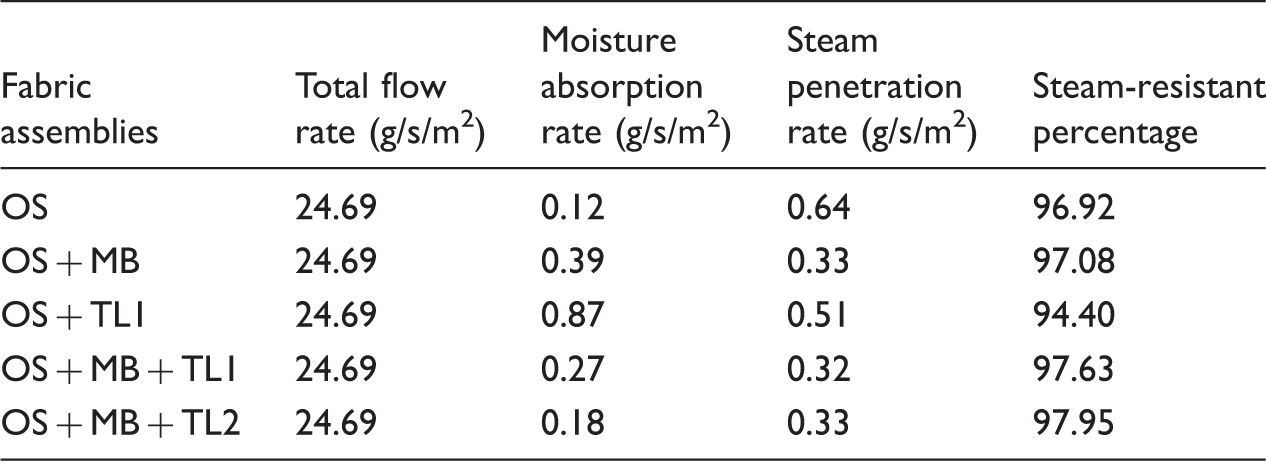
MB: moisture barrier; OS: outer shell; TL: thermal liner.
Table 3 also shows that the hot steam penetrates the fastest through the single-layer fabric. Instead, the MB added in the fabric system can weaken the difference of steam penetration rate with various fabric assemblies. The correlation between the air permeability and the rate of steam penetration was analyzed, indicating that the increment of air permeability can significantly increase the rate of steam penetration (correlation = 0.955, p < 0.05). Hot steam absorbed by the fabric system also increases the heat transfer rate due to the capacity of storing thermal energy of hot steam [12]. It is found that the fabric system entrapping MB can better resist the penetration of steam through the fabric system. The steam-resistant percentage witnesses an increase with the rising of the thickness of fabric assemblies with MB. In contrast, the lowest steam-resistant percentage is the fabric assembly OS + TL1, since the fabric assembly OS + TL1 has the larger steam penetration rate and the quickest absorbability of the hot steam.
In order to further explore the relationship between the steam transfer property and skin burn, the variation of the steam-resistant percentage, the steam penetration rate and time to second skin burn with different fabric assemblies are illustrated in Figure 4(a) and (b). It is manifest that the variation of burn time for different fabric assemblies has a good consistency with the percentage of steam resistance (correlation = 0.628, p = 0.257 > 0.05) while there is a negative correlation between steam penetration rate and time to second skin burn (correlation = −0.768, p = 0.130 > 0.05). It follows that the steam penetration directly affects the thermal protective performance of the fabric system while the absorbed steam by the fabric system only slows down the harm effect of hot steam. Therefore, the most efficient protection from steam is to reduce the steam penetration by employing the fabric of low air permeability, like MB. Meantime, the increase of moisture absorption can help to increase the percentage of steam resistance to slow down steam heat transfer, such as thicker TL.
Relationship between time to second skin burn and steam-resistant percentage (a), the steam penetration rate(b).
Transmitted thermal energy in fabric assemblies
Figure 5 shows the transmitted thermal energy with various fabric assemblies under different heat exposures. It is clear that the transmitted energy during low steam and radiative exposure is dramatically larger than that during thermal radiation without steam, existing a prominent difference (p = 0.021 < 0.05). The change of the fabric assembly OS + TL1 is the largest among all fabric systems, and agrees well with the results of the skin-burn time in Figure 2. Compared with the difference of the transmitted energy between double-layer fabric assemblies, the thermal energy absorbed by the skin is determined by the steam heat transfer. This is because the air permeability of the fabric assembly OS + TL1 is far larger than that of the fabric assembly OS + MB. On the contrary, the transmitted energy for triple-layer fabric assemblies mainly depends on the dry heat transfer as the steam penetration rate of two triple-layer fabric systems is approximately equal (see Table 3).
Heat transfer through various fabric assemblies under two tested conditions.
The transmitted energy during the cooling of thermal radiation exposure shows an increase as the thickness of fabric system increases, because the thicker fabric system can increase the thermal energy stored in the fabric system [37]. Hot steam can reduce the thermal energy transferring to skin tissues during cooling while there is not statistically significant difference (p = 0.143 > 0.05). It indicates that heat transfer during cooling mainly depends on the ambient temperature and the storing thermal capacity of the fabric system.
Comparisons of dry heat trasnfer under different exposure conditions.

The heat flux distribution in various fabric assemblies is shown in Figure 6. For the radiative heat exposure, the incident heat flux (qe) witnesses a decrease with the rising of the fabric’s thickness. The similar tendency can be observed during the cooling. Despite the fact that the thicker fabric system can store more thermal energy, most energy from the fabric system focus is discharged at the beginning of cool-down and the incident heat flux decreases sharply versus time. These results agree well with the findings of He and Li [37]. For the hot steam and radiative exposure, there is a very good correlation between the total incident heat flux and the steam heat flux (coefficient = 0.944, p < 0.05), indicating that steam heat transfer plays a determining role in heat transfer from the ambience to skin surface through the fabric system.
Heat flux distribution of fabric assemblies under different exposure conditions.
Conclusions
In this paper, the impact of hot steam on the heat transfer in various fabric assemblies was analyzed based on an improved testing apparatus. The results show that the existence of hot steam can weaken the influence of the fabric’s thickness, but increases the influence of the air permeability on the thermal protective performance of fabric assemblies. The steam-resistant percentage witnesses an increase with the rising of the fabric’s thickness. Furthermore, the increment of air permeability significantly increases the rate of steam penetration (correlation = 0.955, p < 0.05) so that the fabric systems containing MB obviously reduce the penetration of steam and significantly improve the thermal protective performance. Therefore, the most efficient protection from steam and radiation is to reduce the steam penetration by selecting the fabric with low air permeability, like MB. Meantime, the increment of the fabric’s thickness helps to increase the percentage of steam resistance to improve thermal protection, such as the thicker TL.
Steam heat transfer in low steam and thermal radiation exposure plays a determining role in heat exchange from the ambience to skin surface through the fabric system. The transmitted energy during hot steam and radiative exposure is significantly larger than that during radiative heat exposure (p < 0.05). During cooling, hot steam can reduce the thermal energy transferring to skin tissues while there is no statistically prominent difference (p = 0.143 > 0.05). In addition, hot steam can decrease the dry heat transfer from the fabric to the skin due to the coupled role of heat and moisture transfer.
Footnotes
Declaration of Conflicting Interests
The author(s) declared no potential conflicts of interest with respect to the research, authorship, and/or publication of this article.
Funding
The author(s) disclosed receipt of the following financial support for the research, authorship, and/or publication of this article: The authors would like to acknowledge the financial support from the National Nature Science Foundation (grant no. 51576038), the Fundamental Research Funds for the Central Universities (grant no. 16D110713), Donghua University PhD Thesis Innovation Funding (grant no. 16D310701), and the Open Funding Project of National Key Laboratory of Human Factors Engineering (grant no. SYFD150051812K).