




Abstract
The insulating layer of the hollow structure of thermal protective clothing plays a positive role in weight and thermal protection. The relationship between the hole shape and the performance of the hollow structure is of great importance to optimization. This paper focuses on the performance optimization of the honeycomb structure insulation layer. Laser cutting technology was used to cut the hole in the non-woven fabric. The thermal insulation layers of five common three-dimensional sections were prepared by the multi-layer composite method. Compared with the conventional solid fabric system, the honeycomb fabric system has better thermal protection. At the same time, the section structure also affects the thermal protection performance. The developed A-type structure possesses a superior Thermal Protective Performance value in comparison to I-type straight structure. It has lower moisture resistance and higher total heat loss. The thermal protection of A-type section structure, together with excellent thermal and moisture comfort, make it put forward the improvement direction for the structural optimization of commercial nonwovens where the balance between thermal protection and thermal and moisture comfort is the key requirement.
Keywords
Introduction
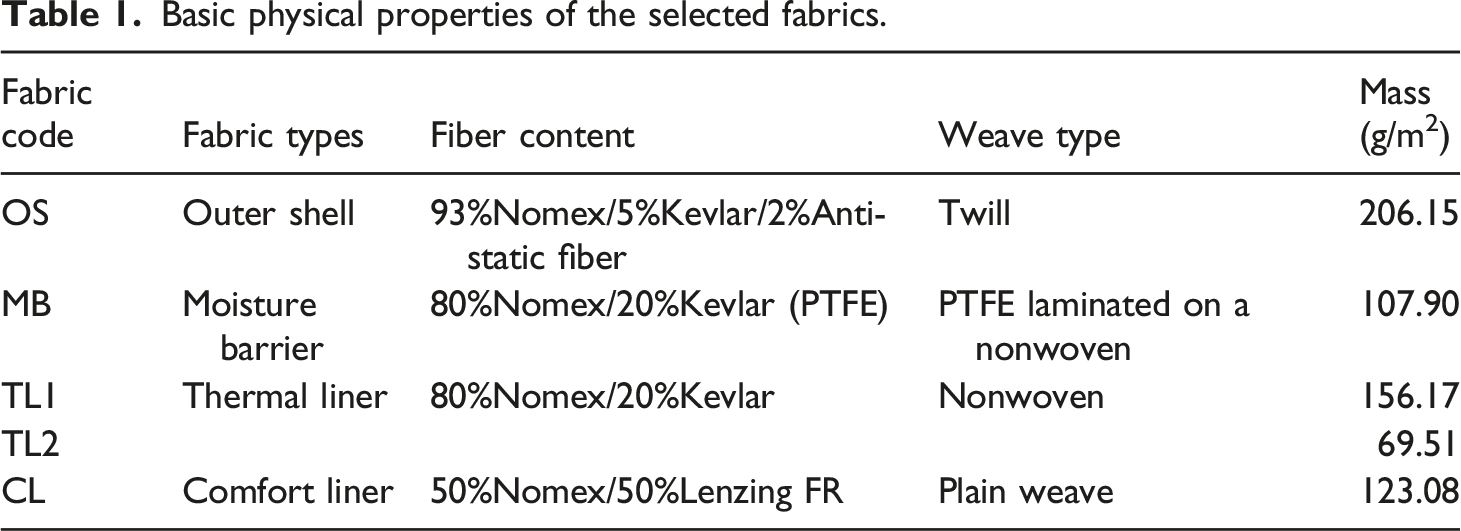
Multi-layer thermal protective clothing is a kind of function clothing, consisting of an outer shell, moisture barrier, thermal barrier, and comfort liner, 1 which can protect our bodies from fire by a series of special materials. 2 Among them, the function of the thermal barrier layer is to isolate the external heat transfer and discharge the sweat under the clothes. Thermal protection performance is mainly affected by weight and thickness.3,4 The greater the weight and thickness, the better the thermal protection performance. However, the increase in weight will cause an excessive load to operators and affect operational efficiency. And the increase in thickness is not conducive to thermal and moisture comfort. 5 Therefore, the optimization of the thermal barrier layer needs to be comprehensively considered.
The hollow structure is developed into the optimization of the thermal barrier layer by the introduction of air as a replacement of insulating material for the sake of reducing the weight of the garment. Some scholars use aerogel with high heat insulation and low density of its porous structure to effectively reduce the quantity of fire-fighting clothing.6–9 The preparation of aerogel textile can be classified into two categories, i.e. ‘aerogel-containing-textile’ where aerogel is mixed into fibers, yarns, and fabrics in the form of powder or particles8,10,11 and ‘textile-containing-aerogel’ where textile materials are added into the aerogel synthesis solution.12–14 Xiong et al. 10 designed a three-layer composite structure containing aerogel particles to stabilize aerogel material by the support of the upper and lower fabrics. Shaid et al. 15 achieved the fixation of aerogel materials by inserting adhesive lining and aerogel particles between two layers of needle-punched cloth. Some scholars prepared a three-dimensional spacer fabric thermal barrier, and found that its thermal protection performance and air permeability were improved compared with needle punched nonwoven felt. 16 The mechanism of the influence of material, 17 structure, 17 and thickness 18 on the performance of spacer fabric was studied to further optimize the performance of the thermal insulation layer. Yu et al. 19 prepared three-dimensional spacer fabric/hollow microspheres reinforced three-phase composites to obtain fabrics with certain supportability. In addition, the hierarchical structure of cocoons was stimulated into thermal protective clothing whose thermal and moisture properties were evaluated to provide a flesh idea for preparing multilayer fabric. 20
The above hollow structure of the thermal barrier can effectively improve the thermal protection performance, but exist defects in wearability affected by materials and preparation, such as the poor breathability of the aerogel fabric and the low compression resistance of the space fabric. The nonwoven processing method can provide flexibility and drapability, 15 and make the fabric have a fluffy structure to contain a lot of air to have a certain thermal protection performance. Therefore, the hollow structure by using laser cutting holes on Nomex nonwovens was provided in previous research, which can meet the wearability performance. 21 Considering that the hexagonal honeycomb structure is the best topology covering a two-dimensional plane having the highest void ratio and lowest weight under the same aperture, 22 it is selected as the shape of the hole for preparation. Meanwhile, through the design of honeycomb hole parameters, the honeycomb hollow structure can improve thermal protective performance, 21 radiant heat performance, 23 and heat storage performance 24 under the same weight. It should be noted that the works mentioned above merely focused on the optimization of thermal protection performance by honeycomb hole configuration of the one-dimensional plane, and the heat dissipation of the human body was not considered. Kong et al. 25 proposed a hole structure with a gradient change in heat transfer direction for a honeycomb sandwich heat exchanger, which proves that the gradient structure can take more heat away than the uniform structure to reduce the temperature under the same porosity. Some scholars have also studied the influence of section shape 26 and transfer direction 27 on the heat transfer effect. The three-dimensional section affects the thermal protection performance, and the performance is different with different transfer directions.
Therefore, this paper focused on five cross-section structures through superposition configuration of multi-layer honeycomb insulation layer to explore the comprehensive evaluation of its thermal protection and thermal and moisture comfort, so as to obtain a more excellent thermal insulation structure to meet the application needs of various fields.
Experiment
Material
Basic physical properties of the selected fabrics.
Honeycomb structure design and preparation
The multi-layer honeycomb fabric system and its parameters including side length (l), wall thickness (w), and core thickness (h) are shown in Figure 1. Based on the study of honeycomb heat transfer mechanism,
21
it is found that the honeycomb hole with different porosity affects the thermal protection performance. The structure of thermal protective clothing honeycomb fabric is optimized. In this paper, the single-layer honeycomb insulation layer is changed into three-layer honeycomb insulation layers. Five typical structures, defined as I-type, A-type, V-type, L-type, and O-type on the basis of cross-section shape, are obtained through the configuration of honeycomb pores with different porosity between layers, shown in Figure 1. Control the consistency of the total porosity of the multilayer structure to ensure the consistency of its quality. Select carbon dioxide laser cutting machine to process the hole pattern of each layer, then point sew with flame retardant yarn to complete the preparation of five section structures. Schematic diagram of multi-layer honeycomb fabric system and hole schemes.
Basic properties of the fabric system.

Thermal protection performance test of honeycomb insulation fabric system
In this experiment, CSI-206TPP (Custom Scientific Instrument Corporation), a thermal protection performance tester developed by American custom scientific instrument company in accordance with NFPA (National Fire Protection Association) 1971 standard, 28 was used.
The test apparatus operates with a combustion lamp and radiant lamp tube capable of generating a heat flux of 84 kW/m2 composed of 50% convection and 50% radiation. The distance between the specimen holder and the fire source is fixed. A specimen holder is used to place the specimen that is 150 mm*150 mm with an exposed fabric area of 100 mm*100 mm. When the temperature of the copper sensor reaches 32.5°C±0.2°C, the experiment starts. The experimental duration is set to 30s. The temperature change value of the copper sensor with time is recorded, which can establish a correlation with the Stoll burn curve to obtain the time required for the simulated skin to reach the second-degree burn, and then multiplies it with the total heat under this condition to obtain the TPP value, as the Formula (1) shows.
28

Thermal and moisture comfort test of honeycomb insulation fabric system
In this experiment, the total heat loss as an index of thermal and moisture comfort was measured by Sweating Guarded Hot Plate. 29
The test apparatus operates with three independent heating area, a test plate, a protective hot plate, and a protective bottom plate, to realize the isothermal condition of the fabric surface and avoids transverse heat transfer. In the thermal resistance test, the fabric is directly placed on the test plate, while in the moisture resistance test, it is covered on the panel with waterproof and breathable film, and the water is supplied quantitatively by the water supply device. The thermal and moisture resistance experiments are carried out respectively. When the climate in the environmental chamber is balanced, the thermal and moisture resistance of the fabric system can be obtained, and the total heat loss (THL) was calculated by Formula (2).
29

Result and discussion
Statistical analysis of TPP, Rcf, Ref, and total heat loss
Analysis of variance analysis of effect of hole shape on thermal protective performance, Rcf, Ref, and total heat loss.

The least significance difference analysis of thermal protective performance.

The least significance difference analysis of thermal resistance.

The least significance difference analysis of moisture resistance.

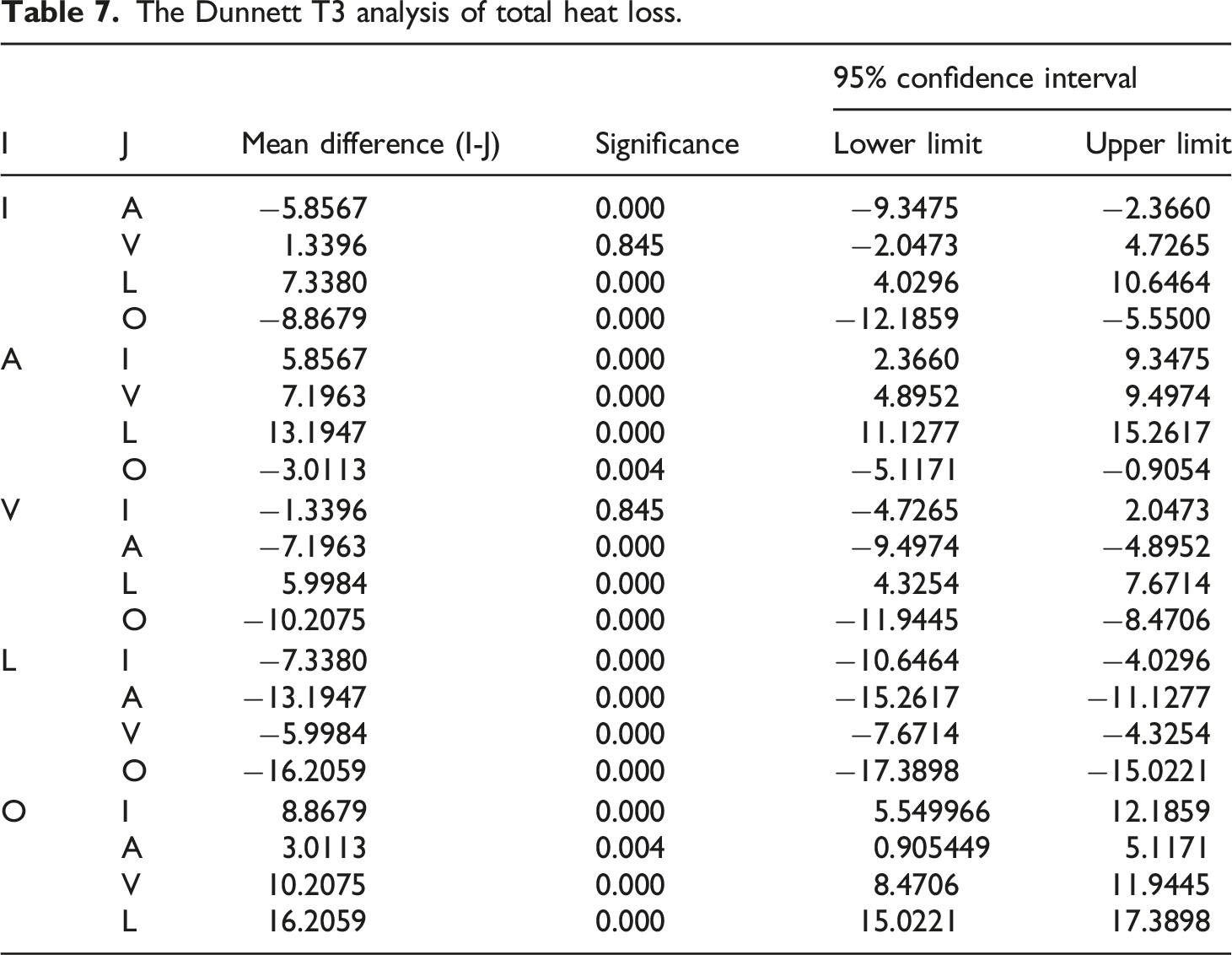
The Dunnett T3 analysis of total heat loss.
Effect of hole configuration on thermal protection performance
The effect of different honeycomb hole configurations on the thermal protection of the fabric system is shown in Figure 2, which shows that the TPP value of the honeycomb fabric system increases significantly compared with the solid fabric system. The introduction of the honeycomb insulation layer can improve the thermal protection performance under the same weight. And the section shape has an impact on the TPP value, in which the largest TPP value is A-type and the smallest is V-type. It is found that there are significant differences between V-type and the other four sections, and also significant differences compared A-type and L-type with the other three sections, but no significant difference between A-type and L-type from the result of the ANOVA, shown in Table 4. Schematic of the effect of honeycomb hole configuration on thermal protective performance.
The heat transfer mechanism of the multi-layer honeycomb structure is shown in Figure 3, taking A-type as an example. The heat transfer mode of honeycomb fabric includes conduction and radiant heat transfer of fabric, conduction heat transfer of air in the honeycomb hole, and radiant heat transfer between the upper and lower sides of the honeycomb cavity. The heat transfer of the fabric system is mainly realized by radiation heat transfer on the upper and lower surfaces under high temperatures. And the contribution of radiation heat transfer to the equivalent thermal conductivity of the fabric system increases nonlinearly with the increase of temperature. Both A-type and L-type are the honeycomb core close to the outer shell with smaller porosity, which results in less heat directly into the comfort liner and reduces the actual effective area of radiant heat transfer between the upper and lower surfaces of the honeycomb cavity. The smaller equivalent heat transfer coefficient makes the better thermal protective performance. That is, the TPP value of A-type and L-type increased by 9.43% and 7.43% respectively compared with I-type. And the TPP value of V-type was observed to be low, it is just a reversal of A-type when seeing both configurations, hence it may be expected that the TPP value is almost too low or the same. When the heat transfer direction is reversed, the third layer of A-type is the fabric layer that first contacts the heat, and its porosity is the largest among the five sections, with large radiation, so the heat transfer is easy. In addition, it can be seen from Figure 3 that the porosity of the first layer determines the transmission amount of most radiation in the thickness direction. TPP value decreases with the increase of the porosity of the first layer. Therefore, the heat transfer mode of reducing the size of the honeycomb core near the outer shell is conducive to improving thermal protection. Schematic of the heat transfer mechanism of multi-layer honeycomb fabric system.
Analysis of thermal and moisture comfort of fabric system
To comprehensively consider the influence of section shape on thermal and moisture comfort, experiments on thermal resistance and moisture resistance of five honeycomb fabric systems are carried out, and the results are shown in Figure 4. The heat dissipation direction of thermal and moisture resistance is opposite to that of the TPP experiment, which is the heat transfer ability from the comfort layer to the outer layer. The order of thermal resistance is I<O<A<L<V. The porosity of the three layers of I-type honeycomb is the same, which is 45.9%. The porosity of the first and third layers of O-type honeycomb is 37.7%. And the porosity of the three layers of V-type honeycomb decreased accordingly, which are 57.4%, 45.9%, and 17.2% respectively. Assuming that the surface temperature of human skin is 35°C (set by Sweating Guarded Hot Plate), the smaller the porosity of the honeycomb core close to the comfort inner, the more difficult it is for heat to be discharged out of the body through the hole, so the order of thermal resistance is I<O<V. While A-type and L-type have larger porosity in the third layer, their porosity decreases layer by layer, which finally prevents the discharge of heat. Therefore, their thermal resistance is greater than that of O-type and I-type. From the one-way ANOVA results, shown in Table 5, it is found that the contribution is not significant between V-type and L-type, set as a group. And there is no significant difference between A-type, I-type, and O-type, set as a group. But the contribution is significant between the two groups. It seems that the effect of honeycomb core size on thermal resistance is not obvious. It may be because radiation has little impact on the results under the low temperature of the thermal resistance experiment. Schematic of the effect of honeycomb hole configuration on thermal resistance and moisture resistance.
In a high-temperature environment, the human body perspires a lot, and the water is adsorbed on the comfort liner. Since the ambient temperature is higher than the skin temperature, the outward transfer of heat is mainly realized through the evaporation of water. The moisture resistance experiment shows the heat loss ability caused by water evaporation. To simulate the scene of massive sweating of the human body, the sweating plate instrument is not covered with waterproof and breathable film during the experiment, so that the liquid water provided by the water supply device is in direct contact with the fabric. The order of moisture resistance is O<A<V<I<L. The moisture resistance of I-type and L-type is larger, and there is no significant difference (Table 6). The possible reason is the straight hole existed in I-type and L-type, which is not conducive to the condensation of water vapor evaporated from the comfort liner on the fabric, but accumulates in the still air in the honeycomb core. Meanwhile, the third layer of L-type has the largest porosity, reducing the proportion of capillary transmission and increasing the proportion of water vapor diffusion, which results in the raise of packing quantity, so the moisture is larger than I-type. And the same reason can be used to explain the phenomenon that moisture resistance of A-type is larger than that of O-type. The proportion of capillary transmission of V-type is the largest, but its funnel structure is also not conducive to water condensation, so its moisture resistance is in the middle.
In general, moisture resistance is mainly affected by the amount of capillary transmission. The more capillary transmission, the smaller the moisture resistance. The porosity near the comfort liner and section shape determines the proportion of capillary transmission. There is a section whose porosity changes from large to small in the direction of water transmission for A-type and O-type, which increases the possibility of condensation to improve capillary transmission. On this basis, make the size close to the comfort liner as small as possible to further reduce the moisture resistance.
According to Formula (2), the total loss of five sections can be calculated by using the thermal and moisture resistance, as shown in Figure 5, which shows that the THL of A-type and O-type is relatively large, and their contribution is significant (Table 7). Schematic of the effect of honeycomb hole configuration on total heat loss.
Based on the significance analysis, the thermal protection performance of the five sections is A=L>I=O>V, while the thermal and moisture comfort performance is O>A>I=V>L. Therefore, the performance of A-type is better than that of the section structure, whose thermal protection performance and thermal and moisture comfort performance are greater than the straight section structure previously proposed.
Conclusion
The objective of the current study was to balance the contradiction between thermal protection and thermal and moisture comfort for hollow structures. Four hole shapes of honeycomb hollow structure thermal barriers have been developed, and their thermal protection and thermal and moisture comfort have been analyzed and evaluated by comparing them with the straight structure. Laser cutting technology was used to prepare the honeycomb pores with different porosity. And the three-dimensional structures with different cross-section shapes were obtained by compounding the honeycomb insulation fabric. The results are as followed. • The honeycomb fabric systems showed impressive thermal protection, and the hollow section affects the TPP value. The TPP value of A-type was found to be 38.3 cal/cm2, 9.43% higher than that of straight structure. In the high-temperature environment, the radiation heat between the upper and lower surfaces of holes increases. The smaller the porosity of the honeycomb core close to the outer shell, the less the radiant heat transfer, and the better the thermal protection performance. On the premise of consistent total porosity, the heat transfer mode of A-type with gradually increasing porosity from outside to inside is conducive to the improvement of thermal protection performance. • The contribution of heat transferred by moisture transfer is greater than that by temperature difference. The moisture resistance of O-type was found to be 24.51 Pa.m2/W, the lowest of the five cross-section shapes. Capillary transmission is the main way of moisture transfer, affected by the porosity of the honeycomb core close to the comfort liner and the possibility of condensation of water vapor in holes on the fabric. The smaller the porosity of the third layer of the thermal barrier, the more the mass of capillary transmission. And the latter must have the section with the porosity gradually decreasing from inside to outside, which exists in A-type, so its moisture resistance is second only to O-type.
According to the experimental results of TPP value and THL value, combined with analysis of variance, it can be concluded that A-type is beneficial to balance the thermal protection and thermal and moisture comfort. The hollow structure with A-type section shape will be a better option for use in thermal protective clothing. And in the future, the thickness design of this hollow structure and opening design of clothing can be combined with different parts of clothing to further optimize the performance.
Footnotes
Declaration of conflicting interests
The author(s) declared no potential conflicts of interest with respect to the research, authorship, and/or publication of this article.
Funding
The author(s) disclosed receipt of the following financial support for the research, authorship, and/or publication of this article: This work was supported by the Fundamental Research Funds for the Central Universities (Grant No. 2232021G-08) and the National Natural Science Foundation of China (Grant No. 51703026).
