




Abstract
In order to develop a suitable washing mode for knapsack, mechanical agitation (1), water bath vibration (2), ultrasonic (3), micro-nano bubble (4) and complex washing mode of the two were systematically investigated. Results showed that regardless of fabric, the washing efficiency of composite washing mode {mechanical agitation + ultrasonic (1 + 3), mechanical agitation + micro-nano bubble (1 + 4)}, was highest among all washing modes. Moreover, the decrease of stiffness, tensile strength, smoothness and micro-morphology of knapsack by using complex washing mode {mechanical agitation + ultrasonic (1 + 3), mechanical agitation + micro-nano bubble (1 + 4)} significantly lower than that of mechanical agitation. This indicated that mechanical agitation was the key to remove stain, micro-nano bubbles and ultrasound only assisted its removal. But the addition of micro-nano bubbles and ultrasound was helpful to improve the washing efficiency and reduce the performance degradation caused by washing mode of mechanical agitation. Complex washing mode {mechanical agitation + ultrasonic (1 + 3), mechanical agitation + micro-nano bubble (1 + 4)} was optimal washing combination for knapsack, especially the composite mode of mechanical agitation + ultrasonic (1 + 3), due to its ability to remove residual stains in the inner layer and slit. Moreover, the complex washing mode was also more environmental-friendly and sustainable, compared to other washing mode, because of washing time and detergent dosage reducing occurred by its high washing efficiency. The results were not only helpful to guide manufacturers of washing machine to develop a program dedicated to the daily washing and care knapsack, but also provided scientific care guidance and optimization ideas for subsequent research and applications.
Introduction
Knapsacks has become the necessary accessories for women when going out, because of its convenience and decorative.1–3 In the process of daily usage, it was easy to adsorb a variety of stains, such as dust, oil, mud, foundation liquid, colored liquid.3–5 In addition, knapsack belongs to a reusable product, and thus washing treatment for knapsack was necessary. Additionally, stains adsorbed on the surface of knapsack cannot be removed in time, it was easy to breed bacteria, harm to human health, especially the health awareness was emphasized today, and thus the reasonable washing-care knapsack has gradually become the focus of attention of current consumers during daily usage.3,5 However, the present work mainly focused on the style, fabrics, colors, patterns, materials of knapsacks and so on, the washing and care of knapsack was not relatively reported.1,3,4 Moreover, the current study on washing and care mainly reported on the washing of clothes, the study on how to wash knapsacks was not reported.6–8 Knapsack was different from ordinary clothes washing because of a two-layer (inner and outer) box-type three-dimensional structure, the difference of two-layer material was significant. Additionally, stain hidden in a slit or corner of knapsacks was not easy to remove, therefore special consideration should be given to the process of knapsack washing.9–11
In addition, if traditional mechanical agitation washing mode was used for knapsacks, the stains on the surface can effectively remove, but it was difficult to remove the stains in the slit. Moreover, it was also easy to appear stiffness decline, cracking and other damage when knapsack was washed by traditional washing mode of mechanical agitation.12–15 Dry-washing was also used for knapsacks, stains removed from both surfaces and slits, but price was relatively expensive. Additionally, the washing-care mode needs to be delivered and inconvenient.16–18 Moreover, with the development of washing technology, a lot of new washing technologies are emerging.18–20 For example, ultrasonic washing technology was widely used in the stain washing of metal machinery because of the cavitation, acceleration and direct and indirect effects of ultrasonic on liquid and stain, was helpful to the stain layer be dispersed, emulsified and peeled from fabric, especially a stain in a slit.19,21,22 Micro-nano-bubble technology was widely used in the washing of fruits and vegetables, due to micro-nano-bubble the characteristics of slow floating speed, large specific surface area and negative charge on the surface.20,23,24 This was because that these characteristics were useful for adsorbing and peeling of colloid particles, chemicals, grease and so on in water.22,23,25 However, there was no report on whether the new washing technology of ultrasonic and micro-nano-bubble was suitable for stain on surface of textile. Therefore, it was very important to systematically investigate the effect of different daily washing modes (mechanical agitation, ultrasonic, micro-nano bubble, water-bath vibration and or combination of the two) on knapsack performance (washing efficiency, appearance smoothness grade, stiffness, and morphology), with the help of WSB-3A intelligent digital whiteness meter, “AATCC Test Method 124-2010 Smoothness Appearance of Fabrics after Repeated Home Laundering,” automatic stiffness tester of fabric (YG207) and scanning electron microscopy (SEM.) HitachS-4800. This finding is not only helpful to understand the relationship between daily washing modes and performance degradation mechanism of knapsacks during daily washing process, but also provided reference for manufacturers of washing machine to develop a washing and care procedure for knapsacks. Additionally, it is also helpful to guide consumers to correctly washing care in the daily usage of knapsacks.
Experimental details
Experimental materials and instruments
Specification of fabrics used in this work.

Note: A1 and A2 belongs to upper layer fabrics, B1, B2 belongs to inner layer fabric. A2 was PVC (polyvinyl chloride) artificial leather without weave type.
Moreover, a series of experimental devices or instruments were used in the experimental process, mainly including: fabric densimeter (Y511B, Changzhou (China) fiber testing equipment Co, Ltd), meter of fabric thickness (YG141, Changzhou (China) fiber testing equipment Co, Ltd), electronic scale (YH-C30001, Shanghai yingheng electronic scale Co, Ltd), domestic washing machine (DG-F75366BCX, Hefei sanyang electric appliance Co, Ltd), ultrasonic washing machine (CR-100S, Barker ultrasonic technology Co, Ltd), micro-nano bubble generator (LX-Q6824, Chongqing xinxiang technology Co, Ltd), oscillator of water bath (SHA-AB, Changzhou yitong analytical instruments manufacturing Co, Ltd), intelligent digital whiteness meter (WSB-3A, Dongguan fangyuan Instrument Co, Ltd), automatic stiffness tester of fabric (YG207, Changzhou (China) fiber testing equipment Co, Ltd), fabric strength tester (YG026HC, Changzhou (China) fiber testing equipment Co, Ltd) and scanning electron microscope (HitachS-4800, Hitachi corporation, Japan).
Experimental process and design
The experiment was divided into preparation stage of stain-absorbent specimens and development stage of the washing mode, and the detailed process (see Figure 1) was listed as follow: The preparation flow chart of the stain preparation and experiment specimens.
Preparation stage of stain-absorbent specimens with carbon black
Stain solution of carbon black (mixing and stirring tallow hardened oil: liquid paraffin: carbon black and stirring for 30 min) were firstly prepared. Then, the samples (380 mm × 380 mm) were soaked in the stain-solution of the prepared carbon black for 6 hours, and then dried in a standard atmosphere of temperature 20°C ± 2°C and relative humidity 65 ± 2%. This dip-and- rolling treatment and drying treatment was repeated twice to obtain simulated stain-absorbent experimental testing specimens.
Experimental stage of the washing mode development
Experimental design of washing mode.

Note: The rinse bath was fixed at 1:10.
In addition, it must be pointed out that the test samples after washing are hung-dried at the indoor environmental conditions of temperature 20°C ± 2°C and relative humidity 65 ± 2%, to ensure the change of the performance of the test sample only owing to washing and care modes. A neutral detergent (pH
Experimental testing indicators and methods
Washing efficiency
In order to evaluate the effect of washing modes on the washing efficiency of knapsack, the surface reflectance of the original fabric and the fabrics before and after washing with different washing modes was measured at four spots using a WSB-3A intelligent digital whiteness meter (Da Rong, China). And washing efficiency was calculated using equation (1)
Appearance smoothness grade
To identify whether of knapsack will appear different degrees of wrinkles after the different treatment of washing modes, smoothness appearance of knapsack after different washing modes was independently assessed by three trained observers, according to “AATCC Test Method 124- 2010 Smoothness Appearance of Fabrics after Repeated Home Laundering”. Additionally, in order to ensure the stability and repeatability of the results, final rating of each perceived smoothness grade of knapsack was the mean scores of smoothness grade given by three trained observers.
Stiffness of fabric
In order to evaluate the effect of washing mode on the mechanical properties of knapsack, the stiffness of samples with different washing modes were tested according to GB/T18318.1-2009 (textile bending performance test part 1: rigid-flex of fabric using the ramp test method). Automatic stiffness tester of fabric (YG207) was used to measure stiffness. Prior to stiffness tests, all the specimens were conditioned for 24 h at above mentioned standard atmosphere. The rate of change bending stiffness was calculated by the following formula.
Tensile strength of fabric
To identify whether occurring the drop in strength of knapsack after different washing modes or not, the tensile strength of knapsack before and after different washing modes were tested using fabric strength tester (YG026HC). Testing methods and operations refer to GBT 3923.1-2013 textiles, fabrics-tensile properties-part 1, determination of breaking strength and elongation at break (strip method). Additionally, in order to maintain the reliability of the data, each sample was measured 6 times, the average value of 6 times of was taken as the tensile strength of the sample.
Appearance morphology
In order to explore whether washing modes affect the performance of knapsack and reveal its mechanism of action, microscopic morphology of knapsack after different washing modes was measured with the help of scanning electron microscopy (SEM.) HitachS-4800 (Japan).
Results and discussion
In order to optimization daily washing modes for knapsack, washing efficiency, smoothness, stiffness, strength, and appearance morphology of knapsack with two-layer structure after different daily washing treatment were analyzed and compared.
Washing efficiency
According to Figures 2 and 3, it was seen that the washing efficiency of fabric adsorbed with carbon black stain after different washing modes was mechanical agitation + ultrasonic (1 + 3) > mechanical agitation + micro-nano bubble (1 + 4) > mechanical agitation (1) > water-bath vibration + ultrasonic (2 + 3) > water-bath vibration + micro-nano bubble (2 + 4) > water-bath vibration (2) > ultrasonic (3) > micro-nano bubble (4), respectively. This observation indicated that single micro-nano bubbles, ultrasonic, water-bath vibration was not conducive to the removal of stains, but the washing efficiency was increased by mechanical agitation combined with micro-nano bubbles, ultrasound, water-both vibrations. This was because that mechanical agitation provided mechanical force for stain removal. Ultrasonic accelerated the stain dispersion, emulsification and removing from fabric surface by cavitation implosion, micro-streaming induced changes in surface boundary layer, as well as the intricate micro-structure of the fiber surface. Micro-nano bubble was helpful to the rapid migration of stains occurring due to the lower floating speed, larger specific surface area, surface negative charge of bubbles, and rich free radicals for adsorption stain. However, the force for stain removal provided by micro-and nano-bubbles and ultrasonic wave was far less than that by mechanical agitation, and therefore mechanical agitation was more efficient at removing stains than microbubbles or ultrasound. In other words, mechanical agitation was the key to remove the stains on the surface of fabric. The composite mode of mechanical agitation combined with micro-nano bubbles or ultrasound more efficient for stain removal, compared with single micro-nano bubbles, ultrasonic, water-bath vibration or mechanical agitation, because of compound mode playing respective advantages in the washing process. Moreover, it was also possible that washing time and detergent dosage of the composite mode were reduced by the use of composite washing mode, and therefore the composite mode was more environmental-friendly than other washing modes. Additionally, based on the results shown in Figures 2 and 3, regardless of washing modes, the trend of washing efficiency of different fabric was basically no difference. Namely, washing efficiency of A1 was always the highest, that of B1 was the worst among the four experimental fabrics. This was due to the fact that A1 was PVC artificial leather, the surface was smoother, and combination-strength of stains on fabric was lower, compared to other three fabrics. Therefore, the stain was easy to be removed from surface, and thus washing efficiency was higher. Moreover, this also means that the washing efficiency was not only related to washing mode, but also has slight relationship with fiber composition of stain-absorbent fabric. Washing efficiency of different washing modes. Post-washing appearance of different washing modes.

Appearance smoothness grade
It was seen from Figure 4 that regardless washing mode, B1 showed worse appearance smoothness grade than other fabrics (A1, A2, B2) used in this work. This may be due to the fact that B1 contained wrinkle-prone cotton fibers (35%), other fabrics were made of wrinkle-resistant polyester or synthetic materials. This indicated that fiber composition was a key factor in the formation of wrinkle. Additionally, as shown in Figure 4, the smoothness of fabric after water-bath vibration (2), ultrasonic (3), micro-nano bubbles (4) were relatively high, that of composite washing mode (mechanical agitation + ultrasonic (1 + 3), mechanical agitation + micro-nano bubble (1 + 4)) was middle, that of mechanical agitation (1) was lowest, among the wash-and-care modes. This means the smoothness of fabric under the condition of mechanical agitation was improved by the recombination of micro-nano bubbles or ultrasonic, but the smoothness of composite washing mode was still lower than that of a single ultrasonic washing mode (3) or micro-nano bubble washing mode (4). This was because that in the process of mechanical agitation, the fabric was subjected to a series of bending and compressing actions, such as twisting, folding, winding, kneading and so on, which contributed to the formation of wrinkle. Under the condition of micro-nano bubble washing mode or ultrasonic washing mode, water-bath vibration washing mode, fabric was unfolded and had less force for promoting the formation of wrinkles. Therefore, mechanical agitation was the key to the formation of wrinkles. In the daily care process, mechanical agitation should be reduced to obtain smooth appearance. Appearance smoothness grade of different washing modes.
Stiffness of fabric
Effects of daily washing modes on stiffness of knapsack.

aUnit of stiffness is mNcm. Additionally, the accuracy of the test data was controlled in the range of ±1%.
Tensile strength
Effects of daily washing modes on elongation at break of knapsack.
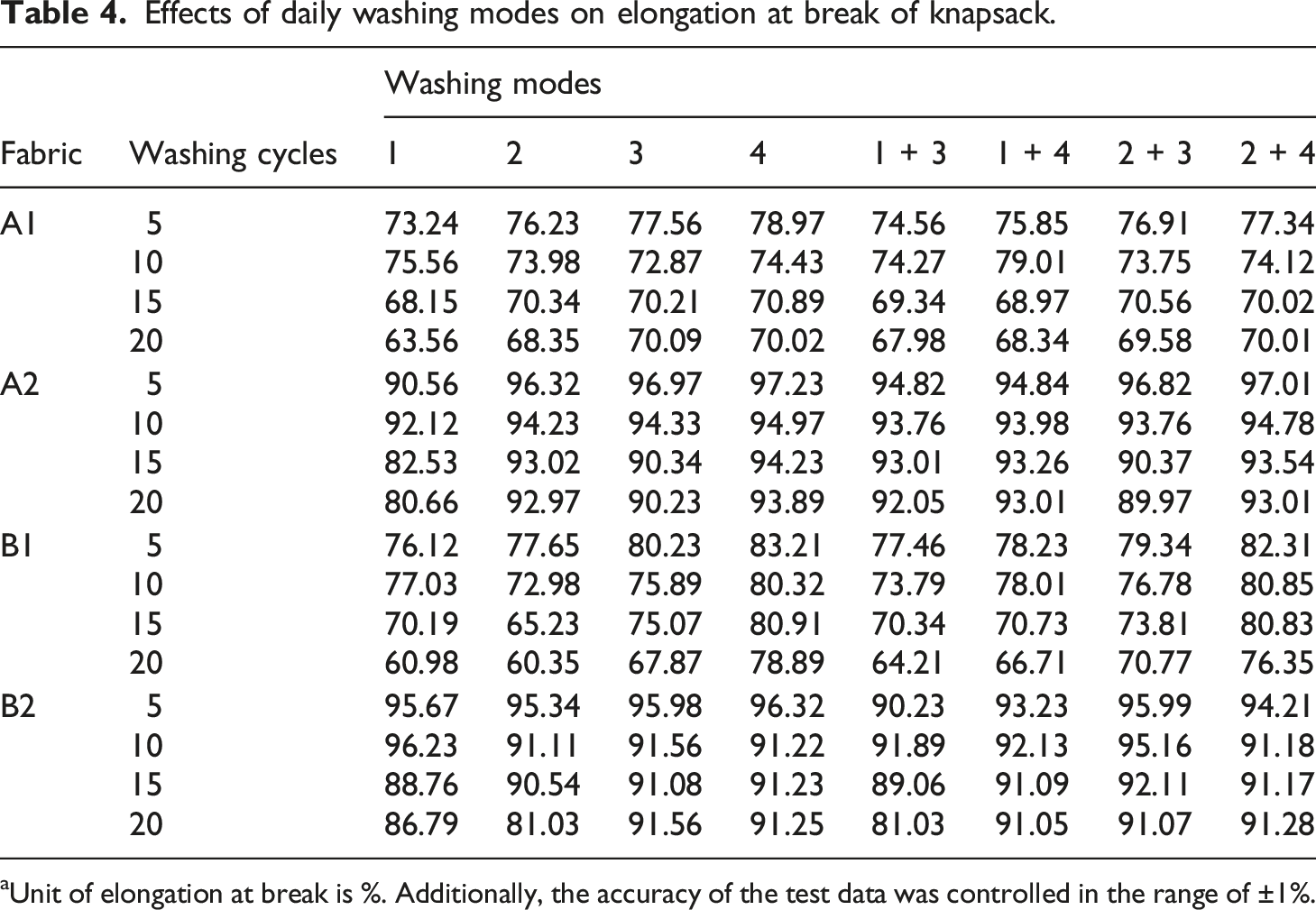
aUnit of elongation at break is %. Additionally, the accuracy of the test data was controlled in the range of ±1%.
Appearance morphology
The morphological information of the outer fabric used in knapsack (single-sided fabric (A1) and double-sided coated fabric (A2)) after different washing modes was investigated by SEM (see Figures 5, 6, and 7). Figure 5 clearly showed the change of micro-morphology of knapsack after different treatments of washing modes. As illustrated in Figure 5, hairiness, distortion and fracture fibrils of fabric (back) were observed under the washing condition of mechanical agitation (1). This deformation was occurred owing to the imbalance swelling and desorption, as well as effect of external force. However, under the washing condition of without mechanical agitation (2, 3, 4), surface and texture of fiber and fabric was smooth and clear. This was because ultrasonic or micro-nano bubble washing process did not appear fiber migration caused by mechanical agitation, and then less damage occurring. Additionally, it also found that surface damage (deformation and hairiness of yarn) of fabric after composite mode (1 + 3, 1 + 4) was relatively slight, compared with mechanical agitation (1). This was because in the composite washing mode, due to ultrasonic cavitation and micro-nano bubble growth-explosion, water film was formed on the surface of fabric, less external mechanical force such as friction, smashing, twisting and so on was applied to the fabric, compared with the pure mechanical agitation mode, which was helpful to decline fabric damage from the mechanical force. This also indicated that surface damage (deformation and hairiness of yarn) was mitigated due to using composite mode. Moreover, compared with single-layer fabric (A1), micro-morphology of double-sided coated fabric (A2) experienced more serious damage in different washing modes (as shown in Figures 6 and 7). This was because the double-sided coated fabric belonged to the fiber braided substrate coated with sol, it is easy to cause damage (peel, wear) and space between yarns broken or loosed owing to excessive mechanical force and swelling (Figure 5). This also to some extent proved that are mechanical washing mode was suitable for knapsack made of single-layer fabric, but knapsack made of double-sided coated fabric should be washed carefully during the daily usage. Effects of daily washing mode on micrograph of single-sided knapsack fabric (a) pre-washing, (b) no mechanical washing mode, (c) pure mechanical washing mode, (d) complex washing mode. Micrograph of double-sided coated fabric before washing (a) front, (b) back, (c) cross-section. Micrograph of double-sided coated fabric after washing (a) front, (b) back of no mechanical washing mode, (c) back of pure mechanical washing mode, (d) back of complex washing mode, (e) cross-section.


Mechanism analysis of different washing mode
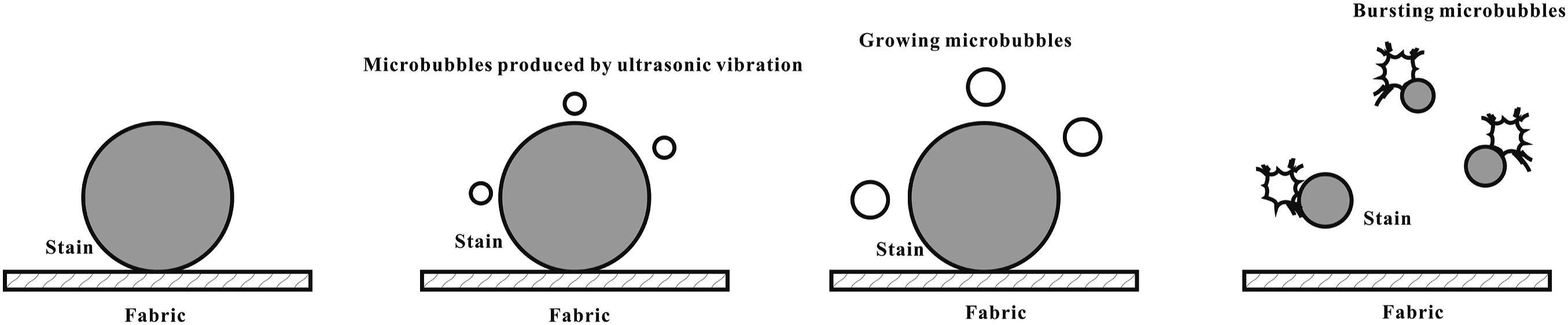
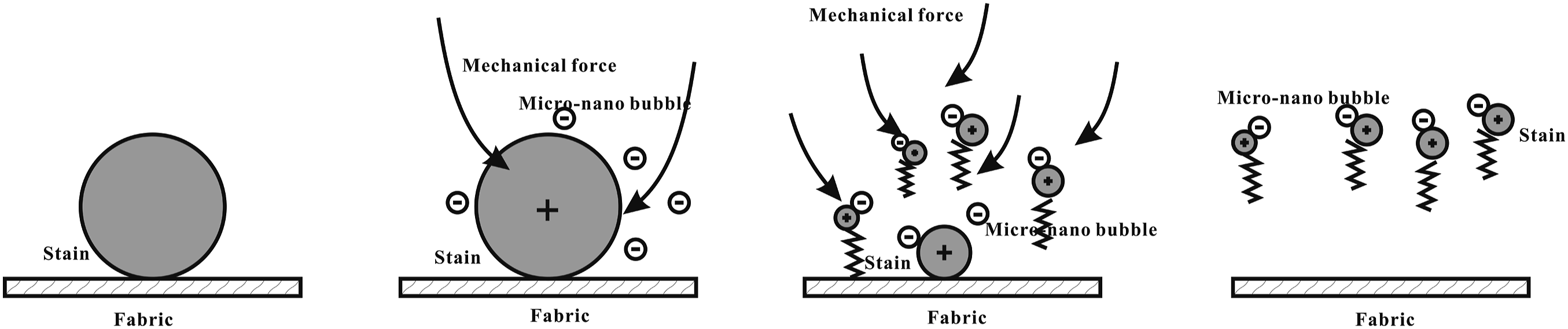
Figures 8, 9, 10, 11, and 12 clearly showed stain removal process of different washing mode. As shown in Figure 8, in the process of washing mode of mechanical agitation (1), the stains were removed by the combined action of mechanical force, detergent and water flow. Specifically, the washing process of mechanical agitation belonged to the process of stain adsorbed on the fabric firstly becoming loosened owing to the emulsifying and micellar effect of the detergent, and then peeling from the surface of fabric with the help of water flow and mechanical agitation. During the process, detergent reduced the surface tension of the water owing to the hydrophilic and hydrophobic orientation of the surfactant in the detergent, which was helpful to the wettability of the stain and the decrease in the adhesion between the stain and the fabric, and thus detergent provided the conditions for the stain to be removed. Moreover, the erosion of water flow and mechanical agitation provided the motive force for the scouring and peeling of the stain from the surface of the fabric. Figure 9 clearly described the removal process of stain under the condition of ultrasonic washing mode (2). As shown in Figure 9, the ultrasonic wave generated by the transducer propagates was firstly spread in the washing liquid and produced a lot of micro-bubbles. Micro-bubbles vibrated and expand with the sound field. Micro-bubbles burst and collapse, when it exceeds a certain threshold value, and produce a high-strength shock wave, high-strength shock wave make the adsorption of stain and fabric was destroyed or dispersed, resulting in besmirch layer of adsorption fatigue, looseness, fragmentation, dispersion, and then realize the stain remove from the surface of fabric. In other words, under the condition of ultrasonic washing mode, stain stripping from the surface of fabric was realized by the direct and indirect effects of cavitation, acceleration and direct-flow action of ultrasonic in liquid to disperse, emulsify and peel. Additionally, because of super penetration of ultrasonic, ultrasonic washing can penetrate into the other side of the surface and cavity, blind hole, slit of being cleaned objects, therefore, ultrasonic washing has other washing mode of mechanical agitation without achieving the function of flaking off of the inner surface and narrow adhesion stains. Figure 10 revealed the process of composite washing mode of the mechanical agitation + ultrasonic (1 + 3). As shown in Figure 10, the removal of stains was the comprehensive effect of mechanical agitation on stain scouring and stripping, and the cavitation effect and mechanical shock of ultrasonic, so it was more conducive to stain removal, especially for stains lingering in the inner layer or slit of the cleaning object. In addition, the composite washing mode also reduces the damage caused by simple strong mechanical agitation to the cleaning object, because ultrasonic does not cause fiber migration like mechanical agitation. The process of micro-nano bubble washing mode (4) was illustrated in Figure 11. As shown in Figure 11, the ability of micro-nano bubbles to remove stains was attributed to the hydrophobicity and negative charge of the surface of the micro-nano bubbles. This was because that the hydrophobicity and negative charge of bubble surface had strong adsorption capacity for colloid particles, chemicals, grease, and the adsorption capacity can force the stain being removed from the cleaning object. Figure 12 showed the process of composite washing mode of the mechanical agitation + micro-nano bubble (1 + 4). As shown in Figure 12, the removal of stains was the comprehensive effect of mechanical agitation on stain scouring and stripping, and the hydrophobicity and strong adsorption of negative charge of micro-nano bubbles that was more conducive to stain removal, especially for oily stains. In addition, the composite washing mode also reduces the damage caused by simple strong mechanical agitation to the washed object, due to the coating effect of bubbles on the washed object. Moreover, composite washing mode was also environment-friendly and energy-saving method, because of its high washing efficiency reducing the amount of detergent and reducing the washing time. To sum up, according to the balance principle of washing efficiency and fabric damage, the composite washing mode was more suitable for the daily washing and care of knapsack, especially the composite mode of mechanical agitation + ultrasonic (1 + 3). The mechanism of stain removal under the condition of mechanical agitation mode. The mechanism of stain removal under the condition of ultrasonic washing mode. The mechanism of stain removal under the condition of mechanical agitation + ultrasonic washing mode. The mechanism of stain removal under the condition of micro-nano bubble washing mode. The mechanism of stain removal under the condition of mechanical agitation + micro-nano bubble washing mode.


Conclusion
In order to develop a suitable washing mode for knapsack, we systematically investigated mechanical agitation (1), water bath vibration (2), ultrasonic (3), micro-nano bubble (4) and composite washing mode of the two. The experimental results revealed that the stains did not be efficiently removed using the washing mode without mechanical agitation {water bath vibration (2), ultrasonic (3), micro-nano bubbles (4), water bath vibration + ultrasonic (2 + 3), water bath vibration + micro-nano bubbles (2 + 4)}, but the washing mode without mechanical agitation almost did not damage to the surface morphology and mechanical properties based on experimental results of SEM, stiffness and tensile strength. However, stain removal effect with mechanical agitation {mechanical agitation (1), mechanical agitation + ultrasonic (1 + 3), mechanical agitation + micro-nano bubbles (1 + 4)} was relatively excellent, but damage was also relatively serious. Additionally, the degree of damage depended on time and the distribution of high mechanical action on the fabric. In addition, based on this investigation, we also found that the composite washing mode {mechanical agitation + ultrasonic (1 + 3) and mechanical agitation + micro nano bubbles (1 + 4)}effectively improved the washing efficiency and reduce the performance degradation caused by simple mechanical agitation, and indicated that the composite washing mode was more suitable for the daily washing and care of knapsack, especially the composite mode of mechanical agitation + ultrasonic due to its ability to remove residual stains in the inner layer and slit. In addition, composite washing mode was also more environmental and energy-saving because of its high cleaning efficiency, reducing the amount of detergent and reducing the washing time. Additionally, it was also found that repeatedly mechanical agitation leaded to surface of fabric used in knapsack (especially double-sided coated fabric) experienced different degrees of damages such as distortion, hairiness, micro-holes, micro-cracks, fracture, and dry-abraded of fibers surface. Meanwhile, the degrees of damages were not proportional to the washing cycles, the increase of damages was more obvious within the range of 0–5 washing cycles.
In conclusion, this work not only assist understanding of the performance degradation mechanism of knapsack in the daily washing process, but also help the manufactures of washing machine to accurately set the parameters specially used for the washing of knapsack, and then guide consumers to reasonably care for knapsack in daily usage. However, we only studied the removal effect of carbon black stains after different washing modes, and did not study other kinds of stains in life (such as oil stains, protein stains, blood stains and so on). Moreover, it was also fact that the adsorption and desorption properties of different stains are significantly different, therefore, in the future, it is necessary to systematically study the relationship between other types of stains and washing modes. This could help establish whether optimal wash modes could be used to help improve washing efficiency and reduce fabric damage. Temporal dynamics of damage over the life time of knapsack should also be examined, as this could help extend knapsack life while at the same time reducing damage from the daily-washing process.
Footnotes
Acknowledgements
The authors would like to thank project partner Anhui Suli Technology Company and Anhui Guqi Down Incorporated company for their contributions to the study. We are grateful to College of Textile and Clothing, Anhui Polytechnic University and Directorate of Library and Documentation for their support in editing and proofreading service of this study.
Declaration of conflicting interests
The author(s) declared no potential conflicts of interest with respect to the research, authorship, and/or publication of this article.
Funding
The author(s) disclosed receipt of the following financial support for the research, authorship, and/or publication of this article: This study is supported by Natural Science Research Project of Anhui Higher Education Institutions (KJ2020A0352); Open Project Program of Shanghai Fire Research Institute of MEM (2020XFZB09); The Open Project Program of Anhui Province College of Anhui Province College Key Laboratory of Textile Fabrics, Anhui Engineering and Technology Research Center of Textile (2021AETKL20); 2022 Anhui Polytechnic University-Jiujiang District Special Fund for Industrial Synergy and Innovation (2022 CYXTB7); School-level research Foundation of Anhui Polytechnic University (Xjky03201908).
