



Abstract
In order to reduce the functional degradation caused by improper daily washing-care and prolong the service life of technical jacket, the relationship between the daily washing conditions and functional degradation in the wearing performance of technical jacket (waterproof, windproof, warmth retention) was quantitatively investigated with the help of hydrostatic pressure, surface contact angle, air permeability, warmth retention, and scanning electron microscopy (SEM) of technical jacket after different daily washing conditions. Results showed that no matter what kind of washing modes, washing parameters, type and dosage of detergent, the wearing performance of technical jacket after washing were subjected to decrease compared with pre-washing. Additionally, it was also found that the effects of washing modes, type of detergents and washing parameters on the wearing performance of the technical jacket were significant, instead of the dosage of detergents. This indicates it was possible ways to minimize functional degradation by setting optimal washing conditions (washing parameters, washing mode, types and dosage of detergent). Balancing considerations of functional degradation and washing efficiency, the washing combination of mechanical agitation + micro-nano bubbles), type of detergent (neutral liquid detergent), dosage of detergent (3 g/L), water temperature (20°C), main washing bath ratio (1:10), main washing speed (15 rpm), main washing time (20 min), rinsing speed (30 rpm), rinsing cycles (2), belonged to the optimal washing combination in this study of washing condition. The results were of practical significance to guide manufacturers of washing machine to develop optimal daily washing produce for outdoor clothing, especially technical jacket.
Keywords
Introduction
With the improvement of health consciousness and living standard, outdoor sports have become an increasingly popular ways of outdoor leisure.1–3 Meanwhile, the outdoor environment belongs to the co-existing environment of the ash, mud, oil and other stains, and thus outdoor clothing easily absorbs various kinds of stains in the process of daily use.4–6 Moreover, the production and R&D (research and development) cost of outdoor clothing was also relatively high because of resisting the external harsh environment.4,7,8 Additionally, if the stain deposited on surface of clothing did not be removed in time, it was not only easy to occur the protective function of outdoor clothing declining, but also easily breed bacteria and even harm the human body.9–11 In addition, according to the existing studies on washing care, the washing-care of clothing belongs to a complex process including water flow, detergent, mechanical agitation, which easily occurred the decline of clothing performance when clothing being improper washing.12–14
However, previous investigators mainly focused on the function development, high-performance fabrics or clothing, style design, pattern optimization of outdoor clothing, and so on, few references on daily washing of outdoor clothing.6,8,15 Moreover, outdoor clothing needs special attention because of protective function, fabric texture and manufacturing process being obviously different from other daily non-functional clothing (such as shirt or dress).1,6,7 In addition, because of excellent wind-proof, water-proof and warm performance, technical jacket has become the first choice of consumers for outdoor activities. 5 Therefore, in our presented work, taking the commonly used fabric of technical jacket as the research object, the relationship between daily washing conditions and waterproof, windproof, warmth, appearance morphology of technical jacket was systematically investigated. Additionally, in this study, we not only in particular to examine the extent of the effects of daily washing conditions (washing mode, washing parameters, type and dosage of detergent) on the functional performance of technical jacket, but also systematically analyzed the damage behaviors and damage formation mechanism due to daily washing. Moreover, the results are of practical significance to guide manufacturers of washing machine to develop a produce for the daily washing-care of outdoor clothing, and help consumers correctly washing-care technical jacket. Additionally, this work may provide the possibility to further improve the service life of technical jacket and reduce resource waste.
Experimental details
Experimental materials and instruments
Combined with product survey, consumer interviews and published literatures on technical jacket, three kinds of commercial outer fabrics (A1, A2, A3) and one kind of commercial inner fabric (B) were selected as experimental fabrics. A summary of basic properties of each fabric was listed in Table 1. Additionally, in order to obtain experimental samples of technical jacket with the two-layer structure, experimental fabrics were firstly cut into sample pieces with the size of approximate 350 × 350 mm, and then sample pieces of outer and inner layer were assembled to form experimental samples (350 × 350 mm) with a two-layer structure. In addition, in order to more truly simulate the effect of daily washing-care on the performance of the technical jacket, experimental samples (350 × 350 mm) with two-layer structure were soaked in the stain-solution of carbon black, and thus the simulated experimental testing specimens were obtained. Moreover, it must be pointed out that technical jacket belongs to the outdoor clothing, therefore, it is easy to absorb mud stains, ash stains during use process of technical jacket. Additionally, the main component of these stains is carbon black, so carbon black liquid was chosen as daily simulation stain of technical jacket in this work.
Specification of fabrics used in this study.

In addition, in order to explore the relationship between the daily washing conditions and functional degradation in the wearing performance of technical jacket (waterproof, windproof, warmth retention), fabric densimeter (Y511B), meter of fabric thickness (YG141), electronic scale (YH-C30001), domestic washer (DG-F75366BCX), ultrasonic washing machine (CR-100S), micro-nano bubble generator (LX-Q6824), oscillator of water bath (SHA-C), intelligent digital whiteness meter (WSB-3A), fluorescent inverted microscopy (DF-450), video contact angle tester (DSA25B), air permeability Tester (YG461E), flat-panel thermal insulator (YG (B) 606E), were also used in the experimental investigation.
Experimental process and design
The experiment was divided into two stages:
Preparation stage of testing specimens with carbon black stains: In detail, stain-solution of carbon black (mixing and stirring tallow hardened oil: liquid paraffin: carbon black and stirring for 30 min) were firstly prepared. Then, the samples (350 × 350 mm) with a two-layer structure were soaked in the stain-solution of the prepared carbon black for 6 h, and then the simulated experimental testing specimens were obtained by twice dip-and-tie treatment and then hung-dried at the indoor environmental conditions of temperature 20 ± 2°C and relative humidity 65 ± 2%.
Experimental stage of the daily washing: In order to clarify the relationship between the daily washing conditions and the functional degradation of technical jacket, the effect of washing mode, kinds and dosage of detergents, washing parameters (washing time, washing rotation speed, rinsing times, water temperature, bath ratio) on the wearing performance of technical jacket (waterproof, windproof, warmth retention) were systematically investigated. Additionally, the experimental parameters and levels are given in Tables 2 and 3.
Experimental design of daily washing mode, types and dosage of detergents.

The rinse bath was fixed at 1:10.
Experimental design of daily washing parameters.

The rinse bath was fixed at 1:10.
Experimental testing indicators and methods
Appearance morphology
In order to investigate the effect of daily washing on the surface morphology of technical jacket, the surface morphology of technical jacket after different daily washing treatment was assessed with the help of scanning electron microscopy (SEM) HitachS-4800 (Japan).
Waterproof property
In order to explore the effect of daily washing conditions on the waterproof property of technical jacket, hydrostatic pressure and contact angle were measured with the help of digital water permeability tester (YG812DA) and video contact angle tester (DSA25B). Detailed description of experiment was listed as follows:
Hydrostatic pressure test: Samples were prepared by cutting an area approximately 150 × 150 mm from experimental samples (350 × 350 mm) with a two-layer structure after different daily washing treatment. The hydrostatic pressure of samples after different washing treatment was tested according to GB/T 4744-2013. The distilled water was used in hydrostatic pressure test. The test was performed in measuring range of 500Pa-200KPa, rising at rate of water pressure 10 KPa/min.
Wettability test: Samples for test were prepared by cutting an area approximately 80 × 30 mm from experimental samples (350 × 350 mm) with a two-layer structure after different daily washing treatment. The volume of water droplet was set to 5 μL, and five different locations of each testing sample were selected to ensure the reliability of experimental results, and the average value of 5 tests for each sample was the contact angle value of experimental sample.
Windproof
In order to evaluate the effect of daily washing conditions on windproof property of technical jacket, air permeability of samples with different daily washing treatment were tested according to GB/T5453-1997 (Textiles – Determination of the permeability of fabrics to air). Air permeability Tester (YG461E) was used in this study. Size of samples for test were 200 × 200 mm. The observed pressure was set at 100 Pa.
Warmth retention
To identify whether occurring the warmth retention of technical jacket after different daily washing treatment or not, warmth retention of sample before and after daily washing treatment were tested using flat-panel thermal insulator (YG(B)606E). Each experimental sample (350 × 350 mm) with a two-layer structure was measured for six heating cycles and tested for three times, the average value of three times was taken as the warmth retention of experimental sample. During the experiment, the temperature of the experimental-testing plate was set to 35°C. Temperature, humidity and horizontal wind speed of being automatically controlled by the instrument at 150 mm above the sample in testing box were set to 20°C, 65%, 1 m/s. In addition, the whole experiment was completed in the laboratory of relative humidity (65 ± 2%) and temperature (20 ± 2°C).
Washing efficiency
In order to evaluate the effect of washing conditions on the washing efficiency, the surface reflectance of the original fabric, stained fabrics before and after washing under the different washing conditions was measured at four spots using a WSB-3A intelligent digital whiteness meter (Da Rong, China). And washing efficiency was calculated using equation (1):

where
Results and discussion
In order to investigate whether daily washing-care lead to functional degradation of the technical jacket, waterproof, windproof, warmth, appearance morphology of simulated experimental testing specimens with two-layer structure after different daily washing conditions were analyzed and compared.
Effects of daily washing on micro-morphology of technical jacket
Figure 1 clearly showed the effects of washing modes, detergents type, and washing parameters on the micro-morphology of the technical jacket. As shown in Figure 1, hairiness, distortion, and fracture fibrils of fabric surface were observed under the washing condition of mechanical agitation {mechanical agitation (1), mechanical agitation + ultrasonic (1 + 2), mechanical agitation + micro-nano bubble (1 + 3)}. Under the washing condition of without mechanical agitation {ultrasonic (2) micro-nano bubble (3)}, surface and texture of fiber and fabric was smooth and clear. In addition, it also found that some grainy stains still remained on the surface of the fabric, which indicated that washing efficiency of the washing condition of without mechanical agitation {ultrasonic (2), micro-nano bubble (3)} was relatively lower compared with the washing condition of mechanical agitation. Namely, mechanical agitation was the key factor in the removal of stains. The washing mode of micro nano bubbles and ultrasonic almost did not destroy the surface morphology, but mechanical agitation destroys surface morphology. Additionally, it was found that the breakage and firnification of fiber or yarn, deformation of water-resistant micro-porous membrane and peeling of the coating structure was caused by the strong alkaline detergent {washing powder (3*), soap (4*)} as shown in Figure 2. Additionally, it was clearly observed that the surface damage became more obvious with the increase the dosage of detergent (see Figure 3). This was because too much detergent leaded to alkaline of washing solution enhancement, and the fabric of technical jacket was not alkali-resistant, so the damage became more serious.16,17 Meanwhile, Figure 4 clearly revealed that excessive mechanical action (long washing time and high washing speed) caused yarn and fiber on the surface of the technical jacket to break or even fibril, and damaged the waterproof microporous membrane and laminate structure or even break away from the outer fabric, which was also strong evidence for performance of technical jacket decreased.
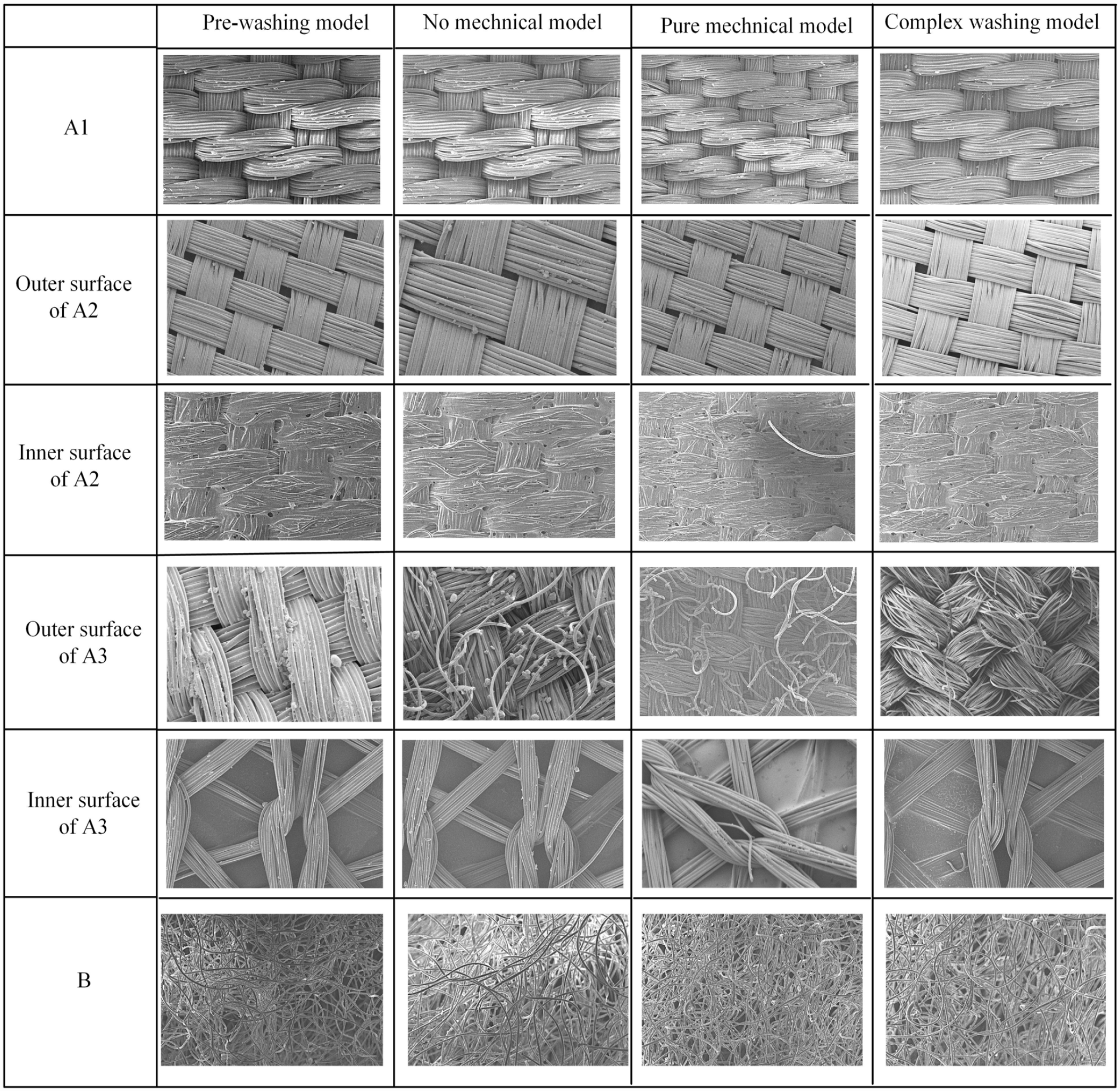
Effects of daily washing mode on micrograph of technical jacket.

Effects of type of detergent on micrograph of technical jacket.

Effects of dosage of detergent on micrograph of technical jacket.

Effects of mechanical action on micrograph of technical jacket.
Effects of daily washing on waterproof performance of technical jacket
The waterproof performance of technical jacket mainly refers to the ability of resisting the liquid water, which was characterized by water resistance (hydrostatic pressure) and wettability (surface contact angle). Therefore, hydrostatic pressure and surface contact angle were tested by means of a digital water permeability tester and surface contact angle tester. The detailed results were listed as follows:
Hydrostatic pressure: Figure 5 and Table 4 clearly showed that the daily washing-care resulted in a slight decrease in the hydrostatic pressure regardless of washing condition, but the change fell within the acceptable range where washing efficiency was greater than 70% and functional degradation was less than 5%. In addition, it also found that the modes and parameters of washing significantly affected waterproof performance of technical jacket, but the effect of dosage and type of detergent was relatively slight. This was because hydrostatic pressure of fabric was closely related to the external pressure, the surface properties of fabric and fiber, and the size of pore diameter. While the technical jacket treated by different washing modes was subjected to different mechanical force, which leading to different change in yarn voids, microporous film and coating. Specifically, the greater the mechanical effect, the greater the decrease in hydrostatic pressure. This is because the washing modes with mechanical agitation {mechanical agitation (1), mechanical agitation + ultrasonic (1 + 2), mechanical agitation + micro-nano bubble (1 + 3)} easily leaded to pilling and wrinkling of fabric or fiber surface, shape distortion and size smaller of pore, due to mechanical agitation and friction, and thus decrease in waterproof occurred.18–20 Additionally, this also further demonstrated by the experimental results of daily washing parameters (the speed and time of main washing stage, speed and cycles of rinsing stage on the hydrostatic pressure more than rinsing time, temperature and bath ratio of main washing stage). Moreover, the slippage between the fibers and between the yarns or exfoliation of microporous film and coating become easier due to the increase in the softness of fabric caused by the active agent in the detergent, and thus resulting in the hydrostatic pressure decreased, especially strong alkaline detergent products such as washing powder and soap.

Effects of daily washing condition on hydrostatic pressure of technical jacket: (a) washing mode, (b) type of detergent, and (c) dosage of detergent.
Effects of daily washing parameters on hydrostatic pressure of technical jacket (unit: KPa).

HP is the abbreviation of hydrostatic pressure, indicating the value of hydrostatic pressure; ∆HP is the hydrostatic pressure of the unwashed sample – the hydrostatic pressure after washing treatment, indicating the change of hydrostatic pressure value; The hydrostatic pressure of A1B, A2B, A3B without daily washing treatment are 13.26 KPa, 19.25 KPa, 21.47 KPa, respectively.
Wettability: Figure 6(a) clearly showed that no matter what kind of daily washing modes, the ability of anti-water of fabric after daily washing had a declining trend. Specifically, the decrease was most obvious in the simple mode of mechanical agitation (1), followed by the compound mode {mechanical agitation + ultrasonic (1 + 2), mechanical agitation + micro-nano bubble (1 + 3)}. However, ability of anti-water of fabric had almost no decrease in the non-mechanical agitation mode {ultrasonic (2) or micro-nano bubble (3)}. This was mainly due to repeated mechanical agitation and water scouring resulting in the waxy and greasy peeling from the fabric surface, making wettability increased, water resistance decreased.21–23 In addition, it was evident from the experimental results (see Figure 6(b)) that the daily washing with using washing powder (3*) and soap (4*) leaded to a significant increase in wettability, but change of wettability of fabric after washing by using neutral liquid detergent (1*), weak alkaline liquid detergent (2*), laundry beads (5*) was not significant. This indicated that there was different decrease in water resistance after daily washing with using different kinds of detergents. Meanwhile, the dosage of detergent has slight increase in wettability (Figure 6(c)). This slight increase was due to the wetting effect of the surfactant in the detergent or the hydrophobic coating and composite film damaging because of mechanical agitation. Additionally, as shown in Table 5, the improper water temperature, speed, time of main washing stage leaded to a significant improvement in the wettability of technical jacket, and thus decline in water resistance. However, the speed and cycle of rinsing had little effect on wettability. This happened because the water temperature, speed, time of main washing stage caused some slight damage to the fabric surface such as fracture and distortion of yarn voids, coated micropores, laminated film as well as hairiness during the daily washing process.24–26 This explanation also supported the fact that the wettability of mechanical agitation type of washing was better than that of non-mechanical agitation type of washing. Moreover, it also found that the contact angles of the three fabrics from high to low were composite fabric, coating fabric, high-density fabric, regardless of the washing conditions. This mainly due to weave type and finishing mode of fabric resulting in the contact angle difference as shown in Figure 7.
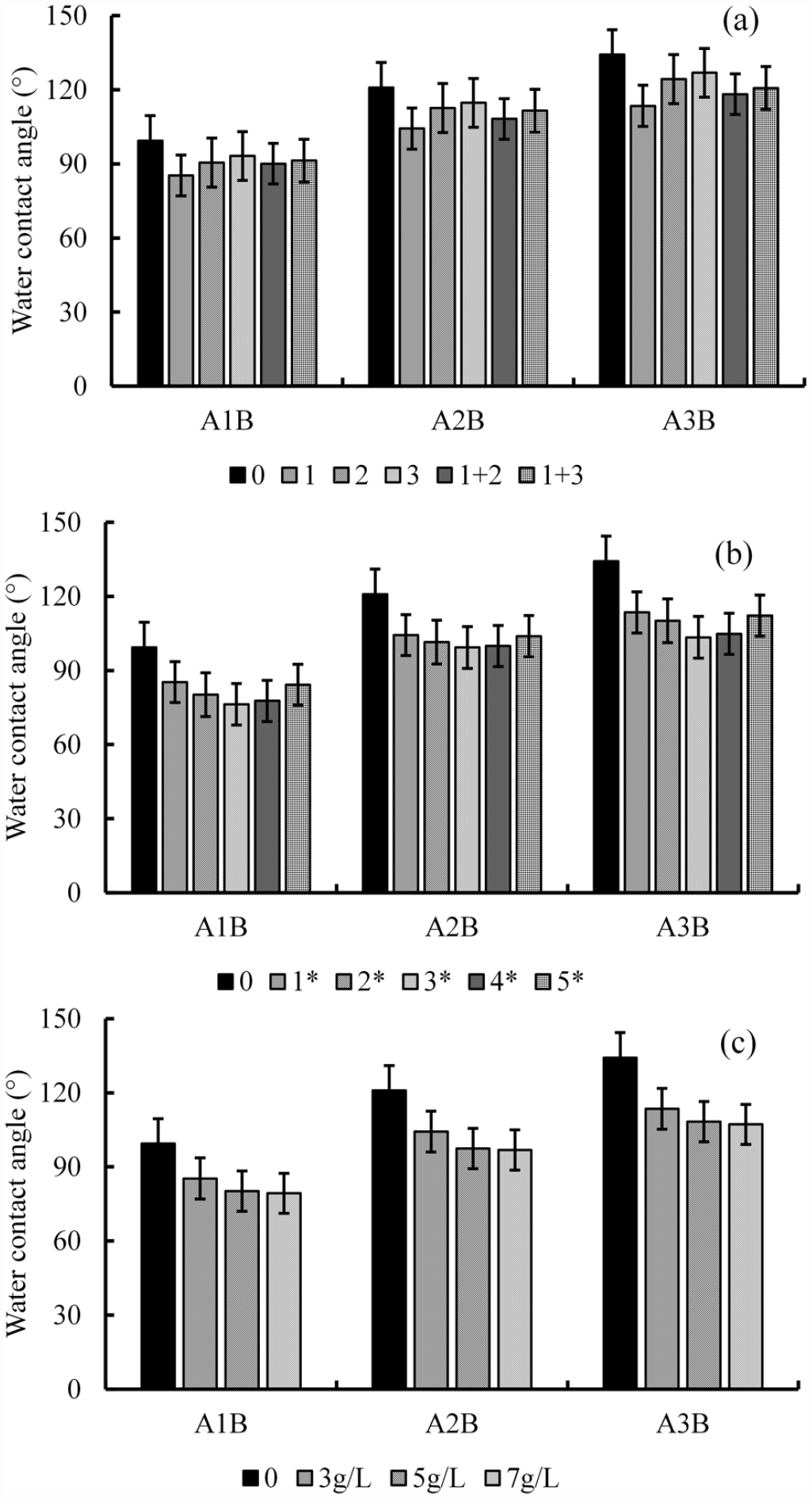
Effects of daily washing condition on water resistance of technical jacket: (a) washing mode, (b) type of detergent, and (c) dosage of detergent.
Effects of daily washing parameters on water resistance of technical jacket (unit: °).

WCA is the abbreviation of water contact angle, indicating wettability of fabric; ∆WCA is the water contact angle of the unwashed sample – the water contact angle after washing treatment, indicating the change of wettability; The water contact angle of A1B, A2B, A3B without daily washing treatment are 99.4°, 120.9°, 134.2°, respectively.

The initial contact angle of fabric of technical jacket used in experiments: (a) high density fabric, (b) coating fabric, and (c) composite fabric.
Effects of daily washing on windproof performance of technical jacket
Compare the different treatment of washing mode (see Figure 8(a)), it was found that the windproof performance of technical jacket after the treatment of mechanical agitation (1), mechanical agitation + ultrasonic (2), mechanical agitation + micro-nano bubble (1 + 3) decreased more than that of ultrasonic (2) or micro-nano bubble (3). This indicated the windproof performance of technical jacket was mainly attributable to mechanical agitation, and the addition of ultrasonic or micro-nano bubble was conducive to reducing the deterioration of protection performance caused by the mechanical agitation. This was due to the addition of ultrasonic or micro-nano bubble significantly improved the rate of detergents emulsify and stain peel-off. Meanwhile, as described in Figure 8(b), the slightly decrease of windproof performance of technical jacket was caused by the washing process of using the neutral liquid detergent (1*) and weak alkaline liquid detergent (2*). Moreover, the reason for the slight difference was caused by mechanical agitation. However, the windproof performance of technical jacket after using washing powder (3*) decreased greatly because of strong alkalinity of washing powder. Additionally, the slight increase of windproof performance of technical jacket after using soap (4*) and washing beads (5*) was found in Figure 8(b). This was likely due to the reduction of yarn-voids caused by washing or the deposition of part of the detergent residue or stain.16,17,27 In addition, according to Figure 8(c), with the increase in the dosage of detergent, the change of windproof performance of technical jacket was slight, which indicated the dosage of detergent did not significantly affect the windproof performance of technical jacket. Additionally, the slight difference was caused by the destruction of the fiber composite or coating structure due to the emulsifying and dissolution of the detergent. Moreover, the effect of washing parameters on windproof properties of the specimens were collected in Table 6. As shown in Table 6, the speed and time of main washing stage, the rinsing cycles were the key factors of affecting the windproof of technical jacket after the treatment of daily washing care. The bath ratio and temperature of main washing stage, and the rinsing speed had relatively slight effects. This was because the speed and time of main washing stage was relevant to the cumulative mechanical effect of surface friction, and the accumulation of mechanical friction leaded to coating or laminating material stripping.20,25

Effects of daily washing condition on windproof performance of technical jacket: (a) washing mode, (b) type of detergent, and (c) dosage of detergent.
Experimental results on the effect of washing parameters on the windproof performance of technical jacket (unit: mm/s).

AP is the abbreviation of air permeability, indicating windproof performance of fabric; ∆AP is the air permeability of the unwashed sample – the air permeability after washing treatment, indicating the change of windproof performance; The air permeability of A1B, A2B, A3B without daily washing treatment was 35.93 mm/s, 19.33 mm/s, 19.85 mm/s, respectively.
Effects of daily washing on warmth retention of technical jacket
As shown in Figure 9, compared with the un-treatment, the warmth retention of technical jacket after washing treatment decreased regardless of washing conditions, and the significant degree of the effect of different washing modes was mechanical agitation (1) > mechanical agitation + ultrasonic (1 + 2) > mechanical agitation + micro nano bubbles (1 + 3) > ultrasonic (2) > micro nano bubbles (3). This is because technical jacket under washing condition of mechanical agitation experienced more intense mechanical effects (friction, thrash, or twist). 26 In contrast, the washing environment of ultrasound and micro-nano bubble was relatively mild, clothing was almost not subjected to mechanical effects.14,28,29 Additionally, it was also found that the combined washing mode{mechanical agitation + ultrasonic (1 + 2) and mechanical agitation + micro nano bubbles(1 + 3)} effectively improved the cleaning rate and reduce the performance degradation caused by simple mechanical action (1). Moreover, Figure 9 also showed that the type of detergent also affected the warmth retention of the technical jacket to a certain extent. Among them, the influence of washing powder (3*) and soap (4*) was more significant, and the influence of neutral liquid detergent (1*) was slightly. This happened because the washing solution of washing powder and soap was strong alkaline, and easily resulted in the surface finishing agent peeling, and then leaded to the decline of warmth retention of the technical jacket. Moreover, Figure 9 also showed that the warmth retention of technical jacket after washing treatment with different dosage of detergent were almost similar, which implied that detergent dosage did not cause the warmth retention degradation of technical jacket. This may be attributed to the warmth retention of technical jacket mainly with the fabric production process and washing mechanical agitation.

Effects of daily washing condition on warmth retention properties of technical jacket: (a) washing mode, (b) type of detergent, and (c) dosage of detergent.
As illustrated in Table 7, the warmth retention degradation of technical jacket was significantly affected by the speed and time of main washing stage, but the water temperature and bath ratio of main washing stage, the cycles and speed of rinsing stage were not main influencing factors. This was possible because the speed and time of main washing stage directly determined the strength and cumulative effect of mechanical action on the surface of clothing during the washing process. 20 Additionally, in the washing process, repeated mechanical movement, water scouring and chemical reagents further accelerated the process of fabric damage.
Experimental results on the effect of washing parameters on the warmth retention properties of technical jacket (unit: K∙m2w).
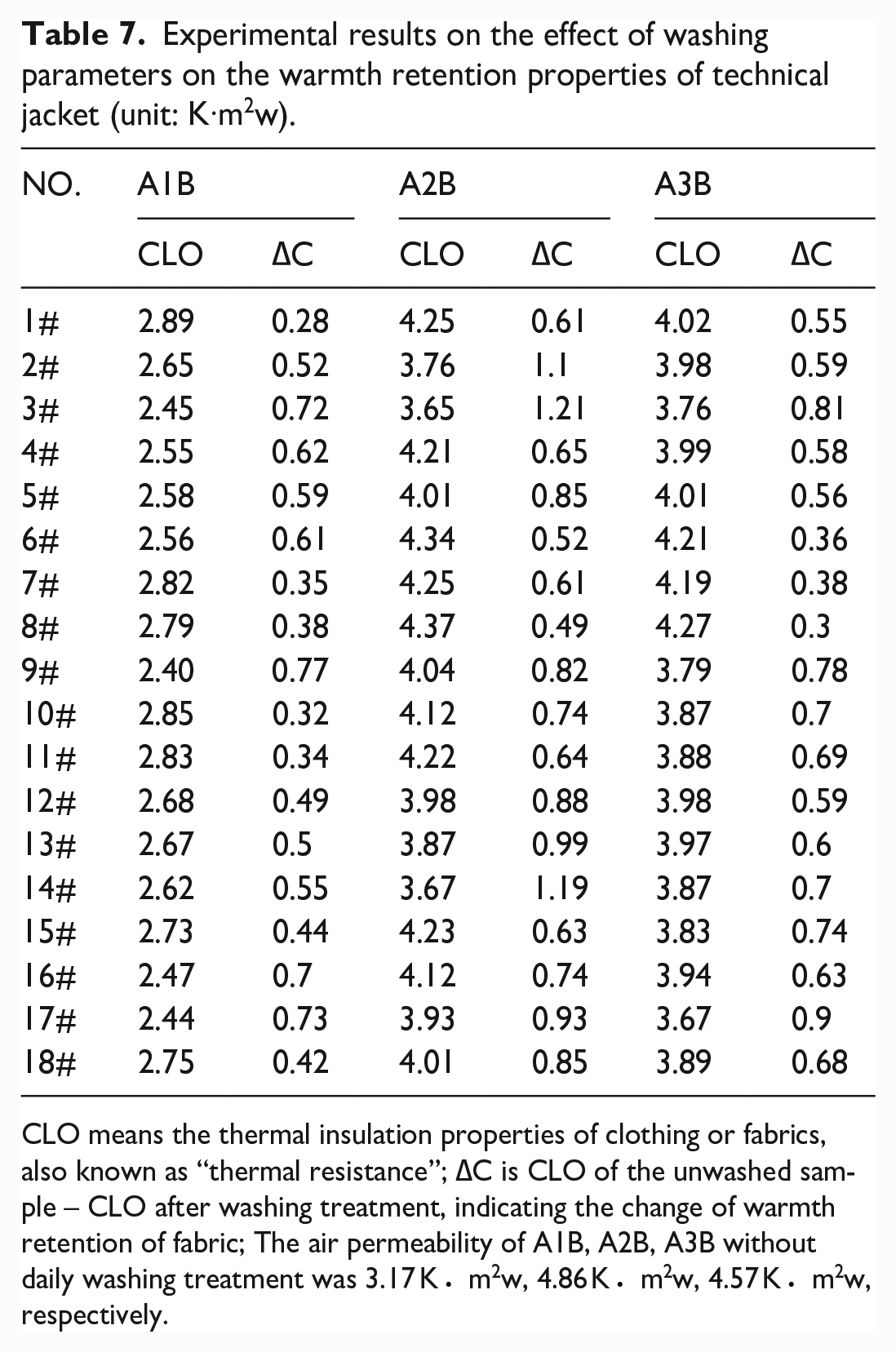
CLO means the thermal insulation properties of clothing or fabrics, also known as “thermal resistance”; ∆C is CLO of the unwashed sample – CLO after washing treatment, indicating the change of warmth retention of fabric; The air permeability of A1B, A2B, A3B without daily washing treatment was 3.17 K. m2w, 4.86 K. m2w, 4.57 K. m2w, respectively.
Washing efficiency of different washing conditions
Figure 10 and Table 8 showed that washing efficiency of technical jacket under different washing conditions. As Figure 10(a) shown, the washing efficiency of fabric after mechanical agitation + ultrasonic (1 + 2) > mechanical agitation + micro nano bubbles (1 + 3) > mechanical agitation (1) > ultrasonic (2) > micro nano bubbles (3). This indicated that the washing efficiency of the washing condition with mechanical agitation {mechanical agitation + ultrasonic (1 + 2) > mechanical agitation + micro nano bubbles (1 + 3) > mechanical agitation (1)} was higher than that of no mechanical agitation {ultrasonic (2) > micro nano bubbles (3)}. Additionally, the combined washing mode {mechanical agitation + ultrasonic (1 + 2), mechanical agitation + micro nano bubbles (1 + 3)} was helpful to effectively improve washing efficiency. This was because that mechanical agitation provided mechanical force for stain removal. Ultrasonic accelerated the stain dispersion, emulsification, and removing from fabric surface by cavitation implosion, micro-streaming induced changes in surface boundary layer, as well as the intricate micro-structure of the fiber surface. Micro-nano bubble was helpful to the rapid migration of stains occurring due to the lower floating speed, larger specific surface area, surface negative charge of bubbles, and rich free radicals for adsorption stain. However, the force for stain removal provided by micro-and nano-bubbles and ultrasonic wave was far less than that of mechanical agitation, and therefore mechanical agitation was more efficient at removing stains than microbubbles or ultrasound. In other words, mechanical agitation was the key to remove the stains on the surface of fabric instead of micro-and nano-bubbles or ultrasonic. The composite mode of mechanical agitation combined with micro-nano bubbles or ultrasound more efficient for stain removal, compared with single micro-nano bubbles, ultrasonic, or mechanical agitation, because of compound mode playing respective advantages in the washing process. Additionally, compared with the washing efficiency of different detergents type, it was found that that of strong alkaline detergent (washing powder and soap) was slightly efficient, compared with that of neutral detergent (liquid detergent and washing beads), but the difference was not significant (see Figure10(b)). Combined with performance testing (the waterproof, windproof, warm performance) of different washing conditions, indicated that consumers should choose neutral detergent (for example, liquid detergent and washing beads) for the daily washing and care of the technical jacket in daily usage. Moreover, in experiments of detergent dosage, it was found that with the increase of the amount of detergent, the washing efficiency of technical jacket slightly increased. This indicated that it is not reasonable for consumers to increase the washing dosage to improve the washing efficiency in the daily washing-care process. Meanwhile, the experimental results of washing parameters (Table 8) also revealed that the washing efficiency of the washing condition with high mechanical accumulation was greater than that of low mechanical accumulation. Repeatedly high machine-washing parameters also leaded to surface of technical jacket experienced several different degrees of damages such as distortion, hairiness, micro-holes, micro-cracks, fracture, and dry-abraded of fibers surface. The degree of damage depended on time and the distribution of high mechanical action on the fabric. Therefore, balancing considerations of functional degradation and washing efficiency, the washing combination of washing method (mechanical agitation + micro − nano bubbles), type of detergent (neutral liquid detergent), dosage of detergent (3 g/L), water temperature (20°C), main washing bath ratio (1:10), main washing speed (15 rpm), main washing time (20 min), rinsing speed (30 rpm), rinsing cycles (2), belonged to the optimal washing combination in this study of washing conditions.

Effects of daily washing condition on washing efficiency of technical jacket: (a) washing mode, (b) type of detergent, and (c) dosage of detergent.
Effects of daily washing parameters on washing efficiency of technical jacket (Unit: %).

Conclusions
Compared with pre-washing, no matter what kind of washing modes, washing parameters, type and dosage of detergent, the performance of technical jacket after washing were subjected to decrease to some extent. Moreover, different daily washing conditions lead to different degree of changes of waterproof, windproof, warmth retention and surface morphology of technical jacket. Specifically, compared with pre-washing, the significant degree of the decline in waterproof, windproof, warmth retention and damage in surface morphology of technical jacket after washing treatment was mechanical agitation (1) > mechanical agitation + ultrasonic (1 + 2) > mechanical agitation + micro nano bubbles (1 + 3) > ultrasonic (2) > micro nano bubbles (3). Washing efficiency was mechanical agitation + ultrasonic (1 + 2) > mechanical agitation + micro nano bubbles (1 + 3) > mechanical agitation (1) > ultrasonic (2) > micro-nano bubbles (3), respectively. Balancing considerations of functional degradation and washing efficiency, the washing combination of washing method (mechanical agitation + micro-nano bubbles), type of detergent (neutral liquid detergent), dosage of detergent (3 g/L), water temperature (20°C), main washing bath ratio (1:10), main washing speed (15 rpm), main washing time (20 min), rinsing cycles (2), belonged to the optimal washing combination in this study of washing conditions. This indicates that it was possible ways to minimize functional degradation by setting optimal washing conditions. Additionally, it was found that the effects of washing modes, type of detergents and washing parameters on the wearing performance of technical jacket were significant, instead of the dosage of detergents. Therefore, it was scientific and interesting to explore the optimal produce by regulating the combination of washing modes, type of detergents, and washing parameters.
In addition, in this study, we only studied the removal effect of carbon black stains after different washing modes, and did not study other kinds of stains in life (such as oil stains, protein stains, blood stains, and so on). Moreover, it was also fact that the adsorption and desorption properties of different stains are significantly different, therefore, in the future, it is necessary to systematically study the relationship between other types of stains and washing modes. This could help establish whether optimal wash modes could be used to help improve washing efficiency and reduce fabric damage. Temporal dynamics of damage over the life time of technical jacket should also be examined, as this could help extend technical jacket life while at the same time reducing damage from the daily-washing process.
Supplemental Material
sj-docx-1-jef-10.1177_15589250231181913 – Supplemental material for Develop an optimal daily washing care for technical jacket by balancing washing efficiency and functional degradation
Supplemental material, sj-docx-1-jef-10.1177_15589250231181913 for Develop an optimal daily washing care for technical jacket by balancing washing efficiency and functional degradation by Yuhui Wei, Haiyan Zhang, Zhaowei Su, Siqi Tao, Xuejiao Cao, Zihao Wan and Wei Pan in Journal of Engineered Fibers and Fabrics
Footnotes
Declaration of conflicting interests
The author(s) declared no potential conflicts of interest with respect to the research, authorship, and/or publication of this article.
Funding
The author(s) disclosed receipt of the following financial support for the research, authorship, and/or publication of this article: This research was supported by Open Project Program of Shanghai Fire Research Institute of MEM (2020XFZB09); Natural Science Research Project of Anhui Higher Education Institutions (KJ2020A0352); The Open Project Program of Anhui Province College of Anhui Province College Key Laboratory of Textile Fabrics, Anhui Engineering and Technology Research Center of Textile (2021AETKL20); 2022 Anhui Polytechnic University -Jiujiang District Special Fund for Industrial Synergy and Innovation (2022 CYXTB7); School-level research Foundation of Anhui Polytechnic University (Xjky03201908).

Supplemental material
Supplemental material for this article is available online.
References
Supplementary Material
Please find the following supplemental material available below.
For Open Access articles published under a Creative Commons License, all supplemental material carries the same license as the article it is associated with.
For non-Open Access articles published, all supplemental material carries a non-exclusive license, and permission requests for re-use of supplemental material or any part of supplemental material shall be sent directly to the copyright owner as specified in the copyright notice associated with the article.
