




Abstract
The friction and wear properties of self-lubricating fabric composites were closely related to fiber properties. In this paper, polyimide (PI), polyetheretherketone (PEEK), polyisophthalamide (PMIA) and cyclic aramid (Aramid III) fibers were selected as reinforcing fibers to compare and investigate the friction and wear properties of self-lubricating fabric composites at high temperature. The tribological behavior of self-lubricating fabric composites was evaluated by ball-on-disk friction test. The wear mechanism was investigated by scanning electron microscope and mechanical test. As a result, the composite with PI as warp and weft reinforcing fiber has outstanding wear resistance because of the higher modulus of PI fiber. Its wear rate is 1.29 × 10⁻⁸ mm3/(N·mm). It shows that the stronger the rigidity of the reinforcing fiber at high temperature, the better the wear resistance of the composite. However, the friction coefficient of composites with PI as weft reinforcing fibers is about 0.8, which is much higher than that of composites with PMIA, PEEK and Aramid III as weft reinforcing fibers. Their friction coefficients are about 0.1. In addition, the self-lubricating fabric composites with different warp and weft reinforcing fibers were prepared as self-lubricating joint bearing liners to evaluate bearing applications.
Introduction
Self-lubricating fabric composites, which are the key components of self-lubricating joint bearings, have high strength, low density, self-lubrication, outstanding corrosion resistance and excellent friction and wear resistance properties.1–3 It is widely used in friction components for aerospace, engineering machinery, rail transportation and military equipment.4,5 Some researchers had prepared and modified self-lubricating fabric composites, and applied them to self-lubricating radial joint bearings 6 and self-maintenance bearings in helicopter main rotor. 7 As a result, the wear resistance of the bearing was obviously improved. Self-lubricating fabric composites can effectively reduce the wear of joint bearings by avoiding direct friction between the outer and inner rings during operation. It is important to extend the service life of joint bearings and ensure the safety of aerospace equipment.8,9 However, there are higher requirements for the service temperature of bearings and liners with the development of aviation industry. The friction and wear properties, service life and reliability of self-lubricating fabric composites and bearings are also facing severe challenges. Therefore, the researches on the high-temperature tribological properties of self-lubricating fabric composites have become the key to improve the quality and prolong the service life of self-lubricating joint bearings.10,11 Yuan et al. investigated the high-temperature tribological properties of TiB2-filled Nomex/polytetrafluoroethylene (PTFE) hybrid fabric composites. The wear resistance of the composites was significantly improved without sacrificing the friction coefficient. 12 Y. Hu systematically researched the effects of ambient temperature (25–200°C) on the damage behavior and wear mechanism of PTFE/Kelvar fabric composites. It provides guidance for the scope of safe use and optimization of material. 13 Although some studies had reported the friction behavior of self-lubricating fabric composites at high temperature. However, there are limited reports about the effects of some high-performance organic fibers on the high-temperature friction and wear properties of fabric composites.
The fabric is the main body of the self-lubricating fabric composite. Its composition and structure will significantly affect the friction and wear properties of the composites. 14 The study of composition and structure of fabric on the friction and wear properties of self-lubricating fabric composites is very important for the development of composites and their applications in self-lubricating joint bearings. It is found that the weaving mode,15,16 weaving density, 17 warp and weft density18,19 and yarn type of fabric can affect the resin wettability, interfacial adhesion and bearing capacity,20–22 and then significantly affect the mechanical properties and tribological properties of the self-lubricating fabric composites. Li et al. woven copper yarns into Nomex/PTFE fabric to improve the strength of the yarns and fabric, so that the self-lubricating fabric lining composite showed better wear resistance. 23 Sun et al. prepared special carbon fiber reinforced composites with surface modified by carbon/PTFE mixed fibers. The friction coefficient and volumetric wear of CF/PTFE mixed fabric composites decreased by 40% and 91% respectively, compared to composites without PTFE additions. 24 Although relevant studies have been conducted, there is no systematic comparative study on the effects of warp/weft yarns composition on the friction properties of self-lubricating fabric composites.
In this paper, four high-performance fibers were selected as warp/weft reinforcing fibers for self-lubricating fabric composites. The effects of warp/weft fiber types on the friction and wear properties of self-lubricating fabric composites at high temperature were compared and investigated. This study can provide some theoretical guidance for the selection of warp and weft fibers for self-lubricating composites to effectively improve their friction and wear properties. It is important to extend the service life of joint bearings and ensure the safety of related equipment.
Experiment
Materials
Self-lubricating fabric composites and phenolic resin were prepared by Shanghai Plastics Research Institute Co., Ltd. Polyisophthalamide (PMIA) fiber, polyetheretherketone (PEEK) fiber, cyclic aramid (Aramid III) fiber, polyimide (PI) fiber and polytetrafluoroethylene (PTFE) fiber used to prepare self-lubricating fabric composites were supplied by Shanghai Textile Research Institute. Figure 1 and Table 1 show the structure and composition of self-lubricating fabric composites respectively. Unit cell diagram of self-lubricating fabric. Composition of self-lubricating fabric composites.

Specimen preparation
Figure 2 shows the preparation process of self-lubricating fabric composites. The fabrics were first ultrasonically cleaned in ethanol for 30 min and dried in an oven at 70°C for 20 min. Then the dried fabrics were immersed in phenolic resin, followed by rolling treatment through a rolling machine. The whole immersion and rolling process was repeated twice and the resin mass fraction was maintained at 20–30%. Subsequently, the immersed fabric was dried at 70–120°C for 2 h to remove the ethanol. After drying, the fabrics were cured under 3.3 Mpa at 150°C to obtain self-lubricating fabric composites with a thickness of ∼0.5 mm. The self-lubricating fabric composite was attached to the AISI-1045 stainless steel sample disk (φ43 mm × 3 mm, roughness 0.45 μm), and the ball-on-disk friction specimen (Figure 3(a)) was produced by heating to 170°C for 4 h under 0.06 Mpa. The oscillating wear test specimen is shown in Figure 3(b). The self-lubricating fabric composite was adhered to the inner spherical surface of the outer ring of the bearing and cured with a PTFE mandrel. Preparation process of self-lubricating fabric composites. Friction specimens; (a) ball-on-disk friction specimen, (b) oscillating wear test specimen.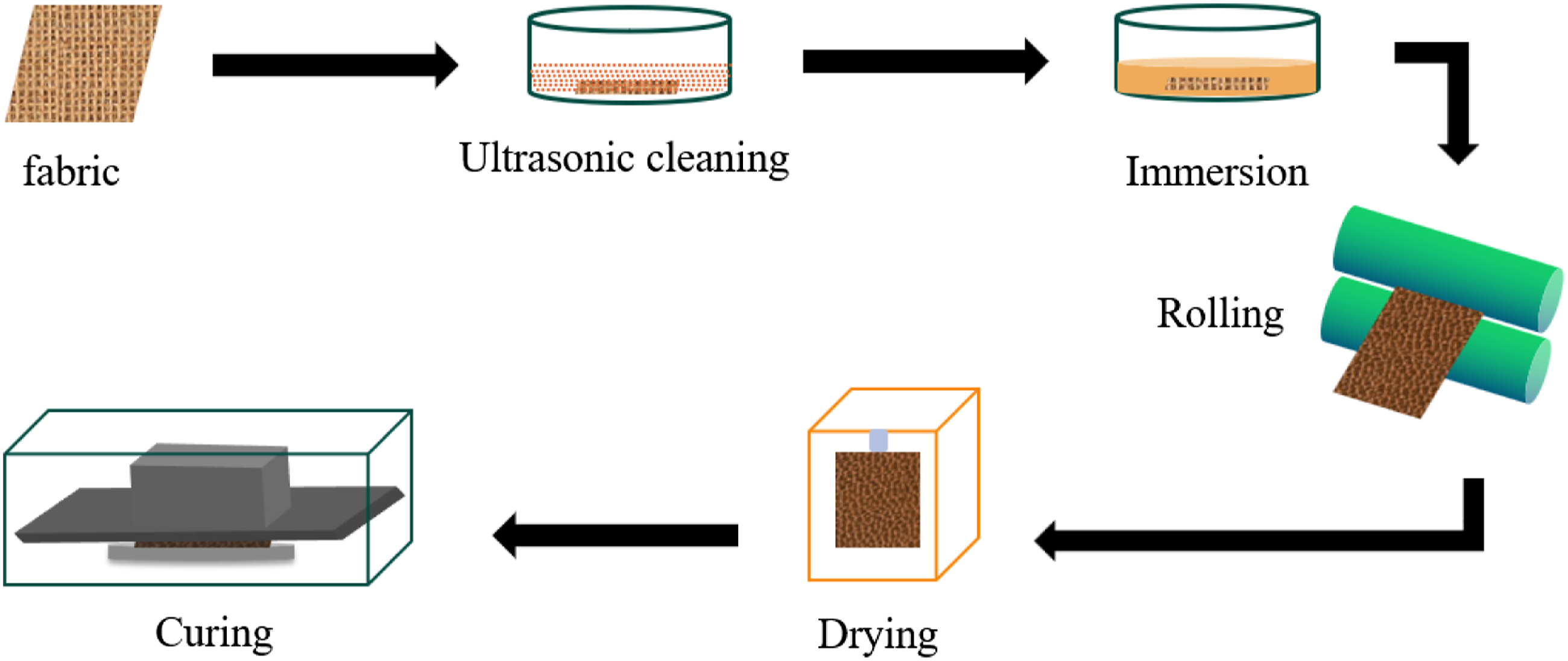

Heat resistance test
The thermal stability of the reinforcing fibers was compared by thermo gravimetric analysis (STA2500 Regulus, NETZSCH). Test conditions: the sample weight was 3∼5 mg, the temperature range was 25–700°C, the heating rate was 10°C/min, the atmosphere was nitrogen. The dynamic thermo-mechanical properties of reinforcing fibers were evaluated in tensile mode by dynamic mechanical analysis (DMA 242E, NETZSCH). Test conditions: the effective length of the specimen was 15 mm, the frequency was 3 Hz, the heating rate was 15°C/min and the atmosphere was air.
Friction and wear test
The friction and wear properties of self-lubricating fabric composites were investigated by a ball-on-disk wear tester (MMUD-5B, HengXu Testing Machine Technology Co., Ltd, China). The test standard was ASTMG99, the test temperature was 163°C, the friction load was 30 N and the linear velocity was 0.115 m/s. Figure S1 is the schematic diagram of the ball-on-disk wear tester (Figure S2). The morphologies of wear surfaces and dual surfaces of the composites were analyzed by scanning electron microscope (Phenom China Co., Ltd, Netherlands). The wear trace depth and cross-sectional area were measured by 3D digital microscope (RH-20,003D, HIROX China Co., Ltd, Japan) and the wear rate is calculated by the following equation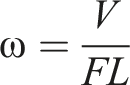
The oscillating wear test of the bearing was conducted on a multi-working condition variable-angle friction and wear tester (HFM-1W, Jinan HengXu Testing Machine Technology Co., Ltd, China). The schematic diagram is shown in Figure S3. The radial friction load was 1.5 kN, the frequency was 2 Hz, the oscillation angle was 25°, the test temperature was 163°C, and the number of oscillations was 25,000.
Results and discussion
Effects of fiber types on the ball-on-disk friction and wear properties of composite at high temperature
In order to clarify the effects of fiber types on the properties of self-lubricating fabric composites. Conventional ball-on-disk friction tests were performed on composites N1, N2, N3, N4 and P1. The friction and wear properties of composites with different warp/weft reinforcing fibers at 163°C were investigated.
Effects of weft fiber on friction and wear properties
The friction and wear properties of N1-N4 are shown in Figure 4. The friction coefficients of self-lubricating fabric composites N1, N3 and N4 are similar and significantly lower than those of N2 as shown by the friction curves (Figure 4(a)). PI fibers have higher rigidity at high temperature because of their higher modulus (Figure 7 and Table 2). Thus PI fibers form some burrs instead of being ground off resulting in a high friction coefficient of the composite (N2). The wear surface roughness, wear amount and wear depth of composites N2 and N4 are smaller from the wear trace profile curve and 3D morphology of the wear surface (Figure 4(c)). Correspondingly, their wear rates are also lower (Figure 4(b)). PI and Aramid III fibers have high mechanical strength at high temperatures and provide better protection to the matrix resin. As a result, they have superior wear resistance. As shown in Table S1 in the Supporting Information, it also has some advantages over other self-lubricating composites studied in the literature. Friction properties of self-lubricating fabric composites N1, N2, N3 and N4; (a) friction coefficient, (b) wear rate, (c) 3D morphology of wear surface and wear trace profile curve. Storage modulus of PI, PEEK, PMIA and Aramid III fibers at 163°C.

Effects of warp fibers on friction and wear properties
Based on the analysis of the friction properties of self-lubricating fabric composites with different weft reinforcing fibers. The wear resistance of composites with PMIA as warp yarn and PTFE-PI as weft yarn is the best. Therefore, we replaced the warp reinforcing fibers of N2 with PI and obtained a self-lubricating fabric composite (P1) with both warp and weft reinforcing fibers of PI. The effects of different warp reinforcing fibers on the friction and wear properties of self-lubricating composites at high temperature were further researched by comparing N2 and P1.
The friction and wear properties of self-lubricating fabric composites N2 and P1 at 163°C were investigated by ball-on-disk friction test. And the warp fibers of N2 and P1 are PMIA and PI, respectively. The friction coefficient of the fabric composite N2 is slightly higher than that of P1 (Figure 5(a)). The modulus of the warp fiber of N2 is much lower than that of the weft fiber PI at high temperature. PMIA fibers are preferentially ground off to produce a large amount of wear debris resulting in a slightly higher friction coefficient. The wear trace surface roughness and wear depth of composite P1 are smaller than those of N2 according to the 3D morphology of the wear surface and wear trace profile curve (Figure 5(b)). Correspondingly, its wear rate is significantly lower than that of N2 (Figure 5(c)), indicating that the self-lubricating fabric composite with both warp and weft reinforcing fibers of PI has better wear resistance. It can be seen from Table 2 that the storage modulus of PI fibers is higher than that of PMIA fibers. Accordingly, PI fibers have greater rigidity and stronger support to the fabric composite, which makes the composite P1 have better wear resistance. Friction properties of self-lubricating fabric composites N2 and P1; (a) friction coefficient, (b) 3D topography of wear surface and wear trace profile curve, (c) wear rate.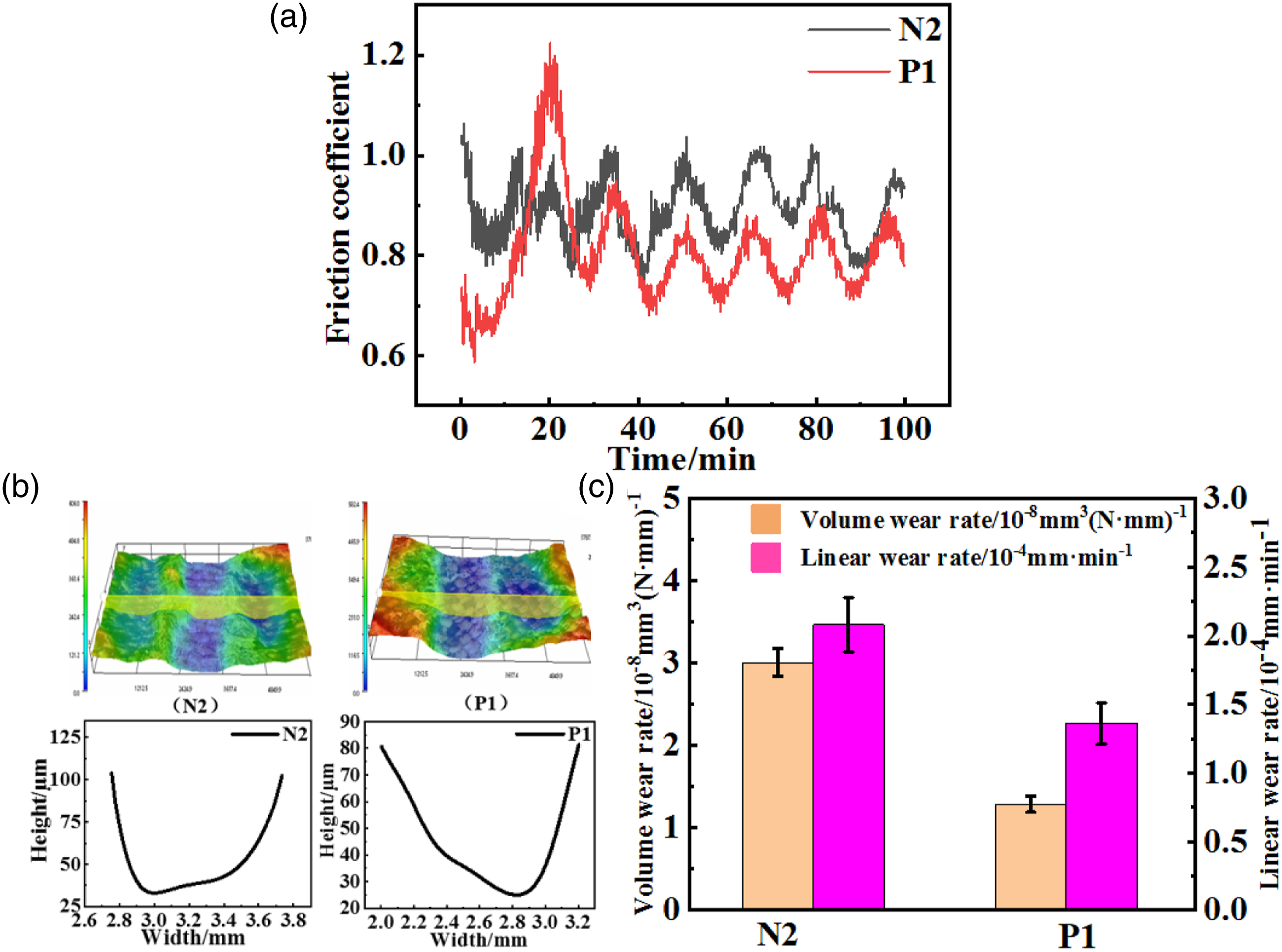
Analysis of wear mechanism
The wear surfaces and dual surfaces of the self-lubricating fabric composites N1, N2, N3, N4 and P1 were observed by scanning electron microscopy (shown at Figure 6 and Figure 8). The effects of thermodynamic properties of weft/warp reinforcing fibers on the wear mechanism of composites were compared and discussed. Wear surface and dual surface morphologies of self-lubricating fabric composites N1, N2, N3 and N4; (a–d) wear surfaces of N1-N4, (e–h) dual surfaces of N1-N4, (i–l) wear state of N1-N4.
Figure 6 shows the wear surfaces, dual surfaces and the actual wear state of self-lubricating fabric composites N1, N2, N3 and N4. There are many broken and exposed fibers, cracks and large holes on the surfaces of fabric composites with weft yarns of PTFE-PMIA and PTFE-PEEK (N1 and N3), showing fatigue wear (Figure 6(a) and (c)). A lot of aggregated wear debris and transfer polymer can also be observed on their dual surfaces (Figure 6(e) and (g)), further indicating more severe wear of the composite. The resin matrix on the surface of composites (N2 and N4) with PTFE-PI and PTFE-Aramid III as the weft yarns is cracked, resulting in plastic deformation (Figure 6(b) and (d)). But the structure of the reinforced fabric is complete, showing typical adhesive wear. In addition, only shallow scratch marks can be seen on the dual surface (Figure 6(f) and (h)), indicating good wear resistance.
The fracture of fibers during the friction process can damage the structure of self-lubricating fabric composites, resulting in a severe degradation of the friction properties of the composites. The high temperature resistance and mechanical strength at high temperature of the reinforcing fibers were elucidated by TGA and DMA tests to further explore the related mechanisms (Figure 7 and Table 2). All four fibers have good thermal stability. Their onset of decomposition temperature are higher than 400°C (Figure 7(a)) and they are able to maintain good stability at the test temperature of 163°C. As can be seen in Figure 7(b), PEEK and PMIA fibers have a low storage modulus at high temperature. So they are easily deformed and damaged during friction due to their low rigidity. While PI and Aramid III fibers can maintain a high storage modulus at high temperature. Therefore, the self-lubricating fabric composites containing PI or Aramid III fibers are not easily damaged and can maintain the structural integrity and mechanical strength under dynamic friction load. The composites have good load-bearing capacity and better wear resistance. In addition, PI fibers are not prone to breakage and deformation during friction due to their high modulus and heat deflection temperature. This plays a large role in wear resistance. TGA and DMA curves of PI, PEEK, PMIA and Aramid III fibers; (a) TGA curve, (b) curve of storage modulus with temperature.
Figure 8 shows the wear surfaces, dual surface morphology and the actual wear state of the self-lubricating fabric composites N2 and P1. PMIA fibers are prone to wear during friction due to their low rigidity. Some fibers are broken and the discontinuous PTFE transfer film is formed on the surface of self-lubricating fabric composite (N2) whose warp fiber is PMIA (Figure 8(a)). The warp/weft reinforcing fibers of P1 are both PI fibers with high modulus, which makes it have high rigidity and strength and easy to form transfer films. Consequently, a large area, more complete and homogeneous friction transfer film is formed on the surface of composite P1, showing typical adhesive wear (Figure 8(b)). In addition, the formation of a complete and homogeneous transfer film is also an important reason for the low wear rate of P1. Wear surface and dual surface morphologies of self-lubricating fabric composites N2 and P1; (a, b) wear surfaces of N2 and P1, (c, d) dual surfaces of N2 and P1, (e, f) wear state of N2 and P1.
Figure 9 is the failure mechanism diagram of self-lubricating fabric composite at high temperature. The load-bearing capacity of self-lubricating fabric composites decreases with the decrease in fiber storage modulus at high temperature. Contact surface cracked under the action of frictional shear. The fibers were ground and the matrix underwent brittle fracture in the microscopic state. The storage modulus of PI fibers is higher than that of PMIA fibers at high temperature. As a result, the rigidity of PI fibers is stronger and the PTFE transfer film is not easily destroyed on the surface of the composite. In addition, the thermal stability of PI fibers is better than that of PMIA fibers according to the fiber thermal stability analysis (Figure 7(a)). The mechanical strength of PI fibers can be maintained under frictional loads. Therefore, the fabric composite P1 with PI warp fibers can keep the structural strength at high temperature and has better wear resistance. The storage modulus of weft yarns PTFE-PI and PTFE-Aramid III is higher than that of PTFE-PMIA and PTFE-PEEK at high temperature according to dynamic thermomechanical analysis (Figure 7(b) and Table 2). Hence, they have better plastic deformation resistance. It provides better protection to the resin matrix and prevents the reinforcing fibers from breaking under the combined action of frictional shear and contact stress. Accordingly, the wear resistance of self-lubricating fabric composites is more excellent. Failure mechanism diagram of high temperature ball-on-disk friction and wear of self-lubricating fabric composites; (a) N2 and N4, (b) N1 and N3.
Effects of fiber types on friction and wear properties of bearing liners at high temperature
In order to further evaluate the engineering service life of self-lubricating fabric composites, the self-lubricating fabric composites N1, N2, N3, N4 and P1 were made into bearing liners. The friction and wear properties of self-lubricating joint bearings with different warp/weft reinforcing fibers at high temperature (163°C) were evaluated by the oscillating wear tests.
Effects of weft fiber on friction and wear properties
Figure 10 shows the friction coefficients, wear rates, optical photographs and 3D morphology of the wear surfaces of bearing liners N1-N4. N2 and N4 have higher friction coefficients than N1 and N3 (Figure 10(a)). However, their wear rates are significantly lower than those of N1 and N3 (Figure 10(b)). Although N2 and N4 have poor lubricity, their wear resistance is excellent. In addition, the wear trace depth and width of N1 and N3 are larger than those of N2 and N4 (Figure 10(c)). It shows that the N1 and N3 liners wear more severely when the bearing oscillates, which is consistent with the wear rates. The result indicates that the wear resistance of bearing liner can be better improved by using high strength fiber PI and Aramid III as weft reinforcing fiber. Friction properties of bearing liners N1, N2, N3 and N4; (a) friction coefficient, (b) wear rate, (c) Optical photograph and 3D morphology of wear surface.
Effects of warp fiber on friction and wear properties
Figure 11 shows the friction coefficients, wear rates, optical photographs and 3D morphology of the wear surfaces of bearing liners N2 and P1.The friction coefficient and wear rate of bearing liner P1 are significantly lower than those of bearing bushing N2 (Figure 11(a) and (b)), and its wear width is also narrower (Figure 11(c)). It shows that P1 has better lubricity and wear resistance. Friction properties of bearing liners N2 and P1; (a) friction coefficient, (b) wear rate, (c) Optical photograph and 3D morphology of wear surface.
Analysis of wear mechanism
The fibers are severely deformed and a large amount of resin is destroyed on the wear surfaces of bearing liners N1 and N3 (Figure 12(a) and (c)). However, only a small amount of fibers are destroyed on the wear surfaces of N2 and N4. The resin layer is not completely destroyed (Figure 12(b) and (d)). In addition, serious fiber deformation occurs at the fiber interweaving point of fabric composite N2. However, an incomplete PTFE friction transfer film is formed on the surface of P1. The resin layer is not completely destroyed and only a few broken fibers appears at the interleaving point (Figure 12(e)). Wear surface morphologies of bearing liners N1-N4 and P1; (a) N1, (b) N2, (c) N3, (d) N4, (e) P1.
The higher storage modulus of warp fiber PI makes composite P1 have better load-bearing capacity. As a consequence, the generated PTFE transfer film adheres to the material surface more completely during the friction process. The direct shear effect of bearing inner ring on the composite surface is replaced by the consumption of the PTFE transfer film. So the wear resistance of fabric composite P1 is better than that of N2.
Figure 13 is a schematic diagram of friction and wear mechanism of bearing liners. Oscillating wear test is different from ball-on-disk friction. The bearing inner ring is in surface contact with the self-lubricating fabric composite. The plastic deformation of PTFE fiber on the surface of the fabric is caused by the alternating force generated by the oscillation of the bearing inner ring. The generated PTFE friction transfer film deforms and slips under the action of cyclic shear stress and begins to spread and fill the matrix resin layer on the surface of the friction pair. The generated self-lubricating layer has spalling pits due to influence of shearing action and friction and wear. The fabric composite gradually produces fatigue cracks. The iron chips in the inner ring of the bearing are gradually embedded in the material, resulting in abrasive wear. The high temperature storage modulus of the weft yarns PTFE-PI and PTFE-Aramid III at high temperature is higher than that of PTFE-PMIA and PTFE-PEEK and their plastic deformation resistance is stronger. The PTFE transfer film provide better support under the combined effects of fatigue wear and abrasive wear. The direct contact wear between the bearing inner ring and the fiber surface is reduced so that the wear resistance of the fabric composite is improved. Schematic diagram of high temperature friction and wear mechanism of bearing liners.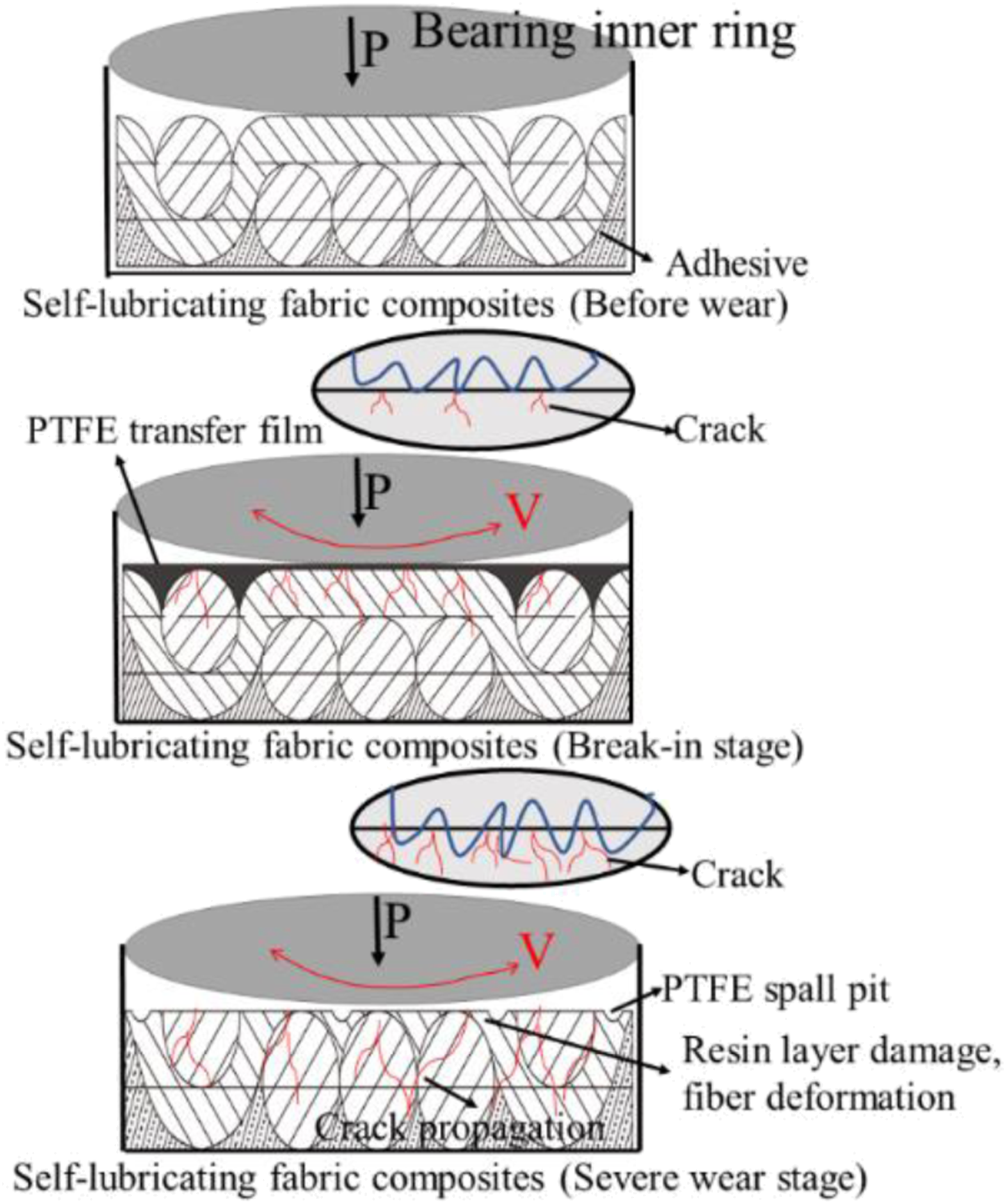
Conclusions
In this paper, PI, PEEK, PMIA and Aramid III fibers were selected as reinforcing fibers to compare and investigate the friction and wear properties of self-lubricating fabric composites at high temperature. The specific conclusions are as follows.
Under the condition of ball-on-disk friction test, the composite has outstanding wear resistance when the warp reinforcing fiber is the same (PMIA) and the weft reinforcing fiber is PI. Its wear rate is 3.01 × 10⁻⁸ mm3/(N·mm). The wear resistance of the composite is further improved when the weft reinforcing fiber is the same (PI) and the warp fiber is PI. Its wear rate is 1.29 × 10⁻⁸ mm3/(N·mm). PI fiber is less susceptible to wear during friction due to its high rigidity at high temperature. Although the PI fibers are not ground off, the produced burrs cause a large friction coefficient of about 0.8.
Under the condition of oscillating wear test, the bearing inner ring is in surface contact with the self-lubricating fabric composite. The uniform and complete PTFE transfer film formed during the friction process has a stronger support capacity. The direct friction between the inner ring of the bearing and the fiber surface can be effectively reduced. Although the result trend and influence mechanism of oscillating wear test are consistent with that of ball-on-disk friction. However, its friction and wear properties is obviously better than that of ball-on-disk friction. For example, the wear rate of the composite was only 0.525 × 10⁻⁹ mm3/(N·mm) when the warp reinforcing fiber is the same (PMIA) and the weft reinforcing fibers is PI.
As a result, the higher the modulus of the reinforcing fibers at high temperature, the better the wear resistance of the self-lubricating fabric composites at high temperature. In addition, the composite has better wear resistance in the oscillating wear test compared with the ball-on-disk friction test. It is proved that it can be well applied in bearings.
Supplemental Material
Supplemental Material - Wear failure mechanism analysis of self-lubricating fabric composites at high temperature
Supplemental Material for Wear failure mechanism analysis of self-lubricating fabric composites at high temperature by Mingming Yu, Min Zhang, Lin Fang, Musu Ren, Lei Liang, Wang Xie and Pibo Ma in Journal of Industrial Textiles
Footnotes
Declaration of conflicting interests
The author(s) declared no potential conflicts of interest with respect to the research, authorship, and/or publication of this article.
Funding
The author(s) received no financial support for the research, authorship, and/or publication of this article.

Supplemental Material
Supplemental material for this article is available online.
References
Supplementary Material
Please find the following supplemental material available below.
For Open Access articles published under a Creative Commons License, all supplemental material carries the same license as the article it is associated with.
For non-Open Access articles published, all supplemental material carries a non-exclusive license, and permission requests for re-use of supplemental material or any part of supplemental material shall be sent directly to the copyright owner as specified in the copyright notice associated with the article.
