




Abstract
Wet wipes are everyday products with the purpose to be flushed down the toilet after usage and dispersed into single fibres and small fragments thereby. During wet storage, these wipes can deteriorate their dispersibility over time, characterized by the slosh box disintegration test, recently named dispersibility ageing. This effect in flushable wet wipes, usually made of long man-made cellulose fibres and short wood pulp fibres, can be reduced by using unbleached softwood kraft pulp as the short fibre component. The aim of this work is to analyse mechanisms that could contribute to dispersibility ageing. Therefore, we will discuss three mechanisms that are able to explain this effect, that occurs in cellulosic fabrics when stored in water. Swelling (1) is demonstrated to be a long-term effect, but altering swelling with pH and salt addition has no effect on dispersibility ageing, making it unlikely that swelling contributes to it. With ionic shielding (2) a mechanism has been introduced that could impact dispersibility ageing by cations leaching from the wood pulp, which was demonstrated for an unbleached softwood kraft pulp by conductivity measurements over wet storage time. These cations neutralize the negatively charged pulp fibre fibrils and restrict their possibility to entangle with each other, which could contribute to decreasing dispersibility ageing. We will discuss the mechanism of interdiffusion (3) in dispersibility ageing, although we were not able to find a method that quantifies the contribution of cellulosic polymer diffusion to the time-dependent deterioration in dispersibility.
Introduction
Wet wipes are an everyday product in personal hygiene and are used globally by millions of people with an annually increasing consumption. 1 Disposal after usage should be easy and clean, which led to the development of flushable-labelled wet wipes ready to be flushed down the toilet after usage. These types of wet wipes are usually manufactured from hydroentangled wetlaid nonwovens2,3 treated with water-based lotions. 4 Hydroentangled, wetlaid nonwovens as a precursor of wet wipes consist of man-made cellulose fibres (MMCF), e.g., viscose fibres, 5 lyocell fibres, 6 but also non-cellulosic synthetic fibres and short wood pulp fibres. The wetlaid process allows the usage of short wood pulp fibres and long viscose fibres in a compound, both being cellulosic and biodegradable. 7 As the fibres of a wet wipe should not only disperse after disposal, but also degrade in the environment, biodegradability of the used fibres is necessary for a wipe to be ‘truly flushable’. 8 Hydroentanglement describes the treatment of the wetlaid nonwoven with high-pressure water jets 9 to improve the wet strength of the fabric by fibre entanglements in the form of knots.6,10
Recent publications11–13 discussed newsfeed critics,14,15 raising the question if wet wipes are flushable, even when labelled so. Together with fats, oils and grease in the sewer, it is possible that wipes are contributing to sewer blockages called fatberg 16 or can be found in sewer pump blockages. 17 Wet wipes found in sewers can be divided into wrongly disposed non-flushable products18,19 and fabrics that do not disperse but are labelled flushable, 12 whereas flushability labels are not unified and can imply different dispersibility results. 20 Dispersibility testing of wet wipes is usually done following the instructions of either the European and US nonwoven organizations 21 or water service organizations. 22 One key method in both guidelines is the slosh box test, still the parameters, such as test duration and pass criteria, in the two guidelines differ. However, the slosh box test represents a reproducible method to determine dispersibility of wet wipes.
In a recent work it was demonstrated that pilot-scale produced wet wipes deteriorate in their dispersibility during wet storage and the effect was named dispersibility ageing. 23 With this effect, it is possible to explain why never-wetted, dry nonwovens disperse well5,6,10 and wet stored wet wipes do not.11,12 The underlying mechanisms of dispersibility ageing are still not understood.
Network strength in wet cellulose webs
In the presence of water, the fibre-fibre bonding strength of untreated pulp fibres normally goes down to zero within the course of seconds,
24
hence it can be expected that network dry-strength mechanisms are not playing a role in wet wipe disintegration. Therefore, the mechanisms of network strength in wet wipes were recently discussed
25
with the conclusion that wet strength in these wipes is dominated by swelling, interdiffusion and fibre entanglements i.e., fibre-fibre friction. There it was shown that no increase in wet strength over wet storage time is measurable. The specific load mode in the slosh box disintegration test seems to be either not representable by monoaxial tensile testing or the load is very low. Still, the increase in network strength is present in dispersibility testing like the slosh box test, allowing the assumption that minor changes in the strength increasing mechanisms vastly influence dispersibility. Therefore, changes in mechanisms such as swelling, interdiffusion and the newly introduced ionic shielding can have a notable impact on dispersibility ageing. The mechanisms that are able to explain dispersibility ageing are summarized in Figure 1. Mechanisms contributing to network strength in wet wipes shown for two adjacent fibre, comprising interdiffusion of polymer molecules, a swelling-induced increase in mechanical interlocking and the adapted theory of ionic shielding.
Swelling
Swelling describes the water uptake of cellulose fibres by which they increase their dimensions and therefore their surface area. The role of swelling in dispersibility ageing was recently discussed, where it increases the contact area of the fibres with each other and also tightens knots and entanglements in the network. 25 The swelling was found to last for several hours 26 and even weeks27,28 which could explain the time-dependency of dispersibility ageing.
Interdiffusion
Interdiffusion describes the migration of the cellulose macromolecule chains of a wetted fibre surface into another one29–31 and is an important factor for increased adhesion in wet cellulose fibre networks. 32 As a bonding mechanism that works on wet cellulose fibre surfaces, 33 it stands to a reason that it is a cause for dispersibility ageing in wet wipes. Long-term swelling could provide the time-dependency of interdiffusion processes.
Ionic shielding
The theory of ionic shielding in dispersibility ageing describes the idea of cations in the suspension that neutralize the negatively charged fibrils of the wood pulp fibres and hinder them thereby entangling with other fibres as depicted in Figure 2. Ions, either added with the applied liquid or originating from the wood pulp, neutralizing the negatively charged fibrils that otherwise entangle with each other. In Figure 2 the behaviour of a shielded pulp and an unshielded one is demonstrated. Ionic shielding in dispersibility ageing for a shielded pulp and an unshielded pulp. Ions appearing in unbleached pulps neutralize fibre fibrils which then are not able to entangle with each other.
This idea is raised from the findings of pulp researchers investigating the effect of cations on the dewatering capabilities of pulps.34,35 Cations are attracted by the negatively charged fibre and fibre fibril surfaces and are aligned to each other and do not entangle and connect to other fibrils, weakening the bond of two adjacent fibres. 36 The origin of these ions could either be the applied liquid or residues of the production process and the used process waters. 37 Wood used for pulp production comes with a large variety of cations, mainly Ca2+, Mg2+ and K+ 38 that could possibly participate in ionic shielding, when released over wet storage time.
Aim of the work
In this work, we give an approach on how to explain dispersibility ageing in pilot-scale hydroentangled, wetlaid wet wipes. We will demonstrate that dispersibility ageing is mainly affected by the wood pulp component of the wet wipe, which is further investigated. We limited the potential causes of dispersibility ageing to three, interacting mechanisms: swelling, interdiffusion and ionic shielding. Measurements with varying applied liquids will demonstrate the impact of swelling and interdiffusion. Charge and conductivity tests will help to understand the mechanisms of ionic shielding and the origin of the required cations.
Materials and methods
Man-made cellulose fibres and synthetic fibres
Man-made cellulose fibres used in this work enclose two grades of viscose fibres. Rectangular, flat viscose fibres with a linear density of 0.19 mg/m and round viscose fibres with a linear density of 0.17 mg/m, and carboxymethyl cellulose incorporations were processed in the tested nonwovens. The linear density of the used round polyester fibre was 0.17 mg/m. All of the listed fibres used in this work have a fibre length of 10 mm.
Wood pulp
Wood pulp characteristics.

Length-weighted fibre length was determined optically using a L&W Fibertester+. An average of three measurements was calculated for each sample. The lignin content (Kappa number) and the cellulose content (alkali resistance) were measured using standardized methods. The lignin content (Kappa number) is therefore defined as the consumed amount of KMnO4 from the tested pulp as defined in ISO 302, whereas the cellulose content denotes the ratio of undissolved sample material after exposure to 18% NaOH solution. The method is not reliable to determine the cellulose content in unbleached pulp grades, but there the cellulose content is distinctly lower than in the bleached pulp and the dissolving pulp.
Wet wipe production
Materials tested in this work are hydroentangled, wetlaid nonwovens. The wetlaid process in Figure 3 contains fibre blending (a), an inclined wire paper machine (PILL Wet-laid nonwoven technology) for web-laying (b) and a drying step (c). The blending of the fibres was done in a mixing chest (a) where 1000 g of fibre material – MMCF/synthetic fibre and pulp – are added to 1000 L of water (= 1 g/L). The gravimetric ratio between wood pulp and MMCF/synthetic fibre was set to 70:30. At the headbox the suspension was diluted to 0.4 g/L. The machine had a web width of 295 mm and the production speed was set to 4.0 m/min. The web was dried with hot air at 105°C (c). Wetlaid process for wet wipes production: mixing chest (a), web-laying via an inclined wire paper machine (b) and hot air drying (c).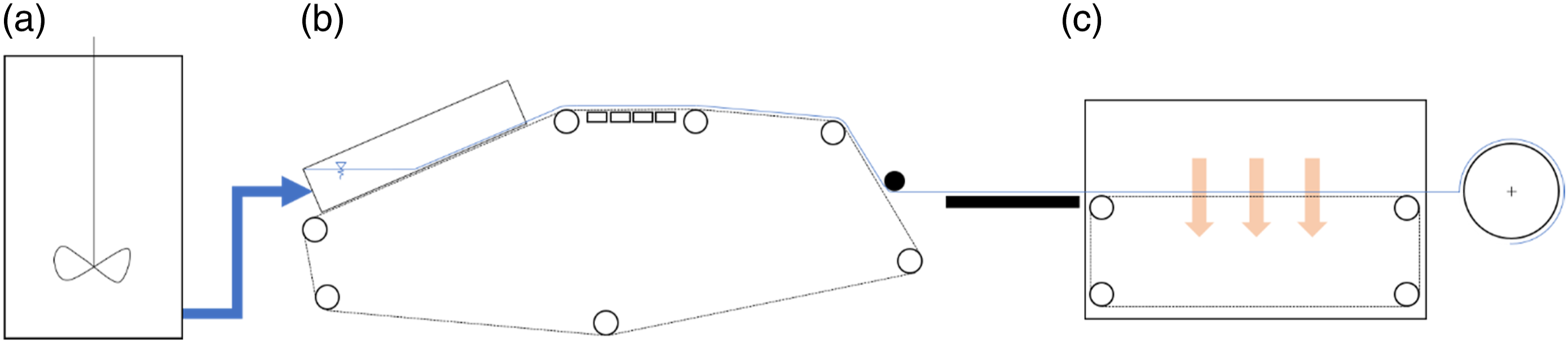
Nonwoven webs used for wet wipe production require a certain level of wet strength which is still insufficient after web-laying. Hydroentanglement is a known bonding process for wet laid nonwovens to increase wet strength.
39
In a hydroentanglement process, the nonwoven webs were treated with high-pressure water jets, as shown in Figure 4. Several nozzle arrays (Figure 4(a)) were activated during our trials and set to defined water jet pressures instead of just one single bar to divide the impact of hydroentanglement. The nozzles at No. 1 were set to 5 bar, at No. 2 to 60 bar and at No. 3 to 70 bar. In these trials, the available bars No. 4, 5 and 6 were not used. After the hydroentanglement, the nonwovens were dried with hot air, cf. Figure 4(b). Both steps – wetlaid process and hydroentanglement – are usually combined in one continuous process on industrial sites. Hydroentanglement process provides multiple, separately adjustable water jet bars (a) and hot air drying (b).
Wet wipes were made from the produced nonwovens using deionized water to simulate the usually applied lotion. In a recent work, it was demonstrated that dispersibility ageing is similar in wipes treated with water and usual lotion, 23 which was applied to the 125 × 175 mm cut sheets in a gravimetric ratio of 1:3. The wet wipes were stored in sets of three in sealed plastic bags. For the tests with varying salt contents in the storage liquid NaCl was used, pH was adjusted with a 5% NaOH solution and a 10% HCl solution.
Dispersibility testing
The capability of a single wet wipe to disperse was quantified using the slosh box disintegration test. A plastic container (435 × 335 × 270 mm³) was filled with 2 L of water, before the single wet wipe was placed on the water surface and the box was swayed for 30 min. The remains of the wet wipe were poured over a 12.5 mm hole sieve stacked on a 200 μm mesh sieve with a distance between the sieve plates of 27 mm. The retained material on the sieves was collected, dried and weighed to calculate dispersibility according to equation (1).
Using this test is encouraged by water service 22 and nonwoven organizations, 21 although with varying specifications. INDA/EDANA recommend several pre-treatment steps and a swaying time of 60 min after which a dispersibility value of 60% or higher is required to be assigned flushable. IWSFG testing procedure comprises also pre-conditioning, a swaying time of 30 min, a 25 mm hole sieve and a dispersibility value of 95% to pass the test. For a better comparability, our testing parameters were set to 30 min of swaying, a 12.5 mm hole sieve and a dispersibility value of 60%. Pre-conditioning was neglected as it is mostly used to rinse the wipes from the applied lotions and in our work only deionized water was used.
Modified water retention value
Dry pulp was stored in water for 1 h before being disintegrated at 9000 revolutions in a standard disintegrator and diluted to a solids content of 4 g/L. An amount of the suspension, equivalent to 2 g solid material, was dewatered in a funnel filter, resulting in cylindrical pulp pads with a diameter of 40 mm and a height of 15 mm. The pads were dried at 105°C and conditioned at 23°C and 50% RH for 24 h before being separately stored in sealable vials, filled with 50 mL of deionized water. After defined wet storage the water not absorbed by the fibres is removed using a laboratory centrifuge SIGMA 3–15 set to 30 min at a relative centrifugal force of 3000 g. The pad was weighed afterwards (mcentrifugated), dried at 105°C overnight and weighed again (motro). The modified water retention value was calculated using equation (2).
Fibre charge measurement
To characterize the capabilities of the used pulp to attract cations for ionic shielding the amount of negative charge on the wood pulps was measured by polyelectrolyte titration. The amount of cationic polyelectrolyte poly diallyl dimethyl ammonium chloride (pDADMAC) adsorbed on the fibres was indirectly measured by determining the depleted concentration of the polyelectrolyte in the supernatant after contact with the fibres. A 1:1 stoichiometry between the initially negative charge on the fibre and the amount of bound positive charge upon polyelectrolyte complexation was assumed. For this, ca. 0.6 g (mfibre) of unbleached and bleached pulp fibres was suspended in 50 mL of deionized water and conditioned for 0 h, 14 h, 24 h, and 168 h, cf. section modified water retention value. To this, 1 mL of pDADMAC (c = 1 mol/L) were pipetted (Vtot) and the suspension was stirred for 1 h to reach adsorption equilibrium. Then the pulp fibres were filtered through a weighted filter paper using a Büchner funnel. The filtrate containing non-adsorbed pDADMAC (Vsample = 0.25 mL) was back titrated with the anionic titrant poly ethylenesulfonic acid sodium salt (PES-Na; cPES-Na = 0.001 mol/L) using an automatic titrator DL58 (Mettler Toledo, Switzerland). The equivalent point was determined spectroscopically using a DP5 phototrode (Mettler Toledo, Switzerland) and the indicator Toluidine blue. A blank sample containing pDADMAC without pulp fibres was titrated in the same way to eliminate the effects of polymer adsorption by the glassware and the glass-fibre filter. The amount of cationic functional groups (Q in mmol/g) is calculated by equation (3).
Conductivity measurement
To get first insights into the origin of the cations for ionic shielding conductivity of the storage liquids was tested before and after storage of the pulp pads were removed from the vials using a Mettler Toledo Cond probe LE703. Therefore, the pads were treated as described in the section modified water retention value For the samples that are dried two times, the pads were again immersed in deionized water for 1 h, dried at 105°C and conditioned (23°C at 50% RH) for another 24 h. This step was repeated for the samples that were dried three times. For better comparability, the initial conductivity of the deionized water was subtracted from the values after the pads were removed, resulting in a conductivity difference in μS/cm.
Results
Dispersibility ageing
Dispersibility ageing has been introduced in a recent publication,
23
where it was demonstrated that pilot-scale produced hydroentangled, wetlaid wet wipes can deteriorate their dispersibility over time, when stored in wet condition. The MMCF/synthetic fibres in a wet wipe were found to have no impact on this effect, which is supported by the results in Figure 5. Three types of wipes were tested for dispersibility made of the same bleached kraft pulp but different MMCF and one other synthetic fibre type. Wipes with flat viscose fibres, viscose fibres with incorporated CMC and synthetic polyester fibres show the same time-dependent deterioration of dispersibility. Especially in water, these three fibre types should differ. Compared to the flat fibres the CMC-incorporated fibres have a much higher water uptake,
40
whereas the polyester fibre does not take up water at all. Still, all of them exhibit the same dispersibility ageing when used in a wet wipe made of the same wood pulp. Only the overall level of dispersibility i.e., when testing the never-wetted nonwoven is influenced by the MMCF/synthetic fibre type. In accordance with recent findings, wood pulp seems to control the dispersibility ageing in wet wipes. Dispersibility over wet storage time of wet wipes made of bleached softwood kraft pulp and varying man-made cellulose fibres or polyester fibres. The measurement procedure represents a compromise of the available testing guidelines. A 60% acceptable line was chosen similar to common guidelines.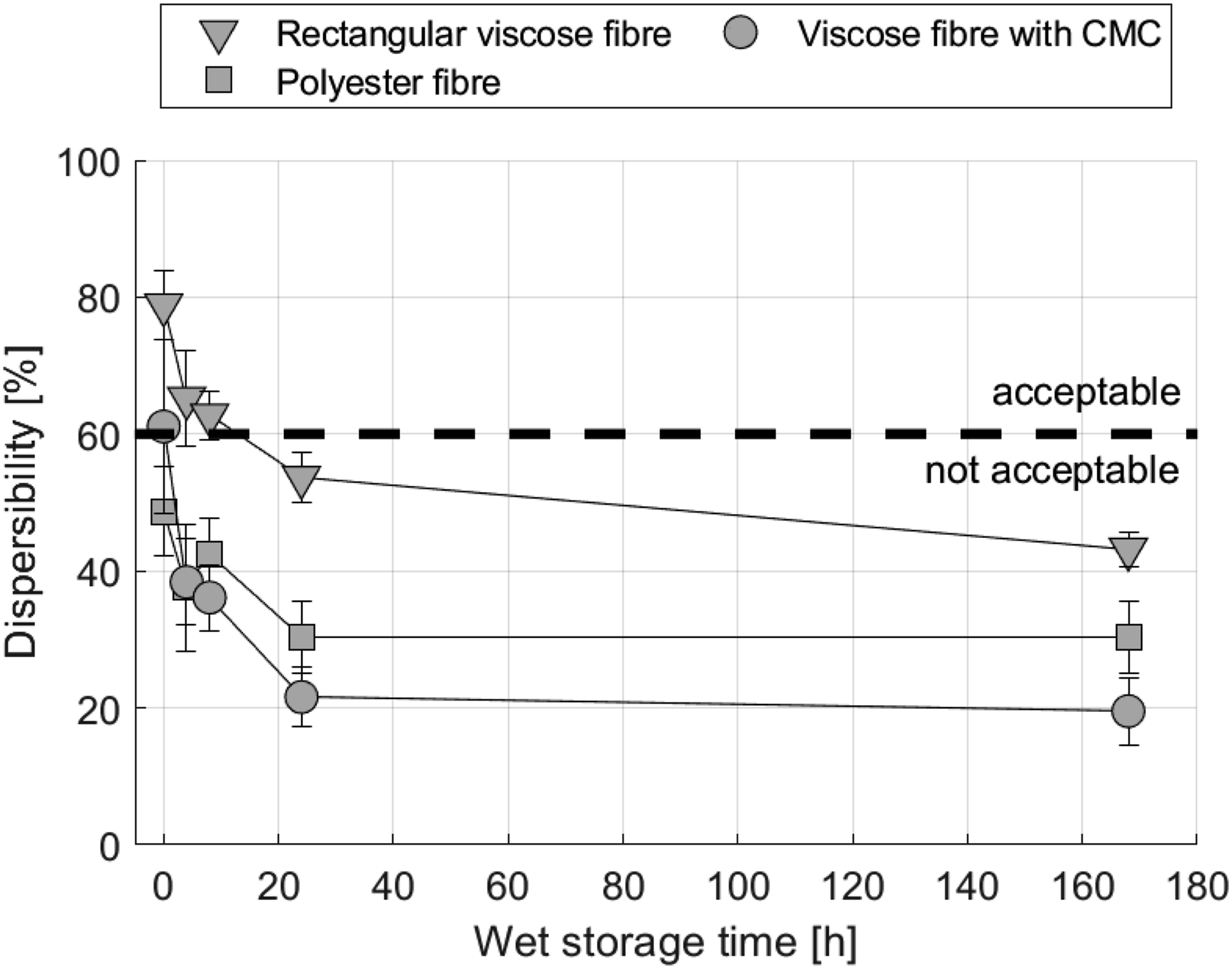
The influence of pulp on the dispersibility ageing can be seen in Figure 6. There, the dispersibility of wet wipes with varying wood pulp grades is plotted over the wet storage time, always using the same flat viscose fibre. The bleached kraft pulp and the dissolving pulp show similar dispersibility ageing, i.e., similar reduction in dispersibility over wet storage time. Both of these pulps are bleached grades, meaning intensive treatment in form of extended chemical pulping and several bleaching steps. Dissolving pulps are precursor materials for regeneration purposes, requiring high chemical purity. Therefore, these pulps are extensively treated to achieve high cellulose contents and substances such as hemicelluloses are removed.
41
Figure 6 also depicts the reduced dispersibility ageing in wipes made of an unbleached kraft pulp. All wipes in this figure use the same flat viscose fibres but only the one with the unbleached pulp is able to retain a dispersibility of over 90% after 168 h. Dispersibility over wet storage time for wet wipes made of flat viscose fibres and varying softwood pulp grades. The measurement procedure represents a compromise of the available testing guidelines. A 60% acceptable line was chosen similar to common guidelines.
Dispersibility ageing in wet wipes is an effect that is controlled by the wood pulp component of the wet wipe and triggered by water. Therefore, it seems beneficial to investigate the behaviour of wood pulps in water to understand the responsible mechanisms. Especially, the differences between the bleached and the unbleached kraft pulps are of interest, as dispersibility ageing in wipes with these two pulps varies tremendously.
Mechanisms
Dispersibility ageing has been recently introduced and only few researchers have been investigating the underlying mechanisms. In a recent publication, 25 it was shown that dispersibility ageing is not visible in mechanical network strength. Therefore, the effect seems to be related to the gentle type of mechanical load applied in the slosh box test, with different mechanisms contributing to it. As introduced above, swelling of the cellulosic fibres, ionic shielding of fibre fibrils and interdiffusion of polymer chains would be able to explain dispersibility ageing.
Swelling & interdiffusion
Swelling of hygroscopic cellulosic materials is reported in pulp research to end after 2 h,
42
but was also found to increase for over 100 h in compound material publications.26–28 The modified water retention values of the wood pulp grades were monitored over 168 h and the results can be seen in Figure 7. Starting at different levels all wood pulps show an increase in their water retention value over time. The unbleached kraft pulp comprises the highest water retention values, followed by the bleached kraft pulp and the dissolving pulp. Additional bleaching steps and prolonged pulping in the bleached pulp grades
43
react first on the short chain-length polysaccharides in the wood i.e., the hemicelluloses. Higher amounts of hemicelluloses are correlated to higher water retention,
44
which is in good accordance to the different levels of water retention values for the pulps depicted in Figure 7. Modified water retention values were monitored over 168 h for bleached and unbleached softwood kraft pulps and a softwood dissolving pulp.
Swelling, in terms of modified water retention values, is shown to be a long-term effect increasing over wet storage time for all softwood pulps used in this work. The swelling of these pulps increases for the same time span dispersibility ageing is observed. However, the unbleached pulp shows a similar swelling increase like the other pulps, but exhibits only a low magnitude of dispersibility ageing when used in wet wipes, which contradicts the assumption that swelling is contributing to dispersibility ageing.
To further investigate the influence of swelling on dispersibility ageing, wet wipes were treated with liquids having specific pH and salt contents. According to literature swelling decreases with increasing salt content and increases with increasing pH, but drops at pH 12.45,46 Figure 8(c) depicts the dispersibility of wipes made of the same flat viscose fibres and the bleached kraft pulp. The pH of the applied liquid is set to pH 2, neutral conditions and pH 12 before storage for 0, 8, 24 and 168 h. After 24 h dispersibility is elevated for the samples at high and low pH, compared to the untreated deionized water. However, after 168 h the values of all three samples are almost the same, indicating that pH treatment only affects dispersibility ageing in a short time scale. For the unbleached pulp, no difference can be observed, also due to the already high dispersibility values of this pulp grade. Dispersibility over wet storage for wipes made of flat viscose fibres and bleached (left, BSK) and unbleached (right, UBSK) kraft pulp treated with liquids with varying salt concentrations (top) and pH values (bottom) of the storage liquid.
The increased dispersibility at low and high pH could be correlated to decreased swelling at these pH values, which fits to literature findings, where swelling of unbleached kraft pulps is reduced at low and very high pH.
46
However, Figure 9 depicts that this is not true for the wood pulps used in this work. Here, the swelling of the bleached and the unbleached pulp was monitored for different pH values and salt contents of the storage liquids. Figure 9 also depicts that swelling decreases with increasing amounts of added salt in the storage liquid. The influence of ion concentration on dispersibility ageing is shown in Figure 8(a) and (b) for wet wipes made of flat viscose fibres and bleached, respectively unbleached softwood kraft pulp. The results for both pulp grades are very narrow, especially for the unbleached one. In both cases, no clear influence of the salt content on dispersibility is visible, with only a small tendency of increased dispersibility at very high salt concentrations. The findings of the swelling measurements and the dispersibility tests do not correlate. Neither adjusting the pH of the storage liquid, nor adding salt to it is affecting dispersibility ageing significantly. Modified water retention values at varying pH and salt contents for bleached (left) and unbleached (right) kraft pulp.
Swelling is strongly influenced by pH and salt concentration of the used liquid, as Figure 9 shows, but dispersibility is unaffected by both alterations (Figure 8). Swelling therefore seems to not impact dispersibility ageing, even though it had been reasonable to assume that it is involved.
Next to swelling, two other mechanisms would be able to explain dispersibility ageing, namely interdiffusion and ionic shielding. Interdiffusion needs swelling as a prerequisite, it increases with increasing swelling and is therefore strongly connected to swelling. All pulps have shown increased swelling over time, thus in principle facilitating interdiffusion. It is thinkable that, due to the differences in treatment and chemical composition, the unbleached pulp could show a lower degree of interdiffusion than the bleached pulp, which would explain its better/lower dispersibility ageing. Determining the contribution of interdiffusion to cellulose fibre network strength is complex and we have not been able to come up with a method to measure it, still it would be interesting to investigate the influence of interdiffusion on dispersibility ageing.
Ionic shielding
How ionic shielding could contribute to dispersibility ageing has been explained in the introduction of this work. To test if ionic shielding is reasonable in the pulps used in this work, charge measurements of the wood pulps and conductivity tests of the storage liquids have been done. Charge measurements will help understanding if the bleached and the unbleached pulps attract ions differently, whereas conductivity tests were made to investigate if ions are leaching from the pulps into the storage liquid.
Surface charge
Surface charge measurements of bleached and unbleached wood pulp have been done over the wet storage time to investigate time-dependent differences in the fibre surfaces. Figure 10 shows the results for charge measurements of both pulps via polyelectrolyte titration. The unbleached pulp provides a higher surface charge quantity but both pulps do not exhibit a distinct change over wet storage time. Available free cations in the storage liquid would be attracted more by the unbleached pulp, but both pulp grades do not show a notable change over time. Without a time-wise change in surface charge the remaining explanation for lower dispersibility ageing in the tested unbleached pulp could be ionic shielding by cations leaching from the pulp. Surface charge measurements of bleached and unbleached kraft pulp over wet storage time.
Leaching of ions
To investigate if cations are leaching from the pulp, conductivity tests were performed for the storage liquids of both pulp grades after the pulp had been stored in them, as shown in Figure 11. The pulp was dried multiple times to reflect the production process of wet wipes. There, pulp is dried for the first time after pulp production before being processed to nonwovens, the second and third drying steps are occurring in the nonwoven production process (cf. Figures 3 and 4). Conductivity of the bleached pulp storage liquid remains unaltered over wet storage time and is hardly affected by multiple drying treatments of the wood pulp. The unbleached pulp exhibits higher conductivity values which are increasing over time. Also, conductivity increases with additional drying steps. Therefore, the unbleached wood pulp seems to release ions, which could shield the negative surface charge and thus reducing repulsion between the fibrils, leading to less fibril entanglement and improved dispersibility (see Figure 2). It is reasonable that the unbleached pulp still contains ions from the pulping process,
37
whereas the investigated bleached pulp exhibits a much lower number of free ions, which most likely have been cleansed in the additional bleaching and washing steps of this pulp grade.
43
The multiple drying steps apparently increase the release of the ions from the unbleached pulp, by changing the pulp structure via swelling and drying. Release of ions over wet storage time for bleached and unbleached pulp after varying drying steps.
Lower dispersibility ageing due to increased ionic shielding is reasonable for wet wipes made of the unbleached pulp tested in this work. Ions leaching from the pulp were found, possibly neutralizing the negatively charged fibrils of the pulp, which therefore align to the fibre and do not entangle with each other. This could decrease dispersibility ageing as it lowers network strength of wet stored wipes. In the unbleached wood pulp this effect can be slightly enhanced by adding high amounts of salts to the storage liquid, as the diagram in Figure 8(b) shows. On the other hand, Figure 8 also demonstrates that plain addition of NaCl to the storage liquid is not resolving the problem of dispersibility ageing, although the salt added should also lead to the shielding effect just described. This somewhat challenges the explanation of dispersibility ageing by ionic shielding. Nevertheless, it is possible that the intensity of the shielding effect is also related to the type of cations in the liquid, which would be an interesting topic for future research.
Conclusions
In good accordance to recent publications,23,25 we demonstrated that dispersibility ageing in hydroentangled, wetlaid wet wipes is controlled by the wood pulp. Man-made cellulose fibres and synthetic fibres like polyester can still adjust the dry dispersibility of a nonwoven, but the time-dependent deterioration seems to be solely influenced by the short fibre component. The unbleached kraft pulp used in this work is reducing dispersibility ageing in wet wipes, setting this work’s focus on the differences between a bleached and an unbleached kraft pulp in flushable wet wipes.
We have identified three mechanisms that can possibly contribute to dispersibility ageing of hydroentangled wet wipes. Swelling was shown to continue for at least 168 h for all tested wood pulp grades. The similar increase in swelling over time for both grades, indicates that swelling does not influence dispersibility ageing. This finding is supported by dispersibility testing and modified water retention value measurements using storage liquids with varying pH values and salt concentrations. Swelling in the bleached and the unbleached kraft pulp increased with increasing pH, and swelling decreased with additional amounts of salts present. Dispersibility ageing has been shown to be almost unaffected by the pH value and salt concentration in the storage liquid, making it unlikely that swelling directly contributes to dispersibility ageing.
We have adopted the theory of ionic shielding, where cations in the pulp or in the storage liquid neutralize the negative surface charge of the pulp fibre fibrils. This hinders the fibrils from entangling with each other, thus reducing the network wet strength. The fibre and fibril surface charges were demonstrated to stay unaltered over the wet storage time. Conductivity measurements of the storage liquid over time revealed, that the unbleached pulp increases the conductivity of the storage liquid over time, by releasing ions stored in the pulp. Ions seem to be removed from the tested bleached pulp in the bleaching process steps, as conductivity is low and time-constant for this pulp. On one hand, ionic shielding represents a reasonable theory to explain dispersibility ageing by releasing ions, on the other hand, it has been shown that addition of NaCl to the storage solution – which should also lead to ionic shielding – is not improving the wet wipe dispersibility. Investigating the influence of different cations on the shielding effect would be interesting, but has to be left for research to come.
Footnotes
Author contributions
The manuscript was written through contributions of all authors. All authors have given approval to the final version of the manuscript.
Declaration of conflicting interests
The author(s) declared no potential conflicts of interest with respect to the research, authorship, and/or publication of this article.
Funding
The author(s) disclosed receipt of the following financial support for the research, authorship, and/or publication of this article: This study is supported by the Austrian Federal Ministry for Digital and Economic Affairs, the National Foundation for Research Technology and Development and Christian Doppler Forschungsgesellschaft.
