




Abstract
A bibliometric analysis based on the Science Citation Index Expanded database from 1991 to 2020 was performed to obtain insight into the future direction of wound dressing research. The study focused on the publication’s performance in terms of yearly outputs and citations, mainstream journals, categories of the Web of Sciences, top countries, leading institutions, trends in research, and hotspots. A summary of the most commonly used keywords extracted from words in the paper title analysis, authors’ keyword analysis, and KeyWords Plus analysis served as the foundation for determining current research priorities and future trends. The findings revealed that the annual output of the corresponding scholarly articles remained more or less the same during the first decade, followed by a rapid increase in the remaining period of the study. Tissue engineering would be the future of the existing wound dressing research. Biomaterials and electrospinning are gaining importance as raw materials and fabrication techniques for wound dressing. Advanced wound dressings with antimicrobial functionality and sustained drug release properties are becoming a popular research avenue in the wound dressing research field.
Introduction
In human history, poultices of mud, milk, and plants were likely the first dressings used by ancient Sumerians to aid healing. Plasters of honey, plant fibers, and animal fats prepared by Egyptians followed. 1 Dressing materials available today are designed to provide particular wound healing benefits and have then slowly evolved from the early wound covers. The evolution of wound dressing materials has increased greatly in the last quarter-century of the 20th century+early 2000s. 2
Some common features of wound dressings, such as their relatively low cost, ease of use, and effectiveness in cleaning, covering, and protecting the wound from the external environment, have made them widely acceptable in wound management. The primary functions of an ideal dressing are to: keep the wound bed moist, remove excess exudate, and avoid maceration, thus minimizing scar formation, protecting the wound from infection, and maintaining an adequate exchange of gases.3,4 Wound dressings should be able to flex and fit the lesion region, avoid excessive dehydration, absorb wound fluid without allowing bacteria to multiply, exhibit adequate mechanical properties, provide pressure for hemostasis, and adhere well to the wound bed to restrict bandage leakage. Furthermore, the wound and the surrounding tissues should also be supported by dressing, be able to protect the wound from further injury, promote re-epithelialization in the remedial stage, and be simple to apply and remove without causing further trauma to the wound.5,6 The development of an ideal wound dressing has been a task for researchers which can manage the wound effectively and efficiently as well as promote wound healing and tissue regeneration. Many research works are being carried out worldwide to develop an ideal wound dressing.
Bibliometrics is a valuable method for mapping the literature on a specific research topic. It has been utilized to track the research trend in specialized fields of study recently, such as pigment coloration research 7 and bacterial nanocellulose. 8 Bibliometrics is a research methodology based on quantitative analysis and statistics commonly used in library and information sciences. This research method can reveal the distribution patterns of articles published in the database within a given topic, field, institution, and country. The Science Citation Index Expanded (SCI-EXPANDED) from the Web of Science Core Collection of the Clarivate Analytics (previously known as Thomson Reuters) is the most valuable and widely used data repository for analyzing scientific achievements across all fields of research.
To the best of our knowledge, there is no bibliometric analysis of wound dressing research in the published literature. This study seeks to assess current research in the literature on wound dressing by bibliometric and visual analyses in order to show global trends and predicting future advancements that would be valuable for fundamental scientists and clinicians to acquire a comprehensive understanding of the area. The research on wound dressing over the last three decades was examined to gain a better understanding of the global research situation in this field. Thus, the analysis synthetically covered quantitative descriptions of publications encompassing major journals, Web of Science categories, annual outputs, and top countries and leading institutions, together with the research trends and hotspots identified through the analyses of paper titles, author keywords, and KeyWords Plus.
Data and bibliometric methods
The data for this present study was obtained from the SCI-EXPANDED Web of Science in Clarivate Analytics (updated on 14 July 2021). The journal impact factors in 2020 were presented on 30 June 2021 in Journal Citation Reports (JCR). According to the definition of journal impact factor, it is better to collect the documents published in 2020 from the SCI-EXPANDED after 30 June 2021. Although SCI-EXPANDED is created primarily to find and search the literature by researchers, it does not present data in a readily available form for bibliometric investigations. 9 As a result, data processing is always required for bibliometric studies, followed by data collection directly from SCI-EXPANDED. Recently, a big difference was found by using ‘front page’ including the paper title, abstract, and author keywords in paper 10 as a filter in widely bibliometric studies. 11 KeyWords Plus can enhance and supplement title-word and author-keyword indexing by extracting additional search terms from the titles of publications that are mentioned by the authors in their bibliographies and footnotes in the ISI (now Clarivate Analytics) database. 12 It was pointed out that the documents that could only be searched using KeyWords Plus were unrelated to the topic being searched. 13 Search keywords “wound dressing,” “wound dressings,” “wound dressed,” and “wound dress” was searched by the terms of Topic in the SCI-EXPANDED. It results in 6552 documents from 1991 to 2020. A total of 255 documents (3.4% of the 6552 documents) do not have search keywords on their ‘front page’. Only 6297 documents were defined as wound dressing publications. For analysis, these records were imported into a spreadsheet, and additional coding was done manually using Microsoft Excel 2016. 14 Moreover, each journal’s journal impact factor (IF2020) was acquired from the JCR in 2020. However, some publications contained the search keywords in their abstract but the wound dressings were not the main research focus in the publications.
The corresponding author is marked as a reprint author in SCI-EXPANDED; however, we utilized the term corresponding author in this study. 15 In the case of articles with multiple corresponding authors, only the last corresponding author, institute, and country was designated as the corresponding author information. 16 In a single-author article where the corresponding authorship was not specified, the single author was considered both the first and corresponding author. Similarly, in an article with a single institution, the institution was designated as the institution of the first and the corresponding author. 17
To have accurate analysis results, affiliations originating from England, Scotland, Northern Ireland, and Wales were categorized as being from the United Kingdom (UK). 18 Four citation metrics were used to analyze the citations received by the publications:
C0: the total number of citations from the Web of Science Core Collection in publication year. 19
Cyear: the total number of citations (in a particular year) from the Web of Science Core Collection. C2020 means the number of citations in 2020. 15
TCyear: the total number of citations from the Web of Science Core Collection since publication year to the end of the most recent year. 20 In this study, the most recent year is 2020 (TC2020).
CPPyear: citations per publication (CPP2020 = TC2020/TP), 15 TP is total number of articles.
Results and discussion
Document type and language of publication
Citations and authors according to document type.

TP: number of publications; TP*: number of publications with author information in SCI-EXPANDED; AU: number of authors; APP: number of authors per publication; TC2020: the total number of citations from Web of Science Core Collection since publication year to the end of 2020; CPP2020: number of citations (TC2020) per publication (TP).
The CPP2020 of the reviews was 3.0 times the CPP2020 of the articles. A total of 583 reviews were published widely in 272 journals, mainly in the Cochrane Database of Systematic Reviews (46 reviews; 7.9% of 583 reviews). Four classic reviews with TC2020 of 1000 or more 28 were published by Lee and Mooney, 29 Bhardwaj and Kundu, 30 Boateng et al., 31 and Agarwal et al. 32 with a TC2020 of 2,808, 2,437, 1,397, and 1,125, respectively. In addition, seven of the top 10 most frequently cited publications were review articles in wound dressing research. It is worth noting that documents in the Web of Science Core Collection can be split into two categories. For example, 145 documents were classified as document types of proceedings, papers, and articles; thus, the sum of the percentages is greater than 100%. 33
Only 5351 articles were chosen for further analysis out of all document categories since they contain the entire research, including the introduction, methods, findings, discussions, and conclusions. One of the most important considerations in bibliometric research as a big data analysis is the language of publishing. 20 A total of 14 languages were used in those 5351 articles. The most common language was English, which accounted for 97% of all articles, followed distantly by German (85 articles; 1.5% of 5351 articles), Korean (19; 0.36%), French (12; 0.22%), and Chinese (11; 0.21%). Some other languages were as follows: Japanese (5 articles), Spanish (4), Czech (3), Portuguese (3), Russian (3), Turkish (3), Polish (2), Welsh (1), and one in a bilingual journal in Serbo-Croatian. Those published in English had a much higher CPP2020 of 26 than non-English articles with CPP2020 of 4.0. Articles published in English had a higher APP of 5.7 than non-English articles with an APP of 3.9. It is apparent that English was the lingua franca for communicating wound dressing research with scientific society in the last three decades.
Characteristics of publication output
To analyze publications and their impact trends in a research field, Ho
34
suggested a connection between the total annual number of articles (TP) and their citations per publication (CPPyear = TCyear/TP) by years. Figure 1 depicts the year-by-year distribution of TP and their citations per publication (CPP
2020
), represented as TC2
020
/TP. In 2003, 57 articles had the highest CPP2020 of 89. A total of 13 articles (23% of 57 articles) published in 2003 were highly cited articles with a TC2020 of 100 or more, including one classic article with a TC2020 of 1000 or more by Khor and Lim.
35
Since 2003, CPP2020 has been on a decreasing trend, but TP has been increasing at a faster rate hitting 800 in the year 2020. That clearly indicates that wound dressing overall has attracted great attention among researchers. It can be expected that the CPPyear in the near future will continue to increase as many more articles are being published every year. Number of articles and citations per publication by year.
Web of Science categories and journals
In the year 2020, a total of 9500 journals were indexed by JCR across 178 Web of Science categories in SCI-EXPANDED. A relationship between the number of papers in categories and publication years was suggested to identify development trends between research fields and their interactions. 36 Wound dressing-related articles (5351) considered for this bibliometric study were published in a wide range of 1070 journals under 129 Web of Science categories in SCI-EXPANDED. In 2020, a total of 191 articles were published in 97 journals with no journal impact factor. These journals were not classified in SCI-EXPANDED in 2020.
The top 10 productive Web of Science category.

TP: number of publications; %: percentage of 5351 articles; TC2020: the total number of citations from Web of Science Core Collection since publication year to the end of 2020; CPP2020: number of citations (TC2020) per publication (TP); AU: the total number of authors; APP: number of authors per publication.
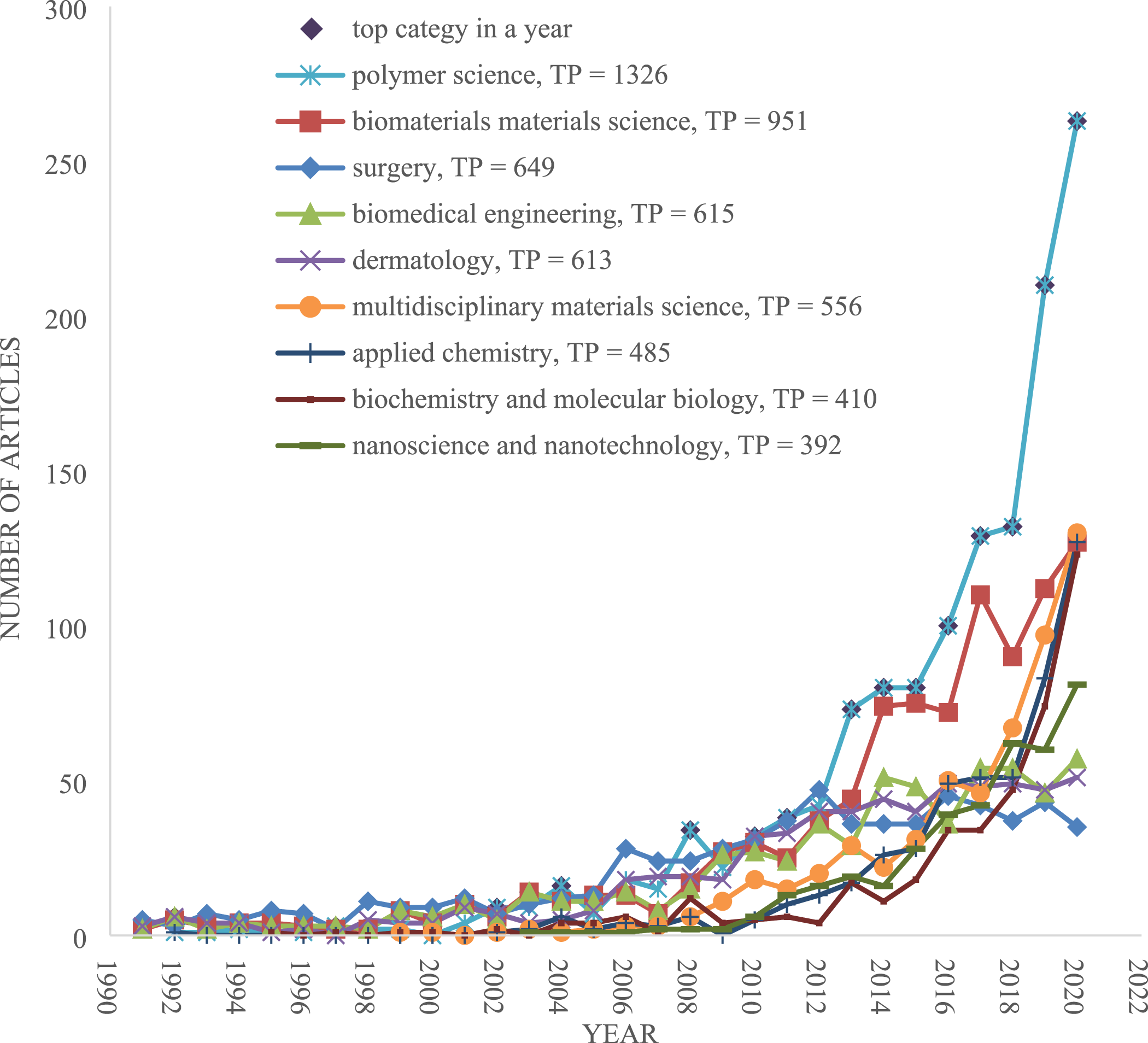
Developments of the top nine Web of Science categories with TP > 400.
The top five most productive journals with 100 articles or more were: International Journal of Biological Macromolecules (IF2020 = 6.953) with 255 articles (4.8% of 5351 articles), Carbohydrate Polymers (IF2020 = 9.381) with 194 articles (3.6%), Materials Science & Engineering C-Materials for Biological Applications (IF2020 = 7.328) with 160 articles (3.0%), Journal of Applied Polymer Science (IF2020 = 3.125) with 152 articles (2.8%), and Journal of Wound Care (IF2020 = 2.072) with 125 articles (2.3%). According to the journal impact factor, Lancet, with one article placed first with the highest IF2020 of 79.321, followed by JAMA-Journal of the American Medical Association with three articles (IF2020 = 56.272), Science with one article (IF2020 = 47.728), and Nature Materials with one article (IF2020 = 43.841).
Publication performance: Countries and institutions
Top 10 productive countries.

TP: total number of articles; TPR (%): rank of the total number of articles and percentage; IPR (%): rank of single country articles and percentage in all single country articles; CPR (%): rank of internationally collaborative articles and percentage in all internationally collaborative articles; FPR (%): rank of first-author articles and percentage in all first-author articles; RPR (%): rank of corresponding-author articles and percentage in all corresponding-author articles; SPR (%): rank of single-author articles and percentage in all single-author articles; CPP2020: number of citations (TC2020) per publication (TP).
Six indicators were used for the comparison of publication performance: total number of articles (TP), single-country articles (IP), internationally collaborative articles (CP), first-author articles (FP), corresponding-author articles (RP), and single-author articles (SP) 37 as well as their CPP2020. China dominated among the four publication indicators with a TP of 1070 articles (20% of 5339 articles), an IP of 836 articles (19% of 4330 single-country articles), an FP of 996 articles (19% of 5339 first-author articles), and an RP of 958 articles (18% of 5312 corresponding-author articles). USA ranked first in the two publication indicators with a CP of 297 articles (29% of 1009 internationally collaborative articles) and an SP with 31 articles (23% of 134 single-author articles). Compared to the top 10 countries, wound dressing articles from South Korea had the highest CPP2020 of TP, FP, and RP, respectively. South Korea is a plastic surgery nation. 38 Three of the top 10 wound dressing articles were published by Min et al., 39 Khil et al., 40 and Rho et al. 41 from South Korea.
Figure 3 shows a comparison of development among the top six leading countries with 300 publications or more. The annual number of articles for a country before 2013 was less than 40, mainly published by the USA. China dominated wound dressing research with a sharply increasing annual number of articles to reach 270 articles in 2020. Iran published the first article in 2004. A sharp increase in the publication by Iranians was found in recent years helping Iran to reach 2nd in 2020 with 91 articles. Comparison of development trends among the top six productive countries with TP > 300.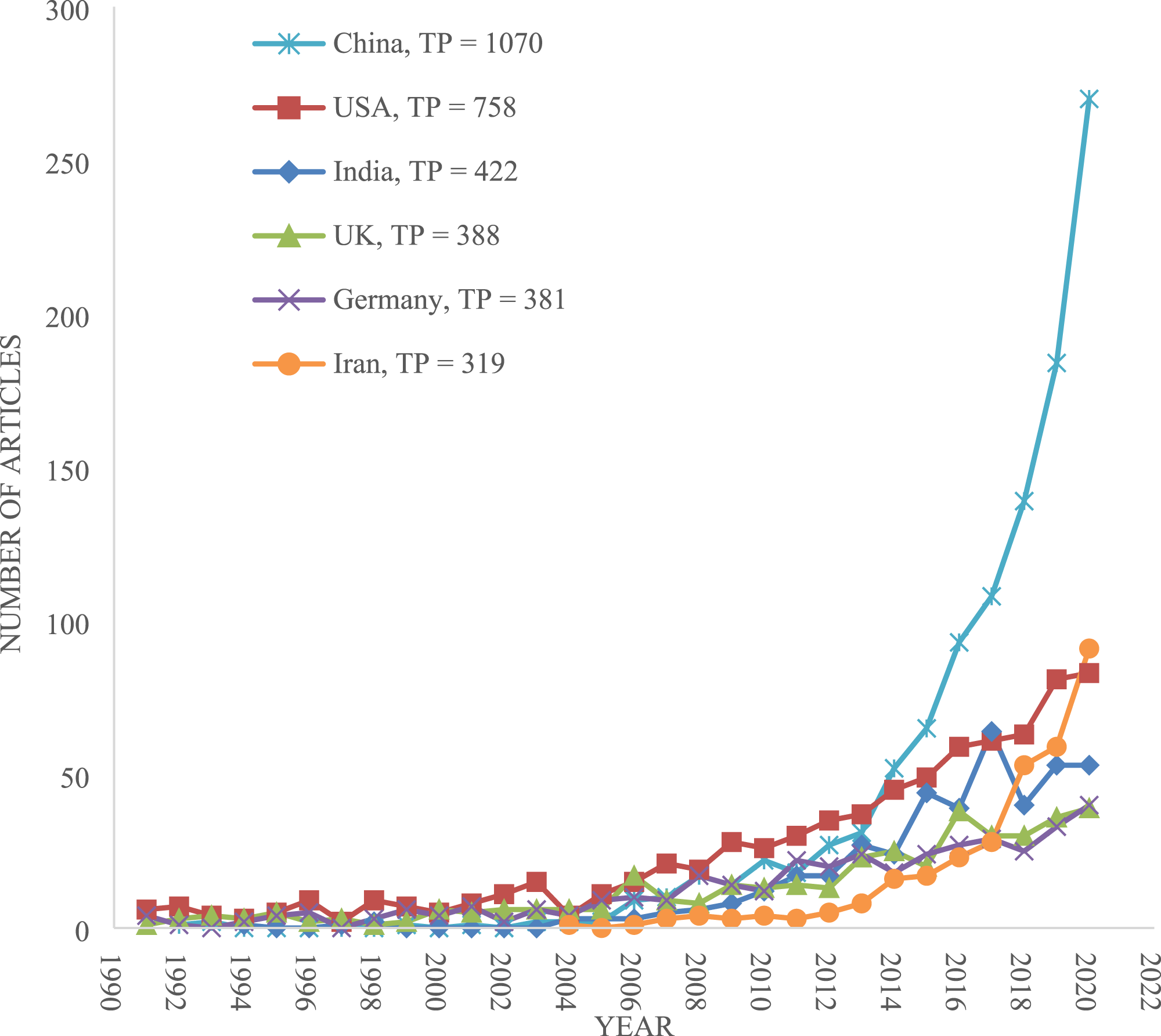
Top 10 productive institutions.

TP: total number of articles; TPR (%): rank of the total number of articles and percentage; IPR (%): rank of single-institute articles and percentage in all single-institute articles; CPR (%): rank of inter-institutionally collaborative articles and percentage in all inter-institutionally collaborative articles; FPR (%): rank of first-author articles and percentage in all first-author articles; RPR (%): rank of corresponding-author articles and percentage in all corresponding-author articles; SPR (%): rank of single-author articles and percentage in all single-author articles; CPP2020: number of citations (TC2020) per publication (TP); N/A: not available.
The Chinese Academy of Sciences in China ranked top with a CP of 70 articles (2.0% of 3417 inter-institutionally collaborative articles). The Amirkabir University of Technology in Iran was the only institute among the top 10 that produced single-author articles. Jiaxing College in China published nine articles, ranking 208th, with an SP of five articles (3.7% of 134 single-author articles). Compared to the top 10 leading institutes, wound dressing articles published by the National University of Singapore had the highest CPP2020 of 160, followed distantly by Chulalongkorn University in Thailand, while institutes in China and Iran had lower values of CPP2020. A bias emerged as a result of the Chinese Academy of Sciences' multiple branches in various cities. 42 At present, the publications of the institute with branches were considered under one institution, and if the publications were divided into branches, different rankings would have resulted.
The most frequently cited articles and the most impact articles in 2020
After publication, highly cited publications may or may not have a high impact or visibility. 43 The number of citations received in the recent year of 2020 (C 2020 ) may offer readers extra information about the influence of a highly referenced work today. 15 When 5351 wound dressing articles were sorted by TC2 020 , a different ranking was generated compared to the ranking obtained from the C 2020 sorting. A total of 1282 articles (24% of 5351 articles) did not receive any citation in the most recent year (C2020 = 0) and 531 (9.9%) articles had no citations from their publishing year until the end of 2020 (TC2020 = 0). Moreover, 46% of the top 100 C 2020 publications were also among the top 100 TC2020 articles. The 5351 wound dressing articles have been searched with search keywords in their title, abstract, and author keywords. A total of 1787 articles (33% of 5351 articles); 4661 articles (88% of 5325 articles with abstract); and 1642 articles (38% of 4303 articles with author keywords) contained search keywords in their title, abstract, and author keywords, respectively. The title of an article is a label that supplies reasonable details of the article subjects. 44 Author keywords were given by the authors to offer more information about the main research focused on articles. Articles that contain search keywords in their abstract might relate less to the search topic directly.
The top three most frequently cited articles included two classic articles entitled “Cytotoxicity and genotoxicity of silver nanoparticles in human cells” 45 and “Implantable applications of chitin and chitosan”, 35 and a highly cited article entitled “Electrospinning of silk fibroin nanofibers and its effect on the adhesion and spreading of normal human keratinocytes and fibroblasts in vitro” 39 contained search keywords in their abstract only. These articles do not directly relate to wound dressing research. Four of the top 20 articles on TC2020 contained search keywords in all their title, abstract, and author keywords. Typical examples include articles by Khil et al. 40 ranked 6th with TC2020 of 614, Balakrishnan et al. 46 ranked 11st with TC2020 of 571, Mi et al. 47 ranked 13rd with TC2020 of 504, and Kokabi et al. 48 ranked 20th with TC2020 of 390.
Figure 4 shows the citation records of the top seven most often cited publications (TC2020 > 500) with search keywords in the title or author keywords. Article by Mi et al.
47
ranked 13th on TC2020 with 504 but ranked 91st on C2020 with 31. Similarly, an article by Khil et al.
40
ranked 6th on TC2020 with 614 but ranked 66th on C2020 with 39. Article entitled “Antibacterial anti-oxidant electroactive injectable hydrogel as self-healing wound dressing with hemostasis and adhesiveness for cutaneous wound healing” by Zhao et al.
49
from Xi’an Jiao Tong University in China and University of Michigan in the USA had a sharp citation increasing trend after its publication year. This sharp increase in the citation of that article may indicate the importance of self- The citation life of the top seven most frequently cited articles with search keywords in their title or author keywords (TP > 500).
The top 10 most frequently cited articles with search keywords in their title or author keywords.

TC2020: the total number of citations from Web of Science Core Collection since publication year to the end of 2020; C2020: the number of citations of an article in 2020 only; R: ranking in 5351 wound dressing articles.
Research focuses and their trends
Top 20 author keywords in publications related to wound dressing.

TP: total number of articles; N/A: not available.
Except for search keywords: chitosan, electrospinning, and hydrogel were found to be the most frequently used author keywords.
The six possible research hotspots of wound dressing research were “tissue engineering”, “biomaterials”, “antimicrobials”, “drug delivery”, “advanced wound dressings”, and “electrospinning.” Each word cluster consists of several supporting words obtained from the results of word analysis.
Tissue engineering
All articles that included supporting words, for example, scaffold, scaffolds, skin, skins, vitro, in vitro, invitro, cell, cells, biocompatibility, biocompatible, and cytobiocompatibility on their front page were contained in Figure 5, which shows that studies on “tissue engineering” rose rapidly and have taken the lead in the last decade (2010–2020). When the skin suffers full-thickness injuries, an excision (surgical removal) of the damaged skin is followed by skin grafting. Nowadays, the split-thickness autologous skin graft (autograft) is considered the clinical “gold standard” for this type of severe wound on the skin. Unaffected healthy skin removed from the patient is transplanted onto the full-thickness wound. Split-thickness transplantation contains thin slices of the epidermis and the initial part of the dermis leading to scar formation.
58
The split skin donor site heals within 7 days and can be used for harvesting up to 3 to 4 times; however, the treatment lengthens the duration of the hospital stay since re-cropping is affected by the time required for re-epithelialization.
59
Development trends of the six topics in wound dressing research.
Moreover, in the case of a more extensive injury, such as occurs in patients with more than 50% total body surface area, the availability of donor sites is extremely limited. The severity of the injury might leave the patient with too little undamaged skin to harvest sufficient autografts. 60 Interestingly, full-thickness skin transplantation is usually scar-free, but at the same time, its application is very much limited by the fact that only a victim with an injured area of less than 2% total body surface area can benefit from this technique. 61
Allografts are clinically indicated as possible therapeutic alternatives when a donor source of autografts is limited. 62 Allografts are grafts taken from other people that are effective at preventing fluid loss, and infection, reducing discomfort, and promoting underlying tissue repair. However, allografts are in limited supply, costly, variable in quality, and present ethical and safety issues related to disease transmission. Allografts require rigorous screening and standardized sterilization and may lead to immune rejection. 58
The above discussion highlights the need for alternative approaches to providing permanent solutions for skin tissue regeneration. Tissue engineering thus emerged as a field of research, which develops functional substitutes for damaged tissue by applying the principles of biology and engineering technology. 63 The ultimate goal of tissue engineering is to provide engineered products that are recognizable and exploitable by the desirable native tissue so that the body can repair and regenerate its own tissue defects and damage, respectively. 64 Many research groups worldwide have been working on in vitro studies for the creation of skin substitution because of the great importance and high demand for skin substitute products. 65 Today, researchers have developed several skin substitutes, and some of them are already used in the clinic.
Biomaterials
All articles that included supporting words, for example, biomaterials, biomaterial, gelatin, chitosan, chitosans, collagen, collagens, collagenase, cellulose, biocellulose, nanocellulose, alginate, alginates, and gelatine on their front page were considered studies on “biomaterials.” Biomaterials were identified as the second important research topic for wound dressing research in the last decade (Figure 5). It was clear from the published articles that researchers working on the wound dressing area are increasingly investigating the scope, physical and biological properties of biomacromolecules that have been used in wound dressings, including collagen, 41 chitosan, 54 alginate, 46 gelatin, 52 keratin, 66 fibroin, 67 microbial cellulose. 50 The choices of biomaterials depend on their functional properties, such as biocompatibility, biodegradability, noncytotoxicity, antimicrobial properties, and wound healing capabilities. 35
Alginates are generally capable of absorbing 20 times their weight, which makes them suitable as a dressing material for use in highly exudative wounds. Alginate dressing is made of sodium and calcium salt of alginic acid derived from seaweed. The sodium and calcium ions undergo interaction with the serum of the wound bed to form a hydrophilic gel.68,69 Collagen is a natural extracellular matrix (ECM) component of many tissues, which makes it a perfect candidate for wound dressing and skin tissue engineering. ECM proteins, for example, type I and type IV collagen, help stimulate cellular attachment and spread. 41 Collagen is a key protein in the body having hemostatic characteristics that help wounds heal and mend. Thus, collagen dressings may provide a substrate for fibroblasts and serve as a matrix to facilitate wound healing. Chitosan is the most common biopolymer used for wound healing applications next to collagen. The use of chitosan is principally due to its many admirable properties such as biocompatibility, biodegradability, hemostatic, and antimicrobial activity. It also has exhibited low immunogenicity, scar reduction capability, and an ability to promote tissue regeneration. 70 Keratin represents the most important biopolymer in mammals after collagen. 71 Keratin can be utilized as a natural protein in biomedical applications instead of collagen and gelatin. 72 Due to its biodegradable, bioactive, biocompatible characteristics, and natural abundance, keratin has been manufactured into films, hydrogels, electrospun mats, and dressings for biomedical applications.
Antimicrobial
All articles that included supporting words, for example, antibiotics, antibiotic, antimicrobial, antimicrobials, anti-microbial, antibacterial, anti-bacterial, nanosilver, silver, nano-silver, anti-infection, antibiosis, antiviral, anti-fungal, antifungal, anti-staphylococcal, anti-biofouling, and anti-inflammation on their front page were considered studies on “antimicrobial”. Figure 5 shows that antimicrobials emerged as the third main research focus of the wound dressing research field. Although it appeared as 3rd in the position, it is actually behind the Biomaterials with a very low margin as if both Antimicrobials and Biomaterials tie in the race. One of the main functions of wound dressing is protecting the wound from infection. Wound dressing limits the risk of infection by acting as a barrier between the wound and environment, thus limiting the access of all kinds of contamination, including microorganisms, to the wound surface. Research is moving towards the functionalization of a wound dressing with antimicrobial agents. Dressings impregnated with antimicrobials can benefit superficially infected wounds by killing microorganisms on the wound surface or under the dressing for up to 1 week. Antimicrobial agents start being released from the carrier dressings in contact with the fluid of the wound bed. Silver 53 and Povidone-iodine 73 are considered broad-spectrum antimicrobial agents and are indicated for the treatment of superficial microbial infections. Other antimicrobial agents, Chlorhexidine, Quaternary ammonium compounds, Octenidine hydrochloride, etc., have also been used for producing antimicrobial dressings. 74 Hydrogels, 49 alginates, 68 gelatin mats, 75 and other forms of wound dressing can be loaded with antimicrobial agents.
Silver is well established as an antimicrobial substance and has been registered as a broad-spectrum biocide in the United States since 1954 76 and is highly efficient in killing a wide range of microorganisms. Inhalation, ingestion, or dermal application of silver do not pose any threat to life. In the human body system, silver makes a complex with protein and can be removed by the liver and kidneys. As a result, silver is safe to be administered to the body in the proper chemical form and concentration.45,77 Antibiotic resistance is becoming one of the most serious problems in treating infection, and pathogenic bacteria have been developing resistance to antibiotics while the AgNPs are effective against multidrug-resistant bacteria. 78
Generally, silver does not show a negative effect on the viability of mammalian cells. 79 The highest effect of silver as an antimicrobial agent can be achieved by optimizing silver ions’ production by increasing the surface area of the silver metal particle. 80 AgNPs, a very popular silver form for antimicrobial applications, such as in electrospun mats containing AgNPs used for wound dressing, show antimicrobial attributes against E. coli and S. aureus.
Advanced wound dressing
Examples of commercially available passive, interactive and advanced wound dressings.

Drug delivery
All articles that included supporting words, for example, release, releases, delivery, deliver, and delivering, were considered studies on “drug delivery”. Drug delivery has also emerged as one of the important research themes under wound dressings (Figure 5). One of the earliest works on the sustained release of an antibiotic drug embedded in a bilayer artificial skin was reported by Matsuda et al. 97 Since then, several works on the controlled delivery of drugs from wound dressings or scaffolds have been continued, and more works were reported in the last 5 years.
The creation of a polymeric matrix such as a scaffold is a common option for the controlled release of drugs as it can protect drugs from biological degradation before their release. Generally, the drug is molecularly dispersed in the polymer phase as a solute. When a polymer is exposed to a solvent that is thermodynamically compatible, it begins to release the drug substance to the surrounding media due to the action of polymer swelling. Solute diffusion or polymer dissolution can control the release mechanism. 98 One potential application for the dissolution of polymer matrices is wound dressing and tissue engineering, such as scaffolds for tissue regeneration. 63 Here, polymers are shaped into scaffolds resembling the structure of the tissue or an organ such as skin. The scaffold is then loaded with a drug used to fight disease or risk of infection. For example, a scaffold for skin tissue engineering can be loaded with antimicrobial drugs to minimize the potential risk of infection. 99 The antimicrobial drug will then be released as the polymer gradually dissolves. Different types of wound dressings, including composite electrospun mat, 100 injectable composite hydrogel, 101 and hybrid nanofiber mat 102 have been loaded with different drugs such as curcumin, 103 AgNPs, 75 epidermal growth factor, 99 and salicylic acid. 104
Electrospinning
All articles that included supporting words, for example, electrospin, coelectrospinning, co-electrospinning, electrospinning, electrospun collagen, electrospun fibers, electrospun nanofibers, and co-electrospun, were considered studies on “electrospinning”. Electrospinning has received great attention in wound dressing research, especially in the last decade (Figure 5), which is not surprising since research on tissue engineering got the most attention during a similar period. Tissue engineering research requires the use of a temporary scaffold, either synthetic or natural, or a combination of both, onto which cells are subsequently seeded, simulating the function of the natural ECM present in the human body. This assembly is then allowed to mature into a bioreactor, where embedded cells attach to the scaffold, multiply, secrete their own ECM, and trigger the creation of new tissue. Thus, in this approach, the scaffold provides the physical support on which the implanted cells organize the formation of the new tissue. 105 Electrospinning is considered one of the best techniques for the construction of these scaffolds, mostly due to its ability to produce micro-and nanoscale fibers. Other advantages offered by electrospun nanofibers include their high length to diameter ratio, enormous surface area per unit mass, and tuneable porosity.106,107
One of the earliest works on wound dressings using electrospinning was reported by Jin et al., 67 where nanoscale diameter fibers were formed from Bombyx mori silk with poly(ethylene oxide). One of the major contributions came from Khil et al. 40 when a porous membrane of polyurethane was prepared via electrospinning. This membrane showed controlled evaporative water loss with commendable permeability to oxygen and the ability to drain fluid. Moreover, it prevented the invasion of foreign microorganisms invasion because of its ultrafine porous structure. Many other natural, synthetic polymers and their combinations have been electrospun for biomedical applications. 108
Conclusion
Publication of wound dressing research increased sharply from the year 1991–2020 in SCI-EXPANDED. Wound dressing research is moving towards the tissue engineering field with appropriate biomaterials to find the platinum standard of skin loss management therapeutics. Choice of biomacromolecules for the preparation of an ideal wound dressing is leading the future of this field of biomaterials research as biomacromolecules can provide the template which is very close to the natural skin architecture. To fight the infection on wound beds, research is shifting rapidly towards antimicrobial dressing materials. Antibiotic drugs and antimicrobial agents are being embedded in the dressing. In the future, research on the low delivery of such drugs will also emerge alongside antimicrobial wound dressing. Nanofiber and hydrogel-based advanced wound dressings will probably be studied increasingly in the coming future. Future research will probably depend on the electrospinning technique to prepare an advanced wound dressing. Many studies in 129 Web of Science categories, including polymer science, biomaterials, materials sciences, surgery, and biomedical engineering, have been taken to develop an ideal solution for wound management. However, wound dressing articles were published mainly in the category of polymer science in the last decade, and the publishing tendency of wound dressing research in medical journals such as surgery was decreasing. Chinese universities took the leading position in the publication of wound dressing research, followed by Iranian universities, whereas the National University of Singapore had the highest CPP2020 (160). Six important future research hotspots of wound dressing have been predicted. Asian countries (seven countries among the top 10) were found to be more engaged in this field, followed by European countries. The USA was the most productive country in this area before falling behind China in 2013. The dominant publishing language was English (97% of the total articles), while 14 other languages were used as well. Although a single language dominated wound dressing research, the research works were found to be highly spread across the globe (97 different countries) with international collaborations from 93 different countries.
Footnotes
Author contributions
The manuscript was written with the contributions of all authors.
Declaration of conflicting interests
The author(s) declared no potential conflicts of interest with respect to the research, authorship, and/or publication of this article.
Funding
The author(s) received no financial support for the research, authorship, and/or publication of this article.
