




Abstract
In order to make full use of the advantages of Chitosan in the process of wound repair and overcome the difficulty that Chitosan can not be electrospinned alone, Chitosan/Polybutylenes succinate nanofiber membrane was prepared by electrospinning, and its properties were tested and analysed. The results show that the content of Chitosan will affect the properties of composite fiber membrane, such as liquid absorption and hemostatic properties. When the content of Chitosan is 90%, the comprehensive performance of Chitosan/Polybutylenes succinate fiber membrane is the best and is most suitable for wound hemostatic dressing.
Introduction
In the process of wound healing, wound hemostatic dressing plays a key role in protecting the wound, stopping bleeding, absorbing exudate, preventing infection and inhibiting microorganisms. 1 Compared with wound dressings prepared by traditional methods, wound hemostatic dressings prepared by electrospinning technology have many advantages. 2 Electrospun fiber membrane has high specific surface area and high porosity, which can promote liquid absorption, cell respiration and air penetration.3,4 Electrospun fiber membrane has a small pore size, which makes it have a certain hemostatic effect, and can prevent the penetration of microorganisms in the external environment and the inward growth of cell tissue.5,6 In addition, electrospun fiber membrane is soft and light, can be cut at will, and can fully heal the wound. 7 Rho et al. 8 studied the healing characteristics of collagen electrospun fiber membrane on mouse wounds. They found that fiber membrane can heal wounds better than traditional wound care, especially in the early stage of the healing process.
Chitosan(CS) is a natural polymer with good biocompatibility and biodegradability.9,10 In the process of wound healing, CS mainly plays the role of antibacterial, hemostasis, promoting wound tissue regeneration and reducing scar formation. 11 CS is an excellent material for preparing wound dressing. 12 If CS can be prepared into nanofibers by electrospinning technology and used in wound dressing, it will have great application potential. However, the electrospinning of pure CS is very difficult, because there is a large number of hydrogen bonds on CS molecules and the intramolecular force is relatively strong, which makes the dissolution and electrospinning of CS more difficult.13,14 Therefore, nanofibers can be obtained by blending another polymer with CS. Rashid et al. 15 blended CS and polyvinyl alcohol (PVA) and added nano zinc oxide to prepare CS/PVA/nano zinc oxide composite fiber membrane. The research results showed that this fiber membrane can promote wound healing.
In order to overcome the difficulty of electrospinning CS alone, CS was blended with Polybutylenes succinate (PBS) in this paper. PBS has good biocompatibility and biodegradability. 16 It can be degraded into carbon dioxide and water under the action of enzymes or bacteria. It is non-toxic to human body and harmless to the environment.17,18 PBS has a good application prospect in the field of medical materials. Li Haiyan 19 completely studied the biocompatibility and water degradation behavior of PBS, and pointed out that PBS can be used as a potential biomaterial in the fields of soft tissue repair and tissue engineering. Wu Binwei 20 successfully prepared the silk fibroin/PBS composite fibers by electrospinning and applied them to tissue engineering vascular scaffolds. Wu Zhongyin 17 developed a new homemade hemostatic agent prepared by the electrospun soluble eggshell membrane protein (SEP) and PBS with thrombin loaded. The results showed PBS/SEP has a significant hemostatic effect and fine biocompatibility, which is a promising product in the clinical application in future.
Therefore, in this paper, PBS is selected and mixed with CS for electrospinning to improve the spinnability and film-forming of CS and ensure the safety of dressing. The properties of CS/PBS composite fiber membrane were studied to provide reference for the development of CS medical wound hemostatic dressing.
Experimental
Materials
Chitosan (CS, AR) was purchased from Shanghai Aladdin Biochemical Technology Co., Ltd. Polybutylene succinate (PBS, AR) and Hexafluoroisopropanol (HFIP, AR) were purchased from Chengdu MICXY REAGENT Co. LTD.
Preparation of electrospun CS/PBS nanofiber membrane
A certain quality of PBS powder was added to the HFIP solution (The concentration of PBS was 20%), and then CS powder was added to the solution (The contents of CS were 0, 20%, 40%, 60%, 80% and 90% respectively). The spinning solution was prepared by stirring continuously for 4 h on a constant temperature magnetic stirrer. Then, the spinning solution was injected into the needle barrel and the electrospinning device was opened. The parameters of electrospinning were set up as follows: the voltage was 15 kv, distance between the needle tip and the collector was 20 cm and flow rate was 1 mL/h. Finally, six kinds of CS/PBS fiber membranes, numbered 1#-6#, can be obtained by electrospinning, in which the concentration of CS is 0, 20%, 40%, 60%, 80% and 90% respectively.
Characterization
Micro-morphology of fiber
The micro-morphlogy of CS/PBS nanofiber was observed by scanning electron microscope (Hitachi, S-4800-I). 50 fibers were randomly selected from each SEM photograph, and the diameter was measured by photoshop. The average fiber diameter and coeffificient of variation were calculated.
Water-vapour transmission
Referring to GB/T 12704-2009: Textiles-Test method for water-vapour transmission of fabrics-Part 2: Water method, the water-vapour transmission of nanofiber membrane was tested by YG601 Computerized fabric moisture permeability instrument. First place the moisture permeable cup containing distilled water at a certain temperature and sealed with fabric samples in a sealed environment with specified temperature and humidity, and then calculate the moisture permeability of the sample according to the change of the mass of the moisture permeable cup within a certain time. The calculation formula is shown in equation (1).

A: effective test area (m2)
t: test time (h)
Wetting capability
In this paper, the OCA15EC Optical Contact Angle Measuring Instrument was used to measure the contact angle of the material. The liquid used is deionized water. Each sample was measured three times, and the contact angle between the left and right sides of the droplet was measured separately. Finally, the average value of the three measurements was taken as the contact angle of the material surface.
Liquid absorbency
This experiment tests the liquid absorption of the samples according to YY/T 0471.1—2004: Test methods for primary wound dressing—Part 1: Aspects of absorbency. Dissolve 8.298 g NaCl and 0.368 g CaCl2 in a volumetric flask with deionized water and dilute to 1 L to prepare the test solution. The test solution contains 142 mmol sodium ion and 2.5 mmol calcium ion, and the ion content is equivalent to human serum or wound exudate. Place the weighed 5 cm × 5 cm sample in the Petri dish and add the test solution preheated to 37°C, with a mass of 40 times that of the sample. Put the Petri dish into the drying oven and incubate it at 37°C for 30 min. Then take it out, clamp one end of the sample with tweezers, hang it for 30 s, and weigh it. After the test, calculate the result according to equation (2).

B: Water-absorbed rate, %
m: Mass of sample after absorbing liquid, g
m0: Mass of sample before absorbing liquid, g
Blood clotting measurement
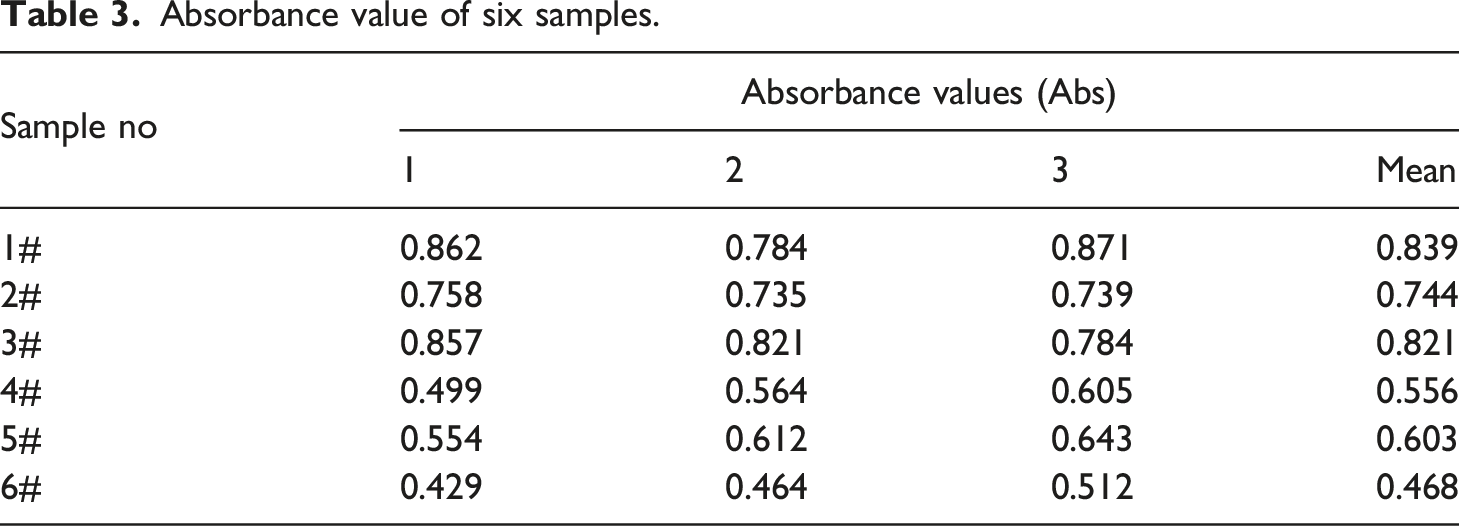
According to the experimental method of Shih MF, 21 the in vitro coagulation performance of the dressing was evaluated by whole blood clotting index (BCI). Cut the fiber membrane into 1 × 1 cm in size, put it into a centrifuge tube and add 0.2 mL of human blood and 20 μL CaCl2 solution (0.2 mol/L), place the centrifuge tube in GHP-9050 Water Separated Constant Temperature Incubator at 37°C. After 5 min, add 20 mL deionized water to the centrifuge tube and incubate for another 5 min. Then take out the centrifuge tube and put it into a centrifuge for centrifugation for 5 min (800 r/min). Take out the centrifuge tube and let it stand for 60 s, suck the supernatant into the cuvette with a needle tube, then measure the absorbance value at the wavelength of 540 nm by V5600 Ultraviolet visible spectrophotometer.
At the same time, the blank experiment was also carried out. The BCI of biomaterials can be quantified by the following equation:

It: Absorbance value of experimental sample;
Iw: Absorbance value of blank sample
It is clear that the lower the BCI value, the better the coagulation effect.
Results and discussions
Micro-morphology of CS/PBS fiber
The SEM images of CS/PBS electrospun fibers are shown in Figure 1. It can be found that the six groups of experiments can form fibers well, and the fibers are flat without beading. The fiber diameter, standard deviation and coefficient of variation is calculated in Table 1. It can be found that different CS content will affect the diameter and uniformity of the fiber. It can be seen that the fiber diameter in the second group is the smallest and its diameter variation coefficient is the largest; the fiber diameter in the sixth group of experiments is smaller and the CV is the smallest, indicating that its diameter is small and evenly distributed. The SEM images of the chitosan/polybutylenes electrospun fiber. Diameter of chitosan/polybutylenes fiber.

Water-vapour transmission
In order to make the wound heal faster, in addition to providing a relatively humid environment, it is also necessary to ensure that the dressing has good moisture permeability, which is not only conducive to the volatilization of exudate from the wound, but also effectively prevent the wound from being infected by bacteria due to the accumulation of exudate. Moisture permeability is the main index reflecting the moisture permeability of the sample.
22
The greater the moisture permeability, the better the performance of the dressing. In this experiment, each sample was tested five times and the mean value was calculated as the experimental result in Figure 2. It can be seen the moisture permeability of the first three samples is slightly higher than that of the last three. This may be due to the last three samples contain more CS, and there are two hydrophilic groups -oh and -NH4 in CS macromolecules, so that the fiber membrane will absorb more water instead of through it. Although the moisture permeability of the first three samples is slightly higher than that of the last three, there is no significant difference in the moisture permeability of the six samples through one-way ANOVA. Moisture permeability of the chitosan/polybutylenes fiber membrane.
Wetting capability
Contact angle of chitosan/polybutylenes fiber membrane.


Image of contact angle.
Liquid absorbency
The liquid absorption of the dressing refers to the weight of the liquid absorbed by the dressing under the condition of no tension and sufficient liquid. Liquid absorption reflects the ability of the dressing to absorb wound exudate. The greater the liquid absorption, the better the ability of the dressing to absorb wound exudate. The liquid absorbency of six groups of samples is shown in Figure 4. It can be seen with the increase of CS content, the liquid absorption of fiber membrane tends to improve. The significance test was carried out to analyze the liquid absorption of each sample. The result shows that there is no significant difference in the liquid absorption of 1#, 2#, 3#, 4# samples; when the content of CS is higher than 80%, the liquid absorption of 5#, 6# samples is significantly improved. Liquid absorption of the chitosan/polybutylenes fiber membrane.
Blood clotting measurement
Absorbance value of six samples.

BCI values of the chitosan/polybutylenes fiber membrane.
It can be seen from the Figure 4 that the BCI value of 1# fibrous membrane with CS content of 0 is the largest, up to 80%, indicating that there is almost no coagulation effect; The BCI value of 6# fibrous membrane (CS content of 90%) is the lowest, indicating that its coagulation performance is good; On the whole, the BCI values of 1#, 2# and 3# fiber membranes with low CS content were higher than those of 4#, 5# and 6# fiber membranes with high CS content. This shows that the addition of CS is conducive to improve the coagulation performance of the material, because the positive groups on the surface of CS polymer can attract each other with the negative groups on the erythrocyte membrane, so that the red blood cells gather with each other, to achieve the effect of coagulation, and accelerate the start-up of coagulation factors, to enhance coagulation. 24 This property makes it play a role in promoting coagulation.
Conclusion
In this paper, CS/PBS nanofiber membranes with CS content of 0, 20%, 40%, 60%, 80% and 90% were prepared by electrospinning. The test results show that CS/PBS fiber membrane with different CS content has different fiber diameter, moisture permeability, wettability, liquid absorption, and blood clotting performance. As a wound hemostatic dressing, hemostatic ability is one of the most important indexes. Therefore, hemostatic performance is the primary consideration in this paper. No. 6 has the lowest BCI index, and the highest liquid absorption, the best wettability, the smallest fiber diameter. Therefore, this membrane (CS content is 90%) is most suitable for wound dressing.
Footnotes
Acknowledgements
The authors acknowledge the support given by Special Fund for The Construction of High-level Teachers in Beijing Institute of Fashion Technology [Grant No. BIFTXJ202218], the Science and technology plan of Beijing Municipal Education Commission (KM202210012009), and Graduate education and teaching reform project of Beijing Institute of Fashion Technology (120301990132).
Declaration of conflicting interests
The author(s) declared no potential conflicts of interest with respect to the research, authorship, and/or publication of this article.
Funding
The author(s) disclosed receipt of the following financial support for the research, authorship, and/or publication of this article: This work was supported by the Science and technology plan of Beijing Municipal Education Commission (KM202210012009), Graduate education and teaching reform project of Beijing Institute Of Fashion Technology (120301990132), Special Fund for The Construction of High-level Teachers in Beijing Institute of Fashion Technology (BIFTXJ202218).
