




Abstract
Nonwoven geotextiles are widely used in tailings ponds for filtration and drainage, but there is a risk of failure of nonwoven geotextile due to physical clogging. In this study, to reduce the clogging of nonwoven geotextile filter in tailings ponds and improve its long-term drainage performance, a layer of woven geotextile is placed between tailings and nonwoven geotextile to form a composite filter of woven-nonwoven geotextile. A series of gradient ratio tests were conducted to study the influence of the aperture of woven geotextile on the filtration characteristics of composite filter. The long-term filtration performance of composite filter was evaluated, and the filtration mechanism of composite filter was revealed. The results show that after adding a layer of woven geotextile with reasonable aperture upon the nonwoven geotextile, the gradient ratio of filter decreased and the flow rate of filter significantly increased. The filtration performance of composite filter of geotextile was better than that of nonwoven geotextile filter. The aperture of woven geotextile had an important influence on the filtration characteristics of composite filter. With the increase of the aperture of woven geotextile, the gradient ratio value of the composite filter decreased first and then increased. For relatively dense tailings, the recommended ratio of the equivalent aperture of woven geotextile (O95) to the characteristic particle diameter of tailings (d85) s is about 1.6.
Introduction
Tailings ponds refer to the places where tailings or other industrial wastes are stacked, and they are dangerous sources of man-made debris flow with high potential energy. Crash of the tailings ponds may cause major accidents. And the saturation line of tailings pond is its lifeline.1,2 High saturation line causes tailings ponds to produce piping and even collapse, which seriously affects the stability and safety of tailings ponds. Therefore, reducing the saturation line of tailings ponds through various drainage facilities is vital for the safe operation of tailings ponds. 3 Geotextile has been widely used in filtration and drainage of tailings ponds because of its advantages of convenient construction, energy conservation, environmental protection, reliable quality and low price.4,5 The study of geotextiles in the filtration field, including new types of geotextiles, 6 design criteria of geotextiles, 7 and long-term filtration performance of geotextiles 8 is attracting more attention.
Clogging of the geotextile filters used in fine tailings ponds is a common issue9–12 owing to the complex nature of the fluid, flow conditions, high stress levels, and the heterogeneity of tailings, which threatens the safety of tailings ponds. Koerner and Koerner 13 reviewed 69 field failures of geotextile filters that performed unsatisfactorily, and found that the clogging of nonwoven geotextiles commonly occurs in cohesionless fine–grained soils. Miszkowska and Koda 14 excavated nonwoven geotextile samples that had been used in Bialobrzegi dam in Poland for 23 years, and measured their permeability coefficient under the load of 0, 2, 20 and 200 kPa. The results showed that the hydraulic performance of nonwoven geotextile under load decreased by factor of 4. Yang et al. 15 analyzed the clogging of the drainage facilities of the Lead-Zinc tailings dam in Yinshan. Compared with the virgin geotextiles, the permeability of the geotextiles excavated at the bottom of dam and near of the drainage well decreased by 85% and 46% respectively. The grain gradings of different tailings are complex and have a certain degree of dispersibility when encountering water. With the improvement of beneficiation technology, the particle size of tailings becomes finer, 16 making the physical clogging of the geotextile in tailings ponds more severe.
To effectively reduce the saturation line of tailings ponds and ensure its safe operation, the clogging problem of geotextile needs to be solved urgently. At present, the common measure for resolving the physical clogging of the filter is the washing method with high-pressure water, 17 but the cleaning range of this method is limited. This method mainly removes the clogged materials on the surface of the filter, and it is difficult to remove the clogged materials inside the filter. For geotextiles wrapped around the drainage pipe, it is difficult to clean the clogged materials by washing method. Compared with geotextile, sand gravel filters have stronger resistance to physical clogging. Therefore, in the fields of mud dewatering 18 and agricultural drain with pipes, 19 placing a layer of sand cushion between geotextile and protected soil was proposed to reduce the clogging of geotextile, and showed good performances. Zhu 20 placed a layer of sand cushion between the residual soil and geotextile to prevent the physical clogging of the geotextile filter. And experimental results showed that the larger the particle size of the sand was, the more effective the clogging prevention was. However, it is necessary to strictly control the particle size and thickness of the sand gravel, which is difficult to construct and the cost is high. Referring to the idea of reducing the clogging of nonwoven geotextile with sand gravel cushion, a layer of woven geotextile is placed between the nonwoven geotextile and the tailings, and the whole of woven geotextile and nonwoven geotextile is called composite filter in this paper. The construction of composite filter layer is convenient. The aim of woven geotextile is to increase opening of the surface of the composite filter and reduce the clogging of nonwoven geotextile filter. Kutay and Aydilek 21 conducted a laboratory test program to evaluate the filtration performance of four different woven/nonwoven geotextile combinations with fly ash and bottom-sea dredged sediments, and found that a two–layer geotextile system significantly increased the filtration capacity. However, there are few studies22,23 on composite filter of geotextile in tailings ponds.
To improve the drainage capacity and anti-physical clogging capacity of nonwoven geotextile filter in tailings ponds, a layer of woven geotextile was placed between tailings and nonwoven geotextile to form a composite filter of woven–nonwoven geotextile. Through gradient ratio (GR) tests, 24 the influence of aperture (surface pore size) of woven geotextile on the filtration characteristics of composite filter was studied, and the long–term filtration performance of composite filter was evaluated. The filtration mechanism of composite filter of geotextile was revealed. This study can improve the ability of geotextile filter to resist physical clogging, and provide guidance for the selection of woven geotextile in composite filter. Simultaneously, it will deepen the understanding of the filtration mechanism of the composite filter.
Materials and method
Evaluation test
Tests were carried out in the GR test system, as shown in Figure 1. This test system includes an improved GR apparatus and water supply system. Test system of GR
The improved GR apparatus is divided into upper, middle and lower parts, which are connected by flange bolts, and the flanges are sealed by rubber pads. This apparatus can accommodate soil specimens up to 100–120 mm in height and 100 mm in diameter. A perforated rigid plate, a wire sieve mesh (1 mm aperture) and a layer of lightweight geotextile (150 g/m2) are placed on top of the tailings to protect them from the scour of water. The geotextile specimen rests on a wire sieve mesh (1 mm aperture) and a perforated rigid plate, which allows for passaging piped soil particles to a lower chamber. These particles were collected for weighing after the test. Six ports are distributed on one side of the apparatus, which can be connected with the piezometric tube or pressure gauge to measure the water head. The distance between port #2 and the geotextile is 6 mm, and this port is sensitive to pick up the mechanisms occurring at the soil-geotextile filter interface. The outer diameter and inner diameter of port 2# are 6 mm and 4 mm, respectively, and the outer diameter and inner diameter of other ports are 10 mm and 3 mm respectively. The water outlet of the apparatus is raised to a certain height by a lifting platform to make it higher than geotextiles, which ensures a saturated seepage of the entire sample. The water heads at the water inlet and outlet of the apparatus are measured through 6# port and 1# port, respectively. The GR apparatus is made of stainless steel.
The water inlet of the GR apparatus is connected with the water supply system, which provides de-aired water with constant head. The water supply system is mainly composed of an air compressor, a pressure regulating valve and a water tank. The pressure regulating valve can adjust the pressure of air and stabilize it at a fixed value. The water in the water tank flows into the GR apparatus under the pressure of air, hence a water source with stable pressure for the test can be obtained. The power of the air compressor is 580 W, and its air storage capacity is 110 L. The maximum output pressure of the air compressor is 0.8 MPa. The precision of the pressure regulating valve is 4 kPa and the range is 1 MPa. The water in water tank is de-air water. The capacity of the water tank is large enough (140 L) to ensure that no water is added during the test.
The GR test is the most commonly used method for measuring the filtration compatibility of soil-geotextile systems (ASTM D5101-12).
24
In general, the value of the GR can be defined as follows


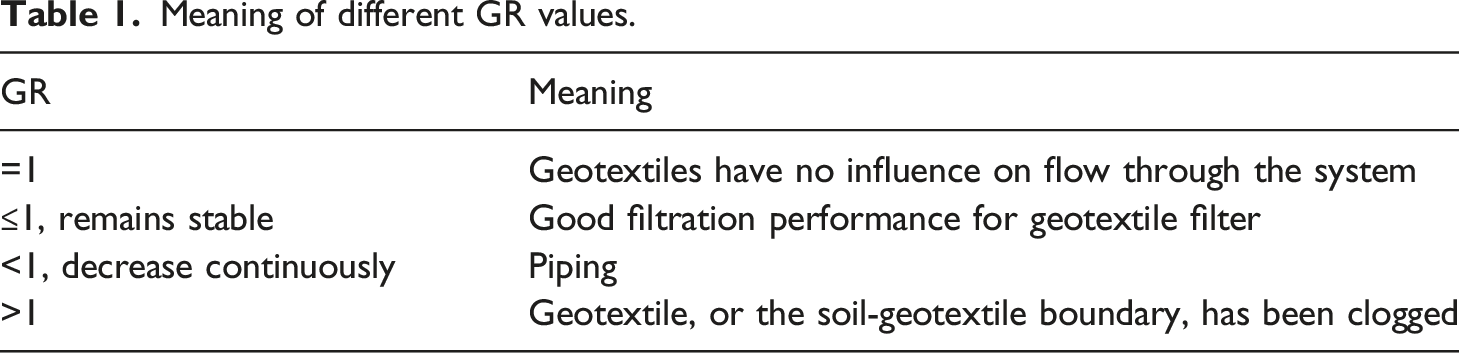
The GR value is an important parameter for analyzing the clogging of geotextiles. The meaning of different GR values is presented in Table 1. GR = 1 suggests that the geotextiles have no influence on the flow through the system. 25 GR value is less than or equal to 1 and remains stable over time, indicating a good filtration performance for geotextile filter. A continuous decrease in GR value with time (below 1) indicates piping. GR values greater than one indicates that the geotextile, or the soil-geotextile boundary, has been clogged by soil particles, resulting in a reduction of flow rate at the soil-filter interface.
Materials
(1) Tailings
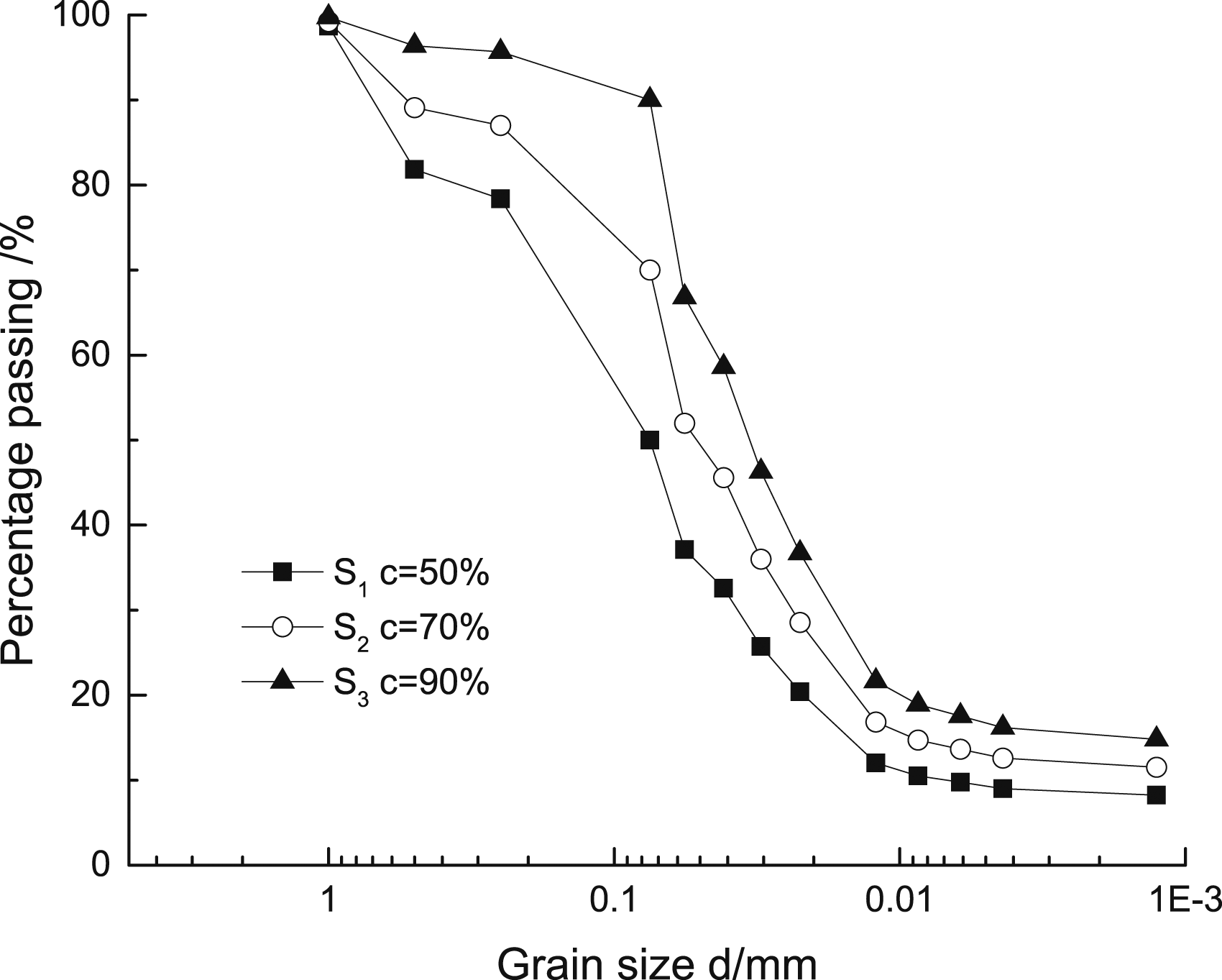
Fine tailings were collected from drying bays of Makeng tailings pond (iron tailings), and the specific gravity (dimensionless) of the discharged tailings is 3.15. An indoor screening test was carried out on the tailings sample, and it was found that the fine particle content (<0.075 mm) of tailings sample was about 65% (mass fraction). It is found that the fine particle content (<0.075 mm) of tailings at different locations of a tailings pond varies from 50% to about 90%. Therefore, the tailings samples collected on site were dried and sieved, and three kinds of tailings with different grades (S1, S2, S3) were configured. The fine particle content of these three tailings accounts for 50%, 70% and 90% of the total mass, respectively. The grain size distributions of these three tailings are shown in Figure 2, and the corresponding characteristic parameters are presented in Table 2. According to the internal stability criteria proposed by Kenney and Lau,
26
these three kinds of tailings were classified as internally stable. (2) Geotextile Grading curve of tailings sand. Meaning of different GR values.
One nonwoven geotextile and eight kinds of woven geotextiles were selected in this paper (see Figure 3). The type of nonwoven geotextile used in this paper was needle–punched geotextile. Its mass per unit area was 350 g/m2 and thickness was 3.84 mm under zero normal stress. The equivalent aperture was 0.073 mm (dry sieving test, O95) and its normal permeability was 0.119 m/s (ASTM D4491/D4491M-17).
27
This nonwoven geotextile was abbreviated as G350 below. Geotextiles. (a) Nonwoven geotextile (b) Woven geotextile.
Characteristic parameters of tailings sand.
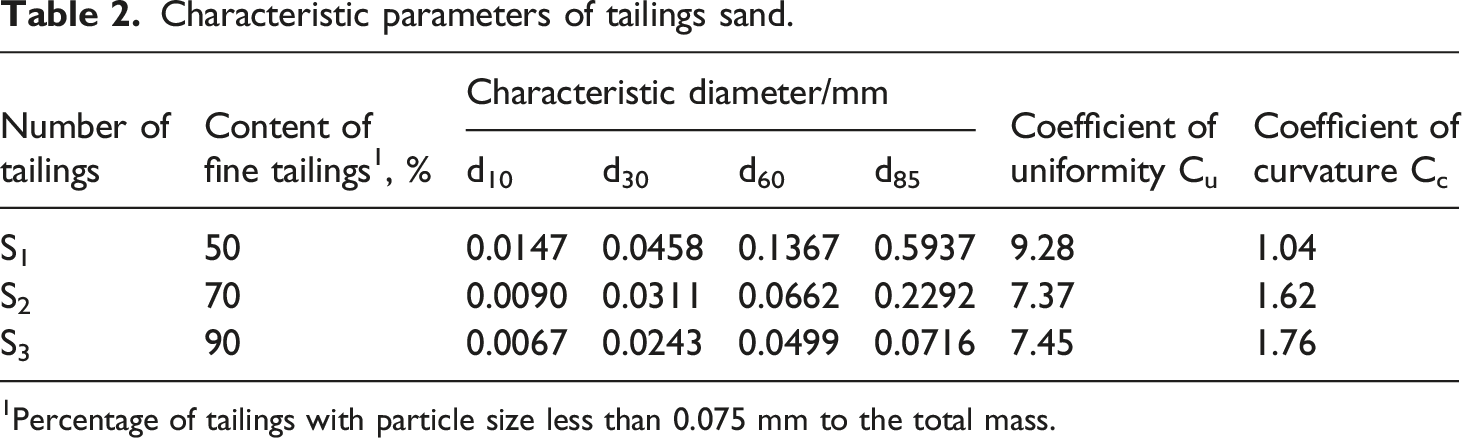
1Percentage of tailings with particle size less than 0.075 mm to the total mass.
Experimental design
Parameters of woven geotextile.

Geotextile filters are widely used in tailings ponds as external wrapping materials of drainage pipes, and the buried depth of drainage pipes in tailings ponds is generally 10–40 m. According to the formula proposed by El Tani, 28 when the buried depth of the drainage pipe is 40 m, the water pressure at a distance of 100 mm directly above the outer surface of the drainage pipe (diameter 70 mm) is close to 0.07 MPa. Considering the most unfavorable conditions, the water pressure at the water inlet of the tests was set to 0.08 MPa except for Test-11-L and Test-12-L, and the corresponding average hydraulic gradient is 80. Test-11-L and test-12-L were long-term tests, which required a continuous water supply. Overflow device was used for water supply in Test-11-L and test-12-L, and the hydraulic gradient was 12.5.
The dry densities of the undisturbed samples of tailings at the depths of 6.0 m and 30.7 m of Makeng tailings ponds were 2.13 g/cm3 and 2.10 g/cm3, respectively. The filling dry density of S1 tailings was 2.10 g/cm3. The relative compactness of tailings has an important influence on the test results. Hence in the tests, S2 and S3 tailings were filled with the same relative compactness (87%), and the filling dry densities of S2 and S3 tailings were 2.13 g/cm3 and 2.04 g/cm3, respectively.
Experimental process
(1) Specimen preparation
The inlets of the six ports were first plugged with light geotextile (150 g/m2) to prevent the piping of the tailings. A perforated plate, a layer of wire sieve mesh, and a layer of light geotextile (150 g/m2, with a diameter of 110 mm) were placed at the bottom of the GR apparatus. The lower and middle parts of the GR apparatus were fixed with bolts, and then the tailings were filled. The total filling height of the tailings was 100 mm. The tailings were filled by four layers, with each 25 mm thick. After filling the tailings, a layer of light geotextile (150 g/m2, with a diameter of 100 mm) and a perforated plate were placed on top of the tailings. The top cap was used to keep the tailings in a dense state, which prepared the tailings to be saturated by a vacuum pump. (2) Saturation process
A vacuum method was used to saturate the tailings. GR apparatus was placed in a vacuum cylinder for 1.5 h under the negative pressure of one atmospheric pressure. De-aired water then flowed into the vacuum cylinder under negative pressure. The tailings were kept under water for 12 h to guarantee thorough saturation. Following the saturation process, the GR apparatus was taken out of the vacuum cylinder and inverted. The light geotextile at the bottom of the GR apparatus was then replaced with a virgin nonwoven geotextile (circular, with a diameter of 110 mm). This virgin one had been subjected to a 12-hour saturation in water containing sodium alkylbenzene sulfonate with a volume fraction of 0.1%. This replacement operation helped to avoid the containment of nonwoven geotextile during preparation. A layer of wire mesh and a perforated plate were placed on the outside of the geotextile, and then the base of the GR apparatus (lower part) was installed. The GR apparatus was then inverted again to make its position return to normal. De-air water was slowly injected into the bottom of the apparatus through the water outlet to drive out air, and then the water outlet was closed. During the test, the GR apparatus should be handled with care to avoid disturbance of the tailings sample. (3) Conducting the experiment
1# port and 2# port were connected to piezometric tubes, and the 3# port to 6# port were connected to pressure gauges. The water outlet of the GR apparatus was closed and the water inlet was connected to the water supply system. The air compressor was opened and the pressure regulating valve was adjusted to the designed value. The water inlet was opened and de-aired water was allowed to flow into the tailings until the water heads of the six ports were identical. The experiment was then started by opening the water outlet, and periodically recording the water heads of the ports and flow rate of the system. Once the readings of the water heads were stable, the water outlet was closed and the test was stopped. Following the experiments, the GR apparatus was inverted, and the geotextile was taken out for clogging analysis. The geotextile was dried and weighed, and the mass of tailings intercepted by the geotextile was calculated.
Results
Influence of aperture of woven geotextile on filtration characteristics of composite filter
This section describes the results obtained in Test-1-C to Test-10, and analyzes the GR value, flow rate and other parameters of the tests. The influence of the aperture of woven geotextiles on the filtration characteristics of composite filter of woven-nonwoven geotextile is studied, and the optimal matching relationship between the particle size of tailings and the aperture of woven geotextiles of the composite filter is explored. There were only nonwoven geotextiles in Test-1-C and Test-6-C, and these two tests were used as control tests.
The variations of GR value and flow rate of the system with time in different tests were similar. The results for Test-1-C and test-4 are shown in Figure 4 as examples. There was a layer of nonwoven geotextile in Test-1-C, and a layer of 40-mesh woven geotextile with a layer of nonwoven geotextile in Test-4. The GR value of Test-1-C and Test-4 increased at the beginning of the test, and then became stable with time. The flow rate of the system decreased slightly and tended to be stable with time. The increase of GR value at the initial stage of the test was mainly due to the migration of tailings particles. The duration of each test was about 12 h, and the stable GR value and flow rate at the end of the test are discussed below. At the end of the test, the flow rates of Test-4 and Test-1-C were 52 mL/min and 50 mL/min, respectively, and GR6 of Test-4 and Test-1-C were 1.06 and 1.36, respectively. Compared with Test-1-C, Test-4 had smaller GR value and larger flow rate, indicating that the filtration performance of composite filter was better than that of nonwoven geotextile filter. Variation of gradient ratio and flow rate with time in Test-1-C and Test-4.
GR
The GR values of Test-1-C to Test-10 at the end of the test are shown in Figure 5. There were only nonwoven geotextiles in Test-1-C and Test-6-C, and these two tests were used as control tests. In all tests, GR6 of the system was greater than GR25, indicating that GR6 was more sensitive to the clogging of geotextiles. Therefore, GR6 was selected for discussion below. Gradient ratio value of system in Test-1-C to Test-10. (a) Tests using S2 tailings (b) Tests using S3 tailings.
Both the GR6 values of Test-1-C and Test-6-C were greater than 1, and the GR6 of Test-6-C is slightly higher than that of Test-1-C. This shows that the nonwoven geotextile in Test-1-C and Test-6-C was clogged to a certain extent. The GR values of Test-2 (O95/d85=1.09) and Test-5 (O95/d85=2.40) differed little with that of Test-1-C, and the GR values of Test-7 (O95/d85=1.12) and Test-10 (O95/d85=2.10) differed little with that of Test-6-C. When the aperture of woven geotextile of composite filter was too small or too large, it could not reduce the clogging of the nonwoven geotextile. When the aperture of woven geotextile is too small, tailings particles were easy to be clogged on the surface of woven geotextile. However, when the aperture of woven geotextile is too large, a large number of tailings particles would pass through the woven geotextile and entered the nonwoven geotextile. Aydlek and Edil 29 also found that the physical clogging was easier to occur for woven geotextiles when there was a smaller aperture of woven geotextiles. On the other hand, with the increase of the aperture of woven geotextiles, more fine particles passed through the geotextile. For the tests using S2 tailings, the GR value of the system was the smallest when O95/d85 was 1.66, and the minimal GR value was significantly less than that of the tests without woven geotextile. It indicates that the woven geotextile with reasonable aperture reduced the clogging of nonwoven geotextile. For the tests using S3 tailings, the GR value of the system was the smallest when O95/d85 was 1.68.
When the aperture of the woven geotextile of composite filter was small, the GR value of the system was relatively large, which is similar with that of the test without woven geotextiles. With the increase of the aperture of woven geotextile, the gradient ratio of the system decreased first and then increased gradually. For tailings with different fine particle contents, the influence of aperture of the woven geotextile on the filtration characteristics of composite filter was similar. Hence there is an optimal range for the aperture of the woven geotextile of the composite filter. Based on the above experimental results, the reasonable ratio of the equivalent aperture of woven geotextile (O95) to the characteristic diameter of tailings (d85) was about 1.6.
Flow rate
The flow rates of Test-1-C to Test-10 at the end of the test tare shown in Figure 6. There were only nonwoven geotextiles in Test-1-C and Test-6-C, and these two tests were used as control tests. At the end of the test, the flow rate of Test-1-C and Test-6-C were 50 mL/min and 43 mL/min, respectively. With the increase of fine particle content of tailings, the flow rate of filter decreased. After adding a layer of woven geotextile between tailings and nonwoven geotextile, the flow rate of the system increased under different tailings conditions. When the ratio of O95 to d85 varied between 1 and 2, the flow rate of composite filter changed little with the increase of aperture of the woven geotextile. The flow rate of composite filter of woven-nonwoven geotextile was greater than that of nonwoven geotextile. The existence of woven geotextile improved the drainage conditions of the nonwoven geotextile and enhanced the drainage capacity. This finding is consistent with the study of Kutay and Aydlek,
21
in which the use of a two-layer nonwoven/woven geotextile rather than a single-woven geotextile significantly increased the drainage capacity of a geotextile container. Flow rate of system in Test-1-C to Test-10. (a) Tests using S2 tailings (b) Tests using S3 tailings.
Clogging analysis of geotextile filter
After the test, the nonwoven geotextile was taken out for drying and weighing, and the tailings mass per unit volume of geotextile was calculated (see Figure 7) to analyze clogging condition of nonwoven geotextile. The tailings mass per unit volume of geotextile ( Tailings mass per unit volume of geotextile in Test-1-C to Test-10. (a) Tests using S2 tailings (b) Tests using S3 tailings.
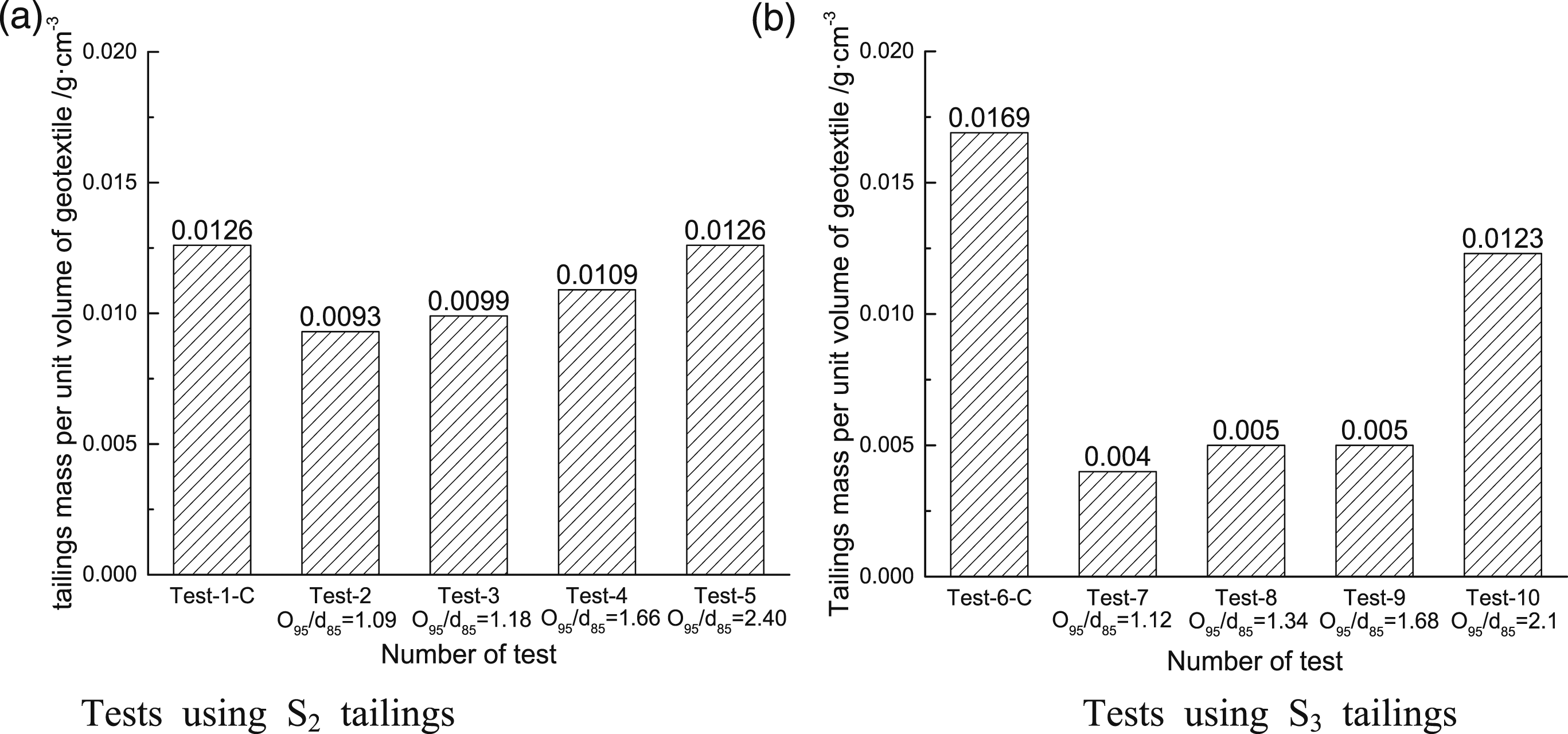
where: μ is the tailings mass per unit volume of geotextile (g/cm³), m 0 is the mass of geotextile before test (g), m 1 is the mass of geotextile after drying (g), A is the area of geotextile (cm2), δ is the thickness of geotextile (cm).
When there was no woven geotextile, the
After the test, the geotextile was taken out to observe the distribution of tailings on its surface (see Figure 8). There were only nonwoven geotextiles in Test-1-C and Test-6-C. After the test, a large amount of tailings were attached to the surface of the nonwoven geotextile in Test-1-C and Test-6-C, as shown in Figure 8(a). The woven-nonwoven geotextile of composite filter after the test in Test-4 are shown in Figure 8(b) and (c) respectively. Most of the openings of woven geotextiles were not blocked by tailings, and the tailings on the surface of nonwoven geotextiles were also greatly reduced. Adding a layer of woven geotextile with reasonable aperture reduced the clogging of nonwoven geotextile. Clogging morphology of geotextiles after test. (a) Nonwoven geotextile (b) Woven geotextile of composite geotextile (c) Nonwoven geotextile of composite geotextile.
Long-term test
To understand the long-term filtration characteristics of composite filter in tailings ponds, two sets of long-term tests (Test-11-L and Test-12-L) were carried out. S1 tailings was used in Test-11-L and Test-12-L, and the filling dry density was 2.10 g/cm³. The test lasted for 10 days under the hydraulic gradient of 12.5.
There was only a layer of nonwoven geotextile in Test-11-L, which was used as a control group. There were a layer of 60-mesh woven geotextile and a layer of nonwoven geotextile in Test-12-L. The variations of GR values of Test-11-L and Test-12-L with time are shown in Figure 9. It is found that the GR value of composite filter in Test-12-L was obviously less than that of nonwoven geotextile filter in Test-11-L. The added woven geotextile reduced the clogging of nonwoven geotextile. The GR value of composite filter in Test-12-L changed little over time, and the GR25 was maintained at about 1. For the Test-11-L which only had nonwoven geotextile filter, the GR value of the system was stable in the early stage of the test. However, after a period of time, the GR value of Test-11-L began to increase gradually, indicating that the nonwoven geotextile was clogged to a certain extent. In the process of long-term use, the anti-physical clogging performance of composite filter of geotextile was better than that of nonwoven geotextile filter. Variation of gradient ratio value of Test-11-L and Test-12-L over time.
The variation of flow rate of Test-11-L and Test-12-L over time are plotted in Figure 10. Due to the clogging of tailings and geotextiles, the flow rate of both tests decreased with time gradually. Before 144 h, the flow rate of the composite filter in Test-12-L was greater than that of the nonwoven geotextile filter in Test-11-L, and the gap between the two decreased gradually with time. After 144 h, the flow rates of the two tests were basically the same. In the early stage of the test, the drainage capacity of the composite filter of geotextile was better than that of the nonwoven geotextile filter. It was difficult to determine the effects of tailings and geotextiles on the reduction of flow rate separately based on the current GR apparatus. It is recommended to place a piezometric tube on the surface of geotextile in the future test. Variation of flow rate of Test-11-L and Test-12-L over time.
Filtration mechanism of composite filter of geotextile
In this section, the filtration mechanism of composite filter of woven-nonwoven geotextile is analyzed. Based on the test results, it is found that adding a layer of woven geotextile with reasonable woven pores reduced physical clogging of the nonwoven geotextile. However, when the pore size of the woven geotextile was too large or too small, it could not reduce the clogging of the nonwoven geotextile. The aperture of woven geotextile had an important influence on the filtration performance of composite filter.
Soil particles would migrate to the nonwoven geotextile under the action of water flow and deposit on the surface and inside of the nonwoven geotextile, blocking the upstream end of the fabric pores and reducing the effective opening area. A thin layer of tailings with low permeability, known as “filter cake”, is easy to form on the surface of nonwoven geotextile over time, resulting in the clogging of nonwoven geotextile. This phenomenon has been confirmed in literature.30,31 After adding a layer of woven geotextile with reasonable aperture on the surface of nonwoven geotextile, a part of fine tailings passed through the woven-nonwoven geotextile. Under the joint catalysis of the woven geotextile and nonwoven geotextile, the coarser tailings particles formed a stable filter structure on the surface of woven geotextile, which had a good long-term filtration effect, as shown in Figure 11(a). According to the previous test results, the ratio of the equivalent pores of the woven geotextile (O95) to the characteristic particle diameter of tailings (d85) was about 1.6. However, the retention criteria cannot be met when the woven geotextile was used alone with such aperture. Schematic diagram of filtration mechanism of composite filter of geotextile. (a) Aperture of woven geotextile is reasonable. (b) Aperture of woven geotextile is too small. (c) Aperture of woven geotextile is too large.
If the aperture of the woven geotextile was too small, a large number of tailings particles would be blocked at the surface of the woven geotextile, forming a thin layer of tailings with low permeability. As a result, the effective area to pass water of the woven geotextile was reduced, and the composite filter of geotextile was clogged, as shown in Figure 11(b). Therefore, the aperture of woven geotextile filter of the composite filter should not be too small, otherwise it would aggravate the physical clogging of the composite filter. With the increase of the aperture of the woven geotextile, its capability of soil retention gradually weakened. When the aperture of woven geotextile increased to a certain extent, the woven geotextile could not block the upper tailings and completely lost soil retention capacity. The tailings particles migrated freely to the surface and interior of the nonwoven geotextile, leading to clogging of the composite geotextile (see Figure 11(c)). These findings are consistent with the study of Aydlek and Edil, 21 in which the GR value of the system increased with the decrease of the aperture of woven geotextiles. On the other hand, with the increase of the aperture of woven geotextiles, the piping rate of fine particles increased.
Discussions
It is found that the aperture of woven geotextile had an important influence on the filtration characteristics of composite filter. Based on the experimental results, the selection of the woven geotextile with reasonable aperture in the composite filter is discussed below. When the O95/d85 was around 1.1, the mass of the nonwoven geotextile after the test increased little, but the GR value of the system did not decrease significantly. The tailings were blocked on the surface of the woven geotextile. When the O95/d85 varied in the range of 1.0–1.6, the GR value of the system gradually decreased with the increase of aperture of the woven geotextile.
When the O95/d85 was around 1.6, the mass of nonwoven geotextile only increased slightly after the test. The woven geotextile blocked most of the tailings, and only a small part of fine tailings passed through the woven geotextile into the nonwoven geotextile, which did not cause obvious clogging of the nonwoven geotextile. In this case, the GR value of the system was the smallest, and the drainage capacity of the composite filter was also improved, showing that the composite filter achieved a good filtration performance.
With the continuous increase of the aperture of woven geotextile, when O95/d85 was greater than 2.0, the woven geotextile could not effectively prevent tailings from entering the nonwoven geotextile. After the test, there was a large amount of tailings on the surface of nonwoven geotextile, and the GR value of the system was basically the same with that when there was no woven geotextile, indicating that the nonwoven geotextile was clogged to a certain degree. In conclusion, to keep good retention capacity, water permeability and long-term anti-clogging capacity of the composite filter in engineering application, the ratio of O95 of woven geotextile to d85 of tailings should be around 1.6 when the tailings is in a relatively dense state.
Experimental scheme of filtration characteristics for composite filters.

Conclusions
In this paper, the filtration characteristics of the composite filter of woven-nonwoven geotextile in tailings ponds were studied through gradient ratio experiments, and the following conclusions were obtained:
After adding a layer of woven geotextile with reasonable aperture on the upper layer of nonwoven geotextile filter, the gradient ratio value of composite filter decreased and remained stable. At the same time, the flow rate of composite filter increased significantly, and less tailings particles were clogged in nonwoven geotextile. The filtration performance of composite filter of woven-nonwoven geotextile was better than that of nonwoven geotextile filter.
The aperture of woven geotextile had an important influence on the filtration characteristics of the composite filter. With the increase of the aperture of woven geotextile, the gradient ratio value of the composite filter first decreased and then increased. In engineering applications, for relatively dense tailings, the recommended ratio of the equivalent aperture of woven geotextile (O95) to the characteristic particle diameter of tailings (d85) is about 1.6.
In the long-term test, the gradient ratio value of composite filter remained stable, however, the gradient ratio value of nonwoven geotextile filter gradually increased in the later stage of the test. Under the joint catalysis of the nonwoven geotextile and woven geotextile, the coarser tailings particles formed a stable filter structure on the surface of woven geotextile with reasonable aperture, which had a good long-term filtration effect.
Footnotes
Declaration of conflicting interests
The author(s) declared no potential conflicts of interest with respect to the research, authorship, and/or publication of this article.
Funding
The author(s) disclosed receipt of the following financial support for the research, authorship, and/or publication of this article: The authors would like to acknowledge the National Natural Science Foundation of China under Grant No. 52179100, Grant No. U2240210 and Jiangsu Water Science and Technology Project under Grant No. 2021075.
