




Abstract
Innovative geotextiles built from meandrically arranged thick ropes were produced. For the production of the geotextiles, the strips of woollen nonwoven were used. The segments of the geotextiles were installed on the bank of a drainage ditch. The behaviour of the geotextiles during 1 year was observed. It was demonstrated that the geotextiles installed in the ditch provide immediate protection of the bank. In the soil-covered wool, the process of slow biodegradation was initiated. Because of a low biodegradation rate at the end of the growing season, when the protective vegetation was not well developed, the geotextiles maintained their protective potential. In the following months, the biodegradation led to further destruction of wool fibres. During the biodegradation, the organic compounds rich in nitrogen were released into the soil. In spring, at the beginning of new growing season, the compounds acted as effective fertilizers, promoting the growth of protective vegetation. The vegetation growing on the bank provided an effective protection and took over the protective function of the geotextiles.
Introduction
For many centuries, wool has been highly valued and used for the production of high quality apparel fabrics, carpets and other interior textiles. At the end of the 20th century, the interest in wool products significantly decreased. Due to the low demand and lack of interest in wool, in Poland and other European countries, sheep farming oriented on wool production became unprofitable. Paradoxically, the costs of sheep shearing exceeded the value for the fleece, and thus, sheep farming was reoriented to milk and meat production. Simultaneously, due to the lack of selection of sheep according to the wool properties, the fibre quality had dramatically decreased and wool was no longer suitable for the textile industry. As a result, wool became a secondary and troublesome by-product of sheep breeding. In many cases, wool shorn from sheep was treated as waste material, which was buried in the soil or burned. Improper disposal of wool created ecological issues and contributed significantly to soil and air pollution [1].
In order to provide an application for low quality fibres, some alternative wool products have been invented. The most popular are thermal and acoustic insulation materials used in the construction industry for the insulation of pitched roofs, walls and ceilings [2,3]. These insulation materials exploit the natural ability of wool to regulate temperature, as well as its other valuable attributes: hydrophobic and hydrophilic characteristics, fire resistance and thermal performance. Unlike mineral wool, natural wool insulation does not cause skin, eyes and respiratory tract irritation, and can be installed without special protective clothing. On the market, one can find soft mats made of 100% sheep wool and semi-rigid panels made of sheep wool (70–80%) with polyester fibres (20–30%) [4]. In some cases, for the production of panels, polyester fibres recycled from post-consumer plastic bottles are used [5].
The second group of valuable wool products includes geomats designed for the protection of grass and wild-flower seeds sown into the ground [6]. The cover mats create a proper microclimate for seed germination. Later, during exploitation, the mats ensure the minimal water evaporation and provide an excellent thermal protection. Through gradual degradation, the mats release organic compounds, which serve as nutrients needed for further plant growth. The mats have some special applications – they are used in places, such as tennis courts, river banks or park areas, where rapid growth of plants is required [7].
A few years ago, some attempts were undertaken to use wool for the production of innovative geotextiles designed for the reclamation of degraded areas and the protection of the soil against erosion. Such geotextiles can serve as an additional alternative for coarse wool products. Moreover, for the production of the geotextiles, waste strips of other products can be applied.
Innovative geotextiles built from meandrically arranged thick ropes manufactured by Kemafil technology were invented in Germany few years ago [8]. The geotextiles were used to strengthen a steep slope in the lignite post-mining area in Restloch Zechau (Thuringia, Germany). Later, similar geotextiles were applied for the protection of the slope at the road construction in Chemnitz (Saxony, Germany) [9].
In the abovementioned places, the geotextiles produced from non-biodegradable materials, mostly synthetic polyester fibres, were applied.
In our investigations, geotextiles made from recycled fibres and wool nonwoven were used. The geotextiles were applied in the gravel pit for the stabilisation of the steep slope prone to land sliding and for the protection of ditches in the clay ground [10–12].
It was revealed that the geotextiles fulfil their protective role immediately after their installation. In the roadside ditch, the geotextiles formed a system of transversal micro-dams, which slowed down the stream of water flowing along the ditch. After the rain, the geotextiles absorbed water and retained it in the space between the neighbouring ropes. The geotextiles installed on the bank of the drainage ditch prevented the soil from slipping and prevented the soil particles from washing away.
In the previously published articles, the details regarding installation of the geotextiles in the ditches were presented. Additionally, the behaviour of the roadside and drainage ditches during half a year after the geotextiles installation and until the end of the vegetation season were described.
In winter and following spring, the monitoring of the ditches was continued. The effectiveness of the geotextiles in the erosion protection of the steep bank in the drainage ditch was evaluated for 1 year. The influence of the geotextiles on the condition of the bank was analysed in connection with the behaviour of wool geotextiles in the soil. The results of the investigations, focused on wool geotextiles and the long exploitation period, are presented in this article.
Materials
In the investigations, the wool geotextiles were applied. For the production of the geotextiles, scoured Polish Mountain Sheep wool with fibre diameter between 25 and 32 µm and the length between 8 and 13 cm was used. At the beginning, the wool needle-punched nonwoven was obtained. The nonwoven was manufactured in industrial conditions by Amanda, Bielsko-Biala (Poland). The nonwoven was produced by interlocking wool carded web with punching density of 70 cm−2. Punching was performed by means of the one-side needling machine operated from above. The strips of the nonwoven, with the thickness of 5.8 mm and mass of 406 g/m2, were used for the production of thick ropes with the diameter of 12 cm. The ropes were covered by the sheath formed from the cotton twine with linear density of 230 dtex (Figure 1). Then, the segments of geotextiles with the width of 1.8 m, formed from the meandrically arranged ropes were obtained (Figure 2). To stabilise the segments, the subsequent turns of ropes were connected with five linking chains. The links were made from the polypropylene three-strand twine with linear density of 310 dtex.
The rope used for the preparation of the geotextile segments. The segment of the geotextiles built from meandrically arranged ropes.

The segments of the geotextiles were installed on the steep and high bank of the drainage ditch exposed to the intense surface erosion caused by the water flowing on the surface of the inclined slope (Figure 3). The geotextiles were installed in May 2015, at the beginning of the growing season. After 6 and 12 months, from randomly selected locations, the samples of geotextiles were taken for laboratory tests. The samples were dried at room temperature and then mechanically cleaned from the soil particles.
The bank of the drainage ditch: (a) surface erosive channels and (b) installation of the geotextiles.
Methods
During the investigations, the condition of the ditch bank surface and the development of the vegetation were monitored. Mechanical properties of the nonwoven forming the geotextiles, fibres morphology and their chemical structure were then investigated.
For the nonwoven, before installation as well as after 6 and 12 months of the exploitation in the soil, the tensile strength, elongation at break, static and dynamic puncture resistance were measured. The tensile strength and elongation at break were measured along and across the nonwoven, by means of the KS50 Hounsfield tensile machine equipped with the wide jaws, in accordance with the Polish standard PN-EN ISO 10319:2010 [13]. The static puncture resistance was determined by CBR test, in accordance with the Polish standard PN-EN ISO 12236:2006 [14]. The dynamic puncture resistance was measured by cone drop test, in accordance with the Polish standard PN-EN ISO 13433:2006 [15].
For fibres used for the production of the geotextiles, before installation as well as after 6 and 12 months of exploitation in the ditch, morphology and chemical structure were analysed. The morphology of the wool fibres was studied by means of scanning electron microscope JEOL JSM 5500 LV. The microscope was operated in backscattered electron mode. The observed fibres were sputtered with gold in JEOL JFC 1200 ionic sputter.
The chemical composition of wool was analysed by Fourier Transform Infrared Spectroscopy (FTIR). For the investigations, the FTIR spectrometer Nicolet 6700 was used. The measurements were performed for tablets formed from the pieces of fibres with the length of 1–3 mm blended with powdered sodium chlorine NaCl. The tablets were placed in a measuring chamber of the spectrometer equipped with a mirror beam collimator. The spectra were registered in the range from 400 to 4000 cm−1 and then smoothed with the OMNIC software. To allow the comparison of changes in band, intensities caused by biodegradation, the FTIR spectra were normalized against the peak intensity. For the normalization, the band at 1451 cm−1 corresponding to CH2 group was chosen.
Results
Monitoring the ditch bank
In the first period of exploitation, the settlement of the soil covering the geotextiles was observed. The geotextiles prevented the soil particles from washing away. During the entire vegetation season, until November 2015, there were no visible erosive damages on the surface of the ditch. Simultaneously, no land sliding of the bank was observed (Figure 4).
The bank protected with the geotextiles: (a) late autumn and (b) winter.
In first year, rare, spontaneously self-sawn plants appeared on the bank surface. Then, after exceptionally – as for the Polish climate – mild winter with only slight frost and minimum snowfall, at the beginning of the new growing season, on the surface of the bank, the spontaneous growth of self-sawn plants was initiated. In the place protected with wool geotextiles, the plant growth was very intensive. In May 2016, 1 year after the geotextiles installation, the place was covered with more than 0.5 m high mixture of grasses and various herbaceous plants (Figure 5(a)). The dense cover was in sharp contrast to the section protected with the geotextiles made of recycled fibres as well as to the unsecured parts of the ditch, where only sparse, miserable plants were visible (Figure 5(b)). The plants that are grown on the wool geotextiles had an intense dark green colour, much darker in comparison to the plants that appeared in other parts of the bank. The high density and the dark green colour of the plants indicated that they were very well nourished.
Fresh vegetation on the bank in new growing season in spring: (a) the part protected with the woollen geotextiles and (b) the non-protected part.
The geotextiles exploited in the ditch
Six and twelve months after the installation of the geotextiles in the ditch, in some places, the buried geotextiles were exposed. It was observed that the polypropylene links connecting the subsequent turns of the geotextiles kept their properties and together with steel pins held the geotextiles in the right position. Simultaneously, it was revealed that after 6 months, the cotton twine forming the sheath of the ropes was strongly degraded and its remnants could be easily hand-torn. The sheath lost its ability to protect the integrity of the ropes and ensure their proper mechanical strength. At the same time, the wool ropes maintained the mechanical integrity and no visible signs of their damage were observed.
In May 2016, 1 year after installation of the geotextiles, the serious damage of the ropes made from the wool nonwoven was revealed. There were plenty gnawing holes, discolorations and numerous signs of rotting visible in the ropes. The ropes could be easily torn with hands. In some places of the bank, only some rotten remnants of the nonwoven were found.
Mechanical parameters
The tenacity and elongation at break of woollen nonwoven.
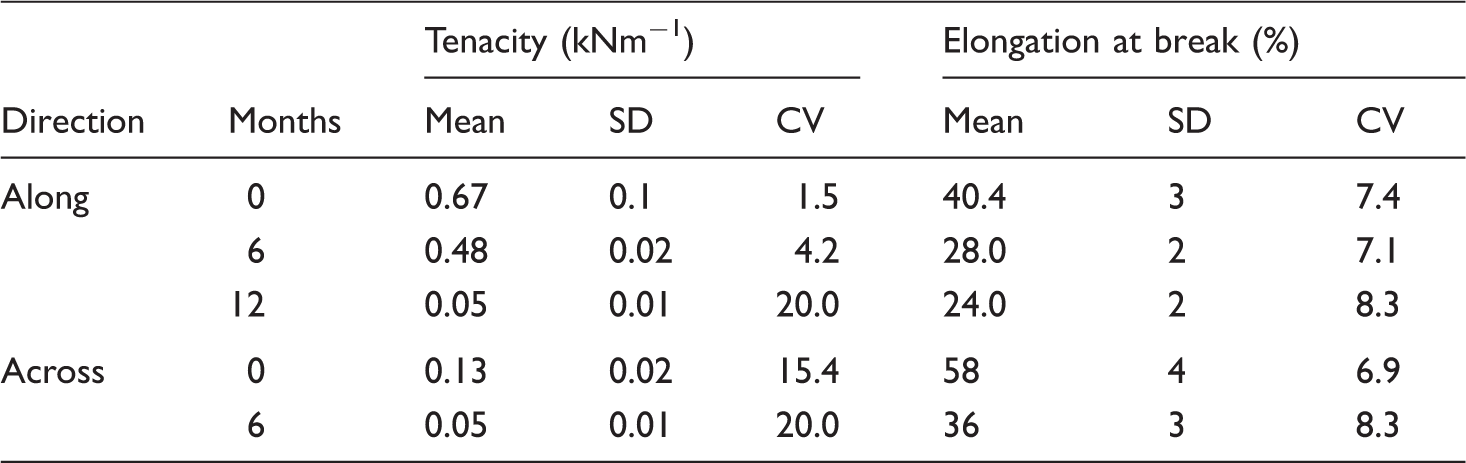
SD: standard deviation; CD: coefficient of variation.
The puncture resistance of woollen nonwoven.

SD: standard deviation; CD: coefficient of variation.
The fibre morphology
On the surface of the wool fibres, the outer cuticle layer forms characteristic scales. In the fibres taken from the nonwoven before installation in the ditch, the scales exhibited even, undamaged and smooth surface (Figure 6(a)). The successive scales overlapped and possessed sharp edges, which were firmly adhered to the fibres surface.
The surface morphology of the wool fibres: (a) the scales on the fibre surface before installation in the ditch and (b) the fibres surface after 6 months (magnification ×1000).
In fibres after 6 months of the exploitation in the ditch, the outer cuticle layer was heavily damaged. The surface of the scales was expelled and the scales edges were completely eroded (Figure 6(b)). With the significant damage of the cuticle, no signs of the destruction of the deeper lying cortical cells were visible.
In certain fibres after 6 months of exploitation, mechanical damages in the form of transverse fractures or longitudinal cracks were observed (Figure 7). The mechanical damage of the fibres resulted in the partial tear of the outer cuticle, what enabled quick enzymatic penetration. This, in turn, resulted in the rapid fibrillization of the fibres.
The structural damages of the fibres after 6 months: (a) the transverse fracture and (b) the longitudinal crack (magnification ×750 and ×1000).
As for the fibres taken out after 12 months, the surface of all the fibres was colonized by numerous microorganisms (Figure 8(a)). Large colonies of microorganisms, which formed a thick layer in certain places, covered almost the whole fibre surface. After 12 months from the installation in the ditch, the outer cuticle layer forming the scales was completely destroyed by acting enzymes. The scales were no longer visible and, in many places, the inner fibrillar structure of the core was exposed. Almost all fibres were heavily biologically damaged. In the fibres, many deep and widespread gnawed cavities were observed (Figure 8(b)).
The fibres morphology after 12 months: (a) fibres surface colonised by microorganisms and (b) the gnawing cavities (magnification ×2000 and ×1000).
FTIR spectroscopy
The FTIR spectra of the wool reveal several typical bands assigned to the peptide bonds of wool keratin (Figure 9). On the spectra obtained for the fibres before installation in the ditch, the amide A and the amide B bands were observed at 3300 cm−1 and 3074 cm−1, respectively. The next characteristic bands – namely, the amide I, II and III bands – occurred at 1656 cm−1, 1536 cm−1 and 1239 cm−1, respectively [16].
The FTIR spectra of wool fibres.
In the fibres taken from the ditch after 6 and 12 months, the position of the amide bands did not change. At the same peak position, a major decrease in the peaks intensity was observed. The significant reduction of the amide bands intensity was visible already in the fibres taken from the ditch after 6 months. As for the fibres taken after 12 months, further slight decrease of the intensity was detected.
The decrease of the amide bands intensity was connected with the breakdown of the peptide bonds in the wool keratin. The spectra show that the breakdown of the peptide bonds occurred already after 6 months of exploitation in the ditch.
Besides amide bands corresponding to keratin peptide bonds on the spectra, other characteristic bands were visible. These bands occurred in sulphoxide region located between 1000 and 1400 cm−1.
In raw nonwoven, at 1073 cm−1, the weak band corresponding to S–O bond of the cysteic acid was visible. For the fibres taken from the ditch after 6 and 12 months, the intensity of this peak considerably increased. The change of the peak intensity was connected with the increase of the cysteic acid content, which was an evidence of the cleavage of the disulphide bonds of cystine.
Discussion
The geotextiles begun to protect the bank of the drainage ditch against erosion immediately after the installation. Then, during several months of exploitation, no erosive grooves on the surface of the bank were formed and no land sliding was recorded.
During exploitation in a moist environment of the soil, the wool fibres were exposed to microorganisms that gradually digested the wool keratin [17,18]. At the beginning, the disintegration of keratin in the outer cuticle was initiated, leading subsequently to the destruction of scales on the fibres surface. The entire destruction of the scales was observed 6 months after the installation in the ditch. At this time, the significant decrease of the mechanical parameters of the nonwoven was also detected. Despite the significant reduction of the tensile strength, the geotextiles maintained their protective potential and protected the bank of the ditch well.
In the following months, on the surface of the fibres covered with the layer of soil – under conditions of oxygen deficiency – the intense growth of microorganisms was observed. During the mild winter and the early spring, the microorganisms quickly multiplied and formed widespread colonies on the fibres surface. The numerous microorganisms secreted next portions of proteolytic enzymes and continued the digestion of wool keratin. After cuticle disintegration, the enzymes penetrated the interior of the fibres and caused disruption of the deeper layers of cortical cells. As a result, deep and widespread gnawing cavities were formed in the fibres. The destruction of fibres structure was followed by the drastic reduction of the nonwoven mechanical parameters.
At the second stage of the biodegradation, the enzymes secreted by microorganisms caused the disruption of peptide bonds inside the keratin chains. By the breakdown of the peptide chains, the insoluble keratin was degraded into soluble peptides and particular amino acids. This way, during the wool biodegradation, different nitrogen-rich compounds were released into the soil.
Due to the high nitrogen content in the wool, which varied between 15 and 21%, the amount of nitrogen compounds released into the soil was pretty high [19]. The compounds accelerated the growth of the plants and acted as effective fertilizer [20–23]. In the spring, they served as an abundant source of nutrients, and enabled the intense growth of grass and other plants on the bank. In the following weeks, due to further wool biodegradation, the next portions of organic compounds were being slowly released. This way, the woollen geotextiles acted as a slowly released fertilizer, which systematically supported the growth of the protective plants. Moreover, the compounds from the degraded wool released into to the soil served as additives, what enhanced soil microbiological activity and improved its characteristic.
One year after the exploitation in the ditch, due to the biodegradation, the wool geotextiles were disintegrated. At that time, the plants growing on the ditch bank took over the protective function of the geotextiles. The canopy elements and plant stems reduced the runoff velocity of the stream flowing along the bank. By reducing the kinetic energy of rain drops and their detachment capacity, the canopy of plants protected the bank surface from the raindrops impact. At the same time, plant roots facilitated the infiltration of water, increased cohesion and shear strength of the soil and reduced its erodibility. As the protective vegetation ensured effective protection of the bank, the use of geotextiles was no longer necessary.
Conclusions
Wool can be used as the production material of valuable products applicable for the protection of soil against erosion. The geotextiles produced from meandrically arranged thick wool ropes ensured immediate protection of the ditch banks exposed to erosive action and local sliding. Due to the slow biodegradation of the wool, the geotextiles maintained their protective potential during one growing season. After the winter, as a result of destructive microorganism activity, the geotextiles lost their protective potential. At that moment, the nitrogen-rich organic compounds, released into the soil through wool biodegradation, acted as effective fertilizers, promoting the growth of protective vegetation. Then, the vegetation growing on the bank provided effective protection and took over the protective function of the geotextiles.
Footnotes
Declaration of Conflicting Interests
The author(s) declared no potential conflicts of interest with respect to the research, authorship, and/or publication of this article.
Funding
The author(s) disclosed receipt of the following financial support for the research, authorship, and/or publication of this article: The authors gratefully acknowledge the funding by ERANET-CORNET consortium under international research project PROGEO ‘Sustainable erosion protection by geotextiles made of renewable resources including innovative manufacturing and installation technology’, DZP/CORNET-16/628/2014.