




Abstract
The primary objective of this research work is to study the effect of surface treated coir geotextiles on the bearing behaviour of sand overlying clay model with geotextiles at the interface. Two woven and two non woven coir geotextiles were treated with bitumen emulsion and unsaturated polyester resin. The surface morphology and thermal stability were investigated by scanning electron micrograph and simultaneous thermal analyser respectively. The bearing ratio of sand overlying clay increased with treated woven/non woven coir geotextiles at the interface in soaked and unsoaked condition. The bearing ratio was higher for treated/untreated and woven/non woven coir geotextiles at the interface in unsoaked condition as compared to soaked condition. The chemical treatment improved the thermal stability of surface treated coir geotextiles through physical and chemical changes.
Introduction
The rural population of the world is growing and will continue to grow in future years, as evidenced by the increased rural infrastructure. Even if the population remains constant, as the level of living standard advances, people will desire to have higher-quality roads and socioeconomic development in their rural areas. Now, to uplift the living standards of people who are residing in rural areas, it is very important to develop and improvise the conditions of the rural roads, which is one of the most important solutions to raise the socioeconomic condition of any country throughout the world. Rapid peri-urbanisation as well as the rise in commercial transactions, has resulted in an expansion of the road network. Heretofore, various industries opted to leave low bearing capacity land for the expansion of the road network and established the road along an alternate route, where bearing capacity is adequate. But presently, due to an increase in population, no choice of land is left and it is mandatory to construct structures on the soil having low bearing capacity for the socioeconomic growth of the country. Engineers for rural road construction are facing variety of challenges, mainly due to low bearing capacity of subgrade soil, undesirable settlement, and high compressibility. 1 The intermixing of fine-grained soil with the base aggregate layer destroys the structural strength of unpaved roads constructed on soil having low bearing capacity, according to most investigations. 2 Geosynthetics have been used for many years to reinforce the weak subgrade soil, thereby improving its structural strength. 3
Presently, the use of geosynthetic materials is avoided by researchers due to its high cost and threat to the environment. As a result, the focus has now shifted towards sustainable growth by using various natural reinforced materials. Taking into consideration, the sustainable development of the country, natural fiber geotextiles are in use as reinforcement to stabilize unpaved roads, since it is a cost-effective, simple, and long-term solution to this problem. Coir is one of those natural fibers which are used as reinforcement to improve the functional and structural performance of unpaved roads.2,4 Natural fibers (coir, jute, sisal, banana fiber, etc.) have a lot of potential but they also possess some drawbacks such as high moisture absorption, degradability and the presence of impurities on the fiber’s surface, which negatively affects its potential application.5–8 Coir fiber also exhibits some disadvantages, such as hydrophobicity, the presence of voids and cracks on the fiber surface which accelerates its degradation rate9,10 and also results in a weak bond formation between fiber and matrix leading to reduced geotextile-soil interaction. 11 The above mentioned disadvantages of coir geotextiles have limited its potential of increasing the load bearing capacity of unpaved roads. 12 As a result, the surface modification of coir geotextiles by chemical treatment has become necessary in order to improve the performance of unpaved roads reinforced with treated coir geotextiles. The present study focuses on the chemical treatment of woven and non woven coir geotextiles and analysing the effect of using treated coir geotextiles as reinforcement on load bearing capacity of two layered pavement model of sand overlying clay.
Literature review
Various studies in the literature13–15 have reported the benefits of including natural fiber geotextiles in unpaved roads, such as improved load-bearing capacity, reduction in the base course thickness, and delayed rutting process. Coir is one such ligno cellulosic natural fiber which has been used as reinforcement for soil stabilization for many years in the form of fibers,2,4,12,16 braided ropes, hand-knotted coir nets, 17 and woven and non-woven geotextiles.14,18–20 Various studies on coir geotextiles have reported the decrease in tensile strength of coir geotextile over time due to its degradable nature. The tensile strength of woven/non woven coir geotextiles kept at the interface of sand and silty sand has been reported to decrease by nearly 8%–12% after 6 months, when kept in controlled condition at a temperature of 40° ± 1°C and humidity of 85 ± 3%. 21 The rate of degradation of coir geotextiles further gets accelerated under different climatic conditions such as the presence of solar radiation, heat, wetting and moisture. In order to overcome the above-mentioned disadvantages of coir fibers, the chemical treatment of coir fiber/yarn/geotextile has become necessary. 22 Various researchers reported that the chemical treatment of coir fiber using alkali and silane,5,23 potassium permanganate, 21 air and oxygen plasma, 11 UV ageing, grafting with acrylate monomer using UV radiation, 7 graft copolymerization of methyl methacrylate, 9 transesterification with butyl acrylate/methyl acrylate, ferric hydroxide, and aluminum hydroxide nanoparticles 24 improved the physicomechanical properties of coir fibers. Chemical treatment of coir yarns by using cashew nut shell liquid 10 and chemical treatment of coir fiber geotextiles with kerosene, 25 p-aminophenol, sodium periodates, and sodium hydroxide 26 has also been reported in the literature which improved the physicomechanical properties of coir geotextiles. Studies conducted on chemical treatment of coir geotextiles also reported that the use of treated coir geotextiles as reinforcement in unpaved roads resulted in increased bearing capacity and uniform load distribution. 27 As per 17 the optimum benefits of coir geotextile reinforcement were obtained by placing it at the depth of 0.2 times the height of california bearing ratio test specimen. As per the aforementioned literature, various researchers have treated the coir geotextiles. However very few of them assessed the bearing capacity of unpaved roads with treated coir geotextiles. Also, no study in the literature has reported the chemical treatment of coir geotextiles by using unsaturated polyester resin, bitumen emulsion, styrene monomer, and methyl ethyl ketone peroxide, and the effectiveness of using treated coir geotextiles in improving the load bearing capacity of two layered pavement model of sand overlying soft clay. Therefore, the present investigation has been done to bridge the required research gap. The influence of untreated/treated coir geotextiles on the load-bearing capacity of sand overlying soft clay is investigated in this study.
Materials used and experimental procedure
The Engineering properties of bentonite clay.

The Engineering properties of sand.

Physical properties of woven and non woven coir geotextiles.

Mechanical properties of woven and non woven coir geotextiles.

The mass per unit area of all four types of geotextiles and polypropylene net and crimp % of warp and weft yarns present in woven coir geotextiles were determined in accordance to 28 and 29 respectively.
The linear density and tensile strength of warp yarns of Type W1 coir geotextiles were 4837 tex and 1.07gf/tex and of Type W2 coir geotextiles were 7274 tex and 1.24 gf/tex respectively, whereas the linear density and tensile strength of weft yarns of Type W1 coir geotextiles were 3667 tex and 0.93 gf/tex and of Type W2 coir geotextiles were 6239 tex and 1.01 gf/tex respectively.
The linear density and tensile strength of coir yarn of Type W1 and Type W2 coir geotextiles were determined in accordance with30,31 respectively. The bulk density of non woven coir geotextiles is determined as per study conducted by.
32
The wide width tensile strength test was conducted for untreated/treated coir geotextiles, in Universal Testing Machine as per.
33
The surface modification of coir geotextiles was carried out by unsaturated polyester resin, bitumen emulsion, styrene monomer, and methyl ethyl ketone peroxide as shown in Figure 1. Styrene monomer was added to the solution to solublise unsaturated polyester resin and aids the cross linking process of curing of unsaturated polyester resin and bitumen emulsion. In order to cure the unsaturated polyester resin at room temperature, methyl ethyl ketone peroxide (1.8%) was used as a catalyst to initiate the cross linking process. Block flow diagram of chemical treatment of coir geotextiles.
All four types of coir geotextile samples were immersed in the solution for 10–15 min and passed through a padding machine roller to remove the excess solution. The samples were then dried at room temperature for 24 h.
The load-bearing capacity of sand overlying clay, with and without untreated/treated coir geotextiles was determined through the California bearing ratio test at a strain rate of 1.25 mm/min in accordance with. 34 The thick layer of clay (164.7 mm) underlies the layer of sand (13.3 mm), which was compacted at its optimum moisture content, by giving 56 blows of a 48.9 N rammer dropped from a height of 450 mm. The surcharge plate of 2.44 kPa was placed on the specimen before testing and the observations of load and deformation were recorded up to 12.5 mm. Five specimens for each type of coir geotextile were tested for a bearing ratio test. To determine the statistical importance of inclusion of treated woven coir geotextiles in two layered model pavement on its bearing ratio, analysis of variance (ANOVA) tests were applied at 95% confidence interval. If the p-values of results are less than 0.05, the inclusion of treated coir geotextiles will significantly affect the bearing ratio of two layered model pavement.
The surface morphology of all four types of coir geotextiles was analyzed by scanning electron microscope (SEM) to see the effect of chemical treatment on the fiber surface. The thermogravimetric analysis (TGA) test was performed on a computerized simultaneous thermal analyzer (Perkin-Elmer, STA 6000) to determine the degradation behaviour of untreated and treated coir geotextiles. The mass of 5–10 mg of each type of untreated and treated coir geotextile were sealed in the aluminum crucible and heated under nitrogen flow (20 mL/min) and analyzed over the temperature range of 0–500°C, at a constant heating rate of 10 °C/min. The weight loss as a function of temperature was analyzed through a simultaneous thermal analyzer.
Results and discussion
The bearing ratio tests were carried out on two layered pavement model with untreated and treated woven/non woven coir geotextiles at the interface in unsoaked and soaked condition and the results are discussed below.
Bearing ratio behavior of untreated and treated woven coir geotextiles
The bearing ratio tests were carried out on unreinforced and reinforced sand overlying clay with untreated/treated woven coir geotextiles (Type W1 and W2) at the interface in unsoaked and soaked conditions. The load-deformation curves for Type W1 and W2 in unsoaked and soaked conditions are shown in Figures 2(a) - (d) and the results of the bearing ratio in unsoaked and soaked conditions are given in Table 5. The bearing ratio of unreinforced sand overlying clay in the unsoaked condition is 1.71%. It can be observed from Table 5 that the bearing ratio of sand overlying clay with untreated Type W1 and W2 woven coir geotextiles at the interface in the unsoaked condition is 4.7% and 5.6%, whereas the bearing ratio of sand overlying clay with treated Type W1 and W2 woven coir geotextiles at the interface in the unsoaked condition is 5.2% and 6.6% respectively. The inclusion of coir geotextiles increased the bearing ratio of the two layered pavement model by separating and preventing the fine-grained sand and soil from getting intermixed, thereby strengthening its structural integrity3,13 Load versus deformation curve for untreated and treated coir geotextiles in unsoaked and soaked condition (a) Untreated and treated Type W1 coir geotextiles in unsoaked condition (b) Untreated and treated Type W2 coir geotextiles in unsoaked condition (c) Untreated and treated Type W1 coir geotextiles in soaked condition (d) Untreated and treated Type W2 coir geotextiles in soaked condition. Bearing ratio of the sand overlying clay with untreated/treated woven/non-woven coir geotextiles at the interface in unsoaked/soaked conditions.

The bearing ratio of sand overlying clay increased with treated coir geotextiles at the interface as compared to untreated coir geotextiles. This is attributed to the fact that after chemical treatment, an additional layer is formed on the yarn surface of woven coir geotextiles, resulting in a lower number of voids and cracks. The presence of a higher number of voids and cracks in untreated coir geotextiles acted as a weak link and limited the bearing ratio of untreated coir geotextiles in comparison to treated coir geotextiles. The bearing ratio of two layered pavement model in unsoaked condition is 9.6% and 15% higher and in soaked condition 38% and 42% higher with treated W1 and W2 coir geotextiles at the interface respectively, in comparison to the two layered pavement model with untreated W1 and W2 coir geotextiles at the interface. Similar observations have been reported by researchers21,26,35 in their study. Also, the bearing ratio of sand overlying clay with untreated/treated Type W2 woven coir geotextiles at the interface is higher than untreated/treated Type W1 coir geotextiles at the interface. As shown in Tables 3 and 4, the tensile elongation, tensile strength, crimp value and thread density of Type W2 coir geotextiles are higher than Type W1 coir geotextiles. As a result, it will absorb the large amount of vertical stress imposed on it by undergoing deformation in the same plane.
The load deformation behaviour of sand overlying clay with untreated/treated woven coir geotextiles at the interface in unsoaked and soaked condition reveals that the bearing ratio of sand overlying clay in unsoaked condition is higher than in soaked condition. This can be attributed to the fact that on application of load, wet soil particles of soaked structure will offer less resistance to deformation whereas in unsoaked structure more resistance will be offered by dry soil particles, resulting in less deformation and a higher bearing ratio. Table 5 reveals that the p-value for bearing ratio for all four types of coir geotextiles is less than 0.05, indicating the significance of chemical treatment of woven coir geotextiles.
Bearing ratio behavior of untreated and treated non woven coir geotextiles
The load bearing capacity of unreinforced and reinforced sand overlying clay with untreated/treated non woven coir geotextiles (Type NW1 and NW2) at the interface in unsoaked and soaked conditions was determined by the bearing ratio test. The load-deformation curves for Type NW1 and NW2 in unsoaked and soaked conditions are shown in Figure 3(a–d) and the results of the bearing ratio of unsoaked and soaked conditions are given in Table 5. The bearing ratio value of unreinforced sand overlying clay in unsoaked condition is 1.71%. It can be observed from Table 5 that the bearing ratio of sand overlying clay with untreated Type NW1 and NW2 non woven coir geotextiles at the interface in unsoaked condition is 2.4% and 3.9%, whereas the bearing ratio of sand overlying clay with treated Type NW1 and NW2 non woven coir geotextiles at the interface in unsoaked condition is 3.1% and 4.7% respectively. Bearing capacity is increasing with the inclusion of treated non woven coir geotextiles at the interface of sand overlying clay. This is attributed to the fact that, after chemical treatment, the strong interaction between fibers is achieved due to the adhesive nature of unsaturated polyester resin and bitumen emulsion. Also, the filling up of intra-fiber and inter-fiber voids in non woven structure will increase the surface area of non woven coir geotextiles. The strong chemical anchoring and increased surface area will result in uniform load distribution, thereby increasing the bearing ratio of sand overlying clay reinforced with treated non woven coir geotextiles at the interface. The bearing ratio of sand overlying clay is 22% and 17% higher in unsoaked condition and 47% and 36% higher in soaked condition while using treated NW1 and NW2 coir geotextiles at the interface in comparison to the bearing ratio of sand overlying clay reinforced with untreated NW1 and NW2 coir geotextiles. Similar observations have been reported by researchers21,26 where coir geotextiles were treated with different chemicals and used as reinforcement in sand overlying clay models. Also, the bearing ratio of sand overlying clay with untreated/treated Type NW2 non woven coir geotextiles at the interface is higher than untreated/treated Type NW1 non woven coir geotextiles. This is due to the high tensile elongation, bulk density, mass per unit area of PP net as mentioned in Table 4 and the existence of fibers which are more entangled, hooked, and looped in Type NW2 as compared to Type NW1.
35
Load versus deformation curve for untreated and treated coir geotextiles in unsoaked and soaked condition (a) untreated and treated Type NW1 coir geotextiles in unsoaked condition (b) untreated and treated Type NW2 coir geotextiles in unsoaked condition (c) untreated and treated Type NW1 coir geotextiles in soaked condition (d) untreated and treated Type NW2 coir geotextiles in soaked condition. Thermogravimetric analysis of woven and non woven coir geotextiles.
It can also be observed from Table 5 that the bearing ratio of the sand overlying clay with the untreated/treated non woven coir geotextiles at the interface in unsoaked condition is higher for NW1 and NW2 coir geotextiles than the bearing ratio in soaked condition because of the reason explained in the earlier section. As observed from Table 5, the p-value for non woven coir geotextiles is less than 0.05, which indicates that the inclusion of treated non woven coir geotextiles at the interface of two layered model pavement has a significant effect on its bearing ratio.
Thermogravimetric analysis of woven and non woven coir geotextiles
The thermal behaviour of untreated and treated woven/nonwoven coir fiber geotextiles were determined by simultaneous thermal analyser (STA). The results of TGA are presented in Figure 4 and the corresponding weight loss as a function of temperature, initial degradation temperature (Tin), final degradation temperature (Tmax) and char residue content are mentioned in Table 6. It can be observed from Figure 4 that the TGA curve of all untreated and treated coir fiber geotextiles possessed two degradation steps. The first step is the initial decomposition of untreated and treated coir fibers and is attributed to the elimination of moisture content through vaporisation, as reported by various researchers.22,36–40 Thermogravmetric analysis curve of untreated and treated coir geotextiles (a) untreated and treated Type W1 (b) untreated and treated Type W2 (c) untreated and treated Type NW1 (d) untreated and treated Type NW2. Thermal properties of untreated and treated coir geotextiles.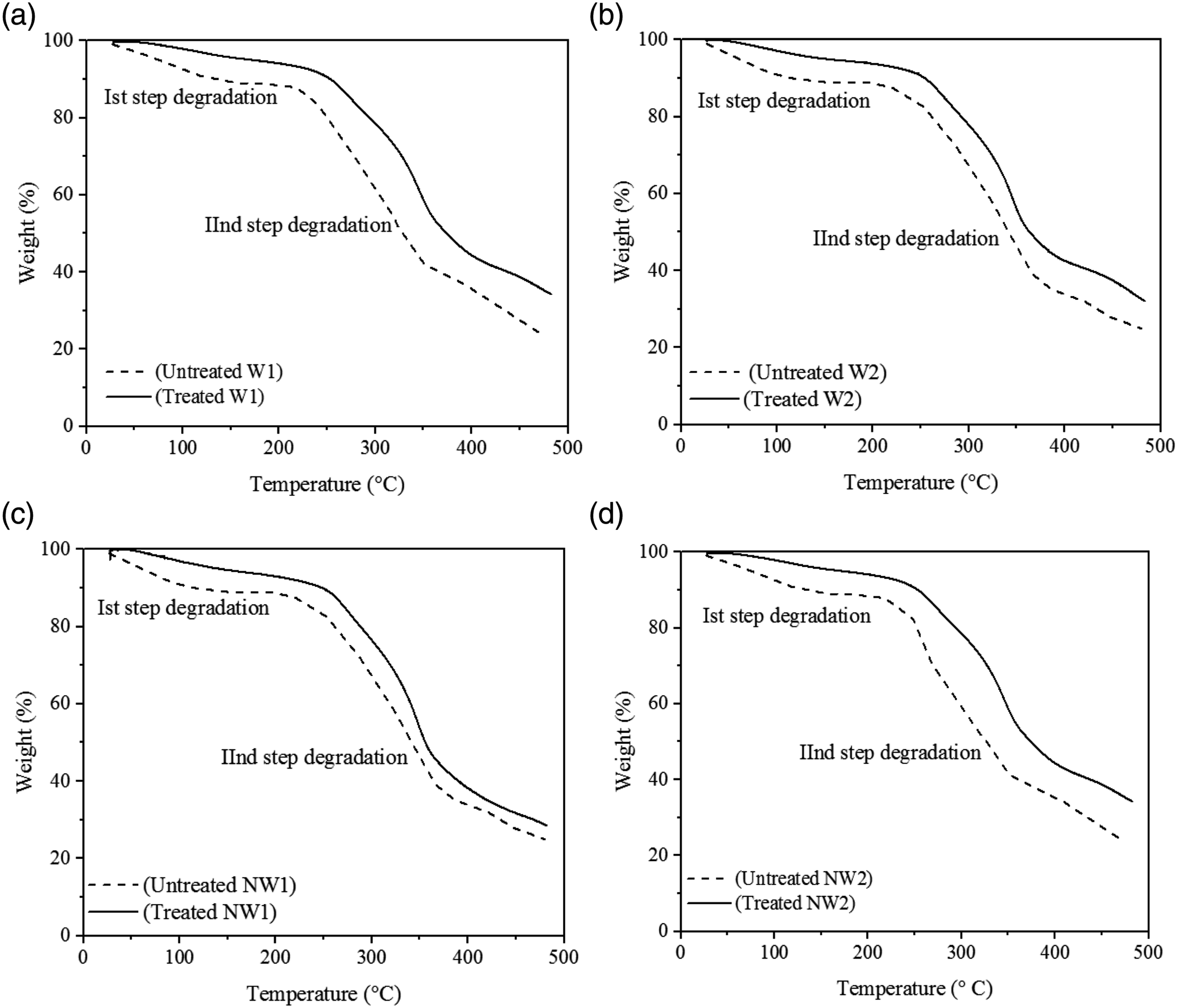
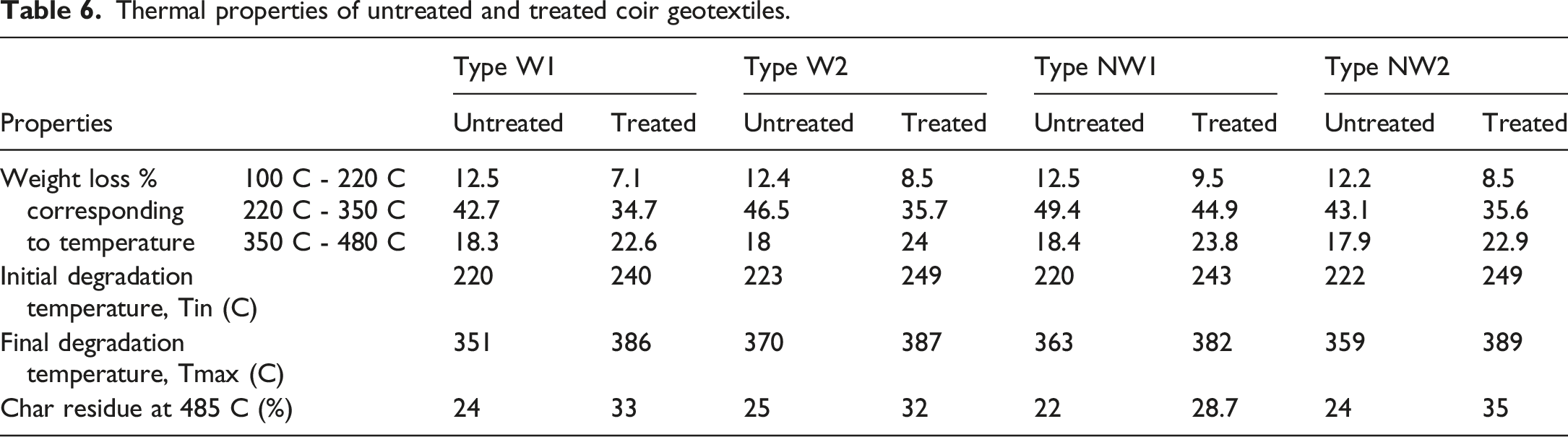
The weight loss % for treated coir fiber geotextiles is less as compared to untreated coir fiber geotextiles. This is attributed to the thermosetting behaviour of unsaturated polyester resin and the formation of a tightly bound three-dimensional network of polymer chains due to chemical cross linking.37,39,41 The second step in the TGA curve is related to the degradation of hemicellulose followed by cellulose and lignin in untreated coir fiber geotextiles. Whereas the second step of all treated coir geotextiles is a result of degradation of fiber and chain scission of the unsaturated polyester resin and bitumen emulsion. 42
It can be observed from Table 6 that the Tmax of all treated coir geotextiles is higher than untreated coir geotextiles. This is due to the strong bond between fiber and chemicals, indicating improved thermal stability of treated coir geotextiles. Table 5 also reveals that the untreated coir fiber geotextiles left the char residue in the range of 22–25%, whereas the treated coir fiber geotextiles left higher char residue in the range of 28.7–35% after degradation.
Scanning electron micrograph study
The surface morphology of all four types of coir geotextiles, Type W1, Type W2, Type NW1 and Type NW2 in untreated and treated condition were observed by scanning electron microscopy (SEM) and images are shown in Figure 5. SEM images of coir geotextiles (a) Type W1, untreated (b) Type W1, treated (c) Type W2, untreated (d) Type W2, treated (e) Type NW1, untreated (f) Type NW1, treated (g) Type NW2, untreated (h) Type NW2, treated.
The SEM images of all the untreated coir geotextiles witness the presence of voids, cracks and other impurities on the fiber surface. 35 These imperfections do not contribute positively to the load bearing capacity of the sand overlying clay model. After treatment, the surface of coir fiber is free from surface debris and the fiber is covered with a layer of unsaturated polyester resin and bitumen emulsion resulting in filling up the voids and cracks.
Economic analysis
Pavement thickness of unreinforced and untreated/treated coir geotextile reinforced structure.
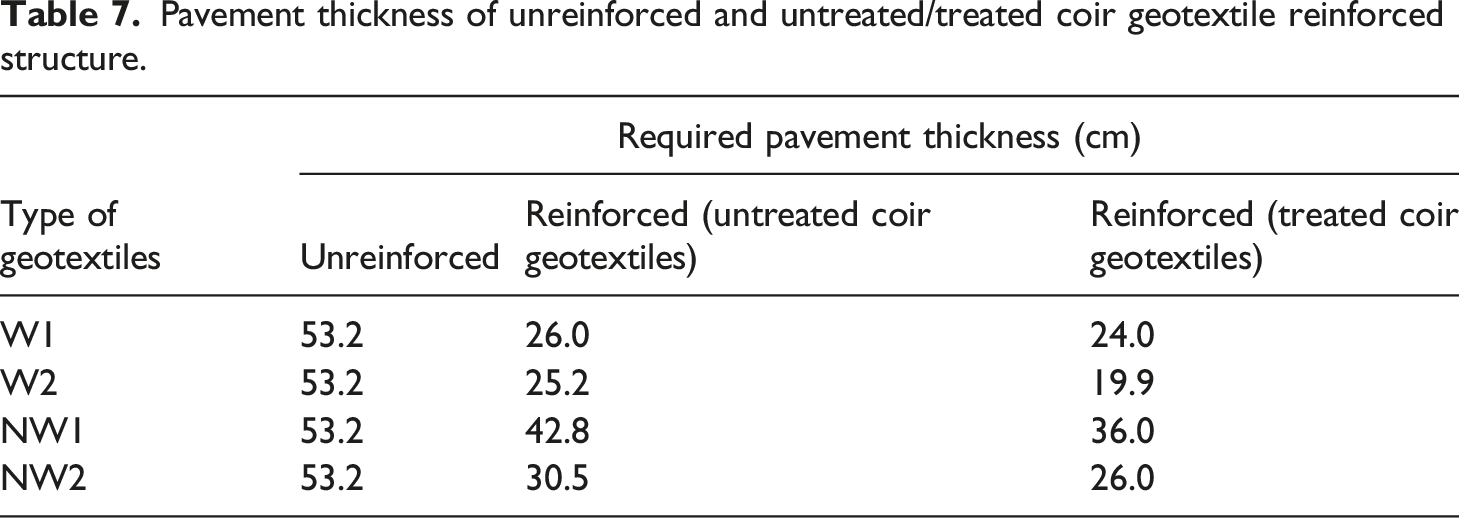
Required earthwork of unreinforced and untreated/treated coir geotextile reinforced structure.

This may be attributed to the fact that after treatment voids and cracks will be filled and an extra layer of chemicals is built up on the fiber surface, which results in increased surface area and more interaction between coir fiber and soil. It can be concluded that the reduced pavement thickness by using treated coir geotextiles will require less earth work, hence it is more economically viable and recommended for the application of unpaved roads.
Conclusions
This study investigates the effect of chemically treated woven and non woven coir geotextiles on the bearing ratio of sand overlying clay model in a soaked and unsoaked condition. The effect of chemical treatment on thermal behaviour and surface morphology of woven and non woven coir geotextiles were also studied. The following conclusions are drawn from current study. 1. The bearing ratio of the sand overlying clay model with coir geotextile at the interface was approximately 58% higher than the bearing ratio of the unreinforced model. 2. The bearing ratio of the sand overlying clay model reinforced with treated/untreated, woven/non woven coir geotextiles was higher in unsoaked condition than in soaked condition. 3. The bearing ratio of the sand overlying clay model increases 16% with inclusion of chemically treated woven/non woven coir geotextiles at the interface in unsoaked condition and increases 41% with inclusion of chemically treated woven/non woven coir geotextiles at the interface in soaked condition. 4. The bearing ratio of the sand overlying clay model reinforced with woven coir geotextiles was 38% higher as compared to non woven coir geotextiles. 5. The chemical treatment improved the thermal stability of woven and non woven coir geotextiles, which was analysed by mass loss%, char residue and degradation temperature. 6. The chemical treatment resulted in surface modification of woven and non woven coir geotextiles. 7. Treated coir geotextile offers the economic advantage over untreated coir geotextiles, since reduction in pavement thickness of sand overlying clay model reinforced with treated coir geotextiles is observed.
In the present study, inclusion of chemically treated woven/non woven coir geotextiles in two layered pavement model of sand overlying clay has significantly improved the bearing ratio in soaked and unsoaked conditions. The present study was based on laboratory performance of two layered pavement model. In future, full scale field trials are required to be conducted to get better interpretation.
Footnotes
Acknowledgements
We are thankful to National Institute of Technology, Jalandhar for providing an opportunity to do research work. Our sincere gratitude to family and friends for their continuous and unparalleled love, help and support.
Declaration of conflicting interests
The author(s) declared no potential conflicts of interest with respect to the research, authorship, and/or publication of this article.
Funding
The author(s) received no financial support for the research, authorship, and/or publication of this article.
