




Abstract
The present study investigates the effects of chemical treatment in characterising the physicomechanical properties of coir geotextiles. Two woven and two non woven coir geotextiles were used in this study. All four types of coir geotextiles were chemically treated with unsaturated polyester resin and bitumen emulsion. The results reveal that the tensile strength of untreated and treated woven and nonwoven coir geotextiles was higher in the warp/machine direction as compared to the weft/cross-machine direction respectively. The chemical treatment increased the tensile strength and decreased the tensile elongation of both woven and non woven coir geotextiles respectively. The chemical treatment modifies the surface morphology of both the woven and nonwoven coir geotextiles.
Keywords
Introduction
Geotextile is a type of geosynthetic that has gained worldwide attention from most researchers in the current scenario. They perform the functions of reinforcement, separation, and drainage. Various researchers1–10 worked on the application of geotextiles which are polymeric in nature. The main disadvantages associated with these polymeric geotextiles are their high cost and are viable to create environmental hazards, which is major concern for the researchers and construction industries in the current time. To find the solution to this problem, the application of coir geotextiles is recommended by various researchers for the sustainable and economic growth of developing countries.11–20 Coir geotextiles are made up of coir yarn, which is composed of coir fiber obtained from the husk of coconut. But there are some disadvantages of coir fiber, such as the presence of wax, pectin, voids and other impurities on the fiber’s surface which affect its physical and mechanical properties.16,21,22 In order to overcome this disadvantage, various researchers have recommended the physical and chemical treatment of coir geotextiles to modify its physico-mechanical properties.23–31
The aforementioned literature indicates that very limited work has been done on analysing the effect of chemical treatment on mechanical properties of coir geotextiles and no work has been reported in the literature on treating coir geotextiles with bitumen emulsion and unsaturated polyester resin. The present study analyses the combined effect of bitumen emulsion and unsaturated polyester resin with styrene monomer as a solvent on physico-mechanical properties of coir geotextiles.
Material and methodology
In the present study, two woven and two non woven coir geotextiles of two different grades were procured from Tamil Nadu as shown in Figure 1. The woven coir geotextiles having an areal density of 650 g/m2 and 1075 g/m2 were designated as W1 and W2 respectively. Areal density is the measure of mass per unit area of the fabric. Type W1 and W2 woven coir geotextiles have a plain weave structure with 55 warps per meter/45 wefts per meter and 75 warps per meter/50 wefts per meter respectively. The coir yarns present in warp and weft direction of Type W1 and Type W2 coir geotextiles were manufactured by a ring spinning process. The average tensile strength of warp yarns of Type W1 and Type W2 coir geotextiles were 1.07 gf/tex and 1.24 gf/tex respectively, whereas the average tensile strength of weft yarns of Type W1 and Type W2 coir geotextiles were 0.93 gf/tex and 1.01 gf/tex respectively. The coir yarn count, twist per unit length and tensile strength of coir yarn of Type W1 and Type W2 coir geotextiles were determined in accordance with32–34 respectively. Untreated coir geotextiles (a) Type W1 (b) Type W2 (c) Type NW1 and (d) Type NW2.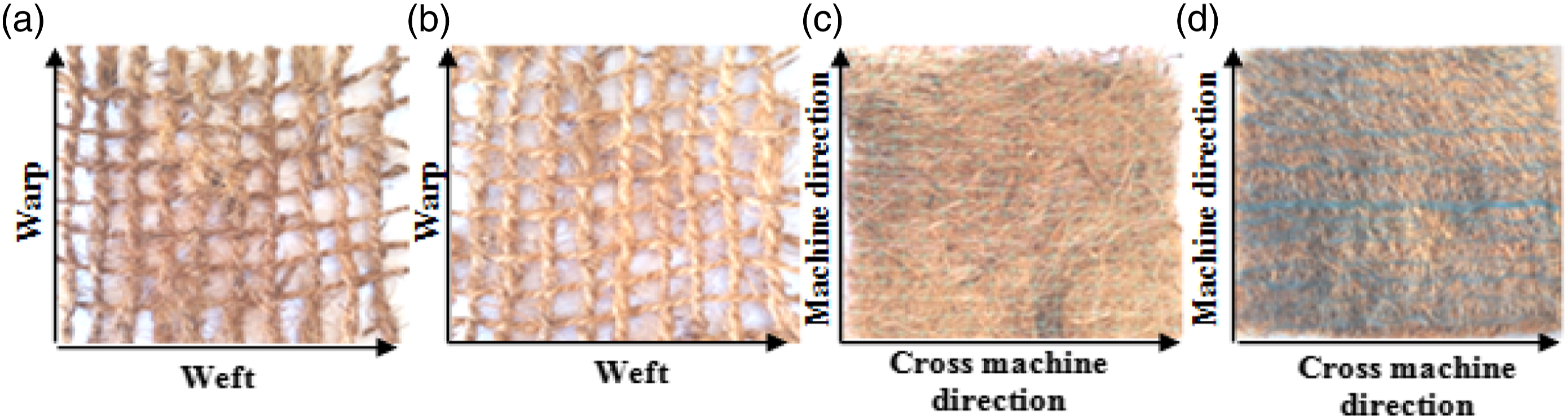
The non woven coir geotextiles have an areal density of 675 g/m2 and 1082 g/m2 were designated as NW1 and NW2 respectively. These non woven coir geotextiles were stitch-bonded with Polypropylene -PP netting on both sides. The Polypropylene yarn of Polypropylene -PP netting was manufactured by melt spinning. The bulk density of Type NW1 and NW2 coir geotextiles was 0.225 g/cm³ and 0.301 g/cm³ respectively.
The bulk density of non woven coir geotextiles is calculated by using the following relationship: Treated coir geotextiles (a) Type W1 (b) Type W2 (c) Type NW1 and (d) Type NW2.

Results and discussions
Tensile strength characteristics of untreated and treated woven coir geotextiles
The tensile strength tests were conducted on untreated/treated woven coir geotextiles (Type W1 and W2) in warp and weft direction, their tensile strength versus elongation curve is shown in Figures 3 and 4, and the results are tabulated in Table 1. It was observed that the tensile strength and tensile elongation of untreated/treated woven coir geotextile in the warp direction are more as compared to the weft direction. The increase in tensile strength of untreated/treated woven coir geotextile in the warp direction is attributed to the fact that the average count (tex) and the tensile strength of warp yarns are more in comparison to the weft yarns of Type W1 and Type W2 coir geotextiles as evident from Table 1. The greater tensile strength of the warp yarn contributes towards the higher tensile strength of geotextiles in the warp direction. The average fiber count present in the cross section of the warp yarn is also higher in comparison to the weft yarn, as evident from Table 1. The average fiber count for each yarn of Type W1 and Type W2 coir geotextiles was determined by dividing the yarn cross section area with fiber cross section area, with the assumption that the cross section of coir yarn and coir fiber are circular.
39
Also, the number of yarns present in the warp direction is more compared to the weft direction. Tensile strength versus elongation curve for untreated W1 and W2 coir geotextiles. (a) W1 in warp direction (b) W1 in weft direction (c) W2 in warp direction (d) W2 in weft direction. Tensile strength versus elongation curve for treated W1 and W2 coir geotextiles. (a) W1 in warp direction (b) W1 in weft direction (c) W2 in warp direction (d) W2 in weft direction. Physical and tensile properties of untreated and treated woven coir geotextiles.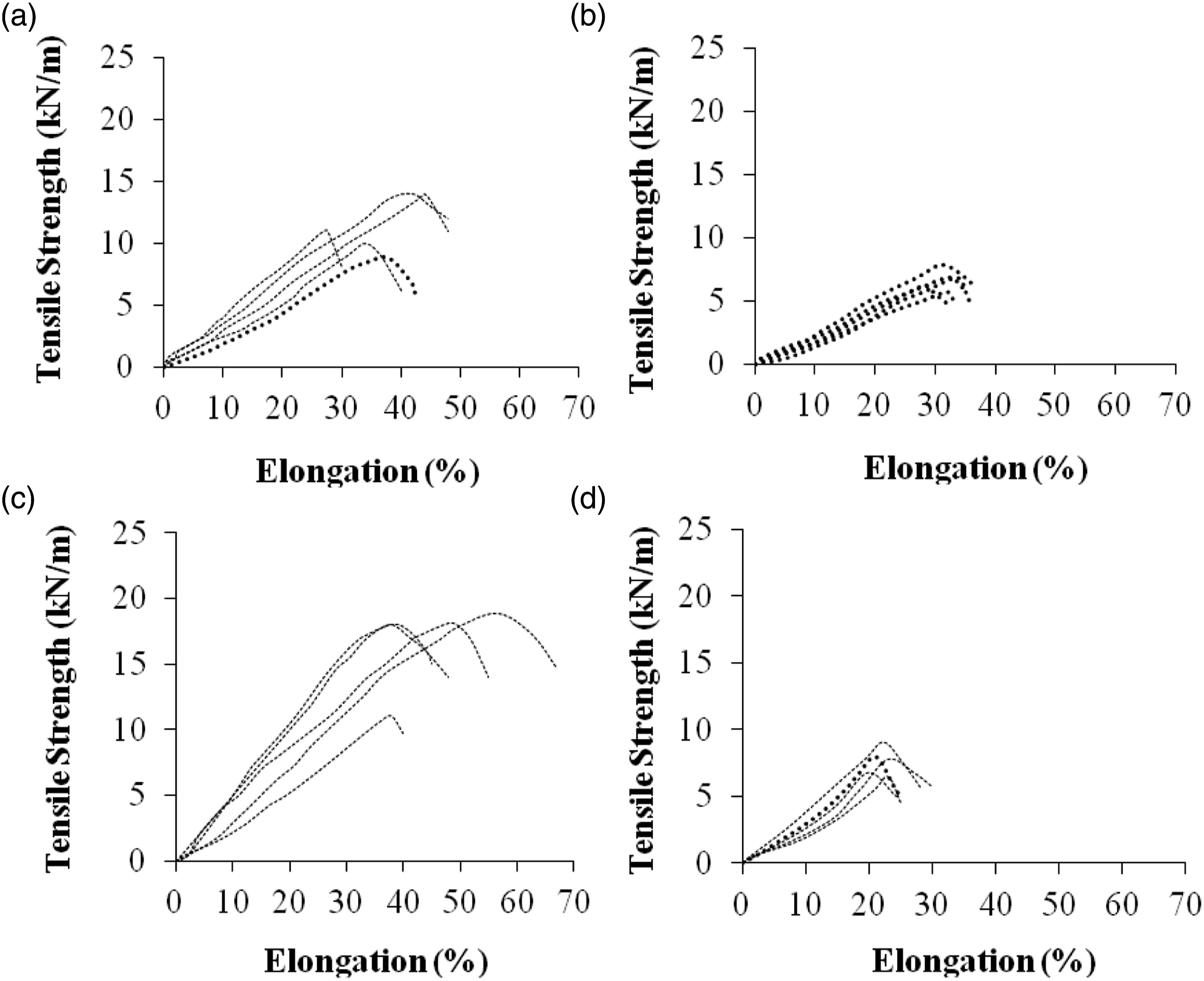


Statistical evaluation of tensile properties of Type W1, W2, NW1 and NW2 coir geotextiles after treatment.

Tensile strength characteristics of untreated and treated non-woven coir geotextiles
The tensile strength tests were conducted on untreated/treated non woven coir geotextiles (Type NW1 and NW2) in machine and cross-machine direction and their tensile strength versus elongation curve is shown in Figures 5 and 6 and results are tabulated in Table 3. Tensile strength versus elongation curve for untreated NW1 and NW2 coir geotextiles. (a) NW1 in machine direction (b) NW1 in cross machine direction (c) NW2 in machine direction (d) NW2 in cross machine direction. Tensile strength versus elongation curve for treated NW1 and NW2 coir geotextiles. (a) NW1 in machine direction (b) NW1 in cross machine direction (c) NW2 in machine direction (d) NW2 in cross machine direction. Physical and tensile properties of untreated and treated non woven coir geotextiles.
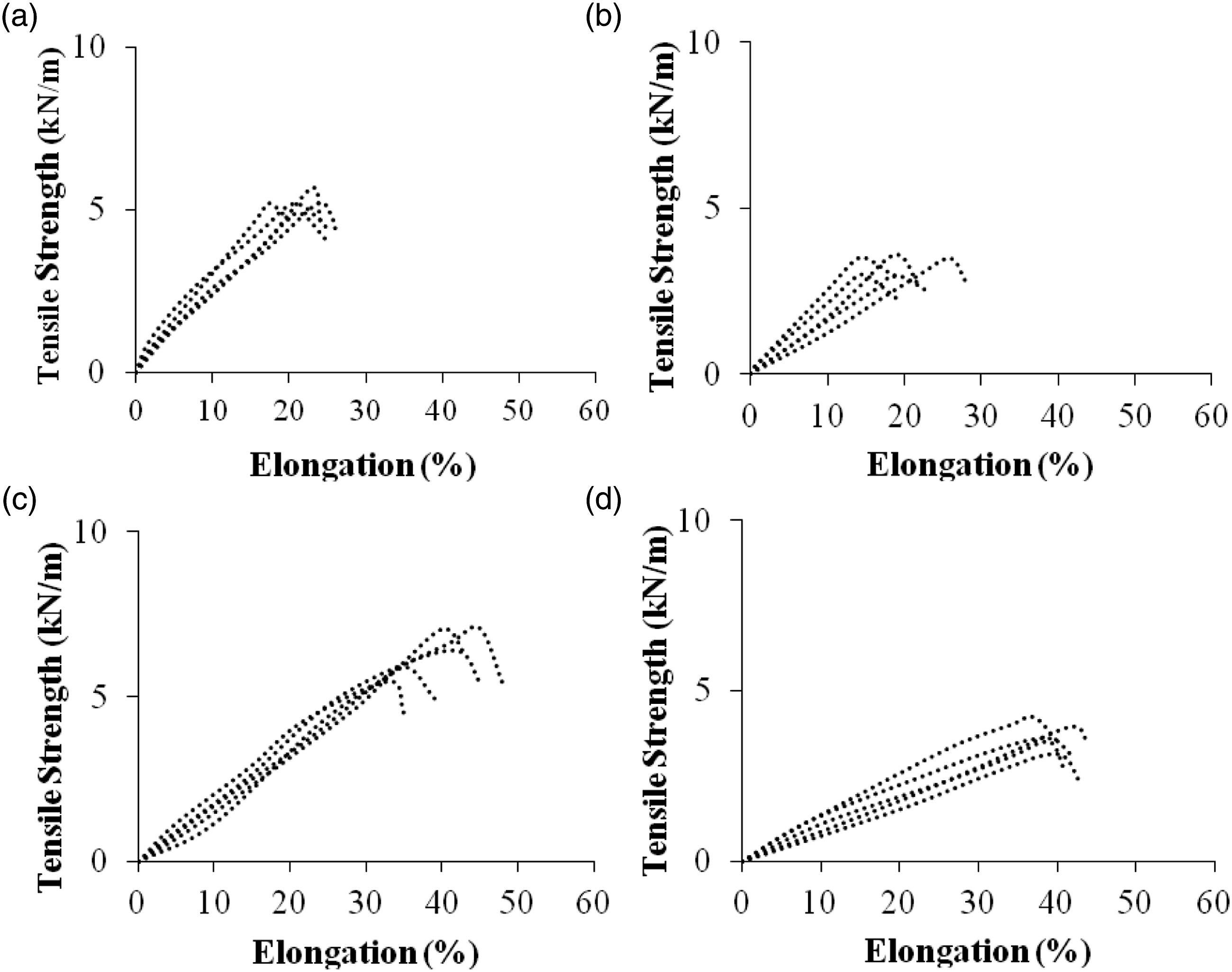

It was observed that the tensile strength and tensile elongation of untreated/treated non woven coir geotextiles in the machine direction are more as compared to cross-machine direction. This increase in tensile strength and tensile elongation of Type NW1 coir geotextiles in the machine direction is attributed to the fact that the fibers present in untreated/treated non woven coir geotextiles Type NW1, are stitched with Polypropylene - PP yarn in the machine direction. On application of external load, the tension developed will be shared by a non woven structure and Polypropylene - PP stitching yarn and more resistance will be offered by fibers to move against each other in the machine direction. The increase in tensile strength and tensile elongation of non woven coir geotextiles Type NW2 in the machine direction is due to the orientation of a greater number of fibers in machine direction which are also looped, bent, entangled and hooked. This fiber orientation and fiber entanglement will resist fiber slippage on the application of load applied in machine direction. Further, it was also revealed that the tensile strength and tensile elongation of untreated/treated non woven coir geotextiles Type NW2 is higher than untreated/treated non woven coir geotextiles Type NW1 in machine and cross-machine direction.
This increase in tensile strength is because of the high bulk density of untreated/treated Type NW2 in comparison to Type NW1. Also, the greater number of fibers in Type NW2 are bent, entangled and hooked in comparison to Type NW1, which will first get oriented longitudinally from their previous orientation on application of load. Thus, as the load increases, fiber orientation will be followed by fiber slippage, thereby offering less resistance to extension and resulting in increased tensile elongation.
It is also observed from Figure 6 that the tensile strength of treated non woven coir geotextiles (Type NW1 and Type NW2) is more than untreated non woven coir geotextiles, whereas no significant change is observed in tensile elongation of Type NW1 and Type NW2 non-woven coir geotextiles after treatment. This is ascribed due to the fact that treatment of non woven coir geotextiles Type NW1 and NW2 resulted in the formation of an additional layer on the fiber surface which will stick the fibers together, increase the fiber mass per unit area and reduce the irregularity of coir fibers. As a result, more load is required to move the fibers against each other and disentangle the treated thick fibers which is responsible for increased tensile strength of treated Type NW1 and Type NW2 non-woven coir geotextile.
Further, it is also revealed from the current study that tensile elongation of Type NW1 and Type NW2 non woven coir geotextiles decreases marginally after treatment. This is because of sticking of fibers and increased mass per unit area of coir fiber. Sticking of fibers will reduce the fiber slippage and increased mass per unit area of coir fiber will make the fiber coarse and stiff. The p value for Type NW1 and NW2 coir geotextiles from Table 2 reveals that the chemical treatment has a significant effect on tensile strength and the results are not significant for tensile elongation in machine and cross machine direction.
Reduction in fiber movement on application of load and increased rigidity of coir fiber will decrease the tensile elongation of Type NW1 and Type NW2 non woven coir geotextiles on application of external load.
Fourier transforms infrared spectroscopy (FTIR) for untreated and treated coir geotextiles
The FTIR spectra of untreated/treated coir geotextiles were recorded on an attenuated total reflection Fourier transform infrared (ATR-FTIR) instrument in the range of 500–4000 cm−1. The FTIR spectra analysis was done to determine the chemical composition of untreated coir fiber and to qualitatively confirm the chemical changes caused by chemical treatment on treated coir geotextiles. Figure 7 gives the FTIR spectrum of untreated/treated Type W1, W2, NW1, and NW2 coir geotextiles respectively. It reveals that broad peaks at 3411 cm−1, 3447 cm−1, 3487 cm−1, and 3450 cm−1 were observed for untreated Type W1, W2, NW1, and NW2 coir geotextiles respectively, which corresponds to the hydrogen-bonded (OH) stretching vibration from cellulose and lignin structure of the fiber. The absorption band at wavenumber range from 2926 cm−1 to 2950 cm−1 shows the presence of the CH group at low intensity and the peak at wavenumber range from 1616 cm−1 to 1647 cm−1 corresponds to the carbonyl (C=O) stretching of carboxyl and acetyl groups in hemicelluloses for untreated Type W1, W2, NW1, and NW2 coir fiber geotextiles. The band at 1237 cm−1, 1378 cm−1, 1476 cm−1, and 1239 cm−1 observed for untreated Type W1,W2, NW1, and NW2 coir geotextiles, is related to vibration of ester (C-O), ethers and phenol groups mainly due to the presence of wax in epidermal tissue of fiber.
40
The intense peak at 1028 cm−1,1013 cm−1,1062 cm−1 and 1033 cm−1 corresponds to the amine group (NH)
41
and C-O stretching of hemicelluloses lignin in untreated Type W1, W2, NW1, and NW2 coir geotextiles. FTIR spectrum of untreated and treated coir geotextiles (a) untreated and treated Type W1 (b) untreated and treated Type W2 (c) untreated and treated Type NW1 (d) untreated and treated Type NW2.
An increase in transmittance is observed from Figure 7, for Type W1, W2, NW1, and NW2 coir geotextiles after treating them with the composition of unsaturated polyester resin and bitumen emulsion. The vibration of the molecule which corresponds to each peak in the pattern seems to increase in number. The influence of unsaturated polyester resin and bitumen emulsion on coir geotextile can be characterized by the formation of peaks in the wavenumber range of 2922 cm−1 to 2925 cm−1 for the presence of C-H alkane chain and appearance of the ester group of hemicelluloses at wavenumber range from 1719 cm−1 to 1724 cm−1 for treated Type W1, W2, NW1, and NW2 coir geotextiles respectively. It is rational to mention that the ester group is a derivative of carboxylic acid and contains a C=O bond, having high bond enthalpy which contributes to increased tensile strength of treated Type W1, W2, NW1, and NW2 coir geotextiles.
The stretching vibration band in the wavenumber range between 3341 cm−1 to 3348 cm−1 for the OH group in treated coir geotextiles was broader and more intense than untreated coir geotextiles. This indicates the formation of hydrogen bonds and compatibility between unsaturated polyester resin, bitumen emulsion, and coir fiber geotextiles. The high intensity of peak at wavenumber range from 1719 cm−1 to 1724 cm−1 for treated coir geotextiles in comparison to untreated coir geotextiles was observed. It appears that due to the removal of wax and impurities from the surface of fiber, the number of reactive sites and available OH groups increased, resulting in greater esterification reaction between the fiber OH group and polyester COOH group and formation of a covalent bond with unsaturated polyester resin. These chemical reactions will improve the interfacial interaction which is responsible for increased tensile strength of treated coir fiber geotextiles. Similar observations have been reported for hemp-polyester composites and borassus fruit short fiber/unsaturated polyester composites.42,43 The formation of the peak in the range of 1620 cm−1 to 1635 cm−1 shows C=C alkene chain and a medium absorption band of 1441 cm−1 to 1445 cm−1 and 1330 cm−1 to 1380 cm−1 shows CH3 chain which confirms the presence of bitumen emulsion. CH3 and C=C are non polar functional groups and C=C also possess strong bonds due to the presence of a double bond between two carbon atoms. The peak at wave number range of 1108 cm−1to 1133 cm−1 for Type W1, W2, NW1, and NW2 treated coir geotextiles are assigned as C–O–C stretching attributed to the β-(1→4) glycosidic linkage in cellulose. 11 The peak in the wavenumber range of 997 cm−1 to 1046 cm−1 shows the functional group C=O carboxylic, and the peak in the wavenumber range of 869 cm−1 to 880 cm−1 and 702 cm−1 to 745 cm−1 shows aromatic functional group and meta aromatic functional group respectively. 44 The main functional groups of unsaturated polyester resin and bitumen emulsion, such as the polyester linkages of carbon-oxygen bonds (C-O-C, C=O, and C-O), aromatic hydrocarbons of styrene and alkane chain (C-H), CH3 chain, hydroxyl (OH) groups and carboxylic group (C=O) can be seen in FTIR spectra of treated coir fiber geotextiles.
Scanning electron microscopic (SEM) studies on untreated/treated coir geotextiles
Scanning electron microscopic analysis is used to examine the surface morphology of Types W1, W2, NW1, and NW2 untreated/treated coir fiber geotextiles. SEM images are shown in Figure 8(a) to (d) reveals that the surface of the untreated fiber is covered with voids, tylosis, cracks, pectin, lignin, and other impurities, thus providing it with a porous structure. After treating Type W1, W2, NW1, and NW2 coir geotextiles with unsaturated polyester resin and bitumen emulsion, SEM images are shown in Figure 8(e) to (h). These figures reveal that the voids and cracks present on the surface of coir fiber are filled up and the fiber surface is now covered with a coating of unsaturated polyester resin and bitumen emulsion. This additional layer on the fiber surface is responsible for increased tensile strength of treated woven/non woven coir fiber geotextile. SEM images of coir geotextiles (a) Type W1 (untreated) (b) Type W2 (untreated) (c) Type NW1 (untreated) (d) Type NW2(untreated) (e) Type W1 (treated) (f) Type W2 (treated) (g) Type NW1 (treated) (h) Type NW2 (treated).
Conclusions
On the basis of the results and discussion presented, the following salient conclusions have been drawn: 1. The tensile strength and tensile elongation at failure of untreated/treated woven coir geotextiles Type W1 and W2 were lower in the weft direction in comparison to warp direction. 2. The tensile strength and tensile elongation at failure of untreated/treated woven coir geotextiles Type W1 and W2 were influenced by coir yarn count, yarn twist multiplier and number of yarns per unit length. 3. The tensile strength and tensile elongation at failure of untreated/treated non woven coir geotextiles Type NW1 and NW2 were lower in cross-machine direction in comparison to machine direction. 4. The tensile strength and tensile elongation at failure of untreated/treated non woven coir geotextiles Type NW1 and NW2 were influenced by their bulk density, fiber orientation and presence of Polypropylene - PP netting present on both the sides of nonwoven geotextiles. 5. The chemical treatment increased the tensile strength and decreased the tensile elongation for Type W1, W2, NW1 and NW2 coir geotextiles. 6. The mass per unit area of all the coir geotextiles increased after chemical treatment. 7. The chemical treatment modifies the surface morphology of both the untreated woven and nonwoven coir geotextiles by forming a surface coating and filling up the voids present on the surface of coir fiber.
Footnotes
Acknowledgements
We are thankful to National Institute of Technology, Jalandhar for providing an opportunity to do research work. Our sincere gratitude to family and friends for their continuous and unparalleled love, help and support.
Declaration of conflicting interests
The author(s) declared no potential conflicts of interest with respect to the research, authorship, and/or publication of this article.
Funding
The author(s) received no financial support for the research, authorship, and/or publication of this article.
