




Abstract
The aim of this paper is to develop an analytical model to predict indentations of the impactor on the composites reinforced with weft-knitted spacer fabric using Hertz contact law. For this purpose, simply supported rectangular plate with partially load developed by Timoshenko was applied to analyze the deflection of top face, and the concepts of the buckling of initially curved struts were used to find the buckling of Z-fibers. To evaluate the accuracy of the model, the effect of the number of Z-fiber per unit area and elastic modulus of Z-fiber were investigated. The results showed that in the outside the contact area, the impact force bends the layer and causes the Z-fibers to buckle, but no indentation occurs. Inside the contact zone, the indentation has occurred, in addition to the layer deflection and Z-fiber buckling. Also, indentations in both X and Y directions decrease by increasing the Z-fiber density. In addition, the higher the z-fiber modulus leads to fewer indentations. Decreasing the angle coefficient of Z-fibers leads to increase their buckling resistance. Moreover, a reasonable agreement was observed between theoretical and experimental results; so that the maximum error of prediction was less than 20%. Furthermore, the proposed model can give the indentation of different points of sandwich-structured composites according to their coordinates.
Keywords
Introduction
3D textiles are widely used in various industries and research fields. The exclusive properties of 3D fabrics in comparison with 2D types lead to improvement of mechanical behavior of composites in the direction of thickness.1,2,3 The most outstanding feature of 3D textiles as a reinforcement of polymer composites is reinforcement in the direction of the thickness of the structures. 4 Among all fabrics, knitted spacer fabrics seem to be suitable for impact applications due to the role of the Z-fibers in absorbing impact energy. When the impactor strikes the composites reinforced with knitted spacer fabrics, the different parts of the reinforcement undergo different deformations, so that the top and bottom layers bend, while the Z-fibers buckle.
Many attempts have been made to describe the low-velocity impact behavior of composite structures.5–16 Fatt et al. 5 found that the rigidly supported panel experiences only local indentation of the top face sheet into the core, while the clamped sandwich panel experience both a local indentation and a global panel deformation. The top and bottom layers may have different deformations, such as the sandwich panel used to cover the floor, but this has not been considered.
Honeycomb as the most common type of sandwich structures has received the attention of researchers.6–8 Xue et al. 6 made a honeycomb sandwich using high ductility and high strength carbon/glass fiber hybrid composite shell under low-velocity and heavy load. Jayaram et al. 7 reinforced honeycomb sandwich panels using polyester pin-reinforced foam and compared them with unreinforced foam filled honeycomb sandwich panels in terms of compressive and low velocity impact performances. Xu et al. 8 used auxetic warp-knitted spacer fabrics to improve impact resistance and energy absorption of honeycomb based sandwich panel.
Hazizan and Cantwell 9 investigated the low velocity impact response of the aluminum honeycomb sandwich structure. Fiber reinforced/epoxy skins and aluminum core was modelled using a simple energy-balanced model which accounts for energy absorption in bending, shear and contact effects. They found that at low energies, the damage was localized immediately to the core material at the point of impact.
As mentioned, honeycomb sandwich panels are reinforced with fibrous structures in various applications. In this regard, the idea of using composites reinforced with spacer fabrics as a sandwich structure was considered. Wang et al. 10 used spacer fabric to improve the compressive, bursting and dynamic impact performance of quasi-static flexible polyurethane foam sandwiches. They concluded that a combination of warp-knitted spacer fabric increases the compressive strength and burst resistance of composite sandwiches. It can be concluded that the fibrous structures improve the mechanical behavior of the composites of the sandwich structure.
The impact behavior of sandwich-structured composites has been extensively studied. Spacer fabrics are a good choice to improve the impact behavior due to the presence of Z-fibers in their structure. Dabiryan et al. 11 used weft-knitted spacer fabrics as reinforcement of the sandwich composite, and realized the important role of Z-fibers in the impact behavior of composites.
Zhu and Sun 12 considered the combination of local indentation and global deformation of the panel, as well as the effect of the impactor shape, and found that for the entire sandwich panel, the core absorbs most of the impact energy as the plastic strain energy. Gong et al. 13 reported that how the cell geometry and velocity of impactor affect total absorbed energy. According to the research by Huoa et al., 14 the impactor shape was known as the main variable on the low-velocity impact response of foam-core sandwich panels. The sandwich panels have the highest and lowest structural strengths against the flat and conical impactors, respectively. Nanayakkara et al. 15 experimented on the impact damage of Z-pinned foam core sandwich composite. They found that through-the-thickness reinforcement of foam core sandwich composite material with orthogonal Z-pins can improve slightly the impact damage properties. Low-speed flat-wise compression testing revealed that Z-pin reinforcement was highly effective at increasing the through thickness stiffness, strength and energy absorption of the core. Feli et al. 16 found that the core height is the most effective geometrical parameter affecting the maximum contact force and contact duration.
Rahman and Zhu 17 studied low-velocity impact behavior of clamped-clamped integrated woven-spacer sandwich composites. They observed that the composite stiffness decreased with the increase in core piles heights, and the energy absorption capacity increases with the increase in core piles heights. Steffens et al. 18 investigated the impact behavior of Jersey weft-knitted composite and auxetic composite which were clamped horizontally on a support and a hemispherical impactor was used. The results confirmed that the auxetic textile structure absorbed more energy compared to Jersey reinforced specimens. Ionesi et al. 19 analyzed impact behavior of weft-knitted spacer fabric by replacing the composite with an equivalent continuous material, with similar mechanical characteristics using FEM. Apart from the information regarding the material deformation, important data are gained concerning the displacement/strain/stress/effort, as well as the deformation forces for single moments during the impact.
Previous researches, have shown that fibrous structures play a positive role in the mechanical behavior of sandwich-structured composite, but rarely spacer fabric reinforced composite is considered as a sandwich structure, analytically. In the present study, weft-knitted spacer fabric reinforced composite is considered as a sandwich structure. Considering the structural parameters of weft-knitted spacer fabric and contact law, a theoretical model is generated to predict the low-velocity impact behavior of sandwich-structured composite reinforced with weft-knitted spacer fabrics.
Theoretical formulation
In general, deformation of a sandwich panel subjected to impact load can be divided into two parts: global deflection and the indentation. 21 Sandwich-structured composites reinforced with weft-knitted spacer fabric are composed of top and bottom layers, and Z-fibers that connect the layers.
The knitted reinforcement in this study is a sandwich fabric where the independent outer layers (plain jersey as top and bottom layers), are connected through knitted layers (Z-fibers) placed as Rib gating pattern to them and hand lay-up method may use to manufacture 3D composite. Figure 1 shows the schematic of the sandwich composite reinforced with spacer fabrics.
22
Schematic of weft-knitted spacer fabric reinforced composite.
22

When composites reinforced with spacer fabrics are subjected to the out of plane loads such as impact force, the layers and Z-fibers show different reactions in the form of deflection and buckling, respectively. In other words, the impact properties of sandwich-structured composites, reinforced with weft-knitted spacer fabrics is a function of the deflection of the layers and the buckling of the Z-fibers. Considering this approach, we would be able to find the relationship between impact behavior and reaction of layers and Z-fibers aforementioned composites. In this paper, low-velocity impact behavior of simply supported textile composite was investigated considering a cylindrical stainless-steel impactor and sandwich-structured target. For this purpose, it was assumed that the bottom layer to be placed on a rigid base and the deformation of the top layer results on an elastic base, was considered. Hence, the effective parameters are listed as below: i. Buckling behavior of Z-fibers ii. Bending behavior of top layer
Therefore, to derive the governing equation of impact behavior of sandwich-structured composites, the following deformation of different parts is considered: - Indentation of the impactor ( - Deflection of top layer ( - End-shortening of Z-fibers
The relationship of aforementioned deformation is simply formulated as below:

It should be noted that unlike common sandwiches, the composites reinforced with spacer fabric have a higher shear strength at the boundary between Z-fibers and layers due to the texture of the yarns. Therefore, the equation (1) can be trusted as the relationship between different deformations under the impact load.
Figure 2 shows the deformation of different parts of sandwich composites reinforced with weft-knitted spacer fabrics under impact force. Based on the above arguments, in the following, the deflection of top layer and end-shortening of Z-fibers are obtained. Schematic of impact indentation in a sandwich structure.
Deflection of the top layer
As pointed out, when the sandwich-structured composite is subjected to the impact force, the top layer undergoes the bending deformation. Based on the constitutive equations for bending of plates
23
:

Considering the cylindrical shape of the impactor, the partially distributed loading is defined for top face of the composite subjected to impact load. Timoshenko
20
developed the following series for a simply-supported plate subjected to the load q distributed over the rectangle.

Figure 3 shows clamped-clamped rectangular plate with partially load. Circular loaded simply-supported rectangular plate
24
; (a) edge condition, (b) loading schematic.
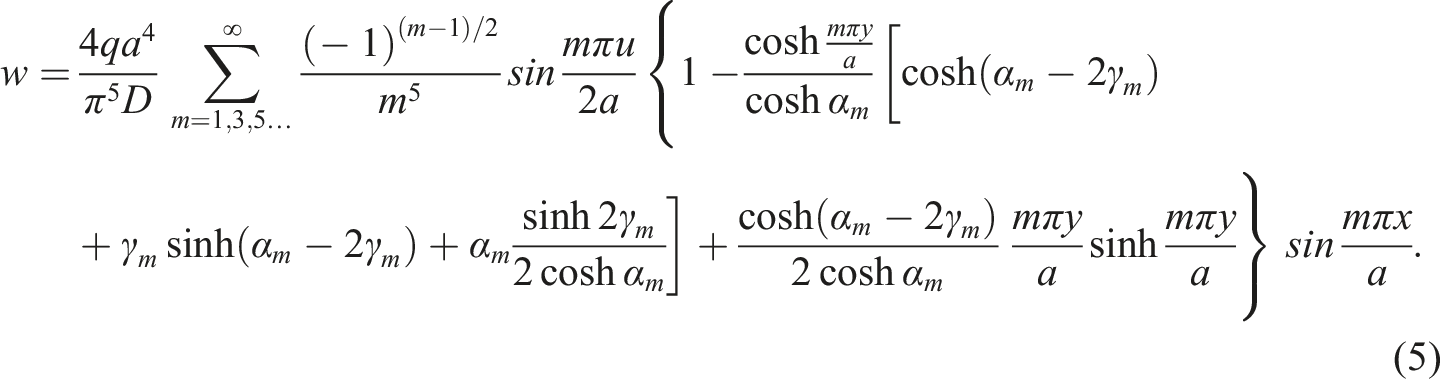
If the general differential equation of plates is taken into account, the relationship between impact force and deflection of top layer from is obtained as below:

A simple solution of equation (4) results in equation (5):


Deflection of the top layer on elastic foundation
If the top layer rests on elastic foundation equation (2) changes according to Winkler model
25
:


The Navier solution is adopted for solving equation (8). The solution of the governing differential equation (8), have to be sought in the form of infinite Fourier series, as follow
26
:

Also the general load q(x, y) can be approximated as following double Fourier expansion equation:

If

Substituting Equations (10)–(12) into equation (8) and solving it, coefficient



So that deflection of top layer resting on z-pile yarns is:

Buckling of Z-fibers
The Z-fiber undergoes the buckling deformation when the impact load is applied to the composite. Considering the curved shape of the Z-fibers, the governing equations of buckling are as follows
27
:

According to Figure 4, the change of spacer yarn’s curvature is due to additional displacement (y). So, the differential equation of bending is: Initially curved strut
27
; (a) general schematic, (b) boundary conditions.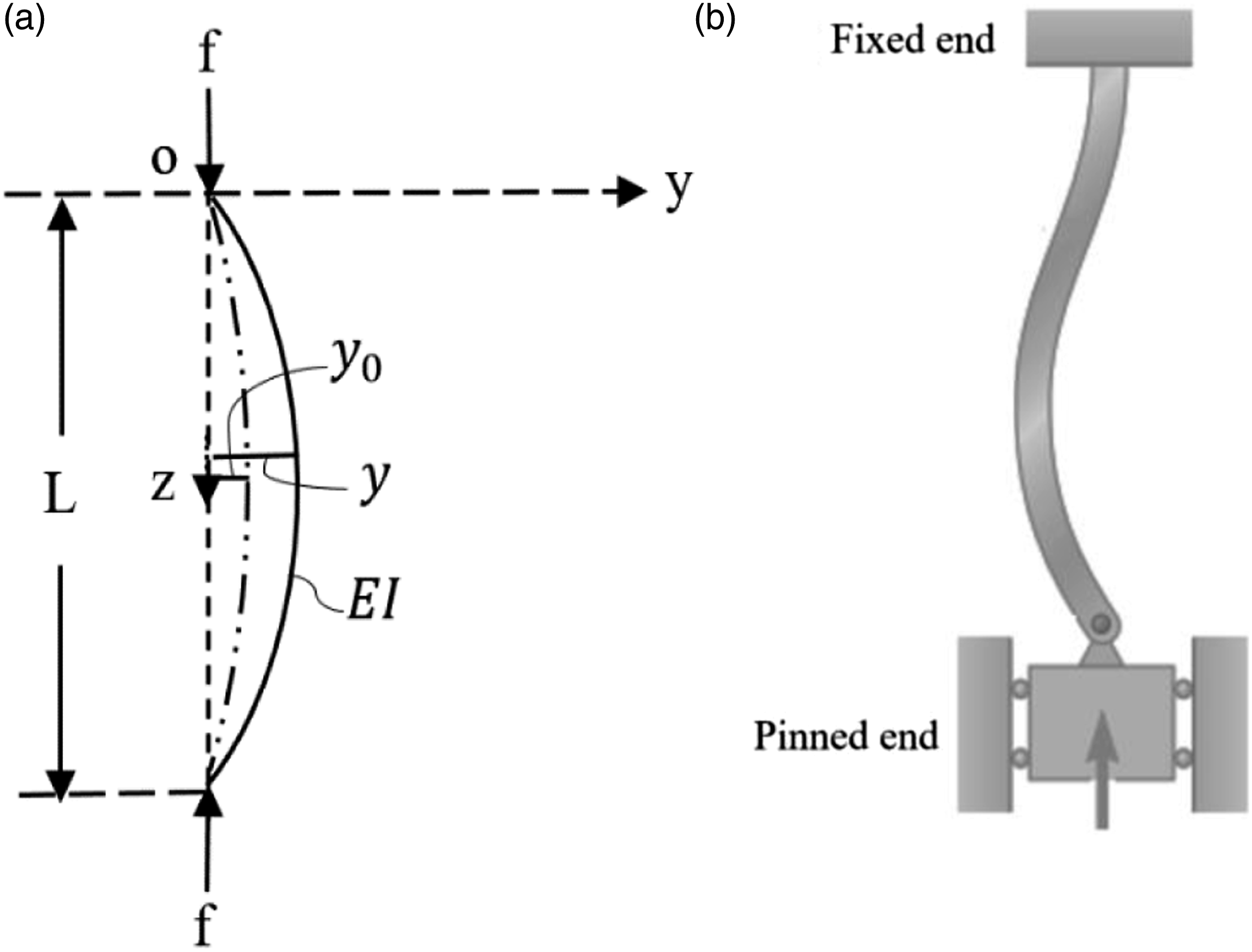

Assuming that

Here,
The buckling shape of pile yarns follows the sine form with different shapes of the arc, which can be defined as the coefficient of the common form of the sine arc. The coefficient c is used to create different shapes.
Setting,

Considering boundary conditions, the equation (19) reduces to:

The energy dissipated due to buckling of a spacer yarns is given by:

Deriving the value of

Solving equation (22) results in to the equation (23):

It is worth mentioning that the contact force f should be obtained for each Z-fiber. The applied force on a single Z-fiber (

Putting the values of

If the work of impact force (

Equating the external work and strain energy leads to:

Substituting Equations (14) and (27) into equation (1):

Equation (28) describes the indentation during low velocity impact by taking into account the role of structural parameters of weft-knitted fabric such as Z-fiber length (L), Z-fiber density (PSC), bending stiffness of layer (EI), z-pile yarn diameter (I), thickness of top layer (h) and shear modulus of the top layer (G).
Contact law
For two isotropic bodies of revolution, contact occurs in a circular zone of radius

In addition, according to the Hertz theory of contact between two elastic solids:


Defining the parameters


Considering the equations (31) to (33), the indentation becomes:

Equating equations (20) and (26), we have:

Indeed, equation (35) is an analytical model to show the low-velocity impact behavior of sandwich-structured composites reinforced with weft-knitted spacer fabric.
Evaluation of the model
Input data.

Geometrical properties of samples.

The indentation of each Z-fiber was calculated for different points in the contact zone. For this purpose, the location of each Z-fiber was defined in XY plane. Using MATLAB software the indentation of different points Results of analytical model for different samples.
Figure 6 shows the displacement of different points of the sandwich-structured composite which indicates the end-shortening of Z-fibers due to deflection of layers and buckling of Z-fibers. As, it can be seen, the shapes of deformations in different areas are in accord to the actual state. Indentation of spacer composite; (a) Global deformation, (b) Local deformation.
To check the values of displacement in different points, as the results of the analytical model, the vertical displacement of selected points was measured on the samples subjected to the impact force. As shown in Figure 7(a), five points in the contact zone, i.e. A, B, C, D and O were chosen on the sample. The location of these points in the XY plane is shown in Figure 7(b). According to Figure 7(b), contact zone in the X axis varies from 37 mm to 63 mm, and in the Y axis varies from −13 mm to 13 mm. Schematic of contact area, (a) Actual photo, (b) Schematic view.
Comparison between indentation of experimental and theoretical results in mm.

As shown in Table 3, difference between experimental and theoretical results is less than 20%. Experimental indentation of contact zone boundary (points A, B, C and D) measured less than the theoretical value, while the experimental value at the center point (O) was more than the theoretical value. Of the five points shown, deformation at four points (A, B, C, and D) is expected to be in the elastic deformation range in both theoretical and experimental results. However, the center of area (point O) in the theoretical model is considered in the elastic range, while in the experimental experiment it undergoes plastic deformation. For this reason, the prediction process of point O is different from other points.
Result and discussion
The generated model is theoretically focused on the effective structural parameters of the weft-knitted spacer fabrics as reinforcement of sandwich-structured composites under low velocity impact loads. As indicated in equation (27), the different structural parameters play a role in the impact properties of composites. To check the performance of the model, the effect of different parameters will be discussed. Figure 8 shows the effect of Z-fiber density of reinforcement on the indentation of the impactor. As expected, indentations in both X and Y directions decrease by increasing the Z-fiber density (number of Z-fibers per unit area). In addition, the model correctly shows the indentation changes along the X and Y directions. Different indentations are attributed to different impact forces for specimens with different numbers of Z-fibers. It is well known that as the number of Z-fibers increases, the amount of impact force per Z-fiber decreases.
11
Obviously, in practice, each Z-fiber individually withstands a part of the impact force. Hence, as the number of pile yarns increases, the amount of impact force for each Z-fiber is expected to decrease. In the theoretical model, the effect of the number of Z-fibers in equation (24) is considered. According to this equation, as the number of pile threads increases, the impact force decreases. Effect of PSC on the indentation; (a) X axis, (b) Y axis.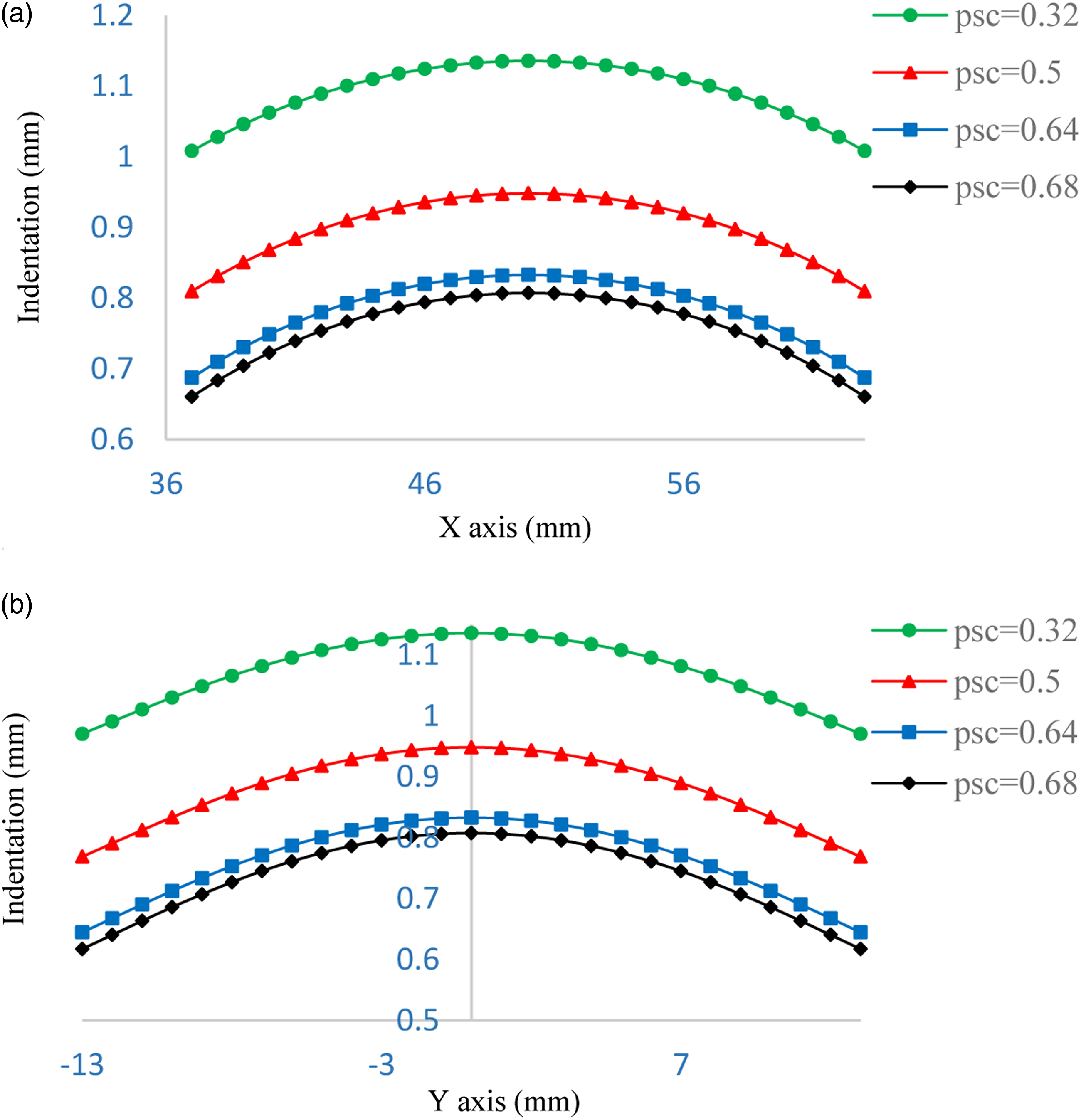
The effect of changes in Z-fiber angle on indentation is shown in Figure 9. Angle coefficient c which is related to Z-fiber position is calculated using The effect of Z-fiber angle on the indentation; (a) X axis, (b) Y axis.
To evaluate the ability of the presented analytical model in the understanding of materials, Z-fibers with different elastic modulus were modeled. Figure 10 shows the indentation of composites reinforced by materials with different elastic modulus. Since, the indentation is directly related to the end-shortening of Z-fibers, the higher the Z-fiber modulus leads to fewer indentation. The same results can be seen in ref.
30
Effect of Z-fiber modulus on the indentation; (a) X axis, (b) Y axis.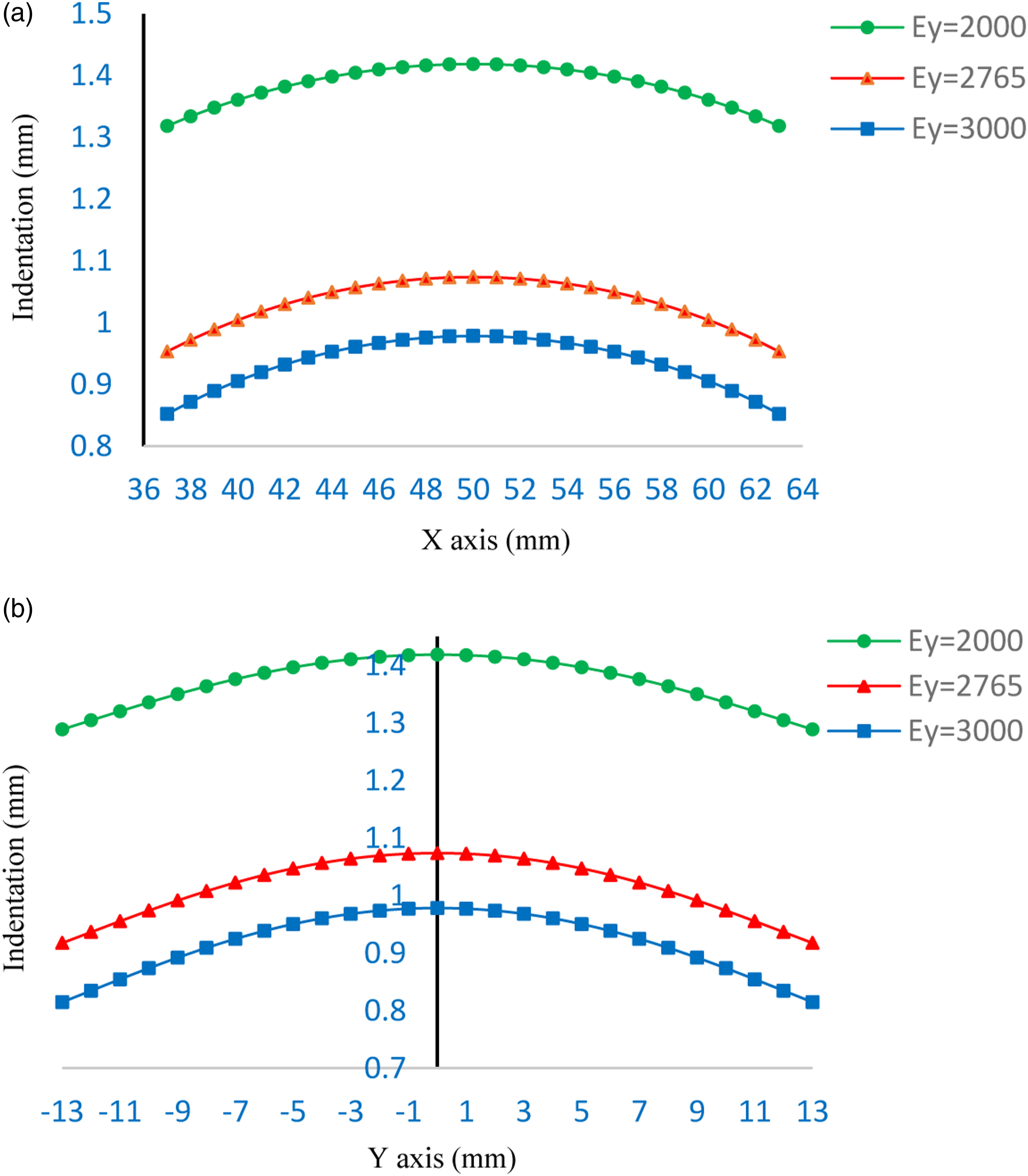
Conclusion
Low velocity impact behavior of sandwich-structured composites reinforced with weft-knitted spacer fabrics was studied theoretically using Hertz contact law. A theoretical model was developed to predict the indentation of sandwich-structured composites reinforced with weft-knitted spacer fabrics under a low-velocity impact. Due to the main role of Z-fibers in through-the-thickness properties of sandwich-structured composites, the structural parameters, i.e. the number of piles per the unit area, angle and modulus and of Z-fibers were considered as variables in this research. The results of generated model showed that the orientation of Z-fibers has the main role in the impact behavior of sandwich-structured composite reinforced with weft-knitted spacer fabrics. Also, the indentation of impactor on the sandwich-structured composites is the resultant of the buckling of Z-fibers and deflection of top face of reinforcements. By increasing the number of Z-fibers in the weft-knitted spacer fabrics, the indentation of sandwich-structured composites decreases. The indentation of composites decreases by increasing the angle of Z-fibers. The comparison between experimental and theoretical results of indentation showed that the error of prediction is less than 20%. Considering the complex structure of spacer fabrics, the error of prediction seems to be reasonable.
Highlights
- Weft-knitted spacer-fabric reinforced composites have a high potential for impact energy absorption. - The structural parameters of Z-fibers in spacer fabrics has the main role in low velocity impact behavior of composites reinforced with weft-knitted spacer-fabric. - Unlike common sandwiches, the composites reinforced with spacer fabric have a higher shear strength on the boundary between Z-fibers and layers due to the texture of the yarns. - The indentation of impactor on the target is the results of deflection of faces and buckling of Z-fibers.
Footnotes
Declaration of conflicting interests
The author(s) declared no potential conflicts of interest with respect to the research, authorship, and/or publication of this article.
Funding
The author(s) disclosed receipt of the following financial support for the research, authorship, and/or publication of this article: This work was supported by Amirkabir University of Technology and the grant number 11893.
