




Abstract
It has been a challenging subject for researchers to manipulate the electrospinning key factors to achieve a composite nanofiber with proper properties. In this study, an experiment according to central composite design to investigate the effect of parameters including polyvinylpyrrolidone concentration, zeolite concentration, voltage, core flow rate and shell flow rate on diameter, maximum strength and porosity of polyethersulfone/polyvinylpyrrolidone/zeolite core-shell composite nanofiber has been designed. Later on, two sets of models consisting of response surface methodology and artificial neural network are trained. Then, their performance was evaluated based on the definition of a novel goodness function. In the next step, the genetic algorithm is used to find the optimal design for scaffold applications. The results demonstrated that the average goodness value of models based on an artificial neural network (
Keywords
Introduction
Tissue engineering primarily aims at presenting a substitute for prevalent transplants via developing biomimetic scaffolds. 1 In the following, the tissue engineers have presented strategies undergoing a flourishing period in the last years through developments in nanobiomaterials and nanotechnology. Thus, a scaffold with a 3D porous arrangement has been accepted as an alternative providing a suitable substrate for cell growth and migration.2–5
The tissue fate and cells are highly influenced by nanopatterned and nanoporous structures due to protein adsorption and large surface area, resulting in enhanced cell attachment and topology guiding the cellular activities toward certain objectives. Also, the nanoporous structure is claimed to influence cellular function through making a change in the conformation of specific cellular attachment proteins or through surface energy alteration.2,6–9 Due to the property of the crystallinity, zeolite is a multi-aspect material possessing a nano- and micro-structure. Zeolite-based platforms are a special group of multidisciplinary nanomaterials employed in tissue engineering attracting considerable interest. 2 Besides, it is less expensive and considered to be non-toxic to humans. As a result, many studies have attempted to assess its significance in biomedical applications such as antidiarrheal agents, hemorrhage control, detoxicates, antibacterial agents and biomedical application scaffolds.6–9 Nevertheless, an additional process is required for zeolite in powder form, like the honeycomb monolith form the fabrication so that they can be available commercially. Despite studies with regard to the process of coating zeolite on the surface and composites of the flexible material, there are still some difficulties in the fabrication of flexible zeolite, such a complex process for degradation and development of properties.10–13 The electrospinning technique, which is an easy-to-implement, economical, and simple method, can be used for increasing efficiency in this respect and flexible zeolite fibers are created using biocompatible polymers.10,14–16
In order to fabricate a bio-scaffold, bioengineers should carefully select biocompatible polymers with relative degradability for remodeling the tissue. 1 Polyvinylpyrrolidone (PVP) is regarded as a key amorphous polymer, which has good spinnability, high biocompatibility, low chemical toxicity, and great solubility in most organic solvents. This polymer is regarded as a good material that can be potentially applied in medical tools and shielding, as well as biological engineering materials. 17 Hence, it can be properly blended with zeolites as an adhesive for binding zeolite nanoparticles. Also, it is assumed that the mechanical characteristics of nanofiber mats are critical parameters in their ultimate applications. However, the strength of PVP nanofibers is not adequate for usage in tissue engineering. Thus, researchers have utilized polyethersulfone (PES) polymers as reinforcement in the core-shell electrospinning process. In fact, PES has drawn high attraction during the past decade in the biomaterial area. Furthermore, it is a semicrystalline hydrophobic polymer with a long-term degradation that has a relatively cheap cost of production, easy manipulation, flexible surface modification, approval of food and drug administration (FDA), and tailor-made and appropriate physicomechanical properties. Due to these special properties, PES and its blends are suitable for usage in drug delivery, tissue engineering, fixation tools, and wound dressing. 18
Currently, researchers are highly interested in the systematic examination of the effect of electrospinning variables effect on the diameter and morphology of the electrospun fibers. Thus, it is required to fabricate fibers with uniform and small-sized fibers that the electrospinning process can be applied on a large scale in industries.19–20 The dimensions and morphological structure of electrospun fibers can be affected by various parameters consisting of solution factors, electrospinning factors and environmental factors. So, a systematic investigation of the parameter impacts on experimental output is essential.21,22 Among the many statistical methods, response surface methodology (RSM) is a useful method for designing and optimizing an experiment. Through this method, an empirical model to express the relationship between the variables and responses is established. More and still, with regard to designing an experiment, RSM reduces the number of required experimental runs for providing statistically significant information. This method has been implemented in recent studies for optimizing variables that affect the nanofiber fabrication process.23–29 The RSM was employed by Gholipour et al. for modeling and optimizing the electrospinning parameters to spin blend chitosan/polyvinylalcohol for controlling fiber diameter at various spinning parameters. There was a correlation between fiber diameter and fabrication variables by using a second-order polynomial function. The estimated fiber diameters showed an acceptable consistency with the empirical results. 30 The quantitative relationship between the average diameter of PVP nanofibers and electrospinning process variables was evaluated by Nasouri et al. using the RSM method. 20 Besides, Yazdanpanah et al. investigated the effect of applied voltage, polymer concentration, flow rate, interaction, and distance on the poly (vinyl alcohol) (PVA) nanofibers’ diameter by the use of the-ethod. Hence, CCD seems to be an efficient approach for designing, analyzing, modeling, and optimizing the electrospinning process, and it is a technique with several influential variables. 21 Also, the RSM was used by Pirsa et al. for optimizing the carboxymethyl cellulose/gelatin/TiO2–Ag nanocomposite antioxidant/antimicrobial film. 31
The application of artificial intelligence approaches in mechanical engineering has been gradually increasing in the last two decades. It is chiefly due to the effectiveness of artificial intelligence modeling systems in the improvement of the engineering area. Since artificial neural networks (ANNs) employ various parameters (biases and weights), they have the capability of estimating the target data of systems in engineering usages with high accuracy. 32 Additionally, ANNs are used for modeling the electrospinning process, primarily aiming to predict the diameter of electrospun polycaprolactone/gelatin/polycaprolactone nanofiber, 33 and polyurethane nanofibers. 34 ANNs are modeling tools to overcome issues regarding nonlinear multivariate regression-based models. Due to the massive interconnected structure, ANN is a great approach that learns via experimental data, with the capability of modeling incomplete data, which is not influenced by data noise. Moreover, it has been proven that these approaches have higher efficiency compared to standard modeling approaches, like the RSM. The electrospinning process could be influenced by different parameters, like the solution properties and processing conditions, as well as other environmental parameters with unknown or known interactions. Therefore, electrospinning is a complicated process, highlighting the requirement for employing an ANN model rather than classical statistical procedures. 35 The ANN model contains some technical parameters directly affecting the predicted results, which need to be optimized. However, no order is presented for completely determining the value of these parameters. Thus, the trial-and-error approach has been used by previous studies for finding the optimal option among these parameters. For this reason, the values obtained are not essentially the best options. That is, only one global optimum exists, one or more local optimum options might be present in the search space. Following optimization, it is possible to find the best option for these parameters. Thereupon, it is a challenging task to solve such multi-objective problems and select the best option. 36 Using the genetic algorithm (GA) and ANN, the nylon 66 polymerization was predicted by Leon and Curteanu. These researchers used GA for optimizing the output of a formula developed for the ANN topology and process, like the node number and connection weights and biases between the neurons in different layers. Also, their focus was on the ANN with two hidden layers. 37
Additionally, coupling the ANN-GA techniques has been extensively applied for predicting and finding the optimal parameters in scientific surveys and engineering design. 36 Besides, such method has been employed for optimizing the structural features of the biological scaffolds for meeting the needed mechanical features of native tissues. Using the same approach, the structural features of the silk tendon scaffold were optimized by Naghashzargar et al. 38 Moreover, researchers have used this technique for optimizing the structural features of bone nanofibrous scaffolds so that the growth of osteoblast cells can be maximized. In the following, the mechanical features of a bi-layered knitted/nanofibrous esophageal prosthesis were optimized by Yekrang et al. by the use of the same procedure. 36
To wrap it up, by using hybrid models including RSM-GA and ANN-GA, a practical approach can be used to produce such an optimum scaffold. In the present study, we undertake an optimization problem using the mentioned hybrid models to find the optimal design of PES/PVP/zeolite socony mobil-5 (ZSM-5) nanofibrous composite mat (NFCM) for scaffold applications. In the following, an experiment according to central composite design (CCD) is designed and then the data are used to develop three second-order polynomial regression models with various coefficients and also three feed-forward back-propagation neural networks with the same architecture but different weights and biases. The proposed models are to generalize the relationship between variables and responses of electrospun fibers. Next, the performance of the models is evaluated based on a novel goodness function and hereafter the best-performed ones are chosen as objective functions for the optimizing step. Finally, the effect of population size on precision of optimization is investigated and the cell proliferation of the optimum sample is carried out.
Experimental data
Materials
Polyethersulfone (PES) E6020P (Mw = 58 kDa) was obtained from BASF (Germany). Polyvinylpyrrolidone (PVP) (Mw = 1300 kDa) was purchased from Rahavard Tamin Pharmaceutical Co., Ltd. (Iran). Acetone (purity:99.5% w/w), N, N-Dimethylformamide (DMF, purity: 99.9% w/w (was purchased from Merck (Germany), zeolite socony mobil-5 (ZSM-5) was obtained from Iran zeolite Co. Ultrapure water was also used. All the chemicals used were of reagent grade unless otherwise.
Experimental design
Independent variables for the central composite design.
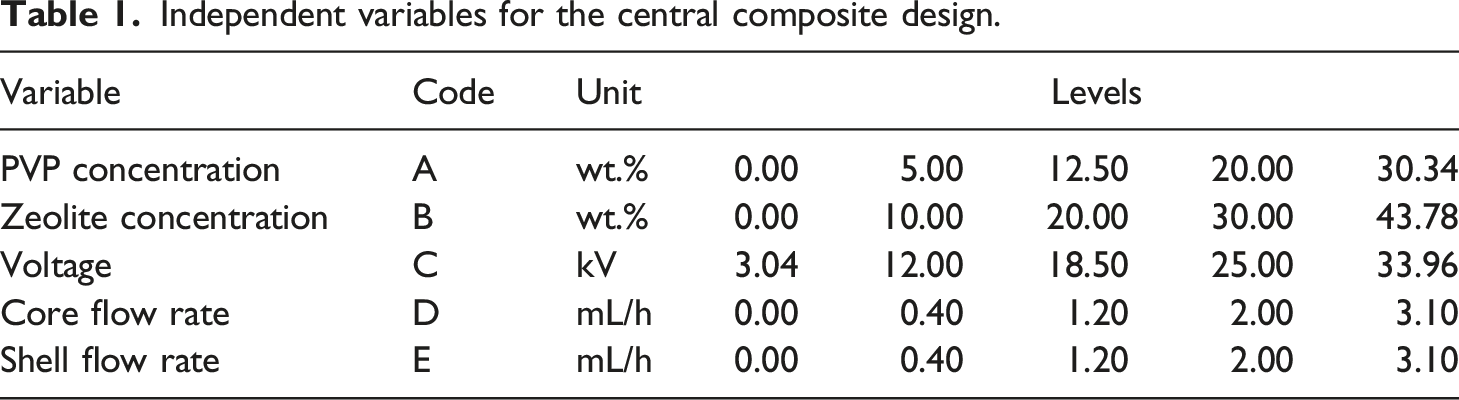
In order to determine the number of experiments, equation (1) has been used.
Production of samples
PES/PVP/ZSM NFCM samples were produced according to the previously reported method
39
as presented in Figure 1. In the following, core spinning of PES flakes in a DMF solvent (25% (v/v)) at room temperature for 3 h until a clear solution was undertaken. In order to produce the shell, firstly, PVP solution was prepared by dissolving PVP powder in DMF: acetone with the ratio of 1:1 for 12 h until a clear solution was obtained. Then, ZSM-5 zeolite was added directly to the PVP solution and stirred at room temperature for 24 h to achieve homogeneous solutions. Next, these dispersions were sonicated (Universal Ultrasonic Cleaner; 100 W Power and 60 kHz) for at least 1 h before using the composite PVP/Zeolite electrospinning solutions. In addition, each electrospun solution was loaded into a 5 mL polyethylene syringe capped with inner and outer needle gauges of 22 G and 16 G, respectively. The needle-to-collector length was set at 15 cm (Humidity 65% Temperature 25°C). Schematic illustration of the NFCM production procedure.
Characterization of samples
Scanning electron microscopy (SEM) was used to examine the morphologies of nanofibers (SEM, XL30-SFEG and FEI Philips, Japan). The average fiber diameter was estimated using Digimizer software to analyze SEM images, and the fiber diameters were measured based on 100 repetitions.
The maximum strength of NFCMs was studied using an (Instron 5566) testing device. To do so, samples with 5 × 30 mm2 dimensions were prepared. During the measurement, the crosshead speed of the moving jaw was 5 mm/min and five repetitions have been considered.
In order to determine the porosity percentage (
Morphological analyses of fibroblast cells on developed nanofibers were carried out 24 h of cell growth, using SEM images prepared from their surfaces. Then, the nanofibers were washed twice using PBS before being fixed for 2 h in 2.5% glutaraldehyde. Next, scaffolds were then cleaned with deionized water and dehydrated in a graded ethanol series. Following a final wash with 100% ethanol, the samples were immersed in hexamethyldisilane (HMDS). By maintaining the samples in a fume hood, the HMDS was airdried. Finally, the samples were sputter-coated with gold and examined under an SEM (S-4160, Hitachi) to reveal cell morphology.
Developing the objective functions
To find optimal design the existence of an objective function to express the relationship between variables and responses of the system is required. In the following, RSM and ANN models will be developed with the same data set (training/testing) to generalize the effect of variables on responses.
RSM models
Generally, the resulting prediction 


In which

In equation (7), 

ANN models
Over the past several decades, ANN-based models are wieldy used to find complex relationships in various kinds of scientific areas which are not possible to obtain with conventional analytical models. An ANN-based model consists of nodes as processing elements and connections between them as weights to empower the output of the nodes. Such models are also called connectionist models due to the connections found between the nodes.
44
Among the various types of ANN, the feed forward-back propagation learning algorithm attracted the attention of many researchers as tool to predict the response of systems. In this algorithm, the total squared error of network output is minimized during the training step by back-propagation of the associated error.
45
In the following, three parallel feed forward-back propagation networks will be considered to predict the diameter, maximum strength and porosity of NFCM. According to the experimental design, the input variables are PVP concentration and Zeolite concentration, voltage, core flow rate and shell flow rate which indicates five nodes in the input layer. Using a trial-and-error approach, the activation function of hidden and output layers is set tan-sigmoid and pure linear functions as Equations (10) and (11), respectively.

Parameter settings of the ANN models.

To define the number of nodes in the hidden layer, the criterion used for regression analyses (total goodness value) has been used to evaluate the performance of different networks. To develop the above-mentioned networks, the ANN toolbox of MATLAB software has been utilized.
Optimization problem
Parameter settings of GA.
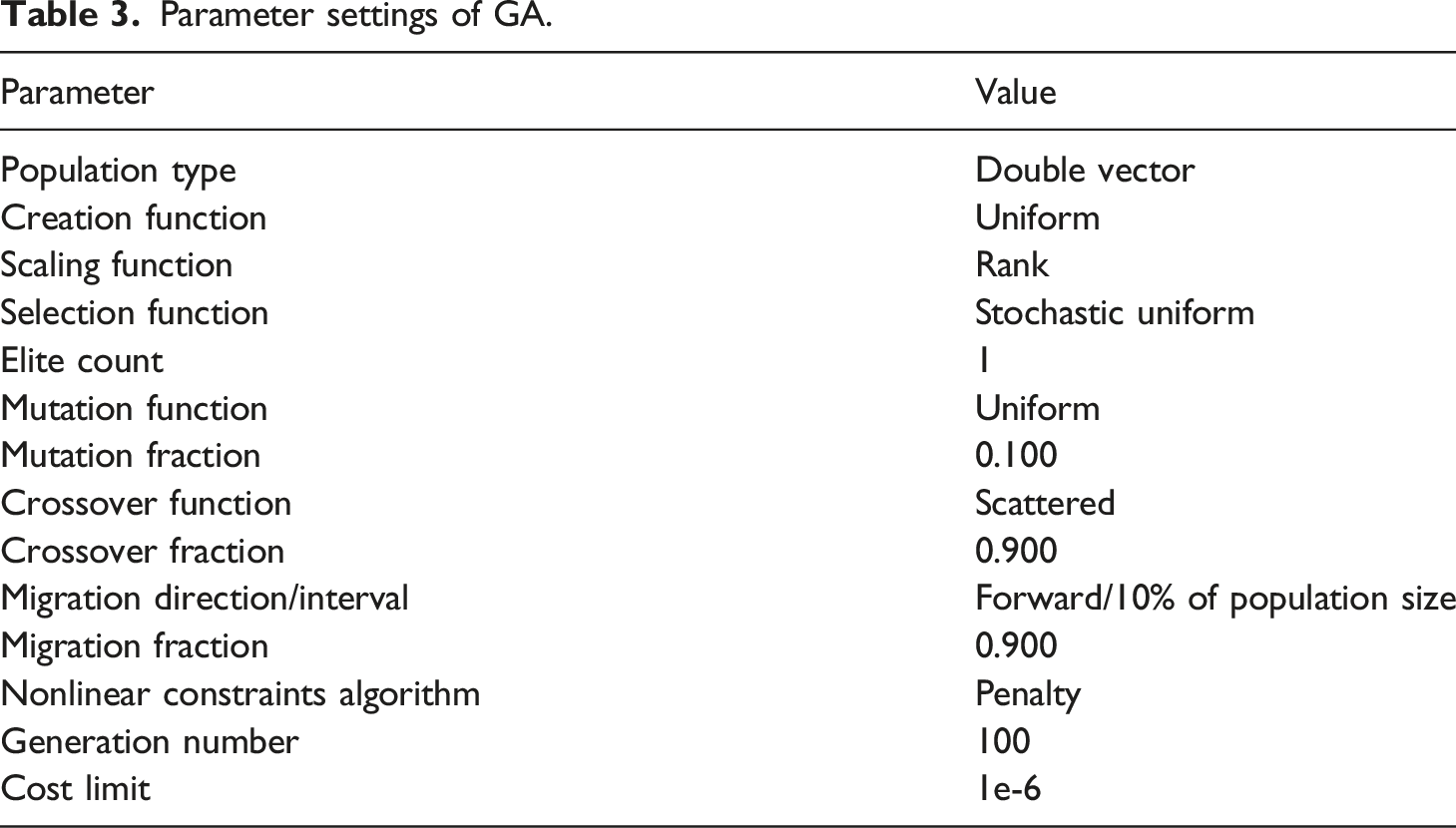
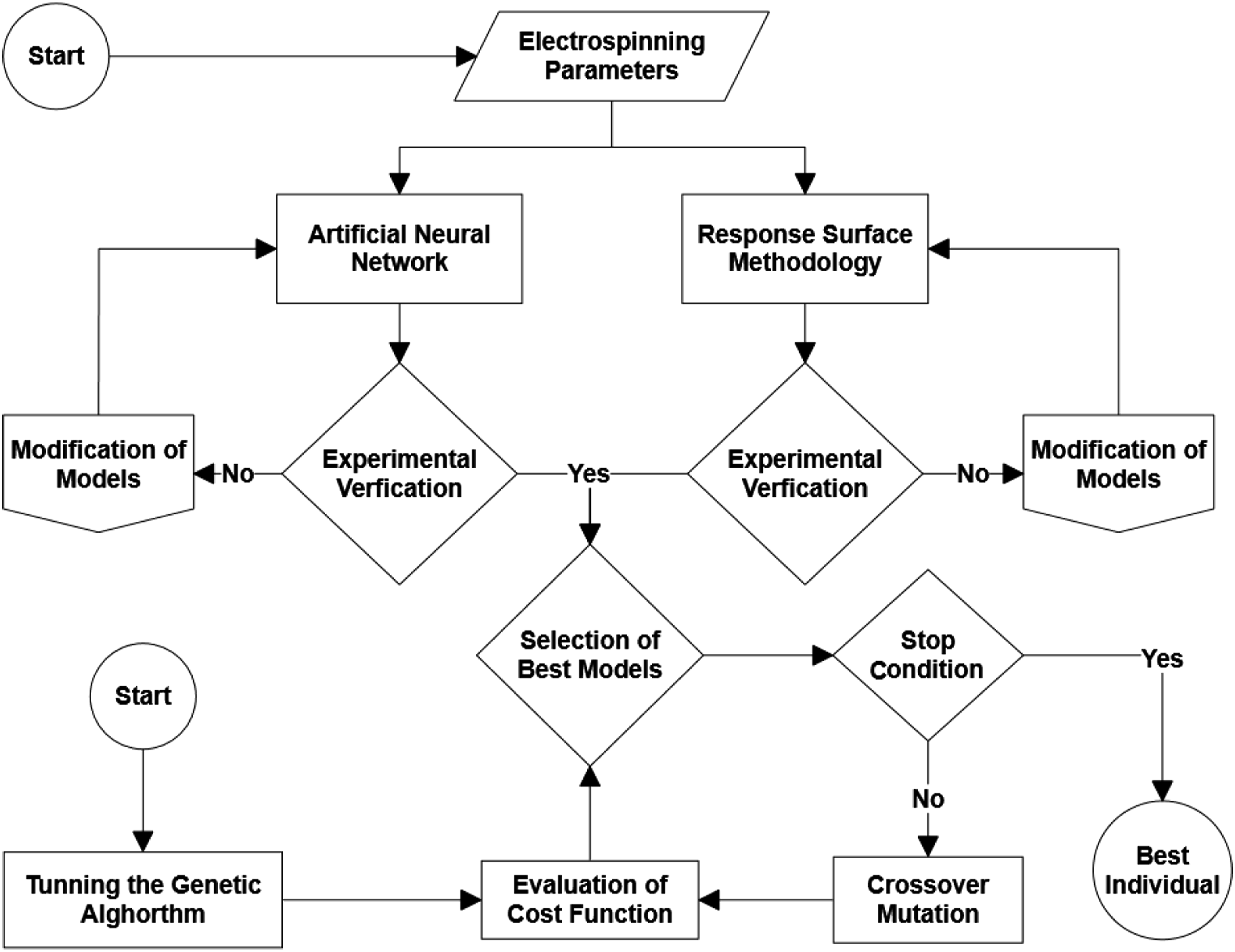
The parameters settings of GA are selected that how to provide a search space with suitable diversity to avoid early convergence. In order to evaluate the cost function, a single objective optimization problem based on the Euclidean distance between the target and individual has been defined as equation (12). The optimization flowchart of hybrid modeling.


Results and discussion
Statistical analysis
Experimental design and results.
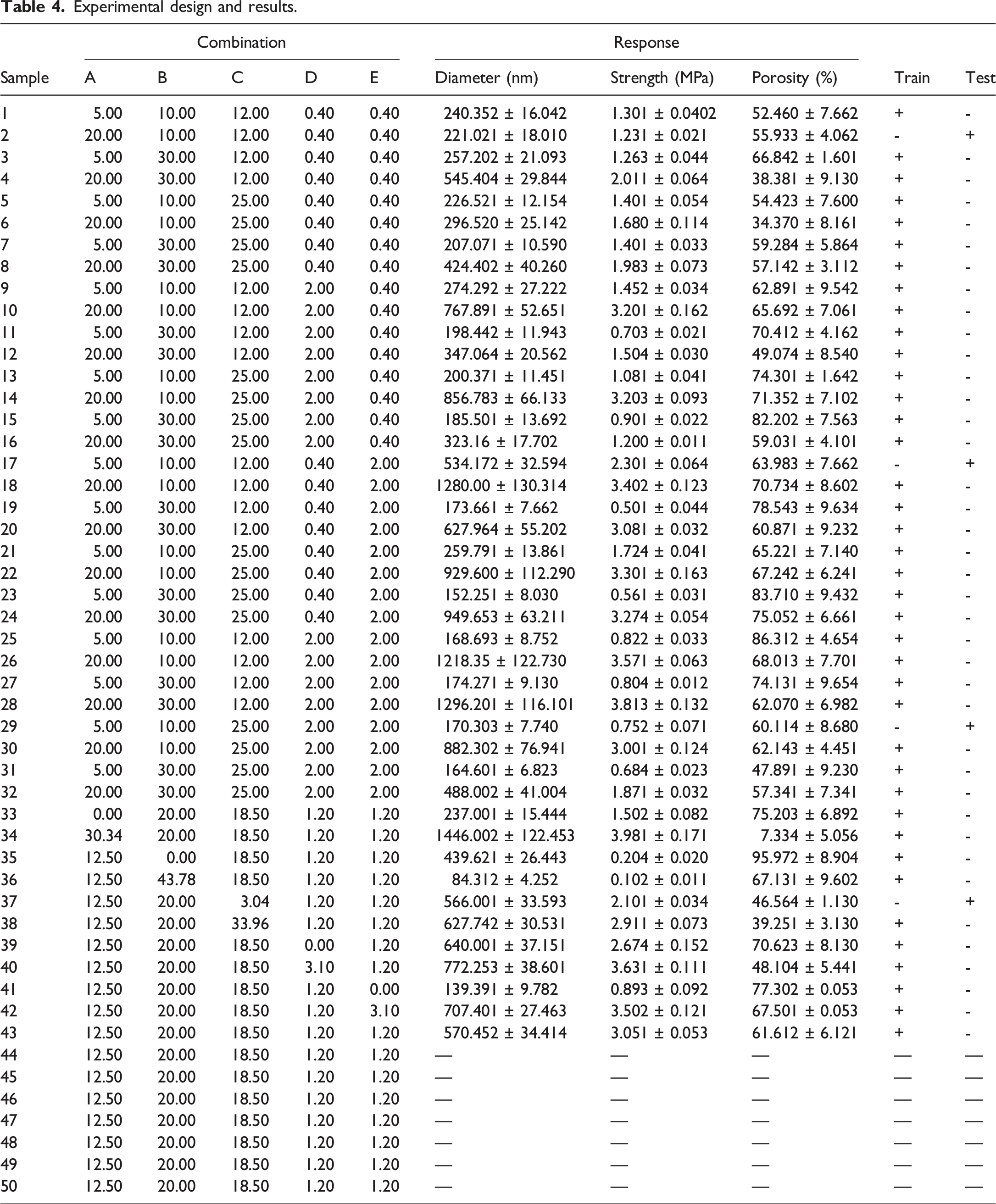
Additionally, equation (19) will be used to normalize data between 0.1 and 0.9 to avoid any quantitative effect in further analysis then it will be utilized to denormalize data in the last step.
Determining the objective functions
In order to evaluate the performance of the RSM models, the normalized experimental data against the predicted values are demonstrated in Figure 3. Performance of the RSM models during prediction at training/testing steps, (a) diameter, (b) maximum strength and (c) porosity.
Performance of the RSM models during the training and testing steps.

The coefficients and offset values of the RSM models.

By using the same coefficients and offset values given in Table 6, the same RSM-based model to predict the diameter, maximum strength and porosity of samples could be constructed. Besides, Figure 4 demonstrates the architecture of the developed network for the prediction of diameter, maximum strength and porosity of NFCM. Architecture of developed neural network models.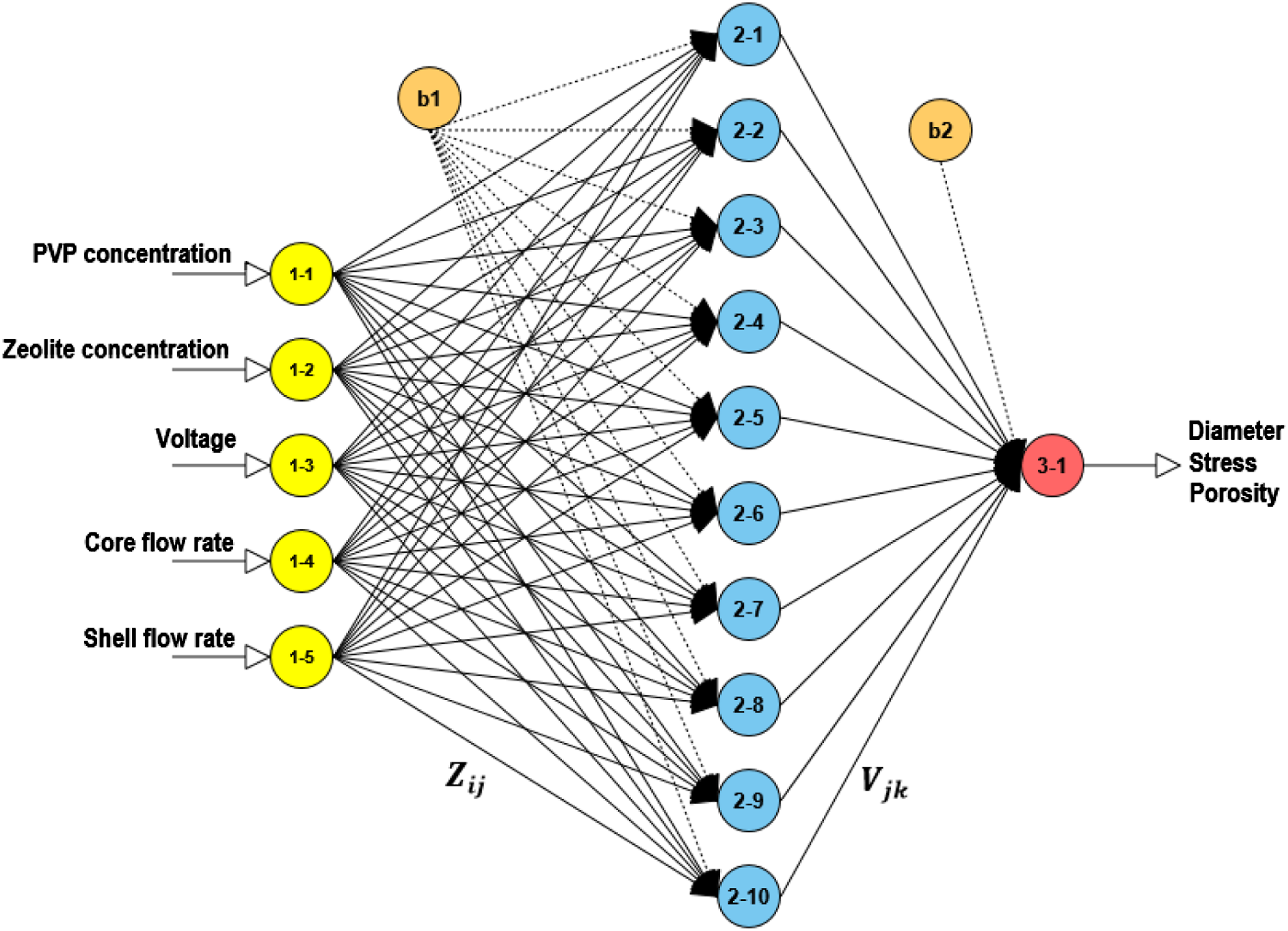
As it can be seen that nodes in the previous layer are fully connected to all nodes in the further layer and nodes in all the layers but the input layer, have been connected to corresponding the bias nodes. In order to evaluate the performance of the ANN models, the normalized experimental data against the predicted values are illustrated in Figure 5. Performance of the ANN models during prediction at training and testing steps, (a) diameter, (b) maximum strength and (c) porosity.
Performance of the ANN models during the training and testing steps.

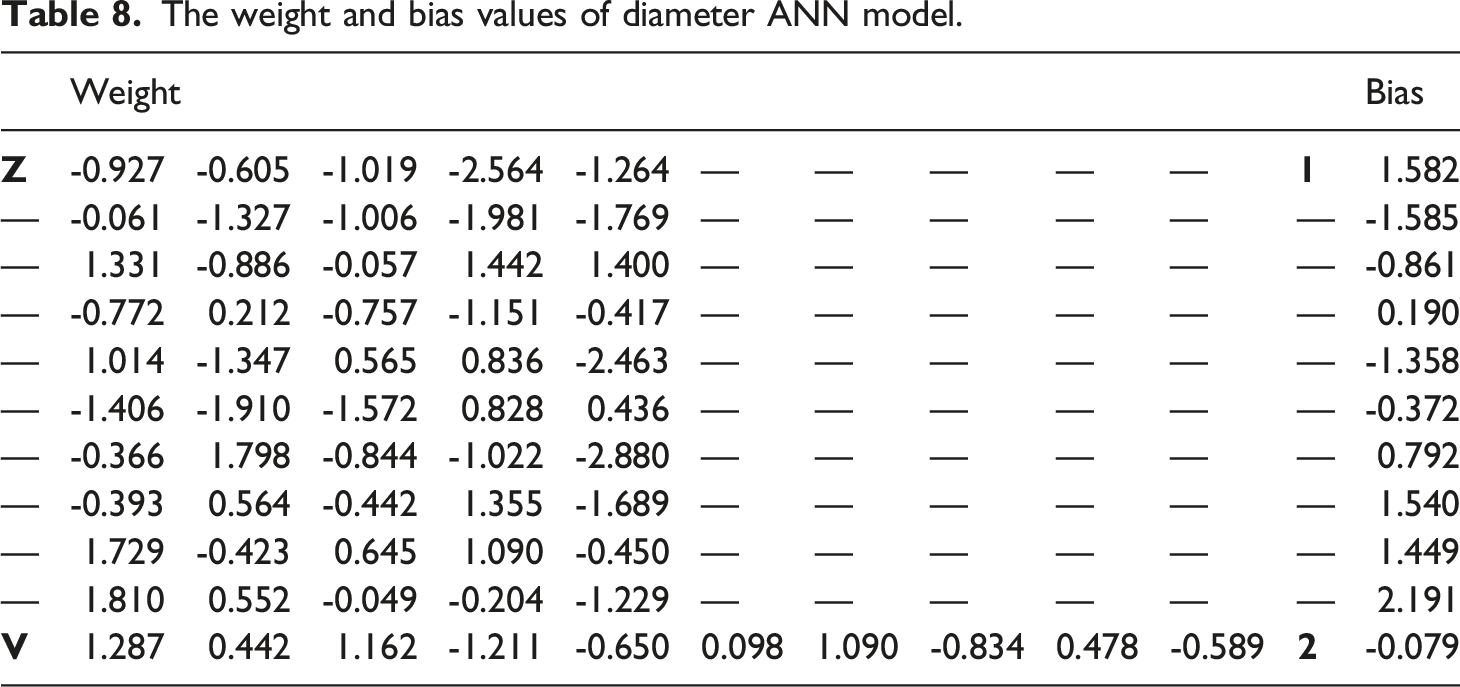
The weight and bias values of diameter ANN model.
The weight and bias values of maximum strength ANN model.

The weight and bias values of porosity ANN model.

By using the same weight and bias values given in Tables 8–10, the same ANN-based model to predict the diameter, maximum strength and porosity of samples could be constructed. Besides, When the ANN models are trained, the effect of input variables on the diameter, maximum strength and porosity of the NFCM is considered using a sensitivity analysis method based on the weights of networks. To assess the relative importance of different input variables (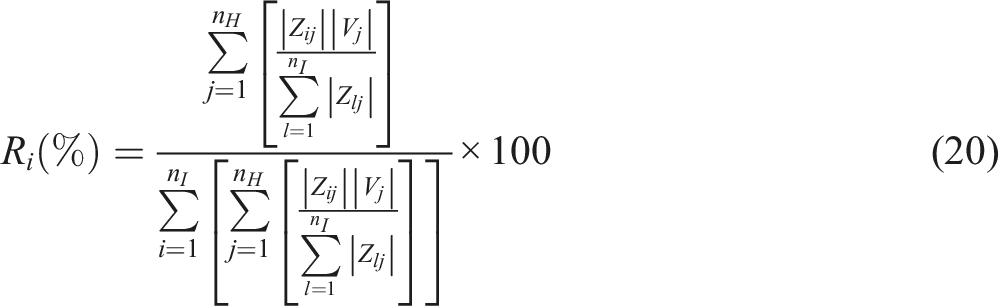
According to equation (20), the higher value will result in a bigger impact of the input variable on the output of the network. The results of the relative importance of input parameters on the output of networks are compared in Figure 6. Relative importance of each input variables in ANN models.
According to Figure 6, it can be found that the shell flow rate, as well as core flow rate, are the most sensitive parameter affecting the diameter of nanofiber with almost the same value as 27.12% and 26.47%, respectively. Similarly, these two parameters are also the highest ones in the case of the maximum strength of 25.87% and 26.34%, respectively. Meanwhile, in addition to shell and core flow rate, PVP and zeolite concentration have almost the same importance on the porosity of the mat. Besides, voltage has the lowest percentage for all three responses. Based on the obtained results, the ANN models are chosen for the optimization step as objective functions.
Optimization results
Cost value of produced samples.

According to Table 11, sample 40 is the closest one to the target sample with a cost value of 0.113. Based on the information in Table 3, GA stops when the cost value is lower than 1e-6 or the generation number reaches the determined value. In order to check the diversity of optimization, the variation of cost value during the different generations under various population sizes is shown in Figure 7. The optimization performance of GA with different population sizes.
The obtained solutions of GA under different population sizes.

Despite sample 4, it can be said that increasing the population size would result in higher precision of optimization. The optimization problem has been defined that how to allow GA not only to improve search space with a higher population size but also provide a proper diversity to find a better individual. However, increasing the population size would result in a higher computation cost. In addition, the performance of GA with 1 generation number and 10 population size demonstrates that the optimization algorithm is able to find the best individual (sample 40 of Table 11) with minimum time and computation cost. After the optimization process, all seven samples of Table 12 were produced to check their actual cost value. Among the new samples, sample 4 of Table 12 demonstrated much better results than sample 40 of Table 4.
Comparing sample 4 of Table 12 to 40 of Table 4, it can be found that there are two sharp contrasts including higher voltage (32.326 > 18.500) and lower core flow rate (1.022 < 3.100), which resulted in the reduction of diameter due to increasing of electrostatic force acting on fibers and decreasing the viscosity of solution.
50
Figure 8 compares the SEM of mentioned samples. Eventually, it can be seen that there is an improvement not only in the case of diameter but also in the case of porosity. Thus, optimization was able to preset a sample that outstrips all other samples.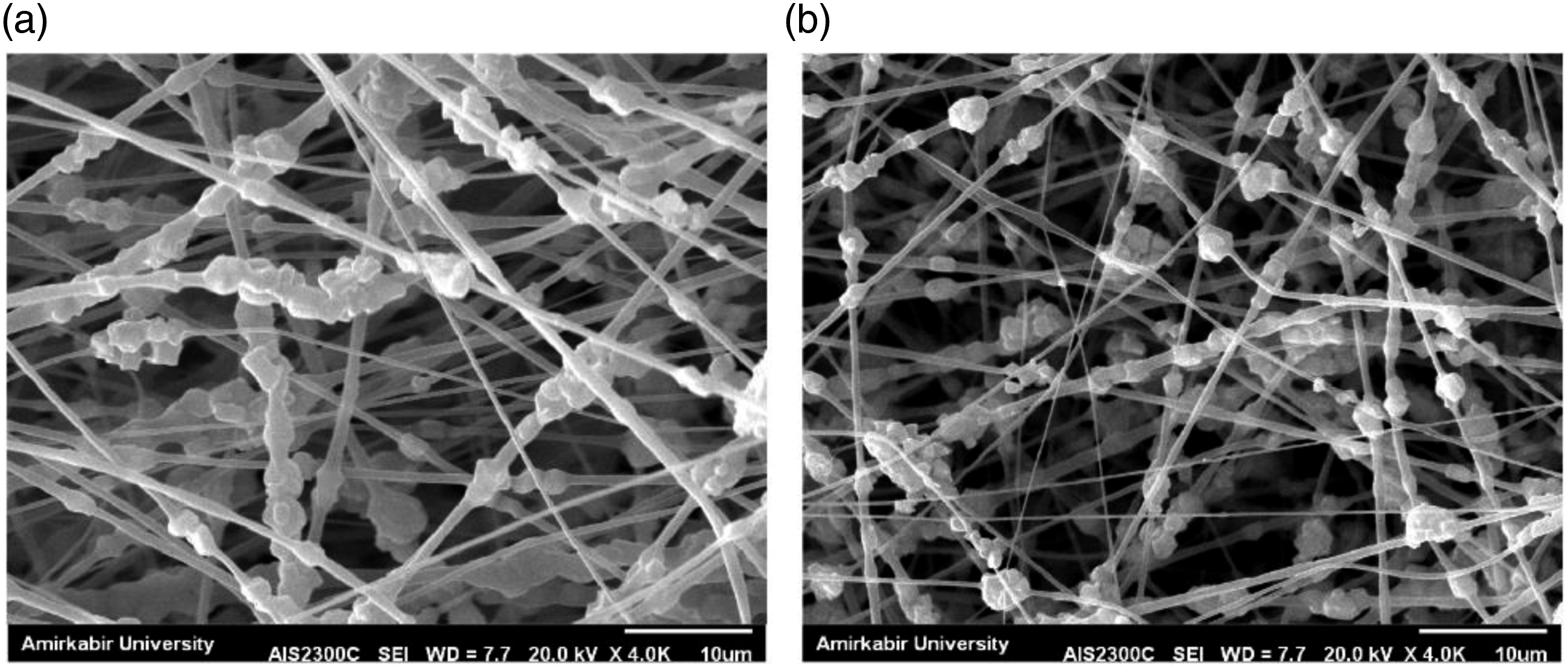
Cell proliferation assay
Researchers examined the cytotoxicity of PES/PVP/ZSM NFCM because of the worries about the possible negative impact of zeolite particles on the health of human. The silicate materials’ cytotoxicity is complicated, and it is principally dependent on the size of the particle, surface functional group, and the zeolite percentage used in nanofiber composite for toxicity survey.
51
In the study by Neidrauer at Drexel University usefulness of a combination of nitric oxide and zeolite in wound healing was revealed. Bioceramics imitate the bone tissues and zeolites are regarded as bioceramics materials and their properties are similar. Thus, it is possible to use them as scaffolds for bone tissue engineering.
52
Zeolite Y biomaterial-hydroxyapatite composite was synthesized in 2014, and based on the 3-(4,5-Dimethylthiazol-2-yl)-2,5-diphenyltetrazolium bromide (MTT) test results, the scaffold with 10% zeolite showed higher cell viability compared to other samples.
53
Considering the morphology of L929 fibroblasts on nanofibers as shown in Figure 9, there is cell attachment to the surface of the nanofibers, and it presents the cellular compatibility of the scaffolds. Upon the contact of cells with materials, they undergo morphological changes to adapt to the surface of cellular materials.
Based on Figure 9, it can be found that sample 4 of Table 12 with 21.96% zeolite as the optimal sample selected in the optimization step, demonstrates strong and good cell proliferation on the scaffold surface after 24 h of culture compared to sample 40 of Table 11 with 20% zeolite and also sample 35 which has no zeolite. Generally, it has been realized that hydrophobic nanofiber membranes impose an anti-adhesion impact compared to ultra-hydrophilic or hydrophilic membranes. The hydrophilic membranes are more promising because of their proliferation performance and cell adhesion. Additionally, ultra-hydrophilic ones show an easy attachment to fats.54,55 Hence, the present work showed that PES/PVA/ZSM core-shell nanofiber membrane could be a suitable nanofibrous membrane for cell proliferation and adhesion due to its average hydrophilic surface.
Conclusion
This work presents an optimization algorithm based on RSM-GA or ANN-GA using a novel goodness function to develop the models and then find the optimal design of NFCM for scaffold application according to experimental information provided by RSM design. In the modeling step, the lack of correlation of RSM models during the training and testing steps has indicated the low performance based on their goodness values (
Footnotes
Declaration of conflicting interests
The author(s) declared no potential conflicts of interest with respect to the research, authorship, and/or publication of this article.
Funding
The author(s) received no financial support for the research, authorship, and/or publication of this article.
