




Abstract
Warp-knitted spacer fabrics (WKSFs) with multi-layers, one of the extraordinary promising materials, are of great significance for structural uses in aerospace, military, construction, building, transportation, and so on. Compressive property is one of the important properties of WKSFs with multi-layer. In order to better understand the flat plate compressive mechanism of WKSFs with multi-layers, simplified models of WKSFs with multi-layers were constructed and their flat plate compression behaviors were simulated by finite element method. The relationship between the number of layers and compressive performance of WKSFs with multi-layers was studied by combining experiment and finite element simulation. The results showed the spacer monofilaments bear the main stress during the compression process. And the larger stress appears at the inflection point of the spacer monofilaments where the bending is serious and contact points among WKSFs with multi-layers. The compressive stiffness increases with the increase of layers in the later stage of compression. The developed finite element models have successfully simulated the flat plate compression stress-strain relationships of WKSFs with multi-layers, which are basically consistent with the general trend of test results, revealing the compression deformation mechanism and providing theoretical reference for the practical application of WKSFs with multi-layers.
Introduction
Warp-knitted spacer fabric (WKSF), also known as a sandwich fabric, is a three-dimensional fabric composed of two separate surface layers and a spacer layer in the middle woven by a two-needle bed warp-knitting machine
1
shown in Figure 1(a). The surface layers could be manufactured in various materials and structures. And the spacer monofilaments connecting two surface layers, usually looped in turn on two beds of needles, could either hold the two surfaces together or separate them.
2
Because of its distinctive characteristics, WKSF confers a great advantage in excellent resilience and compressibility.
3
Besides, WKSF has many other special and excellent properties, such as light weight, heat insulation, moisture protection, sound absorption, environmental protection and so on.
4
Hence, WKSF that has been recognized as one of the most promising materials is of great significance for structural uses in aerospace, military, construction, building, transportation, medicine and others.5–7 (a) Warp-knitted spacer fabric (WKSF); (b) a typical curve of the compressive stress-strain relationship of a WKSF.
Compressive property is one of the important properties of WKSF, which not only reflects the intrinsic quality, but also closely related to its performance. It is found that spacer monofilaments play an important role in compression of WKSF. 8 Many scholars are committed to analyzing and studying the characteristics and influencing factors of spacer monofilaments of WKSFs from multiple perspectives.
Some scholars have established the relationship between spacer monofilament length and pressure of WKSF through Euler’s formula on the basis of the assumption that the spacer monofilaments are slender elastic rods hinged at both ends, but only on the ideal assumption of producing small deflection. In 2011, Mokhtari et al. 9 divided spacer monofilaments into three types according to the elastic theoretical model. It was proved by analysis that there existed an appropriate elastic theoretical model which could predict the compressive properties of WKSFs. And then, Brisa et al. 10 developed a finite element model to study the compressive elastic behavior of vertical spacer monofilaments in a thick WKSF on the basis established by Helbig in this research field, confirming that influence of spacer monofilaments geometry and contact between spacer monofilaments and knitted surface on mechanical properties of vertical spacer monofilaments during flexural buckling process. Beyond that, Zhang et al. 11 analyzed the compression behavior of spacer monofilaments with different shapes and quantities of a typical WKSF structures by finite element method based on the accurate geometric structure reconstructed by μCT scanning. The results showed that the spacer monofilament with shorter length, smaller curvature and smaller torsion had higher compression resistance, and the compressive strength of WKSFs during crushing stage increased with the increase of the number of spacer monofilaments.
The compression deformation mechanism and influencing factors of spacer monofilaments have been revealed. Further, several researchers have attempted to study the relationship between the properties and structure of WKSFs. Analytical and numerical models have been developed to study and understand the overall performance of WKSF under compression loads.
According to the variation of typical stress-strain curve of a single layer WKSF under flat plate compression, the compressive deformation could be characterized by three stages: linear compression stage, yield stage and crushing stage 12 shown in Figure 1(b). In the first stage, the linear compressive stage, the WKSF has a stable compressive stiffness, the slope of which is the elastic modulus combined with Hooke’s law. In the second stage, also known as the yield stage, a smaller increase in force would lead to a larger deformation of the WKSF, so that WKSF is easily compressed during the yield stage. The third stage is the crushing stage, in which the WKSF is compressed to a tight state, indicating higher compression stiffness.
In 2009, Vassiliadis et al. 13 carried out the prediction of the compression performance of WKSFs for concrete applications with the assistance of the finite element analysis applying beam, solid and shell theory from micro and macro perspectives. Qian et al. 14 established the finite element model according to the structural characteristics and deformation of WKSF. The stress and deformation of WKSFs with different structural parameters under flat plate compression and spherical compression load were discussed by ANSYS. The simulation results showed a high degree of correlation in the case of small deformation and moderate deformation, while the difference was obvious in the case of large deformation. In 2015, Liu et al.15,16 analyzed the compressive properties of WKSFs and the influence of various structural parameters by changing the angle and fineness of spacer monofilaments, fabric thickness and surface structure. They focused on the establishment of a constitutive model that could give accurate compressive stress–strain relationships of WKSFs. The influence of each parameter on the compression strain curve was studied by the finite element method and verified by experiments. Du et al.17,18 focused on spherical compression and simulation analysis of WKSF by finite element analysis. The stress distribution and displacement evolution were analyzed to provide a deeper knowledge of the special mechanical behavior of WKSF when they were subjected to spherical compression loads. Datta et al. 19 also found that the cylindrical compressive characteristics of WKSFs were different from those of the flat plate compressibility with the help of numerical methods and experimental results. They found that the cylindrical compressive performance of the WKSFs depends on radius of curvature, linear density of spacer monofilaments, and the thickness of the WKSFs.
As mentioned above, some scholars have carried out some in-depth studies on single-layer WKSF. However, it is difficult to meet the high compressive resistance and other performance requirements of the padding material due to restrictions in thickness and the compressive performance of single-layer WKSF in production and practical application. Therefore, the WKSFs with multi-layers are widely used for structural materials in transportation, automobile industry, household and so on,20,21 which could not only increase the adjustment range of softness and comfort, but also improve fatigue resistance and extend service life. In 2020, Lin et al.22,23 synthesized WKSFs with multi-layers, low-melting polyester nonwovens and modified polyurethane to get a spring-like sandwich composite material with good impact recovery, which could be used as a class of excellent cushioning materials in industrial construction, transport packaging, sports and other fields. However, the design of the layers of multi-layer WKSFs has always been neglected. The relationships between compressive performance of multilayer WKSFs and layers are not clear. Therefore, the compression properties of WKSFs with multi-layers need to be further studied. In 2021, Yu et al. 24 investigated the compressive properties and low-velocity impact properties of WKSFs with multi-layers from an experimental point of view. The relationship between layers and compressive performance of WKSFs with multi-layers was discussed for the first time. In the late compression stage, the more layers the WKSFs with multi-layers have, the greater the compression stiffness. However, the stress distribution of spacer monofilaments during compression couldn’t be obtained by the actual measurement method because of the special three-dimensional structure of WKSF.
In order to better understand the flat plate compressive mechanism of WKSFs with multi-layers and systematically study the relationship between the number of layers and the compressive performance of WKSFs with multi-layers, the flat plate compression behaviors and the layer–property relationships of WKSFs with multi-layers under compression were explored by combining experiments and finite element modelling in this paper. Besides, the stress distribution of the whole WKSFs with multi-layers and spacer monofilaments could be visually observed, revealing the compression deformation mechanism of WKSFs with multi-layers. This paper could provide a theoretical basis for the selection of cushioning material with good compression properties, and has extremely important practical significance for the development and promotion of related products.
Experimental work
Materials
Basic parameters of three kinds of WKSFs.


The real image of three kinds of WKSFs with different layers.
Flat plate compression test
According to the National Standard GB/T24442.1–2009 titled Textiles-Determination of compressive properties-Part 1: Constant method, the compression properties of WKSFs with multi-layers in the form of flat plate compression through MTS Exceed E43 (MTS Systems (China) Co., Ltd., Guangzhou, Guangdong, China) were tested shown in Figure 3. The size of samples is 100 mm × 100 mm × 30 mm. The WKSFs were compressed to 20%, 40%, 60%, 80% of the original thickness at a compression rate of 20 mm/min. The relationships between stress and strain of three kinds of WKSFs with multi-layers were studied to obtain the compressive curve of WKSFs and explore the compressive characteristics of WKSFs with multi-layers. Flat plate compression test.
The relationships between stress and strain of three kinds of WKSFs with multi-layers were studied to obtain the compressive curve of WKSFs and explore the compressive characteristics of WKSFs with multi-layers.
Modeling
Geometrical modeling
As shown in Figure 1(a), (a) single layer WKSF consists of three parts: top layer, spacer layer and bottom layer. Spacer monofilaments, which connects and supports the top and bottom layers, play an important role in the compressive performance of WKSF. Due to the complexity of the loops at the top and bottom layers of WKSF, and the different arrangements of the spacer monofilaments, it is necessary to simplify the WKSFs with multi-layers in the simulation. The multi-layer WKSFs models designed in this paper are ideal. In order to ensure the convergence of simulation results, the following assumptions need to be made before simulation by ABAQUS software: (1) During the compressive process of WKSFs, the pressure is mainly borne by spacer monofilaments, and the surface structure bears little pressure. Therefore, the top and bottom layers of WKSF would be equivalent to an isotropic solid thin plate.
25
(2) The plastic deformation of spacer monofilaments could be ignored during single flat plate compression in elastic region. Therefore, the spacer monofilaments would be equivalent to an elastic rod, whose length remains constant under pressure. (3) Polyester monofilaments with a circular cross section are used as spacer monofilaments. Considering the interaction between spacer monofilaments during compression, friction would occur. Therefore, the friction coefficient between spacer monofilaments would be set to 0.243. (4) The loops of surface layers have a strong constraint on both ends of the spacer monofilaments, and the possibility of lateral displacement in the actual compression process is very small. Therefore, it is assumed that no lateral displacement occurs between the spacer monofilaments and the surface during compression. (5) The difference in structure between the top and bottom layers could cause a lot of friction, and the compressive speed is slow, so the possibility of lateral displacement in the process of compression is very small. It could be assumed that no lateral displacement occurs between layers in the process of compression.
Based on the above hypothesis, the three-dimensional structure models of WKSFs with multi-layers were established.
Spacer monofilaments
Figure 4(a) and (b) show the side view from walewise and the coursewise of spacer monofilaments. The two separate surface layers are connected by spacer monofilaments in inclined forms shown in Figure 4(c). (a) Cross-section view along the wale direction; (b) cross-section view along the course direction; (c) three-dimensional simulation model of spacer layer of WKSFs; 3D visualization of the spacer monofilaments in a unit cell:(d) coursewise; (e) walewise; (f) schematic representation of WKSFs in a unit.
As shown in Figure 5, the stitch composed of controlling points A1-A8 is on the top layer while the other stitch at the same course composed of controlling points B1-B8 is on the bottom layer. The underlap from A8 to B1 is a curve where M1 and M2 are at the trisection position. The coordinates of M1 and M2 are changed according to the spacer monofilament tension so that different degrees of bending are reflected. Simplified geometric models with three layers.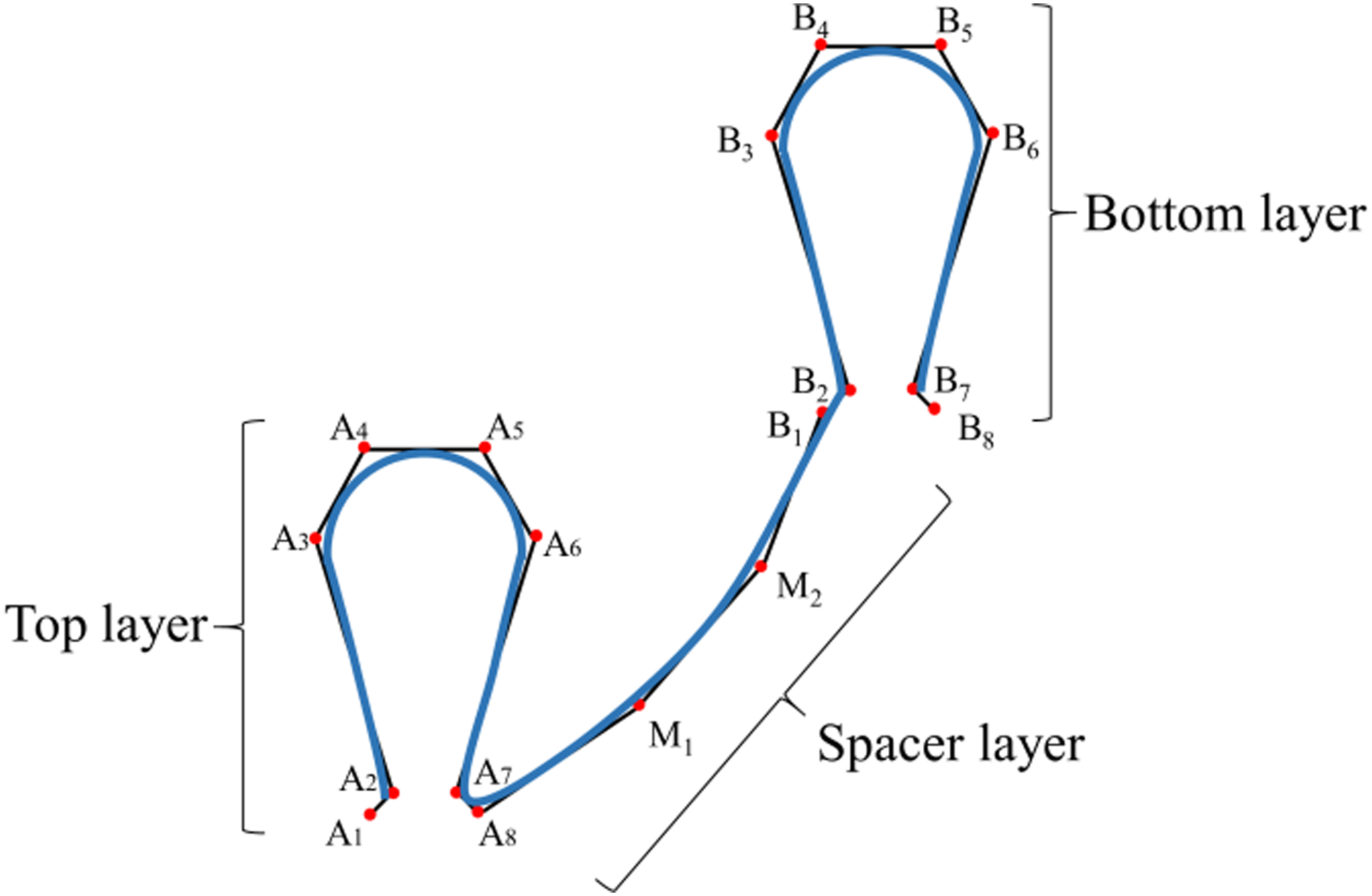
In order to form the yarn curve, the Bezier curve is introduced as shown in Figure 6. The quadratic Bezier curve with lower calculation generated by three controlling points is applied in this paper. The equation is as equation (1) shows. The quadratic Bezier curve.

Supposing that the coordinates of three points are as follows: q
1
is (x
1
, y
1
, z
1
), q
2
is (x
2
, y
2
, z
2
), q
3
is (x
3
, y
3
, z
3
) and the dynamic point q(t) is (x
t
, y
t
, z
t
). Ideally, the x-coordinate of q(t) is regarded as the same as that of q
2
. Therefore, coordinates of other points of the final curve through q(t) could be calculated according to the following equations.


Spacer monofilaments, the main force unit of WKSF, would bend and deform under compressive process. The top and bottom layers and spacer monofilaments are connected with each other, and the structure is more complicated. Besides, the loops of surface layers have a strong constraint on both ends of the spacer monofilaments. So, the spacer monofilament with the diameter of 0.18 mm would be equivalent to an elastic rod without loop structure, and its length would remain constant under compressive process. Based on the above theoretical derivation, the simplified model of the spacer monofilaments in a unit cell for finite element is shown in Figure 4(d) and (e).
Surface layers
The top and bottom layers could be equivalent to the solid thin plate with the same thickness as the surface of WKSF. The organization of the top layer of WKSF is mesh. Therefore, the single unit of the top layer of WKSF could be simplified to a polygonal structure with the thickness of 0.2 mm according to the actual image. The organization of the bottom layer of WKSF is tricot. So, the single unit of the bottom layer could be simplified to a rectangular solid sheet with the thickness of 0.2 mm. The real image and the model diagram of top and bottom layers are shown in Figure 7. (a) (b)The real image and (c–f) three-dimensional simulation model of surface layers of WKSFs (g) (h)schematic representation of surface layers of WKSFs in a unit.
According to the spatial distribution law of spacer monofilaments and surface layers, the locations of spacer monofilaments are marked on a unit of the top and bottom layers shown in Figure 7(g) and (h). While, a white big dot represents a loop, and a loop contains two spacer monofilaments.
Based on the assumptions of the geometric model and the simplification of the WKSF, the simplified unit model was established by SOLIDWORKS 2018 software shown in Figure 4(f), in which the fineness and length of spacer monofilaments and the thickness of the top and bottom layers were set according to the parameters of the WKSFs actually used. A simplified model of the multi-layer WKSFs with the size of 10 mm×10 mm×30 mm for finite element is shown in Figure 8. Structure of WKSFs with multi-layers generated by SOLIDWORKS.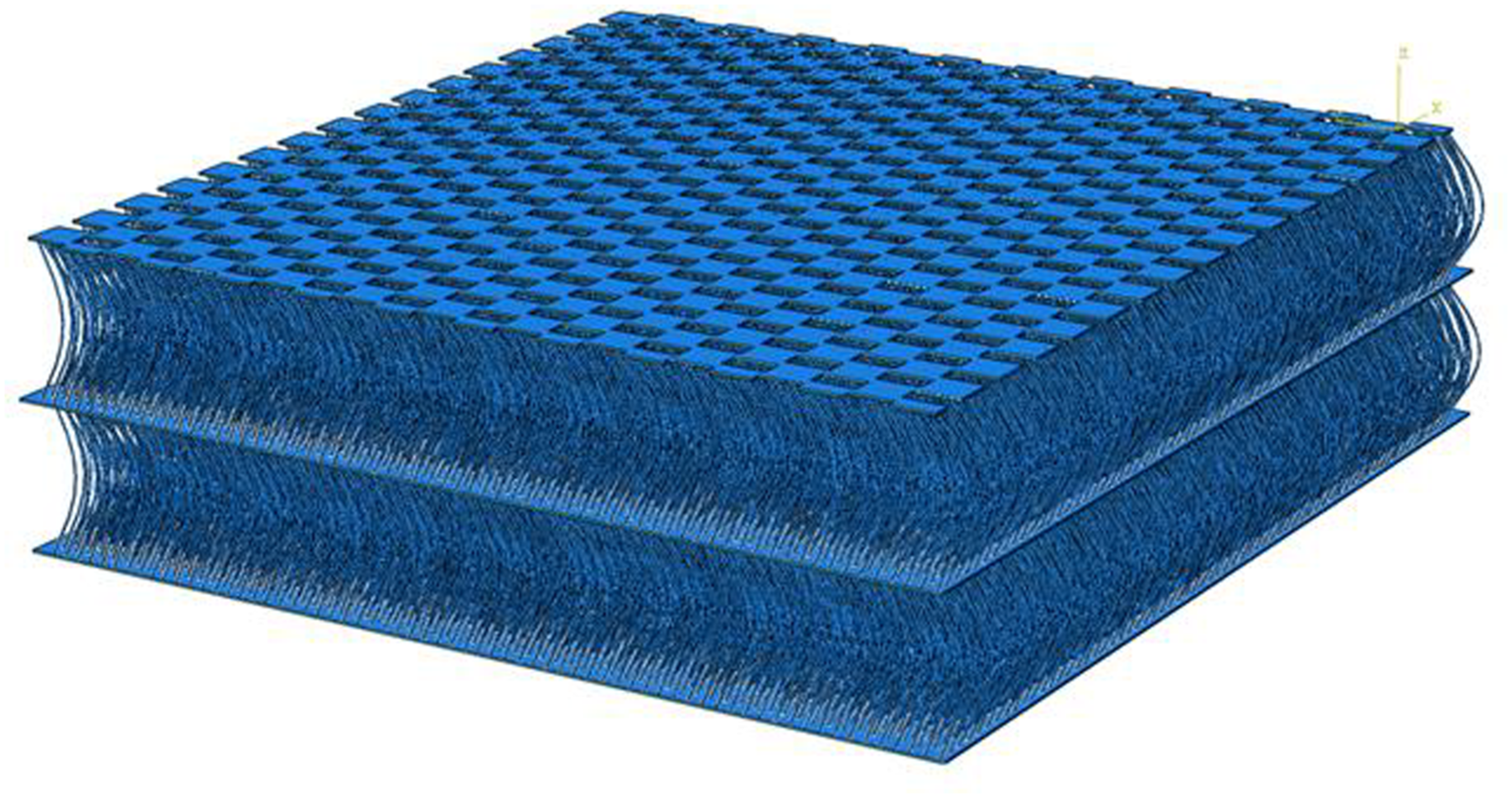
Finite element model
According to the actual materials mentioned above, young’s modulus and density of spacer monofilaments and surface layers were set, respectively. The Poisson’s ratio of surface layers and spacer monofilaments was 0.3. The compression head of the model was defined as the isotropic steel material with an elastic modulus of 200, 000 MPa, a density of 7.85 g/cm3 and a Poisson’s ratio of 0.3.
There were too many elements and meshwork, so the compression time of WKSFs with multi-layers was too long. In order to shorten the calculation time, it was mass scaled and the analysis step time was given as 0.1 s. Stress and strain of WKSFs with multi-layers during the compressive process would be studied, and field output variables and historical output variables should be set accordingly. “Tie” constraints were set between the spacer monofilaments and the surface layers. 26
And the compressive form of WKSFs with multi-layers was set in the Load module in accordance with the test standards. All the possible movements of the bottom compression head have been constrained, the top compression head only generated displacement in the Z direction, the downward displacement was 24 mm, and the displacement in the X and Y directions was 0. Besides, the more the number of meshes, the higher the accuracy of the finite element simulation results. But it would greatly prolong the calculation time of finite element. Therefore, it would be necessary to select a more appropriate number of meshes to divide the whole model. Finally, a job was created and submitted for calculation.
Results and discussions
Compressive properties
The compressive process of three kinds of WKSFs with multi-layers is shown in Figure 9. With the increase of compression strain, the WKSFs with multi-layers mainly showed the bending of spacer monofilaments, and the shape of spacer monofilaments was slightly different in each layer. The flat plate Compression behaviors of three kinds of WKSFs with multi-layers under different strain.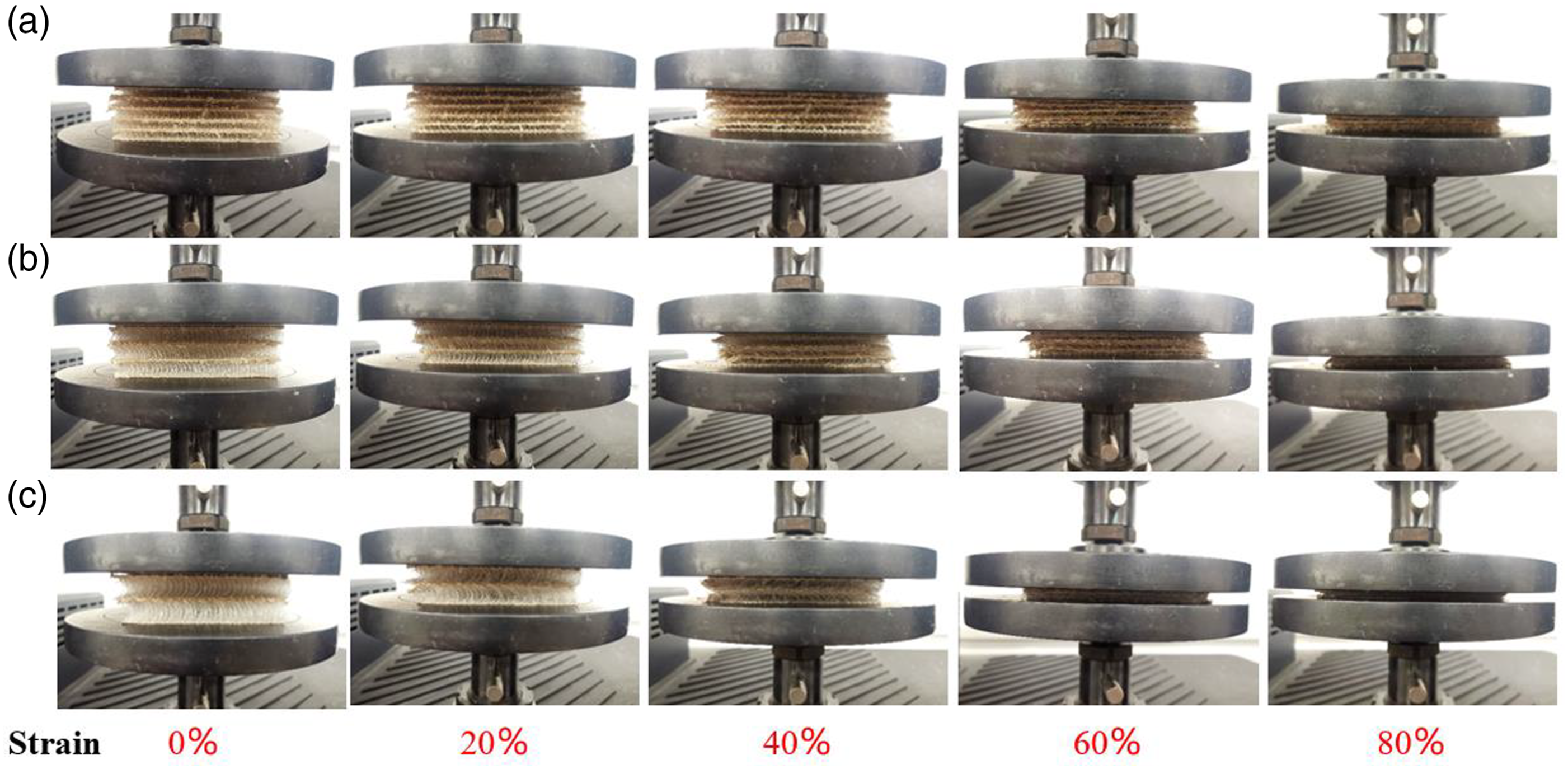
And it could be seen from Figure 10 that the stress-strain curves of three kinds of WKSFs with multi-layers under flat plate compression are obviously discrepant, but could also be divided into three stages: linear compression stage, yield stage and crushing stage. When compressed to about 14% of the original thickness, the compressive stiffness of three kinds of WKSFs with multi-layers has significant difference, the elastic modulus of sample B is larger than that of sample C, while that of sample A is in between. After that, the elastic modulus of sample A is largest, while that of sample C is the smallest. In other words, the WKSFs with more layers could bear more pressure in the later compression. Compressive stress-strain curves of three kinds of WKSFs with multi-layers under different strain: (a)20%; (b)40%; (c)60%; (d)80%.
The stress-strain curve of WKSFs with fewer layers would transition from the linear compression stage to the yield stage earlier. A small increase in force directly results in larger deformation of WKSFs. It was mainly manifested by the serious bending of the spacer monofilaments, which was very obvious for sample C. Among them, three kinds of WKSFs with multi-layers showed deep divergence in the second stage. The stress-strain curve of sample A with the largest number of layers fluctuates most frequently, while the stress-strain curve of sample C with the least layers does not fluctuate in the second stage. Therefore, it could be seen that the frequency of fluctuation is closely related to the number of fabric layers.
In the late compression stage, spacer monofilaments are prone to "lodging phenomenon", which would transition from yield stage to crushing stage. Spacer monofilaments bend close to the limit state under compression load, showing high compression stiffness. Among the three kinds of WKSFs with multi-layers, sample A has more surface layers and shorter spacer monofilaments. The spacer monofilaments would bend during the compression process, and the bending part of the spacer monofilaments would contact the top and bottom layers of the WKSFs earlier, resulting in further increase of stress in the thickness direction. Therefore, the pressure that sample A could bear under the condition of the same strain is larger.
Finite element simulation results analysis
The finite element simulation results of several WKSFs with multi-layers are shown in Figures 11–13. In the initial stage of the simulation, the spacer monofilaments of the topmost WKSF interact with the topmost surface layer. And then, the stress concentration of spacer monofilaments gradually shifts to the middle part of the spacer monofilaments and the contact points between spacer monofilaments and the bottom surface layer. That is, the stress is mainly concentrated on the spacer monofilaments of the first layer of WKSFs with multi-layers in the initial stage of deformation, and the stress of the spacer monofilaments is much greater than that of the surface layers of WKSFs with multi-layers. And then, the stress is then transferred to the next layer. During the early compression process, the spacer monofilaments bend, resulting in a linear increase in stress as strain increases. Von Mises stress plots of sample A at different strain:(a) 0%; (b) 0.09%; (c) 20%; (d) 40%; (e) 60%; (f) 80 %. Von Mises stress plots of sample B at different strain:(a) 0%; (b) 0.09%; (c) 20%; (d) 40%; (e) 60%; (f) 80 %. Von Mises stress plots of sample C at different strain:(a) 0%; (b) 0.09%; (c) 20%; (d) 40%; (e) 60%; (f) 80 %.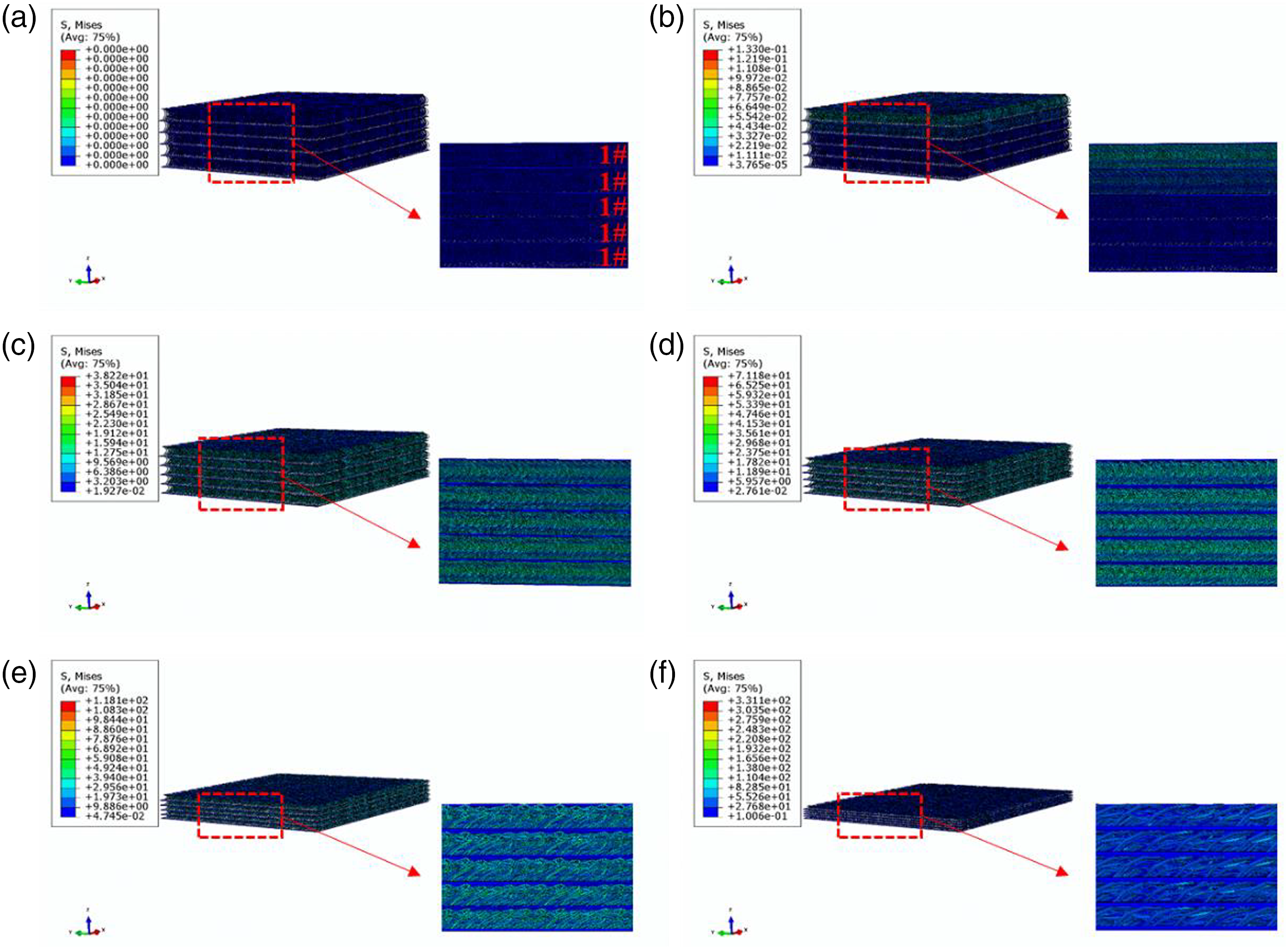


When it comes to the second stage, spacer monofilaments still play a leading role in the compression process, and spacer monofilaments of each layer are stressed. However, the stress of single spacer monofilament is different due to the different inclination angle. The spacer monofilaments bend greatly with the increase of strain, resulting in a slight increase in stress.
In the third stage, called the crushing stage, the length of the monofilaments decreases sharply. There is also some friction between adjacent spacer monofilaments. Besides, the contact between spacer monofilaments and surface layers has an important influence on the compression behavior of WKSFs with multi-layers in the crushing stage. With the increase of compression displacement, the bending of the monofilaments is close to the limit state, and the contact area with the two adjacent surface layers increases gradually. And then, the WKSFs with multi-layers have been pressed to a solid structure, the compression stiffness of the WKSFs with multi-layers increases rapidly. At the moment, small deformations require a lot of stress. In the whole compression process, the stress on the spacer monofilaments is much greater than that on the surface of the WKSFs with multi-layers. And the larger stress appears at the inflection point of the spacer monofilaments where the bending is serious and contact point among WKSFs. The point with the largest stress is the place where the WKSFs with multi-layers are most likely to be damaged when used as a material.
After the stress is transferred to each layer of WKSFs, the stress is evenly distributed on each layer. The compressive characteristics of the WKSFs with multi-layers conform to Kelvin’s law and Maxwell’s Law.
In a single layer WKSF, the stress is borne by n spacer monofilaments. Each spacer monofilament is an elastic rod. According to Kelvin’s law, the spacer layer of the WKSF could be regarded as an elastic element composed of n elastic bodies in parallel shown in Figure 14. According to the characteristics of the model, it can be known that Spacer monofilaments model based on Kelvin’s law.

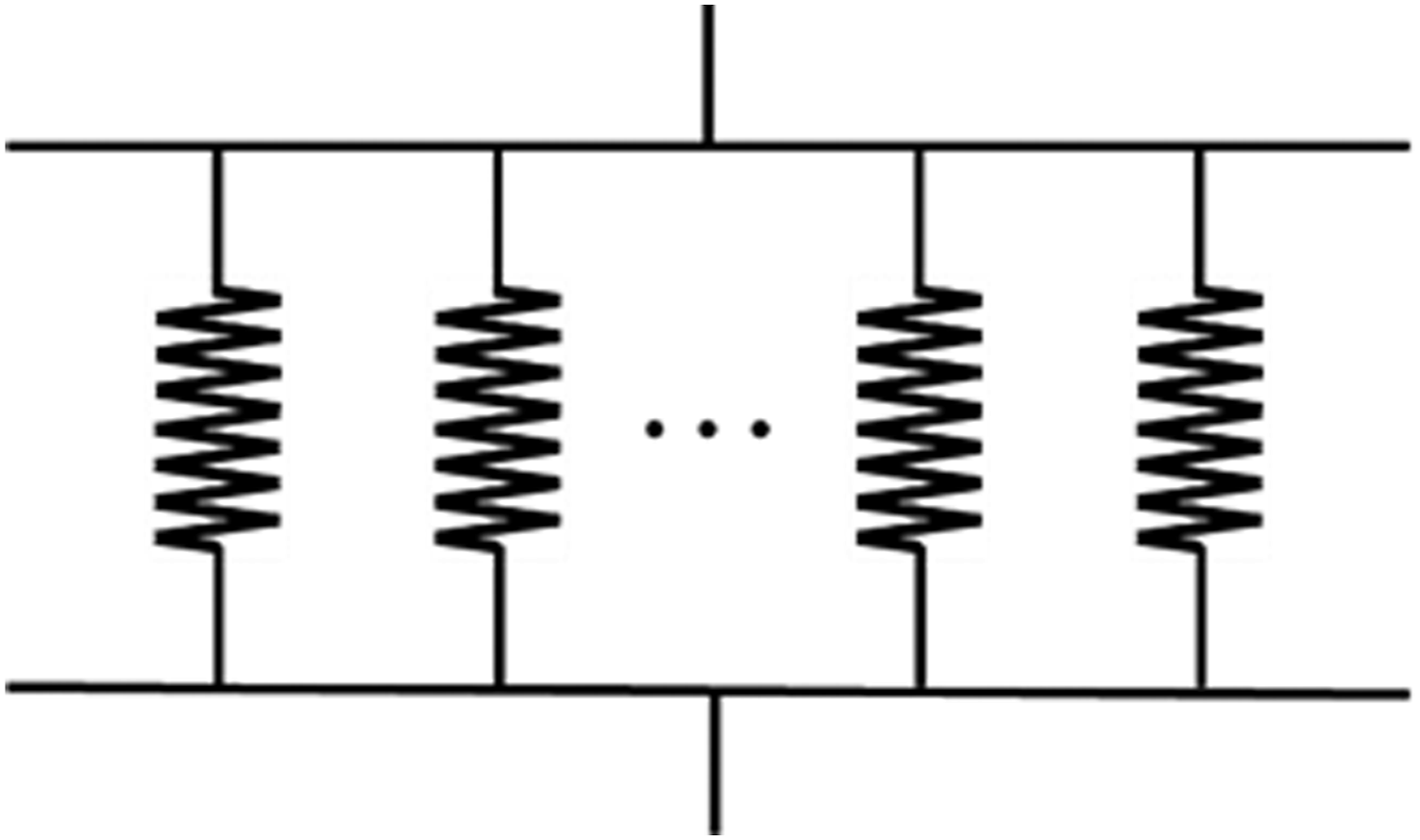
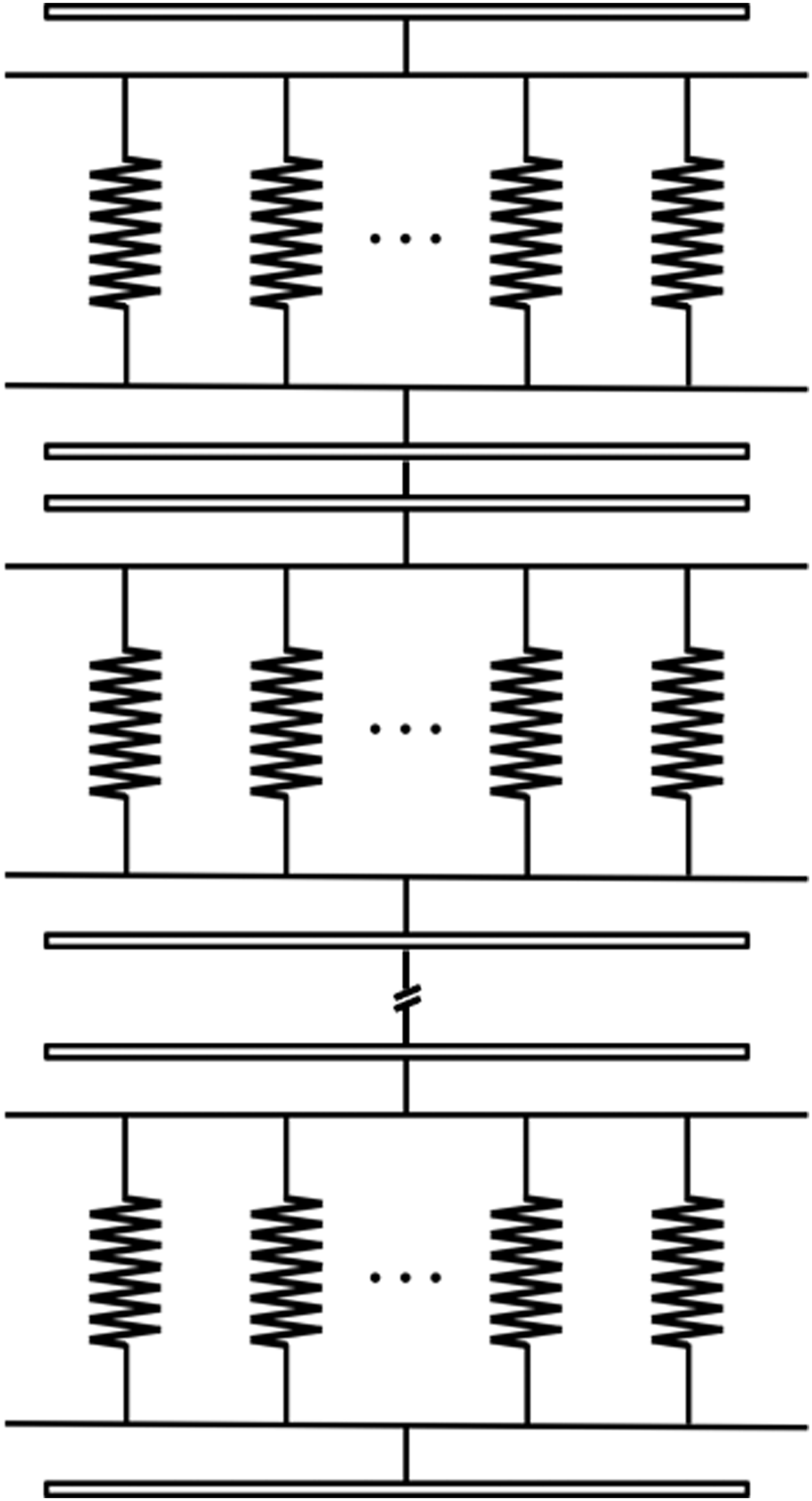
The single-layer WKSF is composed of several spacer monofilaments and surface layers. The top and bottom layers are assumed to be ideal elastic bodies, so the single-layer WKSF could be regarded as a component composed of elastic plates and elastic rods in series (Figure 15 and 16). A single layer WKSF model based on Maxwell’s Law. The model of a WKSF with multi-layers based on Maxwell’s Law.


In this case

Each layer of WKSFs with multi-layers is regarded as a unit, that is, WKSFs with multi-layers are composed of several WKSFs connected in series. This satisfies Maxwell’s law

That is, WKSFs with multi-layers have the same stress in each layer. In addition, studies have shown that the stress of the WKSF is related to the length, inclination and constraint of the spacer monofilaments. Figure 17 shows the stress-strain relationship of the multilayer WKSF model with different layers. All finite element models have similar stress-strain curves. The results have shown that the WKSFs with five or three layers among them have higher compression resistance. This is because when the number of layers is large, the shorter spacer monofilaments are in contact with the adjacent surface layers earlier, resulting in a sharp increase in stress. Therefore, the more the surface layers, the greater the stress in the compression direction in the later stage of compression. Sample A with the most layers could bear a larger pressure under the condition of the same strain. Compression properties experimental and numerical results of WKSFs with multi-layers: (a) sample A; (b) sample B; (c) sample C.
Although the stress-strain curves of the WKSFs with multi-layers model has similar linear compressive stage, yield stage and crushing stage to the experimental curves, there is some error between the stress value of finite element simulation and the experimental results. This analysis is different from the experiment of WKSFs with multi-layers, and the variation pattern of each layer is not consistent, which may be caused by the following reasons: (1) Models were simplified during modeling. Spacer monofilaments and surface layers of the WKSFs with multi-layers are not actually ideal elastomers. (2) There are gaps around the ends of the top and bottom layers of WKSF, which gives more freedom to the spacer monofilaments at the beginning of the deformation. There is a certain restraint and interaction between the spacer monofilaments and surface layers, and there is also a certain connection and interaction between the monofilaments. In this model, the contact action and friction mechanism between the spacer monofilaments and contact layers are simplified. This hypothesis couldn’t accurately describe the nonlinear interaction between spacer monofilaments and surface layers in real WKSFs with multi-layers, which would affect the simulation results. (3) WKSF not only shows compression elasticity, but also produces damping effect [27]. In the initial stage of compression process, the spacer monofilaments mainly exhibit elastic deformation. However, the damping effect would be more and more obvious with the increase of the deformation.
Conclusions
The paper focused on flat plate compression of WKSFs with multi-layers by experimental method and finite element method. The spacer monofilaments bore the main stress during the compression process. And the larger stress appeared at the inflection point of the spacer monofilaments where the bending was serious and contact points among WKSFs. The developed finite element models have successfully simulated the compression stress-strain relationships of WKSFs with multi-layers in satisfactory agreement with the experiments. The experimental results and simulation results have shown that the WKSFs with more layers have higher compression resistance in the later stage of compression. The finite element model established in this study could enhance the understanding of the layer–property relationships of WKSFs with multi-layers under compression, providing provide theoretical basis for the selection of cushioning material with good compression properties, and has extremely important practical significance for the development and promotion of related products.
Footnotes
Declaration of conflicting interests
The author(s) declared no potential conflicts of interest with respect to the research, authorship, and/or publication of this article.
Funding
The author(s) disclosed receipt of the following financial support for the research, authorship, and/or publication of this article: This study is supported by the National Science Funds of China (11972172), the Fundamental Research Funds for the Central Universities (JUSRP22026, JUSRP52013 B), and a Project Funded by the Priority Academic Program Development of Jiangsu Higher Education Institutions (PAP).
