




Abstract
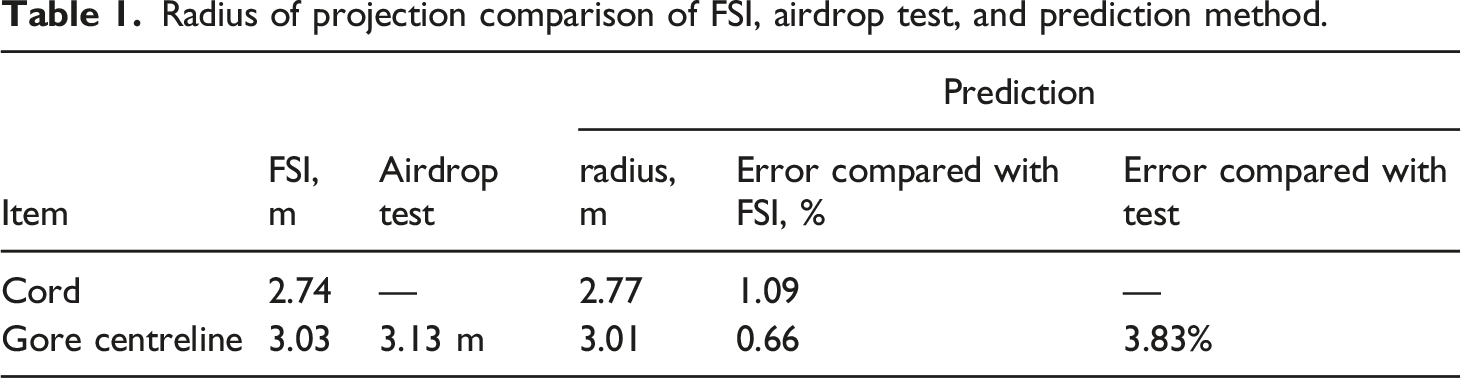
Parachute is decelerator constructed of flexible porous fabrics that changes the motion state of the payload, aerodynamic characteristic in steady descent of which largely depends on equilibrium profile. A novel analytical method to predict the equilibrium profile of flexible porous canopy fabrics in steady decelerating stage is presented. This method introduces Forchheimer’s law and Ergun theory into Ross mechanical equilibrium model, and further considering both the flight status and the materials properties. The prediction error of projection radius of gore centreline is 3.83% compared with the airdrop test results, and the prediction errors of the projection radius of cord and gore centreline are 1.09% and 0.66% respectively compared with Fluid-Structure Interaction method. Results indicate that this proposed method can be an efficient way to obtain an accurate canopy profile with much less computation cost. Finally, some illustrative examples are given to evaluate the effect of structural parameters on the parachute equilibrium profile. It is found that the length of the suspension line should be somewhat longer than the nominal diameter and the spacing of suspension lines should be slightly longer than 1m. And it is recommended that the radius of apex vent should be 0.04 ∼ 0.1 times of the nominal radius of the parachute. The Young’s modulus of materials has little effect on the equilibrium profile. Overall, the new approach could predict the canopy profile quickly for the parachute design and provide an accurate shape basis for the subsequent aerodynamic research based on CFD method.
Keywords
Introduction
Parachutes are widely used in the domains of aerodynamic deceleration, recovery landing and attitude stabilization of strategic missions such as manned spaceflight and deep space exploration due to the light mass and large inflated area.1–4 Both theories and experiments show that the parachute, as an aerodynamic decelerator constructed of flexible fabrics that change the motion state of the payload, aerodynamic characteristic of which in steady descent largely depends on the equilibrium profile of canopy fabrics. The correct three-dimensional model is the basis for further investigations of aerodynamic performance by the CFD or FSI method. Prediction for the equilibrium profile of flexible porous canopy fabrics can help researchers establish exact 3D parachute models, which are more accurate than experimental image-based modeling methods5,6 or traditional direct modeling methods.
Some scholars adopt experimental methods to obtain the inflated shape and drag coefficient of parachutes, mainly including wind tunnel tests,7–9 water tunnel tests, 10 aircraft airdrop tests,11,12 etc. Moreover, the US Army Natick Soldier Research Development and Engineering Centre 13 developed a test program using a guided vertical drop system in a large enclosed structure with a highly instrumented payload to gain repeatable and consistent measurements. Yu’s team 14 has also conducted tests in the wind tunnel to get the inflated shape and aerodynamic characteristics of different parachutes. Then the three-dimensional model could be established by referring to the experimental photography. On this basis, the numerical simulation can be further developed for optimization design. Whereas, the experimental method is not well-suitable for the parachute design stage owing to the long research period and high cost.
In the early researches on the equilibrium profile of canopy fabrics, many scholars handled problems by semi-theoretical and semi-experimental methods. Heinrich 15 acquired the pressure distribution of the flow field around the parachute and the equilibrium profile of the gore centreline through the experiments, and then set up the equations based on the stress of canopy fabrics for the inflated parachutes. Ross 16 regarded the inflated canopy fabrics as soft shells to solve the equilibrium profile problem. And the equations were presented based on the equilibrium of stress, gravity and pressure. The pressure was got through experiments. Mullins 17 treated the canopy as a deformable structure, gave the aerodynamic force on the canopy to replace the differential pressure, and attained the equilibrium profile through iterative calculation with the finite element method. In previous studies, the air permeability of canopy fabrics has not been taken into account, but the air permeability cannot be ignored. Virtually, the fabric porosity of canopies is a considerable factor affecting the equilibrium profile and aerodynamic characteristics, sometimes even up to 50%.18,19
With the development of numerical methods and computer technologies, some scholars utilize the coupling method to study the dynamic changes of equilibrium profiles. In order to get the two-dimensional shape of parachutes, Humi 20 adopted the discrete vortex method to resolve the flow field, avoiding the problem that the grid needs to be updated at each step in the fluid-structure interaction. Then the quasi-static calculation of the canopy shape is conducted at each time step. Purvis, 21 Stein 22 and Yu 23 used the Mass Spring Damper model to describe the canopy structure. Then the flow field was calculated by the CFD method and the shape data of canopy fabrics were obtained by a loosely coupled numerical method. Li24–26 introduced the Spring Model to simulate the canopy fabrics, coupled with the Front Tracking Method to calculate the changes in canopy shape. Currently, the commonly utilized Fluid-Structure Interaction methods for parachutes simulation include deforming spatial domain/stabilized space-time (DSD/SST) coupling method,27–29 Immersed Boundary method30,31 and Arbitrary Lagrange Euler method,32,33 which focus more on details of the flow field around the interface. Though the shape of parachutes can be accurately obtained, the design period of parachutes is greatly prolonged due to the high calculation cost and much time consumption. Hence, these methods cannot be well introduced to the optimization process of parachutes.
The design of parachutes tends to involve the modification and optimization of many parameters, resulting in many calculation conditions, such as geometric dimensions, the properties of materials and so on. Therefore, a method to obtain the three-dimensional shape quickly and accurately is considerable and can be well adapted to multi-parameter effect analysis. In other words, it is of great importance to predict the equilibrium shape of the flexible parachute, so as to further analyse the aerodynamic performance based on the CFD method. The calculation efficiency of this proposed method is greatly improved, and the results of the corrected parameters can be obtained quickly.
The new prediction method for the equilibrium profile of porous flexible parachutes proposed in this paper is an analytical method, which can greatly reduce computational cost remarkably compared with the FSI method. In addition, different from the existing semi-theoretical and semi-empirical methods, this novel method comprehensively considers a variety of factors, such as surrounding airflow status, flight velocity, mesostructure characteristics of porous canopy fabrics and the properties of materials. The research route of this paper is shown in Figure 1. The differential pressure of porous canopy fabrics is described in Sect. 2. Besides, the mechanical equilibrium equations of structures are established in Sect. 3 and is validated in Sect. 4. The effect analyses of structural parameters are implemented in Sect. 5. and concluding remarks are given in Sect. 6. Research route of this paper.
Differential pressure of porous canopy fabrics
Air permeability model
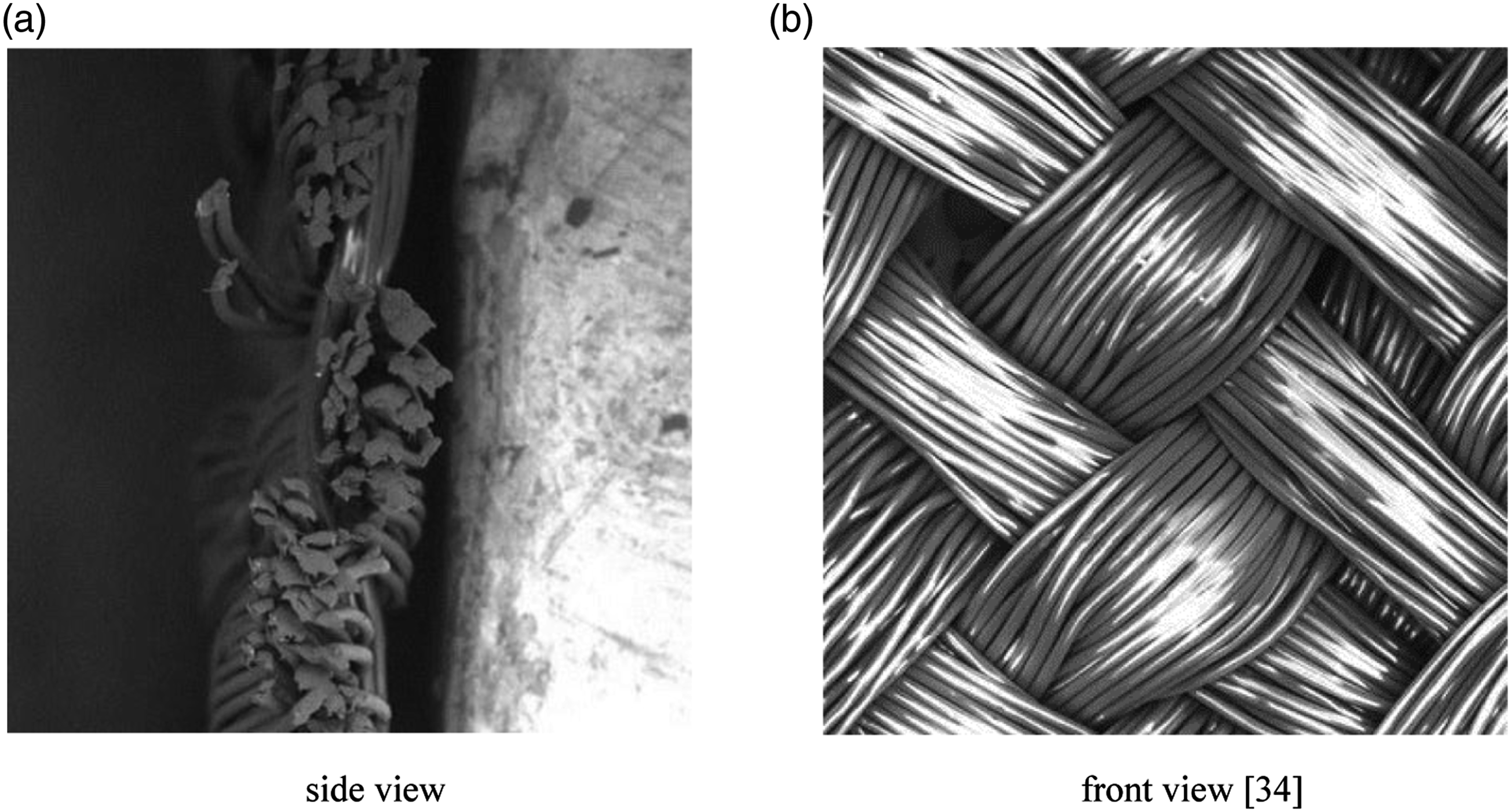
The mesostructure of porous canopy fabrics is photographed by a scanning electron microscope, as shown in Figure 2, where a and b are the side view and front view respectively. From the mesoscopic point of view, canopy fabrics are a porous fabric material. And the pore structures between the yarns allow air to pass through when the fabrics are exposed to pressure differentials. Mesostructure of porous canopy fabrics. (a) Side view. (b) Front view.
34
The air permeability



Differential pressure
The differential pressure Variation of differential pressure coefficient with air permeability.
36
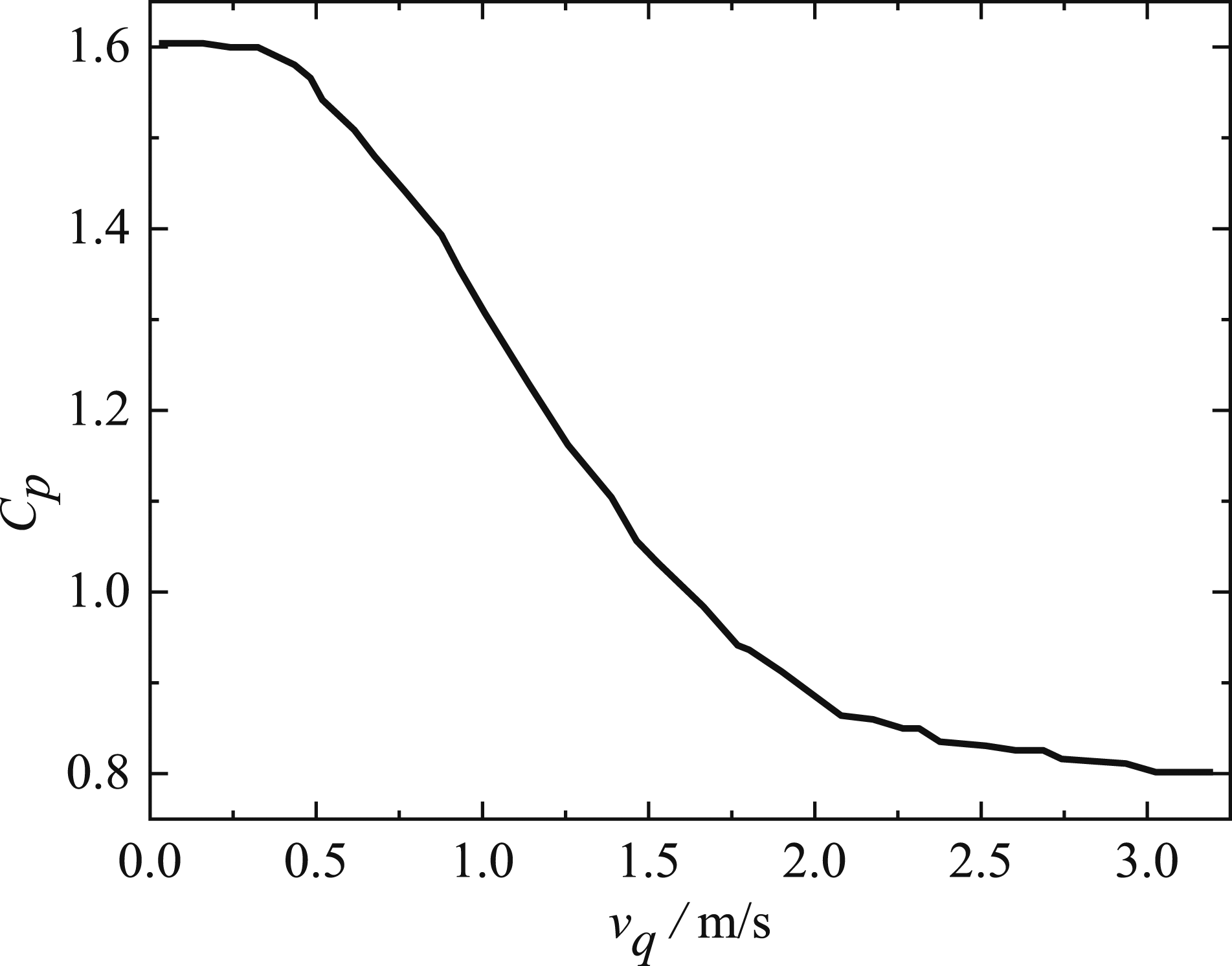

When the flight status and canopy mesostructure are determined, the air permeability
Structural mechanics equilibrium equation
Flexible gore
In the mechanical equilibrium analysis of canopy fabrics, this paper takes the flat circular parachute with an apex vent as the object, which is the most widely used type. During the deceleration process, the flexible canopy fabrics deform and inflate. As shown in Figure 4, the dotted line above represents the flat state of the undeformed parachute, and below is the deformed state after inflation. Construction schematic of gore.
16

The method is based on the assumption that the normal section of the gore bulge is approximately a circular arc after inflation. The shapes of adjacent bulges in contact and non-contact are shown in Figure 5 and Figure 6 respectively. When the inflated shape of the bulge is smaller than the hemispherical shape, the angle of gore bulge β is less than π/2. When the differential pressure is large, there may be contact between adjacent gore bulges, the angle β equals π/2. Then the mechanical equilibrium equations of the canopy is established based on Ross’s stress theory.
16
The contact distance between adjacent bulges is recorded as Shape of deformed gore normal to cords when adjacent bulges are not in contact. View of adjacent bulges in contact.


During the deceleration process, the strain of canopy

Assuming that the meridional force is endured by cords, not canopy fabrics, the pressure on the unit length is equilibrated with stress, and then the following is obtained

Thus,

If the adjacent bulges contact, the solution of the above equations is

Further, the criterion for determining whether adjacent bulges contact or not can be obtained

In brief,
Cord
The equilibrium profile of the longitudinal section is shown in Figure 7. Longitudinal section of cords.
16


The strain of cords

The deformation of cords is described by one-dimensional linear elastic law, so

According to Figure 9, the mechanical equilibrium equations of

Thus

Boundary conditions and equilibrium profile
After sorting out the above derivation, the system of ordinary differential equations is At At
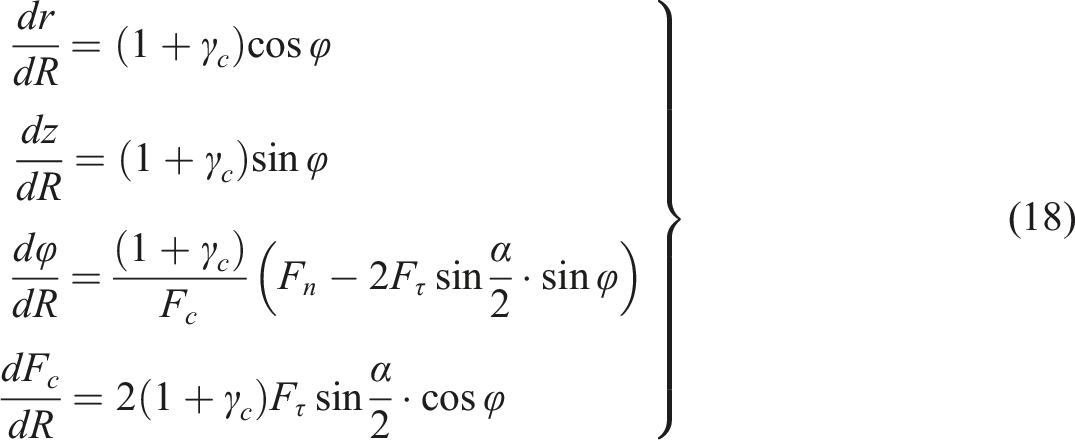


The above equations (19)–(22) are the boundary conditions of the equation (18). The number of boundary conditions is consistent with the number of equations, so the equations are theoretically solvable. Practically, the equations are solved by the shooting method 37 and the Runge-Kutta method.
The equilibrium shape of the fully inflated parachute is determined by the gore and cord (Figure 8). The profile equations of the gore centreline can be given as Longitudinal shape of inflated canopy fabrics.
16



Verification and validation
The geometric diagram of flat circular parachute, i.e. C9 Parachute, is shown in Figure 9. The geometric parameters of parachute are: Geometric diagram of flat circular parachute.
In order to verify the accuracy of the prediction method, the Fluid-Structure Interaction numerical simulation of the parachute in the descent process is launched based on the arbitrary Lagrange Euler method, which has been verified as an accurate approach to simulate parachutes in.
33
The comparison between the prediction results and the FSI simulation is shown in Figure 10. It states that the equilibrium profile of the two are similar, and the calculation error at the skirt is slightly larger. This difference is due to the fact that the differential pressure of fabric is uniform in this method while the pressure distribution calculated by FSI numerical calculation is dynamic. Besides, the distance between the cord and gore centreline in Figure 10 is the bulge thickness. It suggests that the bulge thickness obtained by the prediction method is also reliable. Equilibrium profile comparison of canopy fabrics between FSI and prediction method.
Radius of projection comparison of FSI, airdrop test, and prediction method.
Eventually, the structure information of parachutes can be obtained according to the prediction method, and the three-dimensional model can be established for further aerodynamic performance research.
Effect analysis
In this section, the effect analysis of structural parameters such as suspension line, apex vent, and Young’s modulus of materials on the equilibrium profile of canopy fabrics is investigated.
Effect of suspension lines
Firstly, the influence of suspension lines on canopy fabrics is analysed. The effects of different suspension line lengths on the equilibrium profile and projected diameter are shown in Figures 11 and 12 respectively. In the figure, Equilibrium profile with different suspension line length. Effect of different suspension line length on diameter of projection.

It argues from figures that the projected area of the canopy fabrics becomes larger and the drag performance of parachutes improves with longer suspension line length, but the weight, cost and volume of the parachute system will be increased meanwhile. When the suspension line is longer than the nominal diameter, namely
Then, the effect analysis of the number of suspension lines is studied. The suspension lines are evenly connected at the skirt, and the number is closely related to the canopy area. Therefore, it is of universal significance to take the suspension line spacing Equilibrium profile with different suspension line spacing at the skirt.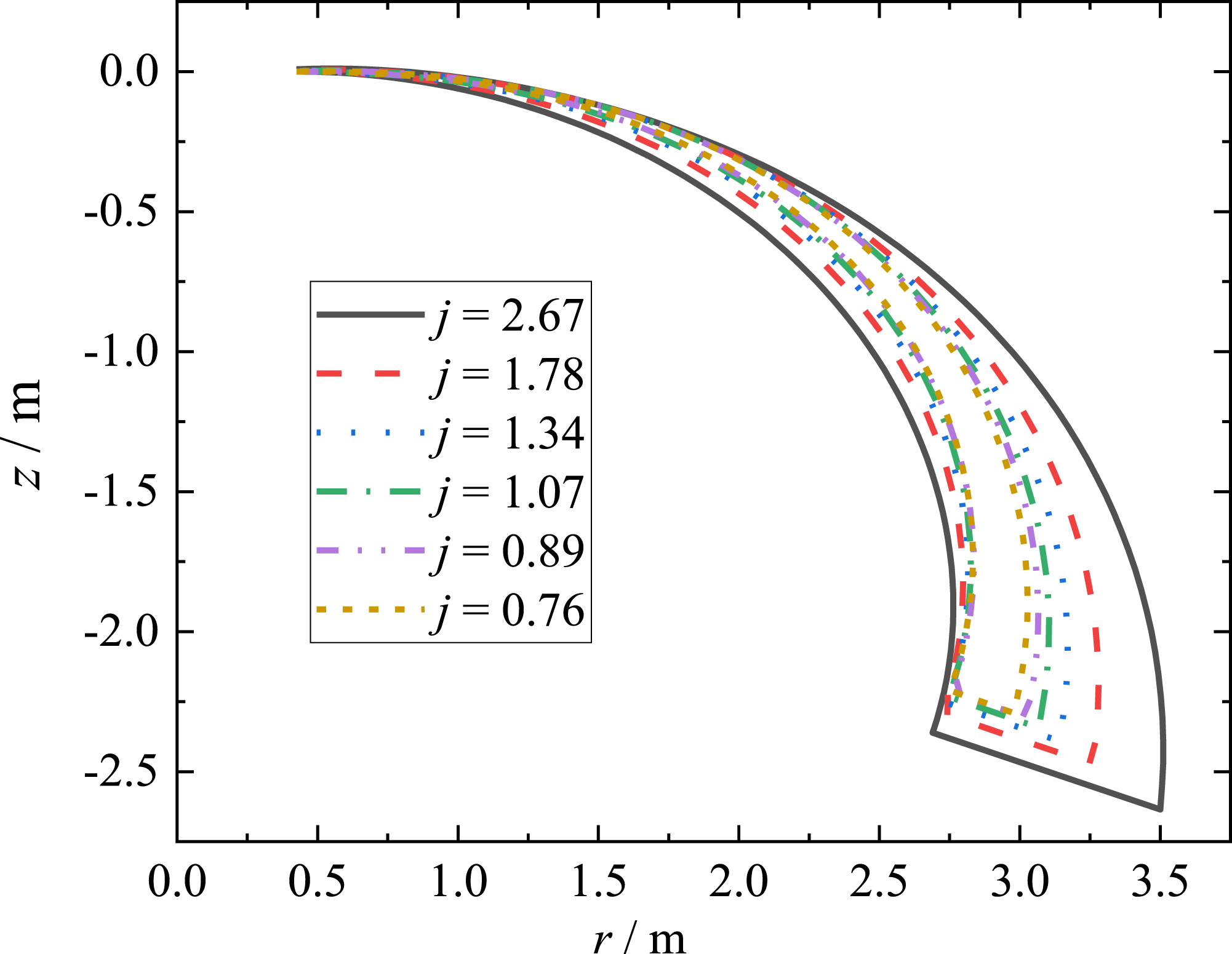
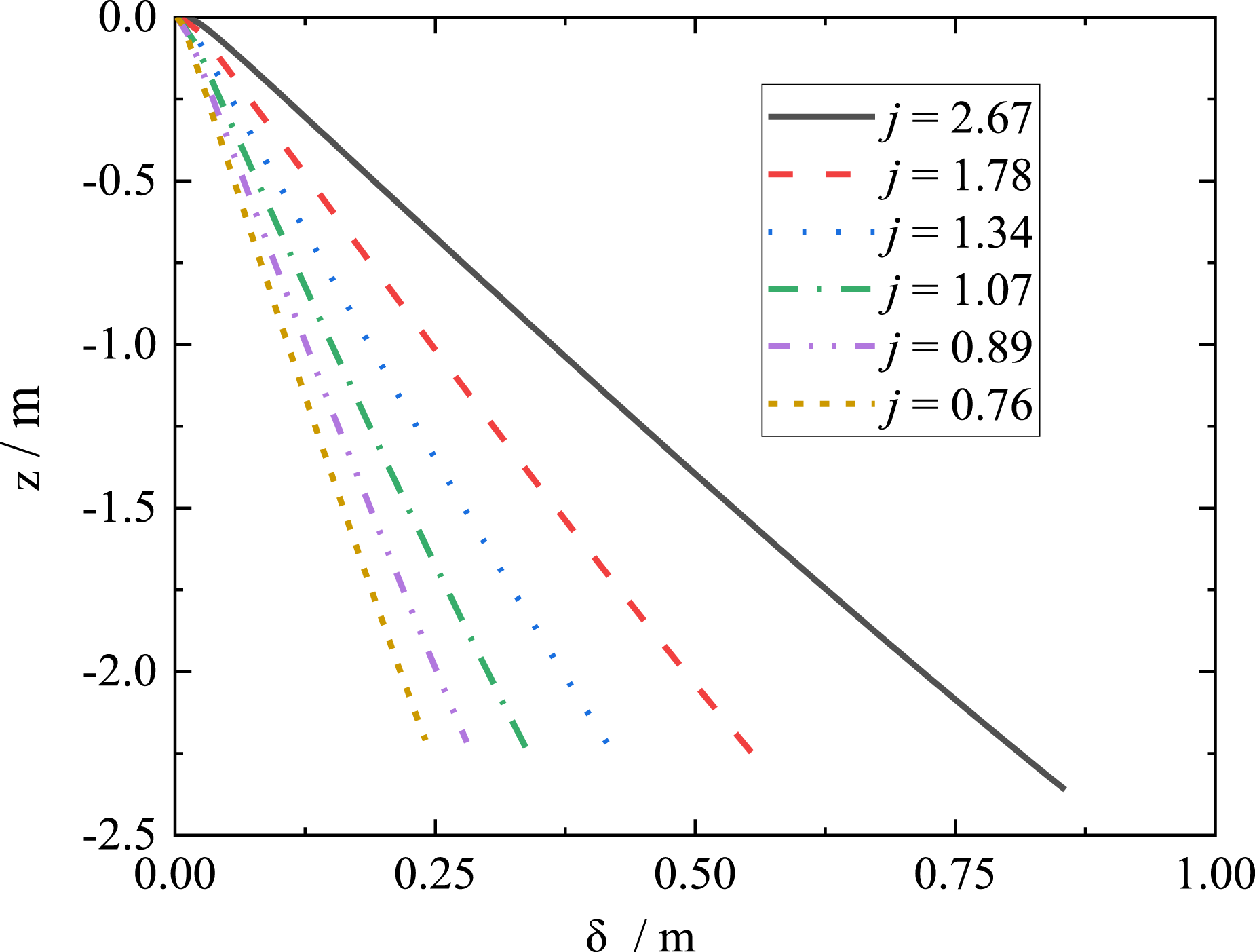
The results show that the profiles of the cord and gore centreline are becoming progressively different with the increasing spacing. Specifically, the bulge is getting thicker as the layout spacing increases, which is not conducive to parachute inflation and flight stability. When the suspension line spacing is less than 1m, the equilibrium profile of canopies changes little. Nonetheless, if the spacing between the suspension lines is too small, the suspension lines will form a “rope cover” phenomenon to prevent the air from flowing into the canopy. It will reduce the critical inflation velocity and increase the mass and volume of the parachute-payload system. Therefore, it is more appropriate to set the suspension line spacing about 1m or slightly greater than 1m. Furthermore, the variation of bulge thickness Variation of bulge thickness with r. Variation of bulge thickness with z.
Effect of apex vent
The apex vent slows the inflation of the canopy and improves the stability of the flight process. Without an apex vent, the shock load in the opening process will be tremendous that it may damage the canopy, and alternating asymmetric wake vortices tend to cause the canopy to swing continuously. In addition, for most circular parachutes, such as extended skirt parachutes and guide surface parachutes, the apex vent is designed to ensure cords do not overlap due to the requirements of manufacture. The effect of apex vent radius on equilibrium profile is analyzed, as shown in Figure 16. The equilibrium profiles of gores with different apex vents are similar, which indicates that the size of the apex vent has little effect on the equilibrium profile of canopy fabrics. And the projected area of canopy fabrics increases slightly with the raising of the apex vent radius. It should be noted that the opening area of the canopy cannot be ignored. The change of the overall drag area with different apex vent radius is shown in Figure 17. It suggests that with the growth of vent radius, the increased projected area is too small compared with the opening area, which will cause a loss of drag. Equilibrium profile with different apex vent radius. Change of the overall drag area with different apex vent radius.

In order to further compare the shape difference of gores with diverse vents, the variation of bulge thickness with r is studied, as shown in Figure 18. It states that there is a weak correlation between bulge thickness and the apex vent radius. In general, the extremely small vent will lead to a fast opening and large shock while a too-large vent is resulting in the decline of drag. According to research experience and variation of drag area, it is suggested that the radius range of the apex vent is from Variation of bulge thickness with r of different vents.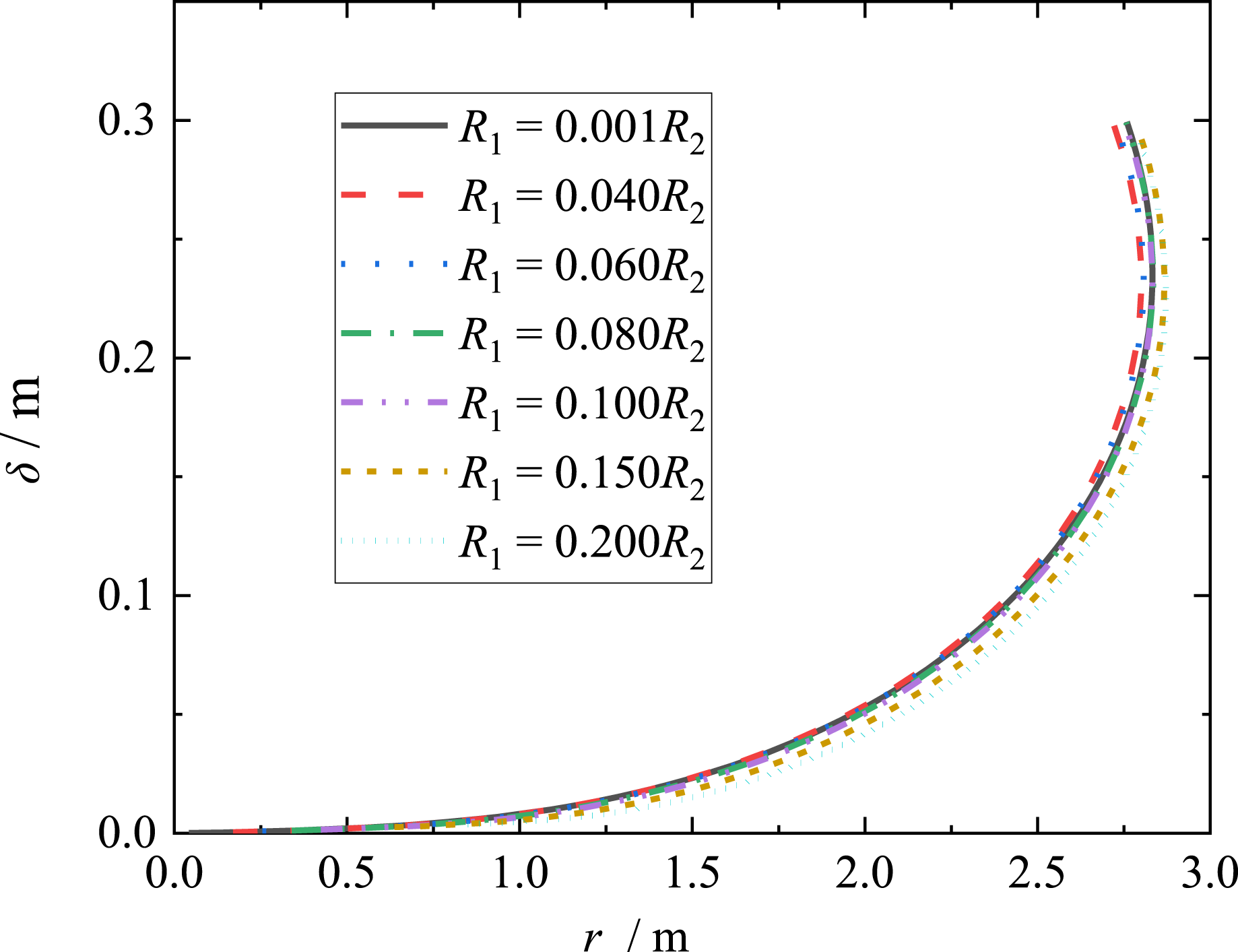
Effect of Young’s modulus
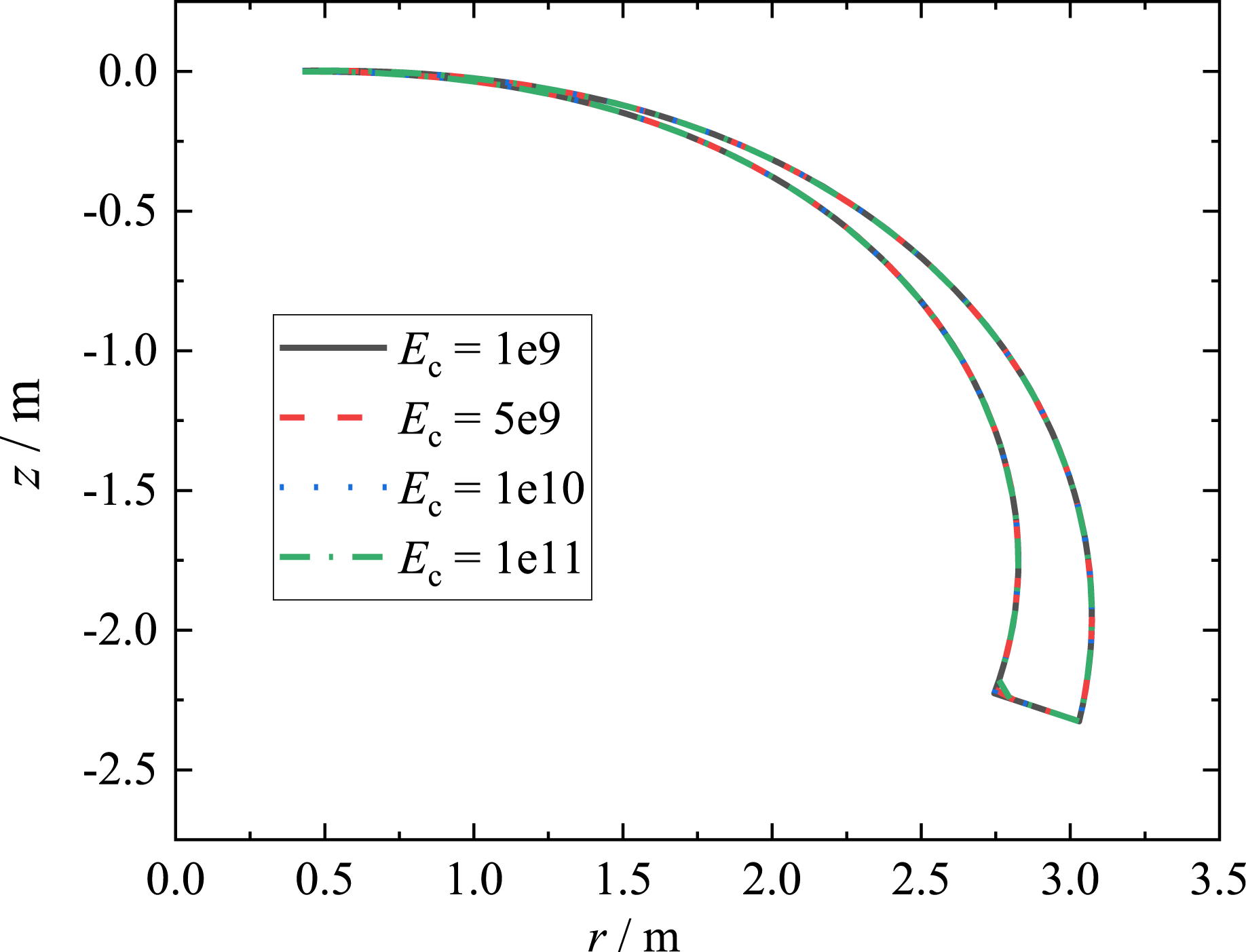
The effect of Young’s modulus of canopy fabrics and suspension lines on the equilibrium profile is shown in Figure 19 and Figure 20 respectively. Figures suggest that Young’s modulus has little effect on the equilibrium profile of canopy fabrics. This is because the scope of Young’s modulus selected in this paper is small, which belongs to the modulus range of common parachute materials. Additionally, this research is a steady-state analysis, while in the author’s previous FSI research, it is found that young’s modulus has an impact on the unsteady calculation. Equilibrium profile with different Young’s modulus of canopy fabrics. Equilibrium profile with different Young’s modulus of cords.
In addition to the equilibrium profile, the influence of Young’s modulus of canopy fabrics on the section shape of the bulge (i.e. angle Variation of β with different Young’s modulus of canopy fabrics.
Conclusion
A novel method for predicting the equilibrium profile of flexible porous canopy fabrics is presented in this paper utilizing Ergun theory, Forchheimer’s law and structural mechanical equilibrium equations. The predicted profile for canopy fabrics is well consistent with the results obtained by the FSI calculation and airdrop test at much less computational cost and time. Therefore, the application of the prediction method in the parachute design can greatly improve efficiency.
The proposed method is used to predict the equilibrium profile for flat circular parachutes with different structural and material parameters. It is found that the size of the vent has little effect on the shape of the canopy fabrics, but it will affect the inflation performance and aerodynamic performance; Young’s modulus of fabric has a higher influence on the upper part of the canopy than the lower part, and has little impact on the projected area; the main factors affecting the equilibrium profile are the length and number of suspension lines. The projected area increase with the growth of length and number. And the decrease of the number of suspension lines will also lead to an increase of bulge thickness which is not conducive to parachute inflation and flight stability. Therefore, suggestions for the design of suspension lines are given.
For other opening structures on the canopy of flat circular parachutes, the corresponding boundary conditions can be modified based on this prediction method. And the idea of this approach can also be applied to the prediction of shape for other flexible fabric structures.
Footnotes
Acknowledgements
The first authors acknowledge the financial supported by China Scholarship Council.
Declaration of conflicting interests
The author(s) declared no potential conflicts of interest with respect to the research, authorship, and/or publication of this article.
Funding
This work was supported by Chinese National Natural Science Foundation (Grant No. 11972192), Interdisciplinary Innovation Foundation for Graduates, NUAA (Grant No. KXKCXJJ202003) and the Priority Academic Program Development of Jiangsu Higher Education Institutions.
