




Abstract
The porosity is one of the important properties of canopy fabric, which affects the stability, aerodynamic performance and inflation performance of parachutes. The similarity criteria for canopy porosity were presented on the principle of similarity analysis. The Ergun theory of porous medium was introduced to establish the model of air permeability and differential pressure between canopies fully considering the air flow property during decelerating process of parachutes. And the differential pressure equation of micro-pore jets of fabric was established based on Bernoulli's theorem. Then, a novel model of air permeability for parachute canopy under different flying environment was proposed. The air permeability calculated by the model is in good agreement with the experiment. According to different environmental conditions, the impact analysis of air permeability and effective permeability of parachute canopies was studied. The results show that geometric and dynamic similarity are sufficient conditions for porous similarity of canopy. The air permeability and effective permeability of canopy are positively correlated with flight velocity and air density, negatively correlated with aerodynamic viscosity and less affected. There exists blockage effect in micro-pore jets of fabric.
Introduction
Parachutes are widely used in the fields of aeronautics and astronautics, such as aerodynamic deceleration, reentry landing and attitude stabilization. The parachute is a kind of aerodynamic decelerator mainly manufactured from flexible fabric with porosity. Different from other aircrafts, the parachute system decelerates by aerodynamic drag (
The total canopy porosity is composed of fabric and geometry. Among them, parachutes are often slotted to improve handling and stability characteristics and the geometric porosity is determined as the ratio of all opening areas to the total canopy area for slotted canopies. While the fabric porosity is more complex to obtain, which is defined as the rate of volume flow air passing perpendicularly through an unit of fabric area at some pressure gradient over a time unit. In order to facilitate calculation and design, the fabric porosity is usually expressed in dimensionless form, namely effective permeability.
Most of scholars have studied the fabrics porosity by experimental methods, that is, measuring the air permeability under different differential pressure. Goglia [1] determined the air permeability of standard nylon parachute cloths, and verified that the air permeability equation of parachute cloths is consistent with Ergun formula through the statistical analysis of a large number of experimental data. Rondeau [2,3] presented an apparatus for assessing permeability of textiles subjected to time-varying differential pressure. The results indicate a small effect of unsteady differential pressure on the fabric porosity. Xiao [4] carried out the air permeability experiment of multi-layer fabric with similar ideas, and found that more fabric layers and a lower initial pressure can reduce the difference between the static and the dynamic air permeability for tight fabric. However, the qualitative experimental results cannot be directly applied to the performance calculation of porous parachutes. Yang [5] used the Ergun formula to describe the dynamic air permeability of the fabric, that is, the air permeability changes with the differential pressure between the canopy. Cruz [6] obtained the air permeability through experiments, which were transformed into an effective permeability for using in calculations related to parachutes, and created models that related the effective permeability to the unit Reynolds through experiments.
With the development of computer simulation technology, some scholars utilize numerical method to study the air permeability of canopy fabric. Dehkordi [7] simulated air permeability of knitted fabrics with rib and interlock structures with computational fluid dynamics (CFD) method. Malik [8] used artificial neural network to tailor barrier fabric porosity depending on the requirements quickly. Sarpkaya [9] utilized the vortex-element methods to investigate the influence of fabric porosity on the flow field. Cheng [10] simplified canopy as one-dimensional porous medium. The momentum governing equation with correction source term affected by the fabric porosity was established in permeability domain and the standard k-e turbulence model was utilized to simulate the flow around the parachutes. Gao [11] combined porous medium method with momentum equation to construct a fluid-structure interaction model for flexible parachutes with fabric porosity. The flow field topology and aerodynamic performance of canopies with and without fabric porosity were studied. Takizawa [12] introduced the conventional Darcy-Forchheimer model of porous medium and space–time computational methods to study compressible-flow aerodynamics of parachutes with geometric porosity.
On the other hand, with the advancement of Mars exploration missions, it is necessary to carry out Mars landing parachute experiments on the earth simulating the Mars entry, landing and decelerating process to obtain the parachute performances [13]. However, the Martian atmosphere is extremely thin, which is quite different from the earth's environment. Hence from the beginning of Mars landing exploration plan, parachute simulation experiments have been one of the key and difficult work of the whole exploration plan. All the present parachutes for Mars exploration missions are disk gap band (DGB) parachute [14–16]. As mentioned above, the environmental parameters affect the fabric porosity and further affect the aerodynamic performance of the parachute. Whereas, current researches of Mars parachute consider the influence of geometry porosity, but rarely consider the effect of fabric porosity. Both theory and experiment show that the fabric porosity of parachute canopy is an important factor affecting the aerodynamic characteristics, sometimes even up to 50% [17,18].
As it stands, most of the above works focuses on the study of the air permeability of the fabric itself, which is not integrated with the decelerating process of parachutes. In addition, in order to get more accurate aerodynamic parameters in the high altitude experiments of Mars parachutes on the earth, it is necessary to consider the influence of fabric porosity to ensure the same porosity. A novel air permeability model of canopy is proposed, which takes into account the properties of air flow around parachutes, the flight velocity and the microstructure of fabric. On this basis, the similarity criteria for canopy porosity is presented, and the influence of effective permeability is analyzed.
Similarity criteria for canopy porosity
Canopy porosity
The total canopy porosity is composed of fabric and geometry. In the similarity study of canopy porosity, the parameters involved are: total canopy porosity




The decelerating process of parachutes is a typical fluid dynamic problem. In fluid mechanics, the principle of geometric similarity is the priority to be satisfied. And the geometric porosity scales linearly with geometry as shown below. Thus, the relationship

Therefore, the geometric similarity ensures the similarity of geometry porosity. In the derivation process, the following relations exists

The dimensionless number
Besides, in the similarity of flow field, the principle of dynamic similarity should also be met, that is,

Therefore, the dynamic similarity ensures the similarity of fabric porosity. In the derivation process, the following relations exists

The dimensionless number
Assuming that the parachutes are made of the same fabric material, the total canopy porosity can be obtained according to the principle of mass conservation as follows

The total canopy porosity can be expressed with dimensionless criteria number as follows

Based on above analysis, the geometric and dynamic similarity ensure the porous similarity of geometry and fabric respectively. Then the scaling factor of total canopy porosity is

Therefore, the total canopy porosity is identical (
Effective permeability
From the microscopic point of view, canopy fabric is a kind of porous medium material. Using Ergun formula [19] of seepage theory, the differential pressure



On the basis of similar geometry and same material,


Additionally,

Besides, canopy belongs to woven fabric, and

The microstructure of canopy fabric was observed by SEM, as shown in Figure 1.

Microstructure of canopy fabric.
Through the observation, there are many micro-pore jets on canopy fabric on the micro level. Therefore, in the decelerating process of parachutes, Bernoulli's theorem can be introduces to obtain the differential pressure of the micro-pore jets. And the differential pressure of canopies can be obtained by ignoring the interference of the inner wall as

Combine the above equations to get the air permeability of canopy

The calculation model of the effective permeability of the canopy is obtained

When the flying environment, structural parameters and material of canopy are determined the effective permeability of canopy can be calculated according to equation (24), thus the total air permeability can be obtained via equation (13).
Through the above analysis, it can be indicated that the dimensionless number opening ratio and effective permeability are two similarity criteria for canopy porosity.
Model validation
The parachute material PIA-C-7020 Type I used in the experiment [21] was investigated for calculation to validate the correctness of the air permeability model of canopy fabric namely formula (23). The main parameters are:
In the test, the outside of fabric was fixed by a device. The air velocity is changed by changing the air flow. The air permeability through the fabric is further calculated by measuring the flow rate and temperature behind the fabric. The percentage deviation from experimental to theoretical result is shown in Table 1, and the overall comparison between the calculated air permeability and the experimental results is shown in Figure 2.
The percentage deviation from experimental to theoretical result.


Comparison of air permeability between calculation with experiment.
It can be seen that the overall percentage deviation between the calculation method and the experimental value is small in the parachute flight process. In the case of higher velocity, the deformation of the fabric under the action of air flow increases due to the elasticity, resulting in a slightly larger error. Therefore, the correctness of the calculation method is proved in the acceptable range.
Results and discussion
The same fabric materials are used to manufacture the model and prototype of parachutes in the actual parachutes decelerating and experimental process, so
Next, on the premise of similar geometry and same materials, the relationships between the effective permeability of canopy and flight velocity, air density, dynamic viscosity are discussed.
Influence of flight velocity
In the earth environment, changes of the canopy air permeability and effective permeability are obtained at various flight altitude H with the flight velocity as shown in Figures 3 and 4 respectively. According to the diagrams, both the air permeability and the effective permeability of canopy go up with the increase of the flight velocity, but the effective permeability tends to be approximately stable at high velocity. This is because canopy fabric belongs to porous medium in microcosmic, and there is blockage effect in micro-pore jets of fabric, which leads to stable effective permeability macroscopically.
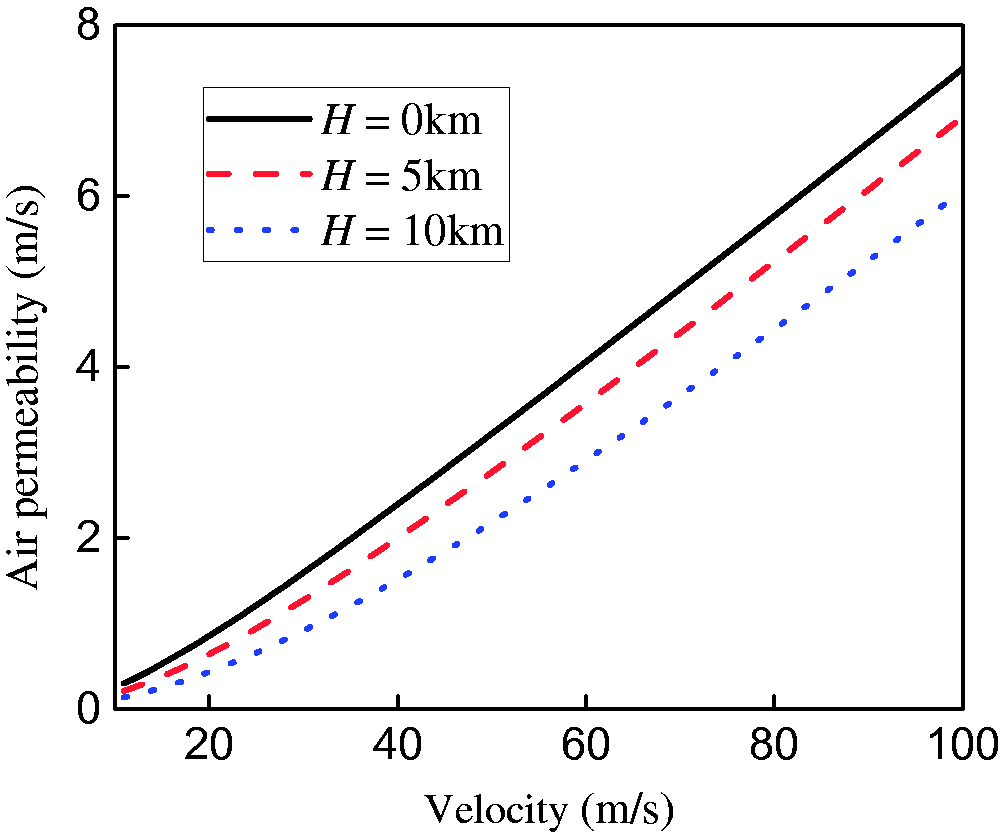
Changes of air permeability with flight velocity.
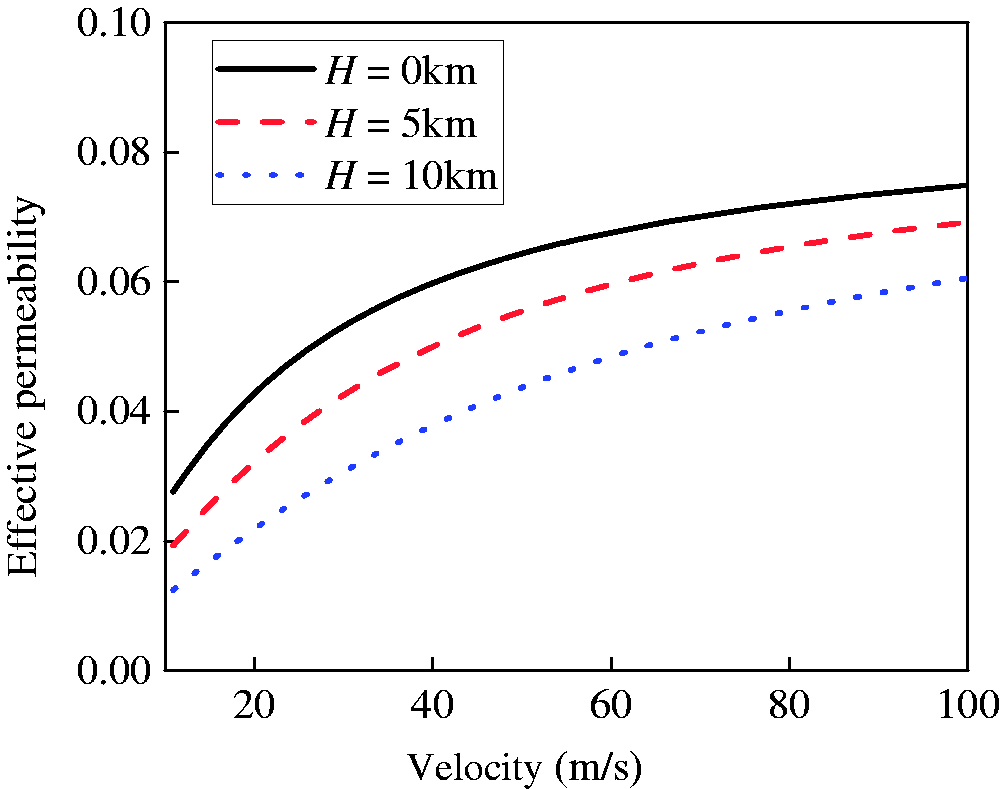
Changes of effective permeability with flight velocity.
The blockage effect in micro-pore jets of fabric proposed in this paper describes the unchanged phenomenon of effective permeability. The air flows in the micro-pore, which produces blockage effect under the action of viscous stress and turbulent shear stress, which are proportional to the velocity gradient. The velocity gradient in the wall of the micro-pore increases with larger flight velocity, and further leads to large force. Thus the effective permeability of the fabric gradually stabilize macroscopically. In the wind tunnel test, there is a similar phenomenon.
Influence of air density
During the inflation and descent process of the parachute, the flight velocity will changes all the time with density. However, in order to explore the influence of air density, the trajectory data is not selected to study, otherwise there are more than one variable. Hence, changes of the canopy air permeability and effective permeability are studied with the air density under different flight velocity (20 m/s, 50 m/s and 80 m/s respectively) as shown in Figures 5 and 6 respectively. As shown in the graphs, the effect of air density on the air permeability and effective permeability of canopy is consistent with these of the flight velocity. Additionally, there also exists blockage effect of the effective permeability of the canopy fabric. However, the reason is different from that of flight velocity. The blockage effect caused by air density is mainly caused by turbulent shear stress in micro-pore.
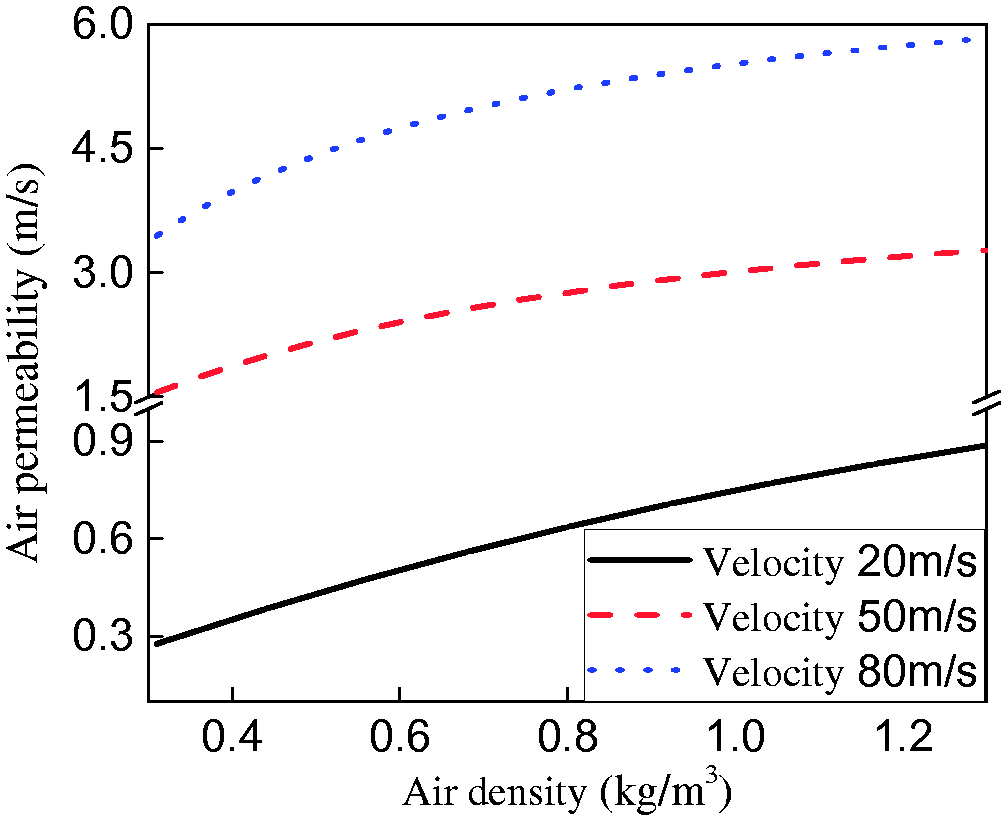
Changes of air permeability with air density.

Changes of effective permeability with air density.
Influence of dynamic viscosity
Similarly, changes of the canopy air permeability and effective permeability are obtained at various flight velocity (20 m/s, 50 m/s and 80 m/s respectively) with the dynamic viscosity as shown in Figures 7 and 8 respectively. It can be seen that the influence trend of dynamic viscosity on the air permeability and effective permeability of canopy is negative correlation, which is opposite to the influence of air density and flight velocity. In addition, the viscosity coefficient can also change the viscous stress theoretically. However, the influence of dynamics viscosity on viscous stress is limited, which results in the effect of dynamics viscosity on effective permeability is much smaller than that of flight velocity and air density.

Changes of air permeability with dynamic viscosity.

Changes of effective permeability with dynamic viscosity.
Conclusion
In this paper, the following conclusions can be summarized: Based on the comprehensive consideration of the properties (i.e. air density and dynamics viscosity) of air flow around parachutes, the flight velocity and the microstructure characteristics of fabric in the decelerating process at high altitude, a novel model of air permeability of canopy is proposed in the flying situation, which improve the efficiency of obtaining. The dimensionless numbers, namely opening ratio and effective permeability, are proposed in similarity criteria for canopy porosity. Geometric and dynamic similarity are sufficient conditions for porous similarity of canopy. On the basis of similar geometry and same material, the air permeability and effective permeability of canopy are positively correlated with flight velocity and air density, negatively correlated with aerodynamic viscosity and less affected. There is blockage effect in micro-pore jets of fabric. With the increase of flight velocity and air density, the air permeability and effective permeability of canopy increased, but due to the blockage effect, the effective permeability gradually increased followed by being stable.
Footnotes
Declaration of conflicting interests
The author(s) declared no potential conflicts of interest with respect to the research, author-ship, and/or publication of this article
Funding
The author(s) disclosed receipt of the following financial support for the research, authorship, and/or publication of this article: This paper is supported by Chinese National Natural Science Foundation (Nos. 11972192), Postgraduate Research & Practice Innovation Program of Jiangsu Province (Nos. KYCX20_0216) and the Priority Academic Program Development of Jiangsu Higher Education Institutions.
