




Abstract
Hands are one of the most vital parts of the body, and many tasks are carried out by hands. Particularly in industrial environments, hands may be exposed to various dangers and consequently injuries; thus protection of them is of great prominence. In this study, the effects of wearing a group of industrial protective gloves on hand performance, were investigated. The mentioned gloves varied in terms of material, thickness, and also the amount of layers. This research evaluates the effect of gloves’ constituent materials, including tarpaulin, leather, and protective layers such as neoprene and spacer, and a cotton nonwoven layer for added hand comfort, on hand performance. Objective and subjective experiments were performed for the assessment of pain threshold force, hand strength (dynamometers and gripping/lifting pipe test), tactile sensitivity (“two-point” discrimination method), and manual dexterity (bolt closure, valve opening, and wrist motion range tests) and an acceptable linear correlation was obtained between the objective and subjective (Thurston’s pair-comparison judgments) outcomes. The results showed that wearing gloves and increasing the number of gloves’ layers, improved the protective performance concerning the increased pain threshold tolerance. On the other hand, wearing multi-layer protective gloves decreased the gloved hand tactile sensitivity, strength capability, and also the range of finger and wrist motion as a measure of manual dexterity.
Introduction
The advancement of science in various fields has improved the quality of human life. Apart from making life more convenient and prosperous, they expose humans to various unexpected dangers in dealing with new technologies and, in particular, industrial equipment. Personal protective equipment is designed in various forms to protect different parts of the body against encountered threats and risks associated with equipment use. 1 The investigation of the comfort of protective equipment such as gloves in industrial work zones revealed that a sizable proportion of workers reported feeling uncomfortable while wearing this equipment. It was even implied that this equipment negatively affected their ability to carry out their responsibilities properly. As a result, workers occasionally refused to wear gloves while performing their jobs. 2 Therefore, it is necessary to design and investigate the gloved hand comfort with regards to the properties of the constituent materials of protective gloves, in order to approach the desirability of using these gloves, which would result in better hand protection against injuries. According to reports, hand and finger injuries are more common than other occupational injuries, accounting for approximately 30% of all injuries. 3 However, wearing protective gloves significantly reduces the associated dangers by approximately 60%. 4 In other words, wearing gloves is the primary factor in avoiding injuries, resulting in a 60–70% reduction in the number of injuries caused by fractures, bumps, amputations, and dislocations. 5
Protective gloves are produced with a considerable variety according to their usage and the level of required protection. In the current study, it is mainly focused on multi-layer industrial protective gloves utilized for building constructions, welding, mechanical operations, etc.
Given the critical nature of recognizing the pain tolerated by the skin and muscles in harm prevention, Hardy et al. (1952) conducted research using a spring esthesiometer to assess the stimulus pain of subcutaneous tissues in the forehead area. The investigation findings indicated that the starting point of pain and its intensity were comparable with pricking and aching pains. 6 Merskey and Spear (1964) examined the perception of pain caused by pressure in normal subjects using a pressure algometer. 7 Reeves et al. (1986) and Kinser et al. (2009) established the algometer’s reliability as a tool for determining pain threshold and sensitivity.8,9 Fischer (1987) used a 1 cm2 rubber disk force gauge to examine the force perception in various subjects’ arms to establish a baseline for analyzing abnormal sensitivity and recording therapy results. 10
Brennum et al. (1989) used a hand-held electronic pressure algometer to examine the pressure perception threshold on the fingers and toes. It was concluded that the pain threshold in males was 50% higher than in females. 11 Hall and Kilbom (1993) investigated the development of the pain threshold in various hand areas. It was concluded that the pressure did not cause an instantaneous injury to the hand. Additionally, by increasing the number of pressure incidents during repeated loadings, the pain threshold decreased. 12
Since wearing protective gloves aims to protect the hands from injury, it is deemed necessary to evaluate the gloves’ ability to protect the hands under various working conditions and their associated risks, which is directly affected by the characteristics of the constituent materials used in single or multi-layer gloves. Therefore, it is of great importance to evaluate the glove performance regarding its construction. To this end, Muralidhar et al. (2000) evaluated gloves’ protective capability and safety performance when multiple layers were applied. 13 Bradley et al. (1969) conducted a study to compare the operation control time for a bare hand against wearing a single-layer wool glove and a two-layer glove (leather glove worn over the wool glove). According to the results, wearing gloves affected the control time, physical characteristics of the control, and the type of control operation. 14
Ertekin et al. (2020) evaluated para-aramid protective gloves’ comfort and mechanical properties when combined with three different types of polyester yarn. The results indicated that the fabric made with para-aramid yarns performed better in terms of protection. However, because this fabric produced an uncomfortable sensation, a combination of corrugated polyester yarn produced a more comfortable experience. At the same time, its cut protection performance was comparable to that of fabrics made with para-aramid yarns. 15
Protective gloves are necessary for the avoidance of hand injuries while performing various kinds of industrial. However, it can inversely affect the hand performance in terms of dexterity, sensitivity, fatigue, comfort etc.
While wearing gloves is necessary to avoid hand injury, they may adversely affect wearers’ dexterity. Berger et al. (2009) examined various methods for evaluating finger dexterity. 16 Johnson et al. (1986) evaluated the subjects’ skills and finger dexterity while wearing gloves using the Pegboard manual dexterity and O’Connor finger dexterity tests. The findings of this study confirmed that wearing gloves had a detrimental effect on hand performance. 17 According to Bensel (1993), increasing glove thickness results in a loss of manual dexterity due to increased operation time. 18
Along with examining the effects of gloves on hand performance and dexterity, several studies examined the strength of hand capabilities, including pulling, pushing, and torque force, while wearing different gloves using a dynamometer and handgrip force measurement techniques (Riley et al., 1985; Roesch, 1987).19,20 To this end, Adams et al. (1988) conducted a study to determine the maximum torque that could be applied to circular electrical connections, where the results showed that wearing gloves increased torque. 21 Rock et al. (2001) used a hand and finger dynamometer to investigate the effect of wearing leather, nitrile, and vinyl gloves on grip and pinch force. 22 Ramadan (2017) examined the effect of wearing industrial protective gloves on handgrip strength. The results demonstrated that wearing industrial gloves significantly reduced the maximum handgrip force. 23
Tiefenthaler et al. (2006) demonstrated that wearing gloves reduced hand sensitivity to some extent, but the magnitude of this reduction varied between fingers and different areas of the hand. 24 However, Hatzfeld et al. (2018) found no significant difference in perceived threshold force between bare hands and surgical gloves in a one-dimensional study of the effect of gloves on tactile sensitivity. 25 Nelson et al. (1995) evaluated hand tactile sensitivity by applying needle pressure to the thickness of four latex gloves. The study concluded that thickening gloves decrease the sensitivity of the hands. 26
According to Willms et al. (2009), increasing the thickness of the glove layers impaired hand function and contributed to fatigue. 27 Chang et al. (2007) used a dynamometer to investigate glove thickness and design effects on performance and fatigue during grip tasks. The obtained results indicated that while wearing gloves and increasing glove thickness resulted in more significant fatigue than using bare hands, their designs had no discernible effect on the overall consumer fatigue. 28
The limitation of hand motion caused by protective gloves is a critical factor in determining the performance and comfort of protective gloves. Bellingar et al. (1993) examined the kinematic movement of the hands, wrists, and forearms while performing routine tasks using pesticide devices. The findings indicated that wearing protective gloves reduced the overall range of hands and wrists motion. 29 Due to the continued use of hand tools in the industry, Dianat et al. (2012) investigated the impact of short- and long-time wearing gloves on hand performance when working with hand tools. 30
Glove characteristics, such as material thickness, are a determining factor in hand performance. In this respect, Taylor et al. (1982) investigated the effect of gloves on hand performance when using aircraft keyboards. 31 Karis (1987) examined the quality of cursor control under various hand conditions while wearing gloves. It was found that increasing the thickness of gloves improved finger positioning in the power controller, resulting in improved hand performance when wearing them. 32 Chen et al. (1989) investigated the effect of glove size and material type on hand performance using two torque exertion tests and during small parts assembly. 33
Batra et al. (1994) studied the link between glove characteristics such as thickness, tensile strength, and flexibility, and performance. 34 Hallbeck et al. (1993) investigated the relationship between glove type, hand and wrist position, and age in individuals with overall hand function. 35 Wells et al. (2010) studied the impacts of rubber gloves’ size and thickness on the wearer’s performance and comfort. The study’s findings established a decrease in hand performance due to increased glove thickness. 36 Dianat et al. (2010) examined the effect of gloves on hand performance when using a screwdriver. 37 Bronkema et al. (1996) discovered that the surface friction of gloves with objects affects the grasp force. 38 Shih et al. (2001) used two-point and Von Frey hair tests to determine the effect of the number of latex layers on hand performance. 39
To inspect the impact of the protective glove’s design on hand performance, Muralidhar et al. (1999) optimized protection and performance by designing a new glove based on the selective protection criteria. 40 Dianet et al. (2014) discovered that the glove’s design affected all hand functions. 41 Yu et al. (2019) proposed that after examining the material and size of sport gloves, it is essential to consider the design and development of gloves in terms of hand length, hand circumference, finger circumference, and the ratio of finger length to palm length in order to achieve improved performance and comfort. 42
According to the review of the literature above, while the effect of material properties such as thickness has been studied, there is a lack of research on the effect of the variety and combination of different materials used to construct industrial gloves on hand performance. In other words, there appears to be a gap in the research on the effects of material types and their properties, the number of layers used in gloves, as well as the method of layer construction on the performance of hand after wearing the glove. In this regard, constituent material properties not only thickness, but also weight, stiffness, and compressibility are considered in this study. This research evaluates the effects of constructing materials such as tarpaulin, leather, and protective layers including neoprene and spacer, and a cotton nonwoven layer for additional hand comfort, on the gloved hand performance. While wearing protective gloves, the actions required to perform industrial tasks, such as tactile sensitivity, strength capability, manual dexterity, and pain tolerance, must be objectively evaluated using industry-standard test methods. Since the current study is concerned with industrial gloves, the experiments were designed in such a way that they would be capable of assessing the performance of different gloves during practical applications. Additionally, this research utilized Thurstone’s law of paired comparison to estimate human perceptions of comfort and subjective evaluation of hand performance and working proficiency while wearing gloves and examined their correlation with the results of objective tests that quantified these functions.
Materials and Methods
Material and Gloves Design
For preparing the glove samples, a group of commercial protective gloves was examined, used for various industrial tasks and activities. Then, the glove samples were made by modifying the design, components, and other properties of commercial gloves. In Figure 1, the modified patterns of various parts of prepared protective gloves are illustrated. Following an examination of various commercial protective glove types, it was determined that leather was the best material for heavy industrial activities, as natural leather has a high resistance to puncture, shearing, and abrasion. The roughness and thickness of natural leather, on the other hand, can cause discomfort when wearing gloves. Consequently, a nonwoven cotton layer was added to the inside of the gloves. Patterns of various parts of the protective glove. (1): back of hand, (2) and (3): space below the middle and, (4): palm area, (5): thumb.
Specifications of the gloves and materials applied in each part.

Properties of the fabrics used in the gloves.

It should be noted that the stiffness of the fabrics was measured based on ASTM D4032, which is a standard test method for the stiffness of fabric by the circular bend procedure. The higher value of the measured stiffness force, the less flexible fabric is. Besides, the relative compressibility (EMC) which is calculated by equation (1) is reported as a measure of compressibility. The high value of EMC points to the better compressibility of the fabric.
Classification of prepared gloves for better comparison.

Evaluating the effect of wearing gloves on hand performance
In order to assess the influence of wearing the gloves on wearers’ performance, 15 men participated in the evaluation process. During all assessments, the right hand was deemed the dominant hand. Participants were aged between 25 to 40 years and had a normal body mass index (BMI). They did not have any underlying muscle disorders, syndromes, or tendon disorders. Additionally, they had no known allergies to the glove materials and had no prior experience with industrial work. The participant’s hand size was in the range of hand length of 204–210 mm and hand circumference of 254–270 mm. In this regard, the glove size of (L) according to the US size was used. Different aspects of hand performance were evaluated while wearing gloves, including the pain threshold (the gloves’ protective ability), tactile sensitivity and recognition, hand and finger strength, manual dexterity, plus wrist, and finger movement angles during downward and upward bending motions. It should be noted that all evaluations were conducted objectively, whereas manual dexterity and hand and finger strength were also evaluated subjectively.
Pain threshold
In this study, the Instron 5566 universal testing machine was utilized to evaluate the gloves protection capability, based on the Algometer apparatus.
13
A cylinder with a diameter of 35.8 mm and a 30° cone tip was designed to apply force on hands. The cylinder was fixed on the upper jaw of the device and was then gradually moved downward to come into contact with the palm and apply pressure to it. When the amount of pressure on the hand resulted in the sensation of pain, the test was completed and the consequent force was recorded as the pain threshold. A five-minute rest period was considered before the assessment of different gloves to prevent the effects of hand inflammation due to repeating loading. Figure 2 shows the set-up of the pain threshold pressure gauge. Pain threshold pressure gauge.
Hand and finger tactile sensitivity
The “two-point” discrimination method was used in this study to determine the tactile sensitivity of subjects after they wore the gloves. To this end, a caliper was used, and after adjusting its tips at 2-mm intervals, both caliper tips were placed on the participant’s palm and fingers, as shown in Figure 3. The participant was asked to identify the number of points sensed on the caliper tips after experiencing a sensation. If the participant recognized two points, the distance between them was recorded; otherwise, the distance was increased by 1 mm until the participant felt both tips on his palm and finger. After wearing each glove, this distance was reported as a threshold for individual tactile sensitivity. Tactile sensitivity assessment with caliper.
Hand and finger strength
Objective assessment of hand and finger strength
The purpose of this experiment was to trace the change in hand and finger strength during force application after wearing gloves. To this end, the SH5001 hand dynamometer was employed to measure hand grip force and the SH5005 finger dynamometer was utilized to measure finger grip force. The image of both dynamometers manufactured by SAEHAN is shown in Figure 4. After wearing the gloves, participants were asked to apply a maximum force (according to their ability) to the dynamometers, twice in succession. After recording the force, the participant was given a 30 s short rest and then asked to apply their maximum finger force to the finger dynamometer. Finally, the mean applied force of these two measurements was used for analysis. Hand and finger dynamometer.
Subjective assessment of hand and finger strength
A gripping and lifting pipe test was developed to determine the force applied by the hand when gripping and lifting pipes while wearing gloves in order to assess hand and finger strength subjectively. Two iron pipes with an outer diameter of 6 and 9 cm and a length of 30 cm were used for this test. The pipes weighed 1.2 and 2 kg, respectively, and are shown in Figure 5. The pipes were lifted 30 cm, vertically. Equipment used for evaluation of hand and finger strength.
The gripping task was developed to characterize the loads on the finger and wrist extensors during grasp. In this case, the extensor muscles of the forearm can be heavily loaded.
Same as manual dexterity, the subjective evaluation of hands and fingers strength was performed using Thurston’s law that is a paired-comparisons method as it was previously explained. In other words, during this task, the participant’s ability to grip and lift the pipes was judged by contributors.
Manual dexterity
Objective assessment of manual dexterity
The process of evaluating a subject’s manual dexterity while wearing the designed gloves included three types of activities, detailed below as a bolt closure test (ISO 898-2), valve opening test, and a wrist motion range test.
Bolt closure
This experiment aimed to determine finger grip ability and dexterity while wearing different gloves, using three screws and hexagon nuts (numbered 6, 12, and 16). For designing an experimental surface with proportional holes, a wooden frame was constructed, as shown in Figure 6(a), and the required holes for the nuts and screws were drilled into its lateral walls. The participants were instructed to pick up the screws numbered 6 to 16 with their dominant hand and, after inserting the screw, were advised to pick up a gasket and nut and fasten them on the desired screw using their dominant hand. Each screw was subjected to two repetitions, and after each task, the time spent on the test was recorded as objective results. The number of dropped pieces was also recorded and reported as a criterion for evaluating hand skills throughout the task. Equipment used for evaluation of manual dexterity.
Valve opening
This test was used to determine the wrists’ ability to apply torque. A short circular polymer valve with a diameter of 13 cm was used for this purpose, and participants were asked to completely open the valve and compare their hand comfort level while performing the mentioned task with each of the gloves. The duration of opening the valve was also recorded to assess the ability to apply torque manually and assess the hand’s manual dexterity. The valve used in this experiment is depicted in Figure 6(b).
Wrist motion range
Due to possible negative impacts of wearing gloves on the hands’ motion, the movement limitation of hands when wearing each glove was investigated by the video capturing of hand movements
29
using a fixed camera and transferring the videos to a tracker software as shown in Figure 7. By utilizing the tracker software and creating a coordinate and scaling for evaluation, the wrist motion range was calculated. Diagram of the method of calculating the hand and finger angle with a tracker software: (1) camera (2) marked hand (3) tracker software (4) time point coordinates.
Subjective assessment of manual dexterity
The subjective evaluation of manual dexterity was performed using the paired-comparisons method as presented by Ezazshahabi et al., (2015)
43
and concerning a group of (n) objects. A set of subjective tests were then performed to evaluate the manual dexterity of the gloves while carrying out each of the above tasks, and each pair of gloves was judged by the participants for their manual dexterity criteria. Finally, the correlation between the objective results of hand functions after wearing each of the gloves and the outcomes of subjective evaluations would indicate the effectiveness of the pair-comparison method, in the rating of each glove. Answers are pairs of experimental data obtained by asking people to select the better glove in terms of manual dexterity perceived in a pair, during performing each task. In this way, each glove will be paired with all the gloves in each group as shown in Table 3. Thus, if the number of samples is n, for each experiment
Results and discussion
The impact of wearing protective gloves on the individual’s performance should be evaluated by the consideration of different important aspects including pain threshold as the measure of consumer’s hand protection criteria, tactile sensitivity, the strength of hands and fingers while wearing gloves, and manual dexterity in various working conditions. In the following section the mentioned features will be thoroughly discussed.
Pain threshold
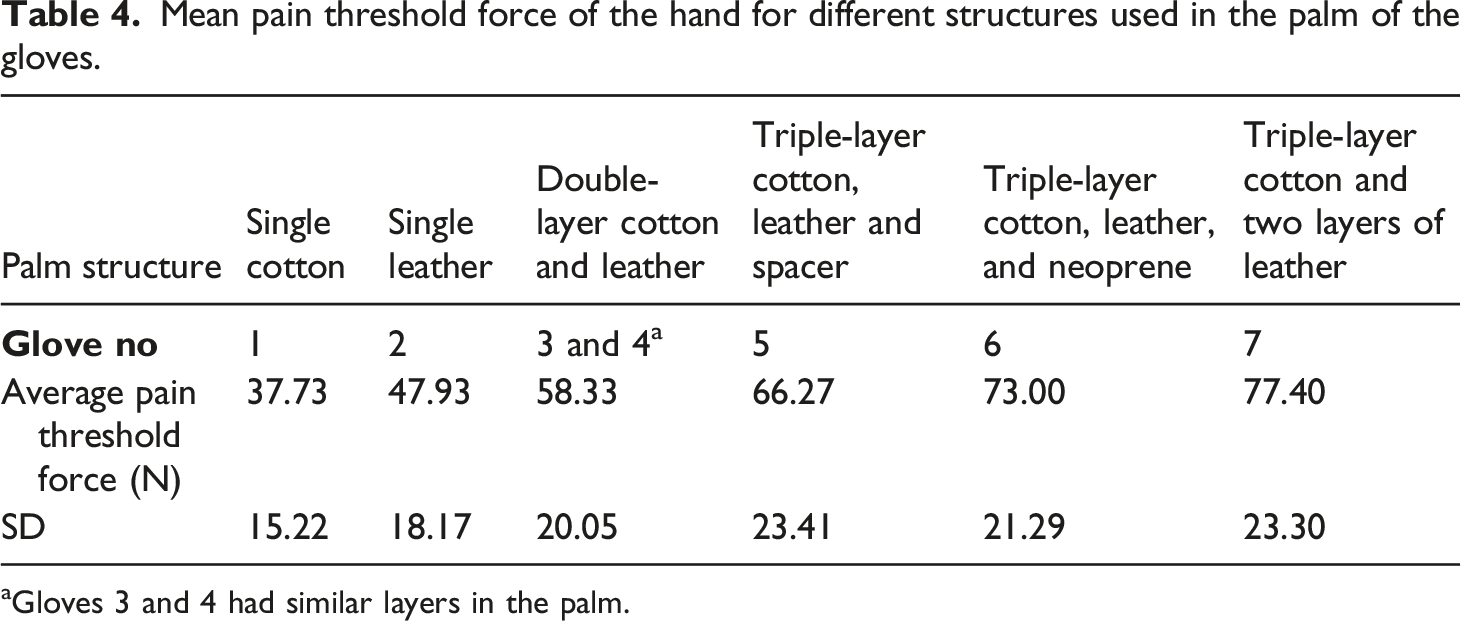
In order to evaluate the protective performance of gloves and the effect of using different layers with various characteristics for the improvement of their protective performance, the quantity of pain threshold during the utilization of gloves was evaluated. Since the protective layers were only incorporated in the palm section, the aforementioned tests were carried out in this area.
Mean pain threshold force of the hand for different structures used in the palm of the gloves.
aGloves 3 and 4 had similar layers in the palm.
According to the reports of participants in this experiment, the type and location of the perceived pain changed during the use of different gloves. For example, by wearing the gloves with lower number of layers and thickness, such as the single-layer cotton or leather glove, the pain appeared as crushing pain, while during the use of double-layer gloves the sensation of the sprains ache was described. It is noteworthy that during the load exertion, most of the participants did not feel any pain in their palm, throughout wearing gloves with a protective layer at the palm area. But, by increasing the load to a specified quantity, they finally recognized pain in the back of their hands. In case of the triple-layer glove, consisting of cotton and two layers of leather, a layer of leather was also sewn on the back of the hand. Therefore, slighter pain was felt in this glove on the back of the hand. This increased the pain threshold force compared to the gloves with neoprene and spacer protective layers. This behavior can be related to the lower compressibility and higher stiffness of the leather comparing with neoprene and spacer layer. This outcome confirms that not only the number of protective layers, but also their property can improve protective ability of the glove. Therefore, proper selection of material is a critical point in designing protective equipment and can enhance their abilities.
The statistical analysis of results for investigating the effect of the type and number of protective layers on the pain threshold of the protective gloves, proved the significant influence of the mentioned parameters on the pain threshold results at the confidence level of 95%.
Tactile sensitivity
Perceived distance for different palm structures of gloves.

aGloves 3 and 4 had similar layers in the palm.
Perceived distance for different constructions at the fingertips of gloves.

As it was mentioned before, the structure of gloves in the finger tips zone for gloves 1, 2, and 3, was different; thus, only the results of these gloves are included in Table 6.
The results revealed that as the number of layers increased, the distance perceived by the wearer enhanced, and this was the same for both the palm and the fingertip experiments. Moreover, it should be considered that the rise in thickness did not increase the perceptible distance, so that although the neoprene and spacer layers were thicker than the gloves made of double layers of leather, the perceived distance was less for the neoprene and spacer protective layers and as a result, their tactile sensitivity was better. In other words, it seems that not only layer thickness, but also other characteristics of layers can affect tactile sensitivity of the gloves. In the studied gloves, application of extra layer of leather, due to the higher stiffness and lower compressibility of the leather, diminished the tactile sensitivity in comparison with other samples. However; spacer layer has more compressibility and lower stiffness than neoprene and leather, and hence, better tactile sensitivity is obtained. In addition, it was observed that the tactile sensitivity of the fingers was better than the palm. It means that if there were identical layers in these two parts of the glove in the finger segment, the individuals were likely to detect two tips of the caliper faster (at lower distance). According to the statistical analysis of results, the structure of gloves’ palm and fingertips had a significant role on the tactile sensitivity of the consumer (significance level α = 0.05).
Hand and finger strength
The ability of hands and fingers for exerting load to other objects, while wearing a protective glove, is an essential feature that needs to be considered. In this regard, the grip and pinch strength was assessed both by objective and subjective measurements.
Objective evaluation of strength capability
Mean of grip and pinch force.

Subjective evaluation of strength capability
The evaluation of capability of gripping and lifting a pipe was carried out to estimate hands strength subjectively, while wearing gloves. By analyzing the results of paired-comparison procedures and utilizing the Thurston’s law of comparative judgment, which was described in section (2.3), the scale value for the gripping strength (the ability to grip and lift a pipe easily) for each group of gloves (Table 3) was calculated. The results of the evaluation for each separate group are presented in Figure 8. Comparison of grip strength scale value in grip and lifting the pipe test.
According to the results shown in Figure 8, for group A, where the layer thickness was examined, leather gloves (gloves 2, 3, and 4) had a higher value on the grip strength scale than cotton gloves (glove 1). The finding, as mentioned above, was due to the pipe’s increased adhesion and lack of slippage when in contact with leather as opposed to cotton. According to the participants, glove number 3 in this group had a lower strength scale value than gloves 2 and 4, owing to the slippage and thickness of the layers in glove 3.
For group B, when lifting the pipe, it was evident that gloves with a protective layer on the palm outperformed leather and cotton gloves (glove 3). Additionally, because gloves with a protective layer had improved gripping efficiency and reduced hand slippage, it was concluded that these gloves performed better in the designated task.
In group C, it was observed that gloves with a spacer and protective neoprene layer in the palm (gloves 5 and 6) performed better when lifting the pipes than gloves with an additional layer of leather (glove 7) which is due to the gap between the hands and the pipe being filled, resulting in increased contact and decreased pipe slippage while wearing gloves. In general, working with protective layers on gloves was easier than working with gloves composed of leather and cotton (glove 3).
Correlation of subjective and objective evaluation strength capability
After subjective and objective evaluations of the grip strength, in order to investigate the relationship between these two evaluations, the corresponding linear correlation was analyzed. Considering the fact that subjective evaluations were done in separate groups, their correlation to objective evaluations was also performed in separate groups. As an example, the mentioned correlation for group A is shown in Figure 9. Correlation between subjective and objective results of grip strength.
As shown in Figure 9, there is a good correlation between the subjective and objective evaluations of the grip force for group. The negative slope of this linear correlation indicates that the lower the applied force by the gloved hand during operation, the easier the task is carried out. Therefore, the gloves with a protective layer in the palm were more desirable despite of applying lower quantity of force for a specific task. Similar results were obtained for the other two groups as well.
Manual dexterity assessment
The manual dexterity of hands refers to the amplitude of arms, hands and fingers’ movement and also the speed of operating with hands and fingers. Therefore, it was necessary to evaluate the manual dexterity during the use of protective gloves, both by objective and subjective experiments, which will be discussed in next sections.
Objective assessment of manual dexterity
• Bolt closure test
As it was mentioned before, bolt closure test was one of the experiments conducted for the evaluation of manual dexterity. In this regard, as it is presented in Figure 10 the number of fallen objects during the completion of this task and also the spent time to close the bolts were recorded. Objective results of bolt closure test (a) number of fallen objects and (b) time to close the bolts.
Glove 3 was at lowest level in terms of the number of fallen objects, due to the slippage of layers on each other. It should be noted that in glove 3, the two layers of cotton and leather were not joined together by sewing or any other joining processes. The longest time for completing the task was achieved for glove 2, because of the rough edges of the leather that limit fingers. Finally, it can be concluded that the bending stiffness of the layers, the flexibility of the glove, and the range of the motion are the dominant factors affecting the time of task completion and have less influence on the number of fallen objects.
Besides, the performance of the double leather gloves (glove 7) was better in the number of falls compared to the gloves with the protective layer (glove 5 and 6). Due to the use of an extra layer of leather on the back of the fingers, the working skills in the bolt test were better on the double leather gloves (glove7). Although an extra layer of leather on the back tends to increase the bending rigidity of fingers and reduce the range of the finger motion, but since this layer resembles the nails, it helps the fingers to move and control the objects and eventually, better performance was achieved.
The difference between the gloves performance was also statistically analyzed and it was found that the effect of glove type on the bolt closure time was not significant at 95% confidence level, while the effect of glove type on the number of fallen objects was significant. • Valve opening test
The duration of the valve opening task was also used as a measure of manual dexterity. Figure 11 shows the results of the opening time test with different gloves. As can be seen from the results, gloves 3 and 4 performed well when it came to opening the valve, and when these gloves were worn, the opening task was completed in less time, whereas gloves 1 and 2 performed poorly. Due to the slippage of the hand on the valve handle in glove 1 and the lack of a cotton layer on the palm in glove 2, and the rugged and rigid nature of leather in contact with the hand, participants reported feeling discomfort when dealing with leather. As a result, the time required to complete the task was increased, reducing hand performance. Gloves with a protective layer (gloves 5 and 6) performed better than gloves with double leather protective layers (glove 7). As a result, it was concluded that the stiffness and compressibility of the layer used in the palm area played a significant role in determining manual dexterity. Objective results of valve opening test.
Additionally, the effect of the material used on the back of the hand must be considered, as this material affects the stiffness of gloves. Glove 7, with its additional layer of leather on the back, was less flexible, resulting in a longer time spent opening the valve than gloves 3, 4, 5, and 6. The difference between gloves 1 and 2 and gloves 3 and 4 was due to an inner layer of cotton affecting hand comfort. • Range of finger and wrist motion
In Figure 12, the continuous wrist movement diagram over time, when wearing gloves, is shown. Diagram of wrist movement angle over time.
The results of the maximum upward and downward motion range of the wrist (angle) while wearing different gloves are shown in Figure 13. The first noticeable fact from the wrist upward diagram in the presence of different gloves was the influence of the type and bending stiffness of the layer used on the back of the glove. As can be seen in this figure, in the upward movement of the wrist, the highest motion range belonged to the gloves made of tarpaulin on the hand back (glove 5, 6, and 7, respectively), and the hardest hand movement occurred in case of wearing gloves consisted of a leather backing (gloves 2, 3, and 4). In case of glove 1, due to the lower thickness and consequently the flexibility of the single cotton layer, the range of wrist motion was also acceptable. Result of wrist motion range.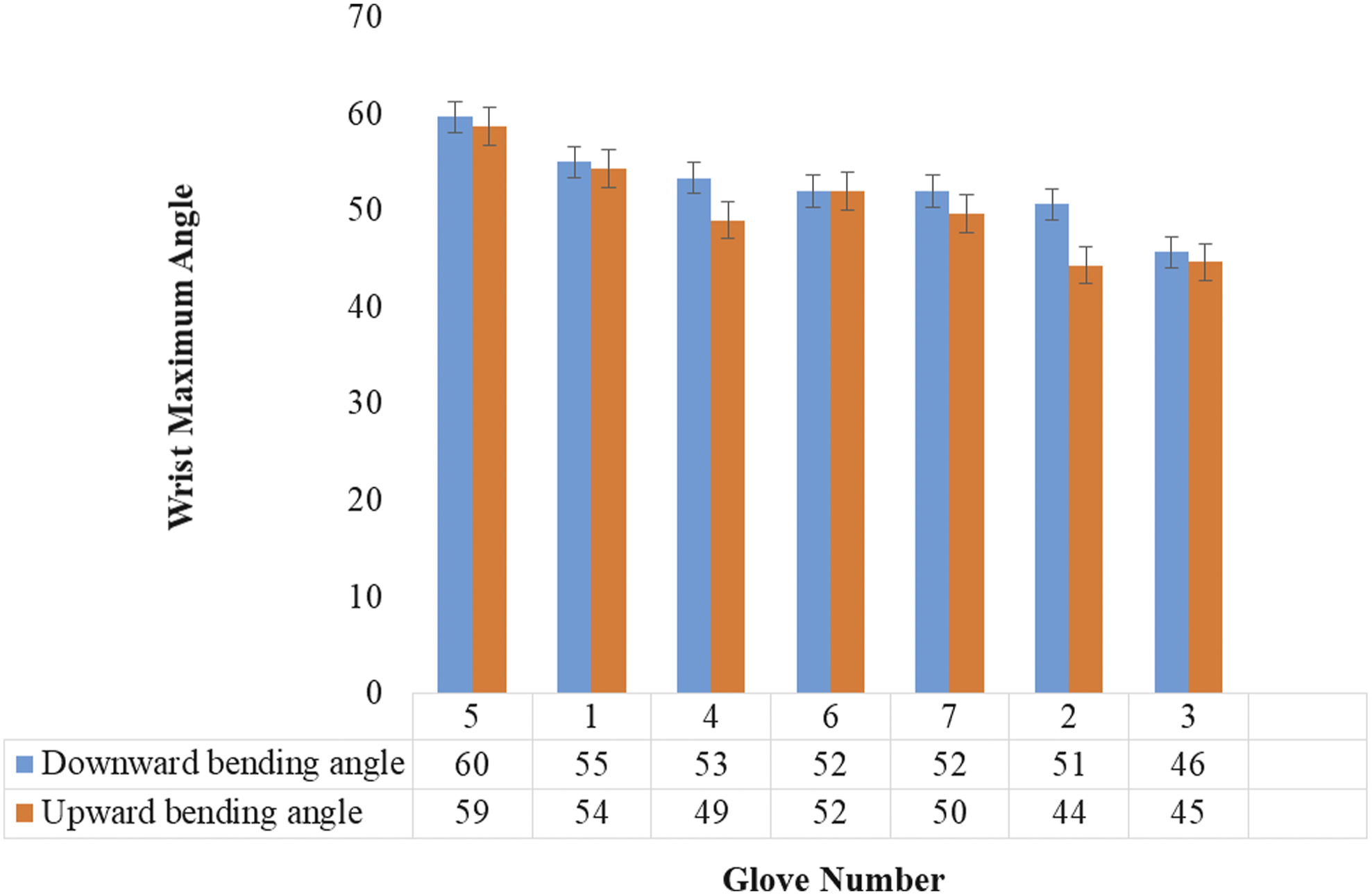
The results of downward wrist angle showed that the material used on the back of the glove, did not have a noteworthy impact on the angle of movement, but the palm composition influenced the downward movement. According to the experiments, gloves 1 and 5, which contained a softer and more flexible layer on the palm, simplified the wrist downward movement compared to the gloves 7 consisting of a harder layer on the palm. In addition, the softness of the glove and the hand’s comfort are also influential in the quality of manual dexterity. There is a great difference between gloves 4 and 2 due to the use of a cotton layer in the palm zone of glove 4. Consequently, the more comfortable the palm of hand, the wearer will bend and flex his hand easier.
The effect of the type of investigated gloves on the range of the hand motion was significant at 95% confidence level.
Subjective evaluation of manual dexterity
Due to the importance of the assessment of hand manual dexterity while using gloves, it was necessary to inspect this characteristic by subjective tests. In this regard the “bolt closure” and “valve opening tests” were carried out. • Bolt closure test
In order to assess the manual dexterity during the use of gloves, the bolt closure experiment was performed and the Thurston’s law of comparative judgment was utilized, as explained before. In this test the wearers were asked to announce the more comfortable glove in a pair and finally the “manual dexterity scale value” was calculated.
Figure 14 shows the subjective results of the bolt closure test. In group A, by increasing the number of layers and the thickness of the glove, the manual dexterity was negatively affected. Glove 4 was preferred more than glove 2 due to its softer palm zone. Comparison of subjective index of manual dexterity in bolt closure test.
According to the responses received in group B, it was found that the wearers’ ability for the bolt closure improves, in case of using a more flexible layer such as tarpaulin on the back of the glove (glove 5 and 6) rather than leather (glove 3). In the comparison of spacer (glove5) and neoprene (glove 6), the spacer layer was scored higher, and participants felt more comfortable using gloves made of this layer. Group D also fully endorses the results of groups A and B, showing that the use of the spacer layer and neoprene layer (glove 5 and 6) on the palm of the glove is much better than the double leather (glove 7) and significantly improves the wearer’s performance. In case of glove 3, due to the presence of a single layer of leather in combination with cotton, the manual dexterity was better than glove 7, which contained double layers of leather. • Valve opening test
For the subjective valve opening experiment, the Thurston’s law of comparative judgment was also used similar to the bolt closure test and the amount of dexterity scale value was recorded for this test. The announcement of the more comfortable glove in a pair, for opening of the valve, was required from the wearers. The results for different groups of gloves are shown in Figure 15. Comparison of manual dexterity scale value in valve opening test.
For group A, it was observed that the leather glove (glove 2) caused hands and fingers discomfort due to their contact with the sewn seams and had the least efficiency in opening the valve. After that the cotton glove (glove1) was not successful in satisfying the wearers, because of its low thickness and exposure of pain and discomfort to the hands and fingers. The most preferable glove in this group was leather gloves with a piece of cotton in the palm (gloves 4). The efficiency of glove 3 which was the combination of leather and cotton glove was comparable with glove 4.
In group B, it is clear that the protective glove containing neoprene layer (glove 6), provided better performance than the glove with the spacer layer (glove 5). This is due to the extra resistance of neoprene against the pressure, which resulted in less compression and pain in the palm zone. The lowest satisfaction was achieved by glove 3.
In group C, the purpose of which was to compare the performance of the gloves with protective layer (gloves 5, 6, and 7) and the double-layer cotton-leather glove (glove 3), it was observed that the use of the protective layer due to the higher compressibility provided better hand performance in this task.
Figure 16(a) shows the correlation of the subjective and objective tests of the bolt closure test for group B. Given these results, it is observed that in group B there is a good agreement between the subjective and objective results. In other words, the higher the glove approval by wearers with regards to the manual dexterity, the lowest the time of the bolt closure task completion. In other words, working with the gloves which were considered more comfortable in the subjective evaluations (having higher manual dexterity scale value), resulted in lower spent time for completion of the task (easier working with a specified glove). Similar trends were also obtained for A and C groups. Correlation between subjective and objective results of manual dexterity in (a) bolt closing test and (b) valve opening test.
According to the Figure 16(b), as an instance for group A, which investigates the linear correlation between the objective and subjective evaluation of manual dexterity for the valve opening test, it was observed that in all groups there was a good linear fit between the subjective and objective results.
Conclusions
Wearing protective gloves while at work can significantly reduce the risk of injury. Numerous factors, including the materials used in gloves, the number of layers, and their combination in various areas of the glove, can affect the wearer’s performance in various situations.
The results of the pain threshold and tactile sensitivity tests indicated that the type and location of layers are influential factors. According to the results of the experiments, increasing the thickness, stiffness, compressibility and layer count improves the protective capability but decreases the tactile sensitivity of the hands. Furthermore, when handgrip strength was evaluated subjectively and objectively, it was discovered that increasing the thickness and number of glove layers can weaken handgrip strength. Furthermore, application of layers with higher stiffness and lower compressibility decreases the gripping force, because higher force is required to deform the layer in the glove structure. Notably, the type of layers in contact with the wearer’s skin is also deemed effective at increasing grip strength and reducing slippage.
The evaluation of gloved hands’ manual dexterity is a dynamic and multidimensional process. Subjective and objective evaluations of this attribute reveal that the type, arrangement, and thickness of the layers in various areas of the gloves are the most critical parameters.
Finally, the evaluation of different gloves with varying designs and layer combinations demonstrates that each variable could affect the functional properties of the gloves. According to the results of the gloves comparison using Thurstone’s law, it is determined that while a particular construction may be advantageous in some aspects of performance, it may have a detrimental effect on other features expected from glove users. As a result, it is impossible to select the most appropriate gloves regardless of the environmental conditions or type of anticipated work.
To summarize, it was observed that glove 5, which was designed with a triple-layer glove in the palm section with cotton as the inner layer, spacer fabric as the compressible protective layer, and leather as the outer layer, can optimally cover all aspects of hand function in cases of increased pain threshold and manual dexterity, as well as the ideal possibility of a gloved hands’ manual dexterity. Additionally, as evidenced by the subjective test results, the glove mentioned above gained the highest level of user satisfaction.
Footnotes
Declaration of conflicting interests
The author(s) declared no potential conflicts of interest with respect to the research, authorship, and/or publication of this article.
Funding
The author(s) received no financial support for the research, authorship, and/or publication of this article.
