




Abstract
This study reports the hardness and flexural performance of the three-dimensional (3 D) orthogonal carbon/glass hybrid fiber/bismaleimide composites subjected to the accelerated aging conditions for 10, 30, 90, 120, and 180 days at 250 °C in an air environment. The rate of reduction in the flexural performance and failure modes were observed, in general, to be related to the aging time. The experimental findings revealed that the significant decline in the flexural performance of the samples aged for less than 30 days was predominantly attributed to the matrix degradation, while for the longer aging durations, the cracks in the composites and decomposition of the residual matrix were responsible for the gradual reduction in the flexural performance. The unaged and 30 days aged samples suffered a brittle failure represented by the macro-cracks and fiber breakage, while the cracked fiber/matrix interface and loosened fiber bundles were the main failure modes for the samples aged for longer times. The changes in the flexural failure modes resulted due to the severe degradation of the matrix under an extreme thermo-oxidative environment. Subsequently, a nonlinear relationship relating the flexural modulus to hardness was proposed.
Introduction
Bismaleimide (BMI) resin-based composites have been widely used in aerospace structural components for operation in harsh environments owing to their excellent thermal performance and ease of processing [1–3]. Among these structural composites, the three-dimensional (3 D) orthogonal composites have specifically received widespread attention for use in load-bearing structures due to the high delamination resistance and strength along in-plane direction and low manufacturing costs [4–6]. Following demands of speed and altitude for supersonic aircraft, it has been estimated that the body surface is heated to more than 180 °C by aerodynamic heating [7]. As thousands of hours of static thermal loading are required during operation, the thermo-oxidative stability of 3 D orthogonal composites with BMI resin must be evaluated.
The previous studies on the thermo-oxidative aging (TOA) of BMI resin-based composites have exhibited the mass loss [8] and reduction in the static mechanical properties of composites, including flexural [9], inter-laminar shear [10], and tensile properties [11]. These studied largely focused on the single fiber-reinforced composites. However, hybrid composites are more extensively employed for long-term high-temperature environments encountered in aerospace applications, owing to their excellent strength, stiffness, and energy absorption [12,13].
Currently, experimental and analytical studies on the behavior of the hybrid composites under TOA conditions are limited. In a related study, Brain et al. [14] reported that the damage occurred initially at the point of contact between carbon fiber (CF) and glass fiber (GF) under TOA condition. Bin Yang et al. [15] reported that the combination of CF and GF in epoxy resin enhanced the mechanical performance of the resulting composites at high temperatures. Our previous study [16] also confirmed that the CF/BMI interfacial bonding was stronger than GF/BMI at the same TOA condition. Thus, understanding the effect of TOA on the performance of hybrid composites has become vital for the effective design of hybrid composite materials. The flexural test is able to not only characterize the resistance of bending deformation, but also reflect the properties of the matrix and fiber/matrix interface [17,18]. Besides, the hardness can effectively signify the deformation resistance of the composite against the concentrated force [19,20]. Moreover, the hardness test results in relatively minor damage to the composite. Hence, it is important to investigate whether the changes in the flexural performance can be characterized by the hardness of the 3 D orthogonal hybrid composites with BMI resin under TOA conditions.
In this respect, the objective of the current study is to determine the degradation mechanism and relationship between the flexural performance and hardness of the 3 D orthogonal CF/GF/BMI hybrid composites under long-term TOA conditions. The 3 D orthogonal CF/GF/BMI hybrid composites have been characterized after exposure to the extreme thermo-oxidative environment to determine the reduction in the hardness and flexural modulus as a function of the aging duration. The surface morphology and microstructure of composites have been further analyzed to gain insights into the experimental findings. Meantime, the changes in the failure modes under flexural loads have been analyzed. In addition, a statistical model has been developed to illustrate the relationship between the flexural modulus and hardness of the 3 D orthogonal CF/GF/BMI hybrid composites under extreme TOA conditions.
Materials and experimental methods
Materials
The materials used in the study were CF (T800-12K) supplied by Toray Inc. (China), two types of GF (S-12K and S-6K) supplied by Shaanxi Huate Inc. (China), and BMI resin (BH301) supplied by Jiangsu Hengshen Inc. (China).
Manufacturing process
Fiber reinforcement weaving
Figure 1 presents the schematic illustration of the fabrication of the 3 D orthogonal woven CF/GF hybrid preform. The preform was fabricated on a 3 D weaving machine developed by Xi’an Polytechnic University. As shown in Figure 1(a), the 3 D weaving machine is comprised of a warp beam, Z-binder yarn beam, healed frame and reed. The warp and weft yarns were interlaced along the x-direction (0°) and y-direction (90°), respectively. The weft yarns were woven manually and subsequently tightened with reed. The Z-binder yarns passed through the thickness of the preform in the z-direction to form an integrated structure (Figure 1(b)). The unit density of the 3 D orthogonal woven CF/GF hybrid preform was 5 yarn/cm. The 3 D orthogonal woven CF/GF hybrid preform comprised of 13 layers, of which the upper and lower four layers were composed of S-GF, whereas the middle five layers contained T800-12K-CF. No buckling behavior was noted in the warp and weft yarns as these did not interweave with each other. The Z-binder yarns in the thickness direction were composed of S-6K-GF, integrating the preform as a whole to effectively resist the delamination failure.

(a) Fabrication of the 3 D orthogonal woven CF/GF hybrid preform and (b) schematic illustration of 3 D orthogonal woven CF/GF hybrid preform.
Composite molding
The vacuum-assisted resin transfer modeling (VARTM) method involving the injection of BMI resin into the preform was used to prepare composites. The detailed fabrication process has been described in our previous work [21]. The dimensions of the formed composites were 250 mm × 185 mm × 4 mm (length×width×height). The morphology of the 3 D orthogonal woven CF/GF hybrid composite (3 D-CF/GF/BMI composite) is depicted in Figure 2. As shown in Figure 2(a), the surface of the unaged sample is sufficiently smooth and crack-free, thus, indicating a well-defined morphology. The Z-binder yarns through the thickness direction are also clearly observed in Figure 2(b), which are beneficial for improving the delamination resistance.

The morphology of the 3 D-CF/GF/BMI composite. (a) the full view of the 3 D-CF/GF/BMI sample, (b) the profile of the 3 D-CF/GF/BMI sample.
Thermo-oxidative aging
Test samples were pretreated in an electric air-blowing drier at 70 °C for 1 hour to remove the excess moisture. The specimens were placed in the air-circulating oven and aged for 10, 30, 90, 120, and 180 days at 250 °C. The chosen aging temperature was above the glass transition temperature of BMI resin (230°C) for demonstrating the extreme oxidation-induced property gradient. The samples were removed from the air-circulating oven periodically, followed by cooling to room temperature and placement in the sealed plastic bags to prevent samples from absorbing moisture.
Characterization and measurements
Thermogravimetric analysis (TGA)
The TGA was carried out on BMI resin using Q500 (TA Co., Ltd., America) in an oxygen atmosphere at a flow rate of 50 mL/min. The samples were heated from 30°C to 800°C using a heating rate of 10°C/min.
Hardness
Shore D Durometer was utilized to analyze the influence of TOA on the hardness of the composites. Figure 3 presents the schematic diagram of the Shore D hardness test apparatus. In principle, the durometer penetrates the material, and the hardness can be interpreted on a 0 to 100 HD scale. The higher the hardness value is, the greater is the resistance to the deformation. The Shore hardness of the composite materials represented an average of values from ten different locations.

The schematic diagram of the Shore D hardness test apparatus.
Flexural performance
To investigate the effect of TOA on the flexural performance of composites, the three-point bending test was conducted on the specimens using a universal test machine (Shenzhen Suns Technology CO., Ltd, China) based on the standard GB/T 1449-2005. Figure 4 shows the schematic illustration of the three-point bending test. A set of three specimens was tested for each aging period using a loading rate of 2 mm/min.

Schematic illustration of the three-point bending test.
Morphology
VHX-5000 Ultra-field microscopy system and scanning electron microscopy (SEM, Quanta-450-FEG, FEI Co., Hillsborough, CA, USA) were utilized to record the macro- and micro-morphology of the specimens, respectively. For SEM analysis, an ultrathin coating of electrically conducting gold was deposited on the sample surface.
Results and discussions
Thermogravimetric analysis
Figure 5 shows the cumulative (TG) and differential (DTG) thermogravimetric traces of BMI resin. The resin shows thermal stability within the temperature range of 30°C to 200°C. On heating beyond 200°C, the weight of BMI resin decreases progressively revealing the thermal degradation. Furthermore, beyond 390°C, BMI resin exhibits a considerable loss of weight. For instance, a significant loss of up to 41.10% is observed in the temperature range of 395.67°C to 477.67°C. After heating to 800°C, the residual weight of BMI resin is observed to be ∼35.05%. Overall, the findings from TGA confirm the excellent thermal stability of the BMI resin at the high-temperature condition for a short time. However, it is vital to investigate the state of the BMI resin after long-term TOA analysis at 250°C. For this, FTIR analysis has been carried out on the original and aged samples in our previous study [16]. The FTIR results indicate that the chemical changes in the aged samples are caused by decomposition.
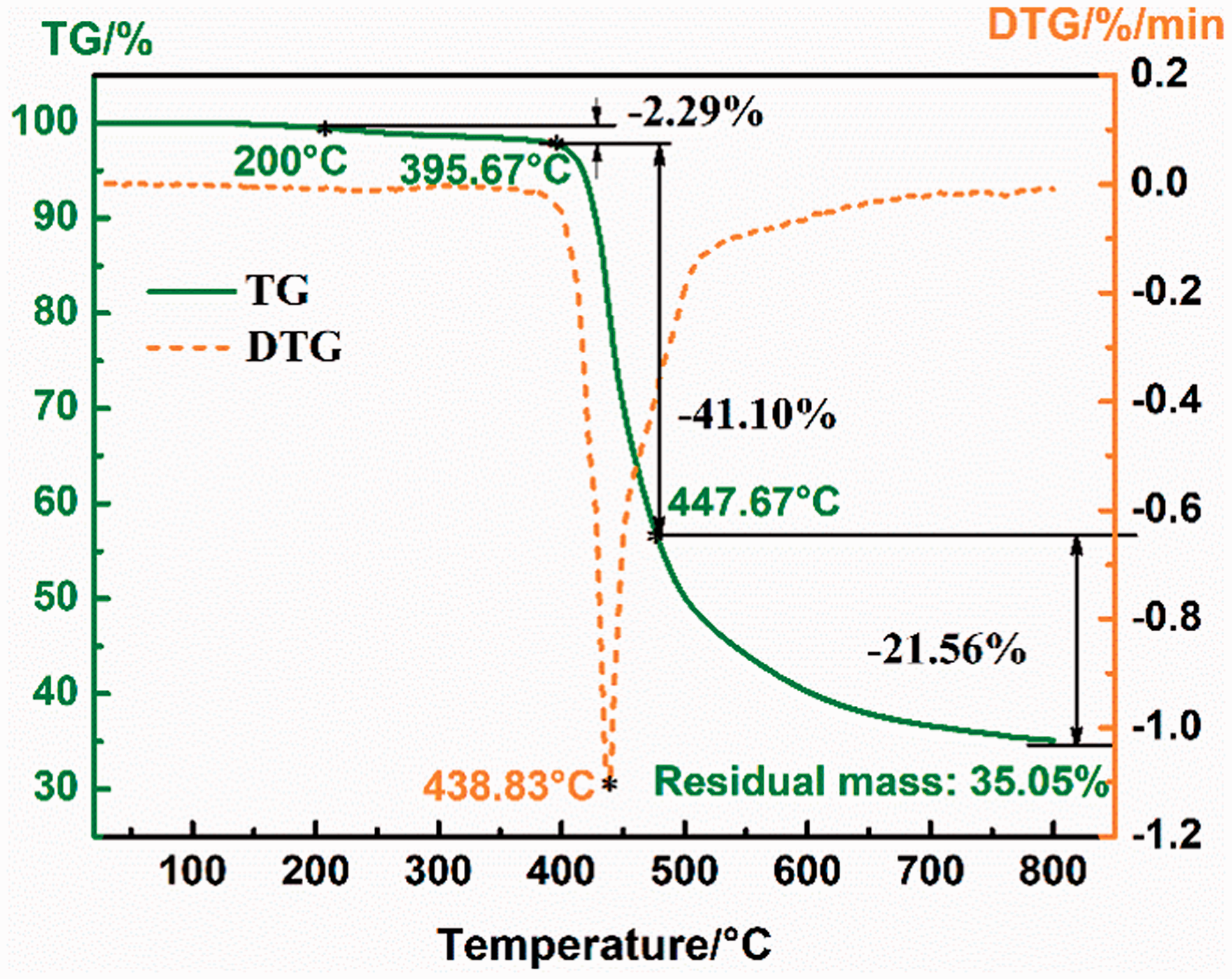
The TG and DTG curves of BMI resin.
Surface morphology
Figure 6 shows the surface features of the specimens taken by the VHX-5000 Ultra-field microscopy system. No evident cracks are observed in the unaged specimen (Figure 6(a)). Figure 6(b) to (f) demonstrates the surface characteristics of the specimens after different aging periods. The cracks are observed to appear and become more obvious with the aging time. Moreover, the surface of the unaged sample is observed to be relatively smooth. Figure 6(b) to (f) indicates a rough surface for the aged samples. On increasing the aging time, map cracking can be observed in Figure 6(c) and (d). The observed phenomenon can be attributed to the severe degradation of the resin, revealed in our previous study [16]. Owing to the breaking of the chains in BMI resin, the resulting shrinkage and mass loss induce the initiation of small cracks. Besides, the coefficient of thermal expansion (CTE) of CF, GF, and BMI resin is -0.38 × 10⁻⁶°C−1, 2.59 × 10⁻⁶°C−1 [22] and 44 × 10−6°C−1 [11], respectively, indicating a significant variation between the constituents. This mismatch generates thermal stresses in BMI resin, thus, leading to micro-cracks. At the same time, the cracks provide additional pathways for the penetration of oxygen in the structure, thus, resulting in further oxidation and continuous reduction in the mechanical properties of the composites. Due to the extreme TOA of BMI resin in oxygen, significant oxidative degradation is observed to take place. This causes Z-binder yarns to be exposed to the environment in Figure 6(e) and (f).

Surface imagines of the 3 D-CF/GF/BMI composites by VHX-5000 Ultra-field microscopy system. (a) the unaged sample, (b) the aged 10-days sample, (c) the aged 30-days sample, (d) the aged 90-days sample, (e) the aged 120-days sample, and (f) the aged 180-days sample.
The microstructure of the composites is illustrated in Figure 7. The interfacial bonding is observed to be dependent on aging time. For the unaged sample, a large amount of resin is observed to be adhered to fibers (Figure 7(a)), thus, representing an excellent interfacial bonding between the fibers and BMI resin. Figure 7(b) to (f) exhibits a low extent of resin remaining on the fibers as a function of the aging time. Specifically, Figure 7(f) also shows the loose fiber bundles. After 180 days of thermal exposure at 250°C in air, BMI resin is observed to experience severe degradation. Thus, the capacity of BMI resin to protect and bond the fibers are observed to be weakened, thus, causing more fibers to become exposed. The observed phenomenon indicates a weak fiber to matrix adhesion. In summary, long-term TOA was responsible for the damage of the fiber/matrix interface.

SEM imagines of fiber/matrix interfaces of samples aging for different times at 250 °C: (a) the unaged sample, (b) the aged 10-days sample, (c) the aged 30-days sample, (d) the aged 90-days sample, (e) the aged 120-days sample, and (f) the aged 180-days sample.
Flexural performance
The representative stress-strain curves for the unaged and aged 3 D-CF/GF/BMI composites are shown in Figure 8. The stress of the specimen is observed to decrease on increasing the aging time. For the specimens aged less than 30 days, the curves exhibit a linear increasing trend at the initial stage due to the elastic deformation of the fiber tows and BMI resin. After the peak stress, the macro-cracks are observed in resin, thus, leads to fiber tows breakage, as shown in Figure 9(a) and (b). Finally, a sudden drop in flexural strength is observed due to the catastrophic fracture of the fiber tows and matrix. Figure 10 displays the flexural data on the 3 D-CF/GF/BMI composites. The flexural strength is noted to decrease by ∼64.48% for the sample aged for 30 days as compared to the unaged sample (Figure 9(a)). The significant decline in flexural strength is similar to that of the weight loss of the samples aged for less than 30 days [16], which indicates that the thermal degradation of BMI resin is the main reason for the observed phenomenon. Similar to the flexural strength, the flexural modulus decreased on increasing the aging time. After long-term TOA, the chemical structure of the BMI resin is observed to be destroyed [16], leading to a reduction in the stiffness of the composites. Therefore, the load-bearing capacity of the 3 D-CF/GF/VMI composites is weakened.

The stress-strain curves of the 3 D-CF/GF/BMI composites.
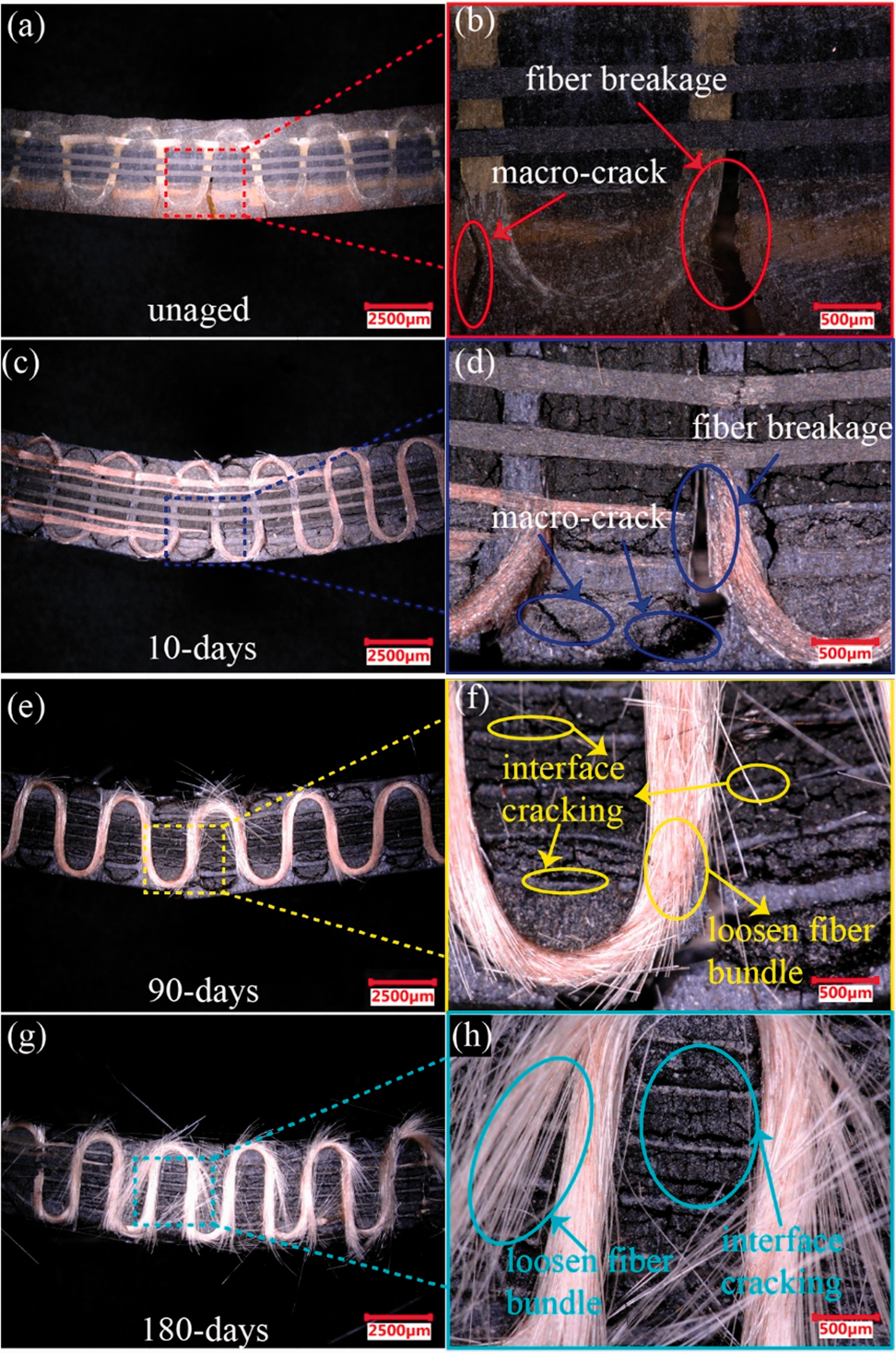
The fracture morphologies of composites after the flexural test. (a) the unaged sample, (c) the aged 10-days sample, (e) the aged 90-days sample, (g) the aged 180-days sample, (b), (d), (f) and (g) are the zoom imagines of (a), (c), (e) and (g), respectively.

The flexural performance of the 3 D-CF/GF/BMI composites vs. exposure time. (a) the flexural strength, (b) the flexural modulus.
On the other hand, a noticeable difference exists between the curves of the samples aged for a longer duration (more than 30 days) and the original sample (Figure 8). For the samples aged for more than 30 days, the linear increase of stress is very small, due to which the cracks appear and propagate (Figures 6 and 7). The observed effect results from the significant decomposition of BMI resin and reduction of the interfacial performance under extreme TOA conditions. Eventually, the stress of the composites reaches a relative plateau value. Simultaneously, after aging for 180 days, the flexural strength and flexural modulus are noted to decrease by 97.27% and 92.87% of their original values respectively, thus, indicating that the composite is not able to bear the external load effectively. The rate of decline in the flexural performance of the samples aged for more than 30 days is noted to be lower than that of the samples aged for less than 30 days. Two factors could explain this observation. Firstly, after long-term TOA, numerous cracks appear in the composites (Figure 6) which provide external channels for oxygen penetration, thus, inducing the continuous reduction in the flexural strength. Secondly, the small amount of residual BMI resins experiences severe degradation under extreme TOA environment. In these circumstances, BMI resin gradually loses the ability to protect and bond the fibers and does not effectively transfer the stress between the fibers. The reinforcement of composites became the main load-bearing components. Thus, the flexural strength and modulus are observed to decrease more gently. In the meantime, the fiber/matrix interface cracking and loosened fiber bundles are evident in the samples aged for 90 and 180 days (Figure 9(c) and (d)). From Figure 9, the 3 D-CF/GF/BMI composites are noted to still possess the structural integrity owing to the addition of Z-binder yarns. The integral structure of the 3 D orthogonal woven composite enables the fibers to bear the flexural load although the matrix resin and fiber/matrix interface exhibit a certain degree of damage after long-term TOA.
Hardness
Figure 11 shows the Shore D hardness of the composite aged at 250°C as a function of aging time from 0 to 180 days. The durometer penetrates only a few millimeters in the material. Thus, the hardness of materials is dependent on the amount of resin on the surface. The rate of decline of hardness in the early aging period (less than 30 days) is observed to be less than that in the later period (more than 30 days). This is due to the reason that there is plenty of resin retained on the surface of the samples aged less than 30 days (Figure 6). After a longer aging time, a smaller amount of resin is left on the surface of the samples, and the fibers are exposed to the environment. For the aging time less than 30 days, no significant difference in hardness is observed between the composite and BMI resin. With further aging, the difference between the samples and BMI resin is observed to increase. Simultaneously, the hardness of the aged sample approaches that of the preform. The continuous decline in hardness can be attributed to the severe degradation of the resin on the surface of aged samples. Moreover, the difference of CTE between the fibers and BMI resin leads to the generation of numerous micro-cracks (Figure 6), which accelerate the aging process in the composites. Thus, after long-term aging, the hardness of the aged composites decreases more than the BMI resin. Additionally, the hardness is a quantitative representation of the deformation resistance of the composite against a concentrated force on its surface [19]. Thus, it can also conclude that the load-bearing ability of the composites declined with aging time.

Shore hardness of the 3 D-CF/GF/BMI composites.
Relationship between hardness and flexural modulus
The hardness and flexural modulus reflect the composites’ resistance to deformation. The hardness of the composite mainly depends on the properties of the matrix resin, and the flexural modulus is the comprehensive reflection of the matrix resin and reinforcement. The decrease of the flexural modulus of the composite under TOA is mainly due to resin decomposition. Additionally, both the flexural modulus and hardness of the composite decrease with the increasing of aging time. Therefore, it is important to investigate if there is a relationship between the flexural modulus and hardness of the composite. Taking hardness as the x-coordinate and bending modulus as the y-coordinate, the scatter diagram has been drawn, as shown in Figure 12(a). It can be seen that the flexural modulus decreases exponentially with the hardness.

The relationship between the flexural modulus and hardness. (a) exponential fitting, (b) linear fitting.
Thus, equation (1) [23] was used to fit the flexural modulus and hardness of the composites as


The fitting coefficient (R2 = 0.9201) is observed to be more than 0.90, indicating that the model is suitable to describe the relationship between flexural modulus and hardness. Besides, during the first three aging periods (blue ellipse in Figure 12(a)), degradation of the resin and fiber/matrix interface performance is noted to predominate. Subsequently, on increasing the aging time, the fiber reinforcement becomes the main load-bearing component. Thus, the degradation rate in the first three aging periods is higher than that of the last three aging periods (yellow ellipse in Figure 12(a)).
Taking the logarithm of equation (1), the following linear form can be obtained:


Equation (4) indicates that the variation of flexural modulus of the composite can be described indirectly by its hardness under TOA. Although there is no obvious relationship between the hardness and flexural modulus of the composite, the hardness may be used as a nondestructive test to predict flexural modulus change of the composite under TOA.
Conclusions
This study set out to understand the effect of TOA on the hardness and flexural performance of the 3 D-CF/GF/BMI hybrid composite. For composites aged for less than 30 days, the flexural performance exhibited a significant decline. Moreover, the aged samples exhibited the failure modes of macro-cracks and fiber breakage, which were consistent with those of the unaged samples. The observed phenomenon was attributed to the thermal degradation of BMI resin. For samples aged for more than 30 days, the decline in the flexural performance was more gradual. The fiber/matrix interface cracking and loosened fiber bundles were observed in the samples, owing to the cracking in the composites and decomposition of residual BMI resin. The BMI resin suffered significant degradation, thus, leading to the weakening of its capacity to protect and bond the fibers. Besides, it did not effectively transfer the stress between the fibers. Finally, a nonlinear relationship was observed between the flexural modulus and hardness of the 3 D-CF/GF/BMI composites. Further work needs to be done to explore the possibility to predict the flexural modulus of the composites by hardness. These results may contribute to the optimized use of the CF/GF hybrid composites in the aerospace industries for durable, safe and reliable development. Moreover, resin matrix with excellent resistance to TOA should be developed for aerospace components.
Footnotes
Declaration of conflicting interests
The author(s) declared no potential conflicts of interest with respect to the research, authorship, and/or publication of this article.
Funding
The author(s) disclosed receipt of the following financial support for the research, authorship, and/or publication of this article: The authors acknowledge the financial support from National Natural Science Foundation, China (No. 52073224, 12002248, 51703179), National Key Research and Development Program of China (No. 2019YFA0706801), Innovation Capacity Support Plan of Shaanxi, China (No. 2020PT-043), Scientific and Technology Project for Overseas Students of Shaanxi, China (No. 12), Scientific Research Program Funded by Shaanxi Provincial Education Department, China (Grant No: 18JS041), Thousand Talents Program of Shaanxi Province.
