




Abstract
Electromagnetic shielding (EMS) has become the necessity of the present era due to enormous expansion in electronic devices accountable to emit electromagnetic radiation. The principal target of this paper is to originate three-dimensional (3D) orthogonal fabrics with conductive hybrid weft yarn and to determine their electromagnetic shielding. DREF-III core-spun yarn using copper filament in the core and polyphenylene sulfide (PPS) fiber on the sheath and fabric constructed of such yarn has a promising electromagnetic shielding characteristic. Box–Behnken experimental design has been employed to prepare various samples to investigate the electromagnetic shielding efficiency of 3D orthogonal woven structures. The orthogonal fabric samples were tested in an electromagnetic Ku frequency band using free space measurement system (FSMS) to estimate absorbance, reflectance, transmittance, and electromagnetic shielding. The increase in copper core filament diameter and hybrid yarn linear density enhances the EMS of orthogonal fabric. Statistical analysis has been done to bring out the effect and interaction of various yarn and fabric variables on EMS. Metal filament diameter, orientation, sheath fibers percentage, and fabric constructional parameters significantly affected electromagnetic shielding efficiency. The inferences of this study can be applied in other 3D structures like angle interlock, spacer fabrics for curtains, and coverings for civilians and military applications.
Keywords
Introduction
The EMS is required to shield electrical and electronic assemblies from external electromagnetic (EM) fields. The electromagnetic shielding fabric (ESF) has inherent and soft functionalities which have found comprehensive application in civilian, industrial, and army-related electromagnetic shielding. 1 The effect of yarn type, weave type, and fabric thickness on EMS was studied a little on two-dimensional fabrics. The fabric weave, an interlacement pattern of warp and weft thread containing conductive materials, is a crucial factor in influencing the shielding effectiveness (SE) of ESF in two-dimensional fabrics. The plain weave fabric was found better than the twill weave fabric for EMS.2–4 The thread density and number of apertures do not effectively regulate the SE of metallic yarn-containing fabrics. The coarser yarns are found more effective in SE of EMS fabrics. 5 With an enhancement in warp and weft density with the number of conductive fabric layers, an increase in EMS is witnessed in 3/1 twill copper fabrics. 6 Copper is found more effective than brass in EMS fabric manufacturing.
An effective physical model was developed to predict the SE of EMS fabrics by considering lateral longitudinal yarn, conductive fibers, and yarn diameter as input parameters. 7 The metal fiber content per unit area has enhanced SE in EMS fabrics. 8 The effect of the copper content in copper/glass knitted polypropylene composite, linear yarn density, and stitch density is studied for electromagnetic shielding and shielding effectiveness. 9
Metal and polyester filaments are used to produce a metallic grid in conductive fabrics. The study concludes that electromagnetic shielding effectiveness (EMSE) increases with metal content and the square grid structure. 10 The cotton/copper hybrid yarns possess higher EMSE than cotton/stainless steel hybrid yarns fabric without a significant effect of weave. 11 Silver coated cotton yarn and silver core-sheath ring yarns produce single jersey knitted fabric for electromagnetic shielding. The fabric produced by the plating technique shows higher EMS than core-spun yarn knitted fabrics at low-frequency regions. 12 A mathematical model also found a high degree of correlation between predicted and measured EMS values in metallic hybrid yarn-based 2D fabrics when metal yarn diameter, metallic yarn periodic spacing, electric conductivity, electromagnetic wave polarization direction, and the weaving angle were considered as input parameters. 13 The plain-woven 2D fabric samples manufactured by core-sheath stainless steel/polyester yarn were exhibited that the direction of hybrid yarns and warp-weft yarn densities affects the SE of EMS fabrics. 14
Polyphenylene sulfide (PPS) fiber/copper particles composites have been successfully utilized to manufacture electrical conductive fabric. However, PPS did not cover copper wire as sheath material for EMS purposes although copper wires were used to develop textile-based sensors and actuators.15,16
PPS staple fiber, a semi-crystalline thermoplastic material selected to cover the copper monofilament using the DREF-III spinning process, has found versatile applications due to its outstanding electrical, tensile, and thermal applications, and inherent flame retardant properties.17,18 PPS/multiwall carbon nanotube composites fibers have been found electrically conductive for EMS purposes. The SE of copper/cotton core-sheath yarns based on 2-dimensional (2D) fabrics was also satisfactory. 19
Maximum researchers have selected 2D woven architecture and studied the effect of different parameters in the various frequency ranges. In the case of 2D woven architecture, it is impossible to keep a thread straight. It is concluded that by bending the conductive yarns, the EMS potential decreases. 20 Three-dimensional woven architecture is more challenging to construct than 2D conventional woven fabrics. In 2D woven architecture, only one layer of thread is used, but in 3D orthogonal architecture, the number of successive thread layers is not restricted.
The 3D fabrics are configured along the X, Y, and Z-axis, imparting high strength in all three directions. The higher thickness of 3D fabrics offers more opportunities for fabric engineering and product development, especially for EMS purposes.
Three-dimensional orthogonal fabric preforms were produced using E-glass fiber as a significant component to enhance fabric thickness, impact resistance, and delamination resistance. Preforms are converted to composite and found to have the maximum influence of vertical yarn layers on impact resistance and Charpy impact energies. 21 The yarn parameters have a higher impact on a load-elongation curve rather than fiber properties. 22 Finite element deformation modeling considers jammed and non-jammed 3D orthogonal structure geometry with tensile properties of constituent yarns and resins with spun and filament yarns. The model has successfully predicted the results close to experimental findings. 23
The interaction between electromagnetic energy and textile fabrics is essential for designing and realizing electromagnetic shielding/absorptive fabrics. Conceptually, when electromagnetic energy is incident on fabric, some part of the energy reflects, transmits, and absorbs. 24 The share of reflection, remittance, and absorption depends on the fabric material’s thickness and conductivity. To engineer the textile structure of desired EMS, the electromagnetic conductivity of yarns and thickness of the textile structure play a vital role. 25
The author’s best knowledge of the 3D orthogonal fabrics, which have considerably higher thickness than 2D fabrics with stuffer yarn presence, did not consider for electromagnetic shielding purposes by other researchers. The unconventional structure of 3D fabrics has enough potential to engineer better ES.
The 3D orthogonal fabric samples are manufactured as per response surface methodology (RMS) and Box–Behnken design of experiment by altering the copper filament diameter, the linear density of PPS fiber, and hybrid yarns.
The present work will provide a concrete platform to establish the mechanism and relationship between various parameters of the 3D orthogonal structure in which warp threads are nonconductive yarns, and weft threads are copper filament-based core-sheath hybrid yarn.
Material and method
Optimized parameters for design of 3D orthogonal fabric.

Scheme of Box and Behnken design of experiment.

Many researchers have agreed that sample manufacturing with each possible factorial combination of the specimen variables is unrealistic because of the sizeable number of samples needed. Hence, the Box–Behnken design of experiment, a response surface modeling, has been adopted for analyzing the influence of various variables affecting the response by altering them simultaneously and conducting a restricted number of experiments. Box–Behnken design has been popularly used for the second-order response surface model with a minimum number of trials, which is not possible in traditional factorial designs. It is created by merging two-level factorial designs with partial block designs in an exceptional approach. The sample manufacturing for each block is replaced by an identical design.27–30
Conductive hybrid yarns of linear density 300, 350, and 400 tex are manufactured using PPS at sheath and copper monofilament of 0.05, 0.1, and 0.15 mm diameter at the core as a similar range of copper filament diameter has opted for conventional knitted fabrics for EMS purposes.
31
Different core-sheath copper/PPS hybrid yarns are produced on a Fehrer AG type DREF-III friction spinning machine. The core is filled by feeding the copper monofilament of 0.05, 0.10, and 0.15 mm diameter and four PPS slivers for sheath fibers. The feed rate and draft of drafting units are adjusted so that the total yarn tex must meet the desired linear density. The spinning-drum speed and the yarn delivery speed were kept constant at 2500 rpm and 50 m/min, respectively, for all the samples. The cross-sectional view of the 3D orthogonal fabric and the conductive hybrid yarn is given in Figure 1. The fabrication of 3D orthogonal fabric was carried out by making special arrangements in the CCITech sample loom employing additional beams. Various parameters such as axial yarn movement, binder yarn (Y), weft yarns are optimized for various experimental works. The exemplary architecture of 3D orthogonal fabric is given in Figure 2. Cross-sectional and surface view of 3D orthogonal fabric. Three-dimensional orthogonal fabric.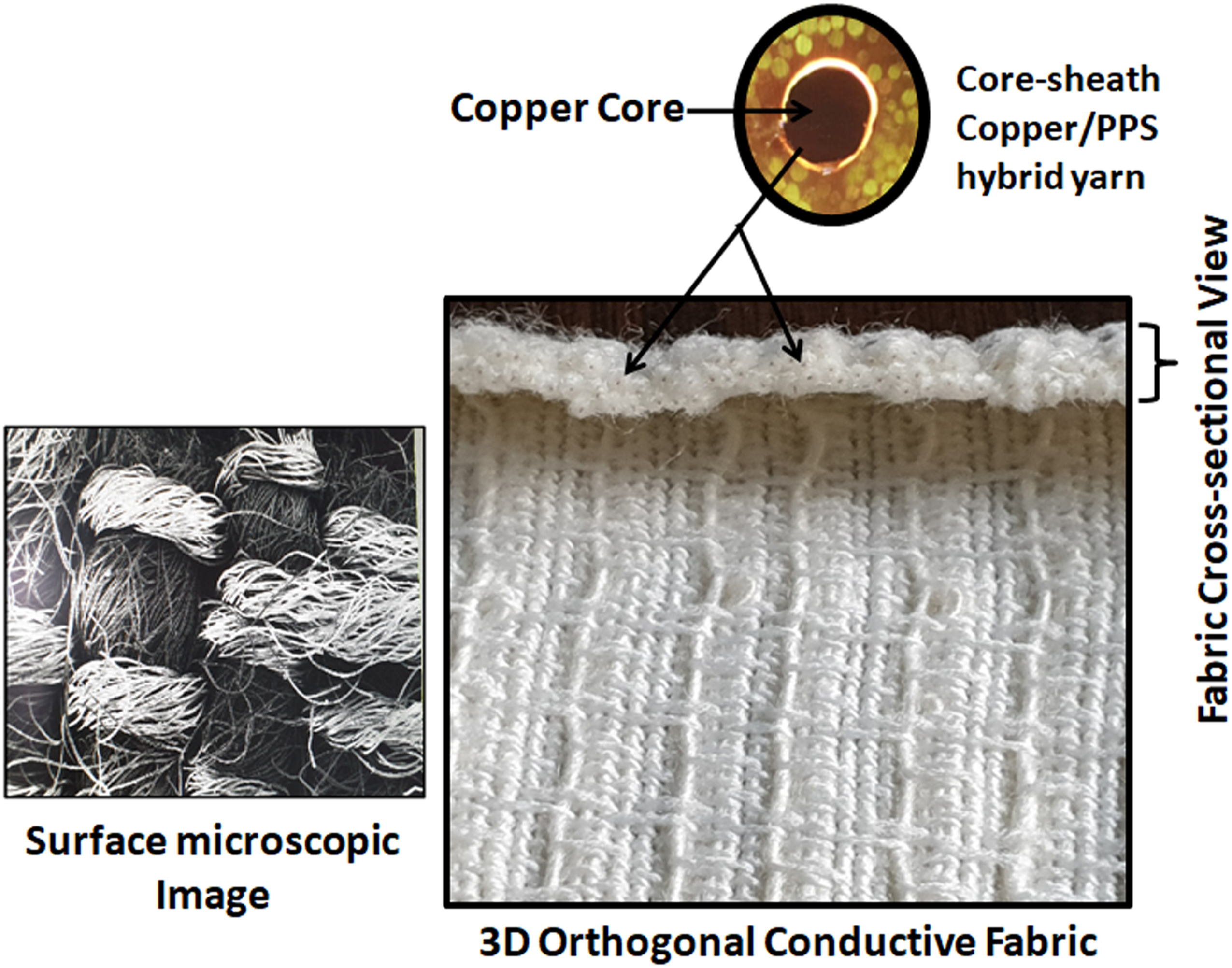

The thickness of 3D orthogonal fabrics is kept constant by engineering the internal yarn free space, as shown in Figure 2.
Electromagnetic shielding test under free space measurement system
The fabric samples are characterized for electromagnetic shielding and shielding effectiveness in the K-under Free space measurement system.
The transmitting electromagnetic waves and receiving antenna are supplemented by a couple of focusing horn lenses in the measurement system. A pair of identical plano-convex dielectric lenses is arranged back-to-back in a conical horn antenna for spot focusing purposes. The ratio fraction between focal distance and lens diameter is kept one. The diameter D is approximately 30.5 cm, focal depth 10, and 3-dB beamwidth of antenna is kept for antenna which is used for having a wavelength of measurement frequency. The electromagnetic shielding potential of material from fall electromagnetic energy is represented by electromagnetic shielding efficiency (SE). The incident energy that falls on the shielding specimen is divided in reflection, absorption, and transmission. Therefore, the shielding effectiveness is the summation of reflection, absorption, multiple internal reflections, and transmission, which provides total enfeeblement as concluded by a researcher
33
Interaction of electromagnetic waves with the material.

The interaction pattern of incident reflected and transmitted electromagnetic wave incident on a 3D material is represented in Figure 4 as described earlier also. 34
Electromagnetic shielding by fabrics
The EMS of the ideal metal sample can be divided into absorption, reflection, and multiple reflections and is defined as


Results and discussion
Analysis of variance (ANOVA) of electromagnetic shielding test results at frequency 13.0 GHz.

The F-value of the model is 37.20 with a p-value of 0.0265 that denotes the model is significant, and the chances of noise in this model are only 2.65%, as shown in Table 3. The p-value of a model is less than 0.0500, which indicates that the model terms are significant at a 95% confidence level. In this case, A, B, C, AC, A2, C2, A2B, and AB2 are significant model terms, and the most significant value at 99% confidence interval is with PPS yarn diameter where p-value is 0.0077, having a significant impact on EMS. At low copper filament diameter, the PPS yarn diameter increases from 10 to 20 μm, and the EMS value increases gradually. However, at a high level of copper filament diameter, as PPS yarn diameter increases, EMS initially decreases than increases, as shown in Figure 5 that may be attributed to the conductive nature of the copper filament. A factual model is contoured in a coding unit of the factors to predict the EMS of the samples. The given model indicates a coefficient of determination (R2) equal to 0.9955, implying excellent goodness of fit. The model to predict EMS of hybrid orthogonal fabrics at 13 GHz is shown in equation (4) Effect of copper filament diameter and PPS yarn diameter on EMS at frequency 13.0 GHz.
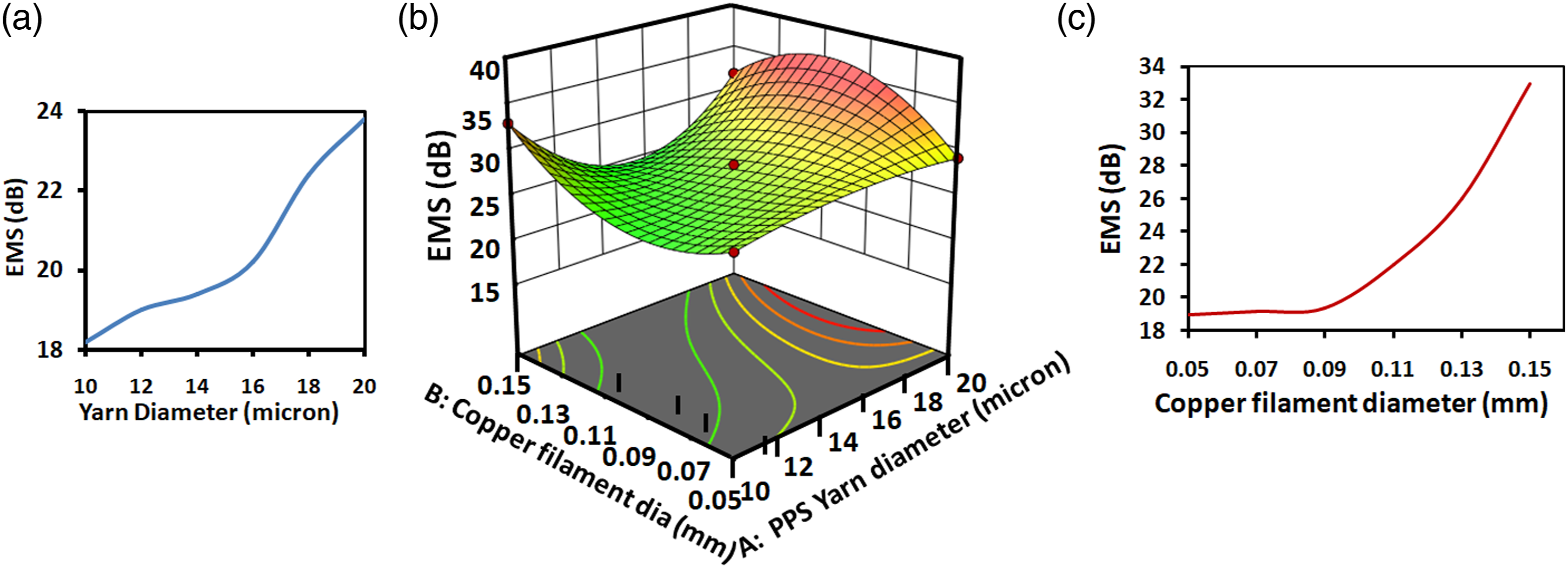
The effect of copper filament diameter and PPS yarn diameter is shown in Figure 5(b). The EMS of orthogonal fabrics was found to be 18.2 dB at 10-micron yarn diameter, which increased to 23.8 dB almost linearly at 20 micron yarn diameter at 13.0 GHz frequency (Figure 5(a)). The EMS of orthogonal fabrics was influenced by copper filament diameter and was found to be 18.2 dB at 0.05 mm copper filament diameter, which further increased to 33 dB at 0.15 mm copper filament diameter at 13.0 GHz frequency was associated to resonance due to metal characteristics (Figure 5(C)).
The effect of PPS yarn diameter and hybrid yarn tex is shown in Figure 6(b). The EMS of orthogonal fabrics was found to be 15 dB at 10-micron yarn diameter, which increased to 34 dB almost linearly at 20 micron yarn diameter at 13.0 GHz frequency (Figure 6(a)). The EMS of orthogonal fabrics was influenced by hybrid yarn tex and was found to be 15 dB at 300 tex hybrid yarn linear density, which further increased to 29 dB at 400 tex hybrid yarn linear density at 13.0 GHz frequency and was associated to resonance due to metal characteristics (Figure 6(C)). Effect of hybrid yarn count (tex) and PPS yarn diameter on EMS at frequency 13.0 GHz.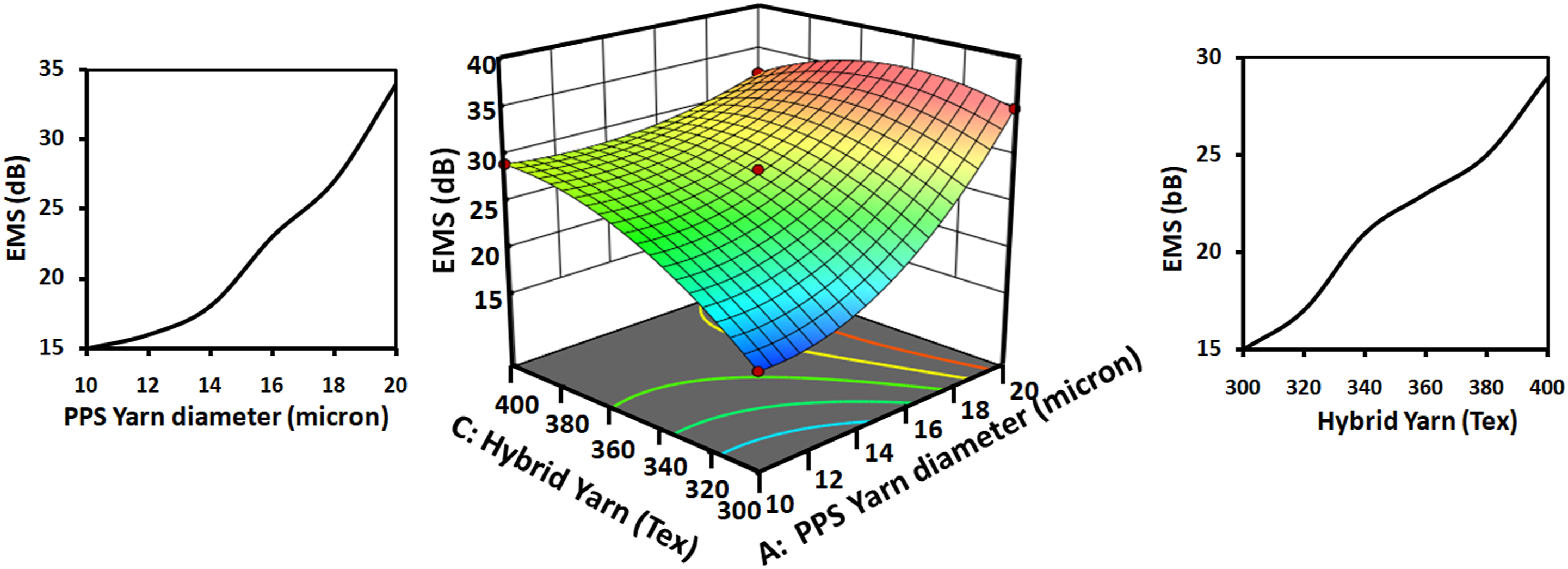
Electromagnetic shielding results at frequency 15.5 GHz.

ANOVA of electromagnetic shielding test results at frequency 18.0 GHz.

The effect of copper filament diameter and hybrid yarn linear density (tex) is shown in Figure 7(b). The EMS of orthogonal fabrics was found to be 15 dB at 300 tex hybrid yarn linear density, which increased to 28 dB almost linearly at 400 tex linear density of hybrid yarn at 13.0 GHz frequency (Figure 7(a)). The EMS of orthogonal fabrics was influenced by copper filament diameter and was found to be 15 dB at 0.05 mm copper filament diameter, which further increased to 24.5 dB at 0.15 mm copper filament diameter at 13.0 GHz frequency and was associated to resonance due to metal characteristics (Figure 7(c)). Effect of hybrid yarn count (tex) and copper filament diameter on EMS at frequency 13.0 GHz.
The EM shielding increases due to the increase in skin effect and decrease in electromagnetic wave amplitude, as similarly concluded in steel/polypropylene hybrid yarns. 37
A linear relationship between the PPS yarn diameter and EMS was observed. The EMS of orthogonal fabric samples was increased with an increase in hybrid yarn linear density at 13.0 GHz, as shown in Figure 7(a) and Figure 7(c). An increasing yarn linear density produces a tightly woven fabric that gives an improved EMS effect, which can be observed from Figure 7(b), and similar trends were found in the interlock knitted fabrics 38 to establish the relationship between shielding and tightness of EMS fabrics. The EMS increases with increasing hybrid yarn linear density attribute to the effect of PPS fibers in increasing EMS of fabric samples.
The PPS has low melt viscosity, which assists in diffusing electromagnetic waves between conductive fillers and the molecular chains of PPS itself. 39 Conductive copper filaments have played the role of conductive fillers in these orthogonal fabrics.
The F-value 50.17 and p-value 0.0197 denote that the model is significant, and the chance of noise in this model is 1.97%, as shown in Table 4. p-values less than 0.05 indicate that model terms are significant at a 95% confidence level. In this case, A, C, BC, A2, B2, C2, and AB2 are significant model terms, and the most significant value at 99% confidence level is with copper filament diameter along with hybrid yarn linear density, where the p-value is 0.0096 having a significant impact on EMS as shown in Figure 8 as is similarly concluded the effect of conductive yarn density on EMS in 2D fabric.
40
An empirical model is fitted in a coding unit of the factors to predict the EMS of the samples. The model shows a coefficient of determination (R2) equal to 0.9967, which implies goodness of fit. The model is shown in equation (5). Effect of copper filament diameter and PPS yarn diameter on EMS at frequency 15.5 GHz.
Adequate precision is used to measure the signal-to-noise ratio. A ratio greater than 4 is desirable for a practical EM shielding fabric.
41
The current ratio is 18.723, which indicates an adequate signal. This model can be used to navigate the design space. The model to predict EMS of hybrid orthogonal fabrics at 15.5 GHz is shown in equation (5)
The effect of copper filament diameter and PPS yarn diameter is shown in Figure 8(b). The EMS of orthogonal fabrics was found to be 18 dB at 10-micron PPS yarn diameter, which increased to 36 dB almost linearly at 20 micron PPS yarn diameter at 15.5 GHz (Figure 8(a)). The EMS of orthogonal fabrics was influenced by copper filament diameter and was found to be 18 dB at 0.05 mm copper filament diameter, which further increased to 27 at dB at 0.11 mm copper filament diameter (Figure 8(c)).
The conductive hybrid yarn diameter mainly increases by an increase in the diameter of the core copper filament. It is noticed from Figure 9 that the EMS effect is increased from 18 to 32 dB by accounting an increase in hybrid yarn linear density from 300 to 400 tex. The EMS was found 18 dB at 10-micron yarn diameter, which then increased to 28 dB at 16-micron yarn diameter at 15.5 GHz frequency (Figure 9(a)). The EM shielding was influenced by hybrid yarn linear density (tex) at 15.5 GHz frequency. The EM shielding was found to be 18 dB at 300 tex, which increased to 32 dB at 380 tex (Figure 9(a)). Effect of hybrid yarn tex and PPS yarn diameter on EMS at frequency 15.5 GHz.
It is observed in Figure 10 that by an increase in hybrid yarn linear density, the EMS rises. The EM shielding was 15 dB in the presence of 300 tex hybrid yarn, which increases to 36 dB with 400 tex hybrid yarns at 15.5 GHz frequency (Figure 10(a)), and that may be attributed to increasing reflection, absorption, and internal reflection by increasing yarn diameters as similarly observed in 2D hybrid fabrics.
42
The copper filament diameter also influenced the EMS of orthogonal fabrics. The EMS of the fabric sample was found to be 16 dB in the presence of 0.05 mm diameter copper filament, which reaches 32 dB as copper filament diameter increases to 0.15 mm at 15.5 GHz frequency (Figure 10(c)). Effect of copper filament diameter and hybrid yarn tex on EMS at frequency 15.5 GHz.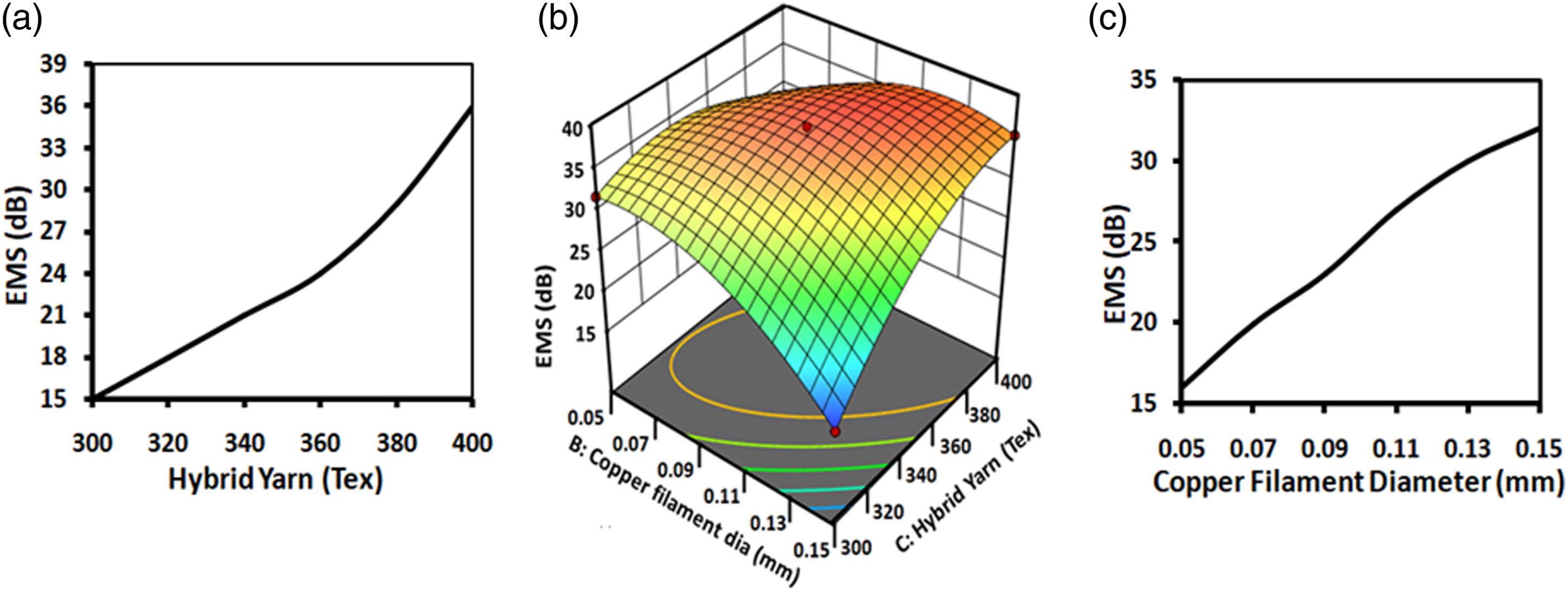
The EM shielding of orthogonal fabrics was increased by increasing copper filament diameter and hybrid yarn linear density at 18.0 GHz frequency (Figure 11(b)). The value of EMS was found to be 30.4 dB at a copper filament diameter of 0.05 mm, which increased to 39.6 dB at a copper filament diameter of 0.15 mm at 18.0 GHz frequency (Figure 11 (a)). The EM shielding was found to be 30.4 dB at hybrid yarn linear density of 300 tex, which was increased to 43.2 dB at 400 yarn tex at 18.0 GHz frequency (Figure 11 (c)). Effect of hybrid yarn count (tex) and copper filament diameter on EMS at 18 GHz.
The F-value 31.83 and p-value 0.0308 denote that the model is significant, and the chance of noise in this model is 1.92%. p-values less than 0.0500 indicate that model terms are significant at a 95% confidence level. In this case, A, B, C, AC, A2, C2, A2B, and AB2 are significant model terms, and the most significant value at 99% confidence level is with PPS yarn diameter where the p-value is 0.0092 having a significant impact on EMS as shown in Figure 11.
An empirical model is fitted in a coding unit of the factors to predict the EMS of the samples. The model shows a coefficient of determination (R2) equal to 0.9948, which implies goodness of fit. The model to predict EMS of hybrid orthogonal fabrics at 18 GHz is shown in equation (6)
Test results of reflectance and EMS.

Further, the studies show that under this configuration of customized fabric, minimum reflectance of 21.03% has been achieved, and the reflectance values show an increasing trend across the intended frequency region.
Conclusion
Three-dimensional orthogonal structures of multifunctional metal composite fabrics have been developed. The EM shielding of 3D orthogonal fabrics is greatly influenced by hybrid yarn linear density, copper filament diameter, and PPS yarn diameter in the Ku band (12–18 GHz) of electromagnetic waves. The incident electromagnetic energy can be managed by altering the diameter and the orientation of copper monofilament-based hybrid yarns in a 3D orthogonal structure. The alignment of copper yarns perpendicular to the direction of the incident electric field shows minimum (0.97–1.15%) transmission of incident energy, and, correspondingly, effective electromagnetic shielding of 15% is achieved across the frequency region. Making changes in copper filament diameter, hybrid yarn linear density, and PPS fiber linear density in 3D orthogonal fabric offers reflectance of 21%, giving an increasing trend of EMS across the intended frequency region. The results are statistically tested by two-way ANOVA and was found that the proposed model is suitable to assist further improvement in 3D fabrics engineering for EMS applications. The future scope of this work will enable the manufacturing of 3D orthogonal composite electromagnetic shields that can be used for enclosing military weapons, fighting jets, and troops to be detected from radars.
Footnotes
Declaration of conflicting interests
The author(s) declared no potential conflicts of interest with respect to the research, authorship, and/or publication of this article.
Funding
The author(s) received no financial support for the research, authorship, and/or publication of this article.
