




Abstract
Incorporation of hollow fibers in polymer base composites has gained great interest due to their flexibility and lightweight structure. Among many research studies on this subject, the mechanical performance of polyester hollow fiber/E-glass reinforced polymer composites has not been investigated. The main objective of the present work was to investigate the fracture toughness and impact resistance of E-glass/epoxy composites hybridized by a separate layer of polyethylene terephthalate hollow fibers (PETHFs). The samples were prepared by placing a layer of PETHFs in different contents (0, 0.23, 1.18, or 2 wt.%) and in two different forms of filaments (PETHF-FIs) or staple fibers (PETHF-STs) between two layers of biaxial or triaxial E-glass fabrics. The mechanical behaviors of the samples were investigated by performing a set of tensile and impact tests. Scanning Electron Microscopy (SEM) and Field Emission Scanning Microscopy (FESEM) were also used to evaluate the surface morphologies of the hollow fibers and the fractured samples. The results revealed that, unlike PETHF-FIs, PETHF-STs could weaken the mechanical performance of the pristine E-glass/epoxy composites. The internal channel blockage of PETHF-STs was observed in the FESEM images of the fractured PETHF-STs hybrid samples. The highest toughening effects were observed with incorporation of 1.18 wt.% PETHF-FIs in biaxial E-glass/Epoxy composites and 2 wt.% PETHF-FIs in triaxial E-glass/Epoxy composites. The highest value of impact resistance belonged to the samples hybridized with 2 wt.% of PETHF-FIs. Crack deflection, fiber pull out, and fiber stretching were the predominant fracture mechanisms observed in the PETHF-FIs hybrid composites.
Keywords
Introduction
Today, composite materials are considered as the most promising alternatives to conventional materials in almost all sectors of aerospace, automotive, and wind turbine blade technologies. The advantages and superiority of composite materials over traditional materials include, but not limited to, outstanding mechanical properties, high stiffness, lightweight, and cost-effectiveness.1–3 In aerospace industries, the aircraft components including wings and wind turbine blades are mainly composed of carbon- and/or epoxy-based composites. 4 Such composite structures are susceptible to impact damages caused by foreign object impactors such as bird strikes, rain drops, hails, or other objects.5–7 Therefore, wind turbine blade composite structures demand appropriate mechanical strength to endure various impact loads. To strengthen the fiber reinforced composites subjected to low-velocity impacts, impact-resistant materials can also be introduced into the structures. It is well established that low-velocity impacts can cause influential internal damages in a composite material, while leaving an unrecognizable or small indentation on the surface. 8 Many attempts have been devoted by researchers to enhance the mechanical properties of composite materials, especially the impact resistance, by focusing on hybrid reinforcements.8,9 Utilization of hollow fibers as the reinforcement material is one of the promising potential routs to improve the mechanical properties of composite materials. 10 The lightweight and flexible nature of hollow fibers offers higher mechanical performance compared with solid fiber reinforcements. 11 Among many available hollow fiber types, most of previous research works have focused on hollow glass fibers. For instance, Wang et al. 10 studied the effects of hollow glass fibers and alumina nanotubes reinforcements on homogenized modulus and stress fields in unidirectional epoxy-based composites using theory of elasticity. Hucker et al. 12 found that incorporation of 20–25% hollow glass fibers in glass/epoxy composites improves the lateral compressive strength and impact resistance. It was found that incorporation of both hollow and solid fibers in a composite structure could improve the mechanical performance. Boniface et al. 11 evaluated the tensile and compressive properties of epoxy-based laminates reinforced by unidirectional and (±45/0) oriented hollow or solid S2 glass fibers. They found that, unlike solid fibers, hollow fibers reinforcements reduced the absolute tensile strength of composite laminates. It was also suggested that in applications that the lightness of weight is the most preferred property, the hollow fiber reinforcements could be used without reducing the compressive strength of the composites. Some research studies have focused on the self-healing capability of hollow fiber reinforced composite structures. 13 According to literature, a wide range of applications have been reported for glass hollow fiber reinforced epoxy composites due to their thermal behavior, acoustic insulation, dielectric characteristics and mechanical properties. 14 Unlike glass hollow fibers, the research studies conducted on polyester type of hollow fiber reinforcements are too limited. Polyethylene terephthalate (PET) is one of the most popular commercial polymers with great advantages such as lightweight, high strength, good toughness, low absorption, good fatigue resistance, high chemical resistance, easy availability, and low cost.15–17 However, the research studies that have investigated the mechanical properties of polymer composites reinforced by PET hollow fibers (PETHFs) are limited to those conducted by Nasr-Isfahani et al.15,18 They investigated the mechanical properties of epoxy-based convex composite laminates reinforced by unidirectional PETHFs. According to the results, PETHFs reinforcements were capable to provide higher impact resistance, crack initiation force and damage resistance when compared with solid fibers. Moreover, utilization of hollow fibers could also successfully reduce the composites density. 18 In another work, the low-velocity impact behaviors of polymer composites reinforced by unidirectional hollow, solid or hybrid (hollow/solid) PET fibers were investigated. It was found that the absorbed energy in PETHF hybrid composite was higher than the composites reinforced by solid fibers. This was attributed to the cross-sectional elliptic deformation of hollow fibers when exposed to impact loadings. It was also concluded that contrary to the brittle glass hollow fibers, PETHFs can be easily deformed to elliptical shapes due to their ductile structure and can be considered as an appropriate option for composite materials. 15 Garoushi et al. 19 also reported that composites hybridized by hollow fibers are capable to endure higher impact loads and absorb higher impact energies than those hybridized by solid fibers.
In the light of literature, it can be said that since PETHFs pose high rupture strains and high deformation when subjected to impact loads, utilization of PETHFs can be considered as an appropriate option to enhance the mechanical properties of Epoxy-based composites. Unlike glass hollow fibers, the research studies conducted on polyester type of hollow fiber reinforcements are too limited. To our knowledge, no evidence is available in literature related to the mechanical behavior of PETHFs/E-glass hybrid epoxy-based composites. Moreover, utilization of PETHFs in separate layers has not been documented. Furthermore, the low cost of PETHFs and lack of need for any preparation process make PETHFs a promising candidate for reinforcing E-glass/epoxy composites. Therefore, the main objective of the present work was to investigate the fracture toughness and impact resistance of E-glass/epoxy composites hybridized by a separate layer of PETHFs. The samples were prepared by placing a layer of PETHFs in different contents (0, 0.23, 1.18, or 2 wt.%) and in two different forms of PETHF-FIs or PETHF-STs between two layers of biaxial or triaxial E-glass fabrics. The tensile strength, tensile modulus and impact resistance of the hybrid composites were investigated and compared. The SEM and FESEM images of the fibers and the fractured samples were also evaluated. It should be noted that the outcomes of this research may potentially be considered for preparing composite structures in various applications such as wind turbine blades.
Experiments
Materials
Specifications of epoxy resin used in this study.

General properties of the biaxial and tri-axial E-glass fabrics used in this study.

Characterization of polyethylene terephthalate hollow fibers
To evaluate the surface area of PETHFs, image analyses were performed by Motic-microscope-B3 (England) and Digimizer software (version 5.3.4). For this purpose, a bunch of fibers under uniform stretching conditions was inserted into the mold and fixed by resin. Then, the prepared mold was cut by microtome SLEE Cutter 4055. Figure 1 shows the prepared PETHF for the cross-section analysis. Preparation of a PETHF for cross-section analyses.
In order to investigate the morphology of PETHF, a single PETHF embedded in epoxy resin was fractured with liquid nitrogen. The fractured cross-section was sputter-coated with a thin layer of gold. Then, morphology of the PETHF was visualized in a SEM microscope (XL30 Philips, Netherlands).
Preparation of composite samples
Biaxial and triaxial E-glass fabrics were cut into 30×30 Interlaying (a) PETHF-STs, (b) PETHF-FIs between the two E-glass fabrics and (c) fabrication of composite samples using VARTM method.
In the next step, the epoxy resin and curing agent were mixed with the mass ratio of 100:30. A mechanical mixer (2000 rpm) was used to provide a homogeneous mixture at the room temperature for 5 min. Furthermore, an ultrasonic bath was used for 10 min to remove the generated bubbles. The PETHF hybridized composites were prepared using vacuum assisted resin transfer molding (VARTM) technique, as shown in Figure 2(c). By injection of epoxy resin into the mold, the epoxy resin was ready to initiate cross-linking procedure. Therefore, the proper pre-curing and post-curing periods were performed at 23–25 oC for 12 h and at 70 oC for 10 h, respectively.
Physical properties of the prepared composites
Since the biaxial and triaxial E-glass fabric reinforcements were used as received, the exact characteristics of fiber volume fraction, composite density and bubble volume fraction within the composite samples should be investigated. Therefore, ASTM D 792 standard test method was used to investigate the densities of different composite samples. A density testing instrument with a precision level of 0.001 was used to determine the composite density based on Archimedes’ principle, i.e.
According to the ASTM D 2854 standard test method, fiber volume fraction and resin volume fraction were investigated. The weight of the composite sample
The resin volume fraction can also be calculated by
Mechanical tests
Tensile tests and impact tests were performed on all samples in longitudinal and transverse directions, respectively. The orientation of fibers in composite structures and the mechanical test directions are presented in Figure 3. The fibers orientations and the mechanical tests directions.
Tensile properties of the prepared composites
According to the ISO 527-4 standard test method, the tensile strength, elastic modulus and fracture toughness of the biaxial and triaxial E-glass/epoxy composites hybridized by PETHFs were investigated via a universal tensile testing machine (Hounsfield Equipment, UK).
Impact properties of the prepared composites
Charpy impact test machine (Wolpert, Dia tester 2RC-S, Germany) was used to characterize the low-velocity impact resistance of the biaxial and triaxial E-glass/epoxy hybrid composites, according to the DIN-ISO-179-1 standard test method. All mechanical test results were normalized to the weight of the composites to ignore all dimension variations of the specimens. Moreover, one-way analysis of variance (ANOVA) followed by Duncan’s test was performed to compare the test results (at a confidence interval of 0.95).
Field emission scanning microscopy analysis of the fractured cross-section of the prepared composites
The fractured cross-sections of the composites obtained from mechanical tests were observed using a FESEM microscope (quanta FEG 450 from FEI America, USA). For this purpose, the fractured cross-section of composites was firstly sputter-coated with gold.
Results and discussion
Figure 4(a) represents the hollow cross-section of a PETHF. As shown in Figure 4(b), glycerol penetration due to the capillary phenomenon can clearly confirm the presence of the non-clogged hollow channel inside the PETHF. The hollow fiber exhibited a circular cross-section with the mean outer and inner diameters of 54 and 34 μm, respectively. Moreover, the fiber surface was smooth and the longitudinal crimps on the fiber surface were successfully removed. The fiber volume fractions, composite densities and bubble volume fractions within the composite samples were theoretically and experimentally investigated. The results are tabulated in Table 3 in the revised manuscript. (a) The SEM image of the cross-section of the PETHF and (b) the optical image of the hollow internal channel in a PETHF.Note: SEM; Scanning Electron Microscopy; PETHF; polyethylene terephthalate hollow fibers. Biaxial and Triaxial E-glass/epoxy composites properties.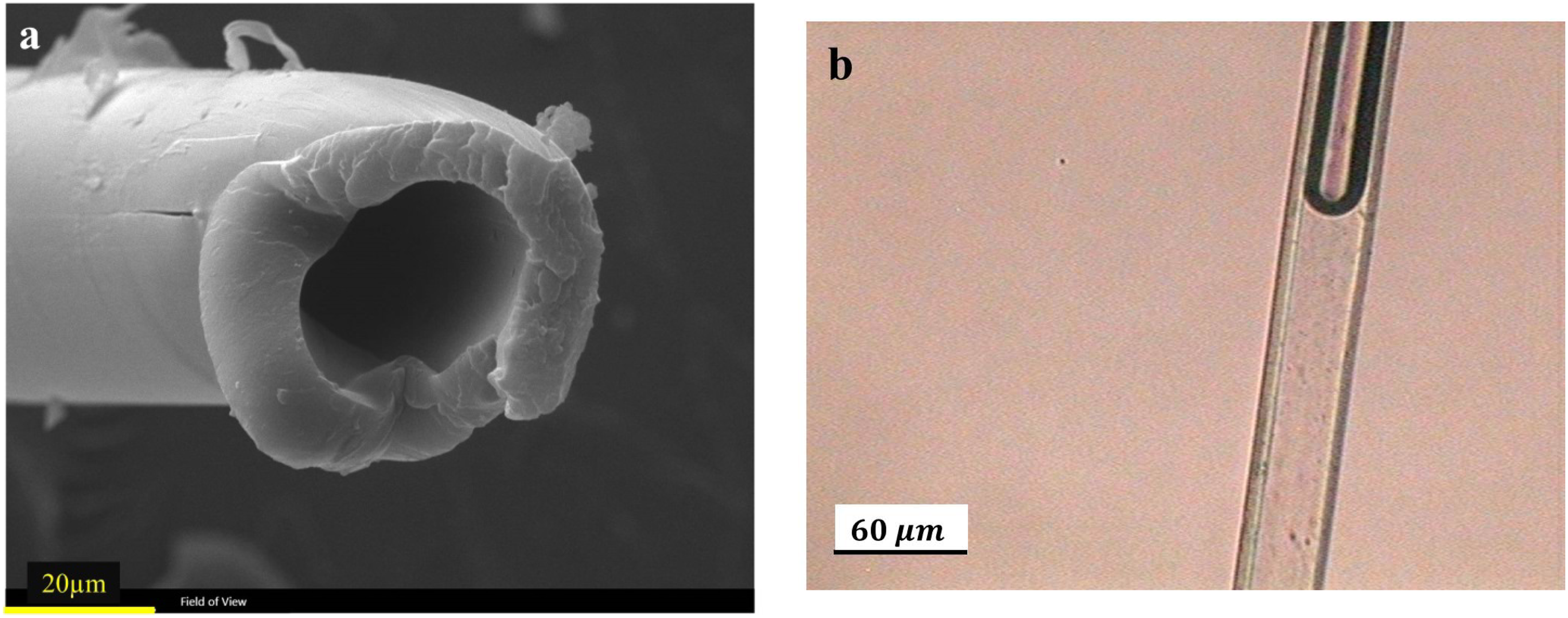
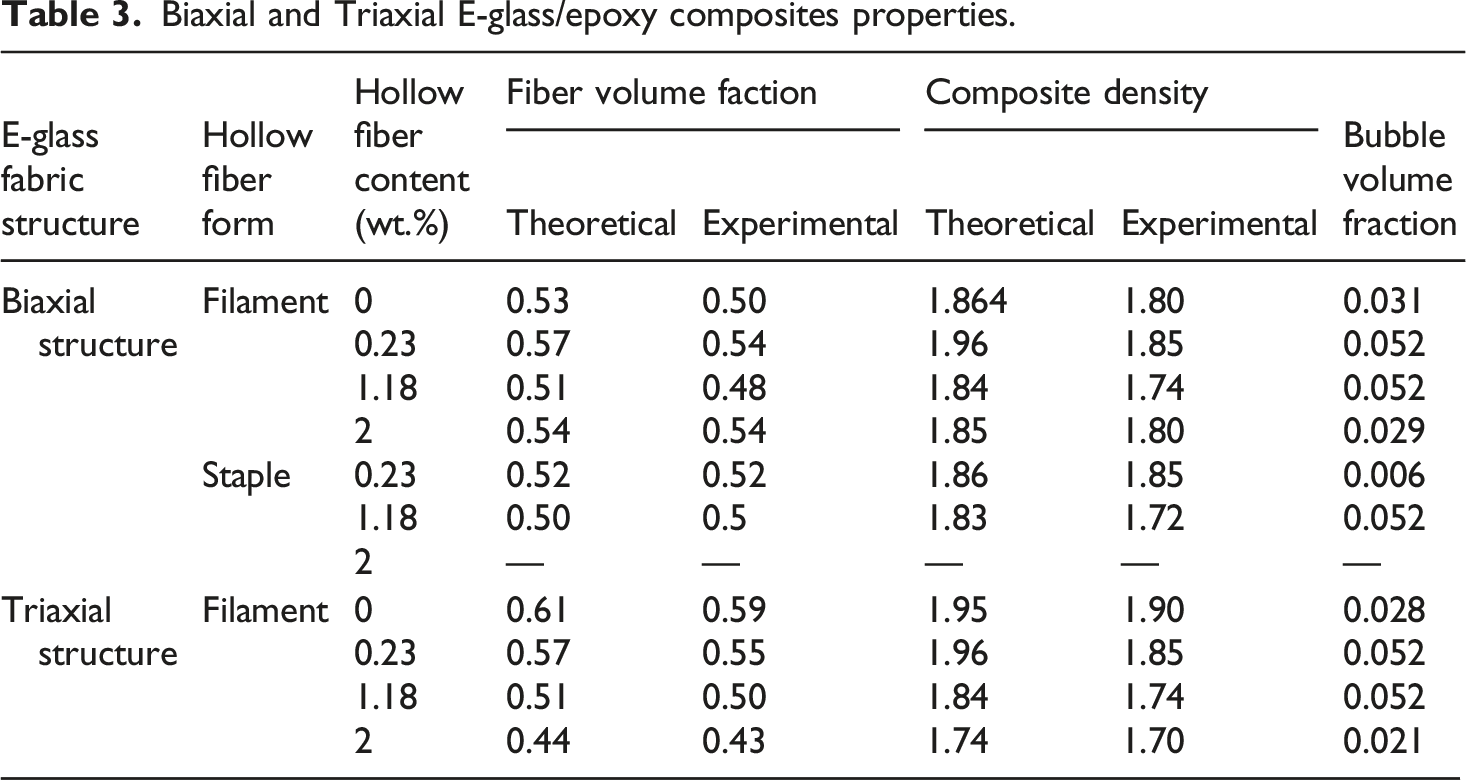
The presence of bubbles within the composite structure makes the theoretical values of the fiber volume fraction and composite densities to be less than the corresponding experimental values.
Comparisons of the tensile properties of the biaxial E-glass/epoxy composites hybridized by PETHF-FI and PETHF-ST are presented in Figure 5 (including normalized tensile modulus, tensile strength, and fracture toughness). According to the results, the presence of staple fibers reduced the tensile properties of the E-glass/epoxy composites. Unlike PETHF-STs, PETHF-FIs reinforcements improved the tensile behavior of the biaxial E-glass/epoxy composites. Incorporation of 2 wt.% of PETHF-FI into the biaxial E-glass/epoxy composite resulted in an increase of the tensile modulus (9%) and tensile strength (8%) of the samples. Unremarkable improvements in the tensile modulus and tensile strength of the PETHFs reinforced samples can be attributed to the low modulus of PETHFs, as can also be confirmed by the rule of mixtures. The statistical analysis (results of Duncan’s test) indicated that the changes in the tensile modulus and tensile strength of composites when reinforced by PETHF-STs were not significant. However, the results show that the toughness of biaxial E-glass/epoxy composites were boosted up to 71.7% with incorporation of 1.18 wt.% of PETHF-FIs. The tensile properties of biaxial E-glass/epoxy composites hybridized by PETHF-FI and PETHF-ST. The data related to sample "0, biaxial" has been reproduced from Ref (20) with permission from SAGE Pub.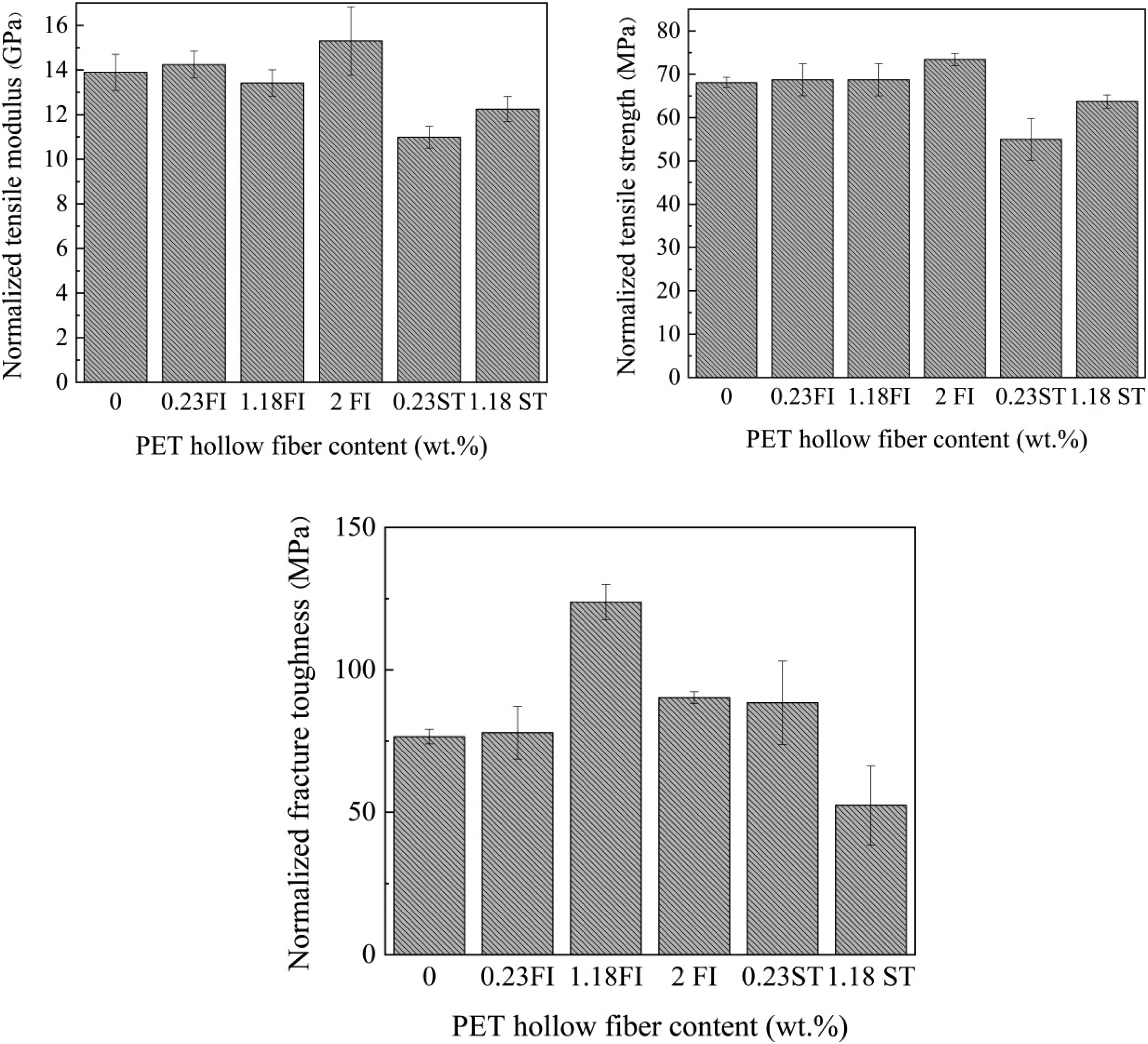
The tensile properties of the triaxial E-glass/epoxy composites hybridized by the PETHF-FIs are presented in Figure 6. The same results were obtained for the tensile strength of the triaxial composite samples. The results together with the statistical analysis can confirm the effectiveness of PETHF-FIs in improving the tensile stiffness and toughness of E-glass/epoxy composites. Incorporation of 1.18 wt.% and 2 wt.% of PETHF-FIs improved the toughness strength up to 26% and 57%, respectively. This considerable effect can be attributed to the high elongation strains of PETHF-FIs which is considered as the dominant factor affecting the toughening mechanism. The tensile properties of triaxial E-glass/epoxy composites hybridized by PETHF-FIs.
To investigate the toughening mechanisms, the FESEM images from the fractured cross-sections of the biaxial E-glass/epoxy composites hybridized by PETHF-STs and PETHF-FIs were evaluated. It should be noted that considering the (0o, ±45o) orientation of the E-glass fibers in the triaxial E-glass E-glass/epoxy composites, the orientation angle of the PETHFs in the composite structure was zero. Therefore, it was difficult to accurately determine the fractured cross-section of the samples. Figure 7(a) represents a distinguishable hollow structure of the PETHF-FIs within the fractured cross-section of a PETHF-FIs hybridized composite. As mentioned by previous research studies,
21
crack deflection is a toughening effect that can always appear when the strength of the interface is low enough compared to the strength of the substrate. Therefore, as can be seen in Figure 7(b), the low and intermediate adhesion strength and toughness of the PETHF-FI/epoxy interface induce crack deflection along the interfaces during the fracture of the hybrid composites. Herein, the two reinforcement components induce toughening effects in two different ways. First, the brittle and sized E-glass fibers make a tough interface with having a strong adhesion to the epoxy matrix. In this case, stress can be effectively transferred. Second, the ductile and unsized PETHF-FIs that are loosely bonded to the epoxy matrix can effectively distribute the generated damages. Therefore, the presence of PETHFs improves the trans-laminar fracture toughness of the composites. In other words, debonding effects in the PETHF-FIs/epoxy interfaces can change and deflect the crack direction. It is also well-known that tubes, hollow fibers or microchannels in the fiber reinforced composites can absorb energy through crack deflection and propagation in matrix.
22
Kousourakis et al. also reported the crack deflection mechanism for the carbon/epoxy composites hybridized by glass hollow fibers.
23
The deflection of cracks can also be found in an image of the fractured epoxy/PETHFs composites in the works conducted by Nasr-Isfahani et al.15,18 The FESEM images of biaxial E-glass/epoxy composites hybridized by (a–b) PETHF-FI and (c–d) PETHF-ST.
The low reinforcing performance of PETHF-STs when compared with the PETHF-FIs can be explained by the modified rule of mixtures for the short fiber reinforced composites. As explained by Rosenthal,
24
the modulus of a fiber reinforced composite can be obtained by
As can be seen from the FESEM images in Figure 7(c) and (d), unlike PETHF-FIs, the hollow channels of PETHF-STs embedded in both biaxial and triaxial composites were indistinguishable and filled with the epoxy resin. This phenomenon led to the conclusion that energy dissipation through transverse deformation in PETHF-STs hybridized E-glass/epoxy composites cannot be achieved. On the other hand, the trans-laminar fracture toughness of composite structures is affected by the layers configuration, which can influence the capability of the composite structures in energy absorption during impact. 27 Therefore, another factor that induce the weak tensile properties of the PETHF-STs hybridized composites can be attributed to the stress concentration caused by filled PETHF-ST.
It should be noted that, according to the observations and also the theory of modified rule of mixtures, the significant reduction of the tensile modulus, tensile strength, toughness, and impact resistance of the composites was found and confirmed in the staple hollow fiber reinforced samples. Therefore, as too many experiments were performed in the present work, a decision was made to do not prepare and waste excessive samples with 2 wt.% of the staple hollow fibers.
Figure 8 depicts the FESEM images representing another toughening mechanism in the PETHF-FIs hybridized composites. The fiber pull-outs and also the stretched PETHFs along the applied load direction due to the higher rupture strain of the PETHFs compared to the E-glass fibers are the dominant toughening mechanisms in PETHFs hybridized E-glass/epoxy composites. This mechanism can also improve the trans-laminar fracture toughness of the E-glass/epoxy composites. The FESEM images of the biaxial E-glass/epoxy composites hybridized by PETHF-FI: (a) stretched PETHF-FIs, (b) pulled-out PETHF-FI.Note: FESEM; Field Emission Scanning Microscopy; PETHF-FI; polyethylene terephthalate hollow fibers filaments or stable fiber.
Figure 9 represents the results of Charpy impact tests performed on the pristine biaxial and triaxial E-glass/epoxy composites and those hybridized by PETHFs. By increasing the weight fraction of PETHF-FIs, a gradual enhancement was observed in the impact strengths of both biaxial and triaxial E-glass/epoxy composites hybridized by PETHF-FIs. The highest impact strength belonged to the biaxial E-glass/epoxy composite hybridized with 2 wt.% PETHF-FIs (72% higher than the impact strength of the pristine sample). Moreover, the impact strength of the triaxial E-glass/epoxy composites was improved by 27% with incorporation of 2 wt.% PETHF-FIs. The reinforcing effect of PEFHTs in the triaxial composites was not as significant as the biaxial composites because of the superior stress distribution of the E-glass fabrics. The impact properties of (a) biaxial and (b) triaxial E-glass/epoxy composites hybridized with PETHFs in different weight fractions (0, 0.23, 1.18, and 2 wt.%). The data related to sample “0, biaxial” has been reproduced from Ref (20) with permission from SAGE Pub.Note: PETHFs; polyethylene terephthalate hollow fibers.
The most important factors that affect the impact toughness properties are the matrix and interface behavior such as fiber debonding, fiber pull-out, and fiber deformation which may elongate the length of fibers pulled out of the fractured surface of matrix and induce toughening effect. 28 As mentioned before, PETHFs are capable to dissipate energy, 9 even better than E-glass fibers which can be attributed to the higher rupture strain and transverse deformation of PETHFs (from cylindrical to elliptical shape). 29 Under the impact loads, the hollow internal channel within the PETHF structure pose efficient energy damping and absorption 9 which can improve the impact strength of composites by transferring the impact stresses. Other energy dissipation mechanisms that can be found in the prepared composites include fiber pull-out, fiber-matrix debonding and crack propagation prevention, as mentioned in the previous research works.9,30
Herein, the prolonged crack deflection path can improve the trans-laminar fracture toughness and also the impact energy absorption. The stress distribution and the maximum elongation are the factors that lead to the improved impact behavior. As mentioned by Nasr-Isfahani et al.,15,18,31 the improved impact behavior of composites reinforced by polyester hollow fibers can also be attributed to the cross-sectional elliptic deformation of hollow fibers when exposed to impact loadings. Contrary to the brittle glass hollow fibers, PETHFs can be easily deformed from cylindrical to elliptical shapes due to their ductile structure and can transfer stress concentration zones from a critical point to other points. One can conclude that the weak shear strength at the interface can distribute damage, while it is impossible for a strong interfacial bonding to distribute damage. 32 On the whole, based on the previous and current findings, it can be concluded that the presence of unsized PETHF-FIs not only improves the tensile modulus and strength, but also intensifies the energy absorption of the E-glass/epoxy composites. The results of impact test on hybridized biaxial and triaxial composite samples were in agreement with the results of the tensile test. In fact, increase of trans-laminar fracture toughness improves the impact resistance in composites. 27 It can be concluded that there was a correlation between the impact strength and toughness strength of the samples. The impact strength of the samples increased with increasing the toughness strength. This means that toughening effects of PET hollow fibers will improve the impact behavior of the hybrid composites.
Conclusion
In this work, the biaxial and triaxial E-glass/epoxy composites were hybridized by a separate layer of PETHFs. The hybrid composites with different PETHFs contents (0, 0.23, 1.18 or 2 wt.%) and two different forms of PETHF-FIs or PETHF-STs were prepared by VARTM technique. The mechanical behaviors of the samples were investigated by performing a set of tensile and impact tests. The fractured cross-section of composites was evaluated by FESEM observations.
Evaluation of the mechanical properties of the biaxial and triaxial E-glass/epoxy composites hybridized by PETHFs provide the following conclusions: Despite the low modulus of PETHFs, high elongation and compressibility of PETHFs together with the interfacial fiber/matrix properties contribute synergistically to the outstanding impact and toughness properties of the E-glass/epoxy composites. Unlike PETHF-FIs, PETHF-STs are susceptible to be filled with epoxy resin during composite preparation. Therefore, PETHF-FIs embedded in both biaxial and triaxial composites exhibit superior performance. Dominant toughening mechanism in E-glass/epoxy composites hybridized by PETHF-FIs is the prolonged crack patch and crack deflection due to the presence of PETHF-FIs. Prolonged crack path, fiber elongation, and fiber pull-out due to the presence of PETHF-FIs resulted in toughening effects with a considerable energy dissipation and enhanced energy absorption. Low interfacial adhesion between PETHFs and epoxy improves the trans-laminar fracture toughness of E-glass/epoxy hybrid composites The reinforcing performance of PEFHFs in the triaxial E-glass/epoxy composites was not as significant as PEFHFs in biaxial E-glass/epoxy composites which was attributed to the superior stress distribution in the triaxial E-glass fabrics.
Footnotes
Acknowledgments
The authors would like to show their appreciation to MAPNA research and technology VP and MAPNA Generator Engineering and manufacturing company (PARS) for their cooperation and support.
Declaration of conflicting interests
The author(s) declared no potential conflicts of interest with respect to the research, authorship, and/or publication of this article.
Funding
The author(s) disclosed receipt of the following financial support for the research, authorship, and/or publication of this article: This work was supported by MAPNA Group Co. (grant number RD-RPE-97–08).
