



Abstract
In this study, the poly(lactic acid) (PLA)/polyurethane (PU) nonwoven mats have been successfully fabricated by electrospinning from PLA/PU (50:50 w/w) blended solutions with/without compatibilizer. The influence of the compatibilizers which are called POSS Amic Acid Isobutyl (AAI), Tetra Silanol Phenyl POSS (TSP) and Joncryl (JO) on the characteristic properties of PLA/PU nanofibers has been investigated. The types of compatibilizer used in this paper were studied for the first time in the literature for PLA/PU blend nanofibers. The nanofibers were characterized with scanning electron microscope, fourier transform infrared spectroscopy, differential scanning calorimetry, thermogravimetric analysis, contact angle test, and mechanical analysis. The electrospun mat which has the smoothest fiber surfaces, thinnest fiber diameter with 812 nm and a superhydrophobic surface structure with an angle of 154° was obtained by using AAI. The fabricated nanofiber by using JO has been seen having the highest strength value with 3.5 MPa and the highest crystallinity ratio with 20.1%. The highest elongation value with 51.9% was obtained for the nanofiber by using TSP. When the 5% weight loss temperature value of all PLA/PU nanofibers was compared, it was noted that the JO added nanofiber has the highest temperature durability with 292.16 °C. Also, the Tm value of all PLA/PU nanofibers has been resulted at about 155 °C like of pure PLA nanofiber. It is expected that thin and flexible biodegradable PLA/PU nanofibers with good physical and mechanical properties can be used in areas such as water repellent coating material, food packaging.
Keywords
Introduction
In the electrospinning process that based on the principle of solvent evaporation qua an influential method of producing micro/nano-sized materials, is applied a high electric voltage to overcome the surface tension of polymer solutions, at a predetermined feeding speed and distance between collector-syringe shortly after, nano/micro-electrospun mats collect on an aluminium plate [1–3]. The fibers obtained by electrospinning provide a very high surface area-to-pile ratio and porosity while being low mass, ultra-thin and flexible in mechanical behaviour. This makes them attractive for applications such as filtration membranes, textile, chemical, tissue and biomedical engineering [4,5].
In recently quite an interest is showed in the planned, synthesis, operation and definition of new bio-disintegrate polymers and thriving fields to them in diverse applications like structural, pharmaceutical, and biomedical areas [6]. Poly(lactic acid) (PLA) which is a linear and aliphatic thermoplastic polyester could be synthesized entirely from natural resources like corn and sugar beets. The PLA can have to semi-crystalline or amorphous structure relying on the stereo layout of the polymer chain [7]. Thermoplastic polyurethanes (TPU) that have well features mechanically and biocompatible are from flexible polymers used in many application areas [8]. The internal of PU exist fundamentally two basic segments as hard and soft section. The molecular structure of polyurethane consists of hard parts that are short, and soft parts that are long and moving. Hard parts are created by diisocyanates and chain extenders, whilst soft parts occur polyester or polyether bottomed polyols. Soft segments guarantee high mobility and flexibility. Hard segments also, constitute the strength, hardness, thermoplasticity and heat resistance properties of the material. The features of PU can be changed by increasing or decreasing the rate of the hard part and soft part [9]. The glass transition temperature (Tg) value of the soft section which has an amorphous form is lower than that of the hard segment [10].
Blends of PLA with elastic polymers like PU are made to develop the mechanically features of PLA such as stiffness or toughness. The PU and PLA polymer blends are made to balance the flexibility features of the PU and the fragility of the PLA. Therewithal, the PLA/PU blends are reported having to mixable property. However, a much better harmonious interaction between PU and PLA is necessary to acquire a blend with adequate features. Increasing the chain length in polymer blend is possible in addition to compatibilizers that develop component strength and thermal constancy. Compatibilizers reconnect polymer chains that are fractured because of a decay reagent thanks to the effects of chain extender properties. The emerged reactions are related to the useful of the preferred compatibilizers and their intensity in the polymer structure [11].
In some studies of polymers like PLA, PU, have been used the kinds of chain extender in the presence of epoxy groups that may activate with the hydroxyl and carboxyl groups in polyester chain‐tips. The polyhedral oligomeric silsesquioxanes (POSS) nanoparticles have a high potential to strengthen, stiffen and balance the polymers on account of their elastic chemical and physical mixture features and comparatively low expense. The experimental formula of POSS that occurred organic/inorganic mixed substances is the (RSiO1.5)n where n is more than 4 (usually 8). Furthermore, the POSS structure which was found its organic side groups that checked the interface harmonize of POSS and polymers and had reactive and/or non-reactive multipurpose have –Si–O– lattice-like carcass. However, the inorganic property can ensure polymers with molecular support, improved thermal uniformity, well blaze durability and so on [12]. The recent studies, a multipurpose styrene-acrylic–epoxy incidental oligomer (Joncryl) has been suggested for chain-extender in the reactive extrusion process application of PLA [13].
Kilic et al. studied PLA/poly(butylene adipate‐co‐terephthalate) (PBAT) blends with compatibilizer named epoxidized-POSS. The having max tensile test values of material obtained with 0.5% mono epoxy‐POSS compatibilizer has been seen [14]. Monticelli et al. indicated that the reaction in the molten state of dihydroxyl-functionalised POSS with the polyurethane chain to fabricate a TPU/POSS hybrids. Especially, an increase of Tg has been seen in the presence of reactive POSS. Also, an increase in surface water wettability has been found [15]. Feng and Ye prepared the PLA/TPU blends in various combinations for improving the toughness of PLA. Micromechanical analysis to evaluate the toughness of blends showed that crack initiation and propagation resistance were increased in toughened blends [16]. Qiu and Pan examined crystal formation, hydrolytic deterioration, and dynamic mechanical features of octaisobutyl‐POSS strengthen PLA composites obtained with the solution casting method. It was observed which the POSS nanoparticles sized between 200–400 nm were quite homogeneous spread in the PLA matrix. Moreover, the presence of POSS that was worked as a heterogeneous nucleating factor added in the PLA [17]. Bliznyuk study reported which when POSS that enriched with aminopropyl and hydroxy incorporated into PU structure create exceedingly crystalline nano areas in the structure of the PU having elastic properties that have been functionalized with inorganic silica [18]. Turan et al. examined the influences of POSS that possess to amine groups on the tensile, surface and thermal features of the raw PLA and plasticised PLA to its structure. In their study has been observed which the supplement of 1–3 wt% POSS spalls for both PLA composites improve modulus value and elongation at break value. However, the mechanical features of both PLA structures reduced due to the increased amount of POSS supplement [19]. Arruda et al. prepared the swelled membranes of PLA/poly(butylene adipate-co-terephthalate) mixtures in weight ratios of 40:60 and 60:40. The compatibilizer named Joncryl ADR 4368 was preferred as multipurpose epoxy as chain expander. All mixtures have indicated a rise in the modulus of flexibility. Obtained conclusions were proved by the alter in morphology that was brought out by modifications in the interface stress because of the compatibilizer and in the viscosity rate owing to the compound [20]. The influences of compatibilizer and the melt mixing temperature on the stereo-complex creation of poly(L-lactide)/poly(D-lactide) mixtures in a weight ratio of 50/50 (w/w) or stereo-complex polylactides were researched by Baimark and Srihanam the Joncryl ADR 4368 that is a styrene-acrylic multipurpose oligomeric factor, was utilized as a chain expander. The conclusions displayed that the compatibilizer has an influence on the stereo-complexation and developed the melting force of the stereo-complex polylactides [21]. Garmabi et al. prepared the poly(L-lactide acid)/TPU mixtures in weight ratios (%) of 70:30 and 50:50 adding of multipurpose epoxy chain expander by reactive melt blending. The mechanical features of the fabricated substances displayed an important development in ductility of the PLA/TPU mixtures whereas the compatibilizer contributed an affirmative influence on the flexible modulus and strain at break of occurred mixtures [22]. The very thin flexible nanofibers have been spun with electrospinning of PU solutions in the study of Demir et al. 7 nm to 1.5 mm diameter of electrospun mats were occurred by getting ready the different solution concentrations. The diameters of electrospun fibers obtained from the highest density solution were observed as trimodal distribution. The curled electrospun mats were obtained with increasing solution density while fibers with beads created from low-density solutions. Both structure defects have caused decrescent the surface area to volume ratio of nonwoven mats. It has concluded that if the temperature of PU solutions increases, the fiber morphology can make better. It was viewed electrospun mats at increasing temperature are homogeneous on the contrary those occurred at room conditions [23]. Patra et al. studied for systematic research that summarizing the plan of experimental studies by determining production conditions during spun of electrospun fiber mats obtained from poly(l-lactic acid). The optimal production conditions have been determined to be low-density of the solution, low feed speed, relatively supplied high voltage and a wide distance between the collector plate and the syringe tip [24]. A notable morphological study was realized upon adding POSS into the PLA/TPU (50/50) mixture by Yazdaninia et al. The blends of PLA/TPU along with 3 wt% of fluorinated-POSS obtained with melt process. It has been observed that the fluorinated-POSS can reduce the Tg of PLA but, it does not influence the Tg of TPU [25].
In this paper, for nano/micron-sized surface production which is frequently encountered in all fields in recent years apart from traditional production methods (extrusion, solution casting, etc.) have used electrospinning method. It is purposed to produce electrospun mat surfaces from PLA/PU blended solutions with/without compatibilizer which not previously studied in the literature with the electrospinning method. In this study, characterization studies of the PLA/PU nanofibers were obtained using different compatibilizer types called POSS Amic Acid Isobutyl (AAI), Tetra Silanol Phenyl POSS (TSP), and Joncryl (JO). To evaluate the effect of three different compatibilizers on fiber properties of fibers, the compatibilizer ratio as 1.0 wt% was kept constant. Thereby the effects of different compatibilizer types on the physical and chemical properties of the electrospun mat surfaces obtained with PLA/PU mixtures were studied in detail. The effect of the compatibilizer types on the characteristics of the PLA/PU nanofiber surface has been examined. It is foreseen that the PLA/PU nanofiber materials in areas where other surfaces are limited will have a wide range of uses areas in medical fields like wound dressing or membrane applications like filtration.
Methodology
Materials
Poly(lactic acid (PLA) which the commercial name is 4043 D was supplied by Nature Works. Estane®GP52DTNAT055 that is aromatic polyether-settled thermoplastic polyurethane was assured from the company Lubrizol (Velox). Dimethylformamide (DMF) and chloroform (CF) solvents were also provided by Merck. In this study, Joncryl ADR 3400 (JO) used as the compatibilizer was supplied by BASF. Other compatibilizers that were named POSS Amic Acid Isobutly (AAI) and Tetra Silanol Phenyl POSS (TSP) were provided by Hybrid Plastics INC. The chemical structure of pure PLA, pure PU, and the compatibilizers used in this study have indicated in Figure 1.
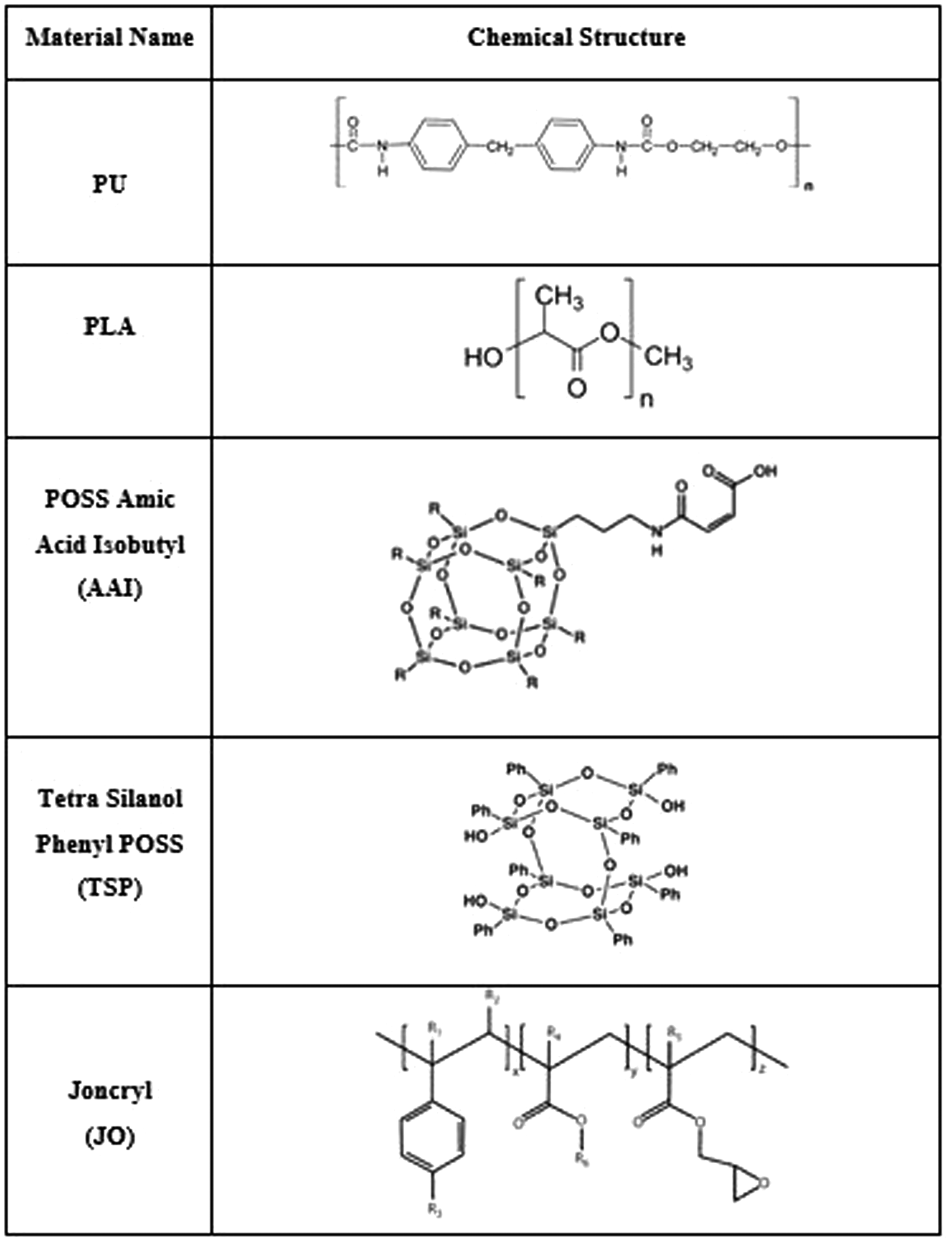
The chemical structure of pure PU, pure PLA and compatibilizers.
Solution forming
Before preparing the solution, the moisture on the PLA and the PU pellets was removed waiting 12 h in an oven at 80 °C. The PLA polymer was solvated in the blend of CF and DMF solvents at an 80:20 (v/v) with stirring at 24 °C ± 2 for 4 h. The PLA/CF-DMF (w/v) solution (pure PLA) of 10% concentration was prepared for the electrospinning process. The PU polymer was also stirred for 4 h at room temperature (24 °C ± 2) conditions. Just after, it was mixed for another 30 min at 120 °C to achieve complete dissolution. The PU/CF-DMF (w/v) solution (pure PU) of 10% concentration was obtained for the electrospinning process.
Firstly, the PLA/PU (50/50-w/w) blend solution without compatibilizer in a single beaker was prepared at 10% concentration same way as the dissolution principle of pure PU solution. To prepare PLA/PU blend solutions with compatibilizer, firstly the solubility of three different compatibilizers was checked in 8 mL CF/2 mL DMF solvent. It has seen that the compatibilizers were dissolved in the solvent mixture without any problem. To prepare a 10% concentration PLA/PU blended solution, 1% of the solid polymer amount (g) was used and added to the solution as the compatibilizer amount (g). The PLA/PU/compatibilizer solutions were prepared the same with the dissolution principle of pure PU solution in a single beaker at the same time. Then, the prepared PLA/PU blended solutions with/without compatibilizer were used for the electrospinning method. The study names, contents of the obtained solutions and densities of all nanofibers were displayed in Table 1. Conductivity values were measured with a liquid conductivity meter at room temperature (24 °C) and it was determined as 0.4 µS/cm for DMF and 0.0 µS/cm for chloroform.
The sample codes and contents of obtained studies.

Electrospinning
All solutions were used in electrospinning without waiting. The experimental studies were achieved at room conditions (24 °C ± 2 – 65%RH). Process conditions of both pure polymers were determined as 15 kV applied voltage, 20 cm distance between syringe tip and collector and 0.5 mL/h feed speed. Also, the electrospinning process for PLA/PU blends was performed with parameters 18 kV applied voltage, 20 cm distance between syringe tip and collector and 0.5 mL/h feed speed. The electrospinning parameters were kept constant for all PLA/PU solutions. The study names of the electrospun mats were encoded the same as the names of the solutions. In the electrospinning process, it has been used a -blunt-end-needle- having a diameter of 0.91 mm. (20 G gauge/inch).
Characterization
In this study, morphology properties of nanofibers were observed via SEM device named QUANTA 400 F Field Emission. FTIR-ATR analysis was performed to determine intramolecular bonds and intramolecular functional groups of PLA/PU nanofibers. The FTIR-ATR spectrometric measurements of nanofibers were realized by using Perkin Elmer Spectrum 100 FTIR device with an ATR unit. IR measurements in the span of 500–4000 cm−1 were recorded during analysis.
Thermogravimetric analysis (TGA) that performed to determine the decomposition temperatures and residue amounts of nanomaterials with the mass loss of the obtained nanofibers due to increase in temperature was carried out with Mettler Toledo TGA 1, in the range of 25 °C to 600 °C, with a heating speed of 10 °C/min and feeding a nitrogen gas that has a flux ratio of 50 mL/min. Thermal analysis was performed by Differential Scanning Calorimetry (DSC) to examine the change of heat capacity of the obtained nanofibers with temperature and to determine the glass transition temperature, melting temperature and enthalpy values of the nanomaterials. DSC analysis of electrospun nonwoven mats was realized in a one-step, between −50°C and 300 °C, with a heating rate of 10 °C/min under the high purity nitrogen atmosphere using the Mettler Toledo DSC 1 instrument. The percent crystallinity (Xc) of fibers was computed according to (
ΔHm is the temperature of melting in each other specimen, ΔHc is the crystallization enthalpy, ωf is the weight fraction, and
The surface wettability properties of nanofibers were performed with static contact angle measurement by using the Hanging Droplet method with the Attension Theta Lite device at room temperature (24˚C ± 2˚C). Distilled water droplets in the amount of 10 µl were dropped onto the surface. The water drop was visualized in the computer environment through a camera equipped with a powerful optical lens. The γ value of drop contact angle value obtained by using Young/Laplace equations with computer software was calculated. The contact angle test was finalized by making calculating the mean of the angle values recorded for 9 s with a camera. This test was repeated 10 times for each nanofiber sample. The average value of the measurements was reported.
The mechanical properties tests of electrospun nonwoven mats were achieved at pulling widget named Lloyd Instruments LRX Plus working at 1/10 mm/min pulling rate, at 5 kN load, at environment temperature (24 °C ± 2 °C) and according to the terms of ASTM D882 standard. For tensile test was prepared electrospun mats at the size of 50 mm x 15 mm and the mean thickness value of 0.20 mm. The tensile tests were carried out to each fiber 5 times and the average values of results were saved.
The density measurement of solid nanofiber surfaces using the Mettler Toledo XS204 Excellence branded precision balance having density kit has been carried by Archimedes’ principle with the principle of the buoyant force within the framework of gravimetric procedures. According to Archimedes' principle, a substance that is partially or completely immersed in a liquid encounters a buoyant force that pushes it upward. The magnitude of this force is equivalent to the weight of the liquid it passes through. The solid was first weighed in air (A), then in distilled water of known density (B). Measurements were repeated 5 times at room temperature (24 °C) for each nanofiber and density values of nanofibers were averaged. The density (ρ) of the solid matter has been calculated according to the formula (equation (2)):
ρ is the density of the sample; A is the weight of the sample in the air; B is the weight of the sample in distilled water; ρ0 is the density of the distilled water; ρL is the density of the air.
Result and discussion
Fourier transform infrared spectroscopy (FTIR)
The FTIR-ATR spectrum of the pure polymers was shown in Figure 2. The FTIR-ATR spectrum of other fibers and all the pure compatibilizer types were given in Figure 3. The characteristic peak of PU is 1600 cm−1 and belongs to aromatic C = O group vibrations. At pure PU and all the 5PLA5PU nanofibers, the peak of 1602–1594 cm−1 was seen. At pure PLA, this peak wasn’t observed. It showed that belongs to CH2 at 1451 cm−1 peak, to vibrations (N-H) + (C-N) + (C-H) at 1308 cm−1 peak, and the carbonyl group (C-O-C) group vibrations at 1260 cm−1 peak. The 1372 cm−1 peak belongs to CH2 was observed on both pure PLA and pure PU nanofibers. Some of these peaks were observed that as belonging to (C-N = O) at 1411 cm−1 peak; to (N-H) + (C-N) at 1523 cm−1 peak, and to (C-H) at 863 cm−1 peak in all the PLA/PU nanofibers. The (C-N = O) at 1221 cm−1 peak belongs to pure PU. But the same bond has seen for pure AAI at the 1225 cm−1 peak. The peaks are seen in the pure PLA nanofiber and all 5PLA5PU nanofibers express (C = O) stress vibrations at 1749–1753 cm−1 peaks and (CH) tensile vibration at 2945 cm−1 peak [27].

FTIR spectrum of pure PU and pure PLA.

FTIR spectrum of all the electrospun mats and pure compatibilizer types.
The CH tensile vibration at 2929 cm−1 peak has seen at pure PU nanofiber. This peak is seen at 2934 cm−1 has shifted from 2945 cm−1 and, it has seen at all 5PLA5PU nanofibers having added compatibilizer. The -OH at 1189 cm−1 peak and C-O-C at 1085 cm−1 peak has seen at pure PLA and all 5PLA5PU nanofibers. It is thought that 1210 peaks seen in 5PLA5PU nanofibers having added TSP and AAI compatibilizers slip to form Si-O bonds [28]. In nanofiber having added JO compatibilizer, it can be said that this peak belongs to (O = C-O) bond. This result can be interpreted as decreasing the number of hydrogen bonds formed between the hard and soft parts of the urethane phase mixture. It was showed that belongs to vibrations (C-O-H) at 2857 cm−1 peak and to (-OH) at 3001 cm−1 peaks. PLA/PU mixtures displayed a typical wide IR absorption top at ∼3400 cm−1 that is verified to NH and OH tension tapes of polyurethane (PU) and polylactide (PLA) [29].
It has been observed that new peaks are formed that are not found in the pure PLA, the pure PU and 5PLA5PU without compatibilizer fibers but appearing in nanofibers that were added compatibilizer types. These peaks belong to vibrations (-O-CH2-O) at 2789 cm−1 peak, to the (-C-O-H-) bonded to the benzene ring at 1698 cm−1 peak. The peak at 1698 cm−1 that was found at only pure AAI has been seen at all 5PLA5PU nanofibers that were added of compatibilizer types. The peak at 1460 cm−1 indicates the amic group connected by NH groups at pure AAI. The (O = C-OH) vibration at 2987 cm−1 peak was seen at only 1JO.5PLA5PU nanofiber. It has been stated that the joint peaks in pure PLA, pure PU and pure compatibilizers also appearing in 5PLA5PU nanofibers that were obtained as adding compatibilizer types, increase the compatibility. According to FTIR results, it can be emphasized that all types of compatibilizers are compatible with PLA/PU fibers. Besides, DMF and CF solvents were noticed to be separated from the structure of the electrospun mats by the electrospinning process. Because the characteristic peaks of the solvents were not seen in the FTIR spectrum.
The surface micrograph (SEM)
SEM micrographs at 10 µm size of the scale bar for pure PLA, pure PU and 5PLA5PU nanofibers, also both 10 µm and 100 µm size of the scale bar for the compatibilized 5PLA5PU nanofibers are shown in Figure 4. When all the nanofibers were compared; it was observed that the pure PLA nanofiber, the pure PU nanofiber, the 5PLA5PU without compatibilizer and the 1AAI.5PLA5PU nanofibers were obtained as without-bead, homogeneous distribution, and smooth surfaces. It has been seen the 1TSP.5PLA5PU nanofiber and the 1JO.5PLA5PU nanofiber have irregular and thick fibers with a branched structure. Also, it has observed structures of fiber that adhered to each other for these nanofibers in the SEM micrographs.

SEM micrographs of electrospun fiber surfaces (scale bar for a–f: 10 µm, magnification for a–f: 10000×, scale bar for g–i: 100 µm, magnification for g–i: 1000×).
To occur bead-less fibers with uniform thinness is the first aim in the electrospinning process. To be formed a homogeneous structure of electrospun nonwoven mats and to obtainment, an equilibrium among the electrostatic impulse, surface strain and viscoelastic powers, the fluid jet in the electrospinning operation must be kept stable. Additionally, the steadiness of operation reproducibility is another significant condition of electrospinning. Indicated conditions are causally related to polymer density. In preceding studies is viewed that polymer density is the most effective determinant for obtaining consistent diameter dimensions of electrospun mats [30]. The molecular weight of the polymer has a quite important influence on nanofiber morphology. The increment in viscosity is associated with the rise in the molecular weight of the polymers owing to the reaction of the chain expander epoxy group with both chain-ends of the polymer [21]. It is known that when the concentration is kept constant, a beaded structure is formed when the molecular weight of the polymer is reduced. When the molecular weight is increased, smoother fibers create [31]. The higher the average molecular weight of the polymer, the higher its viscosity. The firmly interconnected polymer chains form a quite high fluidity.
According to the SEM results, it has been observed that AAI compatibilizer provides the best compatibility between two polymers as a chain extender for PLA/PU nanofiber. Molecular weight refers to the bonding of polymer chains in solution, that is, it reflects the viscosity. In this study, it was concluded that the molecular weight of the nanofibers increased, and smooth fine fibers were obtained thanks to the optimum increase. The situation is different from other nanofibers. It is usual to obtain beadless but cohesive and very thick fibers when having a molecular weight above the optimum viscosity.
As the FTIR results confirm, it is determined that there is an interaction also between polymer chains in the 1JO.5PLA5PU and 1TSP.5PLA5PU and compatibilizers. For this reason, the fiber diameters of these nonwoven surfaces are quite thick. This situation is significant proof of the chain extending of the macromolecules, therefore approving the chain enlargement reaction. All compatibilized solutions were spun at the same concentration in electrospinning. Due to the increasing amount of bonds without changing the concentration, the optimum average molecular weight was exceeded. Increasing molecular weight starts to negatively affect the characteristics of the material. In this case, irregular and adherent nano/microfibrils were formed in 1JO.5PLA5PU and 1TSP.5PLA5PU electrospun fibers. It has been noticed that the fiber that reaches the optimum average molecular weight is 1AAI.5PLA5PU. It was also observed in SEM images that this fiber has the smoothest surface structure and the thinnest fiber.
In another way, the density of polymer and solid matter is directly proportional to the average molecular weight. As the molecular chains get longer, the density increases and the fiber becomes thicker. The density values of all nanofibers were given in Table 1. The density of solid nanofibers has been increased linearly with fiber diameters. This result proves that the highest increase in mean molecular weight is in 1JO.5PLA5PU and 1TSP.5PLA5PU nanofibers.
The graph comparing the average diameter length of all nanofibers was given in Figure 5. Increment the nanofiber thickness dimensions with rising the number of crosslinks in the polymer solution that prepared for electrospinning process is notified preceding studies [32].. Thus, in this study also, it was interpreted that since the hard segments in the PU structure were exhibited partially crosslink property increasing the hard segment chains in the PLA/PU solution prepared by adding a compatibilizer increased the fiber diameter value.

Average fiber diameter (nm) of electrospun fibers.
The thinnest fibers are pure PLA nanofibers. The closest result was obtained in 1AAI.5PLA5PU nanofiber diameter measurements. It has a diameter in the middle of pure PU and pure PLA nanofibers. It is observed that the 1AAI.5PLA5PU nanofiber which average diameter value is 812 nm has even thinner than the compatibilizer-free 5PLA5PU nanofiber. Besides that, it was observed that the 1JO.5PLA5PU and 1TSP.5PLA5PU fibers have too much thicker diameter value than the compatibilizer-free 5PLA5PU nanofiber.
When PLA and PU polymers in some production method (extrusion, melting, films, etc.) are mixed with different polymers using Joncryl and POSS compatibilizers, they have good surface expansion and suitable chain extender properties [12,22,33,34]. In this study too, it is determined that AAI is a suitable compatibilizer to produce PLA/PU blend nanofiber with the electrospinning method.
Surface wettability properties
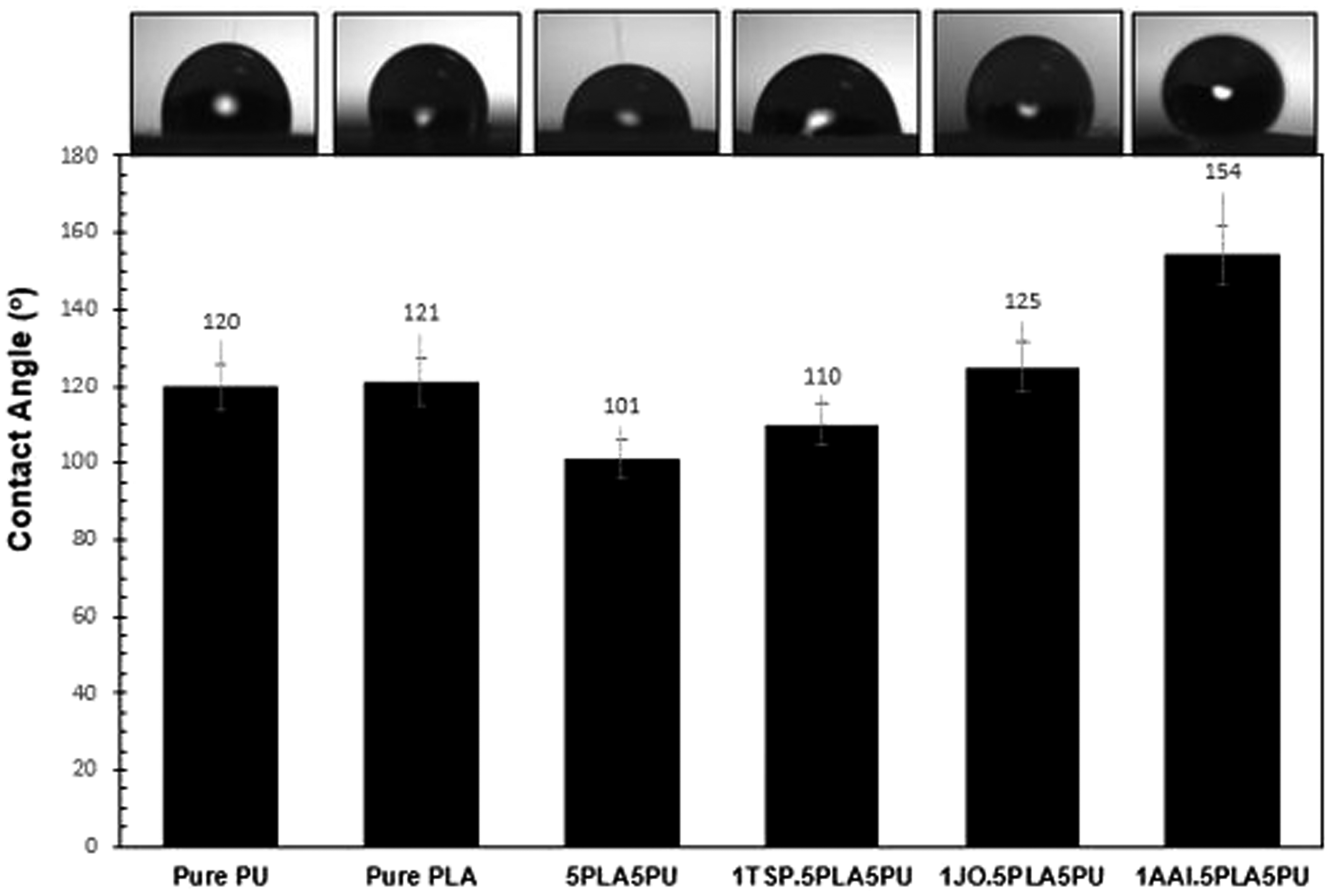
The attitude of the micron-sized drop of water for all the fibers surfaces is shown in Figure 6. Usually, if the contact angle value of the material surface is greater than 65, it is stated that it is a hydrophobic character it’s [35]. The contact angle value for the superhydrophobic character is between 150°≤θ ≤ 180° where the liquid is almost completely spherical on the solid surface and the liquid does not wet the surface [36]. According to the results obtained, it is seen that pure PLA and pure PU have a hydrophobic character with 120° ± 2 contact angle value and all the PLA/PU blend nanofibers except for 1AAI.5PLA5PU nanofiber are the same character too.
Surface wettability properties of electrospun fibers.
When pure PLA and pure PU blended, it was seen that the contact angle with the 5PLA5PU nanofiber decreased. It was determined as value of the 5PLA5PU nanofiber is 101°. This result was owing to the changing in both the chain lengthiness and power area of the contacting surface [37]. After the compatibilizer addition, it was observed that at all nanofibers increases the contact angle value of hydrophobic character. The behaviour of 1AAI.5PLA5PU nanofiber is at the superhydrophobic transition limit, so the degree of hydrophobicity is so high.
The chemical structure (being poly-ester or poly-ether) and molecular sizes of the polyols forming the soft segments in PU polymer significantly affect the properties of the polyurethanes used in their production, such as resistance to cold or heat, hydrolysis stability, and resistance to solvents. For this reason, it divides PU polymer into two groups as polyester and polyether type, depending on whether the soft segments are polyester or polyether. Polyether groups have a more complex structure than polyester groups. So, polyether type PU materials are resistant to hydrolysis and treatments such as alkali bleaching, dyeing. PU type used in this study is also ether based.
As the apolarity of chain and carbonyl (such as -CH3, -C2H5) groups in polymer chain increases, the hydrophobic feature occurs. The -Si- atoms provide a hydrophobic property to the material by reducing the energy of the surface in question. The material with low surface energy repels water molecules and water droplets do not wet the surface. In this case, the -Si- atoms in the AAI and TSP compatibilizer are expected to give the fiber structure a high hydrophobic structure. However, since the AAI compatibilizer contains both -Si- atoms and R (carbonyl groups), it has been observed that it gives the surface superhydrophobic properties; while there are only -Si- groups in the TSP compatibilizer, there are no R groups inducing chain binding. Therefore, it gave a lower surface contact angle value than both AAI and JO compatibilizers. In addition, since -OH groups in the TSP structure increase polarity, they tend to form a hydrophilic surface structure. Thanks to the epoxy and R groups in the JO compatibilizer. It is more prone to show hydrophobic properties. In the non-compatibilizer 5PLA5PU nanofiber structure, the polar structure stands out because of the formation of chains with R and -OH groups and thus the hydrophobicity decreases due to the increasing groups.
Considering both SEM images, FTIR spectra and contact angle results; While the non-compatibilized 5PLA5PU fiber structure is formed by step polymerization with a block copolymer structure; It was concluded that the structure of the electrospun fibers of the mixture of PLA/PU obtained by adding a compatibilizer was formed by the addition polymerization with block copolymer structure.
Tensile test results
The results for tensile stress at max. load, tensile strain at max. load and tensile strain at break of all electrospun fibers were obtained from the mechanical analysis. The tensile stress at max. load graph of electrospun mats was shown in Figure 7. While the rigid segments of PU improve the tensile durability, the loose segments of PU enhance the flexibility property. The pure PLA electrospun nonwoven surface displays a brittle but tough structure. Close look at the tensile strength of all the 5PLA5PU nanofibers, one can notice that PLA/PU blend nanofibers which are compatibilized with Joncryl presented better stiffness than other fibers added compatibilizer. Thanks to epoxy functional groups, Joncryl that is a multi-epoxide styrene‐acrylic polymer chain expander, may initiate ring‐opening reaction with urethane groups belonging to thermoplastic PU chains [34]. The 1JO.5PLA5PU nanofiber exhibited the compatibilizer-free 5PLA5PU nanofiber almost equal tensile stress at max. value. The pure PLA polymer and pure PU polymer may be mixed for balancing the hardness and the durability. For, pure PLA polymer is a limited extent harmonious with the poly- ester or poly- ether group creating the loose part of pure PU polymer [10].
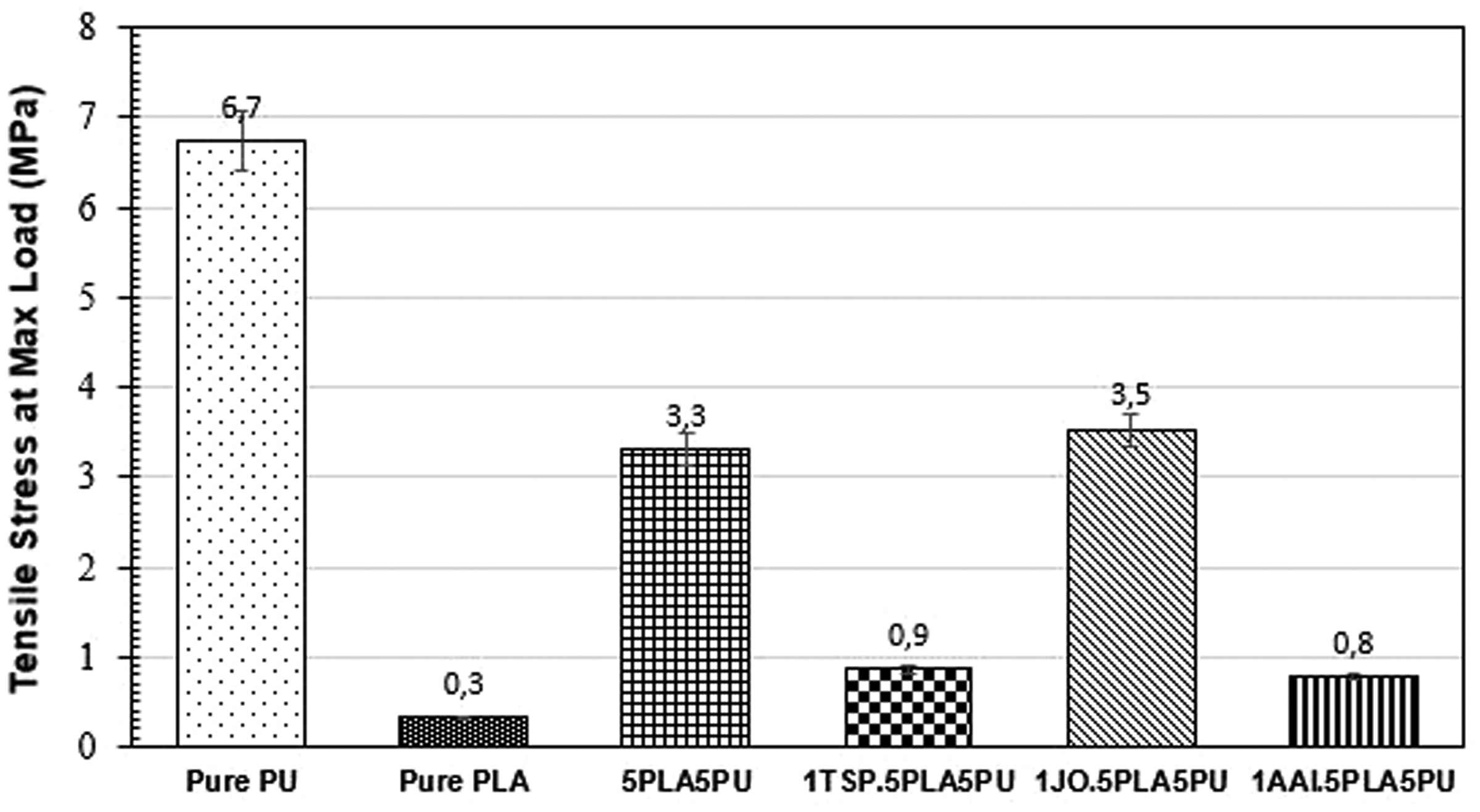
Tensile stress at max load (MPa) of electrospun fibers.
The nanofibers obtained with other compatibilizer types exhibited a resistance behaviour that is significantly lower than that of the pure PU nanofiber and substantially close to that of the pure PLA nanofiber. Therefore, it cannot be said that other compatibilizer types, except for Joncryl, create remarkable effect on the strength values of PLA/PU nanofibers. Furthermore, increment in resistance can be associated with the increment at molecular weight of PLA owing to PLA chain reaction with Joncryl. In the study of Al-Itry et al. have been examined the compatibilization of PLA/PBAT mixtures by using the multipurpose epoxide Joncryl for chain expander. It has been seen increment at the tensile modulus, elongation at break and complicated viscosity of the mixtures by dint of chain extender added to structure [13]. The presence of the JO compatibilizer extended the chain structure and increased the molecular weight of the occurring structure in this study. This result has been demonstrated by the presence of thick filaments seen in the SEM micrographs of the 1JO.5PLA5PU nanofiber. While the tensile strength of pure PU is high, the tensile strength of pure PLA is extremely low. The presence of hard segments of polyurethane affects the tensile strength of the material. When the 1JO.5PLA5PU and the 5PLA5PU fibers were evaluated, it has been noticed that the hard segments increased in the chain reaction with the PLA/PU mixture. It has been interpreted that there is soft segment refinement in both the presence of chain extender and the structure of non-compatibilized 5PLA5PU. Thereby, it has observed that the inter-particle space is decreased and the interfacial cohesion among the PLA and PU materials is increased. Thus, the tensile stress and the tensile strain could be adequately transferred to the loose section of PU from the PLA.
It was shown the tensile strain at max load (%) of electrospun fibers in Figure 8 and tensile strain at break (%) (elongation at breaking) of electrospun fibers in Figure 9. Since fiber and fibrous surfaces do not show flowing behaviour, tensile strain at max load and tensile strain at break values at rupture are almost the same and these graphics can be evaluated together. The values of tensile strain at max load and tensile strain at break of the pure PU electrospun mats gave results at close value each other and stretched about 4.5 times the first long its. The flexibility features, that is enabled by loose sections in the structure of PU, were also viewed in the pure PU electrospun mats. The pure PLA electrospun fibers displayed much remarkably percentage elongation than pure PU electrospun fibers. The cause for the high value of tensile strain at break of the pure PLA electrospun fibers while comparing to tensile strain at max load value is the separation of one-by-one fibres during breaking. This is a negligible behaviour on nanofiber and fibrous surfaces. Because, as soon as the fiber breaks and its strength begin to decrease, all fibrous materials with a fiber network can continue breaking individually and stranded. Therefore, the measurement of the amount of elongation at break continues until the last strand of strand holding each other breaks. However, it can be said that it is not meaningful for nanofiber or fibrous structures where the elongation value is higher in the break that is higher than the elongation amount.

Tensile strain at max load (%) of electrospun fibers.

Tensile strain at break (%) of electrospun fibers.
In the study of Madbouly and Otaigbe, they reached the results of an increment in tensile strength and a decline in the elongation at breaking after POSS addition to the polyurethane and suggested which the POSS spalls are involved in the hard sections contrarily the loose sections [34]. In this study, Regarding, the 1AAI.5PLA5PU and the 1JO.5PLA5PU electrospun fibers, the chain expander supplement did not develop property of the tensile strain at break and tensile strain max load. In the 1AAI.5PLA5PU nanofiber was observed as elongated fibrils the parallel to each other and complex according to SEM micrographs. These values were almost the same as the 5PLA5PU electrospun fiber without chain expander. Thus, it was detected that the presence of other chain extenders, the TSP compatibilizer except, did not provide effective elongation value. These conclusions are evinced by the surface micrographs in the SEM analysis of blended fibers. Very regular or very cohesive fibers change their strength and elongation behaviour due to their arrangement in the structure. The surface change from prolonged and fibrous structure to adherent and branched structure in the mixtures expresses the reduction in flexibility in existing chain expander.
Thermogravimetric analysis (TGA)
It was carried out TGA analysis under a non-oxidative nitrogen atmosphere to describe the thermal behaviour of all the electrospun mats. TGA decomposition curves of electrospun fibers were shown in Figure 10. While pure PLA nanofiber has been degraded in one step curve, pure PU nanofiber has exhibited a three-neck decomposition curve. Within the experimental temperature range, all 5PLA5PU nanofibers too due to their PLA/PU blends have shown a three-neck decomposition curve. TGA curves prove the existence of PLA and PU in the structure in this way. To compare the three-step graphics of electrospun mats more clearly; Tmax values, temperature values of the weight loss at 5% and matter amount of residue at the end of 600 °C have been given in Table 2.

TGA decomposition curves of electrospun fibers.
TGA decomposition values of electrospun fibers.

For pure PU nanofibers It was observed that the soft parts have been shown the Tmax1 value at 297.19 °C temperature and the hard parts have been shown respectively the Tmax2 and Tmax3 values at temperatures of 352.13 °C, 420.08 °C. The Tmax1 value of pure PLA nanofiber is quite high at 354 °C. It was observed that the Tmax1 temperature of the 5PLA5PU nanofiber that obtained with the mixture (50:50) of pure PU and pure PLA nanofibers follow a temperature above the Tmax1 of pure PU. It has seen the Tmax temperatures of nanofibers that were added compatibilizer is at close to Tmax temperature values of pure PU. These values showed that the including of POSS to the soft sections of PU improve some amount the thermal balance of PLA/PU [38]. This conclusion has been stated as a result of molecular movability of great chains of the pure PU electrospun fibers that were added POSS [34]. It has been determined that the POSS addition to the structure of PLA improves its thermal stability [39]. Since the degradation reaction of all the PLA/PU fibers that were added compatibilizer consists on account of existing effective zones on the chain tips, an increment number of the chain ends per group is anticipated to cause an improved ratio of decomposition. It has been also determined that the fiber too with the highest Tmax1 value was the 1AAI.5PLA5PU nanofiber with a temperature value of 312.29 °C. Also, it is observed that there is an increase in temperature value of the 5% weight loss of 1JO.5PLA5PU fiber comparing with values of other PLA/PU blended nanofibers. This situation demonstrates a remarkably presence of branched structure that have an increment number of tips per chain (and overall) according to the linear structured substances fabricated by using Joncryl.
The residue rates of compatibilizer-free 5PLA5PU blended fibers are almost the same as for pure PU. The -CH, -OH like groups remaining in the structure of pure PU and pure PLA nanofibers, reconnects with the addition of compatibilizers to make more bonds and chain elongation. These reactions result in a decrease in residue amounts. The amount of the weight residue at high temperature of all 5PLA5PU nanofibers with compatibilizer has shown values between amounts the weight residue of pure PLA and pure PU electrospun webs just as expected. As can be understood from the solid fiber density measurements, the maximum chain elongation and the lowest residue amount are respectively; It was observed in 1JO.5PLA5PU, 1TSP.5PLA5PU and 1AAI.5PLA5PU nanofibers. It has been considered that the reason for the excess in the amount of residue of 1TSP.5PLA5PU and 1AAI.5PLA5PU electrospun mats are due to the amount of inorganic matter. For this reason, excess has been observed in the residue content of these fiber comparing to 1JO.5PLA5PU nanofiber.
Differential scanning calorimetry (DSC)
The determined values with DSC analysis of all the electrospun fibers were displayed in Table 3 and their DSC curves were reported in Figure 11. The pure PLA electrospun fiber was determined at 59 °C for glass transition temperature (Tg) and 154 °C for melting temperature of (Tm). It has been seen that the pure PU electrospun fiber has a Tg of −49°C specific to the loose section and also, a Tm of 30 °C caused from the loose section and a Tm of 110 °C arising from the hard segment.
Values obtained from DSC results of fibers.
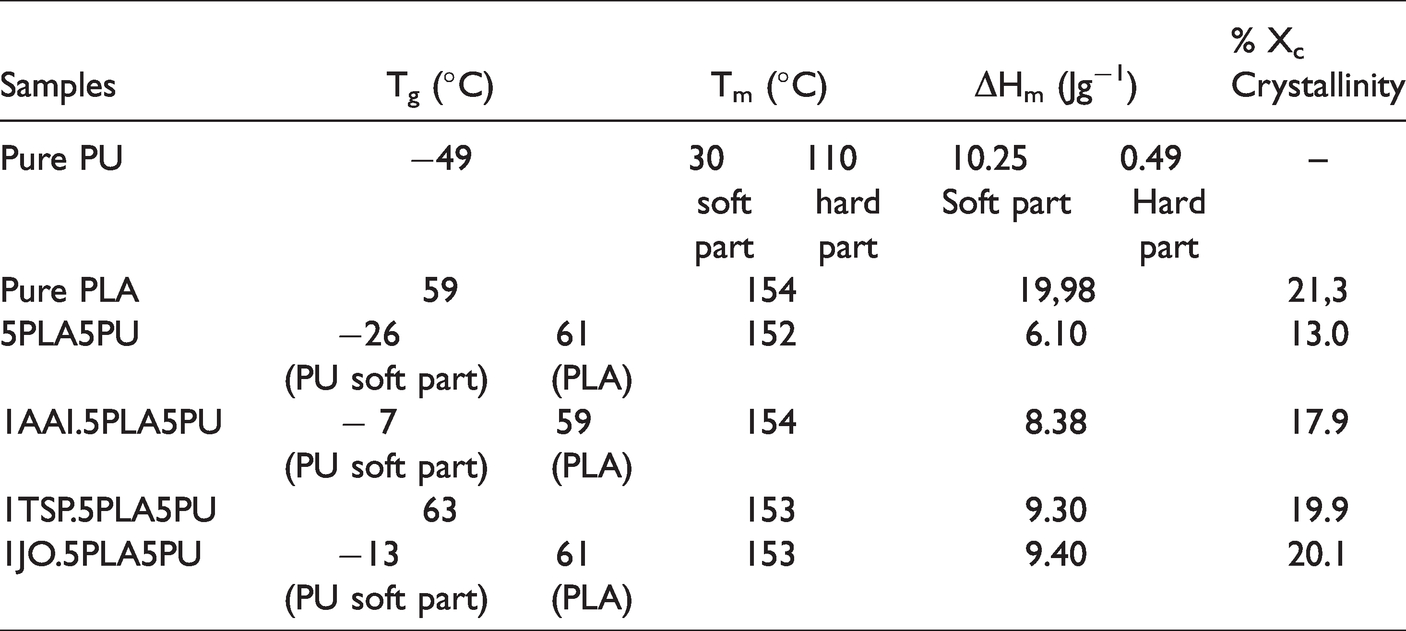

DSC curves of electrospun fibers.
The addition of POSS or Joncryl into the PLA/PU blend did not affect as remarkable of Tg value compared to the 5PLA5PU without compatibilizer nanofiber. The non-observed melting peak of POSS demonstrated that POSS spalls diffuse in polymer structure such that the crystallization of POSS spalls was prevented. The compatibility of polymer mixtures may determine with slip at the Tg of the phases while comparing to their original values [40]. The Tg value of the soft segment of pure PU nanofiber has been observed as a slip toward the Tg value of pure PLA in the blends. The presence of the hard part areas has been grasped from a higher temperature alternation in physical features (loose point) which is not accompanied by an understandable thermal transition in DSC analysis.
Tg values of all the blended nanofibers got closer to each other and the Tg of 1TSP.5PLA5PU nanofiber gave the closest value to the value of pure PLA. The close values in the glass transition temperature of all the 5PLA5PU nanofibers indicate the developed compatibility between the PU and PLA. This result indicates a good mix of uniformity.
The degree of crystallinity of PLA was calculated to be about 21%. Since 100% crystalline melting enthalpy of PU is not observed, no crystallinity was computed for the pure PU electrospun fiber in DSC. The percentage of crystallinity of both all electrospun 5PLA5PU fibers obtained with the addition of compatibilizers to PLA/PU blends and the 5PLA5PU without compatibilizer fiber has decreased according to the crystallinity value of pure PLA. However, it has been seen the degree of crystallinity of the 5PLA5PU nanofibers that was added compatibilizer increase according to the degree of crystallinity of the 5PLA5PU without compatibilizer nanofiber.
It has been known that the flexible groups such as -CH2-CH2-, -Si-O-Si-, -CH2-O-CH2-, carbonyl (such as -CH3, -C2H5) groups, hydrogen bonds and polar interaction increase the flexibility of the chain. Crystallinity has been expected to increase with increasing chain flexibility. The TSP compatibilizer contains the -Si- atoms while the JO compatibilizer contains the R carbonyl groups In line with this information, an increase has been observed in the crystallinity of 1JO.5PLA5PU and 1TSP.5PLA5PU fibers. It can be emphasized that, due to the high crystallinity of these fibers, the chain sequence is linear. Also, the percentage crystallinity of 1AAI.5PLA5PU fiber too is close to that of other PLA/PU nanofibers with compatibilizer.
Conclusion
In this study, the 50:50 in weight ratio PLA/PU blended solutions were prepared both by adding 1 wt% compatibilizer and without compatibilizer. The PLA/PU electrospun nonwoven fibers have been successfully obtained from these solutions by electrospinning. The 1AAI.5PLA5PU nanofiber having the thinnest diameter with 812 nm was found to have an exceptionally smooth, homogeneous and without bead structure in SEM micrographs. According to contact angle test results, the hydrophobic surface structure was observed for all prepared fibers and the 1AAI.5PLA5PU nanofiber showed superhydrophobic property with 154°. A curve with three steps at the average values of both pure PLA and pure PU temperatures in TGA was obtained for all the nanofibers. The melting values of the soft and hard parts of PU showed a single melting peak around 150 °C like pure PLA in all nanofibers. According to DSC results, the crystallinity of all the compatibilizer added nanofibers increased compared to the 5PLA5PU nanofibers without the compatibilizer. The tensile test results showed the highest strength value with the high crystallinity of the 1JO.5PLA5PU nanofiber. It was seen that the highest value in tensile strain maximum load (%) obtained in 1TSP.5PLA5PU nanofiber compared to pure PLA and 5PLA5PU blend nanofiber. When all results are evaluated, it has been determined that the AAI compatibilizer is a suitable chain extender for obtained PLA/PU nanofibers with the electrospinning method. At the same time, it is obvious that the 1AAI.5PLA5PU nanofiber can be used in many areas as a hydrophobic surface material.
Footnotes
Declaration of conflicting interests
The author(s) declared no potential conflicts of interest with respect to the research, authorship, and/or publication of this article.
Funding
The author(s) received no financial support for the research, authorship, and/or publication of this article.
