




Abstract
Polyethylene/polyethylene terephthalate (PE/PET) nonwoven fabrics were first modified with a continuous graphene layer by using a dipping process, and then deposited with silver nanoparticles (AgNPs) by using magnetron sputtering, and that is a novel method called two-step method. Graphene/PE/PET (GPP) and AgNPs sputtered GPP (AGPP) were prepared to investigate the modification processes on the electrical conductivity of the nonwoven fabrics. The influence of the surface modification by silane coupling agent (KH-560) on the durability of conductive PE/PET composited fabrics is also studied. Surface morphology, chemical structure, thermal stability, electrical conductive and ultraviolet protection properties of the composite fabrics were investigated. The results indicated KH-560 treatment can obviously improve the interfacial adhesion between the graphene and PE/PET then contributes to the enhanced conductive durability of the composite fabrics. The combination of graphene and AgNPs provided more opportunities for the charge transfer paths of AGPP, leading to an improved conductive network and an increased electrical conductivity. In addition, graphene and AgNPs gave GPP and AGPP excellent thermal stability. The research exhibited the advantages of the two-step method, and also indicated AGPP has a promising application for the preparation of wearable electronics.
Introduction
In recent decades, multi-functional textiles with electrical conductive properties have been extensively studied due to their novel functionalities, such as flexibility, lightweight, and excellent stretchability [1–3]. The conductive textiles play a vital role in the field of materials, especially in electrode materials [4,5], electromagnetic interference shielding materials [6], embedded health-monitoring equipment [7] and supercapacitors [8]. A variety of methods have been developed to fabricate conductive textiles, such as dipping [9,10], chemical vapor deposition [11], magnetron sputtering [12], electron beam evaporation [13] and plasma jet printing [14], etc. Magnetron sputtering has been one of the most promising technologies for textile modification [15,16], especially for depositing conductive thin film onto the fiber surface due to its advantages of environmental protection, low temperature, high efficiency, and the ability to sputter many kinds of materials [17–20].
Silver (Ag) has excellent electrical conductivity [21] making it an ideal choice for the preparation of conductive textiles by using magnetron sputtering [22,23]. Nonwoven fabrics are one of the important textiles used in daily life or for industrial applications [24,25]. However, it is difficult to form a continuous conductive film on the nonwoven fabrics by using magnetron sputtering because of the unique structure of these fabrics, which is a multi-interface surface for the vacuum deposition method.
To solve the problem, here we proposed a two-step method that a continuous conductive film was firstly formed on the surface of nonwoven fabrics, and then silver nanoparticles (AgNPs) were deposited to further realize an enhanced electrical conductivity of the nonwoven fabrics. Graphene considered as a wonder material has attracted considerable attention due to its excellent properties, including high surface area, chemical and thermal stability, electrical conductivity, mechanical strength and flexibility [26,27]. However, it’s difficult for graphene to combine with textile materials because it has fewer polar groups, such as hydroxyl (–OH) and carboxyl (–COOH) [28]. Therefore, graphene oxide (GO) which can easily form a cross-linking with other polar groups on textile was used in this study because it has a large number of polar groups. Many researchers have dedicated their efforts to endow the textiles with high conductivity from GO following by a reduction to convert the GO to reduced graphene oxide (RGO, namely the graphene) [29,30].
Combining the excellent conductivity of AgNPs and graphene is an effective method to develop highly conductive materials [31]. Huang et al [32] confirmed that the integrating hybrid of graphene nanosheets (GNS) and AgNPs can improve the conductivity of fabric. They found that the polyurethane (PU) nanofibers have a low surface resistance of 150 Ω/sq after dipping into the AgNPs-GNS solution. Voronin et al. [33] deposited the Ag quasi-periodic mesh (Ag q-mesh) onto polyethylene terephthalate (PET) fabric by magnetron sputtering and subsequently formed the RGO on the Ag q-mesh coating as a protective layer. The result shows that the RGO/Ag q-mesh has a low sheet resistance of 12.3 Ω/sq. He et al. [34] reported that the combination of graphene and Ag can improve the electrical conductivity of cotton fabric, and the sheet resistivity of the graphene/Ag/cotton is low at 2.71 Ω/sq. The above researches proved that the fabrics modified with AgNPs and graphene have high conductivity, but the study on the conductive durability of the composite conductive textiles is still lacking. Silane coupling agent KH-560 is a multifunctional organic compound [35,36] and often used as the adhesive to improve the adhesion between the fabric and graphene oxide [37,38]. Therefore, KH-560 would be used in this study to enhance the conductive durability of the composite fabrics.
In this study, PE/PET with good mechanical properties and elastic recovery were selected as the substrate, and a two-step method for the surface modification of PE/PET was proposed. Firstly, the PE/PET was modified with a continuous graphene layer by using a dipping process to preliminary establish a conductive network, and then deposited with AgNPs by using magnetron sputtering to realize a further enhanced electrical conductivity. Surface morphology, chemical structure, thermal stability, electrical conductive and ultraviolet protection properties of the composited fabrics were investigated. The effect of modification by KH-560 on the durability of conductive PE/PET composited fabrics is also analyzed. The resultant composite fabric with excellent electrical conductivity, durability of conductivity as well as anti-ultraviolet properties has potential applications in wearable electronics.
Experimental
Materials
PE/PET (meltblown nonwoven fabric, dimension: 10 × 10 cm, gram weight: 20 g/m2, strength of machine direction/cross direction: 1.11/4.9 MPa) used as a substrate material was purchased from Shanghai Fengge Nonwovens Co., Ltd. (Shanghai, China). GO (SE2430 W, mass fraction: 42.78%) was provided by The Sixth Element Materials Technology Co., Ltd. (Changzhou, China). KH-560 (mass fraction: 98%) and hydrazine hydrate (N2H4.H2O, mass fraction: 80%) were purchased from Sinopharm Chemical Reagent Co., Ltd (China). Acetone was supplied by Shanghai TiTan Scientific Co., Ltd. (Shanghai, China). The anionic surfactant (soap) was provided by Shanghai Soap Co., Ltd. (Shanghai, China). Ag target with a diameter of Φ80 × 6 mm (purity: 99.99%) was supplied by LuoYang Lingshi New Material Technology Co., Ltd. (Luoyang, China). All chemicals were of analytical grade used without further purification.
Preparation of GPP
The preparation of graphene/PE/PET (GPP) by using dipping process and particle size distribution of 1% GO suspension are illustrated in Figure 1. Prior to dipping, PE/PET was treated in sodium hydroxide solution (200 g/L) and stirred at 80°C for 30 min. During the stirring, the ester bond dissociated and the hydroxyla would be generated. After that, the PE/PET was dried in an oven at 80°C for 2 h. Subsequently, KH-560 with a mass fraction of 98% was diluted with deionized water to obtain the ultimately mass fraction of 10%. Surface modification of PE/PET was conducted in water bath with KH-560 dilute solution (mass fraction: 10%) at 70°C for 1 h [37]. During the modification, the material to liquor ratio (PE/PET: KH-560 dilute solution) was set to be 1:40. KH-560 dilute solution treated PE/PET (KH-560/PE/PET) was then dipped into GO suspensions (mass fraction of 1%) at 85°C for 5 h. After the dipping, the excess solution was extruded with rolling mill assembly, and the above process called “dip and dry” which would be performed for two cycles to prepare GO-coated KH-560/PE/PET. The above fabric was then soaked in a 95°C hydrazine hydrate diluted solution (a ratio of hydrazine hydrate to distilled water is 1:5) for 7 h for reduction following by washing with distilled water and dried in an oven at 70°C for 24 h to obtain GPP.

Schematic diagram of the preparation of GPP and AGPP with different sputtering time and the construction model of conductive network.
Preparation of AGPP
Ag/GPP (AGPP) was prepared by depositing AgNPs onto the GPP (10 × 10 cm) through a magnetron sputtering system (model: MSP-300C, Beijing Chuangshi Weiner Technology Co., Ltd., China). Figure 1 shows the fabrication process of AGPP nonwoven fabric by the two-step method. Prior to deposition, the vacuum chamber was evacuated down to a base pressure of 9 × 10⁻⁴ Pa. The distance between the fabric and target was fixed at 150 mm. In order to improve the uniformity of the coated films, the substrate holder was rotated at a speed of 10 r/min. During the deposition, the gas flow rate of argon was kept at 20 mL/min, the applied voltage was 370 V and the working gas pressure was 1.0 Pa. The deposition process was conducted at room temperature. The influence of sputtering time (10, 15, 20, 25, and 30 min) with a sputtering power of 200 W on the properties of the AGPP was systematically investigated.
Characterization and measurement
Surface morphology
Surface morphology of GPP and AGPP was characterized by scanning electron microscopy (SEM, model: S-3400N, Hitachi Instruments Co., Ltd., Japan) and element mapping was obtained by energy dispersive X-ray spectroscopy (EDX).
Chemical structure
The chemical structure of the samples was analyzed by using Fourier Transform Infrared Spectroscopy (FTIR, model: PerkinElmer Spectrum Two, Perkinelmer Co., Ltd., USA) and the FTIR spectra were acquired by scanning the specimens for 32 times in the wavenumber range from 4000 to 450 cm−1 with the resolution of 4 cm−1.
Thermal stability
Thermal stability of the samples was measured by Thermogravimetric Analysis (TGA, model: TGA 4000, Perkinelmer Co., Ltd., USA) [39,40]. All of the TGA was conducted with the following conditions: nitrogen gas at a flow rate of 20 mL/min, and measurement temperature ranging from 30 to 750°C with a heating rate of 15°C/min.
Electrical conductivity
The surface electrical resistivity of different samples was measured by using a four-point probe system with a linear probe head (model: SZT-2C, Suzhou Tongchuang Electronics Co., Ltd., China) [41,42] according to ASTM D257-14 standard at 22°C temperature and 40% relative humidity. The measurements of each sample were conducted for ten times on both vertical and horizontal directions of the samples, and the average was used for evaluation.
Durability of electrical conductivity
Durability of electrical conductivity of the fabrics was studied after washing for different times (5, 10, 15 and 20 cycles) at 40°C with 5 g/L anionic surfactant with a Launder machine (model: Rapid, Xiamen RUBI Precision Machinery Co., Ltd., China) according to the GBT-3921-2008 standard: Textiles-Tests for color fastness: Color fastness to washing with soap or soap and soda.
UV-protection
Ultraviolet protection factor (UPF) and transmittance (UVA and UVB) of fabrics were obtained by anti-ultraviolet tester (model: UV2000, Labsphere Inc., USA). Each sample was tested for five times, and the average value was used to evaluate the UV-protection properties of the fabrics.
Results and discussion
Surface morphology
SEM images of the PE/PET and modified PE/PET are presented in Figure 2. The PE/PET exhibited smooth surface with a clear interlaced structure (Figure 2(a)). Thin film with rough surface was observed on PE/PET fibers after the modification with KH-560 (Figure 2(b)). Graphene nanosheets with a thin and wrinkled structure were clearly found to be affixed on the fiber surface as shown in Figure 2(c), and the surface of GPP is relatively smooth. After sputtering for 10 min (Figure 2(d)), a rough topography composed by AgNPs was observed on the GPP. Moreover, small amount of large particles can be also found. After sputtering for 30 min (Figure 2(e)), the Ag thin film became smooth and the size distribution of the nanoparticles is homogeneous, in addition, agglomerations of AgNPs were observed. The results indicate that an increased deposition time can obviously improve the uniformity of the Ag thin film, and its growth mode conforms to the Volmer-Weber [43] as the increased film thickness, which will contribute to the construction of conductive network.
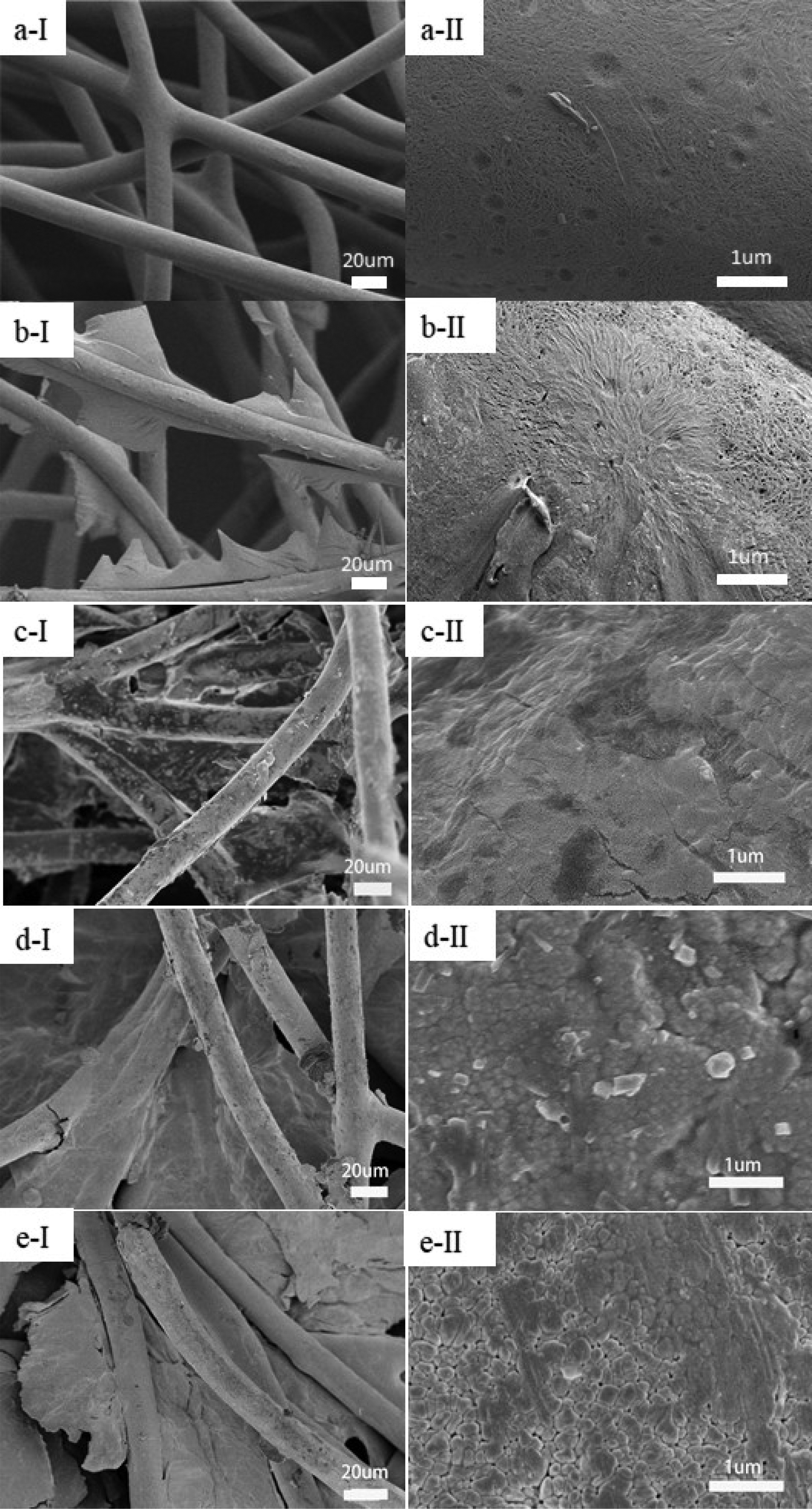
SEM images with different magnifications (I: 100×, II: 20,000×) of various samples: (a) PE/PET, (b) KH-560/PE/PET, (c) GPP, (d) AGPP sputtered for 10 min and (e) AGPP sputtered for 30 min.

Mapping dots of the AGPP sputtering for 30 min.
Distribution of different elements was analyzed by EDX elemental mapping of AGPP. As shown in Figure 3, the elemental mapping of C, O and Ag can also be observed on AGPP and the proportion of AgNPs is 80.15%, which prove that the GPP was uniformly coated with AgNPs.
Chemical structure
Figure 4 shows the FTIR spectra of raw materials and treated fabrics. As shown in the Figure 4(a), the functional group of –OH at 3338 cm−1 was formed due to the reaction of PET and NaOH. The peaks at 2915 and 2847 cm−1 were because of the –CH2– group. The peaks at 1241, 720 and 1713 cm−1 were assigned to the stretching vibration of –C–O–, out-of-plane bending vibration of C–H and C = O stretching of the ester groups, respectively [44]. The FTIR spectrum of GO shows an absorption peak at 3338 cm−1, which is assigned to the stretching vibrations of –OH, and the peak at 1640 cm−1 is due to the stretching vibrations of –COOH.

FTIR spectra of (a) raw materials and (b) treated fabrics (AGPP was sputtered for 30 min).
As illustrated in Figure 5(b), the peaks at 1020 cm−1 and 1630 cm−1 corresponding to Si–O–Si [45] and Si–OH [46] respectively were found in FTIR spectra of both KH-560/PE/PET and GO/KH-560/PE/PET due to the hydrolysis of KH-560. In addition, the functional group of C–O–Si at 1200 cm−1 was formed due to the polysiloxanes hydrogenated with OH groups of PE/PET. Compared with KH-560/PE/PET, the peak at 1640 cm−1 corresponding to –COOH [47] belonging to the characterization peak of GO was discovered in the FTIR spectrum of GO/KH-560/PE/PET, and the intensity of peak at 3338 cm−1 corresponding to –OH increased. These results indicate that the GO can be successfully coated onto the KH-560/PE/PET. The peaks of GPP at 1640 and 3338 cm−1 became weak when compared to that of GO/KH-560/PE/PET, and the peak of 3396 cm−1 corresponding to and C–C belonging to graphene [48] was discovered, which confirms that GO is reduced to graphene. The position of the characteristic peak of AGPP is similar with GPP. Moreover, the peak intensity became weak after the sputtering and there is no new peak appeared in the FTIR of AGPP when compared with GPP. These results proved that the deposition of AgNPs on GPP did not affect the chemical structure of GPP [49], and Ag film was covered the surface of GPP based on the FTIR and EDX results.

(a) TG and (b) DTG curves of PE/PET, KH-560/PE/PET, GPP and AGPP with different sputtering time.

Sheet resistance of AGPP with different sputtering time.
Thermal stability
Figure 5 shows the TG and DTG curves of the PE/PET, KH-560/PE/PET, GPP and AGPP. As shown in Figure 5(a), the GPP and AGPP exhibit good thermal resistance as indicated by the stable weight up to 330°C, and a small peak corresponding to the low weight loss was observed in the DTG curves. As shown in Figure 5(b), PE/PET and KH-560/PE/PET had two obvious thermal decomposition peaks in the temperature ranging from 385 to 550°C due to the decomposition of small molecule and the splitting of the PE/PET main chain. At this temperature range, the weight loss of PE/PET and KH-560/PE/PET were 90.2% and 72.1%, respectively, which due to the good stability of the coupling agent. Two obvious decomposition peaks can be observed from the GPP and AGPP, the first one within the temperature range of 265–370°C, with a mass loss of approximately 4∼8%, it is probably caused by the removal of oxygen functional groups in the samples, the other one within the 385–550°C, with less weight loss than that of PE/PET and KH-560/PE/PET, the reason may be that AgNPs and graphene have excellent thermal stability. When the temperature reaches 750°C, the residual weight of the modified PE/PET significantly increased, and the important parameters corresponding to the thermal behaviors are summarized in Table 1.
Parameters of different samples during the thermal decomposition.

Td: the thermal decomposition temperature at the maximum weight loss rate of the material.
Vd: Maximum decomposition rate; α: weight residue.
D0.5: The temperature when the weight residue is 50%.
IDT: the initial decomposition temperature.
The temperature (Td) at the maximum weight loss rate of KH-560/PE/PET was 511.1°C, that was higher than PE/PET on account of introduction of silane coupling agent with excellent thermal stability. And Td of KH-560/PE/PET was higher than GPP and AGPP due to the degradation of KH-560 and PE/PET in GPP and AGPP, which can easily degrade after the reduction process of GO [50]. However, compared with PE/PET, the maximum decomposition rate (Vd) of KH-560/PE/PET, GPP and AGPP decreased, the weight residue (α) at 750°C and the temperature when the weight residue is 50% (D0.5) of them increased. The result reveals the KH-560, graphene and AgNPs can improve the thermal stability of PE/PET [34]. In addition, the Vd value decreased and the α value increased with deposition time increased from 10 to 30 min indicating a gradually improved thermal stability of PE/PET. That is due to the AgNPs with a high melting point of 960°C [51] deposited onto GPP can restrict the thermal motion of the chains of graphene and PE/PET, and act as a thermal insulation layer to prevent the GPP from degradation.
Electrical conductivity
Based on the testing of surface electrical resistivity, it’s found that the sheet resistance of GPP (840 Ω/sq) is significantly lower than that of PE/PET (insulating material) [52], revealing the graphene can improve the electrical conductivity of PE/PET (as shown in Figure 6). The sheet resistance of AGPP as a function of sputtering time. As shown in Figure 6, the deposition of AgNPs can further enhance the electrical properties of GPP, moreover, the sheet resistance of the AGPP gradually decreased with increasing sputtering time, and the AGPP has the lowest resistance of 0.096 Ω/sq when deposited for 30 min. The result shows that the two-step method has the advantage of excellent conductivity compared with the existing preparation methods (2–150 Ω/sq) [32–34]. That can be attributed to the reducing gaps between the AgNPs with the raising deposition time (as show in Figure 1), which contributes to the increasing perfected conductive network and reduces the scattering of freely moving electrons in the Ag thin film, thereby heightening the conductivity of the AGPP.
The electrical conductivity of GPP and AGPP was further analyzed by different types of charge transfer as districted in Figure 7. As shown in Figure 7(a), graphene can be attached onto the both two sides of PE/PET substrate. As well known that, the carbon atoms in the two-dimensional planar structure of graphene are sp2-hybridized, and then forming three in-plane σ-bonds per atom, thus forming a stable honeycomb arrangement of hexagonal planar layers [53]. Moreover, the remaining fourth electron in the pz-orbital can form covalent π-bonds with the adjacent carbon atoms, thus creating more opportunities for the free movement of electrons in graphene (as shown in Figure 7(a-A)), which endows the GPP an excellent electrical conductivity. Futhermore, the deposition of AgNPs not only repairs the lattice defects of graphene, but also improves the conductive network of the nonwoven fabric, and then further enrichs the charge transfer paths of AGPP leading to an increased electrical conductivity (as shown in Figure 7(b)).

Charge transfer types in (a) GPP and (b) AGPP: (A) between graphene chains; (B) between AgNPs; and (C) between graphene and AgNPs.
Durability of electrical conductivity
The stability of electrical conductivity of GPP and AGPP were analyzed after washing for different times as illustrated in Figure 8. The influence of surface modification by silane coupling agent KH-560 on the durability of conductive GPP is also investigated. As shown in Figure 8(a), although the sheet resistance of GPP increased with gradually increased washing cycles, the resistance was still low at 2070 Ω/sq after the maximum washing time. However, the sheet resistance of GPP-I (PE/PET without KH-560 treatment) increased to 7750 Ω/sq after washing for 20 times. The results indicated that KH-560 treatment can obviously improve the interfacial adhesion between graphene and PE/PET substrate then contributes to the durability of conductivity of fabrics [37]. As shown in Figure 8(b), a growing tendency of sheet resistance is also observed in AGPP (PE/PET treated with KH-560) with raising washing times. It's worth noting that the resistance of AGPP is only increased by 0.584 Ω/sq after the maximum washing time. The results in Figure 8 suggest the GPP and AGPP have excellent fastness to water washing.

Sheet resistance of (a) GPP-I, GPP and (b) AGPP sputtering for 20 min treated with different washing cycles.
The enhancement mechanism of the durability of electrically conductivity is studied as depicted in Figures 9 and 10. As can be observed in Figure 9, the methoxy groups of coupling agent KH-560 was first hydrolyzed to active silanol groups (as shown in Figure 9(a)) then formed polysiloxanes (as shown in Figure 9(b)). The polysiloxanes were then hydrogenated with –OH groups of PE/PET (as shown in Figure 9(d)). The covalent linkage was eventually formed with PE/PET after curing [54] (called KH-560/PE/PET).

Interfacial interaction between KH-560 and PE/PET.

Interfacial interaction between GO and KH-560/PE/PET.
KH-560/PE/PET was further coated with GO through a dipping process, and the bonding mechanism between the GO and the modified fabric is similar with that between KH-560 and PE/PET. As shown in Figure 10, –OH on the KH-560/PE/PET can be connected with the –OH of the GO via a dehydration reaction. GO/KH-560/PE/PET can be obtained after the absorption of GO on the KH-560/PE/PET because of the strong electrostatic interaction, van der Waals force and hydrogen bond between the oxygen-containing functional groups on GO, KH-560 and PE/PET (as show in Figure 10). GPP can be prepared after the reduction of GO/KH-560/PE/PET. In this case, compared with GPP-I without surface modification by KH-560, the durability of electrical conductivity of GPP was improved although after washing for 20 times due to the strong interfacial interaction between GO and KH-560/PE/PET, which is also contributed to the stability of electrical conductivity of AGPP.
UV-protection properties
Ultraviolet protection factor (UPF) is commonly used to indicate the degree of UV radiation protection of textile materials. The fabric with a high UPF value can provide a good UV protection. Figure 11 showed the UPF and transmittance values of GPP and AGPP with different sputtering time. Both the values of transmittance-UVA (315–400 nm) and UVB (280–315 nm) increased after the sputtering of AgNPs for 10 min when compared with GPP, revealing a declined UPF and a low UV-protection of AGPP. That is because PE/PET dipped with the graphene prepared by oxidation reduction of GO shows a dark black color which can effectively improve the ultraviolet shielding properties of GPP than that of a thin Ag film as the surface layer on AGPP [17]. Significantly, the transmittance of AGPP decreased with the further increasing sputtering time from 10 to 30 min because of the increasing density and uniformity of Ag thin film, which corresponding to the SEM result. The AGPP deposited for 30 min are classified as having “Good UV Protection Properties” according to the European standard EN 137580.1 “Part 1-Textiles, Solar, UV protection: testing methods for garments and fabrics”.

UPF and transmittance of GPP and AGPP with different sputtering time.
Conclusions
In this study, the PE/PET composite nonwoven fabrics with excellent conductivity and durability were prepared by using a two-step method: PE/PET nonwoven fabrics were first modified with a continuous graphene layer by using a dipping process, and then deposited with AgNPs by using magnetron sputtering. The influence of sputtering time on the properties of the composite fabric was investigated. Pretreatment with KH-560 on PE/PET was conducted to improve the adhesion between the graphene and fabric. The results indicated that the sheet resistance of AGPP decreased with the rise of sputtering time. Based on the water resistance testing, surface modification by KH-560 can strengthen the interfacial adhesion between the graphene and PE/PET leading to an improved durability of the conductivity of fabrics. The obtained AGPP with excellent electrical conductivity, durability of conductivity as well as anti-ultraviolet properties can be used as the promising materials for the preparation of wearable electronics.
In this study, the resistance of the modified PE/PET jumps, and the critical volume fraction of the conductive filler is called the percolation threshold when the resistance jumps. This value has great significance to the construction of conductive network of modified fabric, which will be introduced into the mechanism analysis of composite fabrics in future research.
Footnotes
Declaration of conflicting interests
The author(s) declared no potential conflicts of interest with respect to the research, authorship, and/or publication of this article.
Funding
The author(s) disclosed receipt of the following financial support for the research, authorship, and/or publication of this article: The authors gratefully acknowledge the financial support for this research provided by the National Natural Science Foundation of China (Grant No. 11702169), Shanghai Local Capacity-Building Project (Grant No. 19030501200) and Research and innovation project for Postgraduates of Shanghai University of Engineering Science (Grant No. 0239-E3-0903-19-01399).
