




Abstract
Chemical protective clothing is widely used by emergency teams in certain industries and such as fire-fighting and medical protection fields. Due to the differences of assessment, specific requirements for target products, and test methods, the relevant standards for such clothing vary greatly. By analyzing standards on chemical protective clothing, this study summarized their differences in assessment items and test methods for basic performances such as seam strength, leak tightness, permeability by liquid/gas chemicals, resistance to ignition, liquid repellency and penetration by liquids.
Introduction
Chemical protective clothing is a general term for protective outfits used by people in occupational activities involving chemical hazards. Many hazardous chemicals have emerged through industrial development and are now prevalent in chemical industries. During the production, storage, transportation, and use of such hazardous chemicals, accidental leak tightness, contact, or other incidents can harm people's health or put their lives at risk. Currently, chemical protective clothing has been widely used in many industries and in fields such as fire-fighting, national defense (e.g., tear-gas, missile launches), and medical protection (Figure 1).

The photos of CPC (chemical protective clothing) from different countries.
Many studies investigated the aramid fabrics [1], silica aerogel-integrated nonwoven protective fabrics [2], filter material [3], functional coating [4] or cooling system [5] for chemical protective clothing. Also, some studies were conducted to investigate the different types of chemical protective clothing from different aspects. For instance, the energy expenditure of soldiers performing training tasks were evaluated in 2 types of personal chemical protective clothing [6]. The effect of seams and zipper of type 5 chemical protective clothing on resistance was investigated [7]. The efficiency of chemical protective clothing material against aerosols after mechanical defamations was investigated [8].
Besides, the testing methods were developed to evaluate the penetration resistance of protective clothing [9]. Shaw et al. invented a new test cell to measure cumulative permeation of water-insoluble pesticides [10]. New norms on the selection of suits for protection against chemical and biological hazards [11]. Rubenstein et al. developed fluid replacement advice during work in fully encapsulated impermeable chemical protective suits [12]. The effects of fabric on thermal and evaporative resistances of chemical protective ensembles was studied from the measurement and quantification aspects [13]. VAN researched that based on current standard how to choose the right protection for the right job [14]. The selection of a reference test chemical for penetration testing on protective clothing for pesticide operators was investigated [15]. Trying to establish the key technical indicators related to positive pressure biological protective clothing (PPBPC), providing technical support for the establishment of PPBPC standards in the future [15]. Permeation, penetration and degradation are three important factors concerning the level of protection against diffusion of chemicals at the molecular level [16]. Selection of CPCs considers many factors, such as weight, comfort, level of protection and duration of required protection [16].
However, due to the differences in formulating approaches, assessment items, specific requirements for target products, the relevant standards have led to significant differences in the design and assessment of chemical protective clothing. By examining and comparing standards for chemical protective clothing, this study compared assessment items and calculated the frequency of each item. In addition, the study made a comparative analysis of test methods for different standards, again to determine which of them have a higher weight.
Comparison of standards on chemical protective clothing
Study approach
The study collected a total of 44 standards on chemical protective clothing, including 16 by International Organization for Standardization (ISO), 11 by European (EN), 11 by USA (ASTM), and 7 by China (GB), 13 by Japan (JIS), 1 British Standard (BS), The comparative study of those standards involves the following aspects: (1) reviewing current studies about standards on chemical protective clothing; (2) comparing assessment items of chemical protective clothing in different standards, and analyzing and evaluating the performance assessment items to obtain the assessment items with relatively high weights based on ISO, EN and GB standards; (3) analyzing differences of test methods in different standards for the same item.
Reviews on standards of chemical protective clothing
The ISO, European, US, GB and JIS standards on chemical protective clothing, in terms of content, cover Classification, selection, use, and maintenance of chemical protective clothing, as well as test methods for protection performances of the special clothing against chemicals (Table 1).
The standards of chemical protective clothing.

The European standards EN943-1 [19] and EN943-2 [20] propose basic performance requirements for chemical protective clothing of different types and adopt assessment norms for their physical performances and comfort levels. The American standards ASTM F 1194 [57], ASTM F 1383 [55], and ASTM F 1060 [76] put forward requirements for such performance items as permeation and thermal protective performance and set up corresponding test methods.
The international standards ISO 16602 [17], ISO 17491 [30–34], and ISO 22608 [39] enclose the detailed classification of chemical protective clothing and systematical test methods for the protection performances of the special clothing against chemicals (as shown in Table 2), which has been adopted by other standards. And Table 3 shows the Classification of chemical protective clothing of China GB standard 24539 [23].
Classification of chemical protective clothing according to ISO 16602.

Classification of chemical protective clothing according to China GB 24359.

Comparison of performance assessment items in the selected standards
Apart from some standards regarding classification, selection, use, and maintenance of the protective clothing, most of them propose performance assessment items for chemical protective clothing. Table 4 lists performance assessment items. Among them, ISO 16602, GB 24359 and EN943-1, 943-2, 14605, 13034 have detailed information on assessment items, basically covering a full range of performances of materials used in chemical protective clothing, with a focus on such physical performances as mechanical performance, comfort, flexibility, and air and moisture permeability, which are also basic requirements for protective clothing.
The list of standards for evaluation of all types of chemical protective clothing.

As Table 5 demonstrated, trapezoidal tear resistance, abrasion resistance, tensile, and conditioning for clothing and material strength have the highest frequencies among all assessment items appearing in the selected BS, EN, ISO, and GB standards. Besides, puncture resistance, flex cracking resistance of material, seam strength and practical performance of clothing were required to conduct evaluations. These high-frequency items cover the basic physical performances of chemical protective clothing. The frequencies of performances of protective clothing against chemicals, such as penetration resistance, permeation resistance are 6. Therefore, it can be concluded that standards on chemical protective clothing should first consider the basic physical performances of fabric required by protective clothing, and then address performances required by any special application and/or environment.
Comparison of assessment items used in the standards.

Through the comparison of performance evaluation indexes of air tight chemical protective clothing (type 1) in Table 6, it is concluded that:
The comparison of different standards of type 1 in terms of assessment item.

Conditioning for clothing: BSEN943-1 and -2 and ISO 16602 require the clothing should be conditioned in 60°0 ± 3°C, 95% for more than 4 hours, and return to ambient condition, followed by – 30°C ± 3°C for more than 4 hours, and return to ambient condition. But GB 24539 only required clothing should be conditioned in 20°C ± 3°C, 65 ± 5% more than 24 hours.
Leakage tightness: BS EN 943-1 and -2 standards require pressure drop shall less than or equal to 300 Pa within 6 min for types 1a, 1b, 1c and 1a-ET, ISO 16602 and GB 24539 standards require pressure drop shall less than or equal to 20% for types 1a, 1b, 1c and 1-ET;
Inward leakage: the requirement by ISO16602 standard is less than or equal to 0.05% for type 1c, while BS EN943-1and -2 standards require leakage shall not more than 0.05% for types 1b and 1c protective clothing. GB24539 required no leakage after 1-h jet test for type 1-ET.
Practical performance: BS EN943-1 requires a simulation work test for types 1a and b. For type 1c, EN934-2 requires a simulation work at normal temperature and low temperature. ISO 16602 specified the testing details in Procedures A and B. GB24539 does not required this test item.
Face piece: BS EN943-1 and -2 require the clothing shall reach classes 2 or 3 according to EN136 for types 1a, 1b, 1c and 1a-ET. For ISO 16602, it should achieve class 2 for type 1a, and class 3 for type 1b.
Airline pass-through for use with self-contained breathing apparatus: According to ISO 16602, type 1a fits with an airline pass-through which shall not separate from the suit material under an applied force of 1000N. EN 943-1 requires the complete devise and its assembly to the suit and body shall withstand a force of 1000N when tested for types 1a, 1b and 1c.
Air-supply system: BS EN 943-1 and -2 require this shall meet EN 14594 for types 1a, 1b, 1c and 1a-ET. ISO 16602 asks this requirement only for type 1c.
Breathing hose and ventilation hose: ISO 16602 states that for type 1b the connections between the suit and the external ventilating hose can withstand a tensile strength of 250N. The reduction of air flow through external ventilating hose shall not be reduced by more than 5%;the external ventilating hose shall not show a permanent deformation greater than 20% of its original diameter. ISO 16602 states that for type 1c the connections between the suit and the external breathing hose can withstand a tensile strength of 250N, and the connections between the suit internal breathing hose and withstand a pull test of (50 ± 2.5)N. The reduction of air flow through external/internal breathing hose shall not be reduced by more than 5%;the external/internal breathing hose shall not show a permanent deformation greater than 20% of its original diameter. EN943-1 states for types 1b and 1c the connections between the suit and the external ventilating hose can withstand a pull test of 250 N before and after conditioning.
Air flow rate: EN943-1 and -2 shows it shall not cause distress to the wearer for types 1a, 1b, 1c and 1a-ET. In addition, it can be adjusted between minimum and maximum values specified by manufacturer for type 1c. ISO shows for type 1c, sound pressure of alarm device shall be in range of 85–90 dBm, frequency shall be between 2000 and 4000 Hz.
Exhaust assembly: EN943-1 and -2 state the valve leakage shall not exceed 100 Pa in 1min for types 1a, 1b, 1c and 1a-ET. ISO 16602 requires the pressure change shall not exceed 100 Pa in 1 min for types 1a and 1c.
Pressure in suit: EN-943-1 and -2 require it shall not exceed 400 Pa for types 1a, 1b, 1c and 1a-ET. ISO 16602 requires the maximum internal pressure shall not exceed 1 kPa, and suit shall not have a pressure drop of 20% during the 4 min test period during the post-air flow test leak tightness test.
Inhalation air: EN-943-1 and -2 require the inhalation air shall meet EN14594 for1a, 1b, 1c and 1a-ET .ISO 16602 requires the inhalation air shall meet EN14594 for type 1c.
Conditioning for clothing material: before all tests, the material shall be conditioned more than 24 hours in temperature 20°C, humidity 65%.
Permeation resistance by chemical of fabric (gas or liquid): EN 943-1 and ISO 16602 requires permeation resistance shall be reach minimum performance class 3 (time to cumulative permeation of 150 µg/cm2 ≥ 60min) for types 1a, 1b and 1c. EN 943-2 requires material should achieve the minimum performance class 2 against 14 chemicals. GB 24539 states time to permeation shall more than 60 min (≥class 3).
Resistance to penetration by liquid under pressure: Only GB 24539 asks for the material shall reach class 1 for type 1-ET regarding this assessment (≥3.5 kPa).
Tensile strength: EN 943-2 requires martial should achieve class 4 (>250 N) for regular robustness and class 6 (>1000 N) for enhanced robustness for type 1a-ET. Others standards state class 3 (>100 N) for limited use and class 4 (>250 N) for reuse should be satisfied.
Trapezoidal tear resistance: EN 943-2 requires martial should achieve class 3 (>40 N) for regular robustness and enhanced robustness for type 1a-ET. Others standards state class 3 (>40 N) should be satisfied.
Puncture resistance: EN 943-2 requires martial should achieve class 2 (>10 N) for regular robustness and class 3 (>50 N) for enhanced robustness for type 1a-ET. GB24539 requires Class 3 (>50 N) for its type 1-ET while others standards state class 2 (>10 N) should be satisfied.
Burst strength: ISO 16602 requires material should reach class 1 (>40 kPa) for types 1a, 1b and 1c.
Abrasion resistance: EN 943-2 requires martial should achieve class 4 (>1000 cycles) for regular robustness and class 6 (>2000 cycles) for enhanced robustness for type 1a-ET. Others standards state class 3 (>500 cycles) for reuse should be satisfied.
Flex cracking resistance: EN943-1 requires class 1 (>500 cycles) for types 1a, 1b, and 1c. EN943-2 requires class 1 (>500 cycles) for regular robustness and class 4 (>8000 cycles) for enhanced robustness. ISO 16602 and GB24539 show the same requirements (≥class 1 for limited use (>1000 cycles); ≥class 4 for reuse (>15,000 cycles)).
Flex cracking resistance at low temperatures (–30°C): EN943-1, -2 and ISO16602 require the same condition regarding this test.
Resistance to flame: EN943-2 requires material should reach class 1 for regular robustness and class 3 for enhanced robustness for type 1a-ET. ISO16602 state the material shall not form droplets and extinguish itself. The samples shall be classified into classes 1–3. Sample is held in flame for 5 s (class 3). Sample is held in flame for 1s (class 2). Sample is passed through the flame (class 1).
Resistance to ignition: material shall not form droplets and prove to be “self- extinguish”. It shall not be of a highly flammable nature and shall not continue to burn for more than 5 s after removal from the flame.
High and low temperature resistance: Only GB 24539 states this assessment for its type 1-ET. After preconditioned in 70°C or –40°C, the drop of tensile strength of material should not exceed 30%.
Seam strength: EN943-1 and -2 require seam strength achieve class 5 (>300 N) for types 1a, 1b 1c and 1a-ET. GB24539 also show the same requirement for its type 1-ET. ISO only classified the materials into classes 1–6.
From above, the EN standard and ISO standard are basically the same. The regulations of EN standard and ISO standard are more complex, and there are more provisions for breathing apparatus and air supply device.
Through the comparison of performance evaluation indexes of non-gas tight chemical protective clothing (type 2) in Table 7, it is concluded that:
The comparison of different standards of type 2 in terms of assessment item.
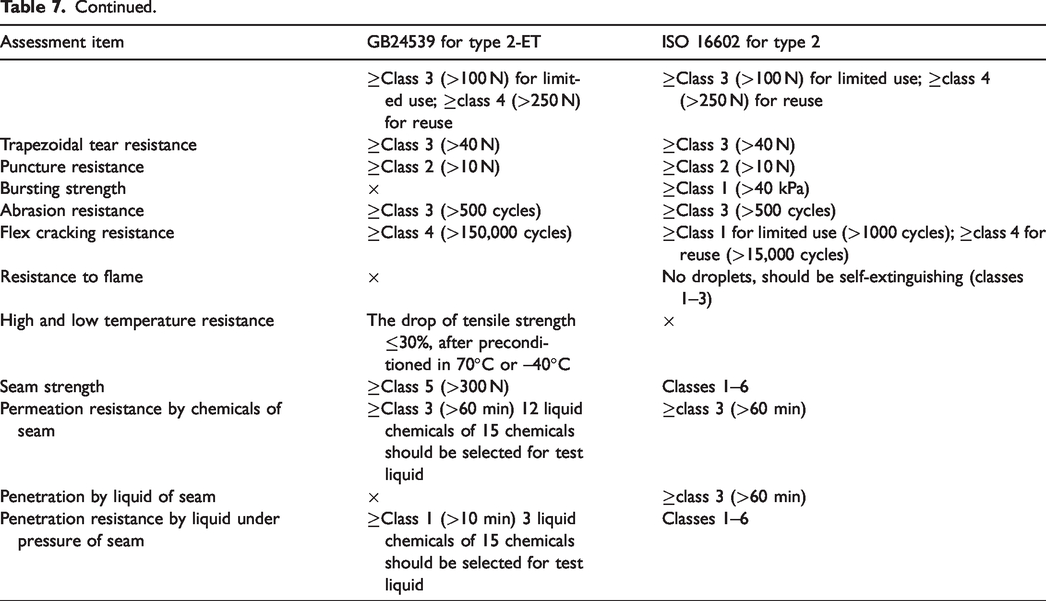
Conditioning for clothing: the condition for clothing of type 2 is same with that of type 1 for corresponding system (ISO and GB).
Inward leakage: the requirement of ISO16602 standard is less than or equal to 0.05% for type 2. GB24539 required no leakage after 20 min jet test for type 2-ET.
Practical performance: ISO 16602 specified the testing details in Procedures A and B. GB24539 does not required this test item.
Air-supply system: ISO 16602 requires this performance shall meet EN14594 for type 2.
Breathing hose and ventilation hose: ISO 16602 states that for type 2 the connections between the suit and the external breathing hose can withstand a tensile strength of 250 N, and the connections between the suit internal breathing hose and withstand a pull test of (50 ± 2.5) N. The reduction of air flow through external/internal breathing hose shall not be reduced by more than 5%;the external/internal breathing hose shall not show a permanent deformation greater than 20% of its original diameter.
Air flow rate: ISO shows for type 2, sound pressure of alarm device shall be in range of 85–90 dBm, frequency shall be between 2000 and 4000 Hz.
Exhaust assembly: ISO 16602 requires the pressure change shall not exceed 100 Pa in 1 min for type 2.
Inhalation air: ISO 16602 requires the inhalation air shall meet EN14594 for type 2.
Conditioning for clothing material: the condition for material of type 2 is same with that of type 1 for corresponding system (ISO and GB).
Permeation resistance by chemical of fabric (gas or liquid): ISO 16602 requires permeation resistance shall be reach minimum performance class 3 (time to cumulative permeation of 150 µg/cm2 ≥ 60 min) for type 2. GB 24539 states time to permeation shall more than 60 min (≥class 3).
Resistance to penetration by liquid under pressure: Only GB 24539 asks the material shall reach class 1 for type 2-ET regarding this assessment (≥3.5 kPa). At least 3 liquid chemicals of 15 chemicals should be selected for test liquid.
Tensile strength: ISO 16602 and GB 24539 state that class 3 (>100 N) for limited use and class 4 (>250 N) for reuse should be satisfied by type 2 and type 2-ET.
Trapezoidal tear resistance: ISO 16602 and GB 24539 show the same requirement (≥class 3 (>100 N) for limited use; ≥class 4 (>250 N) for reuse).
Puncture resistance: Both ISO 16602 and GB24539 require class 2 (>10 N).
Burst strength: ISO 16602 requires material should reach class 1 (>40 kPa).
Abrasion resistance: Both ISO 16602 and GB24539 state class 3 (>500 N).
Flex cracking resistance: ISO 16602 shows the same requirements (≥class 1 for limited use (>1000 cycles); ≥class 4 for reuse (>15,000 cycles)). GB24539 requires class 4 (>15,000 cycles).
Resistance to flame: ISO16602 state the material shall not form droplets and extinguish itself. There is a classification from 1 to 3.
High and low temperature resistance: Only GB 24539 states this assessment for its type 1-ET. After preconditioned in 70°C or –40°0, the drop of tensile strength of material should not exceed 30%.
Seam strength: GB24539 requires seam strength achieve class 5 (>300 N) for type 2-ET. ISO only classified the materials into classes 1–6.
Through the comparison of performance evaluation indexes of liquid-tight chemical protective clothing (type 3) in Table 8, it is concluded that:
The comparison of different standards of Types 3 in terms of assessment item.

Conditioning for clothing: the condition for clothing of type 3 is same with that of type 1 for corresponding system (EN, ISO and GB).
Liquid penetration resistance (jet test): According to BS8428 (types 3a-ET and 3b-ET), BS EN 14605 (type 3), ISO 16602 (types 3a and 3b) and GB2439 (types 3a and 3a-ET), the total stain area shall not greater than three times the total calibrated stain area.
Liquid penetration resistance (spray test): GB24539 requires that penetration shall not greater than three times the total calibrated stain area.
Practical performance: BS8428 requires practical performance is evaluated by work simulation test at normal and low temperature. BS EN 14605 specified type 3 should be evaluated during conditioning. GB24539 does not required this test item.
Conditioning for clothing material: the condition for material of type 3 is same with that of type 1 for corresponding system (EN, ISO and GB).
Permeation resistance by chemical of fabric (gas or liquid): BS8428 requires class 2 (time to cumulative permeation of 150 µg/cm2 ≥ 30 min) .BS EN 14605 requires class 1 (time to cumulative permeation of 150 µg/cm2 ≥ 10 min). ISO 16602 requires permeation resistance shall be reach minimum performance class 3 (time to cumulative permeation of 150 µg/cm2 ≥ 60 min) for type 3. GB 24539 states time to permeation shall more than 60 min (≥class 3).
Resistance to penetration by liquid under pressure: Only GB 24539 asks the material shall reach class 1 for type 2-ET regarding this assessment (≥3.5 kPa). At least 3 liquid chemicals of 15 chemicals should be selected for test liquid.
Tensile strength: BS8428 requires tensile strength of material should achieve class 4 (>250 N) for limited use and class 6 (>1000 N) for reusable suit. ISO 16602 states that class 3 (>100 N) for limited use and class 4 (>250 N) for reuse. BS EN 14605 and GB24539 only require class 1 (>30 N).
Trapezoidal tear resistance: BS8428 requires tear resistance of material should be more than or equal to class 3 (>40 N) for limited use and reusable suit. Other three standards have the same requirement (≥class 1 (>10 N)).
Puncture resistance: BS8428 requires puncture resistance should be better or equal to class 2 (>10 N) for limited use and class 3 (>50 N) for reusable suit. Other three standards have the same requirement (≥class 1 (>5 N)).
Burst strength: Only ISO 16602 claims materials should attain class 1 (>40 kPa).
Abrasion resistance: BS8428 demands the abrasion resistance should be equal or up to class 4 (>400 cycles) for limited use and class 6 (>2000 cycles) for reusable suit. GB 24539 requires the grade should be reach class 3 (>500 cycles), while others requires class 1 (>10 cycles) alone.
Flex cracking resistance: BS8428 claims class 1 (>500 cycles) for limited use and class 4 (>8000 cycles) for reusable suit. Although EN14605, ISO 16602 and GB24539 require at least reach class 1, they ask for different cycles (500 cycles from former, 1000 cycles from l).
Flex cracking resistance at low temperatures (–30°0):BS8428 states under –30°0 material should achieve class 2 (>200 cycles) for limited use and for reusable suit. EN14605 requires at least class 1 at 500 cycles, while ISO16602 requires class 1 at 1000 cycles.
Resistance to flame: BS8428 claims different requirement for limited use (≥class 1) and for reusable suit (≥class 3). As for class 3, sample stops for 5 s in the flame; as for class 2, sample stops for 1s in the flame; as for class 1, sample passes through the flame without stopping. ISO16602 state the material shall not form droplets and extinguish itself. There is a classification from classes 1 to 3.
Seam strength: Among four standards, BS8428 exhibits highest requirement as for seam strength (≥class 5 (>300 N)). GB24539 asks for class 1 (>30 N). Material only can be classified into classes 1–6 with accordance to BS EN 14605 and ISO16602.
Permeation resistance by chemicals (gas or liquid) of seam: ISO 16602 and GB 24539 lists the requirement about permeability resistance of seam, where class 3 (>60 min) should be reached. BS8428 states class 1 (>10 min) is needed to attained.
Resistance to penetration by liquid under pressure of seam: Only GB 24539 claims class 1 (>10 min) is required after testing under at least 5 liquid chemicals of 15 chemicals in standard.
Type 3b of GB 24539 is a liquid spray protective clothing which is corresponding to ISO16602 and BS EN 14605 for type 4. Hence, the comparison is conducted among GB 24539 for type 3b, ISO16602 and BS EN 14605 for type 4 (Table 9).
The comparison of different standards of type 4 in terms of assessment item.
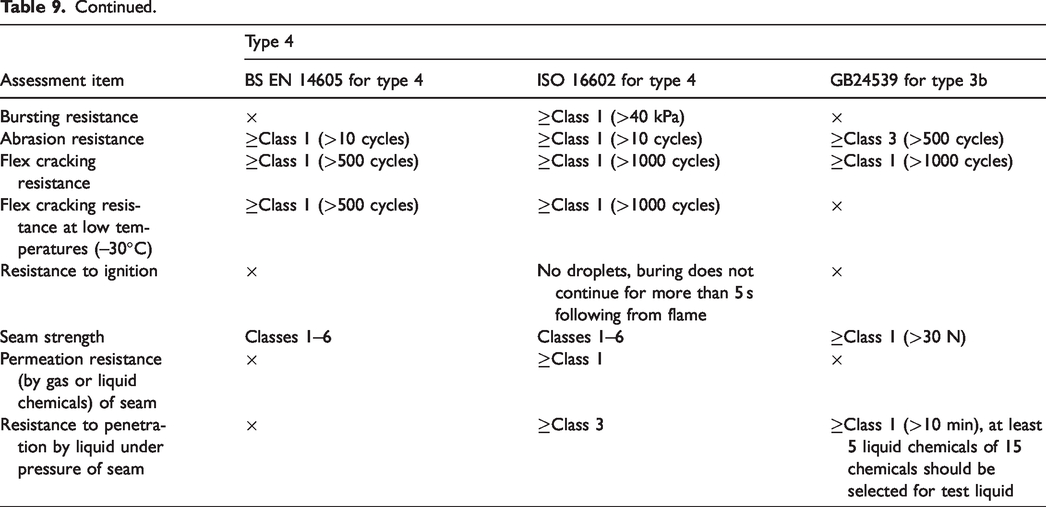
Conditioning for clothing: the condition for clothing of type 4 is same with that of type 1 for corresponding system (EN, ISO and GB).
Liquid penetration resistance (spray test): EN 14605, ISO16602 and GB 24539 require the total stain area shall not greater than three times the total calibrated stain area for testing liquid spray chemical protective clothing.
Practical performance: EN 14605 and ISO lists the evaluation of practical performance should be conducted during conditioning.
Conditioning for material: the condition for material of type 4 is same with that of type 1 for corresponding system (EN, ISO and GB).
Liquid repellency: Only 24539 GB requires liquid repellency test, the clothing should reach class 1 (repellency index >80%, penetration index < 10%).
Permeation resistance of fabric (by gas of liquid chemical): EN 14605 and ISO16602 state the time to cumulative permeation of 150 µg/cm2 should greater than 10 min (≥class 1). GB 24539 states the time to permeation should greater than 10 min (≥class 1). At least one liquid chemical of 15 chemicals should be selected for test liquid.
Resistance to penetration by liquid under pressure: Only ISO16602 requires to test the resistance to penetration by liquid under pressure, the grade shall exceed class 3 (penetration pressure > 14 kPa).
Tensile strength: BS EN 14605, ISO 16602, and GB24539 claim the same requirement where the tensile strength of material should reach class 1 (>30 N).
Trapezoidal tear resistance: BS EN 14605, ISO 16602, and GB24539 claim the same requirement where the trapezoidal tear resistance of material should reach class 1 (>10 N).
Puncture resistance: BS EN 14605, ISO 16602, and GB24539 claim the puncture resistance should reach class 1 (>5 N)
Burst strength: Only ISO 16602 claims burst strength of materials should attain class 1 (>40 kPa).
Abrasion resistance: BS EN 14605 and ISO 16602 require materials should reach class 1 (>10 cycles) in terms of abrasion resistance. GB 24539 claim a higher requirement for materials which should reach class 3 (>500 cycles).
Flex cracking resistance: EN14605 requires class 1 (>500 cycles) for flex cracking resistance, while ISO 16602 and GB24539 requires class 1 (>1000 cycles).
Flex cracking resistance at low temperatures (–30°0): EN14605 requires class 1 (>500cycles) for flex cracking resistance at –30°0, but ISO16602 requires more cycles (≥class 1, >1000 cycles).
Resistance to ignition: ISO 16602 requires no formation of droplets, and burning does not continue for more than 5s following from flame.
Seam strength: BS EN 14605 and ISO 16602 classified the materials into classes 1–6. GB24539 requires it should reach class 1 (>30 N).
Permeation resistance by chemicals (gas or liquid) of seam: ISO16602 requires class 1 regarding this performance.
Resistance to penetration by liquid under pressure of seam: Both ISO 16602 and GB24539 require the resistance to penetration by liquid under pressure of material is same with that of clothing (≥class 1) respectively.
Through the comparison of performance evaluation indexes of chemical protective clothing against airborne solid chemicals (type 5) in Table 10, it is concluded that:
The comparison of different standards of type 5 in terms of assessment item.

Conditioning for clothing: the condition for clothing of type 5 is same with that of type 1 for corresponding system (ISO and GB).
Resistance to penetration by airborne solid particles of clothing: ISO 13982-2 and GB 24539 require the inward leakage of clothing shall be less than or equal to 30%, and total inward leakage per suit shall be less than or equal to 15%.
Practical performance: clothing shall pass a “three movements” test sequence with accordance with ISO 13982-1.
Conditioning for material: the condition for material of type 5 is same with that of type 1 for corresponding system (ISO and GB).
Resistance to penetration by airborne solid particles of fabric: only GB 24539 requires this assessment for particle tight protective clothing which reaches class 1 with penetration ratio between 20 and 30%.
Hydrostatic pressure resistance: class 1 (>1 kPa) of hydrostatic pressure resistance is specified by GB24539.
Tensile strength: GB24539 requires tensile strength grade at least at class 1 (>30 N).
Trapezoidal tear resistance: in ISO 16602, tear resistance is classified by EN 14325 (classes 1–6). GB24539 explicates its required grade (≥class 1 (>10 N)).
Puncture resistance: in ISO 16602, puncture resistance is classified by EN 14325 (classes 1–6). GB24539 claims fabric shall be reach at least class 1 (>5 N).
Abrasion resistance: in ISO 16602, abrasion resistance is classified by EN 14325 (classes 1–6). GB 24539 claims fabric shall be reach at least class 1 (>10 cycles).
Flex cracking resistance: ISO 16602 classified material into classes 1–6 by EN 14325, while GB 24539 asks for greater than 1000 cycles which material occurs specific damage (≥class 1).
Resistance to ignition: ISO 16602 explains there should not form droplets, and burning does not continue for more than 5 s following from flame.
Seam strength: ISO 16602 classified material into classes 1–6 by EN 14325. GB24539 states class 1 (>30 N) should be achieved by material.
Resistance to penetration by liquid under pressure of seam: GB24539 requires at least class 1 (>10 min). At least 5 liquid chemicals of 15 chemicals should be selected for test liquid.
Through the comparison of performance evaluation indexes of chemical protective clothing with “limited protective performance against liquid chemicals” (type 6) in Table 11, it is concluded that:
The comparison of different standards of Types 6 in terms of assessment item.
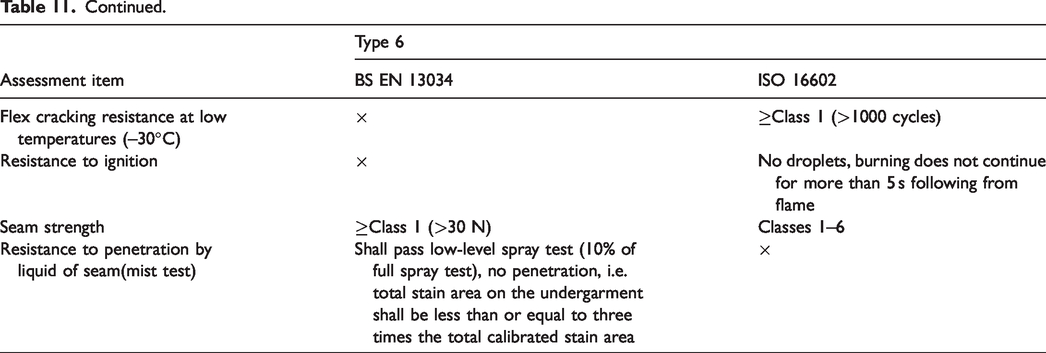
Conditioning for clothing: the condition for clothing of type 6 is same with that of type 1 for corresponding system (EN and ISO).
Limited liquid penetration resistance (modified spray test): according to ISO16602, the clothing shall be exposed for a 1 min. After spray, sample does not show no penetration greater than three times the total calibrated stain area.
Resistance to penetration by liquid in the form of a light spray (mist): BS EN 13034 requires clothing shall pass low-level spray test (10% of full spray test). There is no penetration, i.e. total stain area on the undergarment shall be less than or equal to three times the total calibrated stain area.
Practical performance: EN 13034 requires clothing shall pass “seven movements” test sequence. ISO 16602 evaluated the practical performance during conditioning by subjects.
Conditioning for material: the condition for material of type 6 is same with that of type 1 for corresponding system (EN and ISO).
Liquid penetration resistance: EN 13034 requires the liquid penetration index should be less than 5% (≥class 2). ISO16602 requires a higher grade of this performance which shall more than or equal to class 3 (penetration index <1%).
Liquid repellency: both EN 13034 and ISO claims at least class 3 where repellency index shall be more than 90%.
Tensile strength: both EN 13034 and ISO claims tensile strength of material shall be more than or equal to class 1 (>30 N).
Trapezoidal tear resistance: both EN 13034 and ISO claims tear resistance shall be more than or equal to class 1 (>10 N)
Puncture resistance: both EN 13034 and ISO claims puncture resistance of material shall be more than or equal to class 1 (>5 N)
Burst strength: ISO16602 states the burst strength of material shall be more than or equal to class 1 (>40 kPa).
Abrasion resistance: Both EN 13034 and ISO 16602 requires the abrasion resistance of material shall be more than or equal to class 1 (>10 cycles)
Flex cracking resistance: ISO 16602 states the flex cracking resistance of material shall be more than or equal to class 1 (>1000 cycles).
Flex cracking resistance at low temperatures (–30°C): ISO 16602 states the flex cracking resistance –30°C at of material shall be more than or equal to class 1 (>1000 cycles).
Resistance to ignition: ISO 16602 explains material should not form droplets, and burning does not continue for more than 5s following from flame.
Seam strength: EN 13034 requires seam strength should be more than and equal to class 1 (>30 N). ISO 16602 does not require the specific grade but only classifies the performance into classes 1–6.
Resistance to penetration by liquid of seam: EN 13034 states light spray test (mist test) is conducted to evaluate, and material shall pass low-level spray test (10% of full spray test), no penetration, i.e. total stain area on the undergarment shall be less than or equal to three times the total calibrated stain area.
Comparison of test methods used by the selected standards
From frequencies of assessment items shown in Table 3, it can be learned that requirements of standards on chemical protective clothing for performance assessment items mainly cover three aspects: 1) basic requirements for physical performances, 2) requirements for protective performances against chemicals, and 3) requirements for comfort level. This paper focused mainly on physical performance items for protection against chemicals and analyzed differences and frequencies of test methods.
Test methods for seam strength
The EN standards require that all specimens of chemical protective clothing materials undergo 5 cycles of cleaning and be conditioned by storage at (20 ± 2) °C and (65 ± 5)% relative humidity for at least 24 h before testing. The tests must start within 5 min of removing specimen from the conditioning atmosphere. A sample of each type of straight seam construction shall be tested in accordance with EN ISO 13935-2. Three straight specimens of each type of seam shall be tested and the mean of each set of three specimens was calculated.
In accordance with GB/T 13773 [77], GB 24539 measures the maximum seam strength by imposing vertical force on seams of straight specimens. The specimen is fixed in the upper clamp to make the lengthwise center line of the specimen overlap with the center line of the clamp and the seam vertical to the center line, and the seam is positioned in the center place between two clamps. The specimen droops under its gravity, straight in the lower clamp, and then fastened by the lower clamp. Then start the test apparatus until the specimen is damaged. Record the maximum force with Newton and reasons for damage: a) fabric rupture; b) fabric rupture around clamps; c) fabric rupture around the seam; d) breakage of sewing thread; e) slide of thread; or f) any combination of above-mentioned reasons. If a) or b) causes the damage on specimen, exclude the results and start new test on a new specimen, until five different results are obtained.
Test methods for leak tightness
For chemical protective clothing types 1a, 2, 3, and 4 (see Table 2), EN943-1 specifies that the subject wearing the suit during the test walks on a treadmill over which there is an enclosure. Through this enclosure flows a constant concentration of the test agent (sodium chloride (NaCl) or sulphur hexafluoride (SF6). On one hand, the test atmosphere should preferably be analyzed for NaCl by means of a suitable flame photometer. The probe for sampling the test atmosphere must be positioned near the hood. The NaCl concentration inside the suit is analyzed and recorded by a flame photometer. This concentration, measured within the head section of the suit, is a measure of the total Inward leakage. On the other hand, the test atmosphere should preferably be analyzed for SF6 continuously by means of a suitable analyzer or spot checks as necessary to determine the concentration during tests. The SF6 concentration inside the suit is analyzed and recorded. This concentration, measured within the head section of the suit, is a measure of the Inward leakage.
For type 1b – gas tight chemical protective clothing with air supply outside the clothing, the test procedure of EN 943-1 is according to EN 464. ISO 16602 follows ISO 17491 testing method A2. The protective clothing is pressurized/deflated from 1750pa ± 50 Pa for 10 min and adjusted to 1650pa ± 25 Pa for 6 min. For type 1c - hermetic chemical protective clothing with external air supply and positive pressure for clothing, the inward leakage rate is less than or equal to 0.05% when tested according to ISO 17491 method B1 (sulfur chloride) or B2 (Sulfur Hexafluoride as test gas). When tested according to ISO 17491 method B1 (sulfur chloride) or B2 (Sulfur Hexafluoride as test gas), the inward leakage rate is less than or equal to 0.05%.
The ISO 16602, following test method A2 used by ISO 17491, checks leak tightness by inflating the suit to the pressure (1700 ± 50) Pa and rubbing the whole chemical protective suit (including such parts as seams, gloves, cuffs, and joints) with thin soap water or aqueous solution, and then observing any soap bubbles in the rubbed section of chemical protective suit. The emergence of bubbles indicates possible leak tightness. If it is allowed, all the evident loopholes should be mended in light of the specific instructions given by the manufacturer.
The test method in GB 24539 is as follows: the chemical protective suit is inflated to pressure A, not less than 1.29 kPa, and the pressure is maintained for at least 1 minute; the suit is deflated to the test pressure B and time counting starts; after 4 minutes, the final pressure is record C. The difference between the test pressure B and final pressure C is calculated. The test pressure shall not be less than 1.02 kPa. If the pressure drop in 4 minutes is above 20% of B, the protective suit is unqualified in leak tightness.
Permeation resistance (by liquids/gaseous chemicals)
In ASTM F 1383, the permeation of chemicals through a protective clothing material is assessed by measuring the breakthrough detection time, standardized breakthrough time, and subsequent permeation rate through replicate specimens of the material intermittently contacted with the chemical. In the permeation test apparatus, the protective clothing material specimen partitions the challenge chemical from the collection medium. Contact of the challenge chemical with the clothing material's outside surface is made intermittently by periodically adding and removing the test chemical from the challenge chamber of the test cell. The collection medium is analyzed quantitatively for its concentration of the challenge chemical and thereby the amount of that chemical has permeated the barrier as a function of time after its initial contact with the material. By either graphical representation or appropriate calculations or both, the breakthrough detection time, the standardized breakthrough time, and the cumulative permeation of the challenge chemical are determined.
In accordance with Method A (liquid chemicals with continuous contact of ISO 6529 [37], 2346 the test method of ISO 16602 is as follows: the liquid chemical is expeditiously loaded into the challenge chamber of the permeation test cell (the chamber to which the normal outside surface of the material specimen is facing). The chamber is filled to the mark on the stem. Time record starts when the addition of the liquid commences. The concentration of chemical found in each sample is recorded as well as the associated time that has elapsed between the time that the liquid was charged to the cell and the withdrawal of the sample.
Method B is designed for testing gaseous chemicals with continuous contact. The flow of the test gas into the challenge chamber of the permeation test cell (the chamber to which the normal outside surface of the material specimen is facing) shall be commenced. Timing of the test shall begin once the equivalent of five chamber volumes of gas have passed through the chamber as determined by means of a rotameter or other flow monitoring device placed in the inlet stream to the chamber.
Method C guided test under liquid or gaseous chemical with intermittent contact. This is applied to test samples intermittently by variation of contact time (1,5 or 10 min), purge time (10,20 or 60 min) and number of cycles (11,8 or 2 times) correspondingly. At the start of the test, sample is exposed to the challenge chemical in accordance with either method A or method B. Then, chemical is left in contact with the sample for the specified contact time, after which chemical is removed and challenge side of test cell is flushed with air or an inert gas. Flushing is continued for the specified purge time. This sequence is then repeated for the number of cycles specified.
The test method used by GB 23462 [61] specifies that the specimen of chemical protective clothing material in the test cell or test chamber is subjected to continual or intermittent contact with chemicals. The collection medium in the collection chamber shall collect chemicals penetrated through the specimen. Through quantitative analysis, concentration or mass of chemical penetrated through the chemical protective clothing material is measured, then the penetration time, standard penetration time and penetration rate of the chemical penetrating through the chemical protective material are calculated, and the penetration performance of the chemical protective material is evaluated.
Test methods for resistance to ignition and flame
EN 14325 is a standard of protective clothing against chemical – test methods and performance Classification of chemical protective clothing materials, seams, joins and assemblages. The test for resistance to ignition is intended to evaluate only that a material is not of a highly flammable nature. It followed EN 13274-4 (respiratory protective device), method 3, with the outer side of the material exposed to the flame. Samples shall not form droplets and shall prove to be “self-extinguishing”, i.e. it shall not be of a highly flammable nature and not continue to burn for more than 5 s after removal from flame. A material which passes this ignition evaluation may not offer sufficient protection against heat and flame. If resistance to heat and flame is required, the chemical protective clothing should be tested and marked according to the appropriate European standards.
The test for resistance to flame is a more demanding test than resistance to ignition. Hence, the test method 3 in EN13274-4 for flame tests to be applied. It requires the protective clothing material shall not form water drops and shall prove to be “self-extinguishing”, i.e. it shall not be of a highly flammable nature and not continue to burn for more than 5 second after removal from flame. The resultant maximum flaming time value shall not be greater than 5 second after removal from the flame. The resistance to flame of the chemical protective clothing material shall be Classified according to the levels of performance. Class 3 required sample stops for 5 seconds in flame; class 2 required sample stops for 1 second in the flame; class 1 required sample passes through the flame without stopping. Using the longest flame exposure, at which the above flame exposure requirements are fulfilled and which does not cause damage to the leak-tightness of the material. To determine the level of performance, the leak tightness of samples should be determined before and after flame exposure.
Test methods for resistance to penetration by liquids (spray test)
ISO 17491-4 describes a test method for determining the spray penetration resistance of chemical protective clothing for type 4 (with spray-tight connections between different parts of the clothing) and type 6 (limited performance protective clothing). The surface tension of testing water is (52 ± 7.5)×10−3N/m for method A and (30 ± 5) ×10−3N/m for method B. Nozzles supply liquid at a rate of 0.47 ± 0.05 l/min at a 300 kPa pressure for method A (low-level speed test) and 1.14 ± 0.10 l/min at a 300 kPa pressure for method B (high-level speed test). The subject wearing one layer of undergarments, shall be dressed with the absorbent overall, and subsequently with the rest garment.
The spray is applied for 1 min to test subject, whilst the turntable is rotated through 360°. During the spray period, the test subject shall alternately raise each foot approximately 20 cm from the turntable (30 ± 5) times and put it back in its original position. Meanwhile, the arms are kept straight and swung from the back to the front, above the head and back downwards, in unison with the leg movements. Turn the turntable off and allow the clothing to drain for 2 min while the subject is still standing on the turntable.
ISO 17491-5 specifies to directly spray water with water soluble fluorescent or visible dye under a control condition to the chemical protective suit dressed by a mannequin. It differs from the method in ISO 17491-4 where it uses a test subject. Liquid penetration resistance is determined by the absence of liquid inside the chemical protective suit on the inner liquid absorptive garment. The chemical protective suit is rated as passing if liquid does not penetrate and as failing if liquid does penetrate.
ASTM F 1359 [54] specifies that a test specimen (protective clothing or protective ensemble) is placed on a mannequin that is already dressed in a liquid-absorptive garment covering portions of the mannequin form that are of interest. Water, treated to achieve a surface tension of 0.032 ± 0.002 N/m (32 ± 2 dyens/cm), is sprayed at the test specimen from nozzles positioned in a specific configuration with respect to the specimen. The specimen is exposed to the liquid spray for a period of 20 min in Procedure A (five shower nozzles) and 10 min in Procedure B (three shower nozzles). Liquid penetration resistance is determined by the absence of liquid inside the specimen or on the inner liquid-absorptive garment or by the absence of observable liquid detected on the interior of the specimen, or both. The sample is rated as passing if liquid dose not penetrate and as failing if liquid does penetrate.
EN 468 states an aqueous spray containing a fluorescent or visible dye tracer, is directed under controlled conditions at the chemical protective clothing worn by a human test subject. Inspection of the inside surface of the clothing and the outside surface of absorbent clothing worn underneath allows any points of inward leakage to be identified. Position the test subject wearing the chemical protective clothing on the geometrical center of the turntable and mark the position of the feet. Apply the spray for 1 min to the test subject, whilst the turntable is rotated through 360°. During the spray period the test subject shall alternately raise each foot approximately 20 cm from the turntable (30 ± 5) times with the arms straight but swinging backwards and forwards in unison with the leg movements. The feet shall be replaced on the original mark. Allow the clothing to drain 2 min. Remove the clothing and examine the internal and external surfaces for any signs of penetration. Either mark the location and extent of any sign of penetration of the test chemical on the protective clothing and the coverall or photograph the absorbent coverall.
In GB 24539 Appendix 2 [78], water treated to achieve a surface tension of 0.032 ± 0.002 N/m, spray water to manikin with the inner liquid-absorptive garment and test sample, the total duration is 60 min, and 15 min for each direction (manikin is rotated at 0°, 45°, 90°, 135°). The spray speed is 3.0 ± 0.2 L/min. Within 10 min after spray stop, check if the inner liquid-absorptive garment is wetted/colored/lighted which is dependent on the content of spray water.
In GB 24539 Appendix 3, the method 2 for liquid spray tight protective clothing (3 b) is guided [79]. Test subject wear the inner liquid-absorptive garment and test sample. When the speed of rotation is at 1 r/min, spray water for 30 min. During the spray period, the test subject shall alternately raise each foot for 1 min approximately 20 cm every 5 min. from the turntable (30 ± 5) times with the arms straight but swinging backwards and forwards in unison with the leg movements. The feet shall be replaced on the original mark. Allow the clothing to drain 2 min.
Test methods for resistance to penetration by liquids (jet test)
ISO 17491-3 describes a test method for determining the spray penetration resistance of chemical protective clothing for type 3 (with liquid-tight connections between different parts of the clothing).
Water surface tension is (30 ± 5) ×10−3N/m. the subject wearing one layer of water-repellent undergarments, shall be dressed with the absorbent coverall, and sub subsequently with the rest garment. The jet nozzle shall be positioned at (1.0 ± 0.1) m from the test spot. The pressure of the liquid shall be (150 ± 15) kPa. The liquid jet shall be directed at each test spot for (5 ± 0.5) s, starting at the lowest test spot. After exposure the test subject shall stay in the test room for 2 min to allow the clothing to drain.
EN 463 tests the resistance to penetration by a jet of liquid (jet test). An aqueous jet, containing s fluorescent or visible dye tracer, is directed under controlled conditions at chemical protective clothing worn by a test mannequin of human test subject. The test subject shall be fitted with the correct size of absorbent coverall, and shall be limited to wearing one layer of undergarments underneath the absorbent coverall, and then be dressed in correct size of test garment. Following the similar procedure of ISO 17491-3.
GB 24539 Appendix 3 (method 1 for liquid jet tight protective clothing (3a) and method 2 for liquid spray tight protective clothing (3b))requires that a nozzle is used to spray test agent under the pressure 150 kPa for a period of 5 sec to a specific test spot, and then shall be moved to the next test spot for 5 s of spray test until all test spots have undergone the test. After 2 min, leftover test agent on the surface of the chemical protective suit specimen is removed and penetration occurs inside the chemical protective suit or the inner indicative suit is checked. The subject wearing dressed with the absorbent coverall, and sub subsequently with the rest garment.
Test methods for liquid repellency
Following the specification in ISO 6530 [38], the test method of ISO 16602 is as follows: liquid is sprayed on the chemical protective clothing material specimen for 10 s, the index of penetration is calculated and recorded, based on which liquid repellency of the chemical protective clothing material is judged.
GB 24539 specifies that a certain amount of test agent shall be continually sprayed on the surface of the chemical protective clothing material specimen fastened in a slanting groove under a specified rate. By calculating the penetration index, absorption index, and liquid repellency index, the liquid repellency of the chemical protective clothing material is evaluated.
Sample preparation and condition
EN 14325 requires all chemical protective clothing materials samples shall undergo 5 cycles of cleaning according to the manufacturer's instructions before testing, and all specimens shall be conditioned by storage at (20 ± 2) °C and (65 ± 5)% relative humidity for at least 24 h. If applicable, the tests shall be started within 5 min of removing the specimen from the conditioning atmosphere.
Conclusions
Through the comparative analysis of standards on chemical protective clothing, it can be noticed that the EN standards have more detailed specifications, propose requirements for different Classes of protective clothing used in different environments, and also give corresponding performance requirements for every Class of protective clothing in limited or repeated use. For many performances, requirements of the ISO standards are lower than those required by the EN standards. ISO standard system is similar to EN standard system, but ISO standard concentrates all classification information in one standard, which is easy to find and apply. China national standard emphasizes emergency rescue for types 1, 2 and 3. The classification of GB standard system is more reasonable, covering both high-grade and low-grade chemical protective clothing, and the classification is simpler and more convenient. But, the improvement of GB standard in terms of practical performance and breathing apparatus performance needs to be added in future.
Footnotes
Declaration of conflicting interests
The author(s) declared no potential conflicts of interest with respect to the research, authorship, and/or publication of this article.
Funding
The author(s) disclosed receipt of the following financial support for the research, authorship, and/or publication of this article: This work is supported by the Fundamental Research Funds for the Central Universities (2232020 D-45, 223200 E-06), funds by Arts & humanities Research Council of UK (AH/T011483/1), funds by Shanghai style fashion design and value creation knowledge service center (ZX201311000031).
