




Abstract
Highly stretchable composite yarns containing metal wire have attracted great interest as a fundamental building block for special protective fields. A method for producing tri-component elastic-conductive composite yarns (t-ECCYs) has been described previously. The main purpose of this work was to investigate the mechanical behavior and structural stability of a highly stretchable woven fabric containing t-ECCYs inserted in its weft direction. By virtue of the unique structure of t-ECCYs, the woven fabric has a denser and tighter surface than the reference fabric (100% cotton), which facilitates its weft elastic stretchability in excess of 40%. Furthermore, a typical initial low-stress tensile curve characteristic and an acceptable cyclic elastic recovery stability at a higher strain of 25% were observed, indicating excellent mechanical robustness of as-prepared woven fabric. Also, a modified standard solid model by introducing an exponent to the exponential function can fairly well replicate the tensile characteristics during stretch. Importantly, the structural stability of the fabric remained nearly unchanged following cyclic expansion (≈43%) and washing-drying (10 times) cycles. It is promising that this kind of mechanically robust and highly stretchable woven fabric containing metal wire is prerequisite for the next wave of superelastic electromagnetic shielding materials.
Keywords
Introduction
There is currently rapid advancement in the development of electrical and electronic devices and accessories that emit electromagnetic (EM) energy in different frequency bands, with an associated increase in human exposure to EM radiation [1]. Environmental protection and health care multifunctional textiles application become the mainstream consciousness [2]. The manufacturing of textiles that incorporate conductive and/or electro-shielding properties typically involves the use of conductive yarns and/or surface treatments on textiles. In the former method, metal staple fibers and/or filaments are extensively incorporated during spinning [3,4]. Blend yarns with metal filaments, e.g., stainless steel [4–9], copper [10], silver-coated wire [11], and fabrics containing these yarns have received increased attention due to their versatility, conformability and comfort. The deposit of conductive elements onto the fabric substrate, such as metal nanoparticle [12–14], CNT [15], graphene [16], MXene [17,18], or conducting polymer [19] is another method. However, poor adhesion of the deposited layer(s) to the fabric surface and expense currently limit practical use of this latter approach. The greater versatility, durability and quality are the major appeals of incorporating metallic filaments into yarn and fabric. Moreover, the excellent electromagnetic shielding effectiveness (EMSE) along with the stretchability and dimensional stability of tri-component elastic-conductive composite yarns (t-ECCYs) incorporated into fabric are also of great importance in terms of their practical use.
Elastic fabrics ideally have an instant response to deformation, e.g., extension, so they can return back to their original shape and form during physical movement [20]. To date, only a few investigations have been completed on the elastic properties of EM shielding fabrics. Lin et al. [2] fabricated EM and far-infrared shielding elastic warp-knitted fabrics using PET and rubber threads in the warp and charcoal/stainless steel wrap yarns in the weft. The fabrics displayed reasonable EM shielding capacity at a lower frequency range up to 3 GHz and excellent elastic response rates after five cyclic tests with 50% strain. Qu et al. [21] prepared EM interference (EMI) shielding knits with excellent elasticity using cotton/stainless steel/spandex double filament core yarns. Its EMSE was assessed from 0.2–1.4 GHz. In addition, fabrics are usually subjected to stretching, bending, washing and abrasion during wear, superior structural stability turns out to be a prerequisite for EMI shielding reliability of fabrics under these external conditions [14,22,23]. As a result, it is important to evaluate the structural stability of the such fabrics.
However, as mentioned above, previous investigations have focused on knitted fabric structures with elastic and effective EMSE capacity. A review of the literature revealing that little investigation on the preparation of stretchable woven fabric structures with robust EMSE has been performed. Also, the mechanical behavior and structural stability of woven fabrics constructed from elastic-conductive yarn have not been systematically clarified. These gaps were examined in this paper.
Recently, a straightforward approach for fabricating tri-component elastic-conductive composite yarns (t-ECCYs) was proposed by our group [24–26]. Based on this study, elastic and durable EM shielding woven fabric using t-ECCYs was prepared for analysis. The mechanical behavior and structural stability of the resultant fabric were investigated in details. This work provides useful information for development of the next generation of stretchable EM shielding fabrics.
Experimental details
Preparation of two fabric samples
Tri-component elastic-conductive composite yarns were prepared as per Wang et al. [24–26] These incorporated an elastane filament (EF) of 140 denier as the core and a stainless steel filament (SSF) of 30 μm diameter wrapped with rayon fibers (RFs) in a helically wound sheath around the elastane core (see Figure 1(a)). Two 2/2 twill weave fabrics, one with the t-ECCY used in the weft to create a weft-stretchable conductive fabric (W-SCF) and a reference fabric (RF) were produced as per Wang et al. [27] (see Figure 1(b)). The letter-pattern “AHPU” marked on both fabrics illustrates the capacity for the W-SCF sample to be extended substantially in the weft direction (see Figure 1(c)).

(a) Schematic of t-ECCY fabrication using a modified ring spinning frame; (b) A rapier loom used for weaving RF and W-SCF; (c) Comparison of elastic stretchability of the above fabrics.
Mechanical characterization
Fabrics in their practical use are often required to support loads applied either in a static (simple tensile) or in a dynamic (fatigue) mode. It should be noted that the t-ECCY was only inserted in the weft direction of as-prepared W-SCF sample aimed at facilitating the subsequent analysis whether the EMSE depended on the orientation of SSF element within the fabric structure or not. Assessment of mechanical properties of each fabric was carried out only in the weft direction.
Uniaxial tensile test
Tensile tests on the fabrics were performed using an Instron 5567 testing machine at a speed of 100 mm/min as per the China Standard GB/T 3923.1-2013. Strip samples (50 mm width × 100 mm length) of the W-SCF and RF were tested with a 1N preload and elongated until complete failure. Note that the weft runs along the length of the sample, and the warp along the width. Five replicates were tested for each sample. To make the strip sample, the respective fabric was first cut into an oversized rectangular strip, and then a number of yarns along fabric length were removed from both ends of the weft direction, thereby producing samples without yarn crossovers along the edges. This step is necessary to ensure that the edge defects are minimized and that the loaded yarns will not slip out of the cross yarns during the test.
Cyclic elastic test at a constant elongation
On the basis of the high weft elastic stretchability of the W-SCF (>40%) and the elastic resilience required in active wear fabrics in response to the human movement [20,28], the elastic ‘fatigue’ properties of the W-SCF in cyclic extension were tested based on the China Standard FZ/T 01034-2008 [29]. Samples (50 mm width × 100 mm length) of the W-SCF in the tension-free state was extended using an Instron 5567 testing machine to 25% extension at 100 mm/min and held at this elongation for 1 min. Tension was then released at the same speed to its original position for 3 min relaxation. Repetitions of 1, 10 and 20 cycles were tested using the same process, with the pretensioned fabric length remeasured after each set of cycles. At least five replicates were tested for each condition. Length measurements were used to calculate two indices, i.e., the elastic recovery ratio (ERR) and plastic deformation ratio (PDR):

Assessment of structural stability
Dimensional stability of W-SCF following cyclic expansion
The schematic diagram of preparation and testing procedures used to characterize the dimensional stability of W-SCF following cyclic expansion test are graphically shown in Figure 2. A cylinder-shaped W-SCF sample with a diameter of d was prepared through sewing the respective two free edges together. Then the sample was worn on the surface of a circular solid object with a larger diameter of D (i.e., D > d) and held at this state for 1 min. After that, the sample was taken off for 1 min relaxation. Repetitions of 10 cycles were performed using the same process. Finally, the measurement of dimensional changes was observed and evaluated under different conditions. The inelastic RF with the same diameter of d was also prepared for comparison.

Schematic of fabrication and testing method of W-SCF used to evaluate its dimensional stability following cyclic expansion test.
Dimensional stability of W-SCF following repeated laundering cycles
The effect of laundering (wash + drying) cycles on dimensional stability of W-SCF was investigated. The RF was also tested for comparison. The laundering test procedure is graphically shown in Figure 3. Samples (40 mm × 40 mm) of each fabric were washed in distilled water of 40 °C at a stirring speed of 40 rpm for 30 min. After that, they were horizontally placed and naturally dried. The adoption of horizontal placement avoids the potential elongation deformation caused by the fabric’s own weight. The laundering procedure was repeated 1, 2, 5 and 10 times to simulate the effects of repeated washing. The dimensional stability of fabric after washing was tested in warp and weft directions. At least three repetitions were tested in both directions for each case. Finally, the value of dimensional stability ratio (DSR) can be calculated:

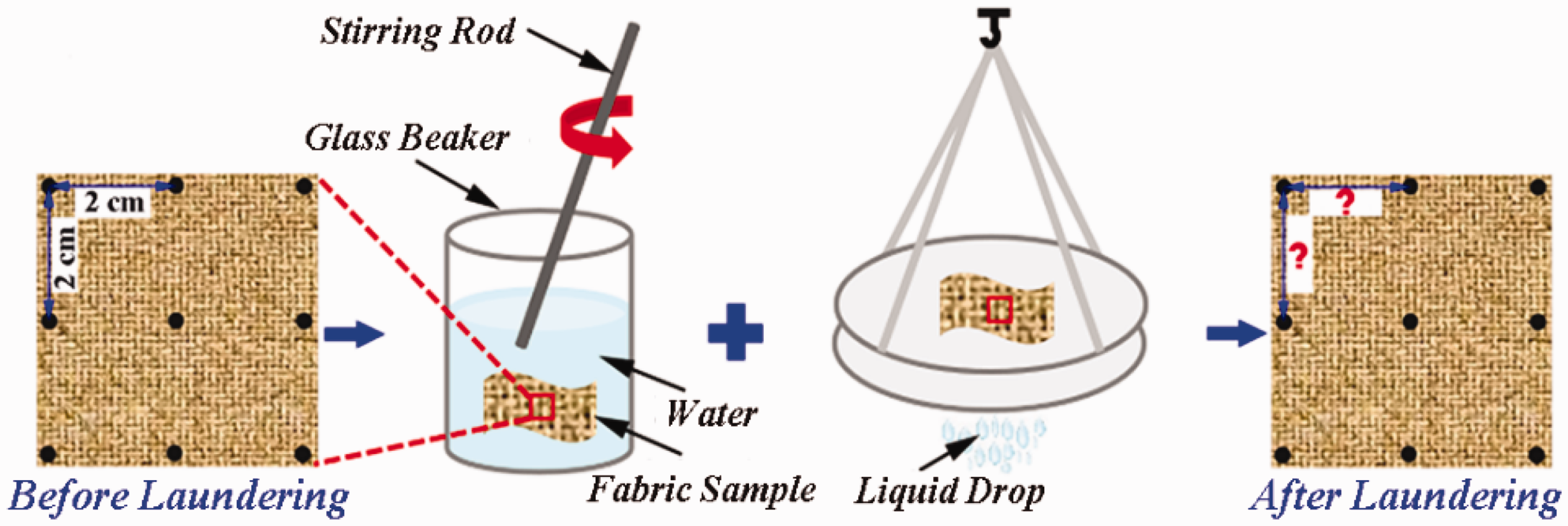
Schematic of laundering procedure for the two fabrics.
Results and discussion
Tensile behavior of W-SCF and RF
Experimental investigation of two samples
The tensile behavior of W-SCF and RF was investigated in Figure 4. The representative stress-strain curves of the two samples were presented in Figure 4(b). As can be seen, there were three distinct regions in tensile behavior of the weft direction for both fabric samples; an initial low stress, a linear pre-peak and then a linear post-peak regions. In initial low-stress region, the warp and weft yarns are orthogonal to each other and the stress increase is relatively low due to the straightening of undulated t-ECCYs in the loading direction with limited yarn stretching. As the tensile strain increases, the yarns are extended and each of the two fabrics exhibit a linear response with no visible failure. As the loading level reaches the peak strength, yarns in the loading direction start to fail, resulting in a dramatic decrease in the load-carrying capacity until final failure.
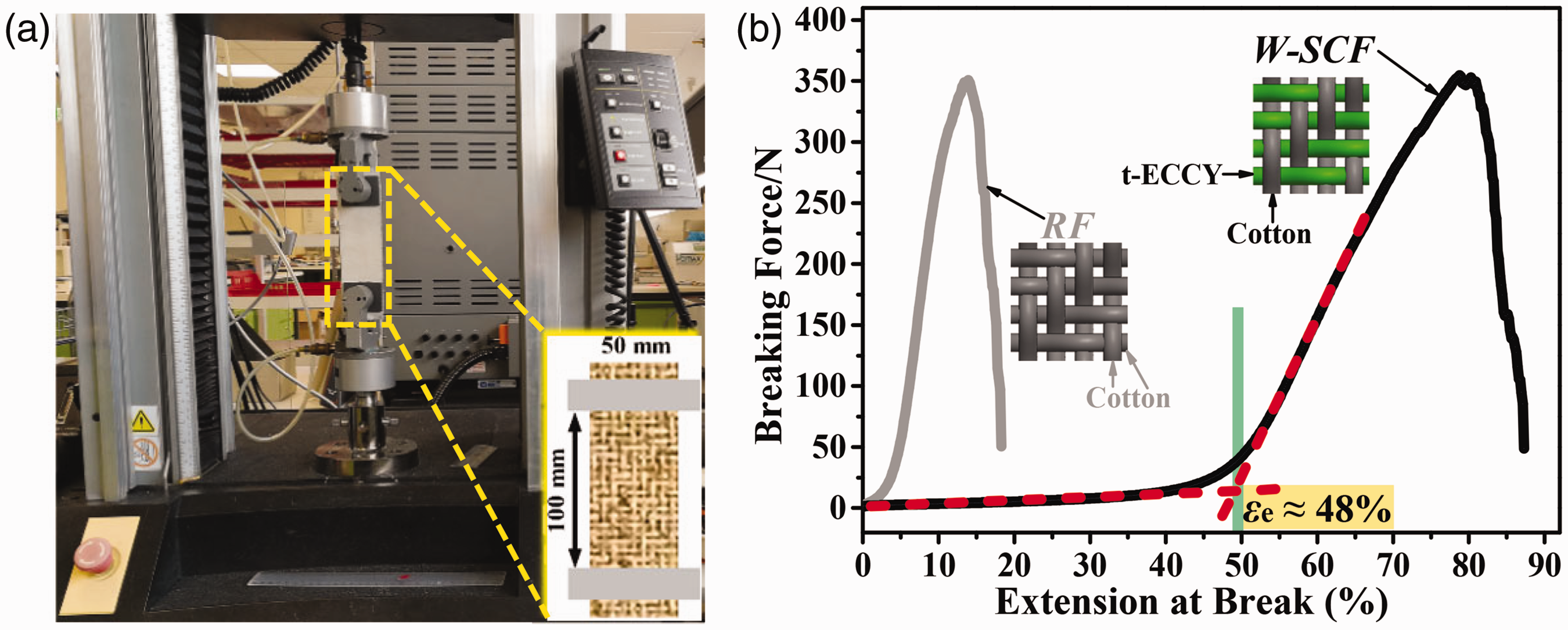
(a) Fabric placement on an Instron 5567 tensile testing machine; (b) Typical stress-strain curves of the two woven fabrics (i.e., W-SCF and RF) under uniaxial tension in the weft direction.
Comparing the stress-strain behavior between W-SCF and RF, the major difference is the initial low-stress region and the ultimate strain (strain at peak force). With respect to RF, the warp and weft yarns have only limited observable stretch, and the maximum strain in initial region was only approximately 0.75%. This initial value is negligible when compared with the ultimate strain at failure (≈13.5%). However, for the W-SCF, a higher initial elastic extension (εe) of about 48% was (expectedly) observed, followed by a much higher ultimate strain before failure (≈80%), attributable to the high elasticity of the elastane filament component in the t-ECCY.
Theoretical modeling of W-SCF
To obtain a deeper insight into the underlying strain mechanism of the t-ECCY fabric, four models; two three-element constitutive models, a power function and a modified Kawabata analytical model were employed to further elucidate the tensile characteristics. These were manipulated using Genetic Algorithm within 1stOpt numerical simulation software for iteration of the nonlinear regressions.
Three-element constitutive models: Two kinds of three-element constitutive models were proposed in Figure 5(a) and (b). Each consists of a Maxwell model and a linear/nonlinear spring in parallel. A pretension of 1N was assumed. Finally, the force-strain equations can be mathematically derived as per the work by Wang et al. [30]


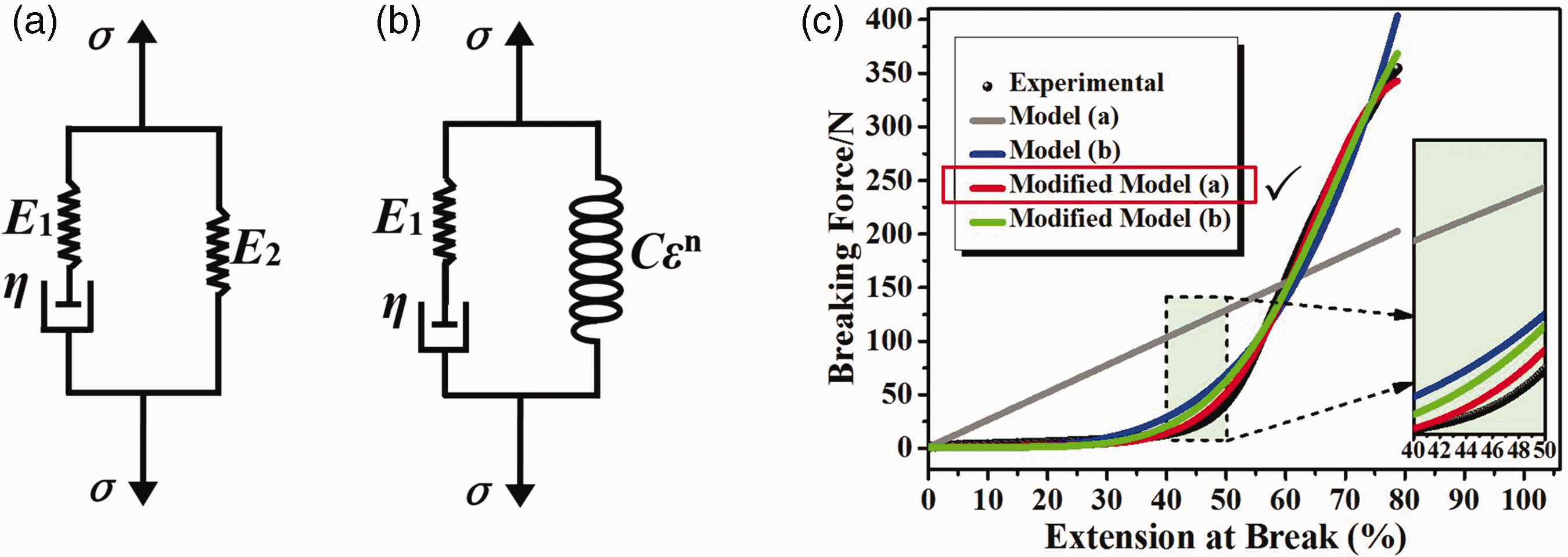
(a)–(b) Constitutive models proposed to describe the tensile behavior; (c) Comparison of four constitutive models with experimental data to predict the tensile behavior of W-SCF.
To obtain a best fit of the experimental curve, an exponent (p > 0) was introduced to the exponential function [30,31]. Therefore, the behavior can be expressed as follows:


As seen in Figure 5(c), the Modified Model (a) provided a fairly reasonable representation of the tensile deformation during stretch, and the shape progression hand in hand with the experimental curve.
Power function: Power function has been applied for prediction because of its simplicity and ease of applicability. The empirical equation considering preload can be expressed as follows:

Modified Kawabata analytical model: An analytical model of describing tensile force dependence on the strain applied to a fabric. It integrates Kawabata parameters such as maximum force Fmax, tensile linearity LT and tensile energy per unit of area WT. The relationship between force F(ε) and strain (ε) including the applied preload tension is given as [32]

Evident from Figure 6(a) is that the Modified Model (a) is capable of representing the tensile evolution of W-SCF during stretch. The linear fits between experimental data and predicted values for each model were listed in Figure 6(b). The higher the slope of the line to a value of 1, the better the goodness of fit. It is apparent that the line slope based on Modified Model (a) reaches 0.999 with a R2 value above 0.99, which further indicates a good predictability of the Modified Model (a), that is, the standard linear model by introducing an exponent to the exponential function.

(a) Comparison of constitutive, empirical and analytical models proposed to describe the tensile behavior; (b) The corresponding linear fitting.
Elastic response of W-SCF after cyclic stretch
A schematic diagram of cyclic testing procedure was illustrated in Figure 7(a). The elastic behavior of W-SCF after cyclic tests (1, 10 and 20 cycles) was characterized at a fixed extension of 25%. As seen in Figure 7(b), an increase of the number of extension cycles resulted in increased extension of the W-SCF. Extension at rest increased from the initial 100 to 101.6, 104.6 and 105.5 mm respectively when the number of cycles was increased from 1 up to 10 and 20 times respectively. Furthermore, as can be seen from Figure 7(c), the elastic characteristic values were dependent on the number of cycles. The ERR value decreased from 93.6% for 1 cycle to 81.6% and 78.0% when the test number of cycles increased 10 and 20 times respectively. With an increase in cycle number, the value of ERR decreased rapidly initially and then slowly with perhaps a small amount of residual extension remaining (creep). The PDR value was accumulated accordingly. The above analysis results indicates that the as-prepared W-SCF tends to be mechanically stable with shape recovery retention under higher numbers of cycles.

(a) Schematic of cyclic tensile deformation of fabric at a fixed extension; (b)–(c) Fabric length after tests when loaded 1N pretension after different cycles and the corresponding ERR and PDR values; (d) Typical cyclic tensile curves of W-SCF (10 times); (e)–(g) The representative force-strain curves of fabric at the 1st, 5th and 10th cycle, respectively.
Further, Figure 7(d) shows the typical force-time curves of W-SCF with 25% extension throughout ten stretch-release cycles. As seen, the shapes of the tensile curves following varying cycles were almost the same, although an elastic hysteresis loop was exhibited. The maximum force achieved in successive cycles drifted downward marginally, and the percentage had decreased by 8.3% and 11.9% when the test number of cycles increased 5 and 10 times respectively compared to 1 cycle test. Specifically, Figure 7(e) to (g) show the corresponding 1st, 5th and 10th tensile curves. The elastic hysteresis loop got smaller and the residual strain increases marginally following cyclic tests, indicating excellent mechanical robustness of W-SCF.
Evaluating dimensional stability of two woven fabrics
Dimensional stability of W-SCF following cyclic expansion
As presented in Figure 8(a) and (b), high weft stretchability and structural restoration ability of t-ECCY enables the cylinder-shaped W-SCF sample of 21 mm diameter to be tightly worn on a solid gum with diameter of 30 mm while still maintaining intimate conformal contact to the object surface, demonstrating a higher expansion ratio (≈43%) of W-SCF in weft direction. However, the RF cannot stand up a macroscopically observable strain, therefore, it cannot wear on the object surface. Furthermore, as seen from Figure 8(c), the W-SCF was found to be stable and reversible after being removed from the object surface after 10 expansion cycles. In short, our W-SCF has great potential for practical applications due to its excellent dimensional stability, elasticity and flexibility.

(a)-(c) Digital photographs of W-SCF worn on a circular object under initial, expanded and 10 repeated initial states, respectively.
Dimensional stability of two fabrics following washing-drying cycles
Figure 9(a) shows the variation in DSR values for W-SCF and RF samples after laundering cycles. It can be seen that wet processing did not have any obvious effect on DSR values of the fabric samples. DSR remained more or less constant across repeated washing and drying treatments; individual DSR changes were all within a range of ±3%. This was observed in both directions.
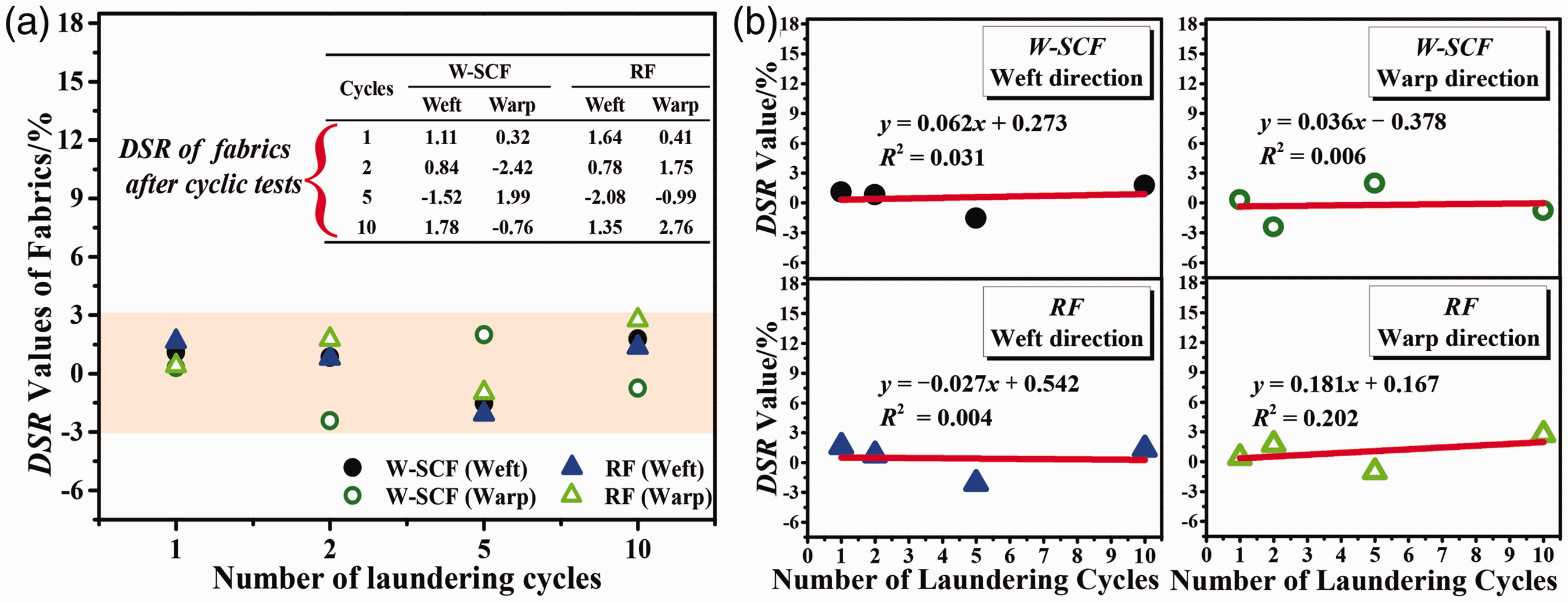
(a) DSR values of two fabrics subjected to cyclic laundering; (b) The dependence of DSR values on the cycling number for W-SCF and RF.
To further confirm or disprove whether there is certain association between DSR values of fabric samples and the number of laundering cycles, a linear regression model was applied to the experimental data. The relationship between DSR values and the number of wash-drying cycles for W-SCF and RF is shown in Figure 9(b). The solid straight line in each graph corresponds to the regression models with parameters obtained by the minimizing sum of squared errors. The value of R2 in each graph is low and therefore usage of a constant function instead of a linear function is more appropriate.
Conclusions
Stretchability and durability are imperative features for the desirable electromagnetic interference shielding materials. In this research, a woven fabric incorporating t-ECCY along its weft direction was produced and characterized against a 100% cotton woven fabric as a control.
By virtue of the unique structure of the t-ECCY yarn and prepared fabric, the resultant woven fabric has a denser and tighter surface compared with the control one. Notably, the t-ECCY fabric identified as tolerated strain up to approximately 40% before break. Expectedly, the control fabric sample did not stand up to the applied strain. Furthermore, a typical initial low-stress curve characteristic and an excellent cyclic elastic recovery stability at a higher extension of 25% (e.g. 78% ERR after 20 cycles) were observed, indicating the super mechanical robustness of the W-SCF. The results also showed the predicted force-strain values of W-SCF based on a modified standard solid constitutive model, by introducing an exponent to the exponential function, agreed well with the experimental data observed during stretch. More importantly, the dimensional stability was maintained after 10 cyclic tests at a higher expansion ratio (≈43%). Also, washing-drying treatments had no noticeable impact on dimensional stability. There remains a myriad more combinations of elastic and conductive components and yarn and fabric structures that need to be further determined to optimize the design and obtain excellent elastic stretchability and electromagnetic shielding capacity. In short, it is promising that this kind of mechanically robust and highly stretchable woven fabric incorporating metal wire can be used in future protective devices.
Footnotes
Acknowledgements
The authors are sincerely grateful to China Scholarship Council that enabled the first author to study abroad at Commonwealth Scientific and Industrial Research Organization (CSIRO) in Australia for one year.
Declaration of conflicting interests
The author(s) declared no potential conflicts of interest with respect to the research, authorship, and/or publication of this article.
Funding
The author(s) disclosed receipt of the following financial support for the research, authorship, and/or publication of this article: This work was financially supported by Anhui Provincial National Science Foundation (2008085QE211), Pre-research Project of China National Natural Science Foundation of Anhui Polytechnic University (Xjky03201904), Scientific Research Foundation of Anhui Polytechnic University (2020YQQ003), and Provincial Key Natural Science Research Project of Anhui Universities (KJ2016A797).
