




Abstract
Seaweeds are considered to be an important source of relevant chemical substances or bioactive compounds of great usefulness in the medical, cosmetic, pharmaceutical or food industry. Recently, some seaweed had been used to produce or incorporate in fibers in order to manufacture technical textiles in which functional ingredient of the seaweed are exploited in the health and body care area. The brown seaweed Undaria pinnatifida (Undaria) has an important nutritive value being consumed as food in several Asian countries. As well Undaria is required in cosmetic or dermatology medicine given the presence of other bioactive chemical substances known as phycocolloids. The objective of this study was to explore the potential use of Undaria in a preliminary development of a functional textile. A soft bilaminate textile with a high crease recovery and an efficient release of mucilage, was achieved using a fine dust (particle of <0.26 mm) of Undaria between two layers of nonwoven. The best combination of the two layers of nonwoven was laminate and fine spundbond. The extract of Undaria used in our experimentation had minerals and vitamins with positive effect to the human skin, besides it is no irritant when applied to healthy or abraded skin. Further research focused in the incorporation of this alga in nonwoven fibers is required. We expect to obtain a textile with a dermatologic use in the near future; so as to turn Undaria into a resource susceptible to exploitation given the specie is considered a worldwide plague.
Introduction
The use of natural products in the textile factory is greatly encouraged in the global market due to the environmental and health hazards associated with the production process of synthetic materials [1]. For example, several plants and animals species are proposed as a potential alternative source of textile dyes like onion skins, trees, sea grass, seaweed or cochineal [2–5]. Likewise, many researches focused on the exploration of marine species, searching for chemical substances for the medical, pharmaceutics, cosmetic or nutrition field [6,7]. In this sense, seaweeds result to be an important source of relevant chemical substances as nutrient, vitamins, antioxidant, and antimicrobial, as well as, they represent biocompatible and biodegradable material [8,9] that may be appropriate to the textile industry. Thus, the use of seaweed in the manufacture of technical textile for medicine and health or body care areas, represent an emergent researches activities [10,11]. In recent functional cloths, antioxidant, antimicrobial or UV protection features are granted to textile by adding substances from marine seaweed or because they are compounds of the other natural dyes [2,10]. In particular, the alginate extracted from brown marine seaweed is used to elaborate biodegradable fibers employed in the manufacture of nonwoven textile that it is generally made by polyester or polypropylene [12].
The marine brown algae Undaria pinnatifida (Harvey) Suringar known as “wakame” has been consumed as food in its native region, the coast of Northeast Asia (Japan, China and Corea). This algae has an important nutritive value for its high concentration of mineral, vitamins and proteins [13], and its use is extended both in human and animal food [14] and in the fertilization of horticultural soils [15,16]. Moreover, its common antioxidant pigments, B-carotene and fucoxanthin, provide it important uses in the field of pharmaceuticals and dermatology industry [17] and its inhibition proprieties of tumor and herpes are known to improve the ranges of opportunities in medicine [18–20].
Undaria pinnatifida (Undaria) is considered a global plague given that it has invaded several coasts of the globe, among which are the Mediterrean coast of France [21], Spain [22], Italy [23], the Atlantic coast of England and France [24], the Pacific coasts of United States and Mexico [25,26], New Zealand and Australia [27]. In South America, Undaria was accidentally introduced in 1992 in the Patagonia coast (Argentina) and then expanded both to the south and north directions [28–32]. In 2011 Undaria was observed for the first time in the port of Mar del Plata (Buenos Aires, Argentina) [33], and currently, although its abundance is notoriously greater, it is not distributed outside the calm waters of the harbor (Becherucci, pers. obs.). The introduction of Undaria, as other marine organism, is probably associated with ocean-going vessels [34,35]. Thus, in order to control and eradicate the populations of Undaria, different countries currently apply management plans that involve activities such as cleaning boats’ hauls, protocols for ballast water treatment and manual removal of the algae in areas of high population density, among others [36]. Both, algae removals as well as large arrivals of drift algae on beaches represent an important biomass of raw material suitable of exploitation [37,38].
Given that the invasive algae Undaria is a exploitable resource and represent a suitable source of nutrients for body care, the aim of this study was to explore the potential use of extract of Undaria plants obtained from the Mar del Plata harbor (Buenos Aires, Argentina) in a preliminary development of a functional textile. Thus, in the present study, experimental bilaminate textiles were performed using commercial nonwovens and Undaria dust at a non-industrial laboratory scale. Additionally, the concentration of micro (I, Fe, Cu, Cd, Ni, Hg and Zn) and macro-elements (Mg, Ca, P, K y Na) and vitamins (E, A y B2) were determinate in Undaria fronds, and possible dermal irritation effects of Undaria dust were evaluated on vertebrate skin.
Materials and methods
A total of 9 sporophytes of Undaria were collected inside the harbor of Mar del Plata, Argentina (38° 02′ S; 57° 33′ W; Figure 1).

Location of the Undaria pinnatifida population whithin the harbor of Mar del Plata.
The sporophytes total length ranges between 29 and 77 cm, with a mean length of 50 cm (SD = 15.8), and represents a total biomass of 647.62 g. All the individuals showed a well-developed sporophyll, being reproductive mature specimens. The holdfasts were removed and the individuals were dried in an open area (Figure 2). Dry material was grinded into small units with the help of a hand mortar. The obtained fraction was sieved with the aims of a 0.5 mm and 0.26 mm pore mesh. Thereby, two types of seaweed particle (dust) were obtained: thick (between 0.5 and 0.26 mm), and fine (<0.26 mm). Previously to the experimentation, a pilot bilaminate textile of 20 × 20 cm was obtained and a 4 g of thick fraction and 3.5 g of fine fraction were decided to use for manufacturing the textiles.

Wet (a) and dry (b) thallis of Undaria pinnatifida.
The experimental textiles were manufactured with commercial nonwovens generally used in the health care area (Meditech): laminate of cellulose with polyethylene film (hereinafter laminate), weight 10 g/m2; spunbond fine polypropylene, weight 5 g/m2; spunbond thick polypropylene, weight 20 grs./m2; and Tivek® model 1431 N, weight 41 g/m2. Each experimental textile was consisted of two layer of nonwoven 20 × 20 cm with dust of Undaria added with adhesive between both layers (Figure 3). First, a water-based adhesive was applied and a gridded template was placed over an area of 20 × 20 cm of the nonwoven (external layer of the textile), then the seaweed dust was spread so that it covered the entire area evenly, the template was removed and the internal layer of non-woven was placed. Finally, sealing pressure was applied with the help of manual press machine, simulating a calendered process (see all production sequence in Figure 4). Four combination of nonwoven were used to manufacture the textile, refereed as to: A (laminate in the external layer and fine spundbond in the internal layer), B (thick spundbond in both layers), C (thick spundbond in the external layer and fine spundbond in the internal layer) and D (tyvek in the external layer and fine spundbond in the internal layer), and two sizes of dust: thick and fine dust. Thus, eight experimental textiles were performed (4 nonwoven combinations × 2 dust size = 8, see Table 1).

Manufacture of bilaminate experimental textile.

Production sequence of the preliminary bilaminate textile prototype. 1-Undaria dust weight, 2-adhesive applied over the nonwoven (external layer of the textile), 3-gridded template placement, 4-Undaria dust placement, 5 and 6- gridded template removed, 7- nonwoven (internal layer of the textile) placement, 8-sealing pressure, and 9-the preliminary bilaminate textile prototype.
Treatment of experimental textiles, measured qualities (smoothness, crease recovery and hygroscopicity) and final textile category.

Replicates of each treatment were not different, only one value is showed.
Threes textiles (replicates) were made for each treatments, totalizing 24 textiles. Once the experimental textiles were obtained, the level of smoothness (coded as high, intermediate and low), crease recovery (divided in high, intermediate and low) and hygroscopicity (measured as cm3 of absorbed water) were measured for each textile. We defined the smoothness as the capacity to scrape the human bare skin. For this, an alternative method of subjective nature was designed. The textiles were palpated three times and smoothness (softness) was measured as: high if it never did scrapes the skin, intermediate if it occasionally did scrapes or low if it always did scrapes the skin. The crease recovery was the ability of the textile to recovery after be folded. In this case, textiles were shriveled manually once and observed whether they return to their original shape or remain wrinkled. Hence, a high crease recovery was attained if the textile returned to its original shape, intermediate if it did not still wrinkled but neither returned to its original shape or low if it stayed wrinkled. The hygroscopicity was defined here as the capacity of the textile to absorb water and transfer the resulting algae mucilage to the exterior of the textile. For this the textiles were dewy with a known quantity of water until the mucilage was observed protruding the exterior of the textile. Finally, the obtained experimental textiles were grouped into three categories according the level of smoothness, crease recovery and higroscopicity: ideal (high smoothness and crease recovery, and a hygroscopicity of 10 ml), medium (low either smoothness or crease recovery, and a hygroscopicity of 10 ml) or non-ideal (low both smoothness and crease recovery and a hygroscopicity of 10 ml, or low either smoothness or crease recovery and a hygroscopicity of 15 ml). In order to find if the treatment were related to the category of the obtained experimental textile, a test of Chi-square was performed. To determine the presence of natural smell of the algae in the obtained ideal textiles, an olfactory analysis were performed. To do this, the treated textiles were moistened and then applied in contact with the skin of three people who carried out the odor evaluation, leaving 20 minutes between the analyses of each sample. The evaluation consisted of assigning a value between 0 and 10 to each sample where 10 is an easily identifiable smell of the algae and 0 is no smell present. A textile without algae was taken as a reference (i.e. value 0). The concentrations of 7 micro-elements (I, Fe, Cu, Cd, Ni, Hg and Zn), and 5 macro-elements (Mg, Ca, P, K and Na), and of the vitamins E, A and B2 in fresh plants of Undaria were measured in the laboratory. The concentrations of Mg, Ca, I and P were determined by Flame Photometry, Volumetric and Gravimetric Methods, while the concentrations of Fe, Co, Cd, Ni, Me, Zn, K and Na were determined by Atomic Absorption Spectrometry. The concentrations of vitamins A and B2 were determined by High Resolution Liquid Chromatography (HPLC - DAD), and the concentration of E vitamin was determined by gas chromatography. All determinations were conducted in the Laboratorio Bioquímico Mar del Plata S. A. belonging to the Instituto de Análisis Fares Taie, Argentina.
A non-human skin irritation test with dust of Undaria was under taken by the Specialized Analytical Institute, Buenos Aires (IAE). A Primary Skin Irritation Index was applied following the Draiz methodology [39].
Results
Three categories of textiles were obtained: ideal, medium and non-ideal (Table 1). The Chi-square test indicated that the category of textile was related to treatment (1 to 8) (X2exp. 42.54 > X2critic 23.685; p = 0.05), being the treatment 2, 4 and 6 those that accomplished an ideal textile. The values of olfactory analysis for treatment 2, 4 and 6 were 6 (here and thereafter, mean value), 5.3, and 6.6 respectively.
The concentration of micro and macroelements, and vitamins in Undaria is depicted in Table 2. Potassium (K) was the most abundant element in the analyzed seaweed with a total concentration of 1182.87 mg/100 g. The remaining macronutrients have the following sequence of concentrations: Na> Ca> Mg> P. Iodine (I) was the most abundant trace element (36.02 mg/100 g), while the remaining microelements showed the following order: Fe> Zn> Cu> Ni> Cd> Hg (Table 2).
Micro and macroelement, and vitamin contents of brown seaweed Undaria pinnatifida in mg/100 g dry weight.

The estimated value of the Primary Skin Irritation Index for Undaria dust was 0.00 (Table 3), thus resulting in a non irritating product over healthy or abraded skin.
Results of the determination of the Primary Skin Irritation Index (P.S.I.I) of Undaria dust according to the Draiz methodology (1959).
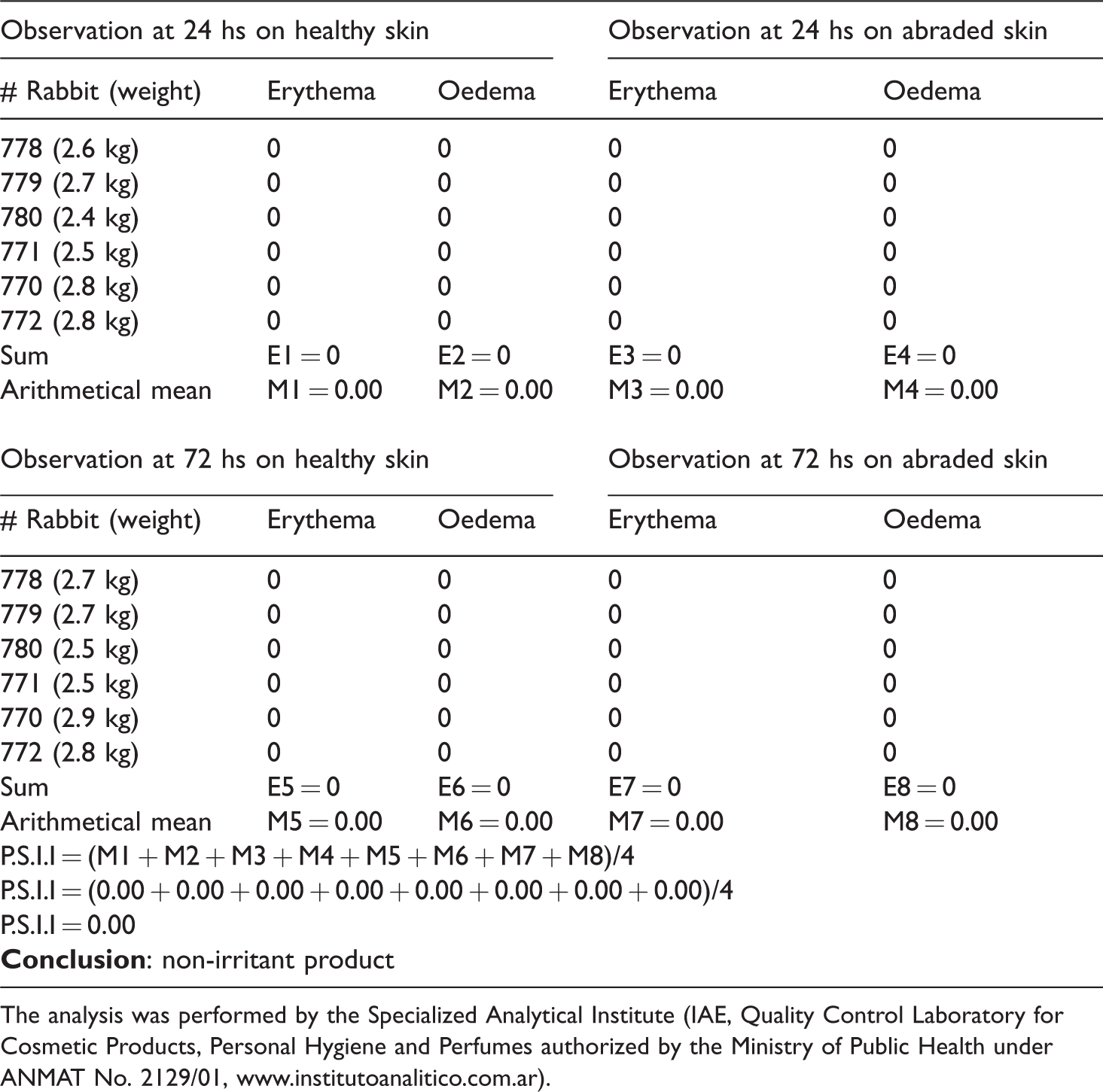
The analysis was performed by the Specialized Analytical Institute (IAE, Quality Control Laboratory for Cosmetic Products, Personal Hygiene and Perfumes authorized by the Ministry of Public Health under ANMAT No. 2129/01, www.institutoanalitico.com.ar).
Discussion
In this study the potential use of the invasive marine algae Undaria in a new functional textile prototype was tested. According to the experimentation performed, three treatments accomplished an ideal textile: combination A (laminate in the external layer and fine spundbond in the internal layer), combination B (thick spundbond in both layers) and combination C (thick spundbond in the external layer and fine spundbond in the internal layer); all using fine dust extracted from the algae. Even though the three types of textiles comply with the desired crease recovery, softness and hydrophilicity, we consider that the most appropriate treatment for the textil is treatment 2 (combination A with fine dust of algae) given that in this textile the liquid (water) is retained due to the waterproof (laminate) external layer. This feature enables rapid mucilage generation. The same property was observed in the textiles made with the combination D, however in this case the external layer (tyvek) appears as very rigid as well as waterproof and the textile loses flexibility. The waterproofing of the external layer allows the bedding or clothing not to be stained. Therefore, we don’t recommend using treatments 4 and 6 (which include combination B and C) because the mucilage is released by both layers, and thus reducing the performance of the textile. Although treatment 2 did not obtain a good olfactory evaluation, treatments 4 and 6 were not much better; in fact all three textiles presented values close to 6. We believe that another alternative should be approached to avoid the natural smell of the algae such as a microencapsulation of the algae. This technique consists basically in wrapping the active principle of the algae in a polymer wall; the same remains circumscribed and does not allow the smell to be perceived in the textile. This technology will not only mask the natural smell of the algae but also controlled release of the active substances from the seaweed and it could be possible apply to other textile substrates of different compositions. The nonwovens selected for the realization of the textiles in this project are those used in the health and hygiene sector (i.e. in clothing and hygiene products) [40,41]. However, other nonwovens can be tested, though we recommend that the external layer of the textile be a waterproof nonwoven and the internal layer a permeable one. This study only supports evaluations for the development of a laboratory-scale textile, so research should continue until a minimum viable product is achieved, with the tests, trials and certifications required to be able to scale it to a pilot plant. However, it is not ruled out to look for other alternatives that allow avoiding the natural smell of algae (Figure 5).
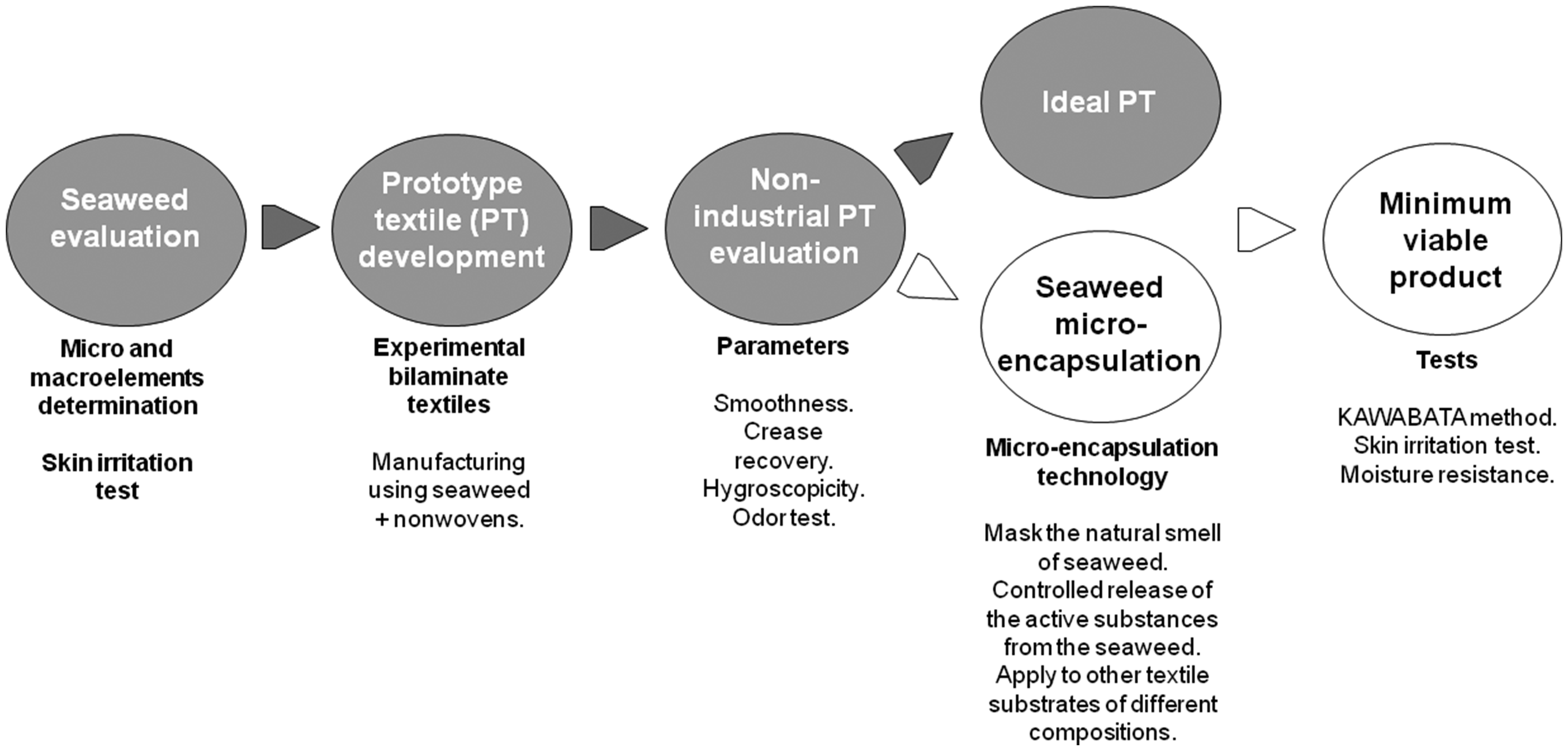
Outline of scope of the study (full circles) and futures evaluations (empty circles).
According to our results, the functional textile containing dust of Undaria could be a source of minerals as iodine, zinc, iron, cupper, magnesium, calcium, phosphorous, potassium and sodium, as well as vitamin A and B2 to the skin of the textile users. The mineral content is in line with previous studies in which iodine was the most important microelement and sodium, calcium and potassium were the most important macroelements in Undaria extract [13,14]. The minerals and vitamins have the potential to act as antioxidant, improving the ageing of the skin [20]. For instance, topically applied, Mg2+ ions have an anti-inflammatory effect and, in cooperation with Ca2+ ions, accelerate skin barrier recovery [42]. In line with the mineral benefit in dermatology, it was observed that topical application of minerals contained in Dead Sea water over the skin organ cultures, or skin in vivo, can down-regulate aging pathways in epidermal cells and stimulate mitochondrial activity [43]. Likewise, mineral rich extracts from seaweed are commonly known for their anti-inflammatory and antipsoriatic properties [44]. Conversely, the presence of cadmium (Cd) and mercury (Hg) was negligible. This is a promising result given that these non-essential metals are highly toxic even at low concentration [45]. However, despite the fact that the presence of the above mentioned toxic metals in the analyzed thalli does not suppose a risk to the health of textile users based on the levels detected in this study, there should be greater monitoring of these microelements in this Undaria population given that this algae develops inside the harbor of Mar del Plata, a highly anthropogenic polluted environment [46,47].
The predominant antioxidants substances present in seaweeds are categorized into vitamins which are extracted from both micro and macro algae for commercial purposes in medical and pharmaceutical applications [10]. In our study, Undaria already showed high concentrations of vitamins A and B2 available to the skin health. Vitamin B2 also provide ultraviolet protection factor to block out the harmful UV rays from the sun over human skin [10]. Besides the benefit of minerals and vitamin from the skin, brown seaweeds as Undaria are rich in fucoxanthin and its metabolite fucoxanthinol which have also an important radical scavenging activity [20]. Future studies focused on the quantification of these biocomponents, as well as exploring its antimicrobial properties, would substantially improve the scope of the obtained functional textiles.
The obtained textile can be scale up to a pilot test and reach a minimum viable product plausible to be used for the manufacture of technical clothes in the health area as hospitalization or resting shirts in which the nutrient and antioxidant properties of Undaria can be exported to the skin of user textile. In cases where patients are requested to stay in bed for a long period of time, the mucilage of Undaria provided by the textile, and activated by the sweat skin, may improve the health of the skin that is subjected to constant pressure, avoiding the generation of bedsores. Moreover, according our results, the Undaria extract is no irritant when applied to healthy o abraded skin. The incorporation of seaweed into the manufacture of technical textiles is currently widespread in order to exploit the therapeutic properties of the seaweeds. For instance, the German company “Smart fiber AG” with the brand Seacell® presents a fabric composed of 5% brown seaweed where various trace elements, carbohydrates, fats and vitamins are used [10, also see http://www.smartfiber.de/). Similarly, textile materials with UV protection properties are important for the medical and body care textiles. The strong UV protection characteristics and antioxidant activity present in seaweeds, as in other marine organism as well, is mainly due to the secondary metabolites such as mycosporine-like amino acids (MAAS) [48]. In that sense, the company “Sombra sana” made available over-the-counter functional cloths where UV protection features are granted to textile by adding this substances from marine seaweed (see www.codigovida.com). Other novelty application of the seaweed in the textile industry is the seaweed fibers used for apparels. However, only the woven and knitted fabrics are produced with seaweed fibers and it is blended with other cellulosic fibers [10].
Despite their direct use as food or supplement [13], other important role of mankind interest as source of bioactive compounds with a diverse range of applications in medicines, health and body care areas were found in Undaria [10]. Likewise, as a natural product, it can be a more economical source of chemical diversity than the synthesis of equivalent numbers of synthetic chemicals [8]. Moreover, Undaria show typical features of invasive species: rapid growth, early maturity, high spore production, rapid nutrient uptake, and a very wide range of temperature tolerance [49]. On the other hand, its heteromorphic digenetic life cycle consists of the alternation between a macroscopic sporophyte that develops during spring and summer, and a microscopic gametophyte that develops during winter. These characteristics determine the great difficulty in eradicating it from the environments where it has invaded [36]. The species has produced various impacts on the invaded coastal ecosystems, mainly affecting the native marine biodiversity, the quality of the underwater landscape, and changes in the local food webs, among others [31,50]. In order to control and eradicate the populations of Undaria, management plans are being developed involving various activities such as boat cleaning, ballast water treatment protocols, and manual extraction of algae in areas of high population density, among others [36]. The latter generates an important algae biomass that constitutes an organic waste susceptible to exploitation. The manufacture of a textile product using Undaria would provide an additional alternative to the use of this invasive algae especially in countries where it is not commonly consumed as human food; otherwise, the chemical properties of the algae would be wasted along with the organic residue that is generated with the summer arrivals of the algae or as a result of controlled extractions from it.
Conclusion
The use of Undaria in a functional textile is highly possible. We recommend that the manufacture of the bilaminate textile combine nonwovens as laminate and fine spundbond in order to obtain a soft textile with a high crease recovery, achieving waterproofing of the external layer and permeability of the internal layer. The size of Undaria dust between the two layers of nonwoven must be <0.26 mmin order to obtain an efficient release of mucilage. Nevertheless, it is expected to continue with pilot scale assessments, exploring nanotechnology alternatives (i.e. microencapsulation of the algae), to obtain a textile meditech in futures studies, with application in the hygiene and health sector and thus attain a sustainable use of Undaria which is considered a worldwide plague.
Footnotes
Acknowledgments
The authors thank Dr. Seco Pon (IIMyC, Argentina) for assisting with the writing of an early draft of the manuscript. We thank four anonymous reviewers for their comments and suggestions that improved the manuscript.
Declaration of conflicting interests
The author(s) declared no potential conflicts of interest with respect to the research, authorship, and/or publication of this article.
Funding
The author(s) disclosed receipt of the following financial support for the research, authorship, and/or publication of this article:: This research was supported by Conservation, Research and Education Opportunities International (CREOi)-USA (Principal investigator: Becherucci, M.E.).
