




Abstract
Yucca fiber is a natural cellulose fiber that can be extracted from the Yucca plant leaves by retting. The physical properties of the Yucca fiber are extremely sensitive to the retting conditions. This research was designed to study the effects of chemical retting on the structural and properties of this fiber. Chemical retting was done by soaking the Yucca leaf in 10 to 150 g/l sodium hydroxide concentration at 80 to 100 °C for 60 to 240 min. Fiber characteristics such as fineness, tenacity, functional groups, crystallinity, thermal degradation, and surface morphology were then investigated. The Yucca fibers exhibited high crystallinity (56–66%), high tenacity (36–46 cN/tex), and low linear density (3–5 tex). It was also found that the elementary fiber had a mean diameter of about 1.2
Introduction
In the last decades, natural cellulosic fibers have been attractive for researchers and industries as they are renewable and biodegradable materials with such intrinsic properties as good tensile strength, high moisture absorbance, low weight, low cost, and the wicking property [1,2]. The extraction process of the natural fibers can be done in textile fiber processing for textile manufacturing (e.g., yarns, twines, and clothes) [1] or in non-textile fiber processing for pulp and paper [3], composites (e.g., for automotive industry and construction) [4–6], geotextiles [7], insulation products (e.g., construction material) [8,9], and the nonwoven manufacturing [10].
There are common natural cellulosic fibers for use in clothing and technical textiles, such as fibers bundles in the inner bark of stems (e.g., flax, jute, hemp and ramie), leaf fibers running lengthwise through the leaves of the monocotyledonous plant (e.g., sisal and abaca), and seed fibers and fruits (e.g., cotton, coir, kapok and milkweed) [11–13]. In addition to the traditional natural fibers, numerous non-traditional plants are being studied to extract fibers from plants; these include vekka, date, bamboo [14], sausage plant [15], Hierochloe Odarata [16], Juncus effuses [17], Ficus religiosa [18], conium maculatum stem [5], and okra [19].
Jute fiber is one of the most important cellulose fibers used in ropes, twines, packaging and, especially, in Persian home textiles including carpet backing [20]. In the last decades, jute fiber has been produced domestically; however, today these fibers are imported from Far East countries such as India, Bangladesh, Pakistan, etc. Iran imported about 93.7 thousand tons of jute, kenaf and allied fibers in 2017 [21]. Due to the high consumption of plant fibers such as jute in the country, finding a suitable source for fiber extraction can be important due to the country's vegetation.
Yucca is an evergreen plant belonging to the agave subfamily of the Asparagus family; it is an ornamental garden plant that is widely cultivated in different cities of Iran. Yucca fiber is one of the oldest cellulosic leaf fibers that has not been widely studied by researchers. About 40 species of succulent plants belong to the genus Yucca, all of which have fiber in their leaves [22]. The flat green leaves are 30 to 70 cm long and 2–4 cm wide. Yucca is an economically viable plant that can produce about 60 to 80 leaves per year. The weight percentage of the extracted fibers is dependent on the plant species and generally, less than 20% of fiber extraction has been reported [22]. Chemical extraction, microbial retting, water retting, and mechanical scotching have been applied to the entire Yucca fiber [23]. The beating of leaves using a knife or a piece of wood may also be used to extract fibers [24]. Chemical extraction may result in a fiber with a greenish color due to the presence of chlorophyll [22].
Bell and King [25] found that the fibrous bundles were distributed in the Yucca leaves; they consisted of groups of xylem and phloem which were capped above and below with fibers. McLaughlin and schunk [26] treated the fresh leaves of Yucca in 5% potassium hydroxide at 60–65°C for 40–48 hours and determined the length, diameter, and cell wall thickness of the fibers. They extracted fiber with a diameter of 13–18 µm and cell- wall thickness of 4.5–6.2 µm. Azanaw et al. [23] also extracted fibers from Yucca Elephantine leaves using water retting (26 days in the river water at room temperature) and chemical extraction (3–20% of NaOH, boiling temperature, 2 h). Chemical-extracted fibers at 3% NaOH had better tensile properties (7.5 cN/tex) in comparison to water-retted ones (5.7 cN/tex); the fineness was decreased from 5.96 to 4.2 tex with NaOH concentration. The authors also found that the tensile properties of the Yucca fibers were the same as the bast fibers, such as sisal and hemp fibers [23]. The microbial retting (90 days in de-ionized water and decomposition of leaves) and chemical extraction for obtaining fibers from Yucca aloifolia [27] were studied by Ekunsanmi and Tripathi. In chemical extraction, they treated leaves with 11% sodium hydroxide at the boiling temperature for 45 minutes; then, this was continued with 3% hydrogen peroxide for 10 minutes. They found that the chemically extracted fibers had lower tensile strength in comparison to the microbial retted fibers. Bartlett also investigated three Yucca species, including Y. angustissima, Y. baccata and Y. glauca, to study the tensile properties of these fibers [28]. The Yucca fiber was extracted by processing the leaves in an autoclave at 121 °C; then, it was submerged in water and finally, gently scraped manually. The results showed that Y. baccata fibers were 32% and 45% stronger than Y. angustissima and Y. glauca, respectively.
Fiber extraction is a complex process and the process conditions can greatly affect the properties of the fibers. In the previous studies on the extraction of fibers from Yucca leaves, limited experiments have been performed on the chemical extraction conditions, while the fiber properties are highly dependent on the extraction condition such as time, temperature, and chemical concentration. Also, a comprehensive study of the fiber properties is important for a better application of this fiber.
The objective of this study was, therefore, to extract cellulose fibers from Yucca leaves through the chemical extraction and to investigate the effects of the sodium hydroxide concentration (10–150 g/l), time (60–240 min), and temperature (80–100°C) of extraction on the physical properties of the fibers. The obtained fiber was characterized using scanning electron microscopy (SEM), X-ray diffraction (XRD), Fourier transform infrared (FTIR) spectroscopy, thermogravimetric analysis (TGA), and tensile testing to characterize the surface, crystallinity, structural changes, thermal stability, and tenacity. Furthermore, some important properties of the extracted fibers were measured and compared with the new natural cellulose fibers.
Materials and methods
Materials
The Yucca plant used in the present study was obtained from a local plantation in Bonab, East Azerbaijan province, Iran. The plant species used was Yucca filamentosa (belonging to the Agave subfamily of the Asparagus family) (Figure 1). The leaves were cleaned and cut into small pieces (about 100 mm). Other reagents used were sodium hydroxide flakes (NaOH, Dr. Mojallali, Iran), acetic acid (CH3COOH, Ghatran Shimi Tajhiz, Iran), and potassium bromide (KBr, Sigma-Aldrich, USA).

The picture of the Yucca plant, a laboratory-dyeing machine used for chemical extraction, and the fiber obtained after extraction.
Methods
Fiber extraction
Fiber extraction from Yucca leave, which is the first step in fiber processing, can be done mechanically or by retting [23,26]. The controllable leaf fiber quality within a short time can be obtained by chemical retting [29]. In this study, a laboratory-dyeing machine (Model LDM97, Novin Reessanj, Iran) was used for the chemical extraction of the Yucca fiber. Eight experiments were simultaneously carried out in eight 150-ml stainless steel beakers, each containing 5 g leaf and sodium hydroxide, as listed in Table 1. The sealed beakers were rotated in a heating medium of glycerin at the temperature range of 80–100°C. The extracted fibers were removed from the beaker, washed in hot water, and neutralized using 2 g/l acetic acid. The fibers were then dried overnight at room temperature.
Chemical extraction of the Yucca fibers.

Tenacity
The tensile tests of the extracted fibers were performed using a tensile measurement instrument (SANTAM 20, Iran) with a constant strain rate (CRE), according to ASTM D3822-01. The fiber length was 20 mm, and the crosshead speed was 2 mm/min. An average value on 30 tests was taken for each parameter.
Linear density
The linear density of the fibers (the amount of mass per unit length) was determined according to ASTM D1577-96 by weighing the known lengths of the fibers. The following formula was used to calculate the fiber linear density:
FTIR spectroscopy
The chemical structure of the Yucca fiber was analyzed by the Fourier transform infrared (FTIR) spectroscopy (Shimadzu, Japan). The fiber was milled to powder, mixed with an analytical grade of potassium bromide (KBr), and then pressed into a disk for measurement. The FTIR spectra were measured in the transmittance mode in the range of 4000–400 cm−1 by using 32 scans.
Surface morphology
The longitudinal and cross-sectional views of the Yucca fiber were determined by the scanning electron microscopy, FEI ESEM QUANTA 200 (Thermo Fisher Scientific, Waltham, MA, USA). To obtain a sectional view, the fiber was mounted on a conductive adhesive tape (Agar, United Kingdom) and sputter-coated with gold-palladium (COXEM, South Korea) before being observed under SEM. The images were captured with an accelerating voltage of 25 kV and magnifications of 100× to 5000×.
Crystallinity and crystalline size
The structure of the extracted Yucca fiber was characterized by an X-ray diffractometer (PANalytical International Corporation, Almelo, Netherlands). The XRD was performed at 40 kV and 40 mA using the Cu K
The crystallite size was calculated using the Scherrer’s equation (equation (3)), where 
Thermal degradation
The thermogravimetric analysis (TGA) was performed to find the rate of change in the mass of the Yucca fiber as the temperature changed. The analysis was performed under a nitrogen environment using a TA instrument (TGA SDT Q600, USA). Initially, the masses of the fiber were precisely measured at room temperature; then, the temperature of the samples was increased from 25 °C to 500 °C at a constant heating rate of 10 °C.min−1 simultaneously.
Results and discussion
FTIR spectroscopy
The Fourier transform infrared spectrum of the extracted Yucca fiber is depicted in Figure 2. Two major regions were visible in the spectra. The first zone was the wavenumber range from 4000 to 2700 cm−1 with a low peak number, and the second one was the wavenumber range from 1700 to 600 cm−1 with a larger peak number.

The FTIR spectrum of the extracted Yucca fiber.
The FTIR spectrum for the fiber extracted at 80 °C showed strong broadband at 3433 cm−1 due to the stretching vibration of the hydrogen bond of the OH groups. The intensity of this peak was increased for the fiber extracted at 100 °C due to the more removal of lignin and an increase of the hydroxyl groups in hemicellulose and cellulose [32]. The peak at 2887 cm−1 was assigned to the C-H stretching vibration of CH and CH2. The signal intensities at the bands of 1460 cm−11,427 cm−1 and 1028 cm−1, due to the symmetric C-H deformations, the aromatic skeletal vibration and methoxyl groups in lignin, were reduced or disappeared due to the lignin degradation and the cleavage of methoxyl groups by extraction at the higher temperatures [5,33,34]. Lignin is a hydrophobic layer in the natural fibers, causing some poor interfacial bonding between natural fiber and hydrophilic resin in the polymer composites [32]. The removal of lignin and the other non-cellulosic materials can improve the interfacial bonding of the fibers with resins.
The amount of the crystalline cellulose, relative to the amorphous components, can be obtained by the transmittance values of 1439 cm−1 and 894 cm−1, referring to the lateral order index (LOI) [35]. This is an empirical crystallinity index proposed by Nelson and O’Connor (1964) to show the overall degree of order in the cellulose. LOI of the Yucca fibers was calculated to be 2.64 and 2.43 for the fiber extracted at 100 °C and 80 °C, respectively. This could indicate further removal of non-cellulosic components and an increase of the cellulose content due to an increase in the extraction temperature. The calculated LOI was greater than that for new fibers including conium maculatum (1.01) [5], linden (0.96) [36], althea (0.79), ferula fibers (0.70) [34], and famous fibers including jute (0.99), kenaf (0.93), ramie (1.05) and sisal (0.970) [37].
Fineness and tenacity
The chemical retting parameters, such as alkaline solution concentration, time, and temperature of the process, can affect the fineness and tenacity of fibers. In the process, it was found that extracting fibers from the Yucca leave needed sufficient conditions. The extraction process at sodium hydroxide concentrations lower than 75 g/l within 60 min did not result in fiber extraction, as shown in Table 2. However, increasing the extraction time led to a decrease in the concentration of sodium hydroxide, so that it was possible to extract the fiber at a concentration of 40 g/l for 240 minutes. This showed that the chemical extraction time could be an important factor in the chemical retting of the natural fibers [38]. Increasing the processing time led to the rise of the fiber tenacity, as shown in Figure 3(a). As can be seen, increasing the hydroxide concentration within 60 and 120 minutes led to the rise of the fiber tenacity, but the tenacity of fiber was decreased with increasing the NaOH concentration over 240 minutes. This finding is supported by similar studies, such as those on Acacia tortilis fibers [4] and Yucca elephantine fibers [23]. As suggested in Table 2, the extraction of fibers using an alkaline solution of 75 g/l at 80 °C within 240 min resulted in good tenacity and fineness.
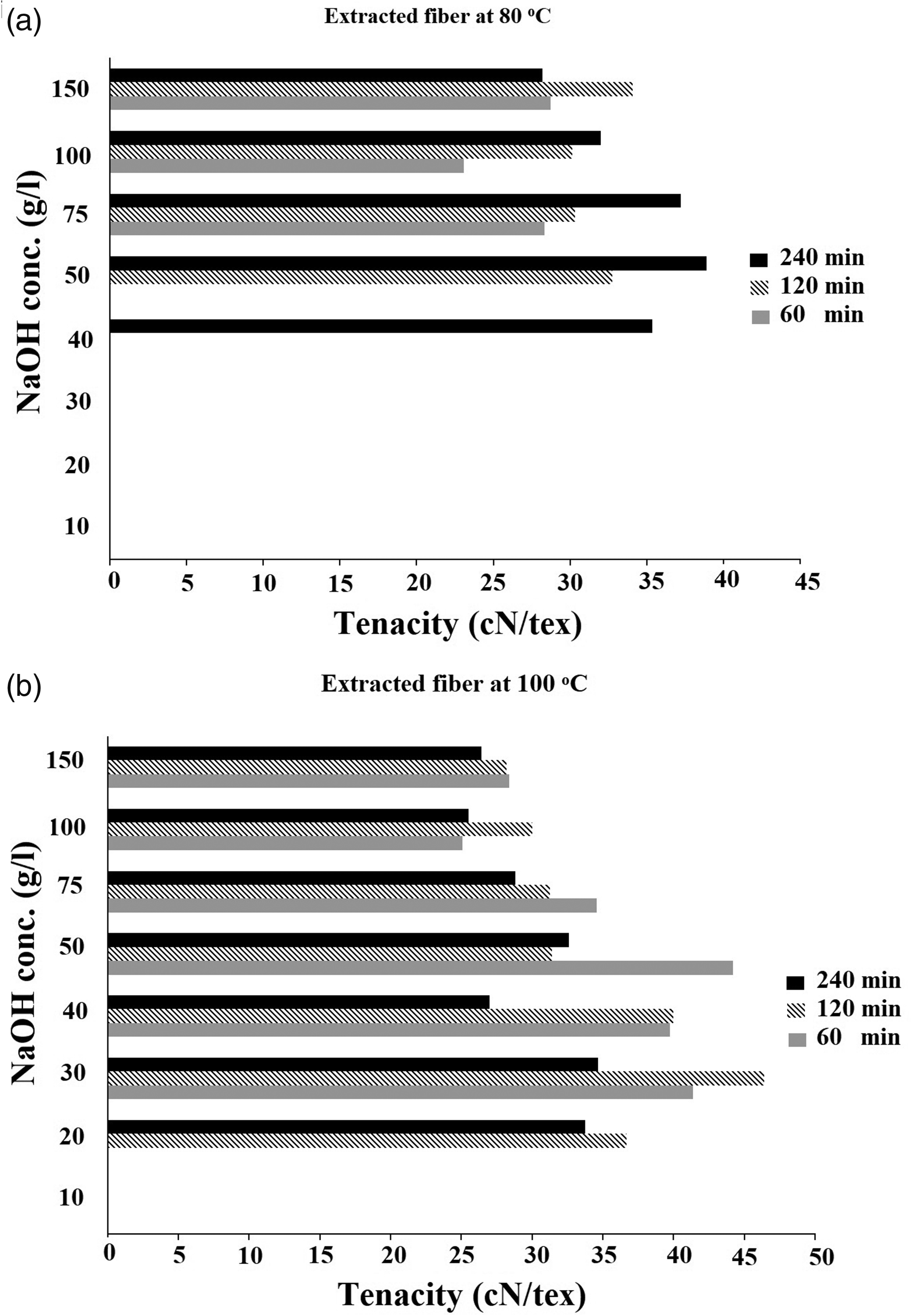
The effect of sodium hydroxide concentration and time on the tenacity of the extracted fibers (a) at 80 °C and (b) at 100 °C.
Tenacity and linear density of the extracted Yucca fibers at 80 °C

* The fibers are not extracted
a-c Means with the same superscript are not statistically different (P < 0.05)
Tenacity and linear density of the extracted Yucca fibers at 100 °C

* The fibers are not extracted
a-c Means with the same superscript are not statistically different (P < 0.05)
Extracting fibers from the Yucca leaves at 100 °C, in comparison with that at 80 °C, could result in fiber extraction at a lower alkaline concentration (Table 3). Figure 3(b) reveals that unlike the fiber extraction at 80 °C, an increase in the processing time had a negative effect on the tenacity of the fibers obtained at 100 °C. Therefore, chemical retting within 120 min resulted in fiber extraction with higher tenacity in comparison to that within 240 min. On the other hand, the tenacity of the fiber extracted at 100 °C was much higher when compared to that of the fiber obtained at 80 °C. Generally, chemical retting at high temperatures could remove the non-cellulosic and impurities on the fiber surface and increase fiber crystallinity and tenacity. This could be due to the high alkali penetration in the amorphous region of the cellulose structure. The decrease in tenacity at high alkali concentration levels could be attributed to the partial degradation of lignin and hemicellulose in the crystalline structure of cellulose that stuck cellulose chains together. These findings have been supported by similar studies on other natural fibers [39–41]. Therefore, fibers obtained from chemical retting containing 30 g/l sodium hydroxide solution within 120 min had the highest tenacity and suitable fineness, as illustrated in Figure 3(b).
The tensile strength of the Yucca fiber was obtained to be 350–480 MPa, which was better than that of Coir (108–252 MPa), coconut fiber (95-230 MPa), bamboo (140–230), and banana (355 MPa) fibers; also, it was closer to Sisal fiber (227–627 MPa) [42]. This showed that the Yucca fiber could be used as a reinforcement material in the polymer composites.
Surface morphology
The scanning electron microscopy images of the extracted Yucca fiber are shown in Figure 4. It can be seen that the Yucca fiber was composed of elementary fiber joined and covered by waxy, and gum materials such as lignin, pectin, etc. (Figure 4(a)). The mean diameter of the elementary fiber and the composite of the Yucca fiber was 12

Scanning electron microscope images of the extracted Yucca fiber at (a & b) 80 °C for 4 h, and (c & d) 100 °C for 2 h.
Figure 4(c) shows that the mean diameter of the elementary fiber could be lower than 10
The cross-section of the Yucca fiber is shown in Figure 5. Figure 5(a) shows that the elementary fiber had a helical structure of square-shaped spires covered with a gummy material. This helical structure was also shown by Msahli et al. [43] in the case of Agave American L. elementary fibers. It seemed that the Yucca fiber had an irregular cross-sectional shape without any certain lumens (Figure 5(b)). These results were consistent with the study by Bell et al. (1944) [25], proposing that individual fibers were tapered regularly to the rounded end and the lumen was usually very distinct.
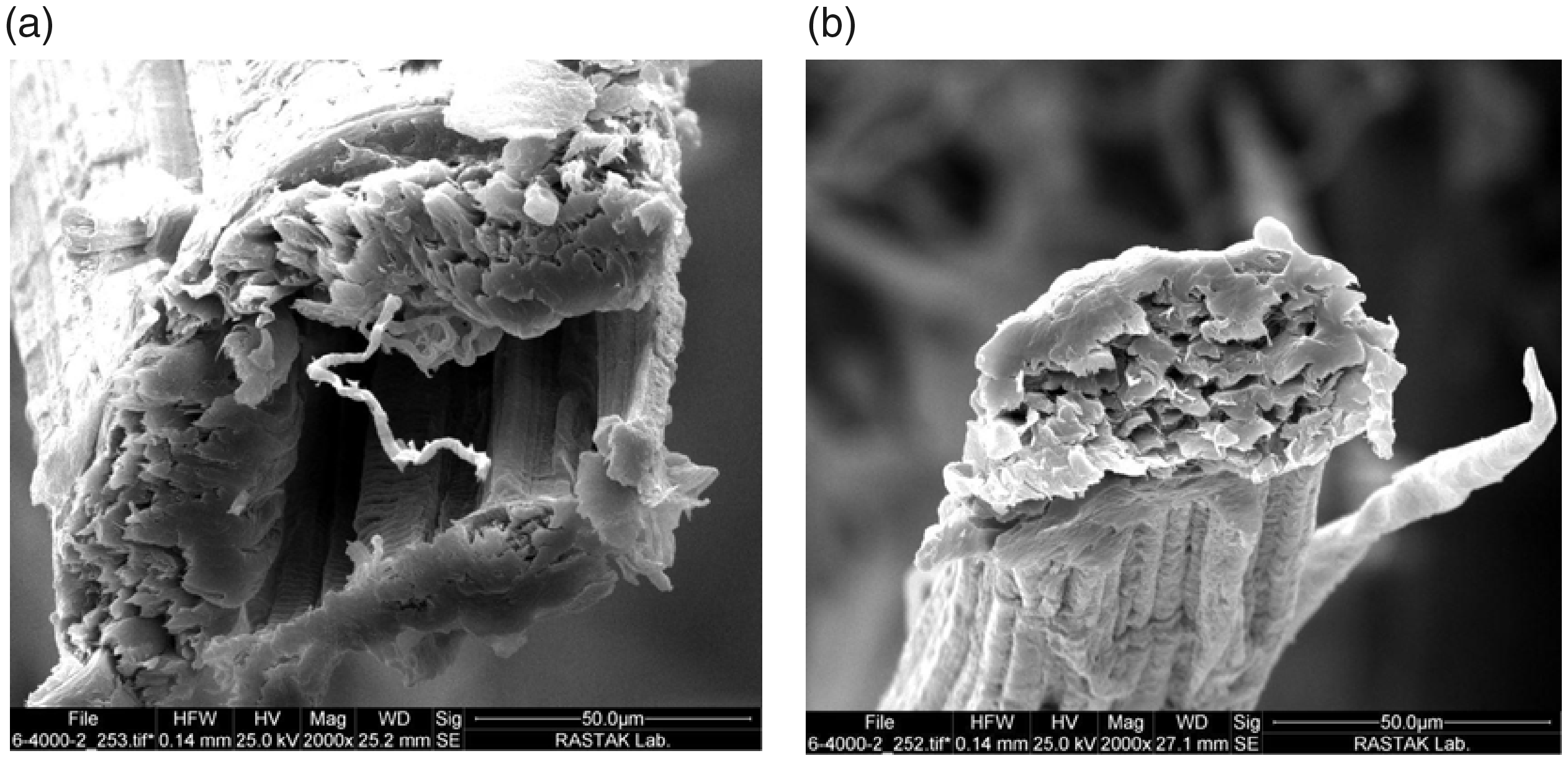
A cross-section SEM image of the Yucca fiber.
Crystallinity and crystal size
The X-ray diffraction pattern of an extracted Yucca fiber is presented in Figure 6. The main amorphous and crystalline peaks, crystallinity percentage and crystallite size are given in Table 4. Three less defined peaks around 15°, 16° and 35°, and a strong peak around 22° characterized the XRD pattern of the Yucca fiber, indicating the semi-crystalline nature of this fiber [37]. The main diffraction peaks were observed at 2θ = 15.1° and 16.12°, which referred to the Miller index [−110] and [110], respectively; 2θ = 35° referred to the Miller index [004], and 2θ = 22.22° could be attributed to the Miller index [200]. According to the crystalline planes, the Yucca fiber was assigned as cellulose I [49].

X-ray diffraction pattern of the Yucca fiber.
Crystallinity and crystal size of Yucca in comparison to other new natural cellulose fibers.
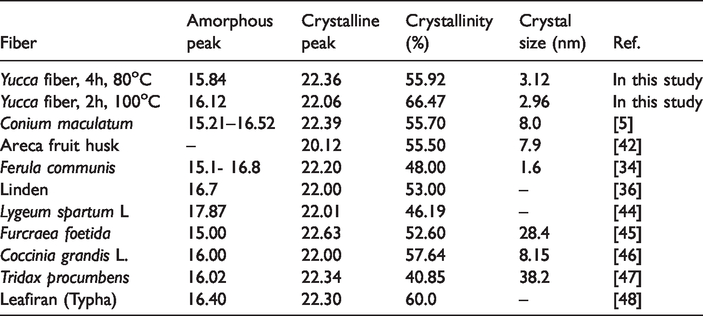
Cellulose crystallinity percentage is one of the significant crystalline structure parameters. Increasing crystallization results in an increase in fiber rigidity and a decrease in its flexibility. The data gathered from a comparison between the extracted fibers at different conditions showed that the fibers obtained at higher temperatures had a higher crystallinity percentage (about 66%). This might be due to the decrease in non-cellulosic materials such as hemicellulose and lignin, which are amorphous structures, and the increase at cellulose content, which is a crystalline structure [41,50]. This result was confirmed by SEM images.
Table 4 shows the crystallite properties of the natural cellulosic fibers that have been recently obtained from the stem, leaf, etc. for the textile and composite applications. Similar to cotton (60–68%), jute (57–70), ramie (58–74%), and coir fibers (48–57%) [36,48], the Yucca fiber had higher crystallinity (about 66%), in comparison to the new natural cellulose fibers. The high crystallinity may have led to the high tenacity and enhancement of the mechanical properties of the corresponding composites. The lower crystal size increased the chemical reactivity and water sorption of the natural fiber, which could lead to the better dyeing of these fibers.
Thermal analysis
The study of thermal stability and the investigation of the maximum weight loss rate of components is possible by using thermogravimetric analysis (TGA) and derivative thermogravimetric analysis (DTGA), respectively. The thermal stability of the natural fibers results from the degradation temperatures of cellulose, hemicellulose and lignin components. Yao et al. [51] found that an onset decomposition temperature of numerous natural fibers was in a range of

Thermal gravimetric analysis curves of the extracted Yucca fibers.
Conclusion
Chemical retting was successfully carried out for the extraction of natural cellulose fibers from the Yucca leaves. Determination of tenacity, thermal stability, crystallinity, and microscopic observation showed the effect of chemical retting on the properties of the extracted fibers. Upon extraction at high temperature, the crystallinity and tenacity of the extracted fibers were increased. The chemical extraction of the Yucca fibers showed that: The tenacity of the extracted fibers was in a range of 36–46 cN/tex, which was closer to that of the sisal fiber. The XRD-analysis showed that the crystallinity of the fibers was about 66%, which was closer to that of cotton, ramie, and coir fibers. The scanning electron microscopy analysis revealed that the extracted elementary fiber had a mean diameter of about 1.2 µm and a helical structure of square-shaped spires. The thermogravimetric analysis also showed that the fibers started to decompose above 250°C.
The combined results, therefore, showed that the Yucca fiber, as natural cellulose fiber, had the desired characteristics for use in textiles and as the potential reinforcement in thermoplastic polymeric composite applications.
Footnotes
Declaration of conflicting interests
The author(s) declared no potential conflicts of interest with respect to the research, authorship, and/or publication of this article.
Funding
The author(s) received no financial support for the research, authorship, and/or publication of this article.
