

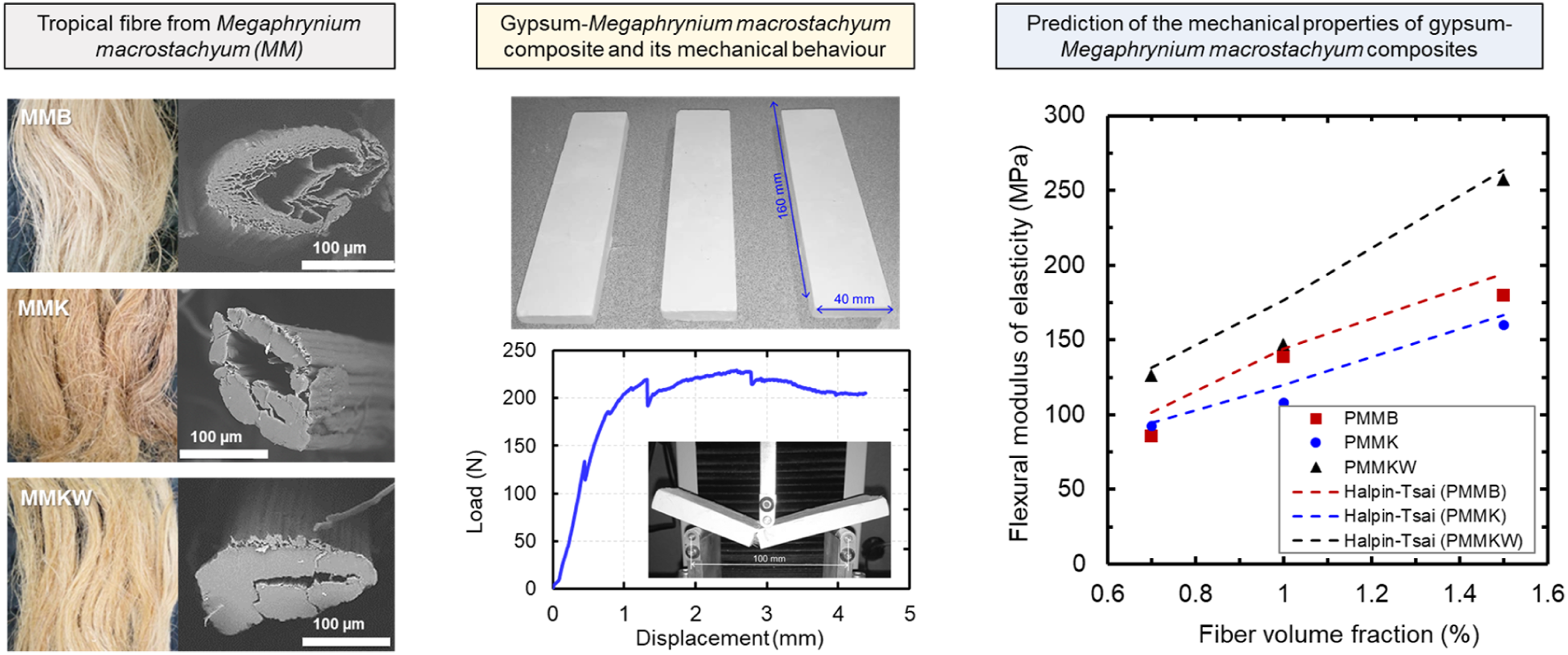
Identifying the potential of new bast fibres is a solution for diversifying biobased reinforcements and replacing environmentally harmful synthetic fibres. In this study, fibres were extracted from Megaphrynium macrostachyum stems by biological and chemical retting. The chemical fibres were bleached with a 2.5wt% sodium hypochlorite (NaClO) solution. The biological, chemical and bleached fibres were analysed from a chemical, morphological, physical, mechanical and thermal point of view. The possibility of using these fibres as reinforcement in gypsum-based biocomposites for construction was analysed by three-point bending tests. Chemical analysis revealed a cellulose content of more than 56 wt% within the usual range (50-85 wt%) for reinforcing fibres. SEM images showed that bleaching cleans the surface of the fibres. Physical analysis by gravimetric analysis showed that the bleached fibre had the lowest density (1.01 g.cm−3), fineness (5.2tex) and water absorption (64wt%). In addition, the highest thermal stability (237°C) was obtained for the chemical fibre. Young’s modulus and tensile strength, evaluated according to ASTM D3822-07, were dispersed and depended on the fibre diameter, and the highest values were obtained for the chemical fibre (6.4 GPa and 251 MPa). In contrast, gypsum composites with a volume fraction of 1.5% bleached chemical fibre had the highest stiffness (258 MPa) and flexural strength (5 MPa). The results obtained for each fibre type are relatively close to those of other fibres in the literature, indicating that all three fibre types studied can be used as alternative raw materials for the manufacture of gypsum-based biocomposites.
Prem KumarNChellapandianMArunachelamN, et al.Effect of mercerization on the chemical characteristics of plant-based natural fibers. Mater Today Proc2022; 68: 1201–1207. DOI: 10.1016/j.matpr.2022.05.319
2.
NdengueMJAyissiMZNoahPMA, et al.Implementation and evaluation of certain properties of a polymer matrix composite material reinforced by fibrous residues of <i&gt;Saccharum officinarum&lt;/i&gt; in view of an Applicability orientation. J Miner Mater Charact Eng2021; 09(02): 206–225. DOI: 10.4236/jmmce.2021.92015
3.
PageJAmzianeSGominaM, et al.Using linseed oil as flax fibre coating for fibre-reinforced cementitious composite. Ind Crops Prod2021; 161: 113168. DOI: 10.1016/j.indcrop.2020.113168
4.
RameshM. Flax (Linum usitatissimum L.) fibre reinforced polymer composite materials: a review on preparation, properties and prospects. Prog Mater Sci2019; 102: 109–166. DOI: 10.1016/j.pmatsci.2018.12.004
5.
BaleyCGominaMBreardJ, et al.Variability of mechanical properties of flax fibres for composite reinforcement. A review. Ind Crops Prod2020; 145: 111984. DOI: 10.1016/j.indcrop.2019.111984
6.
DumontPJJOrgéasLMartoïaF, et al.Composites polymères et fibers lignocellulosiques-Propriétés, transformation et caractérisation. In: HermesLavoisier. Chapter 5: Françoise Berzin, 2017, pp. 160–201.
7.
LibogLBiyemeFOmgba BetenéAD, et al.Influence of the extraction zone on the physical and mechanical properties of the pseudo-trunk banana fibers. J Nat Fibers. 2023; 20(2): 2204451. DOI: 10.1080/15440478.2023.2204451
8.
VinodASanjayMRSiengchinS, et al.Fully bio-based agro-waste soy stem fiber reinforced bio-epoxy composites for lightweight structural applications: influence of surface modification techniques. Constr Build Mater2021; 303: 124509. DOI: 10.1016/j.conbuildmat.2021.124509
9.
RaghunathanVDhilipJDJRameshM, et al.The effects of stacking sequence on the mechanical and water absorption properties of areca-pineapple fiber-based epoxy composites. J Nat Fibers2022; 19(14): 9681–9692. DOI: 10.1080/15440478.2021.1990183
10.
WangWXuMLouJ, et al.Changes in physicomechanical properties and structures of jute fibers after tetraacetylethylenediamine activated hydrogen peroxide treatment. J Mater Res Technol2020; 9(6): 15412–15420. DOI: 10.1016/j.jmrt.2020.10.096
11.
LemitaNDeghboudjSRokbiM, et al.Characterization and analysis of novel natural cellulosic fiber extracted from Strelitzia reginae plant. J Compos Mater2022; 56(1): 99–114. DOI: 10.1177/00219983211049285
12.
ObameSVBetenéADONaohPM, et al.Characterization of the Neuropeltis acuminatas liana fiber treated as composite reinforcement. Results Mater2022; 16: 100327. DOI: 10.1016/j.rinma.2022.100327
13.
BetenéADOBetenéFENgaliFE, et al.Influence of sampling area and extraction method on the thermal, physical and mechanical properties of Cameroonian Ananas comosus leaf fibers. Heliyon2022; 8(8): e10127. DOI: 10.1016/j.heliyon.2022.e10127
14.
NkaplewehADTendoJFEbandaFB, et al.Physico-chemical and mechanical characterization of triumfetta Pentandra bast fiber from the equatorial region of Cameroon as a potential reinforcement of polymer composites. J Nat Fibers2022; 19(16): 13106–13119. DOI: 10.1080/15440478.2022.208522
15.
OkungbowaMAOsimeEOEnwemaJC, et al.Effect of Megaphrynium macrostachyum leaf extract on some haematological parameters using albino Rats: a preliminary study. Ann Biomed Sci2013; 12(2): 21–28.
16.
Eya’ane MevaFOkalla EbongueCFannangSV, et al.Natural Substances for the Synthesis of Silver Nanoparticles against Escherichia coli: the Case of Megaphrynium macrostachyum (Marantaceae), Corchorus olitorus (Tiliaceae), Ricinodendron heudelotii (Euphorbiaceae), Gnetum bucholzianum (Gnetaceae), and Ipomoea batatas (Convolvulaceae). J Nanomater. 2017; 2017: 1–6, doi:10.1155/2017/6834726
17.
Chokouadeu YoumssiDVModtegue BampelYDNjankouoJM, et al.Chemical composition of some plantation wood species (Eucalyptus saligna, Cupressus lusitanica and Eucalyptus paniculata) and assessment of compatibility with plaster. J Indian Acad Wood Sci2017; 14(2): 146–153. DOI: 10.1007/s13196-017-0200-3
18.
Di BellaGFioreVGaltieriG, et al.Effects of natural fibres reinforcement in lime plasters (kenaf and sisal vs. Polypropylene). Constr Build Mater2014; 58: 159–165. DOI: 10.1016/j.conbuildmat.2014.02.026
19.
DjoudiAKhenferMMBaliA, et al.Performance of date palm fibres reinforced plaster concrete. Int J Phys Sci2012; 7(21): 2845–2853. DOI: 10.5897/IJPS11.1553
20.
AlcarazJSBeldaIMSanchisEJ, et al.Mechanical properties of plaster reinforced with yute fabrics. Compos Part B Eng2019; 178: 107390. DOI: 10.1016/j.compositesb.2019.107390
21.
LiYMaiYWYeL. Sisal fibre and its composites: a review of recent developments. Compos Sci Technol2000; 60(11): 2037–2055. DOI: 10.1016/S0266-3538(00)00101-9
22.
DalmayPSmithAChotardT, et al.Properties of cellulosic fibre reinforced plaster: influence of hemp or flax fibres on the properties of set gypsum. J Mater Sci2010; 45: 793–803. DOI: 10.1007/s10853-009-4002-x
23.
CarvalhoMACalil JúniorCSavastano JuniorH, et al.Microstructure and mechanical properties of gypsum composites reinforced with recycled cellulose pulp. Mat Res2008; 11: 391–397.
24.
AiziDEKaid-HarcheM. Mechanical behavior of gypsum composites reinforced with Retama monosperma fibers. Proceedings2020; 63(1): 40. DOI: 10.3390/proceedings2020063040
25.
IucolanoFCaputoDLeboffeF, et al.Mechanical behavior of plaster reinforced with abaca fibers. Constr Build Mater2015; 99: 184–191. DOI: 10.1016/j.conbuildmat.2015.09.020
26.
HamzaSSaadHCharrierB, et al.Physico-chemical characterization of Tunisian plant fibers and its utilization as reinforcement for plaster based composites. Ind Crops Prod2013; 49: 357–365. DOI: 10.1016/j.indcrop.2013.04.052
27.
EbandaFAtebaA. Study of the thermal behavior of the plaster reinforced Vegetable fiber. Int J Eng Sci Invent2016; 5(9): 62–67.
28.
KengohJBPeter EtapeEVictorine NamondoB, et al.Influence of Urena lobata fibre treatment on mechanical performance development in Hybrid Urena lobata: fibre/gypsum plaster composites. Adv Mater Sci Eng2021; 2021: 1–10. DOI: 10.1155/2021/5514525
29.
BetenéOAD. Composite biosourcé à base de plâtre et de fibres tropicales: rhéologie au cours de leur mise en oeuver et propriétés d’usage. PhD thesis in codirection: University Douala (Cameroon) and INSA Lyon Cameroun, 2021, pp. 1–200.
30.
EveSGominaMGmouhA, et al.Microstructural and mechanical behaviour of polyamide fibre-reinforced plaster composites. J Eur Ceram Soc2002; 22(13): 2269–2275. DOI: 10.1016/S0955-2219(02)00014-6
31.
MathurVK. Composite materials from local resources. Constr Build Mater2006; 20(7): 470–477. DOI: 10.1016/j.conbuilmat.2005.01.031
32.
VijayRSingaraveluDLVinodA, et al.Characterization of alkali-treated and untreated natural fibers from the stem of parthenium hysterophorus. J Nat Fibers2019; 18: 80–90. DOI: 10.1080/15440478.2019.1612308
33.
KuTHNakatsuboFKubokiT, et al.Hindrance to nanofibrillation of undried pulp produced by the kraft cooking process. Carbohydr Polym2022; 291: 119481. DOI: 10.1016/j.carbpol.2022.119481
34.
BeteneADOBeteneFEMartoïaF, et al.Physico-Chemical and Thermal Characterization of Some Lignocellulosic Fibres: <i&gt;Ananas comosus&lt;/i&gt; (AC), <i&gt;Neuropeltis acuminatas&lt;/i&gt; (NA) and <i&gt;Rhecktophyllum camerunense&lt;/i&gt; (RC). J Miner Mater Charact Eng2020; 08(4): 205–222. DOI: 10.4236/jmmce.2020.84014
35.
BeakouANtengaRLepetitJ, et al.Physico-chemical and microstructural characterization of “Rhectophyllum camerunense” plant fiber. Compos Part Appl Sci Manuf2008; 39(1): 67–74. DOI: 10.1016/j.compositesa.2007.09.002
36.
SangoTCheumani YonaAMDuchatelL, et al.Step–wise multi–scale deconstruction of banana pseudo–stem (Musa acuminata) biomass and morpho–mechanical characterization of extracted long fibres for sustainable applications. Ind Crops Prod2018; 122: 657–668. DOI: 10.1016/j.indcrop.2018.06.050
37.
Ilaiya PerumalCSaralaR. Characterization of a new natural cellulosic fiber extracted from Derris Scandens stem. Int J Biol Macromol2020; 165(December): 2303–2313. DOI: 10.1016/j.ijbiomac.2020.10.086
38.
VinodASanjayMRSiengchinS. Fatigue and thermo-mechanical properties of chemically treated Morinda citrifolia fiber-reinforced bio-epoxy composite: a sustainable green material for cleaner production. J Clean Prod2021; 326: 129411. DOI: 10.1016/j.jclepro.2021.129411
39.
IslamMHIslamMRDulalM, et al.The effect of surface treatments and graphene-based modifications on mechanical properties of natural jute fiber composites: a review. Iscience2022; 25(1): 103597. DOI: 10.1016/j.isci.2021.103597
40.
AlmeshaalMPalanisamySMurugesanTM, et al.Physico-chemical characterization of Grewia Monticola Sond (GMS) fibers for prospective application in biocomposites. J Nat Fibers2022; 19(17): 15276–15290. DOI: 10.1080/15440478.2022.2123076
41.
MewoliAESegoviaCEbandaFB, et al.Physical-chemical and mechanical characterization of the bast fibers of <i&gt;Triumfetta cordifolia&lt;/i&gt; A.Rich. from the Equatorial Region of Cameroon. J Miner Mater Charact Eng2020; 08(4): 163–176. DOI: 10.4236/jmmce.2020.84011
42.
RamasamyRObi ReddyKVarada RajuluA. Extraction and characterization of calotropis gigantea bast fibers as novel reinforcement for composites materials. J Nat Fibers2018; 15(4): 527–538. DOI: 10.1080/15440478.2017.1349019
43.
MartoïaFPergeCDumontPJJ, et al.Heterogeneous flow kinematics of cellulose nanofibril suspensions under shear. Soft Matter2015; 11(24): 4742–4755. DOI: 10.1039/C5SM00530B
44.
DuBWangXChaiL, et al.Fabricating lignin-based carbon nanofibers as versatile supercapacitors from food wastes. Int J Biol Macromol2022; 194: 632–643. DOI: 10.1016/j.ijbiomac.2021.11.107
45.
De RosaIMKennyJMPugliaD, et al.Morphological, thermal and mechanical characterization of okra (Abelmoschus esculentus) fibres as potential reinforcement in polymer composites. Compos Sci Technol2010; 70(1): 116–122. DOI: 10.1016/j.compscitech.2009.09.013
46.
PanditPPandeyRSinghaK, et al.Pineapple leaf fibre: cultivation and production. In: JawaidMAsimMTahirP, et al. (ed) Pineapple Leaf Fibers: Processing, Properties and Applications. Green Energy and Technology, 2020. Singapore: Springer. DOI: 10.1007/978-981-15-1416-6_1
47.
SamouhZCherkaouiOSoulatD, et al.Identification of the physical and mechanical properties of Moroccan sisal yarns used as reinforcements for composite materials. Fibers2021; 9(2): 13. DOI: 10.3390/fib9020013
48.
ElseifyLAMidaniMHassaninAH, et al.Long textile fibres from the midrib of date palm: physiochemical, morphological, and mechanical properties. Ind Crops Prod2020; 151: 112466. DOI: 10.1016/j.indcrop.2020.112466
49.
BorisNEbandaBAtebaA. Study of the diffusion behavior of water vapor sorption in natural fiber composite: plaster. Rhecktophyllum Camerunense MOJ App Bio Biomech2019; 3(1): 12–16. DOI: 10.15406/mojabb.2019.03.00093
50.
BezaziABelaadiABourchakM, et al.Novel extraction techniques, chemical and mechanical characterisation of Agave americana L. natural fibres. Compos Part B Eng2014; 66: 194–203. DOI: 10.1016/j.compositesb.2014.05.014
51.
NdoumouRLSoulatDLabaniehAR, et al.Characterization of tensile properties of Cola lepidota fibers. Fibers2022; 10(1): 6. DOI: 10.3390/fib10010006
52.
MdJSMadhuSChakravarthy KS, et al.Characterization of natural cellulose fibers from the stem of Albizia julibrissin as reinforcement for polymer composites. J Nat Fibers2022; 19(6): 2204–2217. DOI: 10.1080/15440478.2020.1807440
53.
TrujilloEMoesenMOsorioL, et al.Bamboo fibres for reinforcement in composite materials: strength Weibull analysis. Compos Part Appl Sci Manuf2014; 61: 115–125. DOI: 10.1016/j.compositesa.2014.02.003
54.
TiwariYMSarangiSK. Comprehensive characterization of new natural fiber extracted from the stem of grewia flavescens plant. J Nat Fibers2022; 19(16): 14579–14591. DOI: 10.1080/15440478.2022.2068107
55.
GuoASunZSatyavoluJ. Impact of chemical treatment on the physiochemical and mechanical properties of kenaf fibers. Ind Crops Prod2019; 141: 111726. DOI: 10.1016/j.indcrop.2019.111726
56.
VielMColletFLanosC. Chemical and multi-physical characterization of agro-resources’ by-product as a possible raw building material. Ind Crops Prod2018; 120: 214–237. DOI: 10.1016/j.indcrop.2018.04.025
57.
LegrandNBRLucienMPierreO, et al.Physico-Chemical and Thermal Characterization of a Lignocellulosic Fiber, Extracted from the Bast of and Cola lepidota andStem. J Miner Mater Charact Eng2020; 08(5): 377–392. DOI: 10.4236/jmmce.2020.85024
58.
HamidonMHSultanMTAriffinAH, et al.Effects of fibre treatment on mechanical properties of kenaf fibre reinforced composites: a review. J Mater Res Technol2019; 8(3): 3327–3337. DOI: 10.1016/j.jmrt.2019.04.012
59.
LoganathanTMHameed SultanMTAhsanQ, et al.Characterization of alkali treated new cellulosic fibre from Cyrtostachys renda. J Mater Res Technol2020; 9(3): 3537–3546. DOI: 10.1016/j.jmrt.2020.01.091
60.
HalpinJC. Effects of environmental factors on composite materials. Fort Belvoir, VA: Defense Technical Information Center: Air Force Materials Lab Wright-Patterson AFB OH, 1969. DOI: 10.21236/ad0692481
61.
Mvogo NemeSDSimon ArmandZTNoah PierreMA, et al.Elaboration and characterization of raw clay matrix composites reinforced by vegetable fibers with a view to their industrial uses. J Eng2022; 2022: 1–13. DOI: 10.1155/2022/2132086
62.
HuiskenPWMTchemouGTagneNRS, et al.Effect of the addition of oil palm Mesocarp fibers on the physical and mechanical properties of a Polyester matrix composite. Int J Polym Sci2022; 2022: 1–12. DOI: 10.1155/2022/3399986