




Abstract
The quality of woven bed sheets is often conveyed by the thread count i.e. the number of threads per square inch of the fabric. However, bed linens need to encompass three essential characteristics such as high breathability, moisture absorbency and soft feel to ensure quality sleep. Sleep quality is significantly influenced by thermal regulation characteristics such as thermal conductivity, air permeability and moisture vapor permeability of the sheeting cloth. Hand of sheeting material is also considered as one of the most important attributes of a high quality bed linen as it comes in direct contact with human body for a substantial duration. In this research, an effort has been made to develop an objective method to measure the performance behavior of the bed linen fabric. Performance index is a calculation of how well a material works to meet its defined goals. The subjective assessment of bed linen performance indicators was conducted by expert opinion to decide the properties affecting the bed linen performance index (BLPI) along with their weightage. Discriminant analysis and coefficient of concordance was determined to find the agreement among the judges. The eight shortlisted properties were determined objectively and the results were normalized to shrink the data in the scale 1 to 5. The weightage and normalized data was used to determine the BLPI by using the developed equation. A high correlation of 0.84 was found between the subjective and objective BLPI. This study concludes that the BLPI could be estimated well using the developed equation.
Introduction
Bed sheet as one of the bed linens, is a fabric placed immediately above the mattress of a bed to provide softness, comfort, warmth and embellished effect. Sheeting fabric is most often used to make bed linens but its light weight, easy care and versatility make it a popular fabric for quilt backings, linings and other items. The sheeting cloths have different behaviors such as aesthetic, comfort and durability. The major requirements of a bed sheet are to be supple and comfortable, soft touch and durable, machine-washable and dryable, absorbent and breathable, wrinkle free, pre-shrunk and stable, singed, mercerized and pill free. Breathability denotes whether the fabric will remain cool or heat-up against our skin [1]. With advancements in textile science, bed linens are designed for performance rather than aesthetics. Based on the use and purpose, different sectors such as hospitals, railways, hotels, homes, etc. use different type of bed linens.
Cotton is the most common fiber used to make bed sheets [2]. However, it is also blended with other compatible natural and manmade fibers to achieve various structural and functional properties, and also to reduce cost [3]. Cotton blended with bamboo fibers are now a days being used for hospital bed linens due to its good hygiene properties [4,5]. The quality of woven bed sheets is often conveyed by the thread count i.e. the number of threads per square inch of the fabric. In general, the higher the thread count, the softer the sheet, but the weave and type of thread may affect the "hand" of the fabric so that a sheet with a lower thread count may actually be softer than one with a higher count. Yarn quality also plays a part in the look and feel of sheets, as finer yarns tend to create a finer sheet fabric. Higher thread count may influence water absorbency, thermal resistance, water vapor transmission rate, and radiant heat resistance whereas air permeability is reversed with increase in fabric cover which ultimately causes an engineering paradox in manufacturing sheeting cloth [6–8].
A good night sleep is one of the most important things one can give to his mind and body. There are many factors which directly or indirectly contribute to a quality sleep [9]. Bed room environment which includes good blinds, color psychology, a great mattress, bedroom ambience and bedding quality are few attributes need to be carefully selected [10,11]. Bedding needs to encompass three essential characteristics such as high breathability, moisture absorbency, soft feel and OEKO-TEX certified chemical finish to ensure quality sleep. Fabrics which are finished by mechanical treatment are not suitable for a luxury consumption because the appearance is not excellent and glittery [12]. The aesthetic property like pilling is also important for bed sheets. The fiber modulus affects the pilling property of fabrics [13,14]. Pilling also affects the yarn strength, therefore in one of the research the yarn strength was investigated on pilling of cotton/polyester blended fabrics [15]. The requirement of bed linen is also season specific; summer demands cold felled, highly thermally conductive, breathable, high water absorbency and air permeable cloth; contrary to these properties, winter requires warm felled, highly thermally resistant, soft surface and quickly dryable clothing material.
In fact, sleep quality is largely dependent on thermal regulation [16,17]. Therefore, thermal conductivity, air permeability and moisture vapor permeability of a fabric determine the ability of the fabric to ensure thermal comfort [18]. A theoretical study on thermal comfort model in the sleeping environment confirmed that insulation provided by sleepwear and bedding maintains thermal comfort during sleep [19]. Textile fabrics, through their inherent thermal insulation and hygral properties, have critical influence on thermal comfort with respect to heat and moisture transfer between skin and the surrounding environment [20,21]. Temperature plays a big role in quality sleep. Mattress materials, as well as the bed sheets and our body deal with heat differently. Some materials can trap heat and make it more difficult to sleep in warmer months [22]. Household goods and apparels are mostly discarded as the fabric loses its aesthetic appeal. Therefore, the aesthetic characteristics of fabrics play an important role in determining the durability and serviceability of the fabrics [23,24].
Bed linen comes in direct contact with human body for about one-third of life span. Therefore, tactual property and some low stress deformation behavior of the fabric are prime concerns of a high quality bed sheet. It would not be irrational to say that the fabric hand is one of the essential properties of the sheeting cloths considering real user dynamics. The term ‘hand’ is given to the way of assessment by ‘touch’ or ‘feel’ which depends on subjective assessment of fabric by a person [25]. Terms such as smoothness, roughness, stiffness or limpness depend on the type of fabric being assessed [26,27]. Objective evaluation of hand of bed sheet has received significant importance in recent years among users in developed society. Manufacturers pay a great deal of attention to this aspect and make efforts to improve fabric hand as customers always touch and squeeze the fabric and the perceived fabric hand partially influence their buying decision [28]. Foregoing discussion clearly reveals that fabric engineering and objective evaluation of sheeting cloth is still at its infancy. The criteria to accept the quality of a bed sheet is yet to be developed. Engineering design of sheeting should be carried out according to functionality and end use but not based on style, pattern, or pure aesthetic appeal. The multifarious requirements of a high quality bed sheet need to be integrated to develop a reliable and acceptable quality index. Therefore, in this research, an effort has been made to develop a standard equation to evaluate the bed linen performance index (BLPI) objectively.
Experimental procedure
Materials
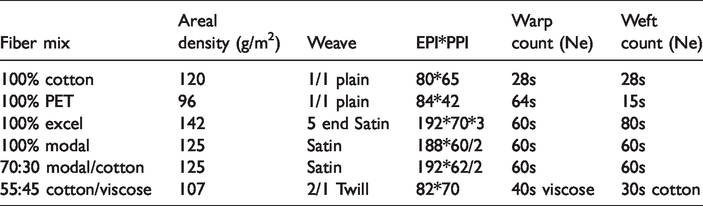
The fabric samples were developed by using natural and man-made fibers. The CCI tech sample sizing machine was used for sizing of warp yarns and CCI tech sample weaving machine was used to produce fabrics under industrial manufacturing condition. The particulars of the fabrics are given in Table 1. Warp and weft single ply yarns were used. All the spun yarns have a twist multiplier of 4.3–4.4 to facilitate weaving of high cover fabric.
Particulars of fabric samples.
Chemical processing of fabrics
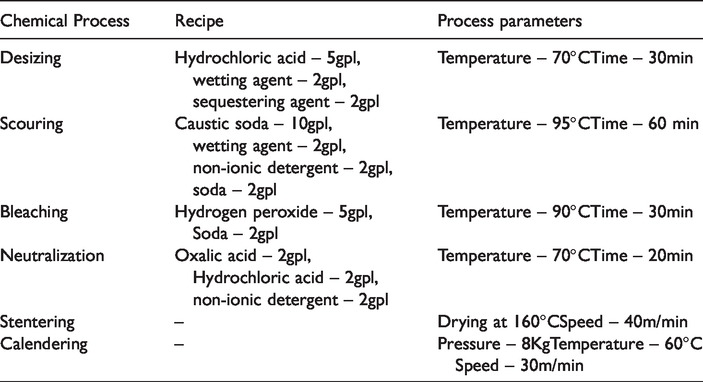
The chemical processing of all the fabrics was carried out under standard industrial conditions. The sequence of chemical processing of fabrics is shown in Figure 1. The recipe and the process parameters used are given in Table 2.

Process sequence of chemical processing of fabrics.
Recipe and process parameters used in chemical processing.
Characterization techniques
Descriptive quantitative survey to determine the bed linen performance indicators and their weighted contribution
A questionnaire was prepared and a survey was conducted to identify the bed linen performance attributes by a group of 25 judges. The judges were selected on their knowledge in the field of bed linen such as experts from bed linen industry, academic institutions, etc. so that their opinion should match with the general opinion of the users [29]. This survey was carried out into two steps. In the first steps, the experts were asked to identify the performance indicators that would impact the bed linen performance quality and provide ranking according to their priority in ascending order. In the second step, the weightage (%) was given to the performance indicators for a good bed linen fabric in such wise that the total of all the indicators was 100%. The survey was open-ended and the judges were free to include any indicator which they think would be essential for bed linen fabrics. A discriminant analysis was carried out to determine the variation in the weightage contribution of each performance attributes by the individuals.
Subjective assessment of performance index of bed linen fabrics
The second survey was conducted to evaluate the overall performance of the fabrics subjectively in the scale of 0-5. This step was carried out to understand the consumer’s desire and preference for a good quality bed linen. The coefficient of concordance was calculated to find out the agreement among the judges using the equation (1) [30].

where Ri = Average Rank Sum, R = Mean of the Data, r = Total Number of Judges, and n = Total Number of Grades
Evaluating the fabrics properties
The bed linen fabrics were evaluated for the shortlisted properties. The eight important properties determined were total hand value, air permeability, one-way transport capacity, thermal resistance, abrasion resistance, drapability, pilling resistance, and crease recovery angle.
Crease recovery angle
The Shirley crease recovery tester and the standard IS 4681-1968 was used to determine the crease recovery angle of the fabrics. It is the property of fabrics to recover from creases by measurement of the recovery angle [31]. The test sample was first crumpled under a half kg weight for duration of one minute. The size of the sample was 40 × 15 mm. Scale range was 0° – 180°. The fabric recovery is zero when the angle of recovery is 0° means and the fabric recovery is full when the angle is 180°.
Pilling resistance
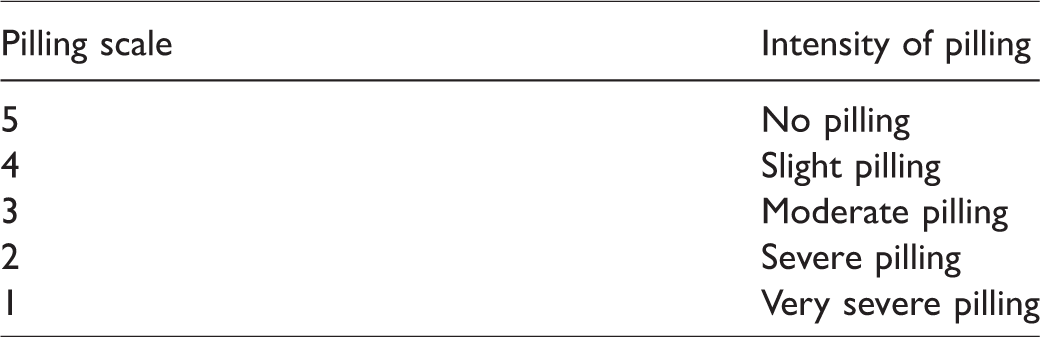
Martindale abrasion and pilling tester was used for determining pilling rating in a scale of 1–5. The scale of intensity of pilling is given in Table 3. The number of revolutions used was 1000 revolutions. It consists of testing plates mounted on base plates of the instrument, on which abrading fabric was attached and there is a revolving plate, which revolves with the help of three cranks, pegs & motor. Thus, the abrading cycles starts and after the completion of cycles the pilling rating was determined. The standard used was ASTM D4970.
Intensity of pilling scale.
Abrasion resistance
The abrasion resistance of the fabric was tested on Martindale abrasion tester. In this test the fabric sample gets abraded in all directions. A 38 mm diameter circular specimen was abraded under 9KPa pressure against a standard fabric. During testing 10,000 cycles were used for all the samples. After completing the abrasion, the weight loss of the fabric was calculated. The ASTM standard used was ASTM D4966-98.
Drapability
Cusick drape tester was used to evaluate the drape coefficient of the fabric samples and the ISO 9073-9:2008 standard was used. The circular fabric specimen was used with diameter 30 cm. The fabric was kept in between the two small horizontal disc of 18 cm diameter and was allowed to drape into folds under its own weight [32]. The drape coefficient was calculated using the equation (2).
The fabric is stiffer if the drape coefficient is higher.
Air permeability
The air permeability of the samples was measured on Textest FX 3300 air permeability tester according to the standard ASTM D737-96. The air pressure maintained was 100 Pa. The instrument measures volume of air passing through the fabric per unit area per unit time [33].
Thermal resistance
The thermal conductivity of samples was measured by using KES-F7 Thermolabo tester. A constant heat was passed through the fabric sample and the amount of heat lost through the sample was measured to calculate the thermal conductivity of the fabric. By using the thermal conductivity and thickness of the sample, the thermal resistance was calculated using the following formula.
Thermal resistance (m2 °C/W) = thickness of specimen (m)/thermal conductivity (W/m. °C)
Moisture management
The moisture management properties of fabric were determined by using M290 MMT (Moisture Management Tester) with the standard AATCC 195-2009. It measures the dynamic liquid transport properties of a fabric. As the liquid passes through and across the sample, the difference in the electrical resistance was measured and recorded. The One Way Transport Capacity (OWTC) of the fabric was measured and considered as a performance attribute.
Fabric hand
The Kawabata evaluation system KES was used to measure the low-stress mechanical properties of the fabrics. The four modules KES FB1, KES FB2, KES FB3 and KES FB4 were used to evaluate the tensile and shear, bending, compression and surface properties of the fabrics respectively. These properties were used in the calculation of primary and total hand value of fabrics by using standard Kawabata equations [34,35].
Approach to develop bed linen performance index
The eight properties that have an influence on the performance of the bed linen fabrics were identified by the subjective assessment. These properties were total hand value, One Way Transport Capacity (OWTC), abrasion resistance, air permeability, crease recovery angle, thermal resistance, pilling resistance, and drapability. Each of these properties was evaluated on the different testing instruments objectively. All these properties were integrated to determine the bed linen performance index. It is a standard developed to evaluate the performance of bed linen fabrics using an objective measurement of fabric properties.
After the evaluation of the identified properties the data was normalized to develop the index. Normalization technique transforms heterogeneous criteria data (qualitative, quantitative, different units, etc.) into numerical and comparable data to enable aggregation (fusion) of criteria to determine the rating of decision alternatives. The properties measured have different units therefore the normalization of the data was required. This step was very imperative while dealing with parameters of different units and scales [36]. Normalization also known as Min-Max scaling shrinks the range of the data such that the range was fixed between 0 and 5. Equation (3) was used for normalization.
The maximum range value taken was 5 and the minimum range value taken was 1. Thus, the eight properties were normalized by shrinking the data in the range 1 to 5. The maximum value 5 indicates that the fabric has excellent bed linen performance index and the minimum value 1 indicates that the fabric has poor bed linen performance index. The individual properties measured by different instruments and methods were integrated and a standard procedure was developed to evaluate the bed linen fabrics performance by combining the selected properties into a weighted average approach. This integrated index was termed as Bed Linen Performance Index and the equation (4) was developed to calculate BLPI.
Results and discussion
Subjective evaluation of ranking and weightage of bed linen attributes
The ranking and weightage was given to the eight short-listed properties by the experts according to their contribution in the bed linen performance as given Table 4. A discriminant analysis to examine the variation among individual experts’ rating is shown in Figure 2. According to the survey, the total hand value of the fabric has higher weightage than other fabric properties with respect to bed linen performance.
Ranking and weightage of bed linen properties.


Discriminant analysis of the weightage of bed linen properties.
Subjective evaluation of fabrics for BLPI
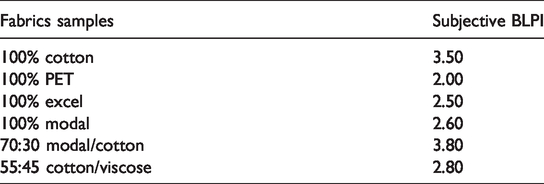
In the second survey, the fabrics were rated for subjective BLPI in the scale of 0–5 by a panel of experts as given in Table 5. The coefficient of concordance was calculated and was found to be 0.66 that stated reasonably a good agreement among the experts in the evaluation process.
Subjective bed linen performance index.
Evaluation of various properties of bed linen fabrics
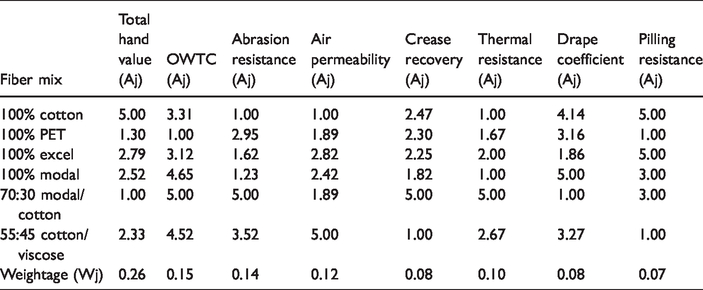
The eight properties were measured using respective standard methods objectively. The results for all these properties are given in Table 6. These properties have different units and to compare the data units must be similar. Therefore, the data was normalized and shrunk into a scale of 0–5 as given in Table 7.
Bed linen performance properties.

Normalized bed linen performance properties.
Evaluation of bed linen performance index
The normalization technique was very important in developing bed linen performance index. The normalized values were used along with the subjective weightage for calculating the BLPI by using the equation (4). In equation (4), Aj was the grade of the fabrics with respect to all the properties as given in Table 7 and Wj was the weightage of the properties as given in Table 4. The value of “k” was eight as the identified properties were eight in number. The objective evaluation of performance index of bed linen fabrics was carried out by the developed equation and the BLPI values are given in Table 8. The coefficient of correlation was determined between the subjective and objective bed linen performance index. The correlation coefficient was 0.84 which was reasonably good as shown in Figure 3.
Objective bed linen performance index.


Correlation between subjective and objective BLPI.
Conclusion
Performance index is an estimation of how well a product works to meet its defined goals. Performance of bed linens depends on many factors such as fabric dimensional parameters, comfort related transmission behavior, hand value and aesthetic properties. In this research work, an effort has been made to develop a standard equation to evaluate the bed linen performance index (BLPI) by integrating eight different fabric properties such as total hand value, one-way transport capacity, abrasion resistance, air permeability, pilling resistance, crease recovery angle, thermal resistance, and drapability. A panel of experts provided ranking and weightage to the properties and also provided subjective BLPI rating to the selected fabrics. Subjective methods have large variation in perceptions due to different skills of the judges thus lacks reproducibility. Therefore, discriminant analysis was carried out to examine the variation among the ratings provided by the individual experts for weightage of the properties and the coefficient of concordance was calculated and it found to be 0.66 that signifies good agreement among the judges. The fabrics were also evaluated for short-listed properties objectively and the normalization technique was used to transform different units into homogeneous data and shrink the data in the scale of 1–5. The weightage and normalized data were used to determine the bed linen performance index (BLPI) by using the developed equation. The correlation between subjective and objective bed linen performance index was quite high at r = 0.84. The study concludes that the bed linen performance index can be estimated with acceptable accuracy level.
Footnotes
Declaration of conflicting interests
The author(s) declared no potential conflicts of interest with respect to the research, authorship, and/or publication of this article.
Funding
The author(s) received no financial support for the research, authorship, and/or publication of this article.
